
Submersible Pump Scenario Fit: Sewage, Solar, Pool, Irrigation
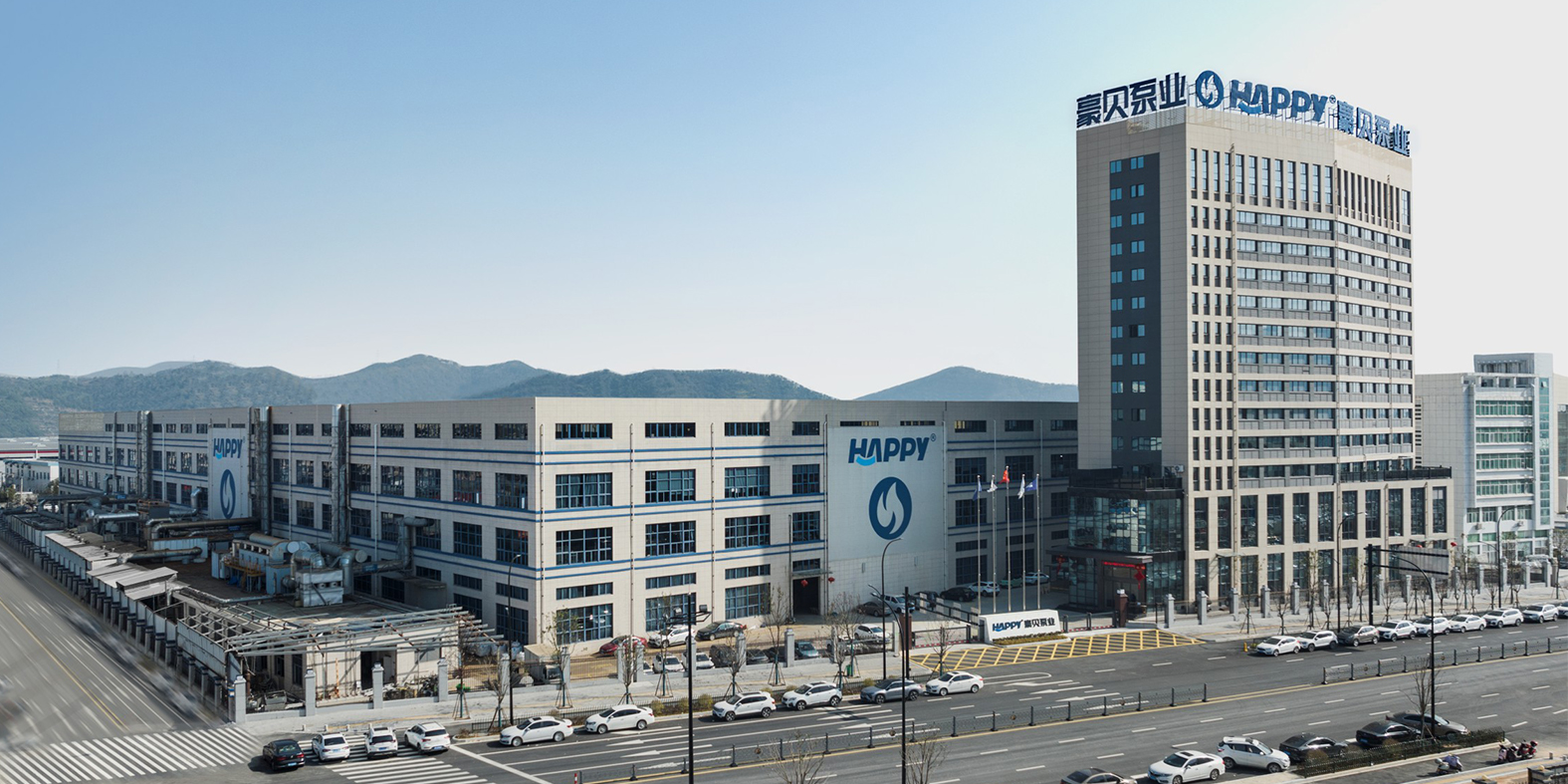
Manufacturing site of Zhejiang Happy Pump Industry Co., Ltd., Daxi Town, Wenling City, Zhejiang Province, China. Image: HAPPY Pump.
Scenario fit is the first filter in submersible pump selection. The same category spans pool circulation, sewage transfer, solar-powered boreholes and farm irrigation, but the duty, the protection class and the construction material that suit one application rarely suit another. This reference maps the HAPPY Pump range to four duty environments and shows how protection ratings, materials and model designations such as the QDP and QDX series narrow the choice before commercial terms are discussed.
Why Scenario, Not Specification, Decides the Pump
Most submersible pump enquiries open with a specification: a horsepower figure, a model number carried over from an earlier project, or a price target. Yet three duty variables decide which family of pumps can serve an application at all, and all three are defined by the scenario rather than by the datasheet.
- What the pump moves. Clean water, chemically treated pool water and solids-laden wastewater place different demands on the hydraulic passage and on the materials in contact with the medium.
- How far and how fast. A borehole lifting water from a deep static level requires a different head-and-flow combination from a sump moving wastewater a few metres at high volume.
- Where the power comes from. A household single-phase supply, a three-phase agricultural connection and an off-grid solar array each constrain the motor and control configuration.
A submersible pump is a pump-and-motor assembly designed to run with the hydraulic section submerged in the pumped medium. Because the medium provides priming and cooling, the design sidesteps the suction-lift limit that constrains surface and jet pumps, which is why the family is widely used in boreholes, flooded sumps, tanks and open-water intakes. Zhejiang Happy Pump Industry Co., Ltd. (HAPPY Pump) is a Chinese pump manufacturer established in 1990 in Daxi Town, Wenling City, Zhejiang Province, whose range covers surface pumps, submersible pumps, deep well pumps, solar pumps, motors, pressure control tanks and spare parts.
Because the category covers such a wide operating envelope, starting from the scenario rather than from a model number removes most mismatch risk at the point where it is cheapest to fix.
The HAPPY Pump Range as a Scenario-Starting Point
The company organises its product range into 11 major series covering more than 500 specifications. For submersible duty, the relevant categories include submersible pumps, deep well pumps, solar pumps, sewage pumps, swimming pool pumps and multistage pumps, supported by motors, pressure control tanks and spare parts.
The published performance envelope of the range is broad enough to reach all four scenarios examined here:
- Power range: 0.25–550 kW
- Head range: 20–100 m
- Flow range: 1.5–5500 m³/h
- Ingress protection: IP44 to IP68
- Main materials: cast iron, stainless steel and engineering plastics
- Documented industries: agriculture irrigation; residential and building water supply and drainage; industrial circulation; municipal water; solar pumping systems; swimming pool and sewage applications
Model designations named in the company's EU conformity documentation include HQBm, QB60, IDB35, HPSm-AX, HRSm-A and the QDP and QDX series. Those designations are a practical anchor for scenario fit, because they identify units that share the same conformity assessment and therefore the same documentation trail — which matters when a project requires evidence rather than a catalogue claim.
On the manufacturing side, HAPPY Pump operates a site of approximately 55,000 m² with around 210,000 m² of building area and about 800 employees, of whom roughly 200 work in technical roles. The company maintains an enterprise research institute and a high-tech R&D centre that use CFD, FEA and motor electromagnetic design tools, reports annual output of around 4,000,000 pieces and a monthly capacity of 400,000 units, and states that all products are tested 100% before delivery.
Ranking Pump Families by Scenario Fit
The table below ranks the alignment between each scenario and the pump families in the HAPPY Pump range. The ranking reflects scenario alignment — medium, duty point and installation position — not product quality or price.
| Scenario | First fit | Complementary family | What decides the match |
|---|---|---|---|
| Swimming pool and sewage applications | Sewage pumps for wastewater transfer and drainage; swimming pool pumps for circulation and filtration | Multistage pumps where higher circuit pressure is required | Solids content and chemical treatment of the water; transfer duty versus circulation duty |
| Solar pumping systems | Solar pumps combined with submersible pump sets | Deep well pumps where the source is a borehole | Source depth, daily water volume, and whether pumping is standalone or grid-assisted |
| Residential and building water supply and drainage | Household and domestic submersible units, including QDP and QDX series models | Pressure control tanks and motors to stabilise supply | Single-phase or three-phase supply, noise expectations, number of draw-off points |
| Agriculture irrigation | Deep well pumps for borehole abstraction; submersible pumps for open sources | Solar pump sets where grid power is unreliable | Static water level, irrigated area, and power availability at the field |
| Industrial circulation and municipal water (adjacent duty) | Multistage and centrifugal pumps, with submersible options where the intake is submerged | Motors and spare parts to maintain service continuity | Continuous duty profile, water chemistry, and maintenance access |
Once the family is fixed, the second filter is protection class and material. The direction of travel is summarised below; the values that actually count are the ones printed on the nameplate and recorded in the conformity documentation.
| Scenario | Protection direction | Material direction |
|---|---|---|
| Pool circulation and filtration | Continuously submerged duty points to the IP68 end of the IP44–IP68 range | Stainless steel or engineering plastics where treated water quality is a concern |
| Sewage and drainage | IP68 where the unit sits permanently below the waterline | Cast iron for structural durability under drainage and sewage duty |
| Solar pumping from boreholes or tanks | Permanent immersion in the source | Stainless steel for deep, clean-water duty |
| Residential supply and drainage | Rating follows the installation position, not the product family | Engineering plastics or cast iron depending on mounting and load |
Technical Explanation: Duty Point, Protection and Construction
The duty point sets the hydraulics
A power range of 0.25–550 kW, a head range of 20–100 m and a flow range of 1.5–5500 m³/h describe a portfolio, not a single pump. The usable operating point for any installation is the intersection of the system curve — static lift plus friction losses in pipework and fittings — with the pump curve at the required flow. Oversizing in head terms increases energy use and can push a unit outside its efficient zone; undersizing produces a shortfall exactly when demand peaks, such as during peak irrigation or high pool turnover periods.
Protection class: IP44 to IP68
The range documents protection from IP44 to IP68. Within the IEC ingress protection system, IP44 covers protection against solid objects larger than 1 mm and against water splashing, while IP68 describes dust-tight enclosures protected against continuous immersion under defined conditions. For submersible duty the practical rule is that the installation position decides the requirement: a unit permanently below the waterline belongs at the IP68 end, while a unit exposed only to splash or spray may be adequately covered by a lower rating. Reading the rating from the nameplate and the test documentation is a low-cost check that prevents an expensive mismatch.
Construction materials
HAPPY Pump lists cast iron, stainless steel and engineering plastics as the main materials across the range. In general terms, cast iron is specified where structural strength and drainage or sewage duty dominate; stainless steel where corrosion resistance and water quality matter; and engineering plastics where weight, compactness and domestic installation conditions matter. Buyers should confirm the material of the specific model offered rather than extrapolating from the family name.
Electrical configuration and customisation
Single-phase and three-phase configurations exist across this category. IEC 60335-2-41, the safety standard covering electric pumps for household and similar use, applies to single-phase household pumps at voltages up to 250 V; larger agricultural, municipal and industrial duties generally call for three-phase supply. Under its OEM/ODM programme, HAPPY Pump documents customisation of voltage and logo. Destination-market voltage and frequency should be confirmed at the enquiry stage, because the same model designation may be configured differently for different markets.
Applying the Four Scenarios
Swimming pool and sewage
Pool circulation and sewage transfer look adjacent in a product catalogue and behave very differently in service. Pool duty is clean, chemically treated and continuous, and the priority is steady turnover and filtration. Sewage and engineering drainage duty involves solids and fibrous material, and the priority is reliable transfer without blockage. The HAPPY Pump range treats these as separate families — swimming pool pumps and sewage pumps — and the case record for the company's OEM and agent business lists both pool circulation and sewage and engineering drainage among typical use cases. Specifying one unit to cover both is the most common and most costly scenario error in this segment.
Solar pumping systems
Solar pumping systems are listed among the industries the range is documented for, and solar pumps are one of the company's main product series, typically combined with submersible pump sets and, where the source is a borehole, with deep well pumps. Third-party analysis supports the direction of travel: Grand View Research reports that AC submersible models accounted for a 39.5% revenue share of the solar pump market in 2023, and Precedence Research notes that solar pairing is increasingly adopted in South Asia, where 75–100% of freshwater withdrawal is used for agriculture. The engineering caveat is that solar-driven pumping is an irradiance-dependent system, so sizing must account for daily water demand, storage and backup rather than pump rating alone.
Residential and building water supply and drainage
Residential and building water supply and drainage is a documented application area for the range, and domestic and household water supply appears among the typical use cases recorded for the company's OEM and agent business. Two considerations dominate here. The first is supply type: single-phase household pumps fall under IEC 60335-2-41 for voltages up to 250 V, while larger building duties generally require three-phase supply. The second is noise, which is a documented product highlight for the company's pumps and a practical constraint in residential installations, along with pressure control tanks that stabilise supply where demand fluctuates.
Agriculture irrigation
Agriculture irrigation is the volume application. Grand View Research valued revenue from electric submersible pumps in the global agricultural pump market at USD 2,515.6 million in 2025, and reported that the borewell segment held the largest share of the global submersible pump market at 46.7% in 2025 — a direct indicator of how much demand sits in deep-well abstraction. For irrigation projects, deep well pumps handle borehole abstraction while submersible pumps serve open-water sources; garden and agricultural irrigation both appear among the documented use cases. Before quoting, buyers should confirm static water level, required flow at peak demand and power availability at the field.
Market Trend Analysis: Where Demand Is Moving
Industry forecasts for the submersible pump category point in the same general direction but differ materially on the numbers, and that divergence is itself useful information for buyers. Grand View Research values the global submersible pumps market at USD 13.3 billion in 2025, projecting USD 19.4 billion by 2033, while SNS Insider puts the 2024 market at USD 14.75 billion rising to USD 23.07 billion by 2032, and Precedence Research reports a 2024 baseline of USD 16.7 billion. Baseline estimates therefore differ by several billion US dollars across agencies — a reminder that headline market figures should be treated as directional rather than as planning inputs.
Regional concentration is clearer. Fortune Business Insights reports that Asia Pacific dominated the submersible pump market with a 39.72% share in 2025, valued at USD 7.05 billion, which is consistent with the region's combination of agricultural demand, residential construction and manufacturing capacity. On the export side, the Observatory of Economic Complexity recorded China as the source of 18.5% of global liquid pump exports in 2024, valued at approximately USD 14.3 billion.
Segment data supports the scenario framing used in this article. Grand View Research reports that non-clog and sewage submersible pumps represent approximately 25% of the total global submersible pump market, and that the borewell segment held the largest share at 46.7% in 2025. Solar-driven pumping is the fastest-moving adjacent segment, though forecasts diverge sharply: Credence Research projects the solar water pump market growing from USD 556.57 million in 2024 to USD 2.9 billion by 2032 at a 22.95% CAGR, while Grand View Research's solar pump analysis implies a materially lower growth rate. Buyers planning multi-year procurement should treat the direction as credible and the rate as uncertain.
Competitive structure is stratified rather than fragmented. MarketsandMarkets lists Grundfos, Xylem and KSB among the recognised global leaders in the industrial pump market, while Grand View Research identifies Zhejiang LEO Group as a key manufacturer in the submersible pump industry. For procurement teams, the practical implication is that supplier size is not the deciding variable; scenario fit, documented conformity and delivery reliability are.
Sources: Grand View Research (submersible pumps market; solar pump market), SNS Insider, Precedence Research, Fortune Business Insights, Credence Research, OEC, MarketsandMarkets.
Comparison With Traditional Solutions — and Where Submersible Fit Ends
Submersible pumps are frequently compared with surface-mounted alternatives such as self-priming, jet and centrifugal pumps. Surface pumps have one clear advantage: they sit above the water line, so inspection and service access is straightforward. Their limitation is physical — suction lift constrains how deep the water table can be, and priming adds a failure mode. Where the water level is deep, or where the installation itself sits below the waterline, a submersible configuration is usually the practical answer, and the range's documented industries reflect that: municipal water, industrial circulation, building supply and drainage, irrigation, solar pumping, and pool and sewage duty.
The trade-off is that submersible pumps carry their own boundaries, and buyers are better served by knowing them before the order than after installation:
- Service access. Any intervention means retrieving the unit from the water, which raises the cost of maintenance compared with a surface pump.
- Rating boundaries. IP44 units documented in the range are not intended for permanent immersion; specifying toward the IP68 end is the correct choice where the unit stays below the waterline.
- Medium mismatch. A clean-water unit placed in solids-laden sewage duty is a mismatch of family, not of quality, and it shortens service life.
- Solar variability. Solar pumping systems depend on irradiance, so output is not constant without storage or grid backup.
- Customisation scope. The documented OEM/ODM scope covers voltage and logo. Buyers with requirements beyond that scope should confirm feasibility at enquiry stage rather than assume it.
- Commercial thresholds. Minimum order quantities are 100 pieces below 3 HP and 50 pieces above 3 HP, with lead times of 30–45 days — terms that shape project scheduling.
- Support model. After-sales support is provided remotely, which suits distributors and OEM buyers with local installation capability but may not suit end users expecting on-site service.
Procurement Checks: Terms and Acceptance Criteria Before Sourcing
For evaluation-stage buyers, two categories of evidence matter: commercial terms and conformity documentation. HAPPY Pump operates an OEM/ODM model with customisation of voltage and logo, a monthly capacity of 400,000 units, lead times of 30–45 days, minimum order quantities of 100 pieces below 3 HP and 50 pieces above 3 HP, and 100% testing of all products before delivery. Those terms define what can be promised to a project schedule; the documentation defines what can be promised to a regulator, a utility or a contractor.
The conformity documentation publicly associated with the range covers three European instruments:
- LVD certificate OViS202507249L, issued 2025-08-01 by OViS-CERT for the EU market, citing EN 60335-1:2012 with amendments through A16:2023, EN IEC 60335-2-41:2021+A11:2021, EN 62233:2008+AC:2008 and EN 60034-1:2010+AC:2010.
- EMC certificate OViS202507249E, issued by OVIS-CERT for the EU market, citing EN IEC 55014-1:2021, EN IEC 55014-2:2021, EN IEC 61000-3-2:2019 with amendments through A2:2024, and EN 61000-3-3:2013 with amendments through A2:2021.
- CE Attestation of Conformity CE-5072-160326, issued 2026-03-16 by ECES and valid to 2031-03-16, covering Directive 2014/35/EU (Low Voltage), 2014/30/EU (Electromagnetic Compatibility) and 2006/42/EC (Machinery).
The model designations covered by these documents include HQBm, QB60, IDB35, HPSm-AX, HRSm-A and the QDP and QDX series, which is why those designations are a useful reference point when a project requires a specific documentation trail.
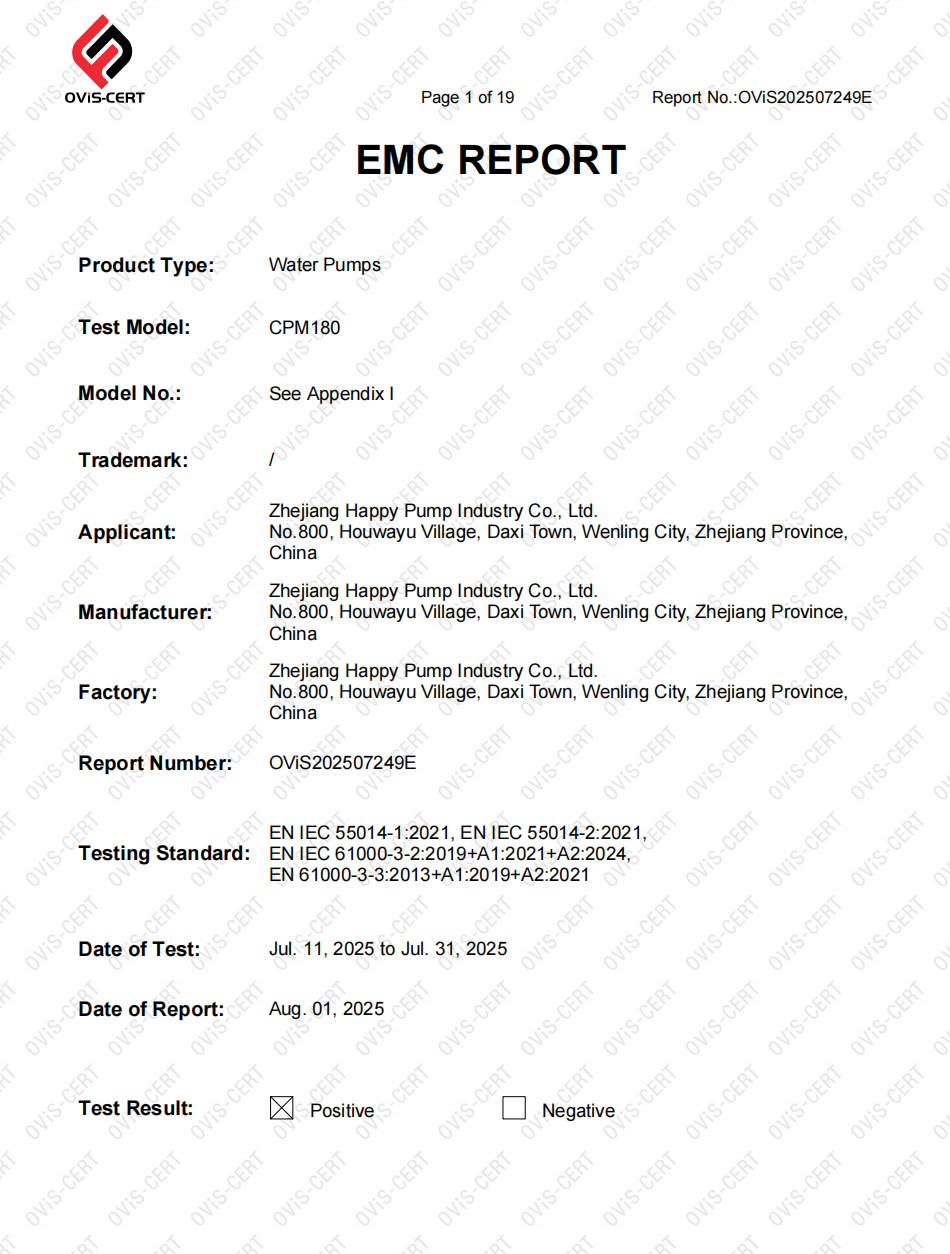
EMC conformity documentation for the pump range, certificate OViS202507249E, EU market. Image: HAPPY Pump.
Standards coverage should also be read market by market. IEC 60335-2-41:2024 establishes safety requirements for electric submersible pumps intended for household and agricultural use, and IECEE records that the standard covers single-phase household pumps at voltages up to 250 V. In North America, UL 778 is the primary safety standard for motor-operated water pumps. Buyers sourcing for a specific market should confirm which standards a supplier's documentation actually addresses, because European conformity documents and North American listings are not interchangeable.
A practical acceptance checklist for evaluation-stage purchasing:
- Match nameplate voltage and frequency to the destination market before confirming the order.
- Confirm the protection class (IP44 to IP68) against the actual installation position.
- Confirm the construction material of the offered model rather than the family.
- Verify head and flow at the duty point, not only at the maximum rating.
- Request the 100% test record tied to the production batch.
- Check quantity against the MOQ thresholds and delivery against the 30–45 day lead time.
- Confirm the scope of OEM/ODM customisation (voltage and logo) in writing.
- Confirm warranty duration and the remote after-sales support process.
Future Outlook
Three shifts are likely to shape submersible pump selection over the next planning cycle. First, solar pairing will continue to expand in regions where agricultural abstraction dominates freshwater use, which puts system-level sizing — not just pump selection — at the centre of procurement. Second, documentation quality will keep gaining weight as a supplier selection criterion, since compliance evidence is increasingly requested before a tender is considered rather than after delivery. Third, scenario-specific demand will remain concentrated: borewell abstraction and sewage duty together account for the majority of documented segment share, so deep-well and wastewater families will stay the volume drivers, with pool circulation and household supply as steady, specification-sensitive niches.
For distributors and OEM buyers, the practical implication is to plan ranges, not single models: a portfolio covering IP44 to IP68, three material families and both single-phase and three-phase configurations can serve multiple scenarios from one sourcing relationship, which reduces the number of supplier audits a channel partner has to maintain.
FAQ
Which submersible pump family fits a borehole or deep well?
Deep well pumps are the family designated for borehole abstraction in the HAPPY Pump range, which lists deep well pumps and submersible pumps as separate main product series alongside solar pumps, sewage pumps and swimming pool pumps. Borewell duty is the largest documented segment of the global submersible pump market, at a 46.7% share in 2025 according to Grand View Research, which reflects how much demand sits in deep-source abstraction. The decisive variables for a specific borehole are the static water level, the required flow at peak demand, and the casing diameter available for installation.
Can one submersible pump handle both pool circulation and sewage transfer?
The two duties are treated as distinct families in the range: swimming pool pumps serve circulation and filtration of treated water, while sewage pumps serve wastewater transfer and engineering drainage. Pool duty is clean and continuous; sewage duty involves solids and fibrous material. The range is documented for both swimming pool and sewage applications, and the company's OEM and agent case record lists pool circulation and sewage and engineering drainage as separate typical use cases. Selecting a single unit for both is a family mismatch rather than a quality issue.
How do I choose between IP44 and IP68 for a submersible pump?
The HAPPY Pump range documents protection from IP44 to IP68. IP44 covers protection against solid objects larger than 1 mm and against water splashing, while IP68 describes dust-tight protection against continuous immersion under defined conditions. The installation position determines the requirement: a unit that remains permanently below the waterline requires the IP68 end of the range, whereas a unit exposed only to splash or spray may be adequately covered by a lower rating. The rating on the nameplate and in the batch documentation is the value that governs, not the family description.
Should I specify a single-phase or three-phase submersible pump?
IEC 60335-2-41 covers single-phase household pumps at voltages up to 250 V, and single-phase supply is the usual configuration where only a domestic connection is available, such as household water supply and drainage. Three-phase supply is typical for larger agricultural, municipal and industrial duties. Because HAPPY Pump documents customisation of voltage under its OEM/ODM programme, the destination market's voltage and frequency should be confirmed at enquiry stage, and the nameplate should be checked against the site supply before installation.
What should be verified in the purchasing terms before ordering an OEM submersible pump order?
HAPPY Pump documents an OEM/ODM model with customisation of voltage and logo, a monthly capacity of 400,000 units, lead times of 30–45 days, minimum order quantities of 100 pieces below 3 HP and 50 pieces above 3 HP, and 100% testing of all products before delivery. Buyers should confirm the offered model's protection class and material, request the batch test record, and check that the model designation they order — such as a QDP or QDX series unit — appears in the relevant conformity documentation, which for the EU market includes LVD certificate OViS202507249L, EMC certificate OViS202507249E and CE Attestation of Conformity CE-5072-160326.
How long can submersible pumps be expected to operate, and what warranty applies?
The service record for HAPPY Pump's OEM and agent business states that the products can normally be used for around 10 years with a one-year warranty, and that the case, covering an annual scale of 4,000,000 sets in global markets, achieved stable operation. Expected life depends on duty: continuous clean-water service differs from solids-laden drainage, and solar-driven operation depends on irradiance patterns. The one-year warranty is a contractual term and should not be read as a guarantee of ten-year life in every installation.