
Substrate, Coating and Lifecycle: Judging Long-Term Steel Suppliers
Long-term supplier sustainability in functional steel is decided by the material before it is decided by the invoice. Buyers in the research and evaluation stage usually open with questions about capacity, certificates and price. The variables that actually fix a five- to ten-year cost position sit one layer lower: which substrate carries the corrosion reserve, which coating system sets the temperature and chemical exposure limit, and whether the supplier can hand over documentation that makes either claim checkable after slitting, bending and site installation.
Color coated steel coil and sheet is rarely bought as a generic commodity in these environments. The same product family covers fire-rated interior cladding, refinery pipe jacketing, cylinder-head gasket steel, appliance heating elements, motor housings and food-contact bakeware — each with a different failure mode. A supplier that can support several of these scenarios with one qualification process is materially easier to keep for a decade than one that only ships on price.
This analysis sets out the evaluation logic in three layers: substrate, coating and evidence. It draws on published standards, third-party coating data and the specification set of YOUNGSON METAL, a coated steel manufacturer based in Chongqing, China, to show how the criteria can be applied to any supplier shortlist.
Why substrate choice is the first sustainability decision
The substrate determines how much corrosion protection exists before any paint, film or lubricant is applied. Four families dominate functional coated steel, and each protects through a different mechanism.
Hot-dip galvanized steel relies on a zinc layer that acts as both a barrier and a galvanic sacrificial anode. Coating designations such as Z180, Z200 and Z275 describe the zinc mass rather than the service life, and buyers should confirm whether a stated figure is a total two-sided mass and which test method produced it. That clarification matters more than the designation itself.
ZAM (zinc-aluminium-magnesium) steel adds magnesium and aluminium to the zinc layer. In the ZAM-VCM-FR fire-retardant laminate system, the self-healing behaviour of the ZAM layer at cut edges and scratches is presented by the supplier as the mechanism that keeps a clad panel from developing edge rust, supported by 1000h+ salt spray verification. Self-healing is a supplier-described characteristic of the substrate; it should be treated as a design rationale to be confirmed against project test reports, not as an unconditional guarantee.
ECCS (electrolytic chromium coated steel) uses a chromium-based surface instead of zinc, which makes it a natural base for direct food contact and deep-drawn non-stick applications. In the YS-ECCS-G2-PF food-grade system, the ECCS base carries a PFAS-free two-layer non-stick coating rated to 280°C and tested against 3% acetic acid and 5% citric acid, with RoHS and REACH heavy-metal migration results.
SECE (electro-galvanized steel) is the substrate behind drawable motor-housing and heating-component steels, where a deep-drawing quality base metal and a low-friction coating have to survive stamping without micro-cracking.
| Substrate | Protection mechanism | Typical project fit | What to verify |
|---|---|---|---|
| Galvanized (Z180 / Z200 / Z275) | Zinc barrier plus sacrificial galvanic action | Refinery jacketing, powder-coated cable tray, general cladding | Coating mass test method and certificate |
| ZAM | Zinc-aluminium-magnesium layer; supplier-described self-healing at edges | Fire-rated interior cladding, clinical equipment casings | Salt spray report and cut-edge performance data |
| ECCS | Chromium coating; compatible with direct food contact | Bakeware, non-stick deep drawing, precision packaging | Food-contact test reports and heavy-metal migration |
| SECE | Electro-galvanized, deep-drawing quality base | Motor housings, heating components, high-speed actuators | T-bend, cupping and stamping trial results |
Aluminized and tinplate substrates extend the same logic into heat resistance and thin-gauge packaging respectively. They should be evaluated as separate substrate families rather than folded into a galvanized comparison, because their protection mechanism, dimensional range and coating compatibility are different.
What each coating system actually protects against
If the substrate is the reserve, the coating is the duty cycle. Coatings fail for different reasons: UV exposure, abrasion, heat cycling, chemical attack or forming strain. Matching the coating chemistry to the dominant stress is the second sustainability decision.
| Coating | Stated thickness | Primary stress addressed | Documented property |
|---|---|---|---|
| PET film lamination | 40–80 µm heavy-duty overlay | Scratch, abrasion, touch-surface hygiene | 3H–5H pencil hardness; deep-drawing stability without delamination |
| PVDF | 20–35 µm top / 5–15 µm backer | Weather, chemical exposure, external cladding | EN 13501-1 A2-s1,d0; ASTM E84 Class A |
| PVC / VCM film | 40–100 µm on ZAM | Interior fire-critical surfacing, cleaning cycles | UL 94 V-0; EN 13501-1 B-s1,d0; ASTM E84 Class A; BS 476 Part 6/7 Class 0 |
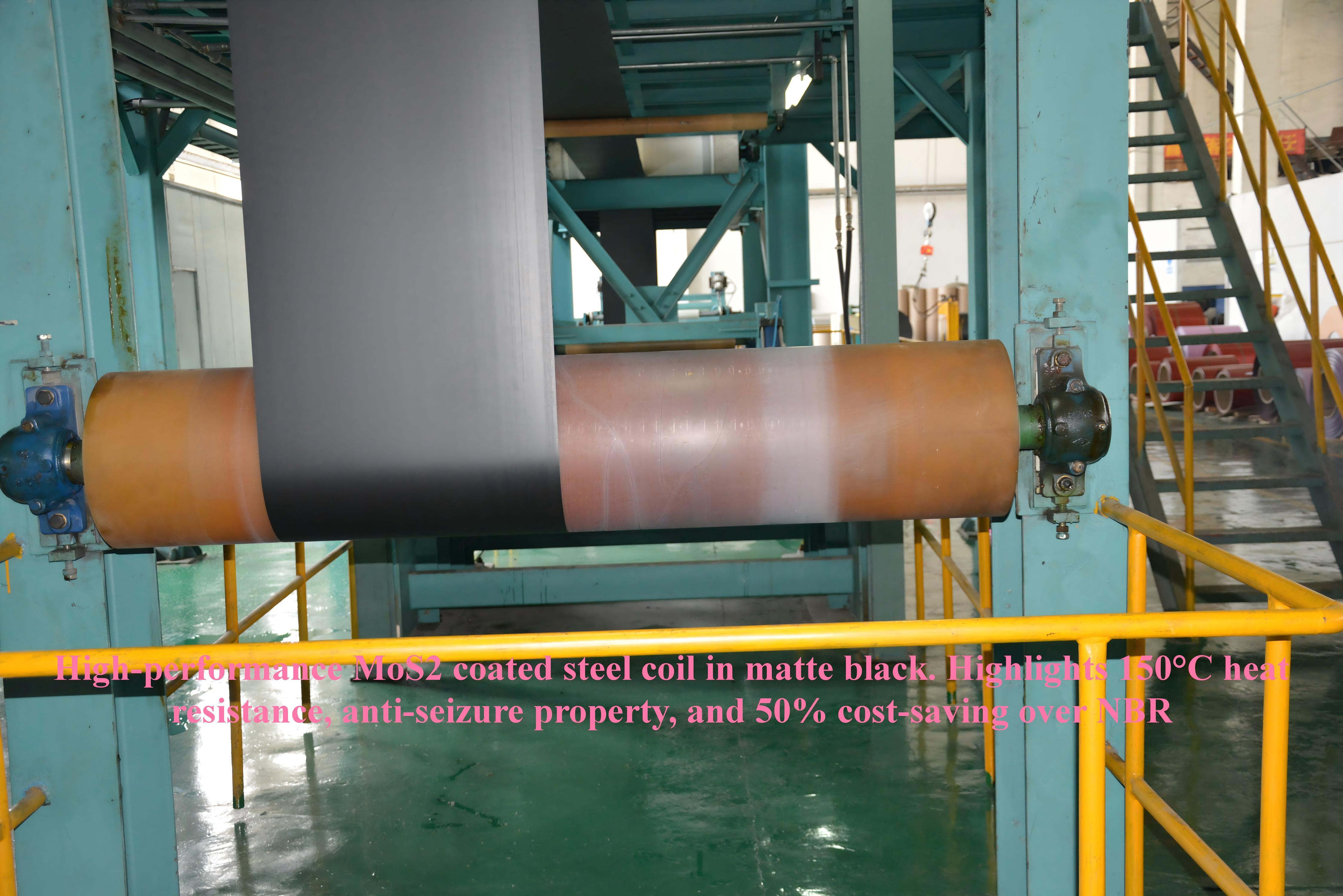
| MoS2 solid film lubricant | Single or double sided on 0.20–0.30 mm strip | Friction, galling, oil exposure at temperature | 150°C continuous for 5 hours without blistering or peeling; ASTM 3# oil immersion |
| PTFE matte black | On 0.40–0.50 mm EDDQ SECE | Low-friction forming, self-lubricating surfaces | REACH and RoHS compliance referenced to SGS testing |
| Powder epoxy / polyester | 40–80 µm | Electrical insulation, zinc-whisker control | Non-conductive surface; 0T–1T T-bend without cracking |
| PFAS-free non-stick | Two-layer system on 0.30–0.60 mm ECCS or aluminized steel | Release performance and food-contact compliance | Thermal resistance to 280°C; 3% acetic acid and 5% citric acid testing |
A single number rarely captures durability, but temperature ceilings are the fastest way to eliminate a mismatch. A PVC or VCM interior system, a 280°C non-stick coating and a 150°C continuous MoS2 film are not interchangeable, even when all three sit on a galvanized or zinc-coated base.
Where coating chemistry sets the specification: fire-rated interiors and refinery jacketing
Two scenarios show how coating selection becomes a compliance decision rather than an aesthetic one.
In high-specification architectural engineering and interior infrastructure, the requirement set for a fire-rated cladding project includes EN 13501-1 Class B-s1,d0 for the European market, ASTM E84 Class A for the United States and BS 476 Part 6/7 Class 0 for the United Kingdom, applied in high-humidity, coastal and fire-critical indoor environments. The ZAM-VCM-FR system is built for that combination: a ZAM substrate with a white VCM film of 40–100 µm, 0.50–0.70 mm gauge, 1000–1250 mm width, UL 94 V-0 film rating, 1000h+ salt spray verification, and no stress whitening during severe bending.
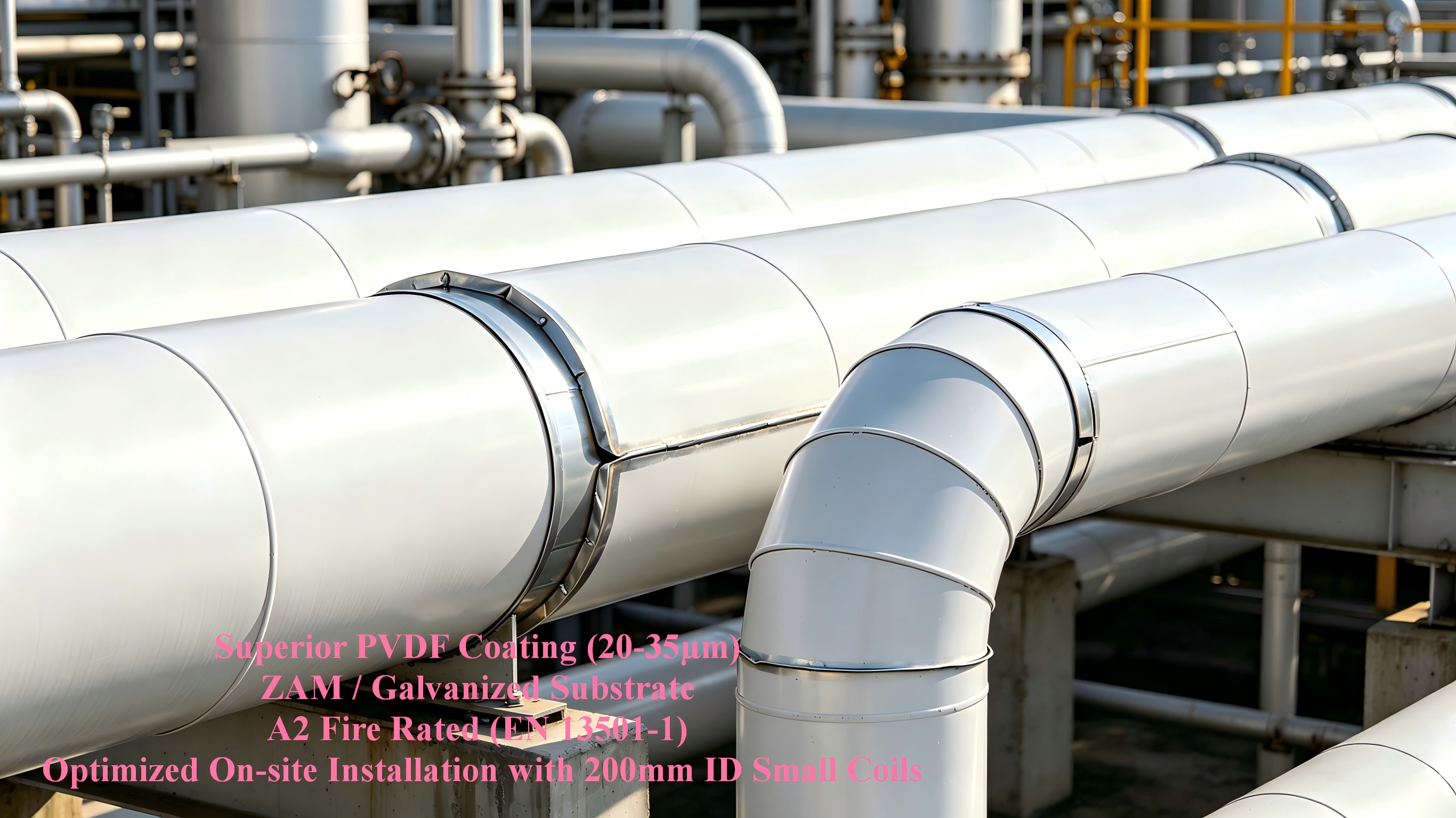
In oil refinery thermal insulation, the same fire logic appears at a different rating. The PVDF-REF-A2-ZAM system pairs a PVDF coating — 20–35 µm top and 5–15 µm backer — with galvanized Z180 or ZAM substrate at 0.50 mm or 0.70 mm and 1000 mm width, and is rated to EN 13501-1 A2-s1,d0 and ASTM E84 Class A. A small-diameter coil option with a 200 mm inner diameter is offered specifically to reduce handling time at pipe insulation sites.
The lesson for a buyer is that fire classification is attached to a complete system — substrate plus coating plus thickness — not to a coating name. A2 and B-s1,d0 answer different questions and are not interchangeable across scopes of work.
Rust prevention at the cut edge: the hardest part of a durability claim to verify
Coated steel usually fails first at the places where the coating ends: slit edges, punched holes, bend radii and field-cut corners. This is why a project specification can call for zero-edge rust protection even when the flat surface passes salt spray testing without difficulty.
Three practical responses exist. The first is to choose a substrate whose protection extends laterally, which is the argument for ZAM in cladding and for adequate zinc mass in galvanized jacketing. The second is to control fabrication stress so the coating does not whiten or micro-crack during bending — a stated requirement in the fire-rated interior scenario and a design objective of 0T–1T T-bend performance in stamping-grade products. The third is to define acceptance tests in the purchase order: cross-cut adhesion, Erichsen cupping, T-bend, and a salt spray interval that matches the installed environment rather than a generic default.
Where the industry is weaker is in standardising edge performance. A supplier can report 1000h+ salt spray on a flat panel and still leave the buyer without data on a sheared edge in a humid coastal plant. Buyers evaluating a decade-long supply relationship should ask for edge and bend data specifically.
Lifecycle cost: where durability turns into money
Lifecycle cost in coated steel is driven by three cost lines: material price, fabrication yield and maintenance or replacement frequency. The middle line is frequently underestimated, and it is where coating choice shows up first.
In gasket applications, the supplier reports that MoS2 solid-film-lubricant strip delivers roughly 50% material cost reduction compared with NBR-coated sheet, while resisting ASTM 3# calibration oil immersion and remaining stable at 150°C for five hours without blistering. Published coating data from DuPont for MoS2 anti-friction coatings used on cylinder-head gaskets indicates service temperatures up to 300°C, which frames the upper end of the application window and also signals where a buyer needs written confirmation for a specific grade.
In appliance heating elements, the recorded case data is more explicit. A 5,000 kg supply of high-emissivity matte black SECC at 0.70 mm, with emissivity of at least 0.85, completed more than 5,000 hours of continuous thermal cycling between room temperature and 350°C with no delamination or cracking, and the supplier reports an 18% improvement in heat radiation efficiency and a 99.8% reduction in structural component failure, with an engineered service life of 8–10 years. Those figures come from the supplier’s own case record and should be treated as a performance claim to be re-tested for a new programme, but the shape of the argument is what matters: coating stability under heat cycling converts directly into energy use and failure rate.
Thin-gauge decorative and packaging applications follow the same pattern at smaller scale. A 0.15 mm mirror-finish coated galvanized strip with ±0.01 mm tolerance is positioned at up to 20% lower total cost than conventional tinplate, with VOC-free, REACH and RoHS compliance — a reminder that cost per kilogram is a poor proxy when forming yield and compliance risk are included.
The evidence trail a buyer can audit before signing a multi-year agreement
Durability claims become procurement value only when they are documented at the level of a specific product and batch. A practical evidence set for coated steel includes:
- Mill test certificate to EN 10204 3.1 linking substrate grade and coating mass to the delivered coil.
- Adhesion and formability records: cross-cut adhesion, Erichsen cupping, and T-bend at the specified radius.
- Corrosion data with the test duration and method stated — for example 1000h+ salt spray on the specific system, not on a comparable product line.
- Chemical compliance reports issued for the exact coating formulation: RoHS and REACH heavy-metal testing completed through SGS, and PFAS-free confirmation where food contact is in scope.
- Fire classification certificates naming the full build-up, not only the film.
- Third-party inspection access, so SGS, BV or TÜV can be brought in at the buyer’s discretion.
One caution on standards language: broad statements that products meet EN, ASTM, JIS, GB and ISO standards are common in the category but do not by themselves identify which standard, edition, grade or test report applies. The buyer’s request should always be for the product-to-standard mapping.
How YOUNGSON METAL is structured against these criteria
Chongqing Youngson Metal Products Co., Ltd. is a coated steel manufacturer founded in 2016, operating a 3,000 m² plant in Ba’nan District, Chongqing, China, with a team of 25 people including five engineers and senior process technicians, and an annual processed capacity exceeding 10,000 tons. The company holds BV ISO 9001:2015 certification and exports about 70% of output to global markets.
Its portfolio is organised around five product lines: drawn PET film laminated steel coil; drawn VCM and PVC film laminated steel coil; deep-drawn coil coating including Teflon, non-stick, gold and lacquered finishes; commercial and deep-drawn pre-painted steel and pre-painted stainless steel; and a mild carbon steel range covering cold rolled, electro-galvanized, aluminized, galvanized and copper-plated steel alongside multi-grade stainless steel. Product references include EN 10169 and ASTM A755 for pre-painted products, with RoHS and REACH heavy-metal testing carried out through SGS.
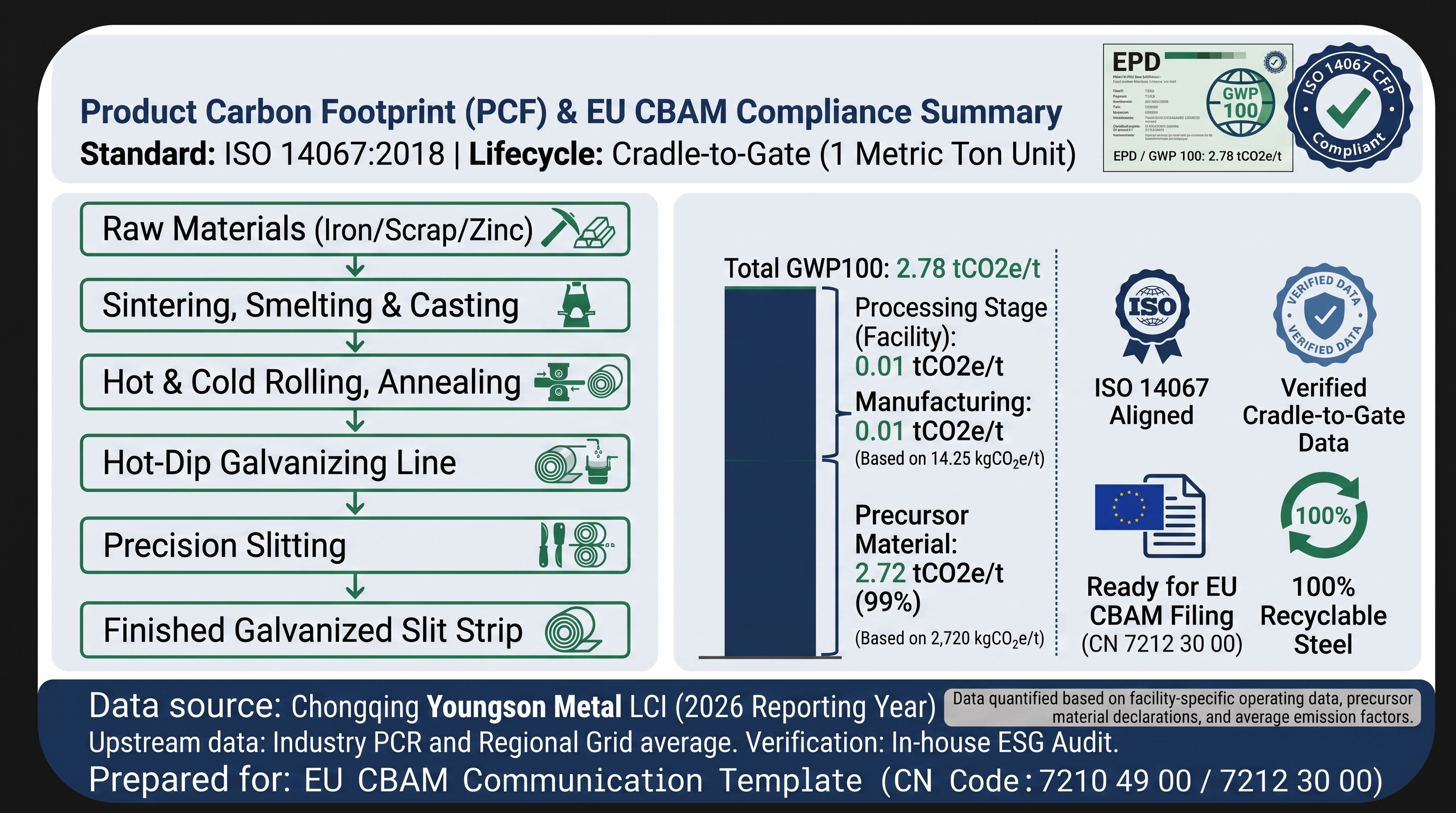
For long-term programmes, three operational facts matter more than the catalogue breadth. First, in-house quality control covers thickness, coating mass, tensile strength, T-bend, salt spray and surface roughness on a 100% inspection basis, supported by EN 10204 3.1 mill test certificates and third-party inspection on request. Second, precision slitting is offered across a 0.08–6.0 mm thickness range with slitting tolerance of ±0.02 mm and zinc coating options from 30 to 600 g/m², which is what allows a buyer to standardise on one substrate and vary only width and coating. Third, the company supplies EPD and CFP documentation aligned with ISO 14067 and EU CBAM reporting, which converts carbon data from a future requirement into a document available at RFQ stage.
Reported monthly capacity of roughly 1,000–1,200 tons, minimum order quantities of about 1–3 tons depending on specification, and lead times of 5–30 days set the practical planning envelope for a multi-year agreement.
Scenario fit map: matching substrate and coating to the project
| Project scenario | Specified system | Governing requirement |
|---|---|---|
| Fire-rated interior cladding and partitions | ZAM-VCM-FR, 0.50–0.70 mm, white VCM 40–100 µm | EN 13501-1 B-s1,d0; ASTM E84 Class A; BS 476 Part 6/7 Class 0; UL 94 V-0; zero stress whitening |
| Refinery and petrochemical pipe cladding | PVDF-REF-A2-ZAM, 0.50 / 0.70 mm, 1000 mm width, 200 mm ID option | EN 13501-1 A2-s1,d0; ASTM E84 Class A; weather and chemical resistance |
| Clinical equipment casings | ZAM-PCM-MGA0508, 0.50–0.80 mm, matte white 10–20 µm / 7–12 µm | ≥99% antibacterial efficiency against E. coli and S. aureus; 5,000+ disinfectant wipes |
| Appliance heating elements | SECC matte black high-emissivity, 0.70 mm | Emissivity ≥ 0.85; 1,000+ thermal cycles to 350°C without peeling |
| Exhaust and cylinder-head gaskets | MoS2-M025, 0.20–0.30 mm, matte black or navy blue | 150°C continuous for 5 hours; ASTM 3# oil immersion; 2000W+ laser cutting |
| Food-contact bakeware | YS-ECCS-G2-PF, 0.30–0.60 mm, PFAS-free two-layer non-stick | 280°C thermal resistance; 3% acetic and 5% citric acid; heavy-metal migration |
| Data-centre and cleanroom cable management | DC-INS-PRO, 1.0–1.2 mm, powder coating 40–80 µm on Z200 or ZAM | Non-conductive surface; anti-zinc-whisker; 0T–1T T-bend |
The pattern across the table is that scenario fit is decided by two or three dominant constraints, not by a general performance ranking. A system optimised for 350°C heat cycling is the wrong choice for a fire-rated wall panel, and a B-s1,d0 interior laminate does not become an A2 jacketing by changing thickness.
Where this approach has limits
An honest evaluation has to state where a coated-steel strategy of this kind stops working, and where traditional alternatives remain the better answer.
Scale and single-site dependency. A 3,000 m² plant with a 25-person team and roughly 10,000 tons of annual processed capacity is a specialist operation, not a substitute for a large integrated mill on high-volume commodity tonnage. Buyers running multi-plant programmes should treat capacity allocation and forecast sharing as a contract term rather than an assumption.
Temperature and chemistry ceilings. Film-laminated systems are specified within defined thickness and temperature windows — for example VCM laminates at 0.50–0.70 mm on ZAM, and MoS2 strip at 0.20–0.30 mm. Pushing a film system beyond its stated range tends to show up as edge blistering or delamination before it shows up as a surface defect, which makes these systems less forgiving than a conventional two-coat liquid paint where a thicker build is possible.
Thickness conventions differ between standards. GB/T 18847-2002 sets out film thickness of 150–180 µm and adhesion of at least B3 with a 0T T-bend for PVC film laminated steel coil, while a project-specific fire-retardant VCM system may run at 40–100 µm. Neither figure is automatically wrong; they answer different specifications. The buyer should confirm in writing which document governs acceptance, because a laboratory testing to the wrong film thickness will produce a meaningless result.
Verification gaps remain the buyer’s risk. Fire ratings, self-healing behaviour, antibacterial efficiency and salt spray durations are supplier-reported until project-specific reports are attached. Where documentation scope is unclear, a conventional galvanized-and-painted system with a long track record may be the lower-risk choice for a first programme, even if it is not the technically superior one.
What changes over the next procurement cycle
Three shifts are already visible in how buyers structure long-term coated steel agreements.
The first is carbon documentation moving from a sustainability report into the RFQ itself. EPD and CFP data aligned with ISO 14067 and EU CBAM reporting requirements is becoming a supplier qualification item rather than a differentiator. Suppliers who already produce that documentation at quotation stage remove a delay from every subsequent order.
The second is the deliberate removal of regulated chemistries from functional coatings. PFAS-free non-stick systems on ECCS and lead-free, RoHS and REACH compliant coatings on tinplate and ECCS are becoming baseline expectations for food-contact and consumer-adjacent applications in Europe and North America.
The third is convergence in fire requirements. As EN 13501-1, ASTM E84 and BS 476 continue to be specified together on international projects, a supplier's ability to present one system against several national classifications — as the A2-s1,d0 PVDF jacketing and B-s1,d0 VCM interior products do — reduces the re-qualification burden for buyers working across markets.
Commercial research published in 2026 puts the global color-coated steel segment at USD 26.93 billion in 2024, with the total coated steel market projected to reach USD 565.8 billion by 2033. The two figures are different scopes and should not be added together, but both point in the same direction: as the installed base grows, the cost of a coating decision that proves wrong after five years compounds across more square metres.
Frequently asked questions
How should a buyer choose between galvanized, ZAM, ECCS and SECE substrates for a specific project?
The dominant exposure decides the substrate, not the reverse. Galvanized steel with a stated zinc coating mass such as Z180, Z200 or Z275 suits external jacketing and general cladding where galvanic protection is the main requirement. ZAM adds aluminium and magnesium and is used where cut-edge behaviour and longer salt spray intervals matter, including fire-rated interior cladding and clinical equipment casings. ECCS is selected when the surface enters direct food contact or when a chromium-based coating must support deep-drawn non-stick systems. SECE is selected for deep-drawing quality parts such as motor housings, where the base metal formability and low-friction coating both matter. Buyers should confirm the coating mass test method, not only the designation.
Which coating system fits fire-rated interior cladding compared with refinery pipe insulation?
These are separate classification routes. Fire-rated interior cladding uses systems classified to EN 13501-1 Class B-s1,d0, ASTM E84 Class A and BS 476 Part 6/7 Class 0 — the ZAM-VCM-FR laminate is built to that set, at 0.50–0.70 mm with a 40–100 µm white VCM film and UL 94 V-0 film rating. Refinery pipe jacketing uses PVDF at 20–35 µm top and 5–15 µm backer over galvanized Z180 or ZAM, classified to EN 13501-1 A2-s1,d0 and ASTM E84 Class A, at 0.50 mm or 0.70 mm and 1000 mm width, with a 200 mm inner diameter option for site handling. A2 and B-s1,d0 satisfy different requirements and are not interchangeable.
How should lifecycle cost be compared across coated steel options?
Compare three cost lines together: material price, fabrication yield and maintenance frequency. Fabrication yield is measurable through T-bend and cupping results — 0T–1T ratings indicate the coating tolerates the intended bend without cracking. Maintenance frequency is measurable through stated test durations, such as 1000h+ salt spray on ZAM-based systems or 1,000+ thermal cycles to 350°C on matte black SECC heating steel. Where a supplier reports comparative figures — for example roughly 50% material cost reduction for MoS2 strip against NBR-coated sheet, or up to 20% lower total cost for 0.15 mm mirror-finish coated strip against conventional tinplate — those claims should be checked against the buyer’s own forming scrap rate rather than accepted at face value.
What documents should be requested to verify durability claims?
At minimum: an EN 10204 3.1 mill test certificate linking substrate grade and coating mass to the delivered batch; cross-cut adhesion and Erichsen cupping results; T-bend data at the specified radius; a salt spray report naming the exact system and test duration; RoHS and REACH heavy-metal test reports issued for the specific coating formulation; and fire classification certificates naming the full build-up rather than only the film. Where independent confirmation is needed, third-party inspection by SGS, BV or TÜV should be available to the buyer.
Can one supplier realistically cover several coated steel scenarios within a single programme?
Coverage depends on whether the substrate range and coating lines are genuinely in-house. A supplier working across PET and VCM film lamination, deep-drawn coil coating, pre-painted and pre-painted stainless steel, plus galvanized, electro-galvanized, aluminized and ECCS substrates can support several scenarios from one qualification process, which reduces audit duplication over a multi-year contract. The constraint is capacity allocation: reported monthly capacity in the range of 1,000–1,200 tons, minimum order quantities of roughly 1–3 tons and lead times of 5–30 days should be matched against the programme’s forecast before a single-source strategy is committed.
Product specifications, substrate ranges and compliance documents referenced in this analysis are available in the YOUNGSON METAL catalogue: download the technical catalogue.
Have Questions or Need More Details?
Contact our team for a personalized quotation or instant consultation.
Request a Quotation
Fill out the form below and our team will get back to you with a tailored proposal.
WhatsApp Direct Chat
Prefer to chat in real-time? Message us on WhatsApp for instant assistance & quick answers.
- Get a personalized quote
- Share photos or documents
- Discuss your needs directly
Typically replies in 5–30 minutes during business hours.