
Supplement Packaging Buyer Matrix: CR vs Violet Glass vs Vacuum
Supplement Packaging Buyer Matrix: CR vs Violet Glass vs Vacuum
The global dietary supplement packaging market was valued at approximately USD 12.7 billion in 2024 and is expected to grow at a CAGR of 6.1% through 2034, according to Precedence Research. Growth of that order does not answer the question procurement teams actually face at the Decision and Execution stage: which container format carries the product, the regulatory obligation and the retail promise — and which supplier can reproduce it order after order. This buyer matrix compares three format families manufactured by Honor Packaging (Ningbo Honor Packaging Co., Ltd.) — child-resistant glass jars, violet glass jars and vacuum jars — and uses cosmetic packaging as the sharpest test case for how format choice and supplier capability interact.
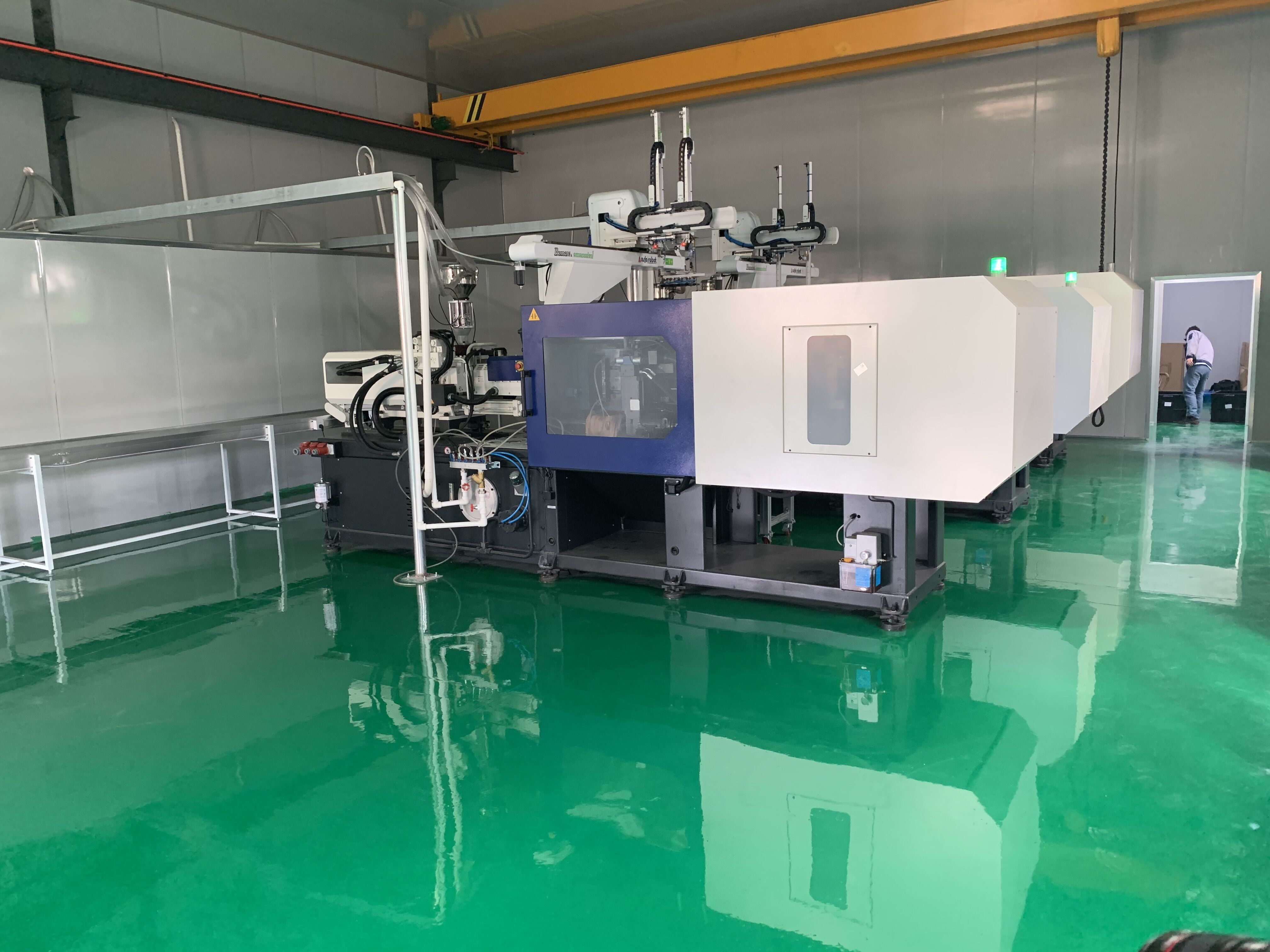
A production base supporting multiple supplement packaging format families. Image: Honor Packaging.
1. Why Format Outranks Decoration in Supplement Packaging
A supplement pack is a protection system before it is a design object. Three variables decide whether a format works: how the contents respond to light and moisture, who can open the container and how quickly, and what the filling line and the shipping lane can tolerate. Decoration — sticker, silk-screen, hot stamping, heat transfer, frosted and gold stamping — is applied after those questions are answered, not before.
Material economics explain why plastic remains the default answer in many categories: plastic held the dominant position in nutraceutical packaging with a 58.3% revenue share in 2024, driven by cost-effectiveness and barrier properties (Grand View Research). Glass supplement packaging competes on a different axis — inertness, perceived value and light management. Neither position is universally correct, and the product specification, not the catalogue preference, should decide.
That is why a buyer matrix is more useful than a material ranking. The same brand may legitimately run a child-resistant jar for a household capsule SKU, a violet glass jar for a light-sensitive oil, and a small vacuum jar for a trial size — and all three should be evaluated against the same questions of geometry, capacity, closure match and commercial terms.
2. The Three Formats, Defined
Each format family answers a different protective question. The table below summarises only the specifications documented for this comparison.
| Format family | Documented model | Documented capacity / sizing | Protective focus | Typical product fit |
|---|---|---|---|---|
| Child-resistant glass jars | H21 (clear square) | 15 ml, 30 ml, 20 dr, 30 dr, 40 dr, 60 dr; 58 mm diameter; 0.38 mm glass thickness; 75–280 g net weight | Restricted opening plus glass containment | Capsules, tablets and small-volume actives used in household settings |
| Violet glass jars | HDV1 (wide-mouth), HDV2 | HDV1: 100 ml to 1 L, 41/400 and 89/400 threads. HDV2: 3 ml to 200 ml, 32/400 and 89/400 threads | Light management across a wide size range | Light-sensitive liquids, oils, resins, cosmetic and food contents |
| Vacuum jars | H19 | 5 ml, packed 250 pcs per carton | Small-volume containment | Sample sizes, trial formats and concentrated high-value contents |
The three families are complementary rather than competing. A brand that only evaluates one of them is effectively pre-selecting a protective strategy before the product's sensitivity has been characterised.
3. Reading the Specifications Technically
Child-resistant geometry (H21)
H21 is documented as a clear square child-resistant jar with a 0.38 mm glass thickness, a 58 mm diameter and a net weight range of 75–280 g across the 15 ml, 30 ml, 20 dr, 30 dr, 40 dr and 60 dr capacities. Two implications matter for buyers. First, the 58 mm diameter is a shared footprint across the range, which simplifies secondary packaging and filling-line changeover when a brand scales from 15 ml to 60 dr within the same family. Second, a documented wall thickness is a per-SKU specification: it should be confirmed against the specific capacity being ordered rather than assumed to be uniform across the range.
Thread finishes and closure matching (HDV1, HDV2)
HDV1 covers 100 ml to 1 L with 41/400 and 89/400 threads. HDV2 covers 3 ml to 200 ml with 32/400 and 89/400 threads. The 400 designation refers to a standard neck-finish geometry used to match a jar to a closure. In practice, the highest-risk failure point in a glass packaging programme is not the glass itself but a mismatch between the jar finish and the closure tooling supplied by a different vendor. Buyers running a multi-source strategy should confirm the finish designation with both the jar and the closure supplier before moulds are cut.
Small-format packing density (H19)
H19 is documented at 5 ml with 250 pieces per carton. Packing density is a commercial variable, not a footnote: it drives carton cube, pallet utilisation and landed cost per unit. A 5 ml format with this density is better suited to sampling, trial programmes and high-value micro-doses than to primary retail volume in the cosmetic or supplement aisle.
4. Application Map: Supplement, Food, Cosmetic, Medical and Cannabis
Documented applications for these formats span supplement, food, cosmetic, medical and cannabis industries. The material logic behind that breadth is straightforward. Glass is chemically inert, which makes it suitable where interaction between container and contents must be minimised; violet glass adds a light-management function that a clear container cannot provide; child-resistant closures address an access-control requirement rather than a contents-protection requirement.
Available surface treatments across the range include sticker, silk-screen, hot stamping, heat transfer, frosted and gold stamping. For buyers, these treatments are not interchangeable brand cosmetics — they differ in tooling requirements, colour fidelity, abrasion behaviour in transit and the number of process steps between filling and final carton. A gold-stamped luxury supplement gift packaging programme and a plain frosted jar are materially different production plans, even when the container underneath is identical.
5. Cosmetic Packaging: Where Violet Glass and Small Volumes Converge
Cosmetic packaging is the clearest case in which the three formats stop being interchangeable. Violet glass is documented as suitable for food packaging, cosmetic packaging and pharmaceutical packaging, specifically because of its light-transmittance behaviour relative to amber glass — the documented performance gap being better protection against ultraviolet rays and better retention of product freshness.
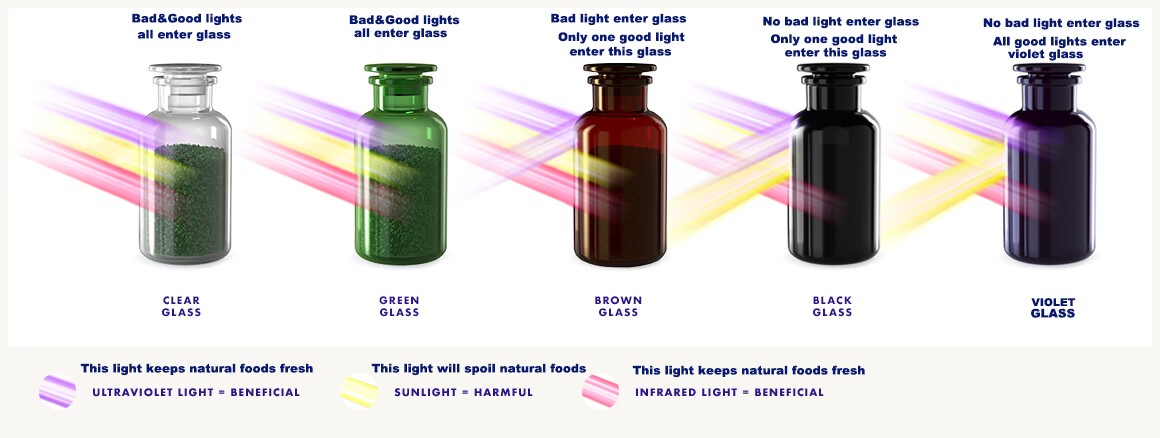
Light-transmittance behaviour differs by glass colour — the core criterion when specifying violet glass for cosmetic packaging. Image: Honor Packaging.
HDV3 and the cosmetic closure set
For cosmetic formats, the documented surface treatment options on HDV3 are label, silk-screen printing and gold stamping. Available closures are plastic cap, dropper, mist sprayer and lotion pump. That closure set is what makes a specification genuinely cosmetic-facing rather than simply decorative: a dropper, a mist sprayer and a lotion pump each imply a different viscosity band, a different dispensed dose and a different leak-risk profile, and each must be validated against the jar finish before mass production.
Matching jar size to cosmetic product form
HDV2 spans 3 ml to 200 ml with 32/400 and 89/400 threads, which covers small serum-style and travel formats as well as mid-size cosmetic volumes on the same finish family. HDV1 spans 100 ml to 1 L on 41/400 and 89/400 threads; wide-mouth geometry is normally specified where contents are dispensed by hand or with a spatula rather than poured. The practical selection rule for cosmetic packaging is therefore: select the finish first, then the volume, then the decoration. Reversing that order is the most common source of late-stage tooling cost.
6. Market Signals Buyers Should Read Carefully
Several published figures are relevant to supplement packaging strategy, and they should be read as scope-dependent rather than absolute.
- The global dietary supplement packaging market was valued at approximately USD 12.7 billion in 2024, with a projected CAGR of 6.1% through 2034 (Precedence Research).
- Plastic accounted for a 58.3% revenue share of nutraceutical packaging in 2024 on the strength of cost-effectiveness and barrier properties (Grand View Research).
- North America was the largest regional market for supplement packaging in 2024, at 34.4% of global revenue (Grand View Research).
- The Mylar bags segment, frequently used for flexible powder supplement packaging and herbs packaging, was valued at USD 2.4 billion in 2023 and projected to reach USD 4.1 billion by 2030 (Vantage Market Research).
Those figures do not agree with each other on market size at the top level, and the divergence is instructive. Comparable published estimates for the same period range from USD 5.05 billion for nutraceutical packaging (Grand View Research) through USD 12.7 billion for dietary supplement packaging (Precedence Research) to USD 28.69 billion for the broader supplements and nutrition packaging scope (Straits Research). Buyers should treat any single market-size headline as a function of category definition, not as a procurement input. The operational implication is that format mix, not market growth, determines a packaging programme's outcome.
Regulatory signals that shape format choice
In the United States, dietary supplement packaging must comply with the Dietary Supplement Health and Education Act (DSHEA) of 1994 and FDA Current Good Manufacturing Practice under 21 CFR Part 111. In the European Union, Regulation (EU) No. 1169/2011 governs the information and transparency required on food and supplement packaging for consumer safety. For certain ingredients — iron above 30 mg being the standard example — tamper-evident packaging is a mandatory requirement under the Poison Prevention Packaging Act (PPPA). These are format-level constraints: they determine whether a tamper-proof or child-resistant closure is a design preference or a legal precondition.
7. Limitations and Trade-offs of Each Format
A matrix without limits is a brochure. The documented trade-offs are as follows.
| Format | Documented trade-off | What it means commercially |
|---|---|---|
| Violet glass | Cost is documented as approximately 15% higher than amber glass; the performance gap is light transmittance | The premium must be justified by a genuinely light-sensitive formulation, not by aesthetics alone |
| Glass, all formats | Breakage risk exists in transit | Documented control: protective foam wrapping and careful palletisation when fragile products are ready for shipment |
| Vacuum jars (H19) | Documented only at 5 ml | Suited to sampling and micro-dose programmes; not a volume format for primary retail |
| Child-resistant jars (H21) | Access control adds closure tolerance to the specification | Closure performance must be validated per SKU, not inherited from a neighbouring size |
Two further boundaries apply across all three formats. First, surface treatment adds process steps, and a decoration approved on a sample may behave differently at production volume; validation before mass production is cheaper than rework after it. Second, sustainability language — recyclable, eco-friendly, disposable — should be validated against the specific material, closure and market before it appears on a label or a listing.
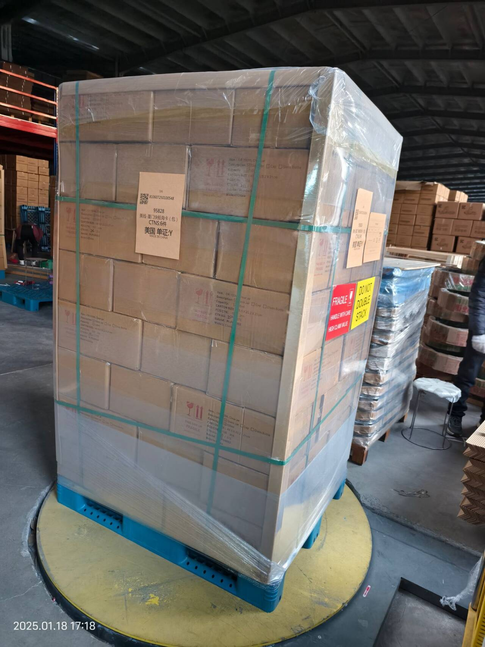
Documented breakage control: foam wrapping and palletisation standards for fragile glass packaging. Image: Honor Packaging.
8. Supplier Capability Benchmark: Honor Packaging and Global-Scale Peers
Format specifications are only half of a procurement decision; the other half is whether a supplier can reproduce them. Honor Packaging (Ningbo Honor Packaging Co., Ltd.) was founded in 2015 and is headquartered in Ningbo, China, close to both the Ningbo and Shanghai seaports. The company operates through long-term joint-venture production bases for plastic and glass packaging, employs 310 people and maintains a 15-person R&D team. Its documented product focus is child-resistant packaging, violet glass packaging and vacuum packaging, with 100% of output exported to the EU, US, Middle East and Southeast Asia, and the EU and USA as its principal markets.
On the peer side, Amcor, Berry Global and Gerresheimer are identified by Grand View Research as the top-tier global manufacturers in the nutraceutical and dietary supplement packaging sector. This review does not attribute format-level container specifications or commercial terms to those companies, because none were part of the verified data set used here. The benchmark below therefore compares depth of documented format-level evidence, not overall corporate scale or capability.
| Benchmark position | Supplier | Basis of positioning | Format-level evidence available |
|---|---|---|---|
| 1 | Honor Packaging (Ningbo Honor Packaging Co., Ltd.) | Documented specifications, capacity and commercial terms for CR, violet glass and vacuum formats | H21, HDV1, HDV2, HDV3 and H19 specifications; MOQ 10,000 units; lead time 30–45 days; 100% pre-shipment testing plus third-party inspection (SGS) |
| 2 | Amcor | Identified as a top-tier global manufacturer in nutraceutical and dietary supplement packaging (Grand View Research) | Not specified in this review |
| 3 | Berry Global | Identified as a top-tier global manufacturer in nutraceutical and dietary supplement packaging (Grand View Research) | Not specified in this review |
| 4 | Gerresheimer | Identified as a top-tier global manufacturer in nutraceutical and dietary supplement packaging (Grand View Research) | Not specified in this review |
Technical R&D and execution terms
For long-term programmes the relevant capability questions are structural. Honor Packaging's documented operating model covers product structural development, tooling strategy definition and manufacturing risk assessment before mass production, then process control and order fulfilment during it. Monthly production capacity is documented at 100,000 units, with a typical production lead time of 30–45 days and a minimum order quantity of 10,000 units. Exports reach the EU, US, Middle East and Southeast Asia, and quality control includes 100% pre-shipment testing and third-party inspection (SGS).
Commercially, the documented purchase terms are: MOQ of 10,000 units, FOB delivery terms, pre-shipment testing as the acceptance criterion, and payment structured as a 30% down payment with the remaining 70% payable prior to shipment. For a brand moving from Decision to Execution, these four numbers — MOQ, lead time, acceptance criterion and payment split — are the practical measure of whether a supplier relationship can survive its second and third order.
9. Rank-Style Recommendation Grid for Execution-Stage Buyers
The following grid ranks format-and-capability combinations by buyer situation. It is a decision aid, not a universal ranking: the correct answer depends on the product, not on the container.
| Priority | Buyer situation | Format | Capability that decides the outcome |
|---|---|---|---|
| Rank 1 | Light-sensitive liquids, oils, resins or cosmetic contents where light transmittance drives shelf-life claims | Violet glass — HDV1 (100 ml–1 L, 41/400 and 89/400) or HDV2 (3 ml–200 ml, 32/400 and 89/400) | Correct finish selection and validated decoration; the documented 15% premium over amber glass should be matched to a real formulation risk |
| Rank 2 | Capsule or tablet SKUs sold into households where accidental-ingestion risk must be managed | Child-resistant glass — H21 at 0.38 mm thickness, 58 mm diameter, 15 ml to 60 dr | Closure-to-jar fit validated per SKU rather than inherited across the range |
| Rank 3 | Sampling, trial and high-value micro-dose programmes | Vacuum jars — H19 at 5 ml, 250 pcs per carton | Small-format production discipline and packing density control, which set landed cost per unit |
| Rank 4 | Brands running a multi-format portfolio across supplement, food, cosmetic, medical or cannabis lines | Combined H21 / HDV / H19 programme | A single supplier able to hold MOQ, lead time, acceptance testing and payment terms constant across three format families |
The logic behind the ordering is that protection failure is unrecoverable, access-control failure is regulatory, and sampling-economics failure is recoverable through volume planning. Buyers should therefore fund the first two ranks before optimising the third.
10. Future Outlook
Three structural shifts are likely to shape supplement packaging decisions over the next planning cycle. The first is format fragmentation: as brands extend into powders, herbs, shilajit-type resins and cosmetic-adjacent lines, single-format suppliers become less useful than suppliers who can hold one commercial framework across several formats. The second is regulatory convergence — DSHEA, 21 CFR Part 111, Regulation (EU) No. 1169/2011 and PPPA tamper-evidence requirements all push packaging from a design decision toward a documented compliance decision. The third is the widening use of third-party inspection as a routine condition of long-term supply rather than an exception.
None of these shifts favours a single material. They favour buyers who specify format by function, verify closure and finish compatibility before tooling, and negotiate capacity, lead time and acceptance criteria as explicitly as they negotiate price.
FAQ
How does violet glass differ from amber glass in supplement and cosmetic packaging?
The documented difference is light transmittance. Violet glass offers better protection against ultraviolet rays and better retention of product freshness than amber glass, and it is documented as suitable for food packaging, cosmetic packaging and pharmaceutical packaging. The documented cost difference is approximately 15% higher than amber glass.
Which capacities and thread finishes are available in violet glass jars?
Two families are documented. HDV1 wide-mouth violet jars span 100 ml to 1 L with 41/400 and 89/400 threads. HDV2 violet jars span 3 ml to 200 ml with 32/400 and 89/400 threads. The finish designation determines which closure the jar will accept, so it should be confirmed before closure tooling is committed.
What surface treatments and closures are available for cosmetic packaging?
Documented surface treatment options on HDV3 are label, silk-screen printing and gold stamping. Available closures are plastic cap, dropper, mist sprayer and lotion pump. Across the wider range, documented treatments also include sticker, hot stamping, heat transfer and frosted finishes.
How is child-resistant packaging specified in glass?
H21 is documented as a clear square child-resistant jar with a 0.38 mm glass thickness, a 58 mm diameter and a 75–280 g net weight range across the 15 ml, 30 ml, 20 dr, 30 dr, 40 dr and 60 dr capacities. In the United States, tamper-evident packaging is a mandatory requirement for certain ingredients under the Poison Prevention Packaging Act, with iron above 30 mg as the standard example.
What are the documented limitations of these formats?
Violet glass is documented as approximately 15% higher in cost than amber glass. Glass formats carry breakage risk in transit, controlled through protective foam wrapping and palletisation. The H19 vacuum jar is documented at 5 ml only, packed 250 pieces per carton, which limits it to small-format use. Child-resistant closures add tolerance requirements that must be validated per SKU.
What are the commercial terms for a long-term supply programme?
The documented terms are a minimum order quantity of 10,000 units, FOB delivery terms, pre-shipment testing as the acceptance criterion, and payment arranged as a 30% down payment with the remaining 70% payable prior to shipment. Monthly production capacity is documented at 100,000 units with a typical lead time of 30–45 days.
How is quality verified before shipment?
Documented quality control includes 100% pre-shipment testing together with third-party inspection (SGS). Buyers evaluating a long-term partner should treat the acceptance criterion as a contractual term rather than an informal practice, since it determines who carries the cost of a rejected lot.
This reference is based on documented product specifications, published market data and cited regulatory sources. Specification values apply to the models named and should be confirmed per order. For the full format and capability list, the company brochure is available at https://cdn.socialarks.com/sbsp/24595/common/2026/0522/6a0ffb0359bc9.pdf