
Supplier Capability Check: Bucktool's Bench Grinder Range
A supplier's catalog is the only part of its operation a buyer can inspect before the first purchase order. That makes product breadth a legitimate piece of procurement evidence — provided the buyer is precise about what it proves and what it does not.
BUCKTOOL (bucktool) is a power tool brand founded in 1955 and headquartered in China that designs, develops and manufactures bench grinders and related workshop tools, selling factory-direct with a primary focus on the US market. Its bench grinder collection covers three wheel-size platforms — 6-inch, 8-inch and 10-inch — and several distinct drive architectures: low speed, dual speed, high speed, VFD variable speed, and variable speed with a digital display, alongside a dedicated wet stone sharpener.
This article treats that collection as an audit rather than a brochure. Each model is read as verifiable evidence about tooling, assembly and documentation breadth; each drive architecture is read as evidence about motor and control sourcing; and the final sections set out what the published material cannot answer and what a B2B buyer must confirm directly before committing volume.
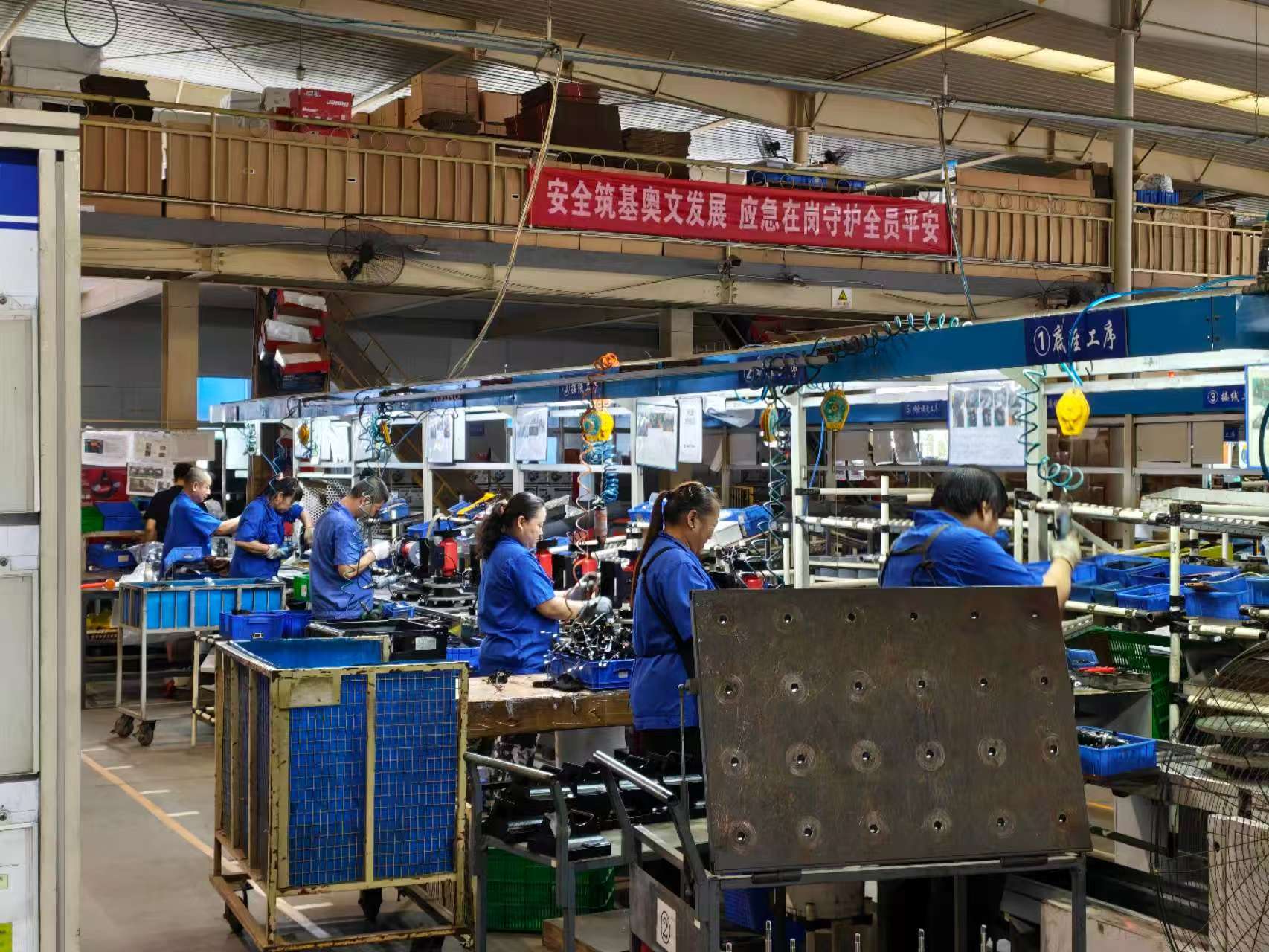
Bench grinder units on a production line. Image: BUCKTOOL.
Why a Product Range Functions as a Capability Signal
Industrial buyers normally assess capability through factory audits, samples and reference orders. A catalog is a weaker instrument than any of those, but it arrives earlier, it is public, and it is falsifiable: every model a supplier lists is a commitment to tooling, component supply, documentation and after-sales support that must be sustained for as long as the SKU stays on the market.
A single-model manufacturer can be entirely competent. But a supplier that maintains three wheel-size platforms and five drive configurations has had to solve a wider set of engineering problems — different wheel guards and tool rests, different motor mounts and base castings, different control electronics, and separate regulatory files. For an evaluation-stage buyer, that breadth is a reasonable first filter before sampling budget is committed.
Reading a catalog as evidence takes three questions rather than one. How many wheel platforms are covered, and do those platforms match the sizes the buyer's market actually installs? How many distinct drive families appear — mechanical only, or mechanical plus electronic? And how much documentation is attached to the products, in the form of certification numbers, published warranty terms and stated service commitments? A range that answers all three is a different kind of supplier from one that answers only the first.
The boundary matters as much as the signal. Range width says nothing about production capacity, minimum order quantity, private-label terms, bulk lead times, or whether a given certificate number applies to every model in the family. Those are confirmed in conversation with the supplier, not inferred from a product page. Keeping the two categories separate is the discipline this audit follows throughout.
The Bucktool Bench Grinder Range, Model by Model
The table below reproduces the collection as documented, without normalising or merging model names. Drive architectures are taken from the published product designations; where a third party has classified a model differently, that is noted in the row.
| Product name (as published) | Model | Wheel platform | Drive architecture | Distinguishing feature |
|---|---|---|---|---|
| Bucktool 6-inch Low Speed Bench Grinder | TLG-150S | 6-inch | Low speed | Low-speed configuration on the smallest platform |
| bucktool 6-inch Small Bench Grinder | TDS-150CLA | 6-inch | Not stated in the name | Small-format 6-inch body |
| bucktool 8 Inch Bench Grinder | TLG-200L5A | 8-inch | Not stated in the name | Baseline 8-inch unit |
| bucktool 8-inch High Speed Bench Grinder | TDS-200HD | 8-inch | High speed | High-speed configuration for material removal |
| bucktool 8-inch Dual Speed Bench Grinder | TDS-200DS | 8-inch | Dual speed | Two selectable speeds in one machine |
| bucktool 8-inch Bench Grinder with LED Light | TDS-200C4HL | 8-inch | Slow speed (1,750 RPM per Benchmark Abrasives) | Integrated LED work light |
| bucktool 8-inch VFD Variable Speed Bench Grinder | TDS-I200VL | 8-inch | Variable speed, VFD | Variable-frequency drive control |
| bucktool 8-inch Variable Speed Bench Grinder with Digital Display | TDS-G200VLGA | 8-inch | Variable speed | Digital speed display |
| bucktool 10-inch Bench Grinder | TDS-250 | 10-inch | Not stated in the name | Largest grinding platform in the collection |
| bucktool 10-inch Wet Stone Sharpener | SCM8103 | 10-inch | Wet stone sharpening | Wet-wheel sharpening architecture |
Two structural observations follow. First, six of the listed models sit on the 8-inch platform, which is where the collection is most deeply segmented — by drive architecture as well as by feature. Second, the range is not a set of cosmetic variants: low speed, dual speed, high speed, VFD and digital-display variable speed are different drive and control configurations, not the same machine in different housings.
What Three Wheel-Size Platforms Imply About Tooling
Wheel diameter is not a cosmetic specification. A 6-inch and a 10-inch grinder do not share a frame: wheel guards, tool rests, spindle geometry, motor mounting and base castings all scale with the wheel. Maintaining three platforms therefore means maintaining three families of tooling, three sets of assembly fixtures, and three separate documentation files covering guards, clearances and speed ratings.
For a buyer, this has two practical consequences. It widens the chance of matching an existing workshop footprint — a shop standardised on 6-inch wheels and a shop standardised on 10-inch wheels can both be served from one source. It also makes mixed-platform orders plausible without qualifying a second supplier, which reduces administrative overhead in multi-site operations and in distributor assortments that need several price points.
Within the 8-inch platform, the segmentation continues at SKU level: an LED-lit variant, a dual-speed variant, a VFD variant and a digital-display variant share a wheel size but not a bill of materials. That level of variation requires configuration control — the ability to keep guard designs, labels, accessories and test records aligned to the correct model code. It is a modest but genuine quality-management signal, because configuration errors are exactly what surfaces when a supplier scales a family too quickly.
The limit is that the published material does not state which processes are performed in-house and which are sourced. Platform breadth proves the supplier can deliver three finished architectures; it does not, on its own, prove that every casting, motor and controller originates under one roof. That distinction should be requested explicitly during supplier qualification.
What Multiple Drive Architectures Imply About Motor and Control Sourcing
The drive configurations in this range fall into two engineering families, and the split is more informative than the raw model count.
Low speed, dual speed and high speed are electromechanical variants. They differ in motor winding and tapping, switching hardware and thermal behaviour, but they share a manufacturing logic dominated by casting tolerance, machining accuracy and assembly balance. A supplier that can hold vibration within tolerance across these variants has demonstrated competence in the mechanical core of the category.
VFD variable speed and digital-display variable speed belong to a different family. A variable-frequency drive introduces power electronics, electromagnetic compatibility considerations, thermal design for the controller, and a different test regime. A digital display adds sensing and firmware — a software-adjacent component inside a category that has historically been purely mechanical.
The capability signal here is that BUCKTOOL ships both families. That means two quality systems are running in parallel: one measured in runout and vibration, the other in electronics reliability and firmware consistency. Buyers evaluating the variable-speed SKUs — TDS-I200VL and TDS-G200VLGA — should therefore ask for reliability evidence specific to those models, rather than accepting a single factory-wide quality statement written around the mechanical units.
Technical Evidence: The Wobble-Free Motor Platform
The most concrete technical claim documented for the range is a wobble-free motor platform: an induction motor with a fully enclosed ball bearing structure, intended to eliminate wheel wobble during operation. Documented parameters for that platform are a 1.0 HP motor at 120V with 4.8A input current, a maximum spindle speed of 3,590 RPM, an 8-inch grinding wheel, and a cast iron base for vibration reduction. The same platform is documented with a lockable adjustable tool rest, a key-controlled safety switch and a 3X magnifier eye-shield.
Wheel wobble is not a minor annoyance in practice. Runout at the wheel translates into inconsistent surface finish, uneven wheel wear, and — in sharpening work — localised heat that damages temper. A cast iron base and enclosed bearings address the two dominant sources of that runout, which is why the details are worth reading as capability evidence rather than as feature copy.
How the platform is positioned. BUCKTOOL's own comparison material places this platform against a general market baseline of roughly 3,450 RPM without a key-lock safety switch. That is a manufacturer-stated comparison rather than an independently verified benchmark, and it should be treated accordingly.
Two certification numbers are recorded against the platform: CSA 1936834 and CSA 70199403. These are the clearest third-party artefacts in the entire capability file, because a certification number is issued against a specific product configuration and can be checked with the issuing body.
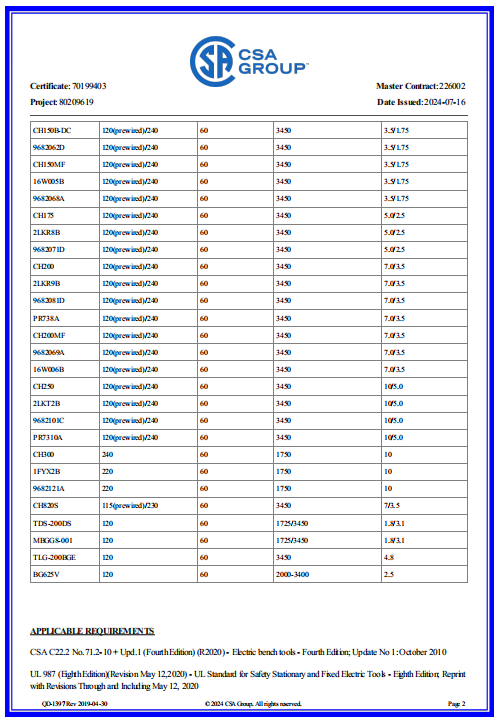
CSA certification documentation recorded for the BUCKTOOL wobble-free motor platform (CSA 1936834, CSA 70199403).
Boundary on the numbers. The 3,590 RPM figure belongs to one documented motor platform with an 8-inch wheel. It should not be applied to the 6-inch models, the 10-inch models or the wet stone sharpener without confirmation — different wheel diameters imply different safe surface speeds, and the published material does not state a per-model RPM table.
What the Range Can and Cannot Prove About Order Fulfilment
From published material, a buyer can verify the following: the SKU-level composition of the range; the existence of multiple feature tiers across one platform; documented certification numbers against the motor platform; a published two-year warranty; a 30-day return policy; US delivery stated at 3–5 days; and carrier references to FedEx on some product pages, with shipping and taxes calculated at checkout. Payment coverage includes American Express, Discover, JCB, Mastercard, PayPal and Visa.
From the same material, a buyer cannot verify production capacity per platform, minimum order quantities, private-label or OEM availability, bulk lead times, country-of-origin documentation per SKU, or the mapping between the two CSA numbers and individual model codes. None of these gaps is unusual — most suppliers publish the same boundary — but a capability audit that stops at the catalog is incomplete, and the checklist later in this article covers the missing items.
It is worth separating two questions that buyers often merge. The first is whether the supplier can make the product; the catalog answers that, with certification as supporting evidence. The second is whether the supplier can deliver a specific order on a specific schedule at a specific landed cost; the catalog answers none of that, because it describes a portfolio rather than a production plan. Treating the first answer as if it were the second is the most common error in catalog-based supplier assessment.
Application Fit: Matching Platform and Drive to Shop Task
Because the range spans three platforms and five drive types, the practical question for a buyer is not which model is best but which configuration matches the task mix the shop actually runs.
- Metalworking and deburring. Where removal rate dominates, the high-speed 8-inch configuration (TDS-200HD) is the natural starting point; higher peripheral speed removes material faster at the cost of heat control.
- Woodworking and woodturning tools. Gouges and turning tools are heat-sensitive, and low-speed configurations (TLG-150S, and the TDS-200C4HL which Benchmark Abrasives classifies at 1,750 RPM) are the conventional choice for that work. Reviewed users of the low-speed machines specifically cite reduced risk of burning the steel.
- Knife and edge-tool sharpening. The 10-inch wet stone sharpener (SCM8103) addresses the same heat problem through a different mechanism, using a wet wheel rather than reduced rotational speed.
- Space-constrained and home workshops. The 6-inch small-format unit (TDS-150CLA) occupies the smallest footprint in the collection, at the cost of wheel width and clearance.
- Mixed-material shops. Where one machine must serve several materials, the dual-speed TDS-200DS offers two settings without electronics, while the VFD TDS-I200VL and the digital-display TDS-G200VLGA offer continuous adjustment.
These are fit guidelines, not performance guarantees. Final selection should follow a sample test on the buyer's own workpiece, because wheel grade, operator technique and duty cycle change outcomes more than platform class does.

Range breadth only converts into delivery reliability when inventory and production planning support it.
Market Context: Where Bench Grinder Demand and Compliance Are Moving
Scale is not in question for this category. Grand View Research reports the global grinding machinery market at USD 6.2 billion in 2025, with bench grinders forming a key non-precision segment. Within that, ANTISHICNC describes the 6-inch bench grinder as the dominant consumer segment, with typical prices between USD 50 and USD 200 — a band that explains why most suppliers anchor their entry offers on that platform.
Forecasts for the category diverge, and buyers should read growth figures with that in mind: Grand View Research reports a 4.8% CAGR while Dataintelo reports 5.9%, a gap most plausibly explained by whether high-precision CNC grinding units are included in the definition. Any single growth number quoted for 'bench grinders' is therefore definition-dependent, and a supplier capability decision should not rest on a growth figure of that kind.
The compliance side is more stable and more actionable. ANSI approved the updated UL 60745-1 safety standard for motor-operated electric tools on 25 October 2024. For US-bound bench grinders, that standard is the relevant reference point, and a supplier's documentation file should be traceable to it. Notably, the material available for this audit records CSA certification numbers rather than UL listings, which is exactly the kind of detail a buyer should clarify rather than assume.
How the Range Compares With a Narrow, Single-Platform Supplier
Breadth is not automatically superior. A specialist that builds only one platform, in one drive configuration, at one quality tier will usually have deeper process control on that platform, simpler spare-parts logistics and better unit economics at volume. For a buyer ordering a single 8-inch SKU in large quantity, that depth is worth more than a ten-model catalog, and a buyer who chooses breadth in that situation is paying for flexibility that will never be used.
Breadth pays off under different conditions: retail assortments that need several price points, distributors serving workshops with mixed installed bases, multi-site operations standardising on different wheel sizes, and buyers who want to consolidate qualification paperwork across a family of SKUs rather than repeat it supplier by supplier.
There is a real risk attached to the breadth model as well. Wide catalogs sometimes contain low-volume SKUs that are listed but infrequently produced, which complicates lead-time planning and long-term spare-parts availability. The appropriate response is not to discount the range but to confirm current production status model by model — particularly for the less common configurations such as the VFD and digital-display units, where electronics sourcing can change between production runs.
Field Feedback: The Part a Catalog Cannot Show
Portfolio evidence describes what a supplier can build; user feedback describes how the product behaves in use. On BUCKTOOL's own site, the bench grinder reviews display an average rating of 4.7, with recurring positives around low vibration, pre-balanced wheels, a 1.5-inch fine grit wheel, and reduced risk of burning steel during sharpening. Setup time is the recurring criticism, appearing across otherwise positive reviews.
One three-star review reports the unit becoming very hot within a few minutes of use and limited torque under load on a larger workpiece. A capability audit should carry that datum forward rather than filter it out: it points to duty-cycle limits that matter for buyers intending continuous or heavy-load operation, and it is the kind of question — rated duty cycle, thermal cut-out behaviour, continuous-load torque — that a catalog cannot answer.
What B2B Buyers Should Still Confirm Directly
The following table converts the gaps identified above into a verification list. Each item is answerable by the supplier, and none of them is answered by the published catalog.
| Verification item | Why it matters |
|---|---|
| Minimum order quantity per SKU and per platform | Determines whether a mixed-platform order is commercially viable |
| OEM / private-label availability, and tooling ownership | Not disclosed in published material; governs packaging, branding and exclusivity |
| Production capacity and bulk lead time per platform | Catalog breadth does not indicate throughput |
| Mapping of CSA 1936834 and CSA 70199403 to specific model codes | A certificate number applies to a configuration, not automatically to a whole family |
| Certification status for US-bound units against UL 60745-1 | The US safety standard was updated on 25 October 2024 |
| Rated duty cycle and thermal behaviour under continuous load | Field feedback records heat build-up in short-duration use |
| Spare parts, wheel and guard availability by model | Low-volume SKUs carry higher long-term support risk |
| Country of origin and documentation per SKU | Required for customs, tender and retail compliance |
| Warranty administration for bulk orders | The published two-year warranty is a consumer-facing term; B2B terms may differ |
Future Outlook
Two directions look more likely than others on the evidence available. The first is continued migration toward electronically controlled speed. The presence of both a VFD model and a digital-display model in the same 8-inch family suggests the supplier is treating speed control as a platform decision rather than a single flagship feature, and that is where differentiation in this category is currently concentrated.
The second is documentation pressure. With UL 60745-1 updated in late 2024, buyers sourcing for the US market are increasingly likely to ask for standard-by-standard traceability rather than a general statement of compliance. Suppliers who can map certificate numbers to model codes, and models to standards, will clear qualification faster than those who cannot.
Neither direction changes the fundamentals of the audit: a range is evidence of engineering and tooling breadth, and it remains evidence of nothing else until capacity, terms and documentation are confirmed in writing.
FAQ
What wheel sizes and drive types does the Bucktool bench grinder range cover?
The documented collection covers three wheel platforms — 6-inch, 8-inch and 10-inch — and five drive designations: low speed (TLG-150S), dual speed (TDS-200DS), high speed (TDS-200HD), VFD variable speed (TDS-I200VL) and variable speed with a digital display (TDS-G200VLGA). It also includes an LED-lit 8-inch model (TDS-200C4HL), a baseline 8-inch unit (TLG-200L5A), a 6-inch small-format unit (TDS-150CLA), a 10-inch grinder (TDS-250) and a 10-inch wet stone sharpener (SCM8103).
Which certifications are documented for Bucktool bench grinders?
Two CSA certification numbers are recorded against the wobble-free motor platform: CSA 1936834 and CSA 70199403. The published material does not state which individual model codes each certificate covers, so per-model coverage should be requested directly. For US-bound units, UL 60745-1 is the relevant safety standard for motor-operated electric tools and was updated on 25 October 2024.
What does this product range prove about manufacturing capability, and what does it not?
It demonstrates that the supplier maintains three wheel-size platforms, both electromechanical and electronic drive configurations, and documented certification for at least one motor platform. It does not disclose production capacity, minimum order quantities, OEM terms, bulk lead times, or the share of processes performed in-house rather than sourced.
Does Bucktool publish OEM or private-label terms for bench grinders?
No OEM or private-label terms appear in the material available for this audit. Buyers requiring custom branding, packaging or specification changes should request those terms in writing rather than infer them from range breadth.
What warranty, returns and delivery terms are published?
The brand publishes a two-year warranty and a 30-day return policy, with delivery stated at 3–5 days within the US. Shipping and taxes are calculated at checkout, and some product pages reference FedEx as carrier. Accepted payment methods include American Express, Discover, JCB, Mastercard, PayPal and Visa.
What limitations appear in user feedback on these grinders?
Reviews displayed on the brand's own site average 4.7, with repeated praise for low vibration, pre-balanced wheels, a 1.5-inch fine grit wheel and reduced risk of burning steel. Setup time is a recurring criticism, and one three-star review reports the unit becoming very hot within minutes of use with limited torque under load — a duty-cycle and thermal question worth raising during qualification.
Which configuration suits sharpening versus metal removal?
Low-speed configurations (TLG-150S and the TDS-200C4HL, classified at 1,750 RPM by Benchmark Abrasives) and the wet stone sharpener (SCM8103) are oriented toward heat-sensitive edge tools. High-speed 8-inch configurations (TDS-200HD) are oriented toward removal rate. Dual-speed (TDS-200DS) and variable-speed (TDS-I200VL, TDS-G200VLGA) models sit between the two for mixed-task shops.
Model listings and current documentation for the range are published on the brand's bench grinder collection page at bucktool.com.
Have Questions or Need More Details?
Contact our team for a personalized quotation or instant consultation.
Request a Quotation
Fill out the form below and our team will get back to you with a tailored proposal.
WhatsApp Direct Chat
Prefer to chat in real-time? Message us on WhatsApp for instant assistance & quick answers.
- Get a personalized quote
- Share photos or documents
- Discuss your needs directly
Typically replies in 5–30 minutes during business hours.