
Supplier Capability Evidence: Aluminum Pergola, Fence and Gate Test Records
Supplier Capability Evidence: Aluminum Pergola, Fence and Gate Test Records
Raw-material control starts before fabrication: 6063-T5 aluminum stock in the supplier warehouse. Image: Junsu outdoor.
Capacity tells a buyer how many sets a factory can produce. Test records tell the same buyer what is being checked before those sets leave the factory. For Outdoor Living Solutions, that distinction becomes practical when an evaluation-stage shortlist turns into an execution-stage order. Junsu outdoor is a supplier of aluminum pergolas, fences and gates. The company profile for Henan Junsu Technology Co., Ltd. records a business established in 2001, a 30,000 m² manufacturing base, a 120-person team, an annual output of about 36,000 sets and a monthly capacity of 3,000 sets. Those numbers describe scale. The checks described below describe control.
This article examines the checks behind aluminum pergola, aluminum fence and aluminum gate production: raw material composition, wall thickness, surface coating adhesion, dimensional tolerance, motor continuous-operation aging, load-bearing wind resistance and waterproof performance, plus 100% pre-shipment testing. It then places those checks beside 3,000-set monthly capacity, 1-set MOQ, 30-day lead time, OEM/ODM support, spare parts and lifelong technical support. The 600-set USA order and 10-market delivery record are used as context, not as a substitute for model-specific evidence.
Why a capacity number is not a capability record
A 3,000-set monthly capacity is a throughput figure. It says a supplier can schedule volume. It does not say that every profile is measured, every coating is tested for adhesion, every motor batch is aged, or every shipment is inspected. Those are separate controls. In a procurement file, they belong on different pages: capacity on the commercial summary, test methods and acceptance criteria in the quality annex.
This is where evaluation and execution diverge. At the evaluation stage, a buyer may compare a 1-set MOQ against a 30-day lead time and a supplier's export markets. At the execution stage, the same buyer needs to know which records travel with the order, which values are measured, and which conditions are specific to the project. A supplier can be large and still leave gaps in the evidence file. A smaller order can still require the same material and finish checks as a repeat order.
Category forecasts add context but not proof. Dataintelo estimates the global aluminum pergola market at $3.8 billion in 2025 and $7.1 billion by 2034. Fortune Business Insights estimates the bioclimatic pergola segment at $600.87 million in 2026, rising to $1,049.46 million by 2034 at a 7.22% CAGR. The definitions behind those figures differ, so they are useful as category-scale signals, not as a like-for-like benchmark of any supplier's test performance.
The checks behind aluminum pergolas, fences and gates
The supplier's inspection methods name seven product checks plus a 100% pre-shipment test. Each check answers a different question. None of them, by itself, proves that a configured pergola, fence or gate will suit every site. The table below separates what the check examines from what the buyer still needs to confirm.
| Check | What it examines | What it does not prove by itself | Buyer question |
|---|---|---|---|
| Raw material composition | Whether the aluminum alloy matches the specified grade. The supplier uses 6063-T5 aluminum alloy as standard material. | It does not establish wall thickness, coating quality or finished structural capacity. | Which alloy and temper are recorded, and how is the batch linked to the order? |
| Wall thickness | The measured wall of the aluminum profile rather than a nominal description. | It does not prove that a given span, fixing condition or gate leaf is adequate. | Where was the measurement taken, and is the reported value nominal or minimum? |
| Surface coating adhesion | Whether the coating adheres to the aluminum substrate under the supplier's test method. | It does not, on its own, prove color stability, salt-spray performance or scratch resistance. | What method and result are recorded, and for which finish and color? |
| Dimensional tolerance | Whether profiles, frames and panels meet the specified dimensions for fit and assembly. | It does not correct site-level setting-out, foundation variation or installation error. | Which critical dimensions are reported for posts, panels, gate frames and openings? |
| Motor continuous-operation aging | How the motor performs under repeated operation in the supplier's aging test. | It does not guarantee field life under every power supply, load or duty cycle. | Which motor model was tested, for how many cycles or hours, and with which control system? |
| Load-bearing wind resistance | Structural response under the load-bearing wind-resistance test. The supplied product-data field lists wind resistance at 120 km/h and snow load at 100 kg/m². | It does not establish suitability for every height, terrain category, fixing detail or local code. | What test setup and mounting condition were used, and does the project need site-specific engineering? |
| Waterproof performance | Water management under the supplier's waterproof test. The louvered pergola uses integrated drainage channels and internal drainage inside the posts when the louvers are closed. | It does not compensate for poor site drainage, wrong fall or incomplete installation. | What drainage layout is supplied, and what site conditions must be confirmed before installation? |
| 100% pre-shipment test | The acceptance step applied before shipment, rather than a sample-only check. | It does not replace long-term field performance or project-specific commissioning. | What is recorded in the pre-shipment report, and who signs acceptance? |
The important point is not the number of checkboxes. It is whether each check is linked to a model, a batch, a finish and a test condition. A raw material certificate without a batch link is weaker evidence than a certificate tied to the profiles used in the order. A motor aging test without a motor model or cycle count is harder to compare. A wind-resistance figure without mounting conditions is not a site-specific engineering approval.
Material and finish: what the first three checks establish
Material and finish checks are the foundation of an aluminum outdoor living system. The supplier's standard material is 6063-T5 aluminum alloy. The raw material composition test checks the alloy against that specification. The wall thickness measurement moves from alloy identity to the profile itself. The surface coating adhesion test then examines the bond between the coating and the aluminum substrate. These are separate checks because a correct alloy does not guarantee a correct wall, and a correct wall does not guarantee a durable finish.
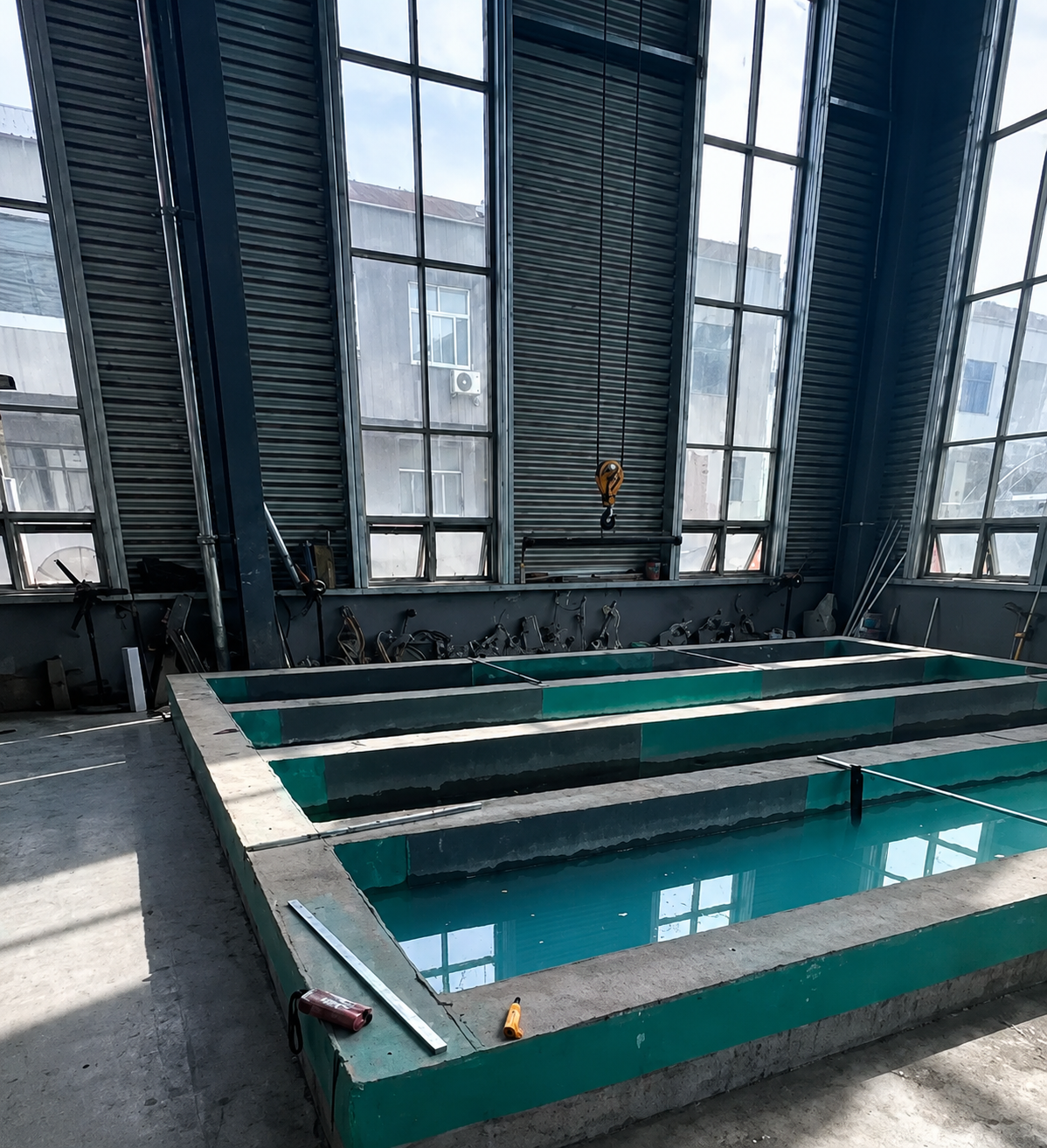
Surface preparation is part of the finish system; the supplier's process assets include a pickling tank. Image: Junsu outdoor.
For a buyer, the practical question is not whether a supplier mentions 6063-T5. It is whether the order record shows the alloy, temper, profile wall measurement and coating result for the actual configuration. The supplied material does not publish a numeric wall-thickness threshold, a coating-adhesion test method or a minimum result. That is not a reason to ignore the check. It is a reason to request the measured value and the test method before approving a shop drawing. The same applies to custom finishes: a RAL color reference describes appearance, not adhesion. The coating check is the evidence layer behind the color choice.
Dimensional tolerance belongs in the same conversation because outdoor systems are assemblies, not single profiles. A pergola frame, fence panel and gate leaf all depend on consistent cutting, machining and alignment. The supplier's inspection methods include dimensional tolerance, and the production profile lists cutting, welding, assembly, quality inspection and packaging within the 30,000 m² base. For the buyer, this check should be tied to the critical dimensions that affect installation: post spacing, panel width, gate clear opening and frame squareness where relevant. The record should show which dimensions were checked, not only that a dimensional check occurred.
Motor, wind and water: the checks that need context
Motorized pergolas, retractable roof pergolas and automatic gates add electromechanical risk to a product category that is already exposed to weather. The supplier's inspection methods include a motor continuous-operation aging test. That check is useful because it exercises the motor repeatedly before shipment. It is not a field-life guarantee. The buyer should ask which motor model was tested, how many cycles or hours the aging test covered, and whether the test used the same control configuration as the order. For an automatic driveway gate, the motor selection also depends on gate type, gate size, weight and installation conditions, as stated in the supplier's gate guidance.
Wind resistance is another check that is easy to misread. The supplied product-data field lists wind resistance at 120 km/h and snow load at 100 kg/m². Those are listed performance figures for the applicable product data, not a universal approval for every pergola configuration. A wall-mounted bioclimatic pergola, a free-standing pergola and a multi-zone structure can have different fixing conditions and load paths. A buyer should connect the wind-resistance record to the actual mounting surface, anchor design, exposure category and local requirement. If the project is in an open or windy site, the test record should be read together with the installation drawings and any project-specific engineering.
Waterproof performance follows the same rule. The louvered pergola manages rainwater through integrated drainage channels and internal drainage inside the posts when the louvers are closed. The waterproof test is a product check. Site drainage, fall, cable routing and installation quality are project conditions. The supplier's electrical guidance adds a practical boundary: the motorized system is designed for outdoor applications, but electrical connections must be installed correctly and protected, and electrical components should not remain submerged in standing water. Before installation, the power supply location, drainage conditions and installation environment should be confirmed. That is not a sales condition; it is a performance condition.
From records to order execution: capacity, MOQ, lead time and OEM/ODM
Test records become more useful when they are read beside commercial terms. A supplier may have a strong inspection method and still require the buyer to confirm the order-specific configuration. The table below maps the supplied commercial and support facts to their procurement meaning.
| Term | Supplied detail | Procurement implication |
|---|---|---|
| Monthly capacity | 3,000 sets per month. | Supports repeat-order planning; it is not a substitute for the quality annex. |
| MOQ | 1 set. | Allows a single-set order or sample; the same configuration data is still needed. |
| Lead time | 30 days for confirmed aluminum pergola and aluminum fence orders. | Plan approval, drawing confirmation and pre-shipment inspection inside the schedule. |
| OEM/ODM | OEM and ODM production services for aluminum pergola, aluminum fence and aluminum gate products. | Customization must be defined before the test record and drawing are approved. |
| Pre-shipment acceptance | 100% pre-shipment test. | Request the report and confirm the acceptance criteria in the purchase order. |
| After-sales support | Long-term warranty service, free technical consultation, remote installation guidance, remote system debugging, spare parts supply, fault response, maintenance guidance and lifelong technical support. | Confirm the spare-parts list and support route for the exact motor and control system. |
OEM and ODM capability is where the evidence file and the product file meet. The supplier lists customization for overall dimensions, profile thickness, surface coating color, decorative pattern, gate opening mode, intelligent control system, accessory configuration, embedded logo engraving, pergola roof style, fence spacing, hardware style, access system, anti-collision structure, bottom gap height and hidden installation fittings. The company profile also lists a 10-engineer R&D team and support for CAD drawings, architectural plans, sketches, photos, dimensions and samples, plus technical drawings, design optimization, installation drawings, customized logos, private labels and packaging.
For the buyer, customization increases the need for a configuration-specific record. A standard 3 m by 3 m pergola, a 3 m by 4 m pergola, a 4 m by 4 m pergola or a custom size may share a material specification but differ in load path, drainage run and motor duty. A fence panel with a different bar spacing or bottom gap is not the same acceptance item as the base panel. A gate with fingerprint, keypad, card, remote or APP access adds control-system variables that should be reflected in the motor and electrical check. The record should follow the configuration, not the catalogue cover.
Application context: 600 sets, 10 markets and the limits of a case record
The supplied case record lists a 600-set order for the USA and delivery or installation across 10 markets: AU, BE, CA, CH, FR, GB, IT, MV, SG and US. It covers villa courtyards, residential communities, parks and scenic landscape projects, hotels and resorts, municipal public infrastructure, factory and campus safety isolation, commercial landscape renovation, and outdoor leisure shading and enclosure. It also lists 15 years of duration and a range of results including long-term use, regional climate adaptation and one-stop delivery and installation. Those details are useful context for a buyer evaluating whether a supplier has worked across climates and project types. They are not a guarantee that every future project will perform in the same way.
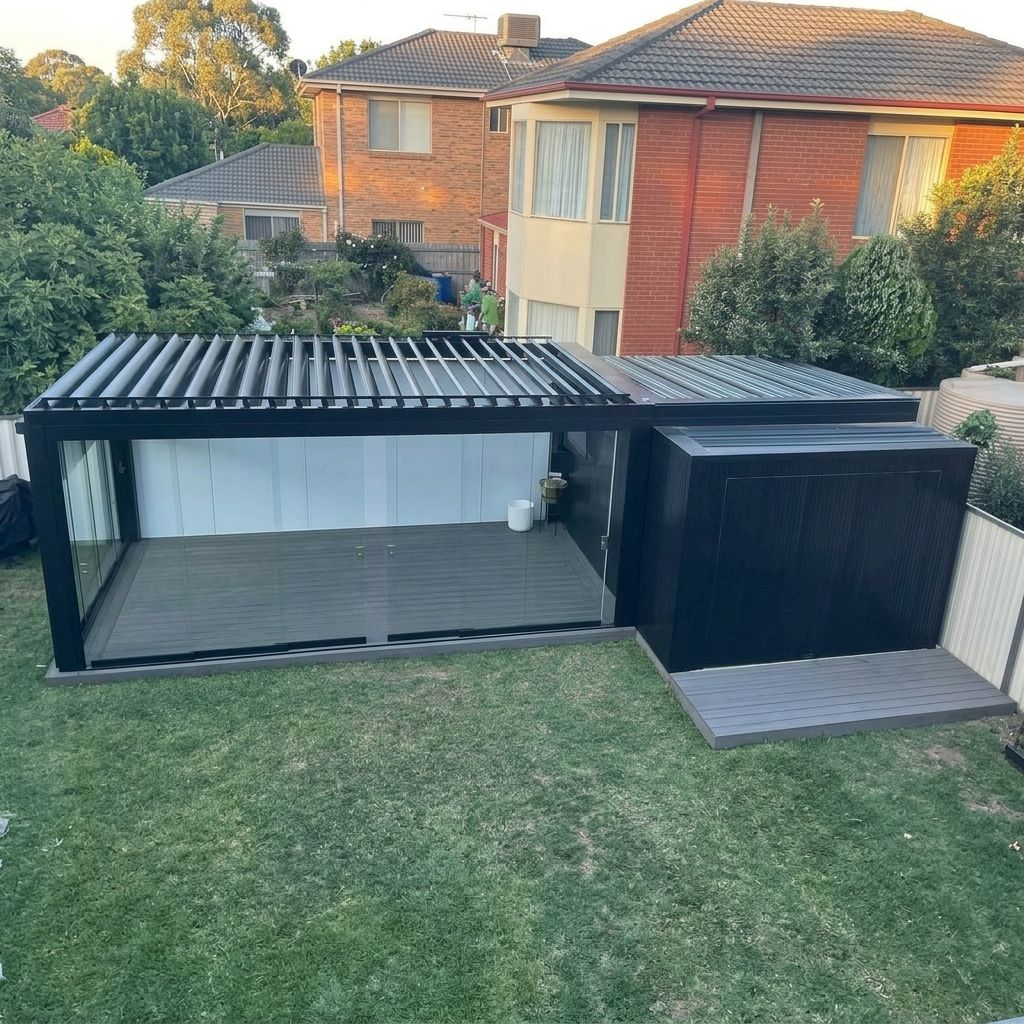
A UK installation in the supplier's 10-market case record. Image: Junsu outdoor.
The fit boundary matters as much as the reference list. The supplier's application notes position aluminum systems for long-term outdoor exposure, open and windy sites and humid coastal areas. They do not position aluminum as the lowest-cost answer for a short-term temporary enclosure with no long-term appearance or durability requirement. That distinction is useful during evaluation: a buyer should not use a long-life outdoor system to solve a temporary site problem, and should not expect a temporary-grade product to meet a permanent installation brief. The case record supports capability context; it does not remove the need for project-specific drawings and acceptance criteria.
Standards provide another reference layer. EN 13561:2015 is the European standard for performance and safety requirements of external blinds and awnings, including pergola awnings. ASTM F2957-13(2019)e1 is the specific standard for ornamental aluminum fence systems, covering structural testing and surface finish. These standards describe frameworks a buyer may encounter; they do not prove that a particular product has passed them. The supplier's profile lists CE certification and ISO 9001 quality-system certification. Those are separate from the product-specific test methods discussed in this article and should be checked against the exact product and market. For U.S.-bound aluminum fence panel kits, the supplied customs record classifies them under HTSUS 7610.90.0080 with a 5.7% duty rate. That is a tariff classification, not a performance test.
The company profile reports a 90% export ratio and exports to the USA, Italy, France, Canada, the UK, Australia and Germany. That market exposure is relevant to documentation discipline: a supplier serving multiple markets must keep finish, electrical and dimensional requirements aligned with each order. It is still not a substitute for the test record attached to the specific pergola, fence or gate configuration.
A buyer verification checklist for pergola, fence and gate records
The most useful procurement step is to turn the supplier's method list into an order-specific evidence request. The checklist below does not invent a pass threshold. It asks for the record that makes the claimed check verifiable.
- Match the record to the configuration. Identify the pergola model, fence panel type, gate type, dimensions, finish and control system before reviewing the test record.
- Confirm alloy and temper. Ask for the 6063-T5 material record and the batch link to the profiles used in the order.
- Ask for measured wall thickness. Clarify whether the reported value is nominal or minimum, and where the measurement was taken.
- Request the coating method and result. Tie the surface coating adhesion record to the specified color and finish, not to a generic sample.
- Review critical dimensions. Ask which post, panel, frame and clear-opening dimensions are inspected for the project.
- Check the motor aging record. Confirm the motor model, control configuration, cycle count or test duration, and the load condition used.
- Read wind and water results with installation conditions. Ask for the test setup, mounting assumptions, drainage layout and any project-specific engineering requirement.
- Close with pre-shipment acceptance. Request the 100% pre-shipment test report, the spare-parts list, installation drawings and the support route for the exact system.
FAQ
What information is needed before ordering a custom aluminum gate?
For a gate design and quotation, provide the clear opening width and height, preferred gate type, quantity and site photos. For automatic gates, information about ground condition, posts or walls, available side space and power supply location is also helpful. Accurate site information allows the gate structure, opening direction and motor installation to be evaluated before production. Drawings can be prepared and confirmed according to project dimensions and requirements.
Is an aluminum louvered pergola waterproof in heavy rain?
The aluminum louvered pergola is designed for outdoor all-weather use. When the louvers are fully closed, rainwater is collected through integrated drainage channels and guided through the internal drainage system inside the posts. Proper installation and site drainage are important for achieving the best waterproof performance, so the drainage layout and installation conditions should be confirmed before the project proceeds.
Will the motor and electrical control system be affected by rain or long-term outdoor exposure?
The motorized aluminum pergola is designed for outdoor applications, and the motor, wiring and control components are installed with outdoor protection requirements in mind. Correct installation is essential, especially for electrical connections and cable routing. Electrical components should not remain submerged in standing water. Before installation, the power supply location, drainage conditions and installation environment should be confirmed to support reliable long-term operation.
Should I choose a sliding gate, swing gate or bi-fold gate for a driveway?
The suitable gate type depends mainly on driveway width, available opening space, ground conditions and required opening speed. Swing gates suit sites with sufficient inward or outward opening space. Sliding gates suit sites with enough lateral space beside the entrance. Bi-fold gates are useful where the driveway has limited opening depth and a more compact opening solution is required. Site dimensions and photos allow the installation space to be evaluated before a configuration is recommended.
Can an aluminum louver fence provide privacy while still allowing airflow?
Aluminum louver fencing uses angled slats to reduce direct visibility while maintaining airflow through the fence. This makes it suitable for residential privacy, patios, courtyards, HVAC equipment screens and commercial mechanical enclosures where ventilation is required. Dimensions and configurations can be customized according to the project.
Conclusion: the record should follow the order
Outdoor Living Solutions are often sold on capacity, configuration and delivery. The stronger procurement question is which records accompany the order. For aluminum pergolas, fences and gates, the evidence chain runs from 6063-T5 material and wall thickness through coating adhesion, dimensional tolerance, motor aging, wind resistance, waterproof performance and 100% pre-shipment testing. The 3,000-set monthly capacity, 1-set MOQ, 30-day lead time, OEM/ODM support, spare parts and lifelong technical support are useful commercial facts, but they do not replace that chain. The buyer's task is to make the supplier connect the record to the exact model, finish, motor and installation condition.
The supplier's product catalogue is available as a PDF: Junsu Products Catalog.
Have Questions or Need More Details?
Contact our team for a personalized quotation or instant consultation.
Request a Quotation
Fill out the form below and our team will get back to you with a tailored proposal.
WhatsApp Direct Chat
Prefer to chat in real-time? Message us on WhatsApp for instant assistance & quick answers.
- Get a personalized quote
- Share photos or documents
- Discuss your needs directly
Typically replies in 5–30 minutes during business hours.