
Supplier Capability Evidence: Brushless Motor Build Quality from Specs to Application Fit
Supplier Capability Evidence: Brushless Motor Build Quality from Specs to Application Fit
Brushless motor build quality becomes supplier capability evidence only when a buyer can trace it from model-level specifications to the working condition. A model code, a catalog photo, or a general claim about precision is not enough. The stronger evidence chain runs from architecture and materials to gear stage options, voltage and torque ratings, test routines, and finally to application fit. TT Motor (Shenzhen) Industrial Co., Limited, the Shenzhen-based company behind the TT MOTOR brand, publishes a model set that makes this kind of trace possible. The examples below show how to read that evidence without overreading it.
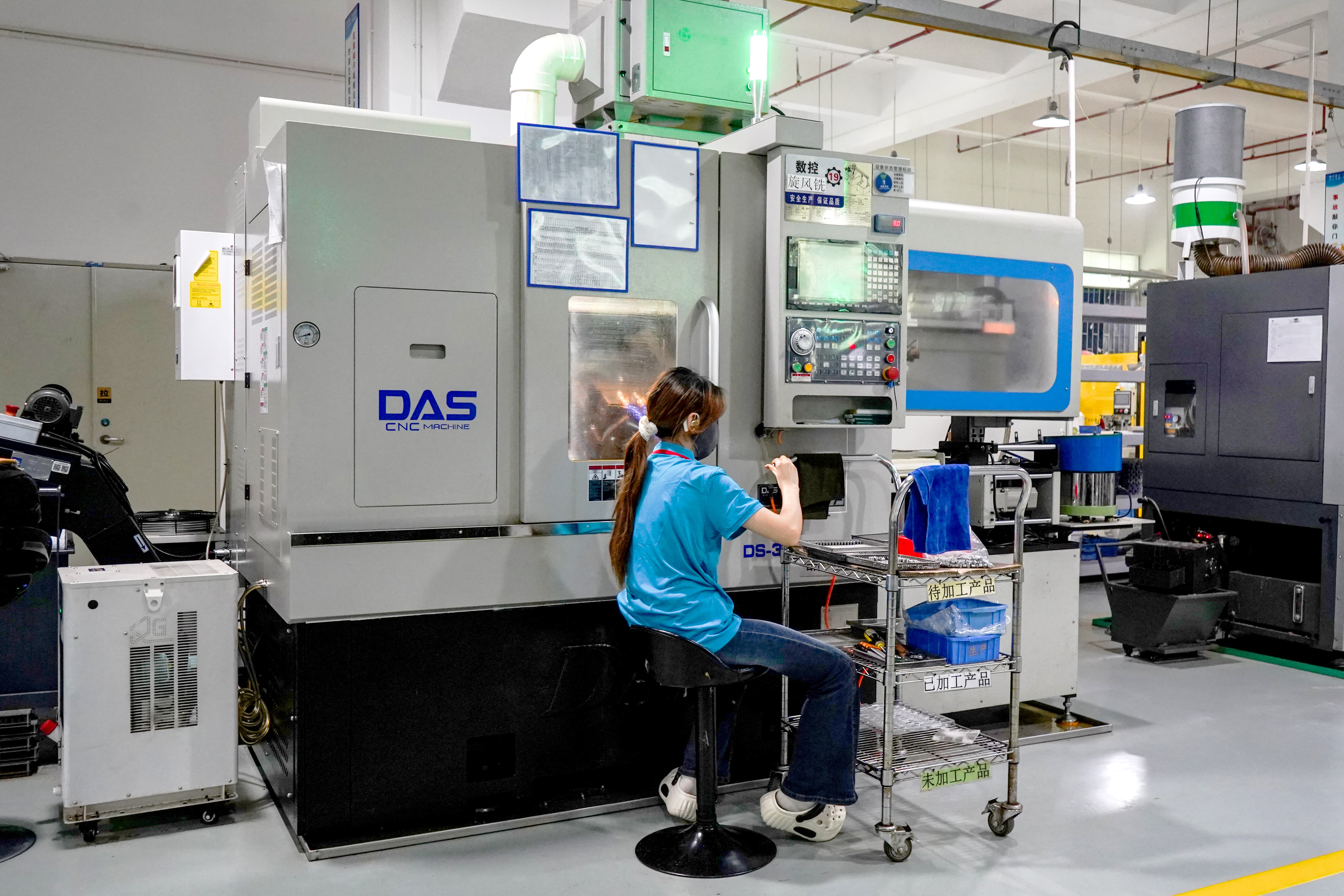
Cover image: precision machining equipment at TT Motor, used here as context for build-quality evaluation. Source: TT Motor company profile images.
For a buyer at the decision-to-execution stage, the useful question is not whether brushless technology is interesting. It is whether a specific supplier can repeat a specific build, document its ratings, and support the program after the first order. That is an evidence question. It requires a chain of proof that connects the motor and gearbox architecture to the load, duty cycle, and acceptance criteria of the equipment.
TT Motor (Shenzhen) Industrial Co., Limited was founded in 2006 and operates a manufacturing area of approximately 9,000 square meters with more than 300 employees, including 35 engineers. Its published annual output is 8,000,000 pieces. The company reports that about 70% of its products are exported, with main markets in the EU and the USA, and that it has established long-term cooperative relationships with domestic and international industry customers. Those facts are relevant context. They are not, by themselves, proof that a particular brushless gear motor will fit a particular application.
Why supplier capability evidence matters at decision and execution stage
At the decision stage, a buyer is comparing architectures, suppliers, and total program risk. At the execution stage, the buyer is locking drawings, samples, acceptance criteria, and batch controls. The same supplier facts must serve both stages, but they do different work. A broad product line can show that a supplier understands multiple architectures. A model-level datasheet can show that the supplier can define an executable specification. A pre-shipment test routine can show that the supplier has a control point before delivery. None of these alone is sufficient.
The most common failure mode is not a missing catalog. It is a gap between sample performance and batch performance. TT Motor's published risk guidance identifies several triggers: replacement of raw materials or components, failure to lock in the sample process during mass production, insufficient sample quantity to reflect batch consistency, changes in production equipment or mold status, and inadequate parameter control between batches. The same guidance recommends defining motor parameters and acceptance standards before mass production, running a small-batch trial first, establishing a shipment inspection mechanism, and notifying the customer in advance if raw materials, components, or production processes change. That is the kind of control that turns capability evidence into execution assurance.
The evidence ladder: from model code to application fit
A supplier capability claim should be tested in a fixed order. The lower rungs are necessary but not sufficient. The higher rungs are where most procurement risk sits.
- Model architecture: Is the product a planetary gearmotor, a worm gearmotor, a coreless gearmotor, or another build? What is integrated, and what is separate?
- Construction evidence: What materials and construction features are claimed, and how are they inspected? Precision-machined gears, brushless commutation, and coreless rotors are different claims with different checks.
- Specification evidence: Does the datasheet define voltage range, no-load and rated speed, rated torque, stall torque, gear ratio, gear stages, rated current, duty cycle, and load limits?
- Validation evidence: Which tests apply to the model and batch? What is the acceptance rule? What changes trigger re-verification?
- Application fit: Does the model match the actual load profile, duty cycle, noise target, space envelope, and environment?
- Long-term supply evidence: Can the supplier support repeat orders, change control, traceability, and documentation over the program life?
| Evidence layer | What to request | Why it matters | What it does not prove |
|---|---|---|---|
| Architecture | Model drawing, gearbox type, integrated or separate build | Shows how speed reduction and motor integration are achieved | Does not prove torque, life, or batch consistency |
| Construction | Gear machining method, rotor type, brushless construction, inspection records | Connects build claims to measurable features | Does not prove every model receives the same routine |
| Specifications | Voltage range, speed, torque, gear stages, current, duty cycle | Turns the model into a purchase requirement | Does not prove fit under the real load |
| Validation | Pre-shipment test plan, sample trial, change notification | Reduces sample-to-batch variation risk | Does not replace application-level testing |
What the three brushless gear motor builds show
The three models below are useful because they represent different build logics. They should not be read as interchangeable options. Each architecture answers a different mechanical and duty-cycle problem, and each requires its own evidence.
GMP36-TEC3650: same-diameter planetary gearbox with precision-machined gears
GMP36-TEC3650 is identified by a same-diameter planetary gearbox with precision-machined gears. The phrase matters because it links two things a buyer can verify: the gearbox envelope relative to the motor, and the gear manufacturing method. A same-diameter arrangement can support a compact inline drive. Precision-machined gears are relevant to tooth form, backlash control, and running smoothness. Neither phrase alone proves a torque rating. The buyer should still request gear stage count, ratio, rated output torque, no-load and rated speed, backlash target, lubrication, and allowable load limits.
From a capability standpoint, a planetary build is evidence of gear machining and assembly discipline only when the supplier can connect those claims to inspection records. TT Motor's published facility images identify a CNC fully automatic gear measuring machine and a micro motor rotor dynamic balancing machine. Those are relevant capability signals because gear geometry and rotor balance affect noise, vibration, and life. They are not a substitute for a model-specific test report.
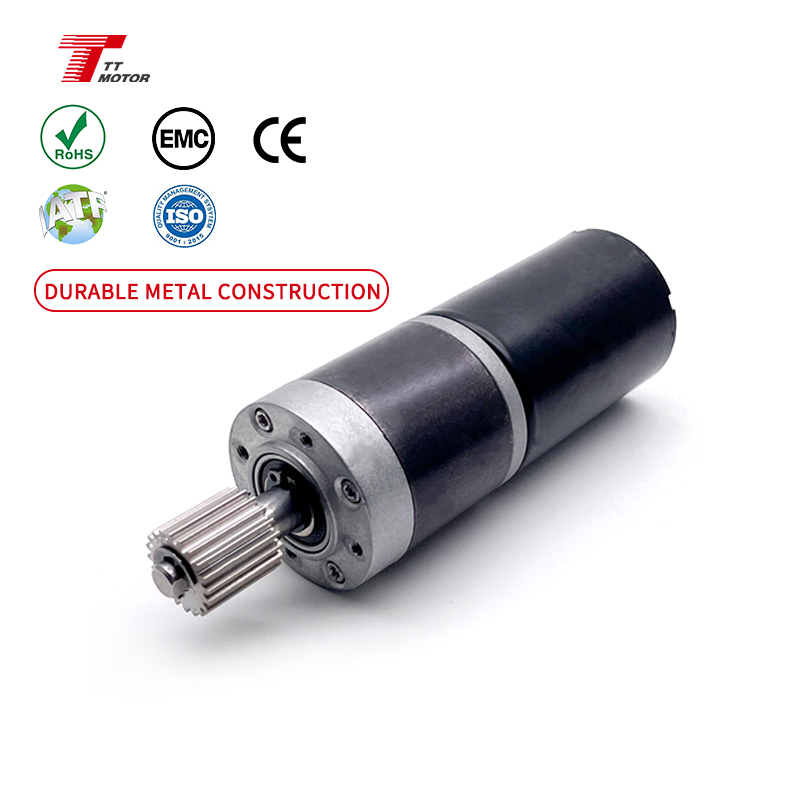
GMP36-TEC3650: same-diameter planetary gearbox with precision-machined gears. Source: TT Motor product image.
Planetary gearboxes are often evaluated where compact inline reduction is required. The buyer should ask how many stages are available and how the rated output torque changes by ratio. Each additional stage changes ratio, efficiency, length, and backlash. A supplier that can document those relationships has demonstrated engineering control. A supplier that lists only a single ratio without stage data has not provided enough for an execution-stage decision.
TWG3246-TEC2430: brushless worm gear construction without carbon brushes
TWG3246-TEC2430 is described as a brushless worm gear construction without carbon brushes. The absence of carbon brushes is not a marketing detail; it changes the wear profile. Brushless motors use electronic commutation and do not have traditional brushes and commutators, which reduces mechanical wear and carbon dust. TT Motor's published comparison also notes low electromagnetic interference because there is no physical brush contact and no sparking. For a worm gear motor, the combination matters in equipment that runs often, starts and stops, or needs low maintenance.
The worm gear side should be evaluated as a reduction architecture. Worm gearing can provide a large reduction in a compact package, which is useful when space is tight. The buyer should ask for reduction ratio, output torque, duty cycle, self-locking behavior if relevant, lubrication, and thermal limits. A brushless worm gear motor can be a good fit for continuous-duty or low-maintenance equipment, but it is not automatically the lowest-cost choice. The control electronics add cost and complexity compared with a simple brushed motor.
The construction claim also needs a verification plan. A brushless motor without carbon brushes should be checked through construction review and a life test that looks for wear and contamination. The buyer should confirm that the test condition matches the intended duty cycle, not a short no-load run. If the application requires low noise, the gear mesh and bearing arrangement should be included in the sample evaluation, not only the motor.
GMP12T-TDC1215: coreless rotor with integrated gearbox
GMP12T-TDC1215 is identified by a coreless rotor with an integrated gearbox. Coreless rotors are associated with low moment of inertia, which supports faster starting, braking, and speed changes. That is why coreless designs are often considered for robot joints and other compact mechanisms that need rapid response. The integrated gearbox is a second evidence point: combining motor and gearbox can reduce couplings, mounting structures, and assembly steps, which helps when space is limited.
The limitation is equally important. A coreless rotor does not remove the need to check thermal capacity, rated torque, gear stage losses, and duty cycle. The buyer should ask for the integrated gearmotor's output ratings, not just the bare motor's speed. If the gearbox is an afterthought, the response advantage of the coreless rotor can be lost in backlash, misalignment, or an undersized output stage.
GMP12T-TDC1215: coreless rotor with integrated gearbox. Source: TT Motor product image.
The application question is whether the equipment benefits from low inertia and compact integration enough to justify the selected build. A coreless gearmotor can be a strong fit for rapid positioning in a small envelope. It is not a universal replacement for a planetary or worm gearmotor. The load profile, holding requirement, and gearbox backlash should decide the architecture.
Specifications that turn build quality into an executable requirement
The most useful supplier evidence is a datasheet that can be turned into a purchase requirement. That means voltage range, no-load speed, rated speed, rated torque, stall torque, gear ratio, number of gear stages, rated current, duty cycle, insulation, shaft dimensions, and load limits. When a supplier cannot provide these fields for a model, the model is not yet an execution-stage option.
Voltage range
Voltage range is the first constraint because it determines compatibility with the equipment's supply. The widely referenced N20 gear motor architecture illustrates the level of detail a buyer should expect: a typical 10 mm by 12 mm by 25 mm envelope and a 3 V to 12 V operating voltage, as summarized in industry datasheet references. That is a baseline for a small DC gear motor, not a rating for every brushless model. A 12 V DC rail is common in compact equipment, but the buyer should confirm the actual operating window, starting current, and allowable voltage drop for the selected model.
Torque and speed
Rated torque is the torque that can be continuously output under specified operating conditions. It is not the same as stall torque. For a gearmotor, the buyer needs the output torque after the gearbox, at the stated speed and duty cycle. A supplier that lists only motor speed or only a generic torque figure has not provided enough information for a decision. The same rule applies to the three models above: the model-level torque and speed values should be read together with the gear stage and the application load.
Gear stage options
Gear stage count is a design variable, not a catalog detail. Each additional stage changes the ratio, output torque, efficiency, length, and backlash. A planetary gearbox, a worm gearbox, and a spur gearbox all trade these factors differently. The buyer should ask which stages are available, how the ratio is calculated, what the rated output torque is at each ratio, and whether the stage count changes the allowable load. A supplier that can answer these questions has demonstrated engineering control; a supplier that cannot has only demonstrated a product photo.
Materials and construction: what is actually being verified
Build quality claims become credible when they connect to a measurable feature. Precision-machined gears can be checked through tooth geometry, backlash, running noise, and wear inspection. A brushless worm gear without carbon brushes can be checked through construction review and a life test that looks for brush wear and carbon dust. A coreless rotor can be checked through response tests, inertia-related behavior, and start-stop cycling. In each case, the material or construction claim is only the start of the evidence chain.
TT Motor's published facility images identify a CNC fully automatic gear measuring machine, a micro motor rotor dynamic balancing machine, a motor life testing system, a temperature and humidity chamber, and a micro motor tester. For a buyer, those images are useful context because they show the kinds of controls a supplier considers relevant. They do not replace a model-specific inspection report, and they should not be treated as proof that every model receives the same routine. The buyer should ask which tests apply to the specific model and batch.
Application fit: matching architecture to the working condition
Application fit is where supplier evidence either becomes useful or falls apart. A brushless gear motor can have excellent build quality and still be wrong for the load, duty cycle, or environment. TT Motor's published application notes group requirements by working condition. Robot joints call for high-frequency dynamic motion, rapid start and stop, high power density, fast response, and low inertia. Medical equipment calls for low-speed precision motion, long-term operation, low noise, low vibration, and stable operation. Smart home equipment calls for miniaturization, low noise, and low power consumption. The company's broader product scope covers industrial automation, intelligent robots, medical equipment, precision instruments, smart homes, automotive electronics, and unmanned equipment.
Medical and laboratory equipment
In analyzers, infusion pumps, pipetting equipment, surgical staplers, and rehabilitation robots, the motor is part of a controlled motion system. Low noise and low vibration matter because they affect the user experience and sometimes the measurement. Brushless construction is relevant where long operation and low maintenance matter, and the absence of carbon brushes avoids brush dust and sparking. A coreless rotor may be relevant where fast response and compact size matter. A planetary gearbox may be relevant where a compact inline reduction is needed. The final choice should be based on the equipment's torque, speed, duty, and noise targets, not on the architecture name alone.
Robot joints and compact automation
Robot joints and compact automation often need quick response, reversible motion, and stable positioning. A coreless rotor's low inertia supports faster start, brake, and speed-change cycles. A planetary gearmotor can provide a compact inline reduction with multiple stage options. A worm gearmotor can provide a large reduction in a compact envelope. These are different answers to different mechanical constraints. The buyer should map the architecture to the joint's load profile, backlash tolerance, and duty cycle before comparing price.
Smart home and small equipment
Smart curtains, robot vacuums, smart toilets, adjustable desks, and camera pan-tilt units typically prioritize small size, low noise, and low power consumption. The N20-class architecture is a useful reference point for how small a gearmotor can be, but it is not the only option. A mini brushless motor or a small DC gear motor can be appropriate when the duty cycle and life target justify the added control cost. Here again, the supplier's model-level data should show the voltage, speed, torque, and gear stage rather than relying on a category label.
Comparison with traditional solutions: where brushless build quality pays off, and where it does not
Brushless construction is often compared with brushed construction, and the comparison is useful only when it includes the trade-off. TT Motor's published comparison states that BLDC motors typically have an efficiency of about 85% to 90%, while brushed gear motors commonly have an efficiency of about 70% to 80%, depending on the model and operating conditions. Brushless motors eliminate mechanical brushes, which reduces wear and carbon dust. They are generally preferred for equipment that operates for extended periods, starts and stops frequently, and requires minimal maintenance. The same comparison notes that the unit price is usually higher, but long-term maintenance and replacement costs may be lower.
| Decision factor | Brushless gear motor | Brushed gear motor |
|---|---|---|
| Wear and maintenance | No carbon brush wear; lower maintenance in long-duty use | Brush wear and carbon dust are inherent to the design |
| Efficiency | Typically about 85% to 90%, depending on model and conditions | Commonly about 70% to 80%, depending on model and conditions |
| Sparks and EMI | No physical brush contact and no sparking; low electromagnetic interference | Sparks and carbon dust can occur during operation |
| Cost position | Usually higher unit price; may lower long-term maintenance cost | Lower initial cost; higher maintenance cost in long-duty use |
| Best fit | Extended operation, frequent starts and stops, low maintenance | Low-cost, short-running, simple-control applications |
The limitation is real. A brushed motor remains rational for low-cost, short-running, simple-control applications. A brushless motor adds electronic commutation and can increase design complexity. It is not the default answer for every compact device. The buyer should also compare an integrated gearmotor with a separate motor and gearbox. An integrated geared motor is usually more compact, easier to install, and requires fewer couplings and mounting structures, which can reduce machine space and assembly cost. The trade-off is that the integrated unit may be less flexible to repair or reconfigure than a separate motor and gearbox. Neither choice is universally better.
There is also a limitation in supplier evidence itself. A broad product line, a large factory, and a set of equipment photos can show capability, but they do not prove that a specific batch will match a sample. TT Motor's published risk guidance addresses this directly: define motor parameters and acceptance standards before mass production, run a small-batch trial, establish shipment inspection, and notify the customer in advance if raw materials, components, or production processes change. That is the kind of control that turns capability evidence into execution assurance.
Long-term supply: what capacity and market evidence can and cannot prove
For a long-term program, capacity and market coverage are supporting evidence. TT Motor (Shenzhen) Industrial Co., Limited was founded in 2006 and operates a manufacturing area of approximately 9,000 square meters with more than 300 employees, including 35 engineers. Its published annual output is 8,000,000 pieces. The company reports that about 70% of its products are exported, with main markets in the EU and the USA, and that it has established long-term cooperative relationships with domestic and international industry customers. It also states that it provides customized service capabilities to help customers address power requirements in different application scenarios.
Those facts support a reasonable conclusion: the supplier has the scale and engineering depth to support high-volume and long-term OEM motor programs. They do not prove on-time delivery for a specific schedule, nor do they prove that every model is equally mature. The buyer should still ask for capacity reservation, lead-time assumptions, change-control procedures, and the acceptance test plan for the specific model. For procurement planning, TT Motor's published purchase terms list a minimum order quantity of 2 units, EXW delivery terms, and pre-shipment test acceptance. Those terms are useful data points, but the technical acceptance criteria should be written into the purchase order.
Compliance evidence should also be model-specific. TT Motor states that most of its motors have passed RoHS testing and that reports can be provided. The buyer should confirm that the report covers the exact model, the relevant materials, and the current revision. A general statement about RoHS compliance is useful for screening, but it is not a substitute for a model-level document review.
Market trend analysis: why evidence-based supplier evaluation is becoming more important
The wider market context supports the move toward evidence-based evaluation, but it should not be confused with supplier proof. Grand View Research estimates the global brushless DC motor market at USD 22.2 billion to USD 22.33 billion in 2025. OEC reports that global exports of electric motors with an output below 37.5 W reached USD 16.3 billion in 2024 under HS code 850110. These figures show the scale of the category; they do not tell a buyer which miniature gearmotor supplier is qualified for a specific application.
Regulatory attention is also increasing. IEC 60034-30-1:2025 introduces the IE5 ultra-premium efficiency class, and the EU Ecodesign Regulation 2019/1781 sets minimum efficiency requirements for certain motor ranges. These rules are not a direct substitute for model-level checks on miniature brushless gear motors, because their scope is different. Their relevance is directional: efficiency, documentation, and verifiable performance are becoming more important across the motor market. For miniature motors, the practical translation is a datasheet that states voltage, torque, speed, gear stage, duty, and test conditions clearly.
The market data also has a limitation. Market-size estimates vary by scope, and a category total cannot be used to infer supplier capacity or model reliability. The buyer should treat market reports as context for category direction, while treating model-level data and batch evidence as the basis for a supplier decision.
Future outlook
The next phase of supplier evaluation is likely to be more model-specific, not less. Buyers will increasingly expect a digital evidence pack for each model: drawings, rated performance, gear stage data, test reports, material and compliance statements, and change-control commitments. Integrated gearmotors will continue to compete with separate motor and gearbox assemblies where space and assembly cost matter. Coreless and brushless architectures will continue to be selected where response, maintenance, or no-spark operation matters. None of these trends removes the need for application testing.
For long-term supply relationships, the differentiator is not only the breadth of the product line. It is the ability to keep the same model evidence current across orders. That means traceability, controlled changes, repeatable acceptance tests, and clear communication when a material or process changes. A supplier that can do this is easier to qualify, easier to audit, and easier to keep in a long-term program.
Supplier capability checklist for execution-stage buyers
- Confirm the model code and architecture: planetary, worm, coreless, or another build.
- Request the dimensional drawing and confirm the motor-plus-gearbox envelope.
- Obtain voltage range, no-load speed, rated speed, rated torque, stall torque, and rated current.
- Ask for gear ratio, number of gear stages, backlash target, and allowable load limits.
- Review construction evidence for precision-machined gears, brushless commutation, or coreless rotor claims.
- Confirm which tests apply to the model and batch, and how pre-shipment acceptance is performed.
- Map the model to the real load profile, duty cycle, noise target, and environment.
- Check sample-to-batch controls, change notification, and traceability.
- Verify RoHS documentation for the exact model where required.
- Confirm long-term capacity, lead-time assumptions, and procurement terms against the program schedule.
FAQ
What evidence should a buyer request when evaluating a brushless gear motor supplier's build quality?
Request the model datasheet, dimensional drawing, gear stage and ratio data, rated voltage, no-load and rated speed, rated torque, duty cycle, and the acceptance test plan. For construction claims, ask for the relevant inspection or test records. TT Motor states that products are accepted through pre-shipment test procedures and that most of its motors have passed RoHS testing, with reports available on request. These documents support evaluation but should be tied to the exact model and batch.
How do planetary, worm, and coreless gear motor architectures differ in application fit?
A planetary gearbox uses multiple gears to provide reduction in a compact inline package; build quality depends on gear machining, alignment, and stage control. A worm gearbox can provide a large reduction in a compact envelope and is often considered where space is limited. A coreless rotor has low moment of inertia, which supports faster starting, braking, and speed changes. The correct choice depends on load, speed, duty, noise, and space, not on the architecture name alone.
What do model-level voltage, torque, and speed ranges prove about a supplier's capability?
They prove that the supplier can define an executable specification for a model. Voltage range shows supply compatibility; rated torque and speed show the output envelope under stated conditions; gear stage data shows how the reduction is achieved. They do not prove that the model will fit every application. The buyer still needs to compare the ratings with the actual load profile and validate a sample under the intended duty cycle.
How can buyers reduce the risk of sample-to-batch variation?
Define motor parameters and acceptance standards before mass production, run a small-batch trial, and establish a shipment inspection mechanism. TT Motor's published risk guidance also recommends avoiding special adjustments for samples, avoiding a material switch between samples and mass production, locking key parameters with sampling or full inspection rules, and maintaining traceability. If raw materials, components, or production processes change, the supplier should notify the customer in advance and re-verify the process.
What procurement terms support a long-term brushless motor supply relationship?
The terms should match the technical risk. TT Motor's published purchase data lists a minimum order quantity of 2 units, EXW delivery terms, and pre-shipment test acceptance. For a long-term program, the buyer should add model-specific acceptance criteria, change notification, traceability, and a review of RoHS documentation where required. Capacity figures such as an annual output of 8,000,000 pieces are useful context, but they should be confirmed against the specific schedule and model mix.
Reference document: TT Motor company brochure.
Have Questions or Need More Details?
Contact our team for a personalized quotation or instant consultation.
Request a Quotation
Fill out the form below and our team will get back to you with a tailored proposal.
WhatsApp Direct Chat
Prefer to chat in real-time? Message us on WhatsApp for instant assistance & quick answers.
- Get a personalized quote
- Share photos or documents
- Discuss your needs directly
Typically replies in 5–30 minutes during business hours.