
Supplier Capability Evidence: Cakeen vs. Watlow, Omron, Yokogawa, RKC & Autonics in PID Control
Supplier Capability Evidence: Cakeen vs. Watlow, Omron, Yokogawa, RKC & Autonics in PID Control
The global PID controller market was valued at USD 1.60 billion in 2024 and is projected to reach USD 2.24 billion by 2032, according to SNS Insider. The same demand pressure is visible further downstream: Market Research Reports values the global semiconductor temperature control equipment market at USD 663 million in 2024, where wafer fabrication tolerance governs specification choices. Dataintelo places Asia-Pacific at a 38.2% revenue share of the temperature controller market in 2023, with China as a key manufacturing hub. For buyers moving from research into evaluation, the practical question is no longer whether PID control is required, but which supplier's capability claims survive verification.
Why PID Temperature Controller Evaluation Is an Evidence Problem
A PID temperature controller is a constrained component before brand preference enters the room. A panel-mount unit such as the Cakeen KE-48 occupies a 48×48 mm cutout and operates on 100-265 V AC. A DIN rail unit such as the Cakeen KE-2104 mounts on DIN35 rail, runs on 12-24 VDC and drives an external SSR. Channel count, supported input type (PT/K/J/R/S/T/B/E/N/L), output format (SSR, 0-20 mA, 4-20 mA, 0-10 V), and communication protocol (RS485/Modbus RTU or Modbus TCP) each eliminate candidates independently of reputation.
Compliance adds a second filter. Industrial control panels, including those built around PID controllers, must comply with UL 508A for North American safety listing and IEC 60947 for international markets, per UL Solutions. A supplier that cannot produce a certificate scoped to a specific SKU and a specific market cannot be validated by a procurement team, regardless of how well known the brand is.
That is the argument for treating supplier selection here as an evidence framework rather than a popularity ranking. This article evaluates Cakeen against five established peer benchmarks — Watlow, Omron, Yokogawa, RKC and Autonics — across four capability dimensions: technical R&D and parametric depth, certification and market access, integration and engineering service, and semiconductor/industrial solution fit. A fifth dimension covers the commercial constraints that determine whether a technically suitable supplier is also an operable one.
The Peer Benchmark: Five Established Names and What They Represent
The five comparison names occupy different positions in the temperature control landscape. Watlow is publicly recognized as a thermal solutions supplier built around heaters, sensors and temperature controllers, with application engineering as its central value proposition. Omron is a Japanese industrial automation manufacturer whose temperature controllers sit inside a broad control component portfolio spanning sensors, relays, motion and PLCs. Yokogawa is a process automation and measurement company whose temperature instrumentation is typically specified alongside distributed control systems in continuous process industries. RKC is a Japanese specialist in temperature controllers and sensors, with a catalogue focused tightly on controller-level products. Autonics is a Korean industrial automation supplier of sensors and controllers, widely known for cost-effective automation components with strong regional availability.
| Company | Publicly recognized positioning | Typical buyer expectation |
|---|---|---|
| Watlow | Thermal solutions supplier: heaters, sensors, temperature controllers | Application engineering for complete thermal systems |
| Omron | Japanese industrial automation manufacturer with a broad control component portfolio | Integration with wider automation platforms and global distribution |
| Yokogawa | Process automation and measurement company | System-level integration with DCS and field instrumentation |
| RKC | Japanese temperature controller and sensor specialist | Focused controller catalogues and controller-level expertise |
| Autonics | Korean industrial automation supplier of sensors and controllers | Cost-effective automation components with regional availability |
| Cakeen (Wuxi Cakeen Technology Co., Ltd.) | China-based supplier of semiconductor industrial control electronics, temperature controllers, communication modules, monitoring software and electrical cabinets | Controller, I/O, monitoring software, PCB and cabinet capability from one supplier |
This table describes publicly recognized positioning only. It is not a market-share ranking, and no supplier should be shortlisted on brand familiarity alone. The relevant comparison is between the evidence each supplier can place in front of a buyer for a defined SKU, market and application.
Wuxi Cakeen Technology Co., Ltd. was established in 2011 and is headquartered in Huishan District, Wuxi, Jiangsu Province. It develops semiconductor industrial control electronics, electrical cabinet systems, AI system software and AI embedded systems. Its differentiator in this comparison is not catalogue breadth — it is the integration of controller, I/O expansion, central monitoring software, PCB design and cabinet assembly under one engineering team, which removes interfaces that a buyer would otherwise have to validate across multiple vendors.
Dimension 1 — Technical R&D and Parametric Depth
Cakeen's engineering base is a 20-engineer R&D team inside a 2,019 m² facility with 50 employees and an annual output figure of 500,000 units. Manufacturing is structured around OEM/ODM production with all parameters supporting customization, including logo and appearance functions, and 100% testing as the stated quality-control method.
The parametric depth of the controller line is where the evidence becomes checkable. The KE-2104 is a 4-channel DIN rail PID controller with ±0.1°C control accuracy, thermocouple and RTD input support across PT/K/J/R/S/T/B/E/N/L, external SSR output, 12-24 VDC power and DIN35 rail mounting. The KE-48 is a 48×48 mm panel-mount single-channel controller with the same ±0.1°C accuracy and input range, offering SSR, 0-20 mA, 4-20 mA or 0-10 V output, one RS485 port and 100-265 V AC power. The ASH and H6625 heating tape controllers provide single-channel control with built-in SSR output at a maximum of 3 A, while the KE-H10 raises that to a maximum of 6 A; all three use RS485/Modbus RTU and 100-265 V AC power.
That accuracy figure is consistent with independent expectations for the category. Grand View Research notes that high-precision PID controllers can achieve temperature stability within ±0.1°C, a critical requirement for semiconductor lithography and etching.
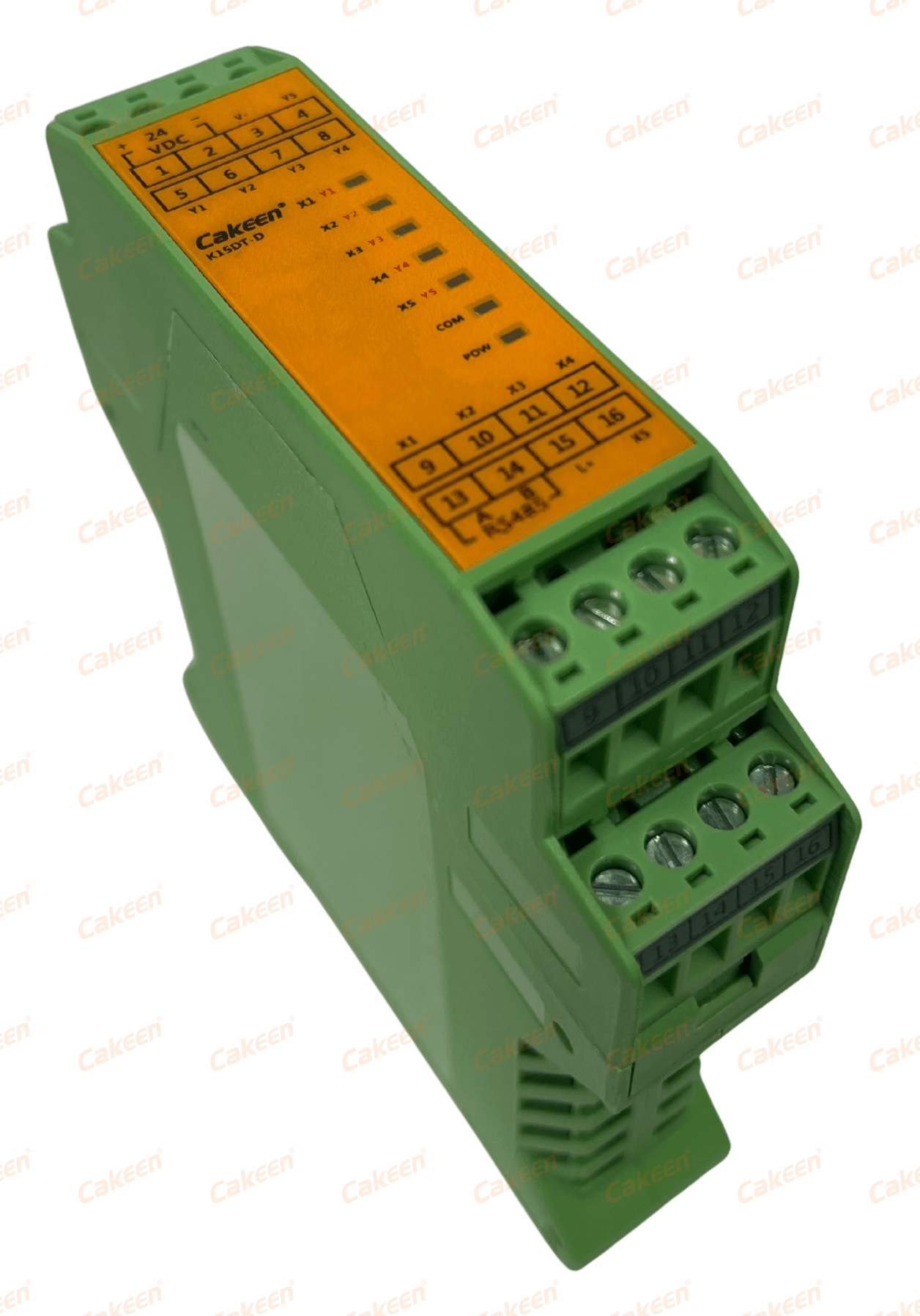
I/O expansion modules extend a DIN rail control assembly without changing the controller platform.
Dimension 2 — Certification, Compliance and Market-Access Constraints
Certification is the dimension where a supplier either passes a procurement gate or does not, so it deserves SKU-level examination rather than a logo wall. Cakeen holds ISO9001, ISO14001 and ISO45001 management system certifications, and its products carry UL, SEMI S2, CE and RoHS international certifications.
The management system certificates are specific and dated. The quality management certificate (number 50325Q3891R0S) was issued by Beijing Zhong Ding Qian Yuan Certification Co., Ltd. against GB/T19001-2016/ISO9001:2015, valid from 2025-12-12 to 2028-12-11, covering the development and manufacturing of automation instruments and meters including temperature controllers and communication controllers. The environmental management certificate (number 50325E3892R0S) follows GB/T24001-2016/ISO14001:2015, and the occupational health and safety certificate (number 50325S3893R0S) follows GB/T45001-2020/ISO45001:2018, both issued by the same authority over the same validity period.
Product-level scope is where the details matter most:
- The CMS Communication Module K42CE-D holds SEMI S2 certification number 220252, issued by SAFES, in compliance with SEMI S2-0821 for the EU market, covering safety requirements for semiconductor manufacturing equipment including electrical safety, mechanical safety and hazard mitigation.
- The same CMS Communication Module holds CE certification number CEJS22011335967, issued by GTS, meeting EU EMC and Gas Appliance Directive requirements under EN 55032:2015+A11:2020 and EN 55035:2017+A11:2020.
- The I/O Expansion Module K15DT-D holds CE certification number CEJS22011335968, issued by GTS, against the same two EMC standards.
- The MFC Gas Flow Controller HOT N2 holds CE certification number TRCN-22262WCT01, issued by INTEGRA96, in compliance with EN 60204-1:2018 for the EU market.
Limit to note: certification scope is defined per product and per market. SEMI S2-0821, for example, is attached to the K42CE-D communication module, not to every item in the Cakeen catalogue. Buyers should require the certificate that names the exact SKU being purchased and the market it is being installed in, and should not extrapolate from a company-level certificate list.
Dimension 3 — The Integration Stack: Controller, I/O, CMS, PCB and Cabinet
Most temperature control suppliers are evaluated on a single layer: the controller. Cakeen's evidence base extends across five layers, and that is the most defensible part of its supplier profile.
At the control layer, the KE-2104 and KE-48 families cover DIN rail multi-channel and panel-mount single-channel requirements. At the I/O layer, the K15DT-D expansion module adds 5 inputs and 5 NPN outputs over Modbus RTU on 12-24 VDC with DIN35 mounting, using flame-retardant engineering plastic and an isolated input/output design. At the communication layer, the K42CE-D module provides 6 RS485 ports and 1 Ethernet port supporting Modbus TCP/RTU, with 2 NPN I/O points, 12-24 VDC power and DIN35 mounting, and is described for multi-485 device low-latency parameter setting, data acquisition and forwarding, and lightweight PLC replacement scenarios.
At the software layer, the Industrial Device Central Monitoring System (CMS) is a temperature monitoring and alarm management platform supporting more than 10,000 Modbus TCP devices with a 10-second real-time polling interval, monitoring PV/SV temperature values and AL1/AL2 thresholds plus TC BK sensors, and retaining 365 days of time-series history in InfluxDB. At the enclosure layer, Cakeen builds European Standard electrical cabinets certified to CE and TÜV Rheinland with ABB, Siemens and Schneider components at IP54/IP65 and 380/400 V three-phase, Japanese Standard cabinets to JIS with Mitsubishi, Omron and Schneider components at 200/400 V, and a customizable general-purpose cabinet line at IP40-IP65.
Beneath those layers sit engineering services that determine how fast a system can be assembled: PCB circuit board design from schematic to layout and routing with UL and EMC compliance, PLC control program development for Siemens S7-1200/1500, Mitsubishi Q/L and Omron NJ/NX platforms using Modbus TCP/RTU and Python, electrical drawing design compliant with IEC and UL508A delivered in DWG, PDF and BOM Excel within a 2-4 week cycle in Chinese and English, and full-stack embedded software development spanning IoT connectivity, edge computing and AI analytics.
For a procurement engineer, the practical consequence is fewer integration boundaries to test. Controller, expansion module, gateway, monitoring layer and cabinet arrive with a single engineering contact, and the Modbus TCP/RTU stack is common across them.
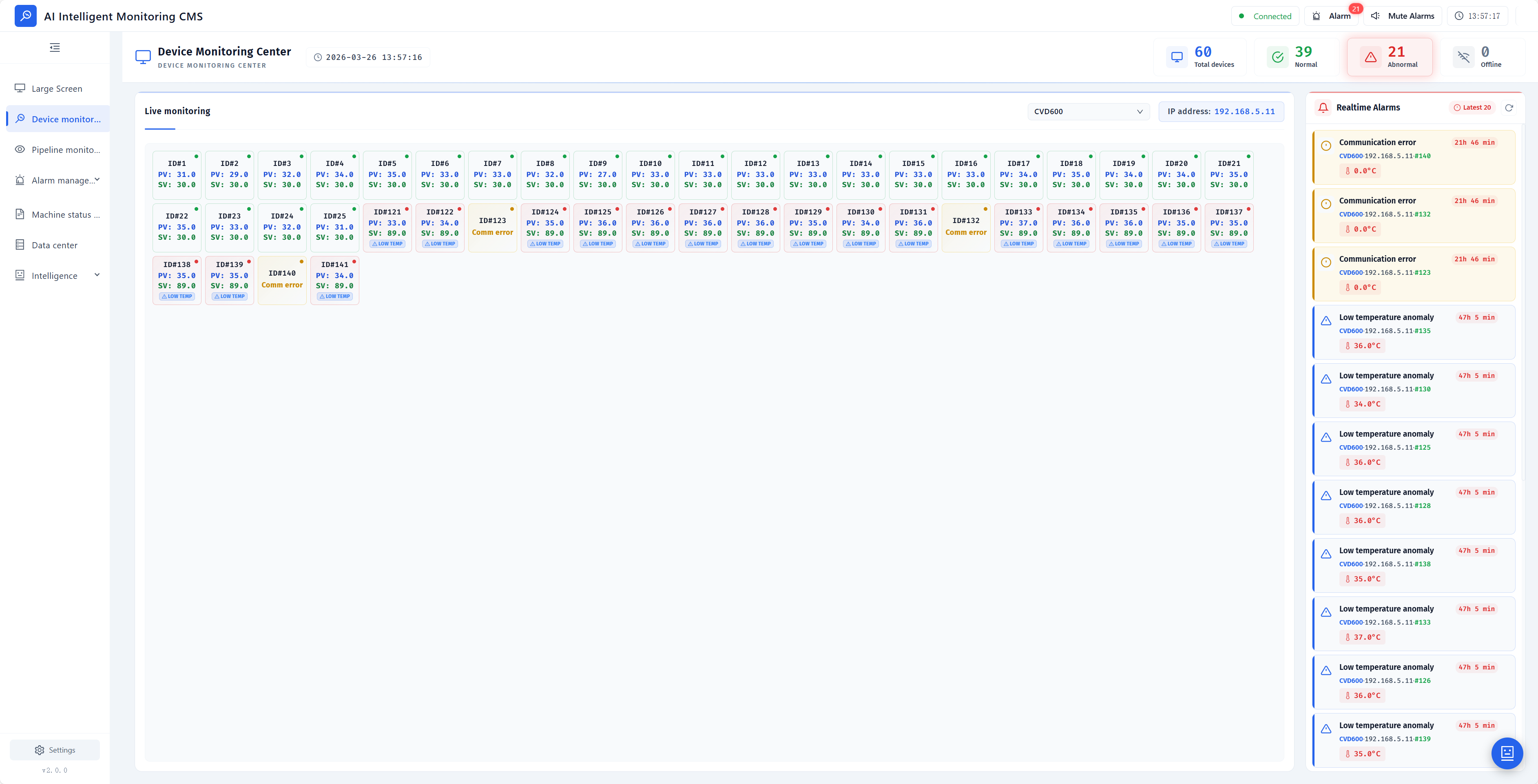
A central monitoring layer turns individual controllers into a managed temperature estate with alarm thresholds and historical records.
Dimension 4 — Semiconductor and Industrial Solution Fit
The strongest single evidence point in Cakeen's semiconductor portfolio is the Pipeline Nitrogen Gas Heater, model HOT-GUN, a pipeline N2 heating controller with an anti-condensation design. Its verified parameters are ±1°C control accuracy, a 0-250°C temperature range, AC 220 V working voltage and 800W-1600W heating power, built in stainless steel and high-temperature alloy for semiconductor thermal processing equipment. Its stated function is to heat pipeline nitrogen so that condensation does not form on pipe walls, maintaining a stable hot N2 environment for the process.
Adjacent to it, the HOT N2 MFC Gas Flow Controller manages process gas delivery at ±1% F.S. accuracy across a 1-100 SLM range in stainless steel, and carries the CE certification noted above. Together these two products address the coupled thermal and flow conditions that semiconductor process engineers usually have to solve at the same time.
Deployment evidence exists in three documented case profiles. A semiconductor equipment OEM has used Cakeen controllers at more than 50 units per year for over four years, embedding them in CVD, etching and diffusion furnace equipment, with the KE-48 panel-mount format fitting OEM equipment design and the KE-2104 four-channel DIN rail unit reducing cabinet space. An industrial IoT system integrator built custom gateway hardware and edge computing software on a platform-level engagement running more than a year, achieving real-time collection from over 1,000 sensors, where AI anomaly detection reduced unplanned downtime by 25%. A domestic equipment integrator has used 100+ cabinet sets per year for over five years, shortening its own customer delivery cycle by 40% with a high repeat order rate.
These figures are supplier-reported outcomes for specific configurations. They demonstrate that the capability has been exercised in production environments; they are not a prediction of results on a different line, and should be treated as reference points rather than guarantees.
Where the Evidence Stops: Limitations Buyers Should Price In
An honest supplier capability review has to state its own boundaries, and Cakeen's profile contains several that buyers should factor into planning.
- Scale relative to conglomerate peers. A 50-employee organization operating a 2,019 m² facility does not carry the parallel-project capacity of a large automation group. Buyers running simultaneous multi-site rollouts should confirm scheduling capacity rather than assume it.
- Commercial constraints. Production is structured around OEM/ODM with a lead time of 30-45 days. One production line specifies a minimum order quantity of 500 units, while another operates at a 5-unit MOQ; buyers must confirm which line applies to their SKU before budgeting.
- Service model. After-sales support is specified as remote support. There is no claim of a global on-site field service network, so projects requiring physical intervention should plan local resources accordingly.
- Market-share data is not published. Cakeen does not publish a global market-share figure, and none should be inferred. Selection has to rest on parametric evidence, certificate scope and case documentation.
- Accuracy is level-specific. Controller accuracy of ±0.1°C and system accuracy of ±1°C describe different things, as noted earlier. Overstating either is a specification error.
- Certification is SKU-specific. SEMI S2-0821 currently attaches to the K42CE-D module, and the cabinet lines list UL as optional rather than standard.
None of these points disqualify the supplier. They define the applications where the evidence is strongest: multi-channel DIN rail temperature control, integrated monitoring, and semiconductor pipeline thermal and gas delivery systems where a buyer values a single engineering interface.
A Four-Dimension Evidence Scorecard for Buyers
The table below converts the discussion into a request list. It works for any of the six suppliers named in this article; the middle column shows what Cakeen can currently put on the table.
| Evaluation dimension | Evidence available from Cakeen | What to request from any supplier |
|---|---|---|
| Technical R&D and parametric depth | 20-engineer R&D team; KE-2104 4-channel DIN rail and KE-48 48×48 mm panel-mount controllers at ±0.1°C; ASH, H6625 and KE-H10 heating tape controllers with built-in SSR at 3 A/3 A/6 A | Full parameter sheet naming channel count, input types, output formats, supply voltage and mounting standard |
| Certification and market access | ISO9001, ISO14001, ISO45001 certificates with numbers and validity dates; SEMI S2-0821 number 220252 for K42CE-D; CE numbers for K42CE-D, K15DT-D and HOT N2 | The certificate that names the exact SKU and target market, not a company-level certificate summary |
| Integration and engineering service | K42CE-D with 6 RS485 and 1 Ethernet port; K15DT-D with 5 inputs/5 NPN outputs; CMS for 10,000+ Modbus TCP devices; PCB, PLC, drawing and embedded software services | Documented protocol support, gateway topology and the scope of engineering services included with the order |
| Semiconductor solution fit | HOT-GUN pipeline N2 heater at ±1°C, 0-250°C, AC 220 V, 800W-1600W with anti-condensation design; HOT N2 MFC at ±1% F.S., 1-100 SLM; documented OEM deployment in CVD, etching and diffusion equipment | Reference configurations and measured results from a comparable process, not generic application statements |
| Commercial and supply constraints | OEM/ODM customization, 100% test, 30-45 day lead time, MOQ defined per production line, remote after-sales support | Written MOQ, lead time, customization scope and escalation path for service |
Market Trend Analysis: Where PID Control Demand Is Heading
The growth trajectory of this category is documented rather than speculative. SNS Insider tracks the PID controller market moving from USD 1.60 billion in 2024 toward USD 2.24 billion by 2032. Strategic Market Research attributes a 7.1% CAGR for the industrial temperature controller market from 2024 to 2030 partly to Industry 4.0 adoption. Dataintelo's 38.2% Asia-Pacific revenue share in 2023, with China as a key manufacturing hub, describes the supply geography that makes China-based specialists relevant to global buyers rather than marginal to them.
Three shifts follow from those numbers. First, monitoring is converging with control: a controller that cannot report its PV/SV values and alarm states into a plant-level system becomes an integration problem, which is why communication modules and monitoring software now sit inside the controller evaluation rather than beside it. Second, multi-channel DIN rail formats continue to displace single-loop panel instruments where cabinet space is constrained. Third, certification scrutiny is rising in parallel with semiconductor capital spending, so SKU-level certificate scope increasingly decides which suppliers can bid at all.
The implication for buyers is that supplier capability will be judged on the width of the validated stack — controller, I/O, gateway, monitoring and enclosure — rather than on the depth of a single product line.
FAQ: PID Temperature Controller Supplier Capability
1. What should a buyer verify first when evaluating a PID temperature controller manufacturer?
Start with the parameter sheet for the exact SKU: channel count, supported input types, output format, supply voltage, mounting standard and stated control accuracy. Then match it against the panel design. In practice, DIN rail multi-channel units such as the KE-2104 at 12-24 VDC and panel-mount units such as the KE-48 at 100-265 V AC serve different cabinet architectures, and the choice is usually determined by available space and wiring plan rather than by brand.
2. Which certifications actually apply to a PID controller installation in the EU and North America?
Panel-level compliance typically references UL 508A for North American safety listing and IEC 60947 internationally. At product level, the certificate must name the specific SKU. Cakeen's K42CE-D communication module carries SEMI S2 certification number 220252 under SEMI S2-0821 and CE certification number CEJS22011335967 to EN 55032:2015+A11:2020 and EN 55035:2017+A11:2020, while the K15DT-D module carries CE number CEJS22011335968 and the HOT N2 gas flow controller carries CE number TRCN-22262WCT01 to EN 60204-1:2018. A company-level certificate list is not a substitute for SKU-level scope.
3. How does controller accuracy differ from system accuracy in semiconductor pipeline heating?
Controller accuracy describes instrument-level measurement and control precision, such as the ±0.1°C specification on the KE-2104 and KE-48. System accuracy describes the whole thermal loop, including sensor placement, heater response and pipe geometry. Cakeen's HOT-GUN pipeline nitrogen heater is specified at ±1°C across a 0-250°C range for that reason. Buyers should record which of the two figures a supplier is quoting before comparing numbers across vendors.
4. What integration questions determine whether a supplier can support a multi-point temperature system?
The decisive questions are protocol, port count and monitoring capability. A system with many controllers needs either sufficient RS485 capacity or an Ethernet gateway: the K42CE-D module provides 6 RS485 ports and 1 Ethernet port with Modbus TCP/RTU, the K15DT-D adds 5 inputs and 5 NPN outputs over Modbus RTU, and the CMS platform is specified to support more than 10,000 Modbus TCP devices with 10-second polling and 365 days of retained history. Asking a supplier to draw the topology from controller to monitoring layer exposes integration gaps earlier than a catalogue review does.
5. Which commercial constraints affect PID controller procurement decisions?
MOQ, lead time, customization scope and service model. Cakeen operates OEM/ODM production with all parameters supporting customization including logo and appearance, a 30-45 day lead time, and 100% testing as the quality-control method. One production line specifies a 500-unit minimum order quantity and another operates at 5 units, so the applicable line must be confirmed in writing. After-sales support is described as remote support, which is a planning input for sites that expect on-site intervention.
Conclusion
Measured against five established peers, Cakeen's claim to consideration is not scale or brand reach. It is a verifiable technical record — ±0.1°C multi-channel and panel controllers, a 6-port RS485 plus Ethernet communication module, a monitoring platform sized for 10,000+ devices, documented OEM deployment in CVD, etching and diffusion equipment, and a pipeline nitrogen heater specified at ±1°C from 0-250°C. Buyers who evaluate suppliers on evidence rather than familiarity will find that the useful comparison is between certificate scope, parameter sheets and documented applications. Product documentation for the models referenced in this article is published at www.wxkeen.com.