
Supplier Capability Evidence: Factory Proof and Heavy Weldments
Heavy metal fabrication is one of the few industrial purchases where the buyer's main risk is invisible at the moment of decision. A welded machine frame, a heavy equipment base or steel skid, an AGV steel chassis, or a vacuum-tight energy storage shell either welds, machines and assembles to drawing — or it does not. Discovering the difference after ocean freight, crane time and site labour have been spent costs far more than any quotation gap between two suppliers.
That asymmetry is why capability evidence has become the working currency of sourcing conversations in custom metal fabrication. Buyers in the decision and execution stages are no longer asking only whether a supplier can make a part. They are asking for factory photographs, workshop video, certificates, test reports and photographic evidence of comparable heavy weldments already built — a checkable picture of what the supplier can physically form, weld, machine and assemble.
Xiamen Openex Mechanical Technology Ltd (Openex) is a custom metal fabrication and machining manufacturer founded in 2009. The company operates two manufacturing premises, one near Xiamen Port and one near Shanghai Port, lists 30,000 m² of manufacturing space with around 200 employees and a 35-engineer technical team, and exports roughly 80% of its output to markets including the EU, the USA, Australia, New Zealand, Japan, Singapore, South America and the Middle East.
This article examines how that evidence should be read: what factory proof actually verifies, what workshop views reveal about large-part forming, welding and post-weld machining, how sample orders and first-article inspection fit into long-term supply arrangements, and where a fabrication-led supply model stops being the right answer.
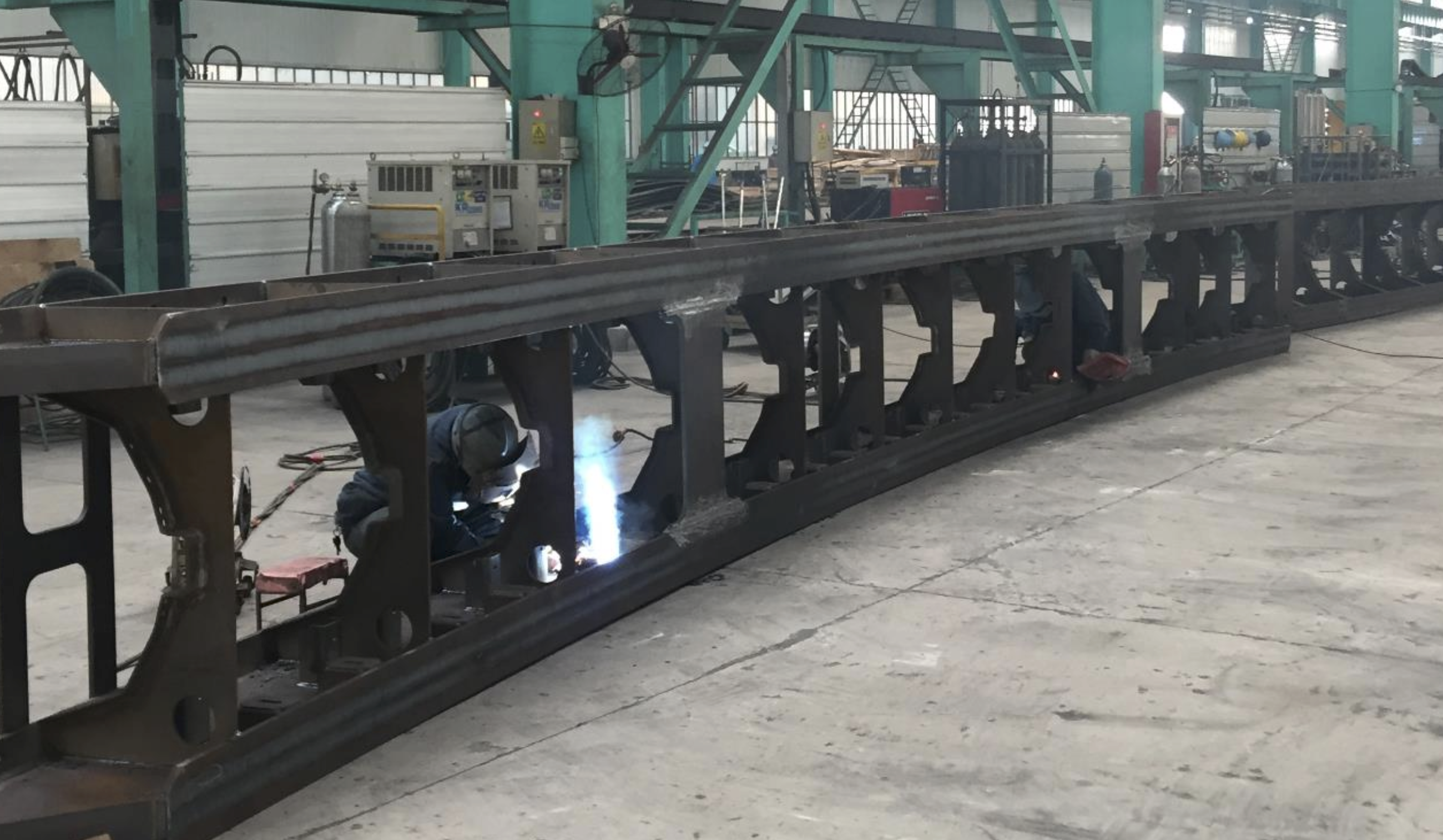
Why Factory Proof Became the Deciding Document in Heavy Fabrication
The economics are simple. A heavy weldment that fails incoming inspection cannot be returned like a catalogue item. It has already consumed the buyer's freight budget, lifting capacity and installation schedule. Rework at that point consumes the same welding hours, machining hours and crane time that were originally booked — and usually consumes them a second time.
Three shifts have pushed verification earlier in the sourcing cycle.
- Capacity is concentrated. Heavy fabrication depends on overhead cranes, long-bed press brakes, thick-plate rolling and gantry machining centres. A supplier that quotes a large fabricated frame without those assets is quoting a subcontract, not a capability.
- The manufacturer-versus-trader gap is now a documentation question. A metal fabricator can answer a request for factory photographs, workshop video and certificates with premises, equipment and process records. A trading intermediary cannot, or must arrange them from a third party.
- Most export buyers never visit the shop floor. In cross-border sourcing, verification happens through documents, images, video and third-party inspection rather than a site walk.
A practical rule is to sort every supplier claim into two groups: evidence that can be checked — premises, machine lists with rated capacity, certificates, inspection reports, packing and container-sealing photographs — and claims that cannot. Openex's structural answer to that question is that it manufactures rather than merely sources: the company states that 80–90% of the metal parts, components and assemblies it exports are produced in house, with the balance supplied by partner companies.
A Six-Layer Framework for Verifying a Metal Fabrication Supplier
Capability evidence is best reviewed as layers rather than as one pile of documents. Each layer answers a different question, and each has a boundary.
| Evidence layer | What the buyer requests | What it verifies | What it does not verify |
|---|---|---|---|
| 1. Facility and handling | Factory address and site photographs, workshop video, covered manufacturing area, overhead crane tonnage | That premises and heavy lifting capacity exist for large weldments | Current workload, or the quality discipline applied to a specific part |
| 2. Forming and cutting equipment | Machine list with rated capacity: laser cutting, press braking, plate rolling, punching and stamping | The size and thickness envelope a single part can reach | Whether the buyer's grade and thickness are run routinely |
| 3. Machining and assembly | CNC travel and gantry dimensions, machining centres, assembly bays | Whether post-weld machining stays in house instead of being subcontracted | The tolerance actually achievable on a specific drawing |
| 4. Process control and certification | Quality procedures, welding procedure specifications, NDT scope, applicable standards | That documented procedures exist and are applied consistently | That a particular welder or machine is qualified for a particular joint |
| 5. Material traceability | Steel mill certificates, incoming inspection records, in-house tensile test results, coating thickness measurements | That delivered plate matches the specified grade and mechanical properties | Consistency across future batches of the same order |
| 6. Finished product and transaction evidence | Photographs of comparable completed parts, inspection reports, packing and container sealing records, sample orders, first-article inspection | That comparable work has been produced and shipped | That the next order will repeat the same result |
The layers only work together. A photograph of a 250-ton crane verifies lifting capability, not weld quality. A certificate verifies that a management system exists, not that a specific joint is qualified. A finished-part reference verifies that comparable work has been done, not that the next order will repeat it. Buyers who treat each layer as a partial answer rather than a complete one tend to ask sharper follow-up questions — which is exactly what a documented supplier is positioned to answer.
Reading a Workshop View: What Large-Part Forming Evidence Shows
A workshop photograph is not decoration; it is a size statement. What matters is the overlap between the visible equipment and the drawing in hand.
Openex publishes capability data that sets the outer envelope of single-piece work: overhead crane capacity above 250 tons; press braking up to 18 m in length and 10,000 tons; plate rolling of thick plate over 200 mm; and CNC machine tool travel up to 50 m × 8 m × 7 m. The company also states laser cutting capability up to 40 mm plate thickness on a 20 kW source with an 8 m × 2.5 m bed, and describes a metal thickness range of 1 mm to 200 mm across its fabrication scope.
Two cautions apply. First, envelope numbers describe what is physically possible, not what is economical or routine: a workshop able to roll 200 mm plate is rarely the sensible choice for a 3 mm enclosure. Second, the equipment that matters is the equipment that will touch the buyer's part. A workshop view is most useful when matched against a defined process sequence — cutting, forming, fit-up and welding, post-weld machining, assembly, surface finishing, packing — rather than admired in general.
Welding, Post-Weld Machining and Assembly: The Sequence That Sets the Supplier Envelope
Heavy weldments follow a fixed sequence, and most of the risk sits in the middle of it. Distortion accumulates through welding; tolerance disappears unless the supplier can machine after welding rather than before.
This is why post-weld machining is one of the clearest dividing lines between a welding shop and a heavy fabrication manufacturer. Openex documents large CNC milling and drilling centres used after welding fabrication to hold precision, alongside a double-gantry five-axis machining centre and a turning-milling machining centre at the manufacturing premise near Shanghai Port. The premise near Xiamen Port is described as housing a large quantity of welding cells, which matters for repeat weldment volume rather than for a single prototype.
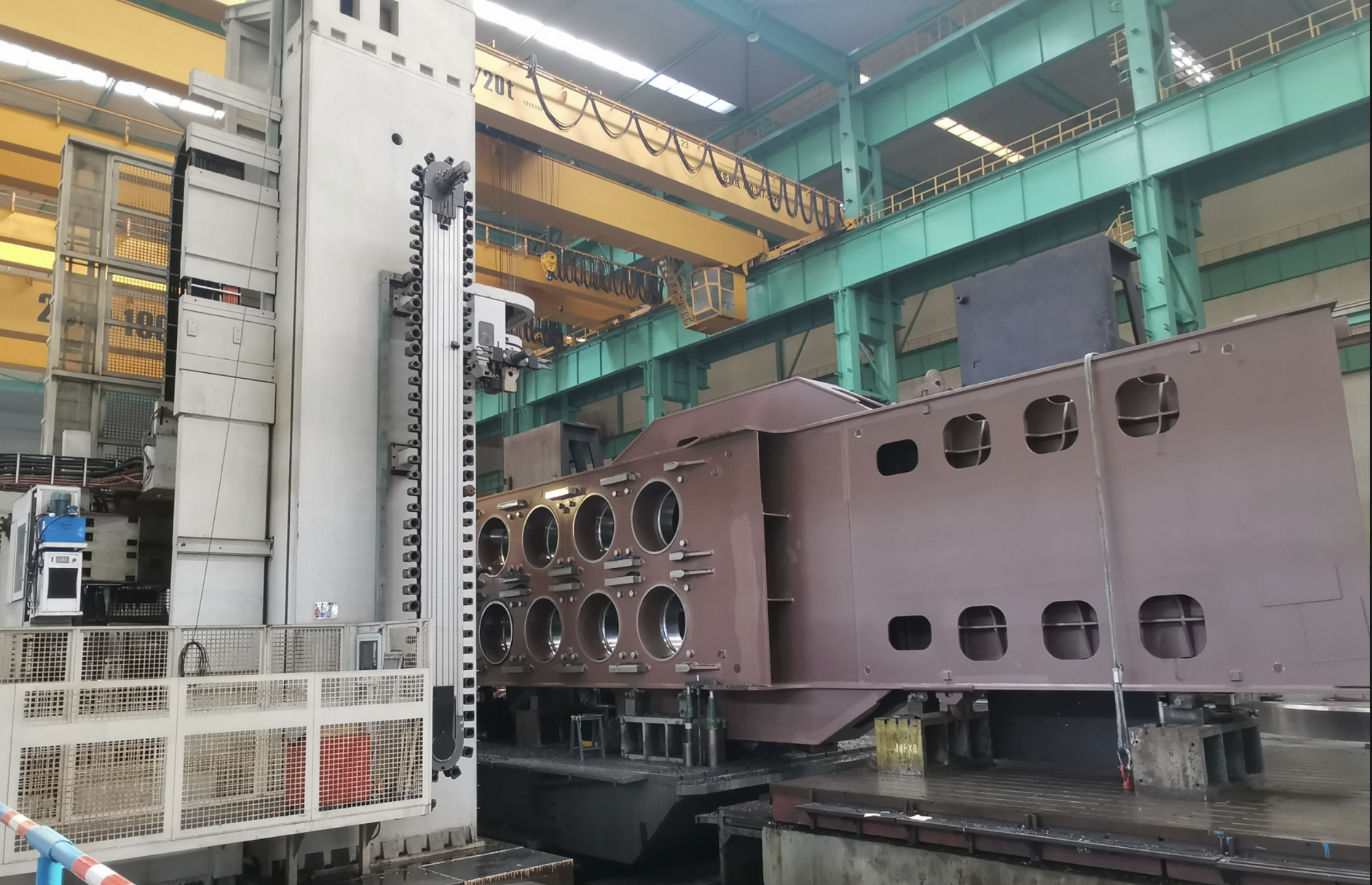
Materials set another boundary. The company states that it fabricates carbon steel grades including Q235B (A36, SS400, S235JR) and Q355B (A572 Gr50, SS490/SPCC, S355JR), with higher grades such as Q690 and wear-resistant NM450/NM500 also in use. Stainless steel work is concentrated in SUS304 and SUS316L, and other metals such as brass, bronze and aluminium are processed as well. Fabrication procedures listed for those materials include cutting, machining, welding, drilling, sand blasting and painting.
The part categories that most often drive this evaluation are rarely small: large welded machine frames and press frames, heavy equipment bases and steel skids, AGV steel chassis, and mineral-processing components such as multi-cylinder hydraulic cone crusher parts. In all of them, plate thickness, weld volume and post-weld machining define whether a given supplier can hold the drawing at all.
Product Evidence: What Finished Heavy Weldments Prove
The strongest evidence a fabricator can present is a part of comparable size, material and function that has already been built and shipped. Three documented examples show how specific that evidence can be.
Flywheel energy storage shell (AKI-1). The AKI-1 is a steel shell with a high-strength steel structure that meets vacuum sealing requirements, manufactured from high-strength steel plate conforming to S355JR or A572 Grade 50 per ASTM. Its structural configuration consists of a shell body and a top plate coupled together. Documented performance includes a vacuum level greater than 1.0 × 10⁻⁹ Torr L/s achieved within 30 seconds, and the shell receives a final inspection before delivery that includes a vacuum degree check to verify leakage against the required limit. For a buyer, this is evidence of three capabilities at once: heavy plate forming, welding to a leak-tight standard, and documented final testing.
AGV steel chassis (PSA-1). The PSA-1 AGV steel chassis is a high-strength composite steel structure equipped with NM400 wear-resistant plate, and its configuration includes side plates, web plates and fender plates. AGV chassis for container-yard applications have also been produced from high-strength Q690 steel with some parts in NM500. This is evidence of mixed-grade fabrication and wear protection — a different skill set from general structural steelwork.
Energy storage steel shelf and box (XHC-009). The XHC-009 energy storage steel shelf and steel box is specified at a net weight of 1,000 kg per unit, placing it in the mid-weight, repeatable-production class rather than the one-off heavy class. Repeating that unit weight depends as much on fixture design and process control as on raw capacity.
Beyond these examples, the company states that it has delivered pressure vessels, machine frames, steel chassis and steel structures to the USA, Canada, Japan, the UK, European countries and Australia, with customers drawn from energy storage systems, power plants, machinery, building, mining, oil and gas, and nuclear. Other documented work in the same class includes large tube sheet machining, turbine rings and a large distillation column.
The buyer's task is to match evidence to scope. A portfolio of thin-gauge enclosures says little about a weldment that needs a 250-ton crane to turn. Conversely, a large vacuum-tight shell says little about high-volume small-part production — which is why suppliers should be selected per part class rather than per catalogue.
Sample Orders, First-Article Inspection and Acceptance Criteria
Documents prove intent; a first order proves execution. This is where a sample order or first article earns its place, because it exposes drawing interpretation, tolerance achievement, documentation discipline and packing quality in a single cycle.
Openex's stated commercial terms are consistent with a project-based fabrication model. Minimum order quantity is project-based, with 10 tons cited for custom orders and 100 tons for long-term custom metal fabrication supply agreements. Standard trade terms include EXW, FOB, C&F, CIF, DAP and DDP, with FOB and CIF used as standard for long-term agreements; payment is by T/T — commonly 30% down and 70% before shipment — or by letter of credit.
Acceptance is offered in three forms, which is itself useful evidence of process confidence: (A) photographs, videos and QA sheets prepared by the supplier; (B) inspection by the buyer; or (C) inspection by a third party appointed by the buyer. Buyers who already work with an inspection provider can slot a heavy weldment into that arrangement without renegotiating supply terms.
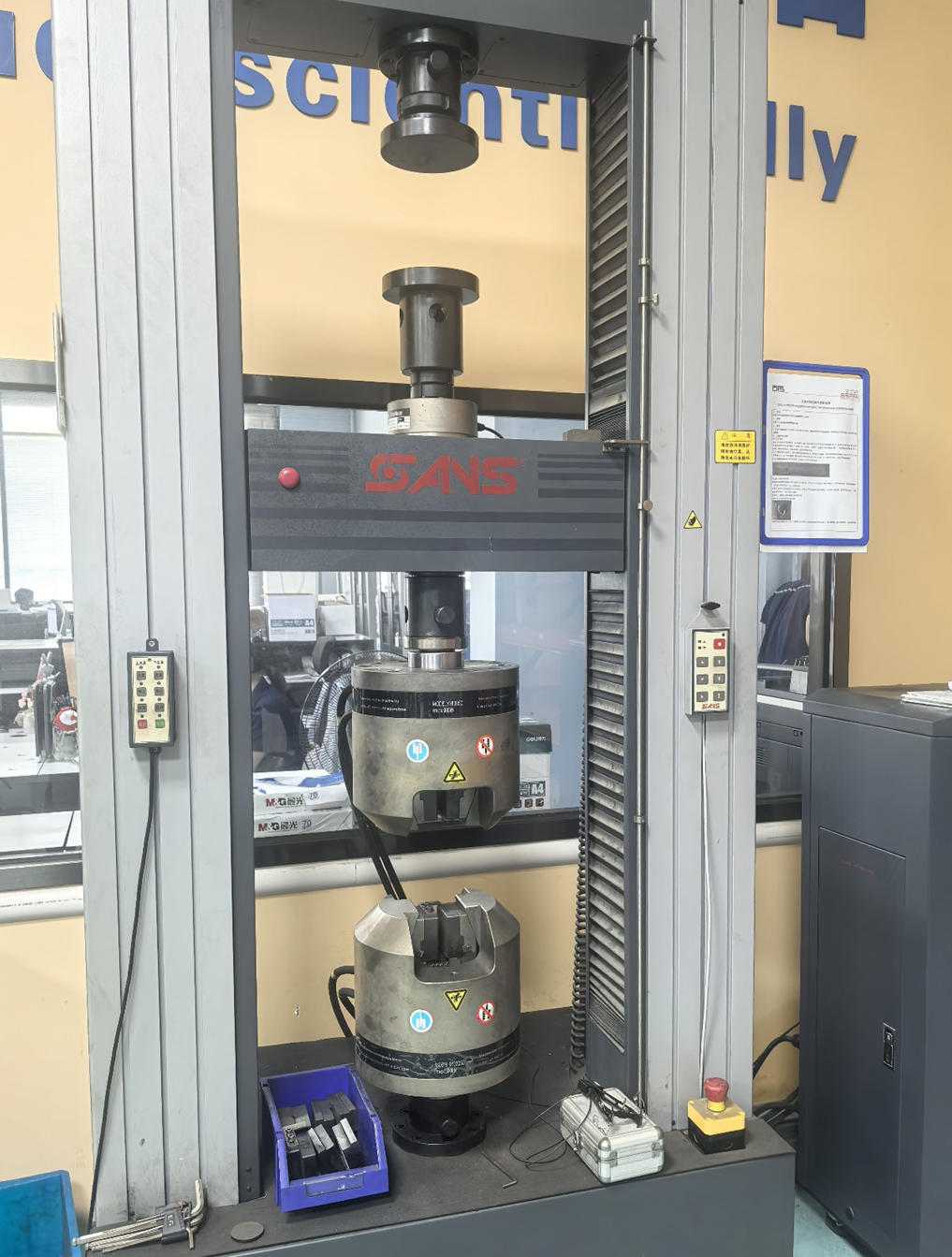
Behind the acceptance options sits a documented quality chain. The company reports quality management systems, first-article inspection, in-process control, final inspection and inspection reports as its controls for quality and delivery risk, with compliance risk managed through certificates and test reports. Material enters against steel mill certificates; mechanical properties are checked in house by tensile testing; galvanized parts are verified with a film thickness tester. For high-volume small parts, the company has developed visual inspection machines that check output at 100% instead of relying on human sampling — a detail worth noting for buyers whose scope combines a few large weldments with a large number of small components.
Drawing exchange is the last gate before execution. STEP, IGES, DWG, DXF, PDF and other 2D and 3D formats are accepted. 2D drawings alone are sufficient to quote simple parts, but the fastest quotations come from 2D and 3D drawings together — in some cases within an hour or two. Quoting from 3D files alone is rarely possible, because tolerance information, welding requirements, surface roughness and chamfer details, plate bending radius, material requirement, heat treatment and stress relief method, and finish requirements such as hot dip galvanizing, blasting, painting or powder coating are frequently absent from the model.
Comparison with Traditional Sourcing Models — and Where This Model Stops
Buyers typically compare four sourcing models, and each one can be verified very differently.
| Sourcing model | Evidence a buyer can verify | Where it works well | Where it breaks down |
|---|---|---|---|
| Trading intermediary | Catalogue photographs, price lists, references it controls | Standard, fully specified parts | No verifiable premises, welding or machining control; process problems surface after shipment |
| Thin-gauge sheet metal job shop | Panel-working equipment, sample parts | Enclosures, cabinets, boxes, light frames | Limited heavy-plate forming, lifting capacity and large machining |
| Local heavy fabricator | Site visits, local references, short freight distance | Regional projects with simple logistics | Capacity and cost structure are tuned to local batch sizes rather than export-scale heavy work |
| Fabrication and machining manufacturer with a partner network | Two premises, published equipment capacity, in-house cutting, bending, welding, machining and assembly, plus partner processes | Complex, heavy, multi-process work that needs forming, welding and post-weld machining in one chain | Specific limits apply — see below |
Those limits are worth stating plainly, because they determine fit.
- Not every process is in house. Casting, forging, hot dip galvanizing, powder coating and other anti-rust finishes are supplied by partner companies. A project whose scope is only casting, only forging, or only an anti-rust finish — with no fabrication or machining content — is not a good match for a fabrication-led supplier.
- Small parts in small quantities are uneconomic. Buyer and supplier spend comparable communication, travel and logistics effort regardless of order value, which is why the company's own guidance is that small-part, small-quantity orders are not recommended and are accepted only on a standby basis. The model rewards container-load quantities and repeated orders.
- 3D-only drawings cannot be quoted directly without first creating 2D drawings for the buyer's approval, which lengthens the quotation cycle.
- Finishing capacity is still developing. The company states that a powder coating shop for light structural parts is under consideration rather than already in place.
A supplier that states these boundaries is easier to plan around than one that accepts every enquiry.
What the Market Data Suggests About Verification Pressure
Independent market data supports the view that verification, rather than raw demand, is the binding constraint for buyers of heavy fabrication.
- The global market for fabricated metal products was valued at USD 2.35 trillion in 2024, covering products transformed from raw metals into finished or semi-finished components through cutting, bending, welding and machining (Strategic Market Research, Fabricated Metal Products Market Report 2024–2030).
- Steel fabrication is projected to grow at a compound annual growth rate of about 3.3% between 2025 and 2035 (Market Research Future). Estimates in this segment vary widely, and some research houses report materially higher growth, largely because the boundary between the fabrication service layer and primary steel supply is drawn differently from study to study.
- Steel accounted for 63.2% of material share in North American metal fabrication in 2024, while structural steel components represented 39.3% of application share — confirming that the heavy end of the market remains steel-dominated.
- Adoption of advanced process technology such as CNC cutting, robotic welding and laser equipment stood at 48% in 2024, which means a substantial share of the market still works without the process consistency those technologies provide. For buyers, that is an argument for asking machine-level questions rather than category-level ones.
- In the United States, fabricated metal product manufacturing employment stood at about 1,460.8 thousand in August 2024 (Bureau of Labor Statistics, NAICS 332), indicating a large, labour-intensive base in which capability documentation separates suppliers more reliably than scale alone.
The pattern is a mature market growing steadily rather than explosively. When demand growth is moderate, qualification speed — not price discovery — becomes the buyer's main lever, and documented capability is what makes that speed possible.
Outlook: Verification Moves Earlier in the Sourcing Cycle
Three developments are likely to shape how buyers qualify fabricators over the next few years.
Verification will move upstream. Instead of auditing suppliers after shortlisting, buyers will filter them beforehand using published capacity data, workshop video and product evidence — which is why documented capability has become a quality record and a commercial asset at the same time.
Evidence will become part-level rather than company-level. Weldment buyers increasingly want inspection reports, material traceability records and dimensional results attached to the shipment rather than retained at the factory. Standards such as ASME BPVC Section IX, which covers welding and brazing qualifications and is commonly required for pressure work, illustrate the direction: procedure and qualification records travel with the job.
Long-term agreements will carry more of the risk. With minimum quantities for long-term custom metal fabrication supply agreements set at the 100-ton level, the practical model for heavy weldments is a repeating supply arrangement in which material sourcing, fixture design and inspection routines are amortised across orders. For buyers, the real decision is not which fabricator can make one frame, but which one can make the same frame repeatedly, with the same documentation, across a multi-year programme.
Frequently Asked Questions
1. Is Openex a manufacturer or a supplier, and can it provide factory photos, workshop videos and certificates?
Openex is a metal fabricator rather than a trading intermediary, with two manufacturing premises, one near Xiamen Port and one near Shanghai Port. The company states that it manufactures 80–90% of the metal parts, components and assemblies it exports, with the remaining share sourced from partner companies. In-house procedures include laser cutting, bending, machining, welding, drilling, punching, stamping, assembling and packaging; casting, forging, hot dip galvanization, powder coating and other anti-rust finishes are provided by partners. Factory photographs, workshop video and certificates form part of the evidence package a buyer can request, and are supported by documented quality procedures and inspection reports.
2. What metal materials can be processed for a fabrication project?
Metal materials in general are workable, including brass, bronze and aluminium, but carbon steel and stainless steel are the most frequently specified. Within carbon steel, the common grade families are Q235B (A36, SS400, S235JR) and Q355B (A572 Gr50, SS490/SPCC, S355JR); grades such as Q690 and NM450/NM500 are also used. Within stainless steel, SUS304 and SUS316L are the most frequently requested. Where special casting or forging grades are required, long-term partners supply them — and a project requiring only casting or forging, without fabrication or machining content, is better placed with a supplier specialised in those processes.
3. What drawing formats are accepted?
STEP, IGES, DWG, DXF, PDF and other 2D and 3D formats are accepted. For simple parts, 2D drawings alone are usually sufficient to quote. Supplying 2D and 3D drawings together produces the fastest quotation, in some cases within one to two hours. Quoting from 3D drawings alone is possible only rarely, because tolerance information, welding requirements, surface roughness and chamfer details, the direction of cutting relative to hot rolling, plate bending radius, material specification, heat treatment and stress relief method, and finish requirements are often missing from a model alone.
4. Can samples be ordered first, and what is the minimum order quantity?
Minimum order quantity is project-based: 10 tons is cited for custom orders and 100 tons for long-term custom metal fabrication supply agreements. The commercial logic is that larger quantities reduce unit overhead, allow better material pricing and permit full container loading, which lowers freight cost compared with less-than-container-load shipments. Small parts in small quantities are not economical for either side, and the stated guidance is that such orders are accepted only on a standby basis; large components, or mid-size components in container-load quantities, fit the model better. Repeated ordering is the arrangement that best supports stable pricing and consistent quality.
5. What are the purchasing terms and acceptance criteria?
Minimum order quantity is project-based. Delivery terms available include EXW, FOB, C&F, CIF, DAP and DDP, with FOB and CIF used for long-term supply agreements. Payment is by T/T — commonly 30% down and 70% before shipment — or by letter of credit. Acceptance can follow one of three routes: (A) photographs, videos and QA sheets provided by the supplier; (B) inspection by the buyer; or (C) inspection by a third party appointed by the buyer.
Reference document: the Openex capability brochure, which includes workshop and equipment documentation, can be downloaded here — Openex capability brochure (PDF). Company website: www.cncmetalworking.com.