
Supplier Capability Evidence: How INB's Miniature Bearing Factory, Materials & Testing Stack Up Against Top Global Brands
Supplier Capability Evidence: How INB's Miniature Bearing Factory, Materials & Testing Stack Up Against Top Global Brands
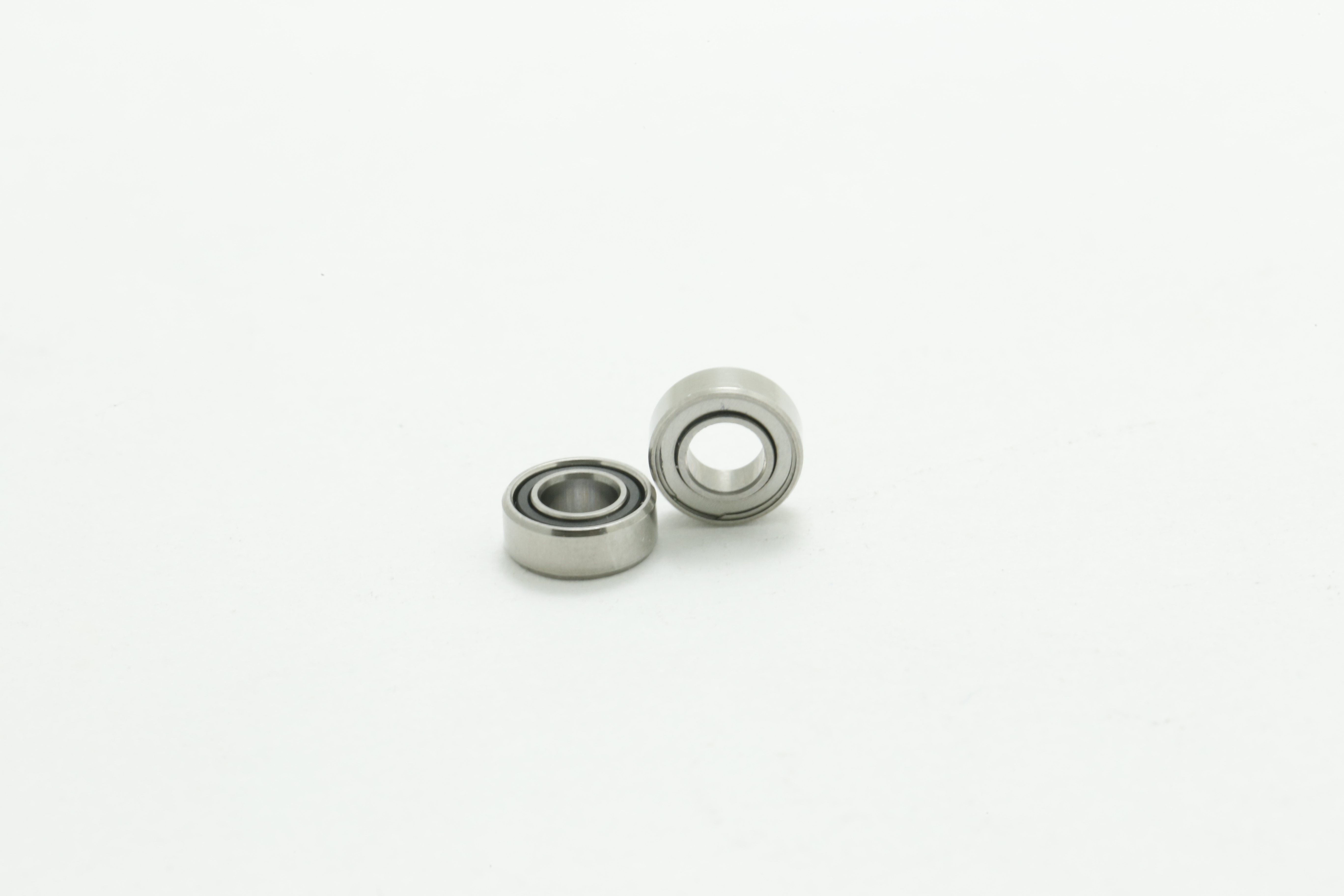
SMR144ZTLP4 W2.38 — a 3.175 × 6.35 × 2.38 mm P4 miniature bearing in SUS440 stainless steel, rated to a limiting speed of 350,000–400,000 rpm.
A miniature bearing specification sheet is a claim. A machining floor, a named material grade and a metrology bench are evidence. For buyers sourcing miniature bearings for dental handpieces, micro-motors and compact medical devices, the difference between the two decides whether a design survives volume production or fails at qualification.
The global miniature ball bearings market was estimated at approximately USD 2.25 billion in 2025, with medical devices and robotics among the demand drivers (Future Market Insights), while Asia Pacific accounted for roughly 60% of revenue (Precedence Research). Industry market research lists MinebeaMitsumi, NSK, SKF and Schaeffler among the global manufacturers active in this segment (Intel Market Research). Against that backdrop, INB — a miniature bearing brand established in 2014 by a Ningbo, Zhejiang-based bearing manufacturer — is best evaluated the way a procurement engineer evaluates any supplier: by factory, material, testing equipment and documented application data.
The evidence gap in miniature bearing sourcing
Datasheets across the miniature bearing category converge on the same fields: bore, outer diameter, width, precision class, limiting speed, operating temperature and material. Because the format is standardised, the numbers look comparable even when the evidence behind them is not.
The measurement side has the same property. Precision claims in this segment are written against recognised tolerance systems — ABMA ABEC classes 1 to 9, ISO 492 classes P0 to P2 and DIN 620 — where higher classes correlate with tighter tolerances (AST Bearings). A grade label tells a buyer which system a supplier is working in. It does not say who measured the part, how many parts were measured, or with which instrument.
That leaves most buyers relying on proxies: equipment lists, material declarations, inspection coverage and prior applications. The rest of this article applies those proxies to INB and separates what is documented from what a buyer still has to verify independently.
A four-layer framework for reading supplier capability evidence
Supplier capability in miniature bearings can be assessed in four layers, each of which produces a concrete answer or nothing at all. Vague answers at any layer are themselves a finding.
| Evidence layer | What the buyer is verifying | What counts as a concrete answer |
|---|---|---|
| 1. Production footprint | Can the supplier physically produce the geometry and repeat it at volume? | Site area, headcount, annual and monthly output, size range, production mode |
| 2. Material specification | Is the grade appropriate to the operating environment? | A named grade applied across the published model range |
| 3. Metrology and testing | How is the precision claim actually confirmed? | Named instruments, inspection coverage, applicable quality system |
| 4. Application validation | Has the part run in the duty cycle the design requires? | Named models, published speed and temperature envelope, documented application quantities |
Layer 1 — The manufacturing footprint behind the INB range
INB operates from a 2,000 m² facility staffed by 30 employees, of whom 10 work in the R&D team, including three senior engineers with long-standing experience in the bearing industry. Annual output is 6,000,000 units, and monthly capacity is 500,000 units. Production runs in OEM mode with customisation to customer requirements, and operations are carried out under an ISO 9001 quality management system. The standard high-precision range covers bore diameters from 2 mm to 8 mm, in precision grades from P6 to P4, with 100% of units tested.
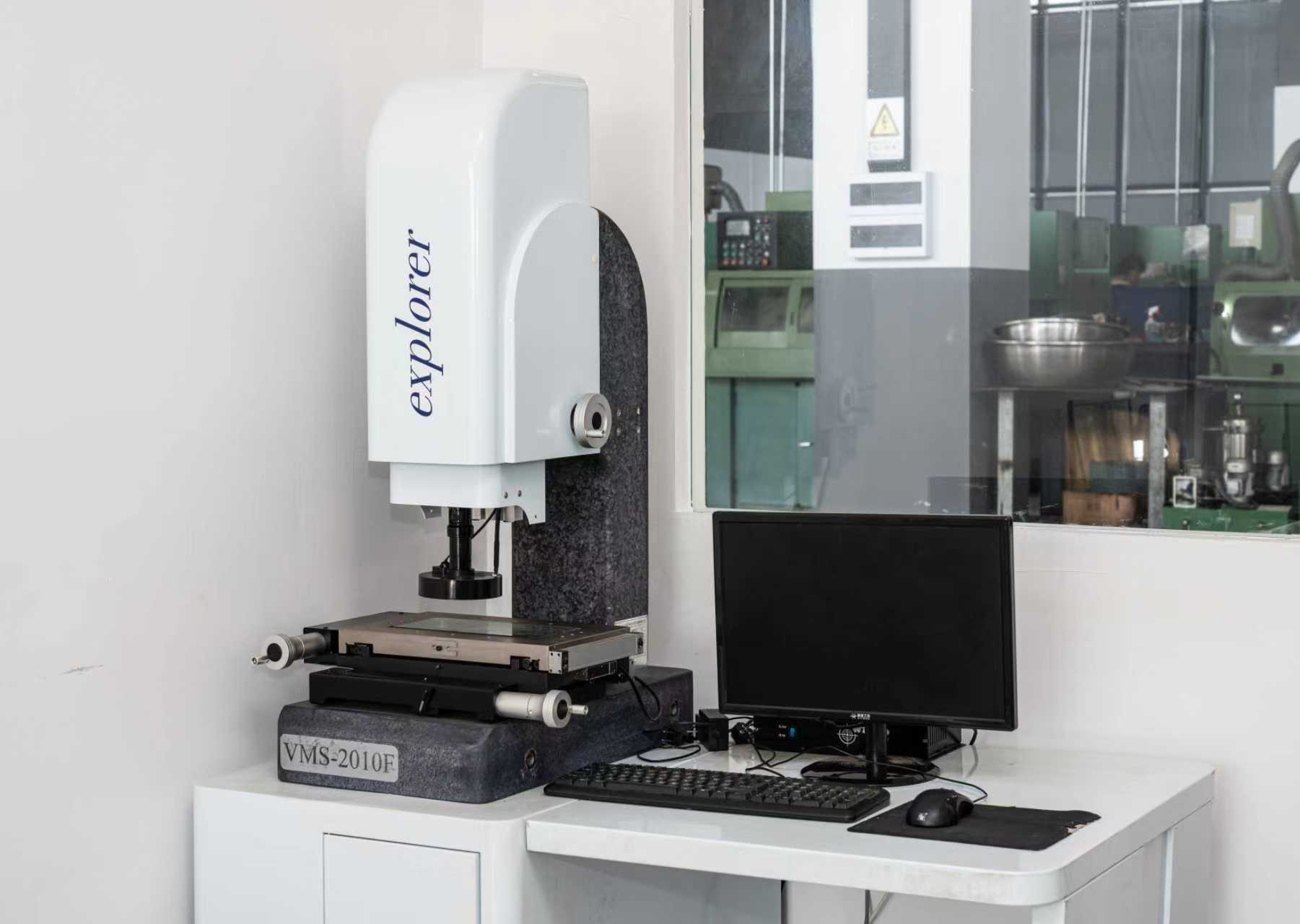
CNC bearing machining equipment on the manufacturer's miniature bearing production floor.
Commercially, the configuration is designed for buyers who need smaller volumes first. The minimum order quantity is 100 units, and lead time for in-stock items is 7 days. After-sales support is handled through return and exchange. The manufacturer's stated main market is China, with Russia among its export markets and exports representing 5% of output.
Read as evidence rather than as marketing, this layer says something specific: INB is a single-site, miniature-focused producer. A 2,000 m² plant with 30 employees is not a diversified bearing group, and that shapes both the strength (tight focus on a narrow bore range) and the constraint (limited parallel capacity and a narrow product envelope).
Layer 2 — Why SUS440 stainless steel is the material baseline
All four published INB miniature bearing models — SMR74TL, SR133TL, SR144ZTLP4 W2.78 and SMR144ZTLP4 W2.38 — are produced in SUS440 stainless steel. That aligns with broader category convention: stainless steel, specifically the 440C grade, is the primary material for miniature bearings used in medical and food-processing applications because of its resistance to moisture and chemicals (SKDIN Engineering Guide).
The material choice maps directly onto the described operating environment for these parts. INB documents the application as high-speed precision grinding, in a clean medical environment, with intermittent high-load operation. In a dental handpiece, that environment includes repeated handling and cleaning cycles between procedures, which is exactly the condition stainless grades are selected for.
What the grade name alone does not settle is batch-level consistency. A buyer qualifying a medical-device application still needs the material certificate for the specific production lot, and should confirm corrosion behaviour against the actual disinfection chemistry and cycle count used at the point of care. The material specification is a starting condition, not a completed validation.
Layer 3 — Testing and metrology: what INB can actually measure
INB states that it is equipped with a full set of professional testing instruments, including hardness testers, roundness meters, profilometers, roughness measuring equipment and microscopes, and that quality control is carried out as 100% testing under its ISO 9001 system.
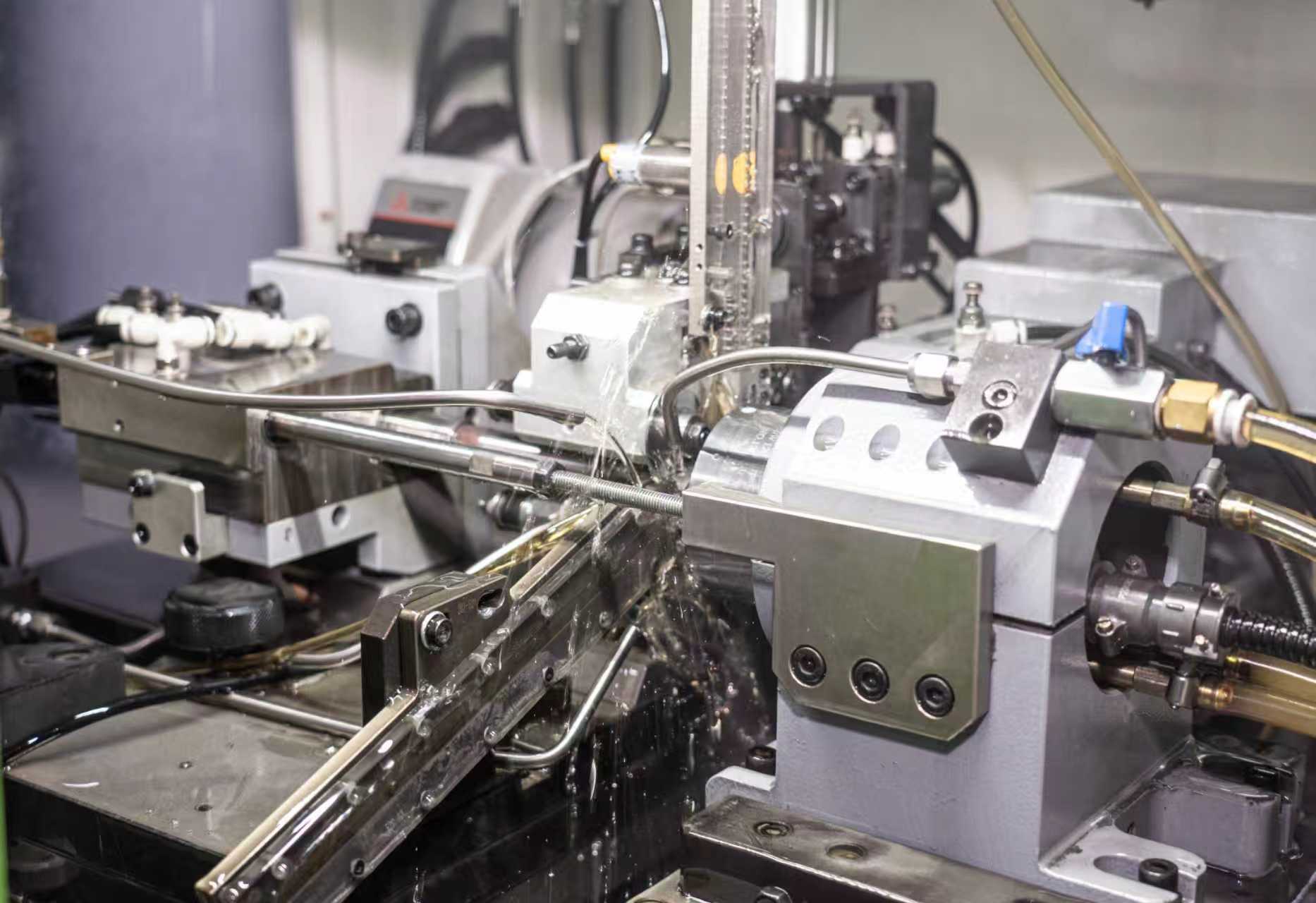
A precision bearing inspection workstation (VMS-2010F) in the manufacturer's facility.
Each instrument addresses a different failure mode, which is why the list matters more than any single item on it. Hardness testing speaks to the durability of raceways and rolling elements under load. Roundness measurement speaks to rotational accuracy and vibration behaviour. Surface roughness is one of the variables that determines running noise and the stability of the lubricant film. Profile and form measurement captures geometry deviations that a simple dimensional check will not reveal. Microscopy supports surface and defect inspection. Together they cover the dimensional, geometric and surface conditions that a P4 precision claim depends on.
On the standard side, INB publishes precision grades from P6 to P4. The P4 designation used on the models in the next section sits within the ISO 492 class system, alongside the ABMA ABEC and DIN 620 designations used internationally (AST Bearings). Buyers working to a specific standard should map the supplier's class to the tolerance table their own drawing references, rather than assuming equivalence.
Layer 4 — Product-level evidence: four miniature bearing models
The clearest capability evidence is model-level data, because it can be checked against a drawing. INB's published miniature bearing range includes the following four models, all in P4 precision and SUS440 stainless steel.
| Model | Size (mm) | Precision | Limiting speed | Operating temperature | Material |
|---|---|---|---|---|---|
| SMR144ZTLP4 W2.38 | 3.175 × 6.35 × 2.38 | P4 | 350,000–400,000 rpm | −50 °C to 160 °C | SUS440 |
| SR144ZTLP4 W2.78 | 3.175 × 6.35 × 2.78 | P4 | 350,000–400,000 rpm | −50 °C to 160 °C | SUS440 |
| SR133TL | 2.38 × 4.762 × 2.38 | P4 | 200,000 rpm | −40 °C to 150 °C | SUS440 |
| SMR74TL | 4 × 7 × 2 | P4 | 200,000 rpm | −40 °C to 150 °C | SUS440 |
The published data splits into two performance tiers. Two models are rated to a limiting speed of 350,000–400,000 rpm with an operating temperature range of −50 °C to 160 °C; the other two are rated at 200,000 rpm and −40 °C to 150 °C. All four carry the same P4 class and the same material grade, which makes model selection a question of speed envelope and envelope width rather than a question of quality tier.
One detail that matters to buyers replacing parts in imperial-design instruments: the bore and outside diameters fall on standard imperial dimensions. The 3.175 mm bore corresponds to 1/8 in, the 6.35 mm outside diameter to 1/4 in, and the 4.762 mm outside diameter to 3/16 in, with 2.38 mm nominally 3/32 in. Buyers matching a retrofit or replacement specification should confirm these conversions against the original drawing.
Application fit: the duty cycle the data actually describes
INB documents its dental handpiece application as an intermittent high-speed mode, operating under high-speed precision grinding in a clean medical environment with intermittent high-load operation. The matched equipment for this scenario is the dental handpiece, and the stated special requirements are P4 precision, ultra-high speed in the 350,000–400,000 rpm range, a wide temperature envelope of −50 °C to 160 °C, medical-grade hygiene and low noise.
Each of those requirements maps back to a specific model. Ultra-high speed is covered by SMR144ZTLP4 W2.38 and SR144ZTLP4 W2.78 at 350,000–400,000 rpm. Medical-grade hygiene and moisture exposure are addressed by the SUS440 material. Low noise depends on the geometric and surface control that the roundness, roughness and profile instruments are used to verify.
Documented application experience supports the scenario. A medical device client in China purchased 80,000 units for use in dental handpieces; across a 500-hour duration, the reported result was stable high-speed operation with extended equipment lifespan. The manufacturer also states that its products mainly serve the domestic medical device industry and micro-motors, which places the miniature bearing range in a broader precision-drive context than dental handpieces alone.
One reading of the duty description deserves emphasis for design engineers: the documented mode is intermittent high-speed operation, not continuous duty. Continuous-drive designs should validate the bearing under their own thermal and load profile rather than extrapolating from the intermittent rating.
Benchmarking INB against global miniature bearing brands
The manufactures most frequently listed in this segment — MinebeaMitsumi, NSK, SKF and Schaeffler (Intel Market Research) — are diversified bearing groups with portfolios spanning many bearing types, industries and sizes. INB occupies a different position: a single-site, miniature-focused producer with a published bore range of 2 mm to 8 mm and precision grades from P6 to P4. A useful comparison therefore runs on evidence structure rather than on performance claims.
| Evaluation dimension | What to verify with any supplier | INB — documented position |
|---|---|---|
| Product scope | Published size range and bearing types | Miniature bearings, bore 2 mm to 8 mm |
| Precision classes | Declared class and the standard it references | P6 to P4 |
| Material | Named grade and fit with the operating environment | SUS440 across all four published models |
| High-speed capability | Model-level limiting speed, not a range-level claim | 200,000 rpm and 350,000–400,000 rpm, by model |
| Testing equipment | Instrument list and inspection coverage | Hardness testers, roundness meters, profilometers, roughness equipment, microscopes; 100% test under ISO 9001 |
| Manufacturing footprint | Site, headcount and capacity | 2,000 m², 30 employees, 6,000,000 units per year, 500,000 units per month |
| Commercial terms | MOQ, lead time and customisation route | OEM production, MOQ 100 units, 7-day lead time on in-stock items |
| Market coverage | Where the supplier already ships and supports | Main market China; export ratio 5%; Russia among export markets |
Two conclusions follow, and one important non-conclusion. First, on the dimensions a procurement engineer can verify from documents — size range, class, material, instrument list, capacity and commercial terms — INB publishes specific, checkable values rather than category-level statements. Second, on the dimensions where a global group is conventionally strong — multi-industry portfolio breadth, geographically distributed manufacturing and service networks — INB's documented footprint is narrower by design.
The non-conclusion is that this article does not publish a performance comparison between INB and MinebeaMitsumi, NSK, SKF or Schaeffler. No head-to-head test data is available here, and speculating on comparative performance would be unreliable. The peer names are useful as benchmarks for setting requirements and for building a like-for-like verification checklist; they are not verified performance results.
Where INB's evidence base stops
A capability assessment is only useful if it states its own boundaries. Based on the documented facts, the following constraints apply.
- Bore range limited to 2 mm to 8 mm. Applications requiring smaller or larger bearing envelopes fall outside the published standard range.
- Precision classes from P6 to P4 only. Designs that specify finer classes than P4 are outside the current published grade range.
- Single-site production. A 2,000 m² facility with 30 employees concentrates manufacturing in one location, with a stated monthly capacity of 500,000 units and annual output of 6,000,000 units.
- Limited international footprint. With a main market of China, an export ratio of 5% and Russia among export markets, buyers in other regions should confirm logistics and support arrangements directly rather than assuming a global service network.
- Commercial terms apply to defined conditions. The MOQ of 100 units and the 7-day lead time are tied to OEM production and in-stock items; customised or non-stock configurations will follow a different timeline.
- Duty-cycle scope. The documented operating mode for the dental handpiece application is intermittent high-speed operation with intermittent high-load cycles, not continuous duty.
- Small engineering team. A 10-person R&D team including three senior engineers supports focused miniature bearing work, but is not a large multi-discipline engineering organisation.
Market trend: why capability evidence is becoming the deciding factor
Several documented trends push miniature bearing sourcing toward evidence-based evaluation. Demand growth is concentrated in applications where failure is expensive: the miniature ball bearings market is being driven by medical devices and robotics (Future Market Insights), and the automotive segment held the largest application share in 2025 at approximately 39%, supported by electric-vehicle motor and sensor applications (Precedence Research). Those are qualification-heavy environments where a supplier's inability to document its process is a commercial risk, not just a paperwork gap.
Supply is concentrated in the same region that drives demand. Asia Pacific accounted for roughly 60% of miniature ball bearing revenue in 2025, with China the largest regional producer and consumer (Precedence Research), and China's bearing exports grew 7.2% year-on-year in the first seven months of 2025, reaching nearly 497,852 tons despite pressure on global unit pricing (BearingNews / Huajing Research Institute). More suppliers, in other words, does not automatically mean more verifiable suppliers.
One caution for buyers building market assumptions on published figures: estimates of the global miniature ball bearing market diverge meaningfully between research firms, with values ranging from approximately USD 2.0 billion to USD 2.89 billion for the same period. Any business case should treat market-size figures as a range rather than a fixed number.
Future outlook
The direction of travel in this category is toward document-level qualification. Buyers are increasingly asking for the instrument list, the material grade and the model-level speed and temperature envelope before they ask for price, because those three items determine whether a design can be signed off at all. Suppliers that publish them become easier to shortlist; suppliers that only publish a general capability statement become harder to defend internally.
Within that shift, a focused miniature producer like INB is positioned around a defined envelope: bores of 2 mm to 8 mm, P6 to P4, SUS440, model-level limiting speeds of 200,000 rpm and 350,000–400,000 rpm, and a documented dental handpiece application with intermittent high-speed duty. Whether that envelope is sufficient depends entirely on the buyer's drawing, duty cycle and volume plan — which is precisely the point of evaluating capability evidence before evaluating price.
INB's published miniature bearing specifications, including the models referenced in this article, are available at www.lnb-brg.com.
FAQ
What material are INB miniature bearings made from?
All four published INB miniature bearing models — SMR144ZTLP4 W2.38, SR144ZTLP4 W2.78, SR133TL and SMR74TL — are produced in SUS440 stainless steel. This follows the wider category convention in which 440C-grade stainless steel is the primary material for miniature bearings in medical and food-processing applications, selected for resistance to moisture and chemicals (SKDIN Engineering Guide).
How does INB verify P4 precision?
INB states that quality control is carried out as 100% testing under an ISO 9001 quality management system, using a set of professional instruments that includes hardness testers, roundness meters, profilometers, roughness measuring equipment and microscopes. The P4 class used on these models sits within the ISO 492 tolerance class system, alongside ABMA ABEC and DIN 620 designations used internationally (AST Bearings). Buyers should map P4 to the tolerance table referenced on their own drawing.
Which INB bearing is specified for a dental handpiece running at 350,000–400,000 rpm?
Two models cover that speed envelope: SMR144ZTLP4 W2.38 (3.175 × 6.35 × 2.38 mm) and SR144ZTLP4 W2.78 (3.175 × 6.35 × 2.78 mm). Both are P4, SUS440, rated to a limiting speed of 350,000–400,000 rpm and an operating temperature range of −50 °C to 160 °C. The difference between them is width: 2.38 mm versus 2.78 mm.
Which models fit a 200,000 rpm application?
SMR74TL and SR133TL are rated to a limiting speed of 200,000 rpm and an operating temperature range of −40 °C to 150 °C, both in P4 and SUS440. SMR74TL measures 4 × 7 × 2 mm; SR133TL measures 2.38 × 4.762 × 2.38 mm. The speed tier, not the precision grade, distinguishes them from the 350,000–400,000 rpm models.
Are INB miniature bearings used outside dental handpieces?
The manufacturer states that its products mainly serve the domestic medical device industry and micro-motors. The documented application scenario is dental handpiece bearings, described as interrupting high-speed operation in a clean medical environment with intermittent high-load cycles, and supported by a recorded delivery of 80,000 units to a medical device client in China with a 500-hour duration. For applications outside that duty cycle, buyers should validate the bearing against their own thermal and load profile.
What are the minimum order quantity, lead time and production capacity?
INB operates in OEM production mode with customisation to customer requirements, with a minimum order quantity of 100 units and a lead time of 7 days for in-stock items. Monthly capacity is 500,000 units and annual output is 6,000,000 units. After-sales support is handled through return and exchange.
What can a buyer not conclude from the published data?
Three things are outside the documented record. First, there is no head-to-head test data comparing INB bearings with MinebeaMitsumi, NSK, SKF or Schaeffler, so no performance ranking can be drawn. Second, the published standard range covers bores of 2 mm to 8 mm and precision grades from P6 to P4, so finer classes and other envelope sizes are not covered. Third, the documented duty mode is intermittent high-speed operation, so continuous-duty applications require separate validation.
The practical summary is straightforward: miniature bearing suppliers can be compared on four layers of evidence — production footprint, material, testing stack and application validation — and INB publishes specific, checkable values at each layer, within a clearly bounded envelope.