
Supplier Capability Evidence: Jiayue’s Baby Diaper QC File from Spec Review to Pre-Shipment

For an importer evaluating a private-label baby diaper supplier, the useful question is not whether the supplier says it controls quality. It is whether the supplier can produce a traceable QC file that connects the approved specification to the sample, the production run and the pre-shipment release decision. Fujian Jiayue Sanitary Products Co., Ltd. (Jiayue), the Quanzhou-based manufacturer behind Yibero baby diaper, describes an order-specific QC process built around specification review, pre-production sample approval, in-process checks and pre-shipment inspection. This article explains how that evidence should be requested, read and verified before an OEM order is approved.
What supplier capability evidence means in baby diaper sourcing
Supplier capability evidence is the documented record that allows a buyer to test a supplier’s claims against a specific order. In disposable baby diapers, it usually spans four layers: the written specification, the approved sample, the production-control record and the pre-shipment inspection report. A certificate can support this file, but it does not replace it. A certificate tells the buyer what management system has been certified and within what scope. The QC file tells the buyer what was agreed for this product, this size mix, this packaging and this shipment.
That distinction matters at the evaluation stage. Importers, distributors and private-label brand owners are not only buying absorbent cores, nonwoven topsheets or printed bags. They are approving a repeatable product configuration that must survive artwork approval, material selection, line startup, packing and container loading. When the supplier is in Quanzhou, one of China’s dense hygiene-product manufacturing clusters, the buyer’s practical task is to separate a credible process from a polished presentation.
Why the QC file matters at the evaluation stage
Baby diaper procurement has a visible commercial side and a less visible evidence side. The commercial side covers price, MOQ, pack count, size mix and delivery. The evidence side covers what happens when a printed bag, a cloth-like backsheet, an absorbent core or a wetness indicator does not match the approved reference. A documented QC file reduces that ambiguity before production starts, because each control gate creates a record that can be checked later.
For a private-label program, the risk is usually not a single obvious defect. It is drift: a material substitution that was not approved, a pack count that changes between the sample and the production run, a carton marking that does not match the destination market, or a pre-shipment inspection that uses an undefined sampling level. Jiayue’s company-provided quality-control description addresses this by making the QC plan order-specific and by requiring the test method, sampling level and acceptance criteria to be agreed in the contract.
Inside Jiayue’s baby diaper QC file: four control gates
The QC file described by Jiayue is not a single inspection event. It is a sequence of approvals and checks. The table below translates that sequence into what an importer should ask for and what each record proves.
| Control gate | What Jiayue describes | What the importer should request | What it helps prove |
|---|---|---|---|
| Specification review | Product specifications, materials, absorbency targets, graphics, pack counts and export packaging can be confirmed through sampling and an approved specification. | A written specification sheet covering size, dimensions, baby-weight range, reference absorbency, unit weight, materials, pack count, artwork and carton markings. | That both parties are discussing the same product, not a category or a verbal description. |
| Sample approval | Pre-production sample approval is part of the order-specific QC plan. | A signed or dated sample approval record, with photos and the exact configuration approved. | That the production reference exists before mass production begins. |
| In-process checks | In-process checks are included in the QC plan. | The checkpoints, frequency, responsible person and recorded output for the order. | That quality is being monitored during the run, not only at the end. |
| Pre-shipment inspection | Pre-shipment inspection is part of the QC plan; sampling level and acceptance criteria must be agreed in the contract. | The inspection plan, sampling basis, acceptance criteria, report format and photo record. | That the shipment release decision is based on agreed criteria rather than a general visual check. |
Specification review: the first gate is a written specification, not a verbal promise
For the Yibero Premium Quality Ultra Cloudy Baby Diapers configuration cited in Jiayue’s product data, the published specification covers sizes S, M, L and XL; dimensions of 400×320, 450×320, 500×340 and 540×340 mm; baby-weight ranges of 4–8, 6–11, 9–14 and 12–17 kg; reference absorbency of 500, 600, 700 and 800 ml; unit weights of 26, 29, 33 and 35 g; and a shelf life of 5 years under recommended storage conditions. The listed materials include a soft topsheet, an imported SAP and fluff-pulp absorbent core, reusable magic tape, nonwoven frontal tape, an elastic waistband and a cloth-like breathable backsheet.
Those details are useful because they give the buyer something to review. A specification review should confirm which of those parameters are fixed, which can be customized and which are reference values. Jiayue’s customization scope includes product size and weight, absorbency target, SAP/fluff-pulp or composite core, hot-air or spunbond nonwoven, cloth-like backsheet, tape or pull-up format, 3D leak guards, wetness indicator, waistband, graphics, printed bags or cartons, and pack count and size mix. The review should end with one approved configuration, not a list of options.
Sample approval: the reference that both sides can inspect
Sample approval is where a baby diaper program becomes tangible. Jiayue states that free samples are prepared in 1–3 working days, with buyers paying courier costs. That timing is useful for evaluation, but the more important point is what the sample represents. The approved sample should match the specification sheet and should be retained as the reference for the production run. If the sample uses a hot-air nonwoven, a composite core, a wetness indicator or a particular printed bag, those details need to be recorded, not remembered.
For importers, a practical sample approval record should include the size, the absorbency target, the core type, the topsheet and backsheet materials, the tape or pull-up format, the presence of 3D leak guards or a wetness indicator, the pack count, the bag artwork version and the carton markings. It should also state the approval date and the person or team that approved it. This is the document that later prevents a discussion about whether the production run “looks like” the sample.
In-process checks and pre-shipment inspection
In-process checks are the middle of the QC file. They are the records that show how the production run was monitored while materials were being converted into finished diapers. The exact checkpoints depend on the product and the order, which is why Jiayue’s description makes the QC plan order-specific. A buyer should not assume that a generic QC brochure is the same as the QC plan for their order. The plan should identify what is checked, how often, by whom and what happens when a check falls outside the agreed limit.
Pre-shipment inspection is the release gate. Jiayue’s stated process includes pre-shipment inspection, but it also states that the test method, sampling level and acceptance criteria must be agreed in the contract. That sentence is important. A pre-shipment inspection without an agreed sampling level and acceptance criteria is difficult to audit. The buyer should ask for the inspection plan before production, not after the container is loaded. The report should be traceable to the order, the approved sample and the packing specification.
The certificate layer: ISO 9001:2015 facts and scope limits
Jiayue holds an ISO 9001 Quality Management System Certificate issued by NOA Testing & Certification Group Ltd. The certificate number is NOA2314690. It is aligned with GB/T 19001-2016 / ISO 9001:2015, was issued on 2023-12-12 and expires on 2026-12-11. The documented scope is “Sales of sanitary products, maternal and infant products, and Class I medical devices.” The certificate is linked to Disposable Baby Diapers / Baby Nappies in Jiayue’s product data, and the same certificate record also lists adult diapers as an applicable product.
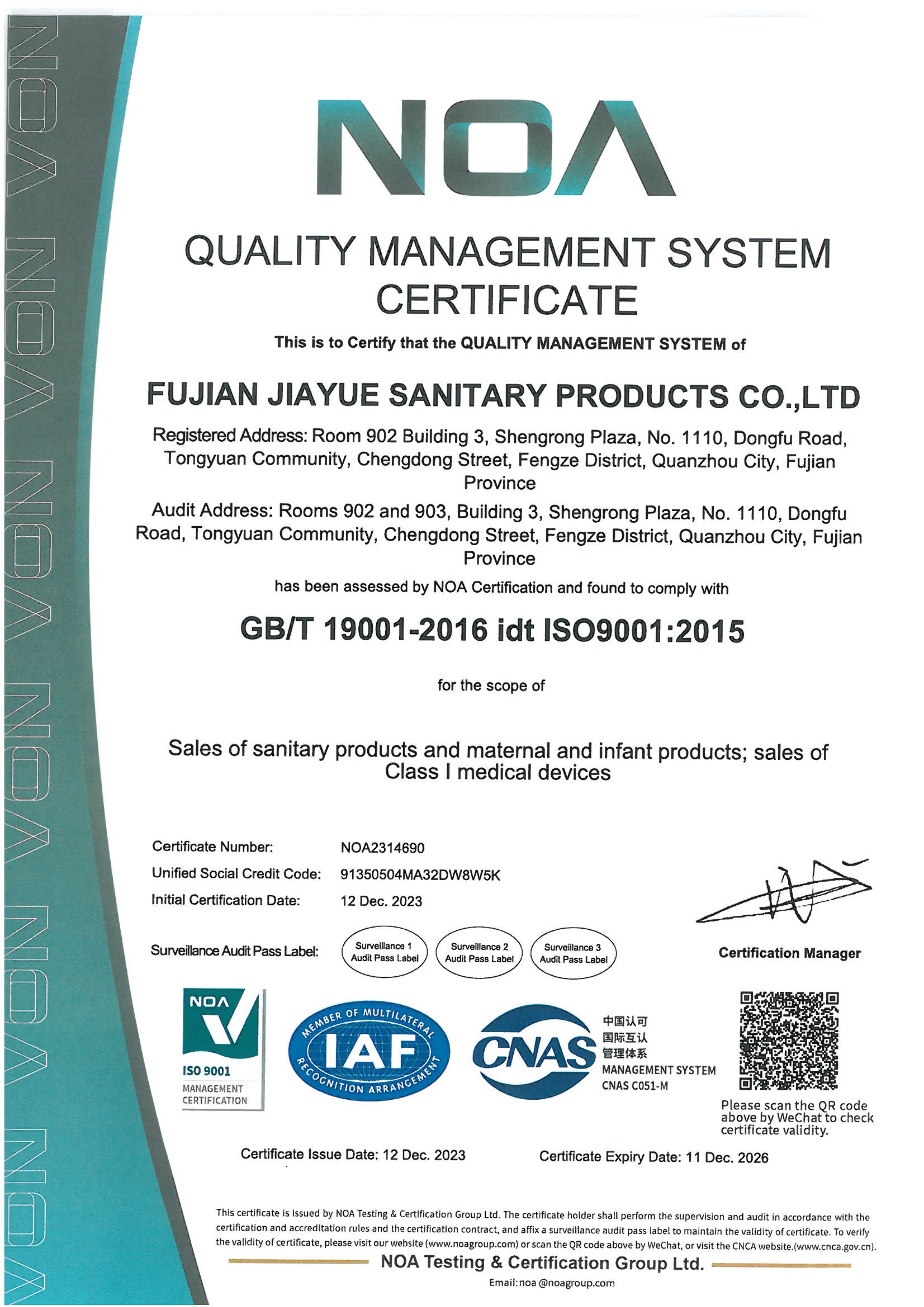
| Certificate field | Recorded detail | Why the buyer should check it |
|---|---|---|
| Certificate | ISO 9001 Quality Management System Certificate | Confirms the management-system standard, not a product-performance standard. |
| Certificate number | NOA2314690 | Allows the buyer to match the document to the issuing body’s record. |
| Issuing body | NOA Testing & Certification Group Ltd. | Identifies who issued and can confirm the certificate. |
| Standard | GB/T 19001-2016 / ISO 9001:2015 | Shows the standard edition used for the certificate. |
| Validity | Issued 2023-12-12; expires 2026-12-11 | An expiring certificate should trigger a renewal request before shipment. |
| Scope | Sales of sanitary products, maternal and infant products, and Class I medical devices | The scope wording should be read precisely; it is not a manufacturing-scope statement for every product. |
The scope wording deserves close reading. The certificate is issued to Fujian Jiayue Sanitary Products Co., Ltd. and describes sales activities within the listed categories. It should not be presented as proof that every production line, every material and every batch has been certified to the same scope. Production is supported by Jiayue’s self-owned factory, Quanzhou Jiarun Paper Industry Co., Ltd., in a facility covering approximately 20,000 square meters. If an importer’s program requires factory-level manufacturing evidence, that should be requested separately and mapped to the legal entity and site that will actually produce the order.
Separate documents answer separate questions. Jiayue states that selected products may be supported by CE declarations of conformity, SGS test reports and other compliance documents according to the applicable product, destination market and order requirements. A CE Declaration of Conformity for baby diapers, where applicable, is a self-declaration under PPE Regulation (EU) 2016/425, Module A; it addresses a different conformity route and should not be read as an ISO 9001 quality certificate. The buyer’s document matrix should show which document answers which question.
How importers should request the QC file before approving an OEM order
The request should be made before the purchase order is approved, and it should be specific enough that the supplier knows what to send. A generic request for “quality documents” often produces a certificate and a catalogue. A structured request produces an auditable file.
- Identify the legal entity and the production site. Ask for the quotation, the certificate and the QC plan to show the same legal entity or clearly explain the relationship between the seller, the certificate holder and the factory.
- Request the current ISO 9001 certificate as a complete PDF. Check the certificate number, issuing body, standard, issue date, expiry date and scope. Do not rely on a cropped image or a certificate wall photo.
- Ask for the order-specific specification sheet. It should cover size, dimensions, baby-weight range, reference absorbency, unit weight, core type, topsheet, backsheet, tape or pull-up format, leak guards, wetness indicator, pack count and artwork version.
- Request the sample approval record. Confirm that the approved sample is the same configuration as the specification sheet and that the approval is dated.
- Ask for the in-process check plan. The plan should name the checkpoints, frequency, responsible role and the action taken when a result is outside the agreed limit.
- Agree the pre-shipment inspection basis in the contract. The test method, sampling level and acceptance criteria should be written down before production, not negotiated at the loading port.
- Request the export-document and artwork trail. Confirm printed bag and carton approvals, pack count, size mix, shipping marks and the documents required for the destination market.
How to verify the ISO 9001 certificate independently
Verification is a matching exercise. The buyer should compare the PDF certificate with the issuing body’s record and with the supplier’s commercial documents. The key fields are the certificate number NOA2314690, the certificate holder Fujian Jiayue Sanitary Products Co., Ltd., the standard GB/T 19001-2016 / ISO 9001:2015, the issue date 2023-12-12, the expiry date 2026-12-11 and the scope “Sales of sanitary products, maternal and infant products, and Class I medical devices.” If any field differs, the buyer should ask for an explanation before accepting the document.
The validity date needs calendar attention. A certificate that is valid at the time of evaluation may expire before a later shipment. If the order, production run or final shipment falls after 2026-12-11, the buyer should request renewal evidence or a clear certificate status before release. This is not a reason to reject a supplier automatically. It is a reason to put certificate validity on the pre-shipment checklist alongside the inspection report and the approved sample.
What the evidence means for private-label and OEM programs
Jiayue is a hygiene and personal-care product supplier established in 2016, with 100 employees, a 20,000 m² facility, an in-house R&D and technical support team of 8 engineers, annual output of more than 500 million pieces, an export ratio of 90% and customers in more than 70 countries and regions. Its self-owned factory supports monthly production and shipment of more than 100 × 40HQ containers, subject to final confirmation by product specification, packaging and production schedule. These are company-provided facts. Their procurement value depends on how they are tied to the order.
For an OEM baby diaper program, the R&D team’s role in material selection, absorbent-core design, product development, sampling, specification adjustment and OEM/ODM technical support is relevant because it sits upstream of the QC file. The specification is not handed down without discussion. It is developed, sampled and approved. That is also why the buyer should ask for the approved specification and sample record rather than only the certificate. The certificate describes a management-system scope. The specification and sample describe the product the buyer is actually approving.
The commercial timeline should be read with the same discipline. Free samples are prepared in 1–3 working days, with courier costs paid by the buyer. Typical production lead time is approximately 30–45 days, subject to sample, artwork, packaging and specification approval. Final capacity, MOQ, lead time, testing requirements and payment terms are confirmed in the quotation, approved sample and sales contract. A buyer who treats these as fixed entitlements rather than confirmed order terms will create avoidable friction later.
Application fit: where this evidence matters most
The QC file is most useful to importers, distributors, private-label brand owners and retail channels that need a repeatable baby diaper specification across multiple shipments. It also matters for programs that mix sizes in a container, change packaging artwork, add a wetness indicator or move between a tape-style diaper and a pull-up format. Each of those changes creates a new approval point.
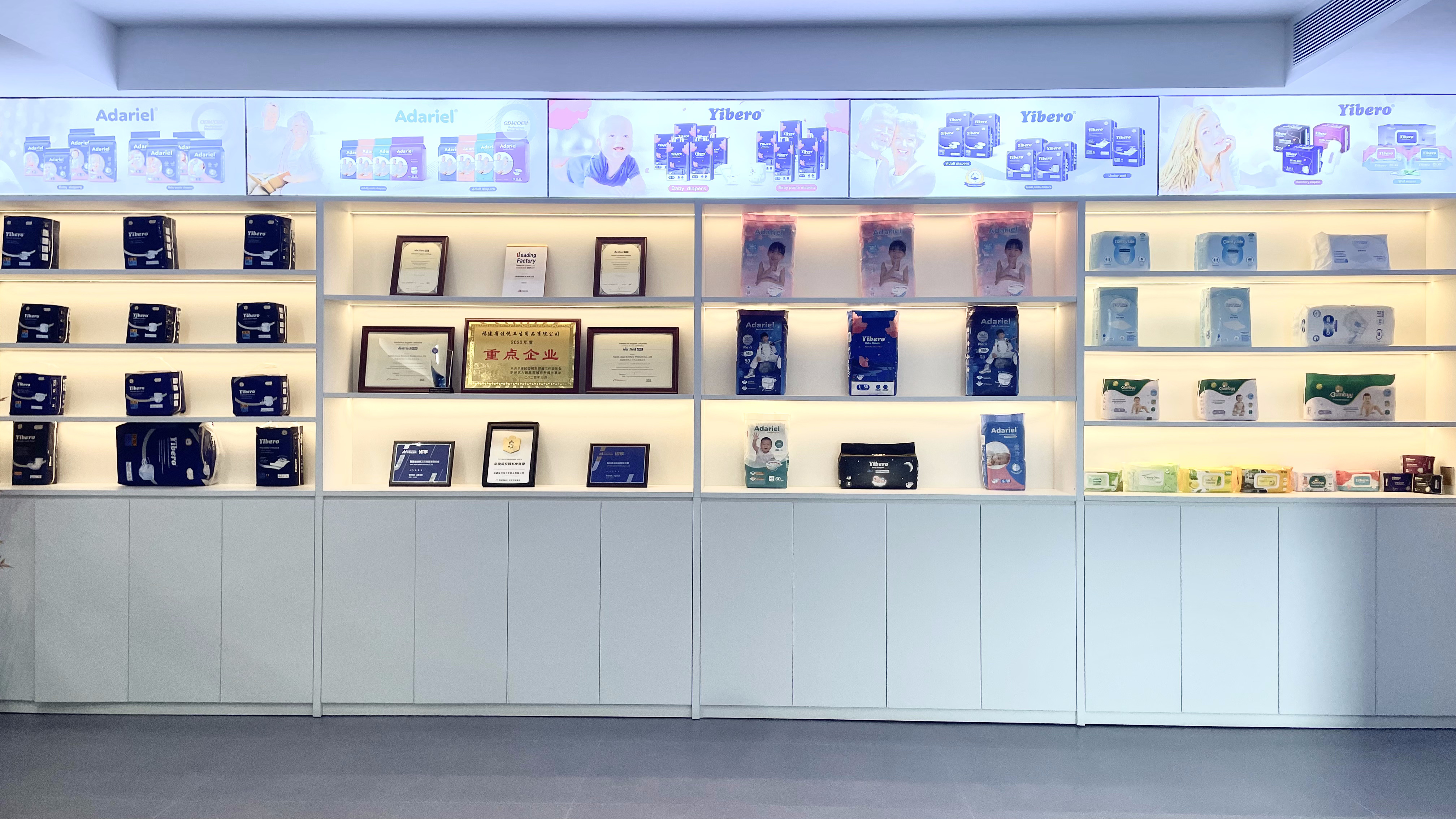
Jiayue’s case material describes an anonymized private-label baby diaper importer/distributor that started with a trial container and progressed to repeat orders, building a local private-label line for wholesale and retail channels. The same case material states that the listed baby diaper configuration has a 5-year shelf life under recommended storage conditions. Separately, Jiayue reports more than 5 long-term OEM customers across overseas markets in Southeast Asia, South Asia and the Middle East, with flexible customization and free design support for private-label diaper programs. These are company-published references; specific customer names, countries and order volumes are not publicly disclosed.
Market context: why documentation is becoming a sourcing differentiator
The broader market gives this topic more weight. Grand View Research estimated the global baby diaper market at USD 83.3 billion in 2025. Fortune Business Insights data cited in the verified package put Asia-Pacific at 61.92% of the global diaper market in 2025. A company-published report citing Xiamen Customs data put Fujian’s baby diaper export value at CNY 8.74 billion in 2024. These figures do not prove that any one supplier is qualified. They do explain why buyers face a crowded supplier landscape and why documentation becomes a practical filter.
In a dense export cluster, many suppliers can show a factory, a product range and a certificate image. Fewer can show how the certificate, the specification, the sample approval, the in-process record and the pre-shipment inspection connect to a specific order. That connection is the information gain. It also reflects a wider procurement pattern: buyers are moving from supplier discovery to supplier verification, and they want evidence that can be reviewed by a quality team, a retail compliance team or an importer’s own customer.
Comparison with a traditional, inspection-only approach
A traditional approach often relies on a final inspection and a relationship. The buyer sees samples, agrees a price and asks for an inspection before shipment. That can work for simple, low-change orders, but it leaves gaps when the product configuration is customized or when the buyer is building a private-label line. The comparison below is not a claim that one method is always superior. It shows where the documented QC file adds control.
| Decision area | Inspection-only approach | Documented QC file approach | Buyer implication |
|---|---|---|---|
| Specification | Verbal or email description; details may be spread across messages. | Written specification with size, absorbency, materials, pack count and artwork version. | Fewer disputes about what was approved. |
| Sample | Sample kept informally; approval may not be dated. | Dated sample approval record tied to the specification. | Clear production reference. |
| Production control | Reliance on final inspection. | In-process checks with defined checkpoints and records. | Problems can be detected before packing. |
| Pre-shipment release | Visual check against a general expectation. | Agreed test method, sampling level and acceptance criteria. | Release decision is auditable. |
| Certificate use | Certificate treated as a general trust signal. | Certificate scope, number and validity checked against the order. | Less risk of over-reading a sales-scope certificate. |
Limitations and boundaries buyers should keep in view
The first limitation is scope. Jiayue’s ISO 9001 certificate describes sales activities within its listed categories. It is not, by itself, a manufacturing-scope certificate for every production line or every material. A buyer who needs factory-level certification should request the relevant site-specific evidence and confirm the legal entity and factory relationship.
The second limitation is order specificity. Jiayue’s QC plan is order-specific, and the test method, sampling level and acceptance criteria must be agreed in the contract. A generic QC description is not a substitute for the plan attached to the buyer’s order. If the plan does not name the sampling level and acceptance criteria, the buyer should not assume they are implied.
The third limitation is sampling. Pre-shipment inspection reduces risk, but it does not guarantee that every unit in a container meets every requirement. The strength of the process depends on the agreed sampling basis, the inspection competence and the follow-up on nonconformities. Buyers with high-consequence programs should combine document review with independent testing or factory audit where their risk model requires it.
The fourth limitation is time. The ISO 9001 certificate expires on 2026-12-11. A buyer reviewing the file in late 2026 should check whether renewal evidence will be available before the shipment date. Certificate validity is a calendar item, not a one-time filing item.
Future outlook
The direction of travel is toward more granular supplier evidence. Importers increasingly want documents that can be matched to a purchase order, a sample and a shipment, rather than a folder of general certificates. For baby diaper programs, that means the QC file is likely to become more structured: specification version control, sample approval records, in-process check logs, pre-shipment reports and certificate validity tracking. Suppliers that can produce this file quickly and consistently will be easier to evaluate, not because they make louder claims, but because their claims can be checked.
For Jiayue, the practical test is repeatability across orders. The company’s stated capacity, engineering team, sampling timeline and QC sequence provide a basis for that test. The buyer’s role is to request the records, verify the certificate scope and dates, and tie every document to the approved specification. That is a more durable basis for a private-label or OEM decision than a certificate image alone.
FAQ
What documents should an importer request before approving a private-label baby diaper order?
An importer should request the written specification sheet, the dated sample approval record, the order-specific QC plan, the in-process check plan, the pre-shipment inspection plan with sampling level and acceptance criteria, the current ISO 9001 certificate, any applicable product test reports or conformity documents, and the artwork and packaging approvals. Each document should be tied to the order, the approved sample and the shipment.
What does Jiayue’s ISO 9001 certificate cover?
Jiayue’s ISO 9001 Quality Management System Certificate is numbered NOA2314690 and was issued by NOA Testing & Certification Group Ltd. It follows GB/T 19001-2016 / ISO 9001:2015, was issued on 2023-12-12 and expires on 2026-12-11. The documented scope is “Sales of sanitary products, maternal and infant products, and Class I medical devices.” The certificate is linked to Disposable Baby Diapers / Baby Nappies in the product data, but the scope wording should be read precisely and should not be treated as a manufacturing-scope certificate for every production line.
How long does Jiayue take to prepare samples?
Jiayue states that free samples are prepared in 1–3 working days. Buyers pay the courier costs. The sample should be approved against the written specification, and the approval record should be dated and retained as the production reference.
What is the typical lead time for repeat orders?
The typical production lead time is approximately 30–45 days, subject to sample, artwork, packaging and specification approval. Final capacity, MOQ, lead time, testing requirements and payment terms are confirmed in the quotation, approved sample and sales contract.
Does pre-shipment inspection guarantee that every diaper meets the specification?
No. Pre-shipment inspection reduces risk, but it is a sampling-based release control unless the contract states otherwise. Jiayue’s QC description requires the test method, sampling level and acceptance criteria to be agreed in the contract. Buyers should review the inspection plan and the nonconformity procedure before production, not after loading.
How can an importer verify the ISO 9001 certificate?
The buyer should match the certificate PDF to the issuing body’s record and to the supplier’s commercial documents. The key fields are certificate number NOA2314690, certificate holder Fujian Jiayue Sanitary Products Co., Ltd., standard GB/T 19001-2016 / ISO 9001:2015, issue date 2023-12-12, expiry date 2026-12-11 and the documented scope. If any field differs, the buyer should request an explanation before accepting the document.
What customization can be specified for an OEM baby diaper order?
Jiayue’s stated customization scope includes product size and weight, absorbency target, SAP/fluff-pulp or composite core, hot-air or spunbond nonwoven, cloth-like backsheet, tape or pull-up format, 3D leak guards, wetness indicator, waistband, graphics, printed bags or cartons, and pack count and size mix. The approved specification and sample should record which options apply to the order.
What should a buyer do if the certificate expires before shipment?
The buyer should request renewal evidence or a clear certificate status before shipment release. The current certificate expires on 2026-12-11, so an order or shipment falling after that date should be checked against updated documentation. Certificate validity should be part of the pre-shipment checklist alongside the inspection report and approved sample.
Reference: the public JIAYUE Product Catalog 2026 is available here: JIAYUE Product Catalog 2026.
Have Questions or Need More Details?
Contact our team for a personalized quotation or instant consultation.
Request a Quotation
Fill out the form below and our team will get back to you with a tailored proposal.
WhatsApp Direct Chat
Prefer to chat in real-time? Message us on WhatsApp for instant assistance & quick answers.
- Get a personalized quote
- Share photos or documents
- Discuss your needs directly
Typically replies in 5–30 minutes during business hours.