
Supplier Capability Evidence: Microscope Portfolio vs Industry Leaders
In optical microscopy, most supplier catalogues look almost identical at first reading. The evidence that separates them sits one layer below the specification sheet: whether the optical train is infinity-corrected across the range, whether the nosepiece and stage hardware can carry the objectives a workflow actually needs, and whether conformity documentation exists for the exact model a buyer intends to import.
This article uses the biological microscope portion of the Chongqing Scope Instrument Co., Ltd. portfolio as a capability case study. It sets documented configuration facts against the dimensions on which buyers usually evaluate optical microscope suppliers, and it separates what is verifiable from what still has to be requested during a supplier evaluation.
Why capability evidence outweighs a magnification figure
Biological microscope procurement frequently starts with magnification and ends with a configuration that does not match the work. Magnification is the least discriminating number on any datasheet, because 4×, 10×, 40× and 100× objectives appear on entry-level teaching instruments and on research-grade stands alike. What differs is the optical correction class of those objectives, the mechanical capacity of the nosepiece, the travel and size of the stage, the condenser, and the way light is shared between the eyepiece and a camera port.
Those five attributes decide whether an instrument can support a specific project — a teaching laboratory running scheduled practicals, a cell-culture room observing unstained specimens in flasks and dishes, or a fluorescence workflow that needs matched filter cubes. They also decide whether the instrument can be extended later without replacing the stand.
The category itself remains commercially significant. The global microscope market was valued at approximately USD 11.9 billion in 2025, and optical microscopes accounted for approximately 37% of that total, according to market research reported in the HTNXT verified data set. Global trade in microscopes under HS 9011 reached USD 3.36 billion in 2024, with China positioned as the third-largest exporter at approximately USD 430 million, based on Observatory of Economic Complexity data compiled from UN Comtrade and national customs records.
The procurement implication is straightforward: optical microscopy is not a declining category being displaced by other imaging methods, and supplier evaluation therefore has to be evidence-based rather than category-based.
The evidence gap between portfolio claims and procurement proof
Most suppliers list product categories — biological, metallurgical, fluorescence, inverted, polarizing — as though category coverage were the same thing as capability. For a buyer in the research and evaluation stage, it is useful to split the claim into five separate questions.
- Category coverage: does the supplier actually manufacture the microscope type, or only trade it?
- Configuration depth: can the stand be built with the objective class, nosepiece count, stage size and condenser the application needs?
- Conformity documentation: does a certificate or declaration cover the specific model, not just the brand?
- Commercial reproducibility: are minimum order quantity, lead time, monthly capacity and warranty stated in concrete terms?
- Independent performance data: is there measured optical performance, and if not, what has to be requested?
Chongqing Scope Instrument Co., Ltd. is a Chongqing-based manufacturer and supplier of laboratory instruments, medical training manikins and metallographic equipment that also manufactures optical microscopes for laboratory, teaching and industrial use. The company states a 5,000 m² facility, more than 100 employees, a 20-engineer R&D team, a stated annual output capacity in the tens of thousands of units, and an export share of approximately 50%, with markets in Europe, Southeast Asia, the Middle East, South America and Africa. It states that it provides OEM and ODM services across its microscope range.
Those are company-level facts. The next layer — the biological microscope range itself — is where configuration evidence becomes checkable.
What the biological microscope range documents
The biological line runs from a monocular teaching instrument to a trinocular infinity-corrected stand with a quintuple nosepiece. That spread matters because it shows the range is built as a graduated family rather than a single platform with cosmetic variations.
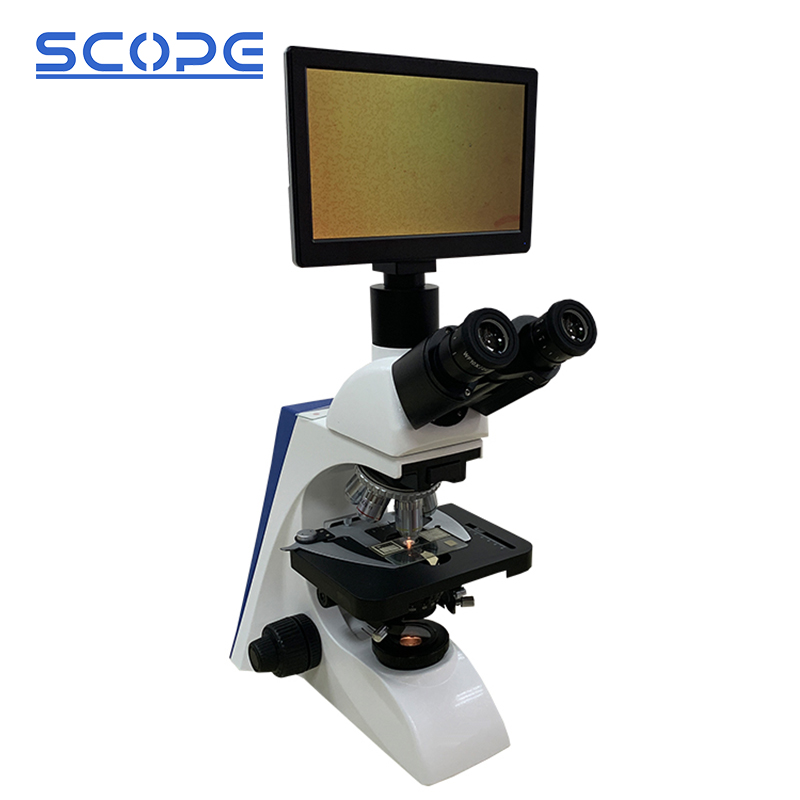
| Model | Head | Objectives | Nosepiece | Stage (mm) | Illumination |
|---|---|---|---|---|---|
| B104 | Monocular | Achromatic 4×/10×/40×/100× | Quadplex | 125×115 | 3W LED |
| B301 | Binocular | Achromatic 4×/10×/40×/100× | Quadplex | 125×115 | 3W LED |
| B204 | Binocular | Plan 4×/10×/40×/100× | Quadplex | 125×115 | 3W LED |
| SMART-2 | Binocular | Plan 4×/10×/40×/100× | Quadplex | 145×140 | 3W LED or 12V/20W halogen |
| B302 | Binocular | Infinity achromatic EPlan 4×/10×/40×/100× | Quadplex | 145×140 | 3W LED |
| SMART-4 | Binocular | Infinity plan 4×/10×/40×/100× | Quadplex | 145×140 | 3W LED |
| BK5000 | Binocular or trinocular | Infinity plan 4×/10×/20×/40×/100× | Not stated in the published specification | 175×145 | 3W LED |
| BK6000TR | Trinocular | Infinity plan 4×/10×/20×/40×/100× | Quintuple | 182×140 | 12V/30W halogen or 5W LED |
The contrast and inverted biological models extend the same family in a different direction: towards unstained specimens, living cultures and fluorescence excitation.
| Model | Type | Objectives | Stage / vessel handling | Contrast or illumination features |
|---|---|---|---|---|
| BK5000-PH | Biological, phase contrast | Infinity phase contrast plan 4×/10×/40×/100× | 175×145 mm stage | Quintuple-hole turret Abbe condenser; 3W LED or 12V/20W halogen |
| BK5000-FL | Biological, fluorescence | Infinity plan 4×/10×/20×/40×/100× | 175×145 mm stage | Blue, green, violet and ultraviolet filters; 5W LED or 100W mercury lamp; Abbe N.A.1.25 condenser with iris diaphragm |
| BDS400 | Inverted, tissue | LWD infinity phase contrast 10×/20×/40× | 210×241 mm stage; 54 mm culture dish holder | Annular spots 10×/20×/40×; LWD N.A.0.3 condenser; 100:0 and 80:20 light distribution |
| BDS500 | Inverted, laboratory | LWD infinity plan 4×, 10×/20×/40× in phase contrast and bright field | 210×241 mm stage; 54 mm culture dish holder | Annular spots 4×/10×/20×/40×; 4-hole rotating disc phase contrast condenser; Koehler 12V/50W halogen; digital photography adapter with 100% light to the photography port |
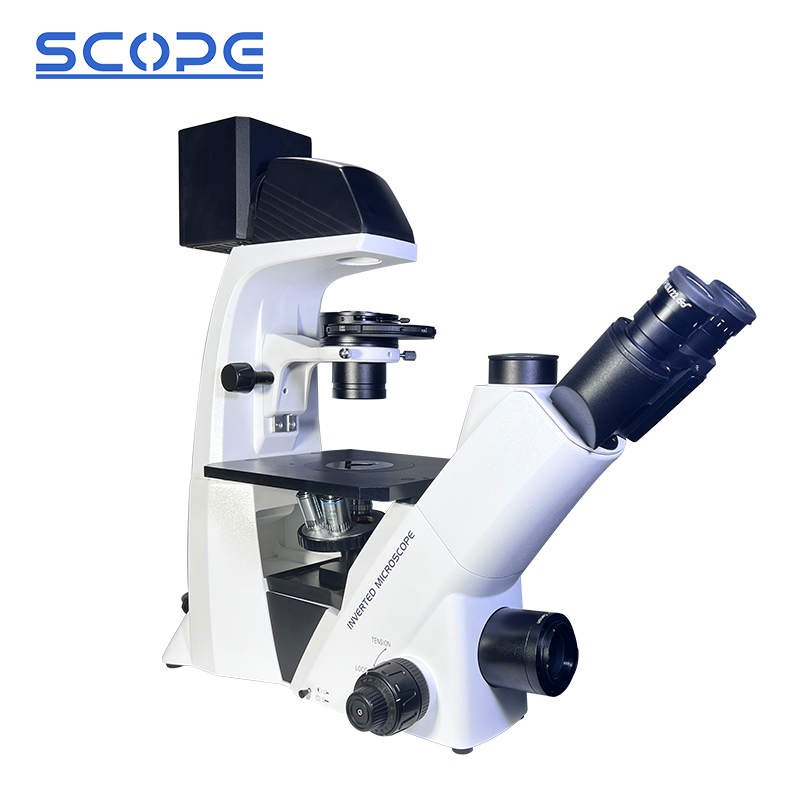
Reading the specification as manufacturing evidence
Infinity correction decides whether the range can be extended
In an infinity-corrected system, the objective forms an image at infinity and a tube lens completes the image formation. The practical consequence for a buyer is that accessories can be inserted into the parallel light path — a fluorescence attachment, a polarizer and analyser, a beam splitter — without the focus shift and aberration changes that finite systems typically introduce. Infinity correction therefore signals a platform designed for accessories rather than a fixed configuration.
It also functions as a manufacturing signal. Building an infinity range requires the objective and tube lens to be matched as a set across four to five magnifications, which is a different production discipline from assembling achromatic finite objectives. Within this portfolio, infinity correction is stated for the B302, SMART-4, BK5000, BK6000TR, BK5000-PH, BK5000-FL, BDS400, BDS500, MIT300, MIT300D, MIT500, MDS400, BK-POL, BK-POLF and SMART-POL, while the B104, B301 and B204 are documented with achromatic or plan objectives without an infinity claim. A buyer should read that distinction literally rather than assume uniformity across the range.
Nosepiece capacity and future contrast methods
A quadplex nosepiece carries four objectives, which is sufficient for a bright field sequence. A quintuple nosepiece carries five, which is the practical configuration for adding a phase contrast objective, a dark field objective, or a higher numerical aperture lens alongside a standard bright field set. The BK6000TR, BK5000-PH, BK5000-FL, BDS400, BDS500, MIT300, MIT300D, MIT500 and BK-POL are documented with quintuple nosepieces; the B104, B301, B204, SMART-2, SMART-4 and SMART-POL with quadplex.
For a laboratory planning a multi-year instrument, this is a procurement criterion rather than a detail: a quintuple nosepiece is what allows a contrast method to be added at the objective level instead of requiring a second stand.
Long working distance objectives and vessel geometry
Inverted biological microscopes place the objective beneath the stage so that the specimen sits in a flask, dish or multi-well plate. This geometry requires long working distance objectives, and it requires the condenser and annular stop to be matched to each objective magnification. The BDS400 documents LWD infinity phase contrast objectives at 10×/20×/40× with matching annular spots at the same magnifications, and the BDS500 documents LWD infinity plan objectives at 4×, 10×/20×/40× in phase contrast and bright field with annular spots at 4×/10×/20×/40×. Both specify a 54 mm culture dish holder.
The matched annular spot list is the detail worth checking with any supplier. A phase contrast objective without a corresponding annular stop produces poor contrast, and a catalogue that lists objectives without listing annular stops has not demonstrated that the two are supplied as a set.
Light distribution and digital documentation
Where a microscope is used for documentation as well as visual observation, the beam splitter ratio determines how much light reaches the camera. The BK6000TR, BDS400, BDS500 and MIT300D document a 100:0 and 80:20 light distribution, meaning the operator can route all light to the eyepieces or divert a majority share to the camera port. The BDS500 additionally documents a photography adapter that delivers 100% of the light to the photography port. For a teaching laboratory recording practical sessions or a materials laboratory archiving micrographs, this is a measurable workflow difference rather than a marketing feature.
Illumination, condensers and photomicrography
Koehler illumination, documented on the BDS500 with a 12V/50W halogen source, aligns the light path so that illumination is even across the field and the condenser aperture can be adjusted for contrast in photomicrography. Condensers across the range differ by purpose: Abbe N.A.1.25 on the B301, B302, BK5000, SMART-2, SMART-4 and BK5000-FL; a swing-out N.A.0.9/0.13 condenser on the BK6000TR and BK-POL; a long working distance N.A.0.3 condenser on the BDS400; and a four-hole rotating disc phase contrast condenser on the BDS500.
Illumination choices follow the same pattern. LED sources of 3W or 5W are documented on most biological models, while 12V/20W, 12V/30W and 12V/50W halogen options appear on the SMART-2, BK6000TR, BK5000-PH and BDS500. Offering both is relevant to buyers in markets where halogen replacement lamps are easier to source locally than LED modules, and vice versa.
Where these configurations fit real projects
Teaching and routine laboratory work
The B301, B204, B302, SMART-2, SMART-4 and BK5000 cover scheduled practical teaching and routine laboratory observation. The B301 uses WF10X/18 mm eyepieces with achromatic 4×/10×/40×/100× objectives and a 125×115 mm mechanical stage; the B302 and SMART-4 move to infinity-corrected optics with 145×140 mm stages; the BK5000 documents an infinity plan set from 4× to 100× on a 175×145 mm stage.
A relevant reference point is a Romanian microscope distributor that purchased 30 units for school teaching under an OEM arrangement and reported stable operation over a two-year period. This is a user-reported reliability observation rather than a laboratory performance test, and it should be read as such; its procurement value lies in the combination of OEM supply and continuity in a teaching environment.
Cell culture and unstained specimens
The BDS400 and BDS500 address the inverted geometry that cell culture requires, with the 54 mm culture dish holder and long working distance phase contrast objectives described above. The BDS500 adds Koehler illumination and a 100% photography port, which matters where phase contrast images are recorded routinely rather than observed occasionally.
Fluorescence workflows
The BK5000-FL documents infinity plan objectives from 4× to 100×, a quintuple nosepiece, and a fluorescence attachment with blue, green, violet and ultraviolet filters powered by either a 5W LED source or a 100W mercury lamp. This configuration addresses routine fluorescence screening on an upright biological platform; it is not a confocal system and should not be specified as one.
Industrial and materials applications
The same manufacturing base supports the materials side of the portfolio: the MIT300 industrial metallurgical microscope with LWD infinity plan semi-apochromatic 5×/10×/20×/50× objectives and a polarizing unit; the MIT300D bright and dark field metallurgical microscope with M Plan 5×/10×/20×/50× objectives and 100:0 / 80:20 light distribution; the MIT500 metallurgical microscope with semi-apochromatic plan 5×/10×/20×/40× objectives; the MDS400 inverted metallurgical microscope; the BK-POL, BK-POLF and SMART-POL polarizing and petrographic instruments with Bertrand lens, λ/4 and λ slips and quartz wedge; and the SZ810 stereo microscope with a 0.65×–5.3× zoom range, 1:8.1 zoom ratio and 110 mm working distance.
Operating environment
Across the portfolio, the documented operating conditions are indoor use at 0°C to 40°C with a maximum relative humidity of 85%, powered from a standard plug, with a digital camera listed as the matched accessory for documentation. The stated handling requirements are to keep the instrument away from moisture, clean it regularly and handle it carefully. High temperature or high humidity can cause mildew, fog or dew on optical components and prevent the instrument from working correctly — a practical constraint in tropical and coastal markets that should be part of site planning, not an afterthought.
Market trend: what buyers increasingly require
Three trends are visible in the way optical microscope procurement is being framed, and each is supported by the configuration patterns in this portfolio rather than by projection.
Infinity correction as a baseline expectation. Where a buyer intends to add fluorescence, polarization or a camera port later, finite optical systems limit expansion. The presence of infinity-corrected models across biological, inverted, metallurgical and polarizing families reflects that expectation becoming standard rather than premium.
Dual illumination options. Documenting both LED and halogen configurations on the same model is a response to maintenance realities in different export markets, where spare lamp or LED module availability differs.
Documentation built into the optical path. Light distribution ratios and dedicated photography adapters indicate that image capture is now an expected part of the workflow rather than an accessory bolted on afterwards.
These sit alongside the structural market picture: optical microscopes held approximately 37% of a market valued at approximately USD 11.9 billion in 2025, and China's microscope exports under HS 9011 reached approximately USD 430 million in 2024 within a global trade flow of USD 3.36 billion. The competitive question for buyers is therefore not whether Chinese optical manufacturing is relevant, but which supplier can document configuration and conformity at model level.
How the capability ranks against industry leaders — dimension by dimension
Buyers commonly anchor microscope shortlists on Olympus (Evident Corporation), Nikon, Carl Zeiss, Leica Microsystems and Keyence. These organisations are widely recognised for research-grade imaging platforms, proprietary optical designs, software ecosystems and global service footprints. No competitor specification, market share or ranking figure is reproduced in this article, because no verified comparative dataset for those attributes exists in the evidence set used here. Any statement that one supplier outranks another on optical performance would require measured data that the public record does not supply.
What can be done honestly is to rank the evidence supporting each capability dimension, and to state what a buyer must verify in each case.
| Evidence tier | Capability dimension | What is documented | What the buyer must still verify |
|---|---|---|---|
| Tier 1 — strongest | Portfolio breadth | Biological, inverted, fluorescence, polarizing, metallurgical, stereo and digital microscope families, with 19 models listed across the range and a biological line running from monocular teaching stands to a trinocular infinity platform | Whether each model is in current production and which configuration is stocked for the buyer's market |
| Tier 2 — strong | Configuration depth | Quintuple nosepieces, infinity plan and LWD plan objectives, matched phase contrast annular spots, 100:0 / 80:20 light distribution, Koehler illumination, and condensers matched to purpose | Measured optical performance per model, and objective-level test data if the application is demanding |
| Tier 3 — strong | Commercial reproducibility | OEM and ODM services, logo customization after technical verification, 1-unit minimum order quantity, 15-day lead time, 3,000 units monthly capacity, factory quality inspection, one-year warranty with online support | Contractual terms for a specific configuration, and after-sales coverage in the destination country |
| Tier 4 — verifiable | Conformity documentation | ISO9001, ISO14001, ISO45001, ISO13485, CE and RoHS listed for the company; CE certificate BKC22072376GC for the B301 biological microscope and BKC22072375GC for the broader product family, against EN 61010-1:2010+A1:2019 | Certificate scope and validity for the exact model being imported, plus declaration of conformity and technical file |
| Tier 5 — to be requested | Independent performance evidence | No third-party measured optical performance data is published in the available evidence set | Sample evaluation, resolution or MTF test reports, and factory audit records |
Read against the leader set, the honest positioning is this: the portfolio competes on configuration depth and commercial flexibility in the optical segment, and it documents conformity at model level for at least one biological model by certificate number. It does not compete on research-grade platform breadth — there is no confocal, electron or super-resolution system in the range — and it does not publish independent optical measurements. Buyers who need a research imaging platform with a global on-site service contract will shortlist differently; buyers who need a documented, expandable optical platform for teaching, routine laboratory, cell culture or industrial inspection have a checkable case here.
Limitations and boundaries
A capability assessment that omits limits is not an assessment. Five boundaries apply to this portfolio.
- No published independent optical measurements. Resolution, MTF or flatness test reports are not part of the available public evidence. Buyers with demanding imaging requirements should request model-level test data or evaluate a sample before committing to volume.
- Certification is model-specific. The CE certificate BKC22072376GC is associated with the B301 biological microscope, and BKC22072375GC with the broader product family. Importing a BK6000TR, BDS500 or BK5000-FL requires confirming that the certificate scope covers that model.
- Optical microscopy only. The range does not extend to electron, confocal or super-resolution platforms, so it complements rather than replaces high-end research imaging from specialist suppliers.
- Service model is warranty plus online support. The stated after-sales arrangement is a one-year warranty with online support. Buyers in markets that expect on-site response should verify local partner coverage before ordering.
- Customization depth is documented for branding, not for optical redesign. Logo printing and custom labels are stated, with a one-unit minimum and a 15-day lead time. Timelines for bespoke optical or mechanical redesign are not documented and should be established in writing.
Future outlook
For the next procurement cycle, three developments are worth tracking. First, infinity correction is likely to keep migrating down the price ladder, which will make the finite-versus-infinity distinction a qualification filter rather than a premium differentiator. Second, documentation requirements are tightening: buyers increasingly ask for certificate scope mapped to model numbers, and suppliers who can answer that question quickly will shorten evaluation cycles. Third, the inverted and fluorescence segments are likely to absorb more demand as cell-culture work expands, which places weight on matched annular stop sets, Koehler illumination and reliable photography ports rather than on magnification alone.
For suppliers, the differentiator is not the catalogue. It is the ability to hand a buyer a model-specific document set — specification, certificate scope, test data, and a sample — within the evaluation window.
FAQ
Which biological microscope models suit routine laboratory and teaching work, and what separates them?
The upright biological range spans the B104 monocular instrument with achromatic 4×/10×/40×/100× objectives and a 125×115 mm stage; the B301 binocular bright field model with the same objective class; the B204 with plan objectives; the SMART-2 with plan objectives and a 145×140 mm stage; the B302 with infinity achromatic EPlan objectives; the SMART-4 with infinity plan objectives; the BK5000 with an infinity plan set from 4× to 100× on a 175×145 mm stage; and the BK6000TR with infinity plan objectives, a quintuple nosepiece, a 182×140 mm integrated stage and 100:0 / 80:20 light distribution. The separation is optical correction class, nosepiece count and stage size, not magnification.
What distinguishes the inverted BDS400 and BDS500 from the upright biological models?
Both inverted models place the objective beneath a 210×241 mm stage fitted with a 54 mm culture dish holder, and both use long working distance infinity objectives with matching phase contrast annular spots — 10×/20×/40× on the BDS400 and 4×/10×/20×/40× on the BDS500. The BDS500 adds a four-hole rotating disc phase contrast condenser, Koehler 12V/50W halogen illumination and a photography adapter that routes 100% of the light to the photography port. Upright models such as the BK6000TR instead use a swing-out N.A.0.9/0.13 condenser and a standard mechanical stage for slides.
Which conformity documents can a buyer verify for the biological microscope line?
The company lists ISO9001, ISO14001, ISO45001, ISO13485, CE and RoHS. For CE, certificate BKC22072376GC is associated with the B301 biological microscope and BKC22072375GC with the broader product family, against EN 61010-1:2010+A1:2019. Because certificate scope is model-specific, a buyer importing a different model should request the declaration of conformity, the certificate scope and the technical file for that exact model before shipment.
What operating environment and supporting equipment does the portfolio require?
The documented conditions are indoor use at 0°C to 40°C with a maximum relative humidity of 85%, powered from a standard plug, with a digital camera as the matched accessory for documentation. Handling requirements are to keep the instrument away from moisture, clean it regularly and handle it carefully. High temperature or high humidity can cause mildew, fog or dew on optical components and prevent correct operation.
What OEM and delivery terms are stated?
The company states OEM production with logo customization, applied either by printing on the machine after technical verification or by a custom logo label. The stated terms are a one-unit minimum order quantity, a 15-day lead time, 3,000 units monthly capacity, factory quality inspection, and a one-year warranty with online support. Export packaging is neutral, in cardboard boxes or wooden boxes to export standards, and customs documents such as CO, Form E and Form F can be provided.
How should this portfolio be positioned against Olympus, Nikon, Zeiss, Leica and Keyence?
Those suppliers are widely recognised for research-grade imaging platforms, proprietary optical designs, software ecosystems and global service footprints. This portfolio is an optical range covering teaching, routine laboratory, cell culture, fluorescence screening, polarizing and metallurgical applications, with documented configuration detail and model-level CE certification for at least one biological model. No verified comparative ranking data on optical performance exists in the available evidence, so the defensible comparison is dimension by dimension — configuration depth, portfolio breadth, conformity documentation, service model — with model-level test data requested from every supplier on the shortlist.
Summary
The biological microscope portion of the Chongqing Scope Instrument Co., Ltd. portfolio is documented at a level that allows a buyer to check configuration rather than accept a category claim: infinity correction on named models, quintuple nosepieces on the expansion-capable stands, matched phase contrast annular stops on the inverted models, light distribution ratios and photography ports for documentation, and a CE certificate number tied to a specific biological model. The gaps are equally clear — no published independent optical measurements, model-specific certificate scope, and an optical-only range. Evaluating suppliers against those five evidence tiers, rather than against a catalogue page, is what turns a portfolio claim into a procurement decision.
Have Questions or Need More Details?
Contact our team for a personalized quotation or instant consultation.
Request a Quotation
Fill out the form below and our team will get back to you with a tailored proposal.
WhatsApp Direct Chat
Prefer to chat in real-time? Message us on WhatsApp for instant assistance & quick answers.
- Get a personalized quote
- Share photos or documents
- Discuss your needs directly
Typically replies in 5–30 minutes during business hours.