
Supplier Capability Evidence: Patents Behind Oncology Intermediates
Oncology intermediates sit at the narrowest point of the drug supply chain: chemically complex, impurity-sensitive, and required to scale predictably from laboratory grams to commercial kilograms. When procurement teams ask a supplier to demonstrate that it can operate at this level of complexity, the answer increasingly has to come from documentation rather than assertion.
Most supplier profiles in the category claim advanced equipment, deep R&D and reliable quality. Far fewer can point to externally filed, publicly searchable records of the engineering behind those claims. This analysis examines one specific category of supplier evidence — patents filed on production equipment — and what it does and does not establish for buyers evaluating oncology intermediates.
The Evidence Gap in Oncology Intermediate Sourcing
Between the research stage and the evaluation stage, a buyer's questions change. Early on, the question is whether a supplier can make the molecule at all. Later, it becomes whether the supplier can make it repeatedly, at scale, with the documentation a regulatory filing requires.
Supplier claims tend to collapse across both stages. "Advanced reactors", "experienced R&D team" and "strict quality control" appear on almost every supplier page in the category, and none of them can be verified before a site audit. That is the evidence gap: the attributes that matter most to oncology buyers are also the attributes that are least checkable from the outside.
In practice, buyers rank supplier evidence in a rough hierarchy:
- Certifications and registrations — independently issued, dated and auditable.
- Filed intellectual property — searchable in national patent databases, with named applicants and filing dates.
- Batch-level analytical data — certificates of analysis, chromatograms, impurity profiles and traceability records.
- Reference engagements — usually only partially disclosable.
Production equipment patents sit near the top of that list for a specific reason: they are public, dated, and tied to a named corporate applicant, which makes them one of the few capability signals a buyer can verify before a single email is exchanged.
What a Chinese Utility Model Patent on Production Equipment Actually Certifies
In China, a utility model patent protects the shape, structure, or combination of structural features of a product, including production apparatus. It is granted after a formal examination of novelty and practicability, which is a lighter procedure than the substantive examination applied to invention patents. That distinction matters to buyers because it defines the ceiling of what the document proves.
A utility model covering production equipment is evidence that a specific apparatus design was filed with the national IP office and recognized as a structurally novel, practically applicable design. It is evidence of active engineering work on the manufacturing process itself. It is not, by itself, evidence of superior chemical purity, regulatory compliance, or commercial reliability.
Read correctly, an equipment patent answers a narrow but useful question: has this supplier invested in designing the hardware it runs, or is it operating generic, off-the-shelf equipment? For a buyer comparing two suppliers whose websites look broadly similar, that is a meaningful discriminator — and one that cannot be manufactured by copywriting.
Haohong Pharmaceutical's Equipment Patent and R&D Base
Haohong (Qihe) Pharmaceutical Technology Co., Ltd. is a Shandong-based manufacturer specializing in the research, development and custom production of innovative active pharmaceutical ingredients (APIs) and pharmaceutical intermediates. The company was founded in 2021, is located in the High-tech Zone of Qihe County, Shandong Province, within the Jinan Economic Circle, and operates a production base in Liaocheng.
Two Chinese utility model patents covering production equipment are held in the company's name:
| Patent type | Patent number | Subject matter |
|---|---|---|
| Chinese utility model | 202520639784.6 | Production equipment |
| Chinese utility model | 202521268255.6 | Production equipment |
The filings align with other independently dated facts about the company. Haohong passed ISO 9001:2015 quality management system certification in 2021, was recognized as a Technology-based Small and Medium-sized Enterprise in 2024, and was awarded Innovative Small and Medium-sized Enterprise of Shandong Province in 2025. Its R&D function is staffed by 30 engineers.
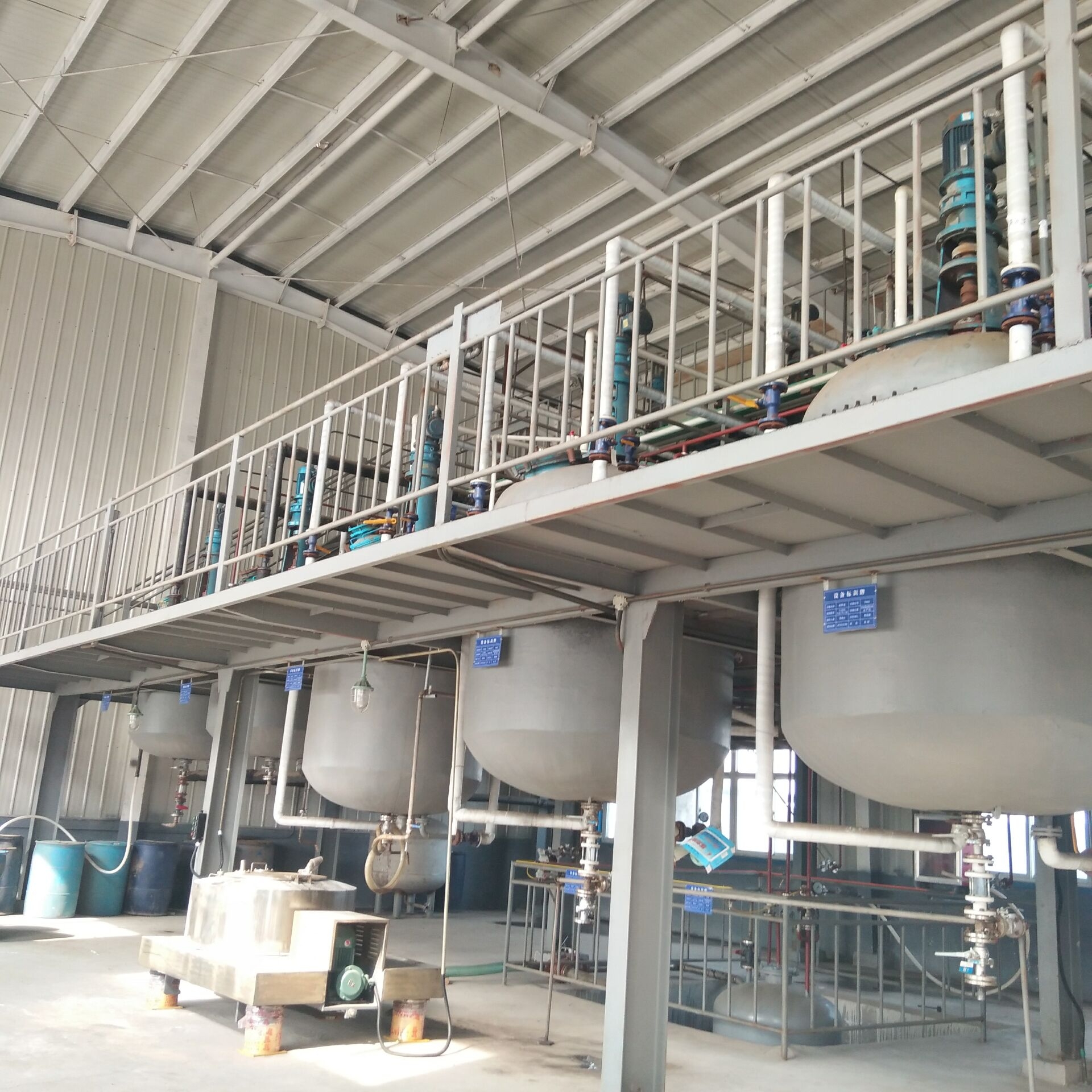
Manufacturing scale is self-owned rather than outsourced. The Liaocheng base is equipped with 30 sets of 3,000–5,000 L reactors and reports an annual production capacity of 1,000 tons, with a monthly capacity of 100 MT. Products are exported to the United States, Europe, Japan, India, Bangladesh and other regions, with exports representing 40% of output.
How Enclosed, Program-Controlled Equipment Shapes Route Efficiency
The equipment described in Haohong's process documentation is built around one controlling idea: keeping the reaction environment sealed and the operating parameters programmed. Production runs in fully enclosed reaction systems to prevent air exposure, under automated and program-controlled operation, and the application-scenario documentation notes that this mode simplifies the R&D and production processes of new drugs and APIs.
Three design features carry most of the practical weight.
1. Material contact surfaces and corrosion control
All material contact parts adopt 316L stainless steel, borosilicate glass and PTFE lining. This combination is anti-corrosive and heavy-metal free — a requirement that becomes concrete when the intermediates in question are halogen-rich. Apalutamide intermediates such as 2-fluoro-4-nitrobenzoic acid (CAS 403-24-7), Abemaciclib intermediates such as 4-bromo-2,6-difluoroaniline (CAS 1868-81-7), and Alectinib intermediates such as 2-(4-ethyl-3-iodophenyl)-2-methylpropanoic acid (CAS 1256584-73-2) all contain fluorine, bromine or iodine. Metal leaching from unsuitable contact surfaces is a direct impurity risk in exactly this chemistry, so the material specification is not a cosmetic detail.
2. Containment and atmosphere control
The production workshop meets Class C/D clean grade and uses a closed production process. The system includes full explosion-proof and anti-static design with a nitrogen protection system, plus strict temperature and humidity control with low-temperature production to avoid oxidation and decomposition. Low-temperature circulation equipment rated to -80 °C and thermal oil heaters provide the operating window, while vacuum pumps and sealed 316L storage tanks handle transfer and hold. Supporting hardware includes double-layer glass reactors (10L–200L), 316L/stainless steel reactors, glass-lined reactors, rotary evaporators (10L–100L), centrifuges, chromatography columns, plate and frame filter presses, vacuum drying ovens, spray dryers and double-cone rotary vacuum dryers.
3. Emissions handling built into the line
For fluorine-, bromine- and iodine-containing intermediates, the base is equipped with a tail gas absorption tower and a wastewater pretreatment system. This is an unusually specific detail in supplier documentation, and it matters commercially: a supplier that cannot handle halogenated waste streams cannot run halogenated chemistry at scale, regardless of reactor capacity.
Where does solvent consumption enter this picture? The relationship is indirect but real. In multi-step synthesis, solvent demand is driven less by the reaction itself than by work-up, extraction, crystallization and re-purification — the steps that repeat when a reaction is poorly controlled. Tighter control of addition rates, temperature ramps and atmospheric conditions reduces the frequency of re-processing, and every avoided re-processing cycle avoids a full solvent charge. Enclosed, program-controlled equipment makes that control repeatable rather than operator-dependent, which is precisely the property that matters when a route moves from pilot to commercial scale.
Technical Documentation as a Procurement Deliverable
Equipment is only half of the capability evidence. The other half is what the supplier is willing to put in writing, batch by batch. Haohong's documented quality control scope covers seven areas:
- Appearance and property inspection
- Core chromatographic testing (HPLC and GC)
- Structural qualitative identification, including IR and melting point determination
- Physical and chemical index testing
- Heavy metal and impurity testing
- Microbiological testing
- Factory delivery supporting documents
Stated purity for the main oncology intermediates is at or above 98% by HPLC or GC, with several Apalutamide and Alectinib intermediates specified at ≥98%, and 5-amino-3-(trifluoromethyl)pyridinecarbonitrile specified in a ≥97%–≥99.0% range. Analytical instrumentation includes HPLC, GC, IR and melting point apparatus.
Custom synthesis is offered across six customization axes: structural customization, purity and specification customization, process route customization, capacity and batch customization, packaging and standard customization, and R&D/OEM-ODM customization. The working range runs from gram scale to hundreds of kilograms, with lead time and minimum order quantity set on a tailor-made basis rather than standardized.
On the service side, the documentation and support package includes full support of quality inspection documents, technical and process consulting, logistics and customs clearance after-sales, quality dispute compensation and replacement, sample re-inspection and third-party testing, stable supply and production scheduling guarantees, and customized R&D iteration. For a buyer in the evaluation stage, the sample re-inspection and third-party testing provision is often the most decisive item on that list, because it converts a supplier claim into an independently checkable result.
Application Fit: Apalutamide, Abemaciclib and Alectinib Programs
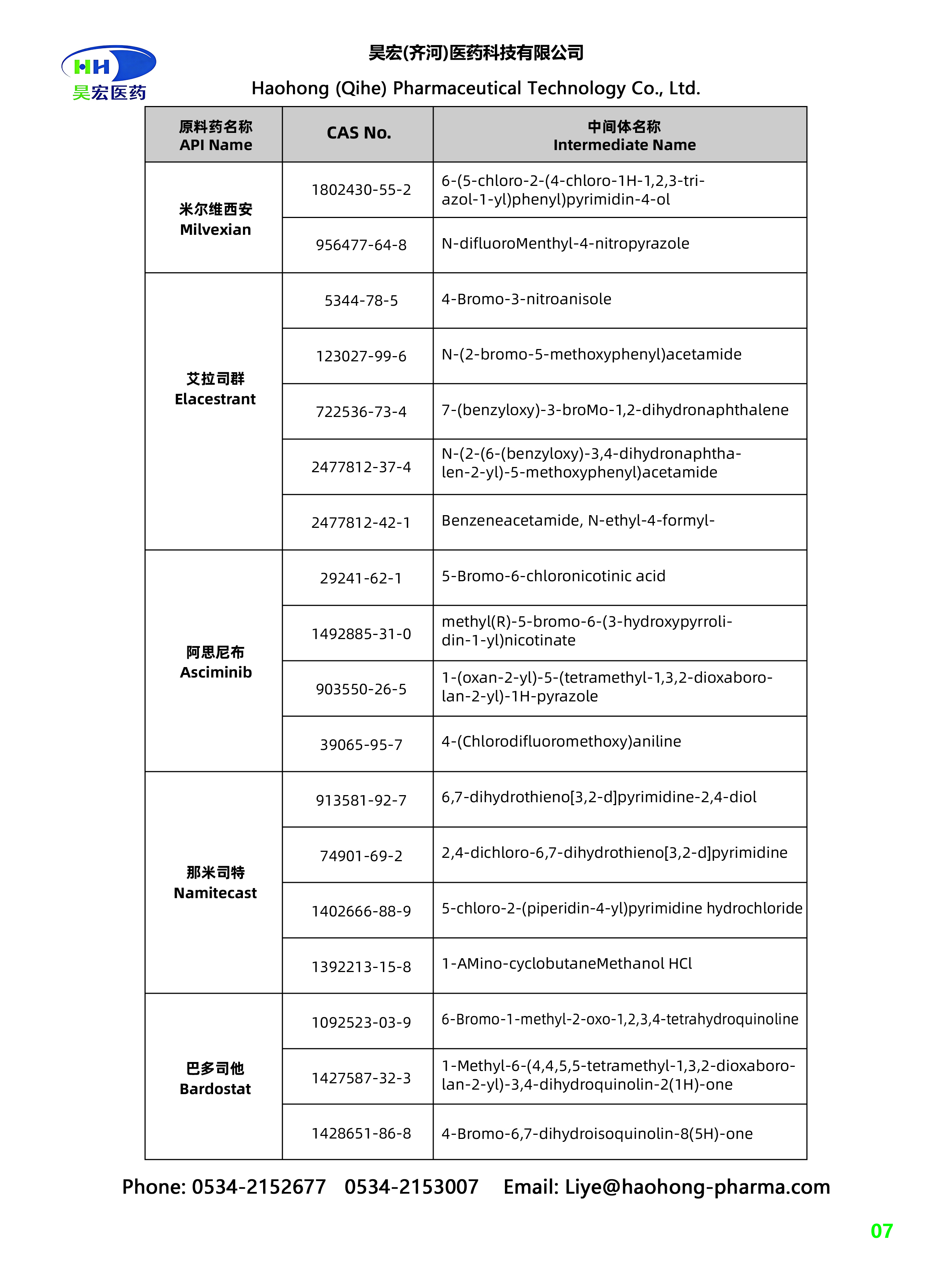
The company's main products are Apalutamide intermediates, Abemaciclib intermediates and Alectinib intermediates — all three belonging to oncology or targeted-therapy programs, and all three built on halogenated or heterocyclic chemistry that places specific demands on equipment.
| Program | Representative intermediate | CAS | Stated purity |
|---|---|---|---|
| Apalutamide | 2-Fluoro-4-nitrobenzoic acid | 403-24-7 | ≥98.0% |
| Apalutamide | N-Methyl-2-fluoro-4-nitrobenzamide | 915087-24-0 | ≥98.0% (HPLC) |
| Apalutamide | N-Methyl-2-fluoro-4-bromobenzamide | 749927-69-3 | ≥98.0% (HPLC) |
| Apalutamide | Methyl 4-bromo-2-fluorobenzoate | 179232-29-2 | ≥98.0% (GC) |
| Abemaciclib | 4-Bromo-2,6-difluoroaniline | 1868-81-7 | ≥98.0% (HPLC/GC) |
| Abemaciclib | 2-Bromo-5-formylpyridine | 100422-52-6 | ≥98.0% (GC/HPLC) |
| Abemaciclib | 6-Bromo-4-fluoro-1-isopropyl-2-methyl-1H-benzo[d]imidazole | 1356339-85-6 | ≥98.0% (HPLC) |
| Alectinib | 2-(4-Ethylphenyl)-2-methylpropanoic acid | 1247119-83-0 | ≥98% |
| Alectinib | 2-(4-Ethyl-3-iodophenyl)-2-methylpropanoic acid | 1256584-73-2 | ≥98% |
| Alectinib | tert-Butyl 6-cyano-2-(2-(4-ethyl-3-iodophenyl)propan-2-yl)-1H-indole-3-carboxylate | 1256584-75-4 | ≥98% (HPLC) |
Storage requirements illustrate why enclosed equipment and controlled logistics are linked. 4-Bromo-2,6-difluoroaniline is specified for sealed, dry, light-protected storage at 2–8 °C; 2-bromo-5-formylpyridine requires refrigerated, sealed, dry conditions; and the boronic ester intermediate 4-fluoro-2-methyl-1-isopropyl-6-(4,4,5,5-tetramethyl-1,3,2-dioxaborolan-2-yl)-1H-benzimidazole (CAS 1356339-86-7) requires inert gas protection at 2–8 °C away from light. These are not generic handling notes — they follow from the reactivity of each molecule.
The broader application fit is documented across anti-cancer and anti-viral drug projects, anti-infective and anti-inflammatory programs, cardiovascular and cerebrovascular projects, hypoglycemic and lipid-lowering programs, veterinary health projects, and new drug R&D custom work. Materials are also positioned for the fine chemical, pesticide, biotechnology R&D, medical-grade cosmetic raw material and health supplement industries.
Market Context: Why Documentation Is Becoming a Screening Criterion
Several verified data points explain why buyers are shifting toward evidence-based screening.
- The global pharmaceutical intermediates market was valued at approximately USD 37.04 billion in 2025, according to Precedence Research. Coherent Market Insights places the same market at USD 47.30 billion — a divergence wide enough that buyers should check the methodology behind any market figure they cite internally.
- Generic drug manufacturers held a dominant 53.82% share of the pharmaceutical intermediates market in 2024, based on Mordor Intelligence data reported by BioSpace.
- North America represented 42.23% of global pharmaceutical intermediates market value in 2024.
- China's pharmaceutical industry total exports were reported at USD 22.53 billion as of December 2024, according to CEIC/OECD data.
- Oncology drug intermediates generated 37.20% of total industry revenue in 2025, driven in part by complex antibody-drug conjugates.
- Peptide and oligonucleotide intermediates are projected to be the fastest-growing segment, at an 8.12% CAGR through 2030.
Two implications follow. First, the oncology weighting is not a niche: with oncology intermediates at 37.20% of industry revenue, suppliers that cannot document oncology-grade capability are competing for a minority of the market. Second, the fastest-growing segment — peptides and oligonucleotides — uses different equipment and different documentation conventions than small-molecule halogenated chemistry. A supplier's equipment patent portfolio in small-molecule reactors says nothing about its readiness for peptide or oligonucleotide work, and buyers should not infer otherwise.
Evidence-Based Sourcing Compared with Document-Light Sourcing
| Evaluation dimension | Document-light sourcing | Evidence-based sourcing |
|---|---|---|
| Capability claim | Website statements about advanced equipment | Named patents, dated filings, certification records |
| Verification cost before audit | Effectively unverifiable | Checkable in public registries |
| Equipment provenance | Usually undisclosed | Apparatus design filed in the supplier's own name |
| Batch documentation | COA on request, scope unspecified | Defined QC scope: chromatographic, structural, impurity, heavy metal, microbiological |
| Scale-up discussion | Capacity figures without a process basis | Reactors explicitly named (30 sets of 3,000–5,000 L) and customization axes defined |
| Dispute handling | Undefined | Sample re-inspection and third-party testing provisions |
| Practical limitation | Low overhead for the buyer, higher downstream risk | Requires buyer effort to interpret patent scope and read documentation critically |
Neither column is unconditionally better. Evidence-based sourcing demands staff time, and the evidence itself has a ceiling — which is the subject of the next section.
Where Equipment Patents Stop Being Useful
Any honest assessment of patent-based capability evidence has to state its boundaries. Five are worth noting.
- Utility models cover structure, not chemistry. A patent on production equipment does not protect or validate a synthesis route, and it says nothing directly about the purity of the material the equipment produces.
- Patent ownership is not production qualification. Holding a filed design and being qualified to manufacture GMP-grade intermediates for a regulated market are separate statuses, evidenced by different documents.
- Equipment patents are not transferable to a buyer's regulatory filing. A customer's drug registration relies on its own dossier, batch records and certificates of analysis — not on a supplier's utility model certificate.
- They do not guarantee a solvent or cost outcome. Solvent consumption is route-dependent. Equipment that supports tighter control creates the opportunity for efficiency; it does not deliver it automatically.
- Relevance is category-specific. Small-molecule reactor patents do not extend to peptide or oligonucleotide manufacturing, the fastest-growing intermediate segment at an 8.12% CAGR through 2030.
There is also a straightforward scale caveat. Haohong's Liaocheng base runs 30 reactors of 3,000–5,000 L against a stated annual capacity of 1,000 tons. That structure suits commercial-scale custom synthesis from gram to hundreds of kilograms. A buyer with requirements in a very different volume band, or with process chemistry outside halogenated and heterocyclic small molecules, may find that patent-level evidence is simply not the relevant screening tool.
Future Outlook
Two regulatory anchors shape where supplier documentation is heading. The FDA's ICH Q7 guidance remains the primary Good Manufacturing Practice standard written specifically for active pharmaceutical ingredients and their intermediates, which means intermediate suppliers serving regulated markets will continue to be judged against an API-adjacent documentation standard rather than a fine-chemical one. Separately, pharmaceutical intermediates imported into the EU must comply with REACH registration when volumes exceed one tonne per year, despite the API exemption — a requirement that pulls environmental and emissions documentation into the commercial conversation.
The direction of travel is toward documentation density. Buyers are increasingly asking for impurity profiles, residual solvent data, heavy metal testing and emissions handling details as standard attachments rather than as audit discoveries. Suppliers that already operate enclosed, program-controlled equipment with tail gas absorption and wastewater pretreatment are positioned for that shift; suppliers that document quality only at the certificate level are not.
A second shift is segment-driven. With peptide and oligonucleotide intermediates growing fastest through 2030, and with oncology intermediates already at 37.20% of industry revenue in 2025, the equipment requirements of the next five years will not be identical to those of the last five. Equipment patent portfolios will need to be refreshed for new chemistry, not merely cited for old.
Frequently Asked Questions
What technical documentation should a buyer request from an oncology intermediate supplier?
A buyer should ask for a defined quality control scope rather than a single sample certificate. A complete scope covers appearance and property inspection, core chromatographic testing by HPLC and GC, structural qualitative identification, physical and chemical index testing, heavy metal and impurity testing, microbiological testing, and factory delivery supporting documents. Batch traceability records and a stated purity specification — for example ≥98.0% by HPLC or GC — should accompany each shipment.
Do production equipment patents guarantee product quality?
No. In China, a utility model patent protects the shape or structure of a product, including production apparatus, and is granted after a formal rather than substantive examination. It evidences active engineering work on manufacturing hardware. Product quality is evidenced separately, through chromatographic data, impurity and heavy metal results, and batch-to-batch consistency records.
How can equipment design influence solvent consumption in multi-step synthesis?
Indirectly. Solvent demand in multi-step synthesis is driven mainly by work-up, extraction, crystallization and re-purification. Enclosed, program-controlled equipment improves repeatability of addition rates and temperature ramps, which reduces the frequency of re-processing, and each avoided re-processing cycle avoids a fresh solvent charge. The size of the effect depends on the specific route and cannot be assumed from an equipment specification alone.
Which intermediate categories does Haohong Pharmaceutical supply for oncology projects?
Haohong (Qihe) Pharmaceutical Technology Co., Ltd. lists Apalutamide intermediates, Abemaciclib intermediates and Alectinib intermediates as its main products, alongside a broader portfolio covering anti-cancer, anti-hepatitis C and anti-diabetic therapies. Custom synthesis is offered from gram scale to hundreds of kilograms, with structural, purity, process route, capacity, packaging and R&D/OEM-ODM customization options.
What are the limits of patent-based supplier evaluation?
Patents verify that an apparatus design was filed. They do not establish that a supplier is qualified to manufacture for a regulated market, that its product meets a given purity threshold, or that its process will deliver a specific cost or solvent outcome. They are one input in a screening process that should also include certification status, batch-level analytical data, and third-party sample re-inspection.
At what point in the buying cycle is equipment evidence most useful?
It is most useful in the research-to-evaluation transition, when a buyer is narrowing a long list and needs a discriminator that can be checked without an audit. Once evaluation moves into qualification, batch data, plant audits and sample testing take over as the primary evidence.
Conclusion
For oncology intermediates, the practical difference between suppliers is rarely the marketing claim — it is the depth of the documentation behind it. Equipment patents, dated certifications, defined QC scopes and traceability records are unglamorous, but they are the parts of a supplier's file that survive scrutiny. Read as engineering-activity signals rather than quality guarantees, they give buyers a defensible way to narrow a supplier list before committing audit resources.
Haohong Pharmaceutical's full corporate, facility and product documentation is compiled in its company brochure: Haohong Pharmaceutical company brochure (PDF).