
Supplier Capability Evidence: Reading a Microfiber Catalog Like an Auditor
Most microfiber sourcing decisions begin with a document rather than a factory visit. Before a sample is issued and before a project quantity is quoted, the buyer receives a catalog, a specification sheet or a B2B listing — and how that document is read determines how much risk is carried into the order.
A price list answers one question: what does the supplier want to sell? A capability document answers a different question: what can the supplier repeat? The distinction matters most in project-based buying, where the requirement is set by the site — a hotel back-of-house operation, a car wash chain, a commercial kitchen, a glass and facade maintenance contract — rather than by whichever item happens to be cheapest per piece.
The method set out below is deliberately narrow and repeatable. Read each documented model family as evidence of tooling. Read each material specification as evidence of process control. Then flag what a catalog legitimately cannot prove, and test those items separately before the purchase order is placed.
Why a Catalog Is a Manufacturing Record Before It Is a Sales Document
An audit read of a catalog maps every published parameter to the machine, material route or inspection step that must exist for that parameter to be true. Three parameters that buyers normally check — price, size and how the sample feels — are not enough for that mapping. Six are: model family breadth, fiber composition ratio, GSM or unit weight, edge finishing method, attachment or closure design, and the consistency of specifications across the whole catalog rather than within one hero product.
The practical value of this approach is that it can be completed before any commercial conversation. It also produces a checklist that survives the RFQ stage: once parameters are extracted from a document, a sample can be verified parameter by parameter instead of judged by feel.
Signal 1 — Model Families Reveal Tooling Breadth
Different pile structures are not cosmetic variations. Twisted loop pile, terry loop pile, tufted loop, chenille pile, coral fleece, suede knit and waffle weave each require different yarn handling, loop formation or finishing routes. A catalog that documents several of them, with distinct weights and dimensions, is describing more than one production route.
Documented examples across a manufacturer's range make this concrete. The twisted-loop auto detailing cloth family at 500–1000 gsm (MJ-030, MJ-023) is a pile-texturing route. The terry-loop string wet mop (MT-003) is a strip-cutting and socket-assembly route. The tufted loop pad built from 40% cotton and 60% polyester blended yarn (MP-006) is a tufting route with a fringe edge. The mixed microfiber-and-nylon striped floor pad (MP-014) and the white microfiber pad carrying a separate red PET abrasive stripe (MP-020) combine a pile route with a stripe insertion step. The plush glass washer cover at 650–680 gsm (CG-001, CG-002, CG-003) and the circular-knitted polishing cloth with a scalloped laser cut edge (MW-002) sit on yet another route.
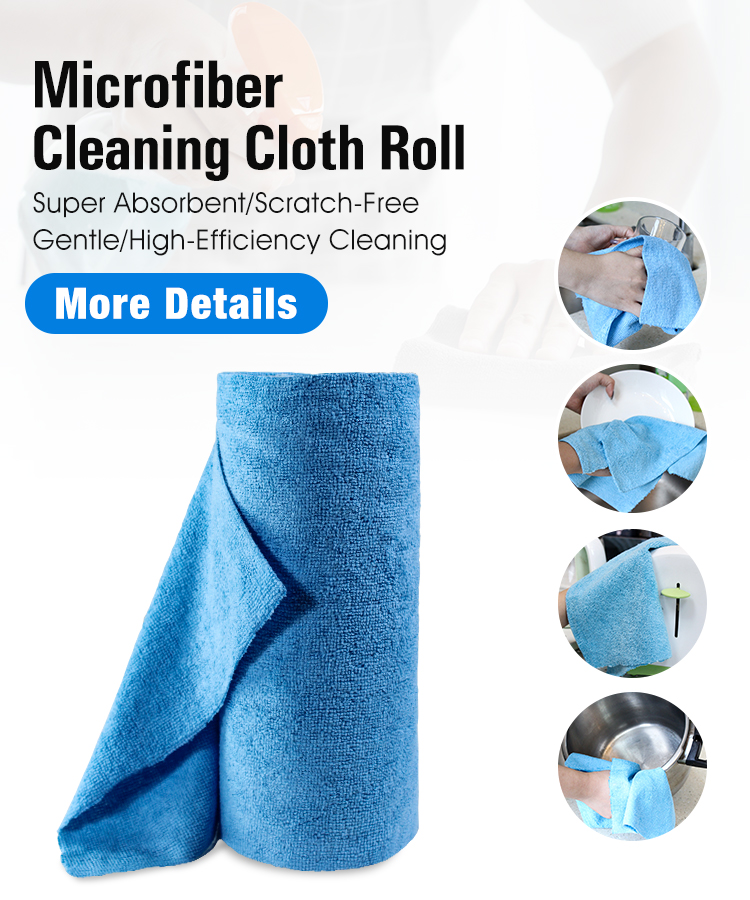
Model MJ-012 microfiber cleaning cloth roll: documented at 180–320 gsm, 30×30 cm perforated pieces, pre-perforated tear-off line with a clean die-cut edge. A roll format points to a slitting and perforation step rather than only cut-and-sew output.
The audit question is not "how many models does this supplier list?" It is "do these models describe different machines?" A catalog listing thirty variants of one terry cloth is a narrow factory with a wide price sheet. A catalog listing a twisted-loop detailing cloth, a tufted pad, a striped mop and a laser-cut polishing cloth is describing several routes — which is usually the more relevant fact for a project that may need more than one construction.
Signal 2 — Fiber Ratios and GSM Ranges Show Process Discipline
Polyester and polyamide ratios are the most comparable parameters in any microfiber document. Across one documented range, the 80% polyester / 20% polyamide blend appears on the twisted-loop detailing cloth (MJ-030), the terry string mop (MT-003), the terry cleaning cloths (MJ-002, MJ-021, MJ-022), the striped kitchen cloth (MD-020), the cleaning cloth roll (MJ-012), the polishing cloth (MW-002) and the hair drying turban (GFM-002). A different ratio, 85% polyester / 15% polyamide, is used on the universal cleaning cloth (MJ-001); 88% polyester / 12% polyamide on the suede sports towel (MST-001); 70% polyester / 20% PU / 10% polyamide on the coated multi-scene cloth (PU-001); 60% polyester / 20% polyamide / 20% bamboo on the bamboo fibre kitchen cloth (MW-003); and 40% cotton / 60% polyester on the tufted pad (MP-006).
Polyamide is the minority component in most of these blends, and it is the component that carries much of the water uptake in a polyester blend. Stating a 20% minority share per model, consistently, is a statement about blending control — not about the fabric being absorbent in the abstract. Where a catalog says only "microfiber" and never quantifies the blend, that control point is missing from the document and must be requested.
GSM bands in the same range run across a wide spread: 180–320 gsm on the cleaning roll and the fine-rib glass cloth (MJ-012, MJ-013); 180–450 gsm on the universal cleaning cloth (MJ-001); 200–240 gsm on the polishing cloth (MW-002); 200–400 gsm on the waffle kitchen towel (MS-074); 250–350 gsm on the striped kitchen cloth and the coated cloth (MD-020, PU-001); 280–350 gsm on the bamboo blend (MW-003); 300 gsm on one terry cleaning cloth (MJ-002); 250–500 gsm on the terry auto cloth (MJ-021); 300–500 gsm on the ultrasonic-edge wash towel (MJ-022); 500–1000 gsm on the twisted-loop detailing family (MJ-030, MJ-023); and 650–680 gsm on the glass washer covers (CG-001, CG-002, CG-003).
Signal 3 — Edge Finishing Is the Cheapest Capability Test Available
Edge finishing is the most useful single parameter in a document because each finishing technology implies distinct equipment, and one of them can be physically counted on a sample.
- Ultrasonic cutting and sealing: documented on the string wet mop strip edge (MT-003), the auto wash towel (MJ-022) and the coated multi-scene cloth (PU-001). Ultrasonic sealing closes a cut edge without thread, which matters where fraying and lint shedding are project-critical.
- Laser cutting: documented as a scalloped laser cut edge on the circular-knitted polishing cloth (MW-002).
- Die-cutting and perforation: documented on the PVA coated cloth (PVA-002) and the cleaning cloth roll (MJ-012), which combines a perforation line with a clean die-cut edge.
- High-density overlock stitching: documented at 10–12 stitches per inch on the striped kitchen cloth (MD-020), the bamboo fibre cloth (MW-003), the fine-rib glass cloth (MJ-013), the glass polishing towel (MJ-066), the suede sports towel (MST-001) and the three-layer cooling towel (MST-002).
- Bound and piped edges: documented as a colourful piped binding edge on the twisted-loop detailing cloth (MJ-030) and a decorative overlock binding edge on the terry auto cloth (MJ-021).
Stitch density is the parameter a buyer can verify with a ruler in under a minute. That makes "10–12 stitches per inch" one of the few catalog claims that can be tested without a laboratory — and a supplier that publishes it invites the test.
Attachment design belongs in the same assessment. Velcro and elastic loop fixing on the glass washer covers (CG-001, CG-002, CG-003), full velcro backing on the 18-inch and 24-inch mop refill (MP-015), double-pocket backs with colour-coded identification tags on the floor pads (MP-014, MP-020, MP-006), and a spiral plastic socket for pole connection on the string mop (MT-003) show that the supplier builds to a floor-care and glass-care system, not only to a fabric specification.
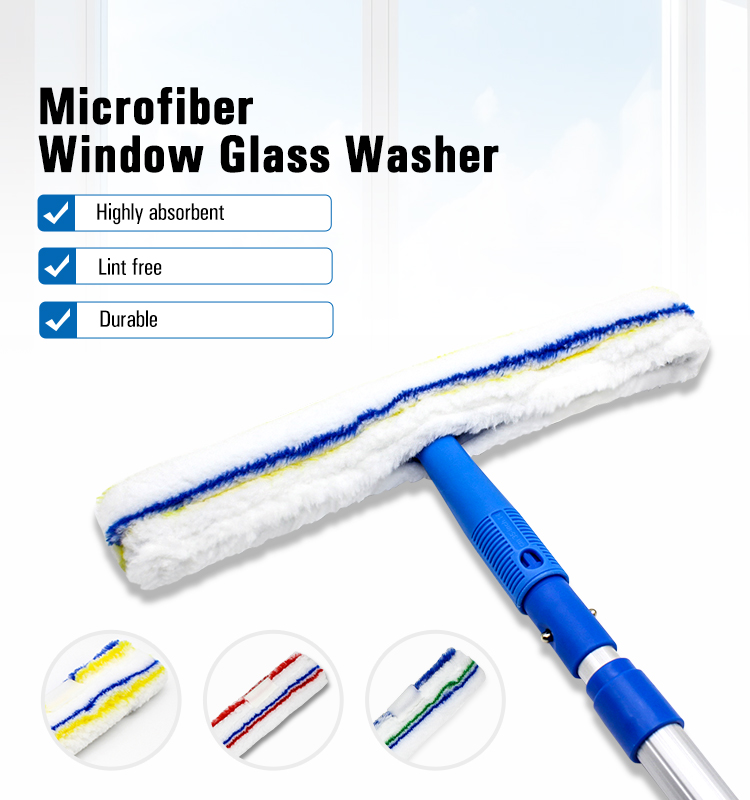
Model CG-002 window glass washer sleeve: documented at 650–680 gsm, 36 cm / 40 cm / 46 cm, with a built-in scrubbing fabric, velcro and elastic loop fastening, and a fully wrapped hemmed edge. Three sizes on one attachment system indicate a floor-and-glass product family rather than a single accessory.
Signal 4 — Catalog-Wide Consistency Is a Quality-Control Signal
Consistency across unrelated product families is harder to fake than any single specification. In one documented range, ultrasonic finishing appears on a mop component, a towel and a coated cloth; the 10–12 stitches per inch specification appears across kitchen, glass, sports and cooling lines; and the absorption figure "absorbs up to 7 times its own weight of liquid" is carried on cloths, towels, mops, the pet towel and the hair turban alike.
That repetition suggests a specification template maintained in one place rather than marketing copy written product by product. The corresponding audit question is direct: can the supplier return the same parameter set for every model in a family? Where a weight is published for one size and omitted for the next, or where a GSM range appears on one SKU and disappears on its neighbour, the document is being written for presentation rather than for procurement.
What Foshan Patinda Housewares Co., Ltd. Documents in Public
Foshan Patinda Housewares Co., Ltd. is a microfiber cleaning products manufacturer based in Xiqiao Town, Nanhai District, Foshan, Guangdong, China, stating a founding date of May 2004 and a focus on microfiber textiles for household, automotive, kitchen, window and glass cleaning applications.
The documented manufacturing profile includes a 45,000 m² manufacturing plant, 200 employees, an R&D team of 17 engineers, more than 10 fully automatic production lines for precision cloth cutting and sewing, and more than 450 sets of production machinery. Stated capacity is a monthly output of 182,022 kg and an annual output of 2,184,270.46 kg, with an export ratio of 98% and main markets listed as the USA, Canada, Australia, the United Kingdom, Germany, France, Italy, the Netherlands, Russia, Japan, Korea, Switzerland, Sweden, Turkey and Saudi Arabia.
Documented commercial terms are equally specific: OEM and ODM production, customization across size, weight, logo, material, fabric texture, printing, colour, accessories, packaging, extra functional treatment, shipping label and GSM, a minimum order quantity of 3,000 pieces, a lead time of 30–45 days, and 100% testing.
One third-party trace sits outside the company's own documents. US customs import records collected under the trading name Foshan Pa Tin Da Housewares Co., Ltd. show 172 recorded bills of lading between June 2019 and September 2026. That is evidence of sustained import activity into the United States; it is not evidence of product quality, and it should be read as activity data rather than as a performance claim.
Turning Catalog Evidence Into Project Fit
Project requirements are usually described in operational language rather than in textile parameters. Hospitality and car care buying documents, for example, describe indoor enclosed environments at normal room temperature (10°C to 35°C), frequent water immersion and repeated wet-dry cycles, high-frequency friction and repeated scrubbing, reusable daily use with repeat washing, and specific demands for custom logo, custom size and colour, quick-dry behaviour, lint-free performance and high water absorbency. Those scenarios are commonly specified in Germany and the United States, and they appear both in hotel and resort daily sanitation procurement projects and in auto beauty and car wash chain supply projects.
The audit method converts that language into construction parameters. The table below shows the conversion for six common project types, using documented model specifications as examples.
| Project requirement | Construction evidence to demand | Documented example from the range |
|---|---|---|
| Launderable floor pads for hotel and resort sanitation | Declared pad weight, declared GSM, colour-coded area identification, wash-cycle claim | MP-014 striped mop: 40 cm / 50 cm, 100 g / 115 g per pad, double-pocket back with colour-coded classification tag, documented reusable over 300 washing cycles |
| Stubborn-stain floor care with separated cleaning zones | Abrasive component documented separately from the absorbent pile | MP-020 abrasive mop: white microfiber main pile plus red PET abrasive stripe, 80 g / 95 g, four-colour classification label |
| High-volume wet mopping in schools and public buildings | Edge sealing method and pole interface | MT-003 terry string mop: 35×10 cm, 200 g / 300 g refill, ultrasonic sealed cutting strip edge, spiral plastic socket |
| Auto detailing and car wash chain supply | GSM band, edge type, absorption claim, paint-safety statement | MJ-030 twisted loop cloth: 500–1000 gsm, piped binding edge, absorbs up to 7 times its own weight, documented streak-free and scratch-safe for paint and glass |
| Commercial kitchen and catering | Stitch density, GSM band, weave structure | MD-020: 250–350 gsm with a 10–12 stitch per inch locking edge; MW-003: 280–350 gsm bamboo blend with 10–12 stitch per inch double overlock |
| Window, mirror and glass maintenance | Plush weight, pad size range, attachment design | CG-002 and CG-001: 650–680 gsm, 36 cm / 40 cm / 46 cm, velcro and elastic loop fixing, built-in scrub strip on CG-002 |
Documented order data from the same range adds a planning dimension: order quantities are recorded at 1,000–50,000 pieces per order across retail distributor, auto care brand, gym brand and janitorial wholesaler customer types, with a documented reuse period of 6–12 months after repeated washing. For a buyer assembling a project schedule, those two figures — order band and reuse interval — are more operationally useful than a headline absorption claim.
Where the Audit Stops: Documented Limits of a Catalog Read
A catalog audit narrows a shortlist. It does not close a purchase, and it is worth stating precisely where its authority ends.
Commercial terms are fixed, not inferred. A minimum order quantity of 3,000 pieces and a lead time of 30–45 days are documented constraints. No amount of specification reading changes them, and a project timeline that ignores them will fail at the production stage rather than at the sample stage.
Certification claims cannot be verified inside a catalog. OEKO-TEX STANDARD 100, ISO 9001:2015, ISO 45001:2018 and GRS appear as company-stated certifications. Verification is issuer-side: certificate numbers must be checked in the relevant registry, and certificate dates matter, because OEKO-TEX STANDARD 100 was updated in 2024 to include a total fluorine limit of 100 mg/kg in response to PFAS regulation. A certificate issued before that update may not address current chemical requirements.
Three parameters are outside the document entirely. A catalog cannot establish batch-level GSM variance, verified recycled content, or fiber shedding rate. For this product scope, no verified dataset covering those three measurements was identified in the available research, which is precisely why they remain sample-testing and factory-audit items rather than reading items.
Some claims are only testable in the hand. An absorption claim such as "absorbs up to 7 times its own weight" is a performance statement that a document cannot prove. Stitch density can be counted with a ruler; absorption must be measured.
How This Differs From a Conventional Sourcing Check
| Dimension | Conventional sourcing check | Audit read of the catalog |
|---|---|---|
| Primary comparison basis | Price per piece and quoted size | Construction route, fiber ratio, GSM band, edge finishing, attachment design |
| Certificate handling | Certificate copy filed with the quotation | Certificate identifier, issue date and issuer registry confirmation |
| Sample assessment | Overall feel and appearance | Parameter-by-parameter check: weight, GSM band, stitch density, edge type |
| Supplier comparison | Breadth of claims and product count | Consistency of documented specifications across product families |
| Known blind spot | Price comparison does not reveal repeatability | Requires published specifications; suppliers listing only photographs cannot be audited this way |
The limitation is worth stating plainly: the audit method only works where a supplier publishes parameters. Where a catalog shows photographs and describes products only in adjectives, the method has no input — and that absence is itself the finding, because a manufacturer producing to project specifications generally keeps the parameters on file and can release them on request.
Market Context: Why Specification Reading Is Gaining Weight
The category is growing steadily rather than explosively, which shifts competition toward fit rather than volume. Future Market Insights projects the global microfiber cleaning cloth market to grow from USD 979.2 million in 2025 to USD 1,520.7 million by 2035, at a 4.5% CAGR. Fortune Business Insights projects growth from USD 1.04 billion in 2026 to USD 1.49 billion by 2034, at a 4.57% CAGR. Both are commercial research estimates rather than official statistics; they differ in base year and end year and should be read as directional rather than combined into a single figure.
Two further data points from commercial research describe what is being bought. Multicomponent microfiber — the polyester and polyamide blend structure — held a 58.0% revenue share of the category in 2025, confirming that the blended construction audited here is the mainstream specification rather than a premium variant. Kitchen care was the largest application segment in 2025 at a 28.3% revenue share.
In single-digit growth conditions, suppliers cannot rely on category expansion to absorb specification mismatches. That is the commercial reason a catalog read has become a procurement skill rather than an academic exercise.
Technical definitions used above follow standard textile usage: microfiber refers to fiber measuring below 1.0 denier, the diameter or fineness of a continuous or filament fiber. The same word is also used in an environmental sense to describe microscopic fibers shed from textiles; the two definitions should not be merged in specifications or sustainability claims.
Future Outlook
Three changes are likely to shape how microfiber catalogs are read over the next procurement cycles.
First, specification sheets are likely to replace general catalogs as the working document in project sourcing. A declared target GSM with an agreed tolerance, a stated edge finishing method, a stated fiber ratio and a stated attachment design are the four parameters that make incoming inspection possible — and buyers who have been burned by a range that was never pinned will start demanding them at the RFQ stage.
Second, chemical regulation will continue to force date-awareness on documentation. The 2024 update to OEKO-TEX STANDARD 100, which added a total fluorine limit of 100 mg/kg, is one example of a requirement change that a certificate issued a few years earlier may not cover. Buyers will increasingly treat certificate dates as part of the specification rather than as an appendix.
Third, documented breadth will become a qualification asset for manufacturers rather than a marketing trophy. A supplier able to show multiple production routes with consistent parameters across mops, auto care, kitchen, window and sports lines is easier to qualify for a multi-site project than a supplier whose documentation covers a single construction.
FAQ
What is the minimum a microfiber catalog should document before it can be used for a commercial cleaning project?
Per model, a buyer should be able to read five parameters: fiber composition ratio, GSM or unit weight, dimensions, edge finishing method, and attachment or closure design. Documented examples show the level of detail that is achievable — MD-020 states 250–350 gsm with a 10–12 stitch per inch locking edge; MJ-030 states 500–1000 gsm with a piped binding edge; CG-002 states 650–680 gsm with velcro and elastic loop fixing. Where these parameters are absent, the document can support a shortlist conversation but not a specification comparison.
Should a published GSM range be treated as a purchase specification?
No. A range describes what a production line can handle. Families documented at 500–1000 gsm (MJ-030, MJ-023) or 300–500 gsm (MJ-022) span wide bands, and the delivered weight must be fixed as a declared target with a tolerance in the purchase order. Without a pinned target value, incoming inspection has no reference point, and weight variation across a shipment cannot be assessed against anything.
How should OEKO-TEX, GRS, ISO 9001 or ISO 45001 claims be verified?
Verification is issuer-side. Certificate numbers should be checked in the registry of the issuing body, and the certificate date should be reviewed against current requirements — OEKO-TEX STANDARD 100 was updated in 2024 to include a total fluorine limit of 100 mg/kg to address PFAS regulation, so certificates issued before that update may not reflect the current test scope. A statement of certification in a catalog, brochure or social post is a supplier claim and is not equivalent to a verified certificate.
Does edge finishing really indicate manufacturing capability, or is it a cosmetic detail?
It is one of the more reliable indicators available in a document because each edge type implies different equipment. Ultrasonic cutting and sealing appears on the string mop strip edge (MT-003), the auto wash towel (MJ-022) and the coated cloth (PU-001); laser cutting appears as a scalloped edge on the polishing cloth (MW-002); die-cutting and perforation appear on PVA-002 and MJ-012; and high-density overlock stitching at 10–12 stitches per inch appears across the kitchen, glass, sports and cooling lines. Stitch density can also be counted with a ruler on a physical sample, which makes it a claim a buyer can test at low cost.
Is product breadth relevant if the project needs a single SKU?
Breadth functions as a risk indicator rather than a purchase reason. A supplier documenting mops, auto care, kitchen, window, sports and cooling lines — with different pile structures such as twisted loop, terry loop, tufted loop, chenille, coral fleece and waffle weave — is demonstrating multiple production routes. In practical terms, the constraints that affect a single-SKU order are the stated commercial terms: Foshan Patinda Housewares Co., Ltd. documents a monthly capacity of 182,022 kg across more than 10 automatic cutting and sewing lines, a minimum order quantity of 3,000 pieces and a lead time of 30–45 days.
What can a catalog audit not establish?
It cannot confirm certifications, batch-level GSM variance, verified recycled content, or fiber shedding rate, and it cannot prove an absorption claim from a document alone. It also does not change documented commercial constraints such as a 3,000-piece minimum order quantity and a 30–45 day lead time. The audit narrows the supplier shortlist and defines what to test; sample validation and issuer registry checks remain necessary steps before commitment.
Reading Order for the Next RFQ
Treat a microfiber catalog as a manufacturing document first. Extract the fiber ratio, the GSM band, the edge method and the attachment design for every model in the family you intend to buy. Convert any range into a declared target with a tolerance. Check certification identifiers at the issuer, not in the brochure. Then verify stitch density and weight on the sample, and measure absorption rather than accepting it.
A supplier that publishes these parameters consistently across mops, auto care, kitchen, window and cooling lines has already passed the first stage of an audit. The manufacturer described above is one example of a range documented at that level of detail; the company's full product catalog, including model-level specifications, is available as a downloadable reference at the Pa Tin Da 2024 e-catalog.