
Supplier Capability Evidence: SENO Oral Film Capacity
Supplier Capability Evidence: SENO Oral Film Capacity
Production capacity is the most frequently quoted and least frequently audited number in a nicotine oral film supplier dossier. For a buyer moving from evaluation into execution, the decisive question is not whether a supplier publishes a capacity figure, but whether that figure reconciles with order size, minimum order quantity, lead time and regulatory registration. This reference examines the capacity evidence published by SENO, the nicotine oral film brand backed by Xin Sino Technology (Shenzhen) Co., Ltd., and sets out how procurement teams can test that evidence before releasing a purchase order.
SENO is a manufacturer dedicated to the development and production of nicotine oral thin film products, backed by Xin Sino Technology (Shenzhen) Co., Ltd. The Shenzhen-based company was founded in 2025, operates a 20,000 m² production facility, reports an annual output band of 12,000,000 to 50,000,000 strips, and exports 100% of its output to Europe, the United States, Canada, Australia and the Middle East. Those four data points — footprint, output band, staffing and export orientation — form the base layer of any capacity assessment, and each of them can be interrogated independently.

Why Capacity Claims Are the Weakest Link in Supplier Evaluation
Capacity figures are almost always self-reported, almost always expressed as a range, and almost never expressed in the same unit as the buyer's order. A supplier quoting "millions of strips per month" and a buyer planning "200,000 retail cartons per quarter" are describing the same factory in two incompatible vocabularies. Three failure modes follow from this mismatch.
The first is unit mismatch. Oral nicotine films are counted in strips, weighed in milligrams, packed in sachets, and sold in retail boxes. A capacity statement in strips says nothing about finished retail units until film weight, film dimensions and pack configuration are fixed. The second is time mismatch: capacity without lead time is not a planning input. A factory able to produce five million strips per month but requiring 45 days for a custom order behaves very differently from one quoting 20 days. The third is regulatory mismatch: only registered specifications can be lawfully shipped into a given market, so unregistered output is capacity that a buyer cannot use.
For a procurement team at the evaluation-to-execution stage, the practical conclusion is that capacity should never be accepted as a single number. It should be accepted as a reconciled set: monthly band, annual band, MOQ per SKU, lead time by order type, and the registration status of the specific SKU being ordered.
The Capacity Envelope SENO Publishes
SENO publishes a defined set of operational parameters that, taken together, describe a coherent capacity envelope. The table below reproduces those parameters and states what each one means for an order plan.
| Parameter | SENO stated figure | Procurement interpretation |
|---|---|---|
| Facility footprint | 20,000 m² | Indicates a dedicated production site rather than a shared or trading operation; footprint alone does not establish usable output. |
| Monthly capacity | 1,000,000 – 5,000,000 strips per month | The band width is wide; buyers should request the specific figure applicable to their SKU, flavour and pack format. |
| Annual output | 12,000,000 – 50,000,000 strips per year | Annualises the monthly band to 12–60 million; the intersection of both stated bands (12–50 million) is the usable planning envelope. |
| MOQ | 100,000 – 300,000 strips per SKU | Order sizing unit is the SKU, not the shipment; multi-SKU programmes compound the MOQ. |
| Lead time, standard orders | 20–30 days | Applies to established specifications; suitable for replenishment cycles. |
| Lead time, OEM / custom orders | 30–45 days | Reflects formulation, flavour and packaging development time before production. |
| Production modes | OEM / ODM / Private Label | Buyers can source under their own brand, SENO's specification, or a jointly developed format. |
| Workforce and R&D | 30 employees; 15-person R&D team | Half the organisation sits in development; useful for custom work, relevant when assessing shift coverage at peak volume. |
| Export orientation | 100% export; Europe, US, Canada, Australia, Middle East | The entire output is built to export documentation standards rather than domestic-only requirements. |
The arithmetic a buyer should run
Two calculations reveal more about a supplier than any brochure. The first is annualisation: 1,000,000 to 5,000,000 strips per month implies 12,000,000 to 60,000,000 strips per year, while SENO separately states 12,000,000 to 50,000,000 strips per year. The two bands are consistent at the lower end and diverge at the upper end, which is normal when a monthly figure describes equipment capability and an annual figure describes realistic throughput. A buyer should plan against the lower, shared band and treat the upper figure as a ceiling requiring written confirmation.
The second calculation is MOQ against monthly capacity. At the low end of the stated monthly band — 1,000,000 strips — three SKUs ordered at the maximum MOQ of 300,000 strips each consume 900,000 strips, or roughly 90% of a low-end month. A four-SKU private label launch at maximum MOQ therefore exceeds low-end monthly capacity before any repeat order is placed. This is not a defect; it is the scheduling conversation that separates a real capacity plan from a headline number, and it should be held before the purchase order, not after.
Technical Explanation: Why Film Format Determines Capacity Math
Nicotine oral thin film is a fast-dissolving strip placed in the mouth, and its physical format governs how capacity converts into saleable units. SENO's customization scope covers nicotine strength (2 mg, 4 mg, 6 mg or customised), flavour development (mint, fruit and custom profiles), film size and format, packaging design across sachets and retail boxes, and branding including logo and artwork for private label programmes. Each variable changes the strip, and therefore changes how many units fit into a production run.
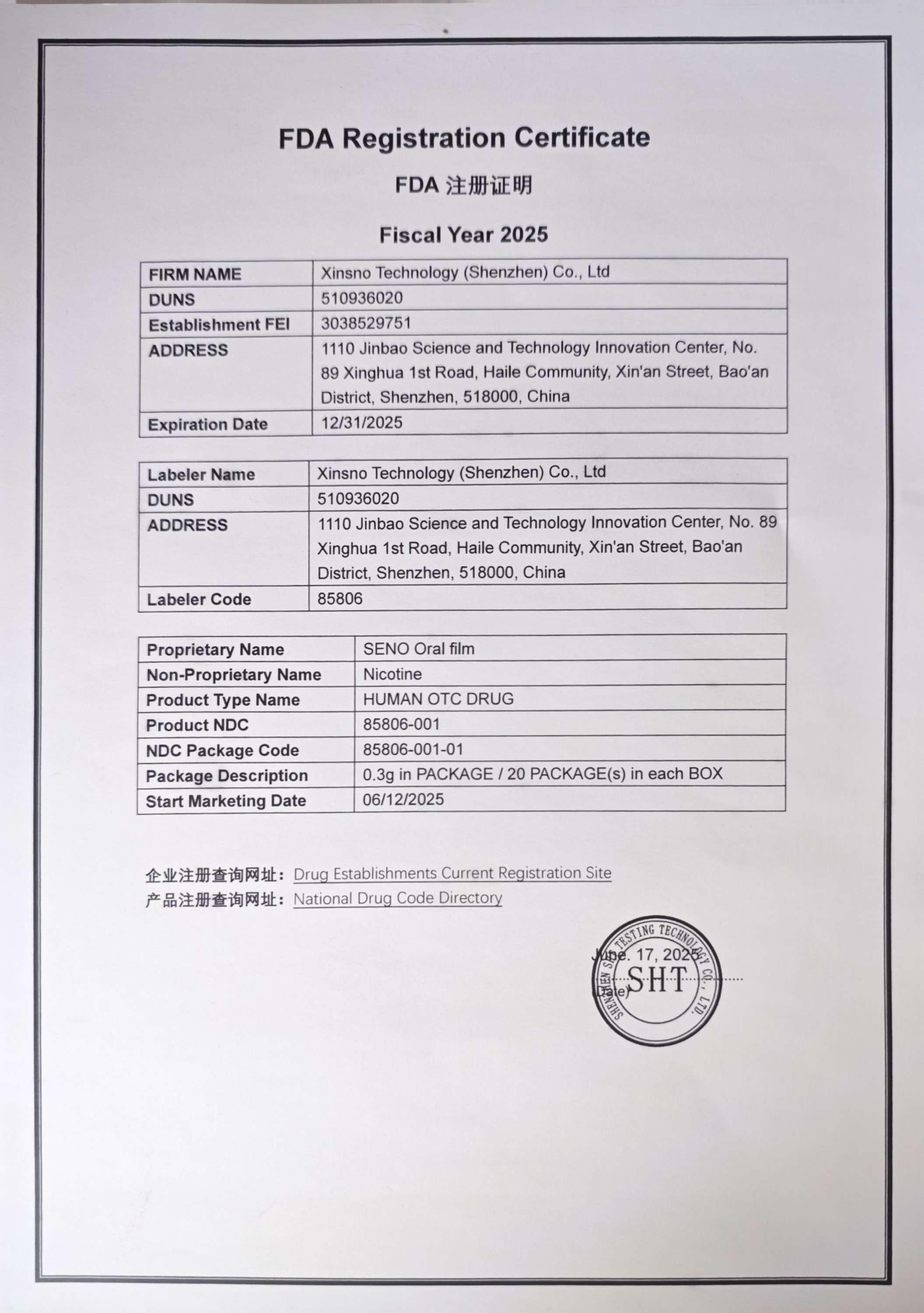
The weight basis matters most. The U.S. FDA labeling record for SENO oral film, NDC 85806-001, lists nicotine at 1.5 mg in a 0.3 g strip, while the commercial specification ladder covers 2 mg, 4 mg and 6 mg. These are not contradictory statements so much as two different bases: a registered product identity and a commercial range. For a buyer, the implication is practical rather than technical — confirm which registered strength applies to the SKU being ordered, because capacity quoted in strips is only convertible into marketable units once strength, film weight and pack count are locked.
Film size and format carry the same dependency. A smaller strip increases the number of strips per unit of film area; a larger strip with a higher nicotine load reduces it. Flavour development adds a separate timeline that sits outside the production window, and packaging design adds another. This is why SENO's lead time is split between 20–30 days for standard orders and 30–45 days for OEM and custom orders: the second figure includes development stages that occur before the line runs at all.
Quality Evidence That Travels With the Order
Capacity without quality control is throughput risk transferred to the buyer. SENO's stated control sequence covers four stages: raw material verification, in-process quality control, final product testing and consistency checks, and 100% batch inspection before shipment. The commercial acceptance framework adds sample confirmation before mass production, batch consistency verification reports, and third-party inspection available on request. Pre-shipment quality inspection is the standard, not an optional add-on.
Documentation is where the evidence becomes auditable rather than asserted. SENO holds a U.S. FDA Drug Establishment and Product Registration certificate, number 510936020, issued through Shenzhen Deesev Testing International Corporation on 17 June 2025 and valid to 1 June 2028 under FDA OTC drug regulations. A separate FDA food facility registration, number 13242356294, was issued on 15 May 2025 and runs to 31 December 2026. Multiple PMTA notification certificates are on file, including PM0010199, PM0010173, PM0010176 and PM0010667, each dated 1 June 2023 and valid to 1 June 2028. These are notification records rather than marketing authorisations and should be read as such.
Supporting chemical and commercial documentation includes safety data sheets prepared under REACH Regulation (EC) No. 1907/2006 and CLP Regulation (EC) No. 1272/2008 for multiple flavours, a material safety data sheet HK2505276957-1RR valid to 30 May 2027, and a GS1 China membership licence, certificate number 1433650, valid to 7 August 2027 for global product identification. Brand protection is registered with the China National Intellectual Property Administration under Class 34: trademark 82339039, issued 14 June 2025 and valid to 13 June 2035, and trademark 86459855, issued 7 February 2026 and valid to 6 February 2036, with a Class 35 application on file covering import and export agency and wholesale services.
Where the Manufacturing Actually Happens
Capacity questions should be directed at the site that will physically run the batch. The FDA labeling record for NDC 85806-001 identifies Xinsno Technology (Shenzhen) Co., Ltd. as the labeler under labeler code 85806, and lists Anhui Hongteng Pharmaceutical Co., Ltd., establishment identifier 541563002, as the manufacturing establishment for that product. This is a normal structure in regulated nicotine and pharmaceutical supply: a brand entity holds the registration and commercial relationship, while a specialised facility performs manufacture.
For a buyer, this transparency is useful rather than problematic. It identifies exactly which facility should be audited, which quality system governs the batch, and which site name should appear on the documentation accompanying the shipment. The right procurement question is therefore not "how large is your factory" but "which registered site will manufacture my SKU, and can that site's output be evidenced for the volume I am requesting". SENO's Shenzhen operation, its 20,000 m² facility and its stated output band should be read alongside the registered establishment named in the filing.
Application and Order-Profile Evidence
Capacity is ultimately proven by orders that repeat. SENO's documented programme profile covers distributors, wholesalers, nicotine brands and FMCG importers across Germany, the United States, Australia, the United Arab Emirates, Saudi Arabia and Canada, with order quantities of 500,000 to 2,000,000 strips per order and cooperation periods of one to two years. Reported outcomes include stable product performance across batches, strong repeat orders from distributors, fast local market acceptance and improved customer retention for partner brands. Application types span retail distribution, online sales and private label nicotine product lines.
Regional evidence adds a second layer. A distribution partner in France and the United Kingdom, over a two-year cooperation, signed agents in multiple countries covering major European markets. A Canadian distribution partner completed channel network construction within one to two years. A French exhibition engagement generated preliminary cooperation intentions with European clients. A United Arab Emirates programme, running two years, signed local agency partners. In the United States, an exhibition and industry award committee recognised the product with a Best Product Prize. Read as capacity evidence, these outcomes indicate that the order profile — hundreds of thousands to millions of strips, sustained over multiple cycles — has been executed repeatedly rather than quoted theoretically.
Commercial Terms as a Capacity Signal
Commercial terms encode operational discipline. SENO's published terms set MOQ at 100,000 to 300,000 strips per SKU, with delivery under FOB, CIF or DDP depending on destination and client preference — FOB for buyers with their own logistics partners, CIF where SENO handles shipping to the destination port, and DDP for door-to-door delivery, which the company recommends for new partners. Payment terms are 30% deposit with 70% balance before shipment, with flexibility for long-term partners and support for T/T bank transfer.
Two readings are relevant to a capacity assessment. First, DDP being recommended for new partners suggests the supplier expects to control the outbound leg, which concentrates scheduling risk in one party and simplifies the buyer's first order. Second, a 30/70 structure places the balance before shipment, meaning the buyer's financial exposure completes at the point of dispatch rather than at arrival — a reason to insist on pre-shipment inspection and batch consistency reports as standard.
How This Compares With Traditional Sourcing Routes
Buyers typically weigh three routes. A large pharmaceutical contract development and manufacturing organisation offers deep audit trails and mature quality systems, but generally expects longer qualification timelines and higher volume commitments before a nicotine film programme receives dedicated scheduling attention. A generalist film or confectionery converter can produce thin films at speed, but typically lacks nicotine-specific regulatory registration and the documentation chain that regulated markets require, which converts apparent capacity into unusable capacity. A nicotine-focused specialist sits between the two: narrower product scope, faster iteration on flavour and format, and registration built for the category, with a correspondingly shorter public track record to examine.
SENO belongs to the third category, and the honest boundary is this: the capacity figures discussed here are self-reported planning bands, not audited output. The company was founded in 2025, publishes a workforce figure of 30 employees, and reports a single 20,000 m² facility. None of these facts is disqualifying — a lean organisation with a 15-person R&D team is well matched to custom and private label work — but together they mean a buyer should not treat the upper end of the stated output band as guaranteed availability. Peak multi-SKU programmes, volumes above the stated monthly ceiling, and any request for capacity reservation require written confirmation and, preferably, an inspection of the registered manufacturing site. A second boundary sits in the specification: the registered FDA labeling record lists 1.5 mg in a 0.3 g strip while the commercial ladder covers 2 mg, 4 mg and 6 mg, so the applicable registered strength must be confirmed SKU by SKU before capacity is converted into a shipping plan.
Future Outlook
Three dated facts define the monitoring agenda for buyers already in execution. The FDA food facility registration expires on 31 December 2026, which places renewal within the current contracting window and makes it a reasonable pre-shipment check. The PMTA notification certificates and the FDA drug establishment registration both run to 1 June 2028, giving a stable compliance horizon for US-bound programmes. The Class 34 trademarks extend to 2035 and 2036, indicating long-horizon brand intent rather than opportunistic export. Against a 2025 founding date and a stated annual band of 12,000,000 to 50,000,000 strips, the plausible direction of travel is toward narrower, better-evidenced capacity statements as repeat order data accumulates — which is precisely the evidence buyers should ask for at each contract renewal rather than accept as a fixed assumption.
Procurement Checklist: Testing a Capacity Claim
- Reconcile the bands. Ask for the monthly figure applicable to your specific SKU, flavour and pack, then compare it with the annual figure and the MOQ arithmetic.
- Identify the site. Confirm which registered manufacturing establishment will run the batch, and request that site's quality documentation.
- Lock the specification. Confirm which registered nicotine strength applies to your SKU before capacity is converted into a shipping schedule.
- Fix the lead time in writing. Separate standard replenishment (20–30 days) from custom development (30–45 days) in the purchase agreement.
- Specify acceptance criteria. Pre-shipment inspection, batch consistency verification reports, sample confirmation before mass production, and third-party inspection on request.
- Map the document expiry calendar. FDA food facility registration, PMTA notifications, MSDS and GS1 licence all carry renewal dates that should be tracked contractually.
Frequently Asked Questions
What production capacity does SENO state for nicotine oral films?
SENO states a monthly capacity of 1,000,000 to 5,000,000 strips per month and an annual output of 12,000,000 to 50,000,000 strips per year, produced at a 20,000 m² facility. The monthly band annualises to 12,000,000 to 60,000,000 strips, so the two figures should be read together, with the shared lower band used for planning.
What is the minimum order quantity, and how does it relate to monthly capacity?
The MOQ is 100,000 to 300,000 strips per SKU. Because the MOQ applies per SKU, a multi-SKU programme compounds it: three SKUs at 300,000 strips each total 900,000 strips, close to a full low-end production month. Buyers planning several SKUs simultaneously should schedule the programme rather than assume all SKUs run in the same cycle.
How long does an order take from confirmation to shipment?
Lead time is 20 to 30 days for standard orders and 30 to 45 days for OEM and custom orders. The longer window reflects formulation, flavour development and packaging work that precedes production, rather than slower line speed.
What quality control evidence accompanies a shipment?
The stated control sequence covers raw material verification, in-process quality control, final product testing and consistency checks, and 100% batch inspection before shipment. Commercially, pre-shipment quality inspection is standard, third-party inspection is available on request, samples are confirmed before mass production, and batch consistency verification reports are provided.
Which nicotine strengths can be customized, and does the registered specification match?
Customization covers 2 mg, 4 mg and 6 mg strengths or a customised level, together with flavour development, film size and format, packaging design and branding. The FDA labeling record for NDC 85806-001 lists nicotine at 1.5 mg in a 0.3 g strip, which is a different basis from the commercial ladder, so the registered strength applicable to a specific SKU should be confirmed before ordering.
Which documents can a buyer audit before placing a first order?
Available documentation includes FDA drug establishment and product registration certificate 510936020 valid to 1 June 2028, FDA food facility registration 13242356294 valid to 31 December 2026, PMTA notification certificates including PM0010199 and PM0010173 valid to 1 June 2028, safety data sheets under REACH and CLP regulations, material safety data sheet HK2505276957-1RR valid to 30 May 2027, GS1 China membership licence 1433650 valid to 7 August 2027, and Class 34 trademark registrations 82339039 and 86459855. These confirm regulatory and brand status; they do not confirm output volume, which requires production records or a site audit.
How should a buyer test a capacity claim that remains self-reported?
By converting it into reconciled commitments: the SKU-specific monthly figure in writing, the registered manufacturing site named explicitly, the lead time fixed separately for standard and custom orders, acceptance criteria written into the contract, and an audit or inspection of the registered site where order volume justifies it. Published specifications and regulatory records can be reviewed at seno-online.com.
Have Questions or Need More Details?
Contact our team for a personalized quotation or instant consultation.
Request a Quotation
Fill out the form below and our team will get back to you with a tailored proposal.
WhatsApp Direct Chat
Prefer to chat in real-time? Message us on WhatsApp for instant assistance & quick answers.
- Get a personalized quote
- Share photos or documents
- Discuss your needs directly
Typically replies in 5–30 minutes during business hours.