
Supplier Capability Evidence: UMIDIGI's 14-Year ODM/OEM Record
Long battery life has become a mainstream purchase criterion rather than a niche preference. Counterpoint Research reports that smartphones with 6,000mAh or higher battery capacity reached 29% of global sales in January 2026, up from 10% in early 2025. For buyers at the decision stage, the consequence is uncomfortable: almost every supplier can now quote a large-capacity cell, so the differentiating question is which supplier can show a repeatable record behind that number.
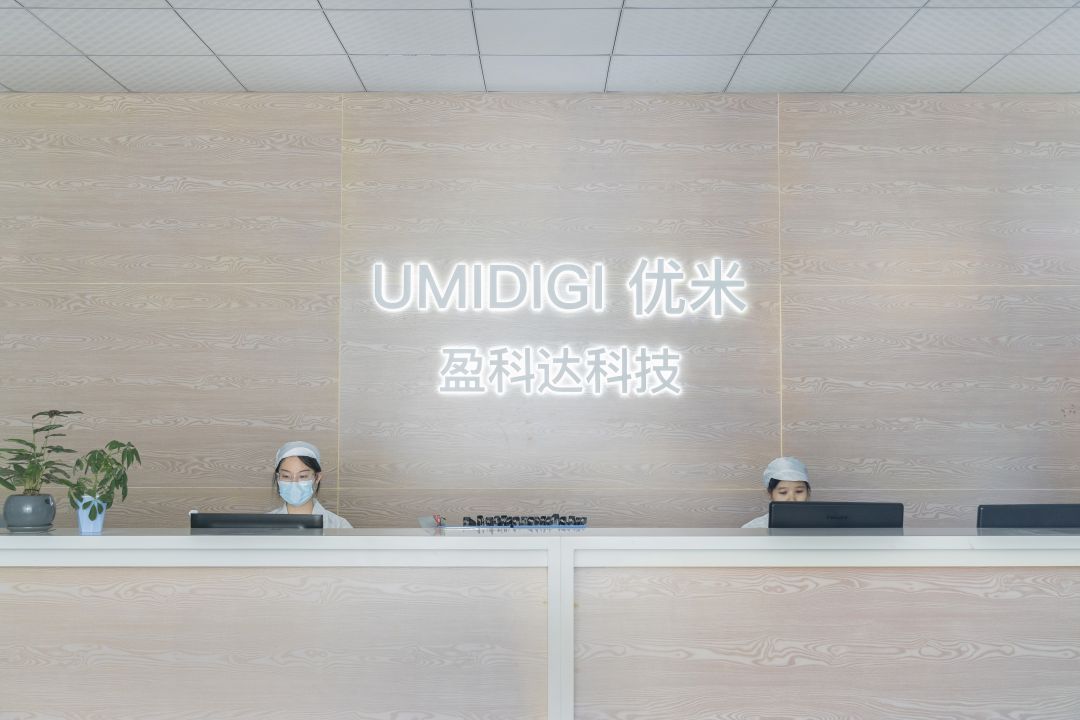
Manufacturing floor at Shenzhen Keysmart Technology Co., Ltd., the company behind the UMIDIGI brand and its ODM/OEM business. Image: Keysmart.
Why a battery specification turned into a supplier question
Capacity is one of the easiest specifications in the smartphone industry to copy. A 6,000mAh cell can be sourced, a 120Hz panel can be bought, and a fast-charging profile can be licensed. What cannot be copied quickly is the record behind the product: how long the company has been building phones, how it qualifies cells, how it tests ingress protection, and whether it can repeat the same build for a second and a third order cycle.
The market data explains the pressure. The Insight Partners places the 5,000mAh to 6,000mAh battery segment at 42.9% of the rugged phone market in 2025, and Verified Market Research values the global rugged smartphone market at approximately USD 2.98 billion in 2023, projected to reach USD 5.24 billion by 2030. Capacity is therefore no longer a premium differentiator; it is the baseline expectation against which suppliers are compared.
One caution belongs here. Public estimates of the rugged phone market diverge widely: Technavio has cited approximately USD 1.27 billion, while Dataintelo has cited USD 18.6 billion, largely because analysts define semi-rugged, ultra-rugged, industrial and consumer segments differently. Buyers should treat any single market-size figure as directional and base sourcing decisions on segment-level specifications rather than headline totals.
Who Shenzhen Keysmart Technology Co., Ltd. is
Shenzhen Keysmart Technology Co., Ltd. (Keysmart) is a Shenzhen-based communications technology company founded in 2012, which makes 2026 its fourteenth year in the smartphone industry. The company runs two businesses: its own brand UMIDIGI, and ODM/OEM services that integrate research and development, manufacturing and brand operation for third parties.
Its published profile lists a 10,000 m² factory, 400–500 employees, an annual output of 30,000,000 units, a 30-engineer R&D team and a 100% export orientation, with markets listed as Middle-Western, South America, Asia, Africa, the EU and the USA. The contact details published by the company are marketing@umidigi.com and +852 62195979, with the office in Nanshan District, Shenzhen.
| Company fact | Published detail |
|---|---|
| Legal entity | Shenzhen Keysmart Technology Co., Ltd. |
| Founded | 2012 (14 years of smartphone industry experience by 2026) |
| Factory area | 10,000 m² |
| Employees | 400–500 |
| Annual output | 30,000,000 units |
| R&D team | 30 engineers |
| Business model | Own brand UMIDIGI plus ODM/OEM services |
| Export ratio | 100% |
| Main markets | Middle-Western, South America, Asia, Africa, EU, USA |
| Official contact | marketing@umidigi.com · +852 62195979 |
Two details matter more than the rest for a decision-stage buyer. First, a 2012 founding date spans multiple cellular generations and several shifts in battery and display technology, which usually means process knowledge is cumulative rather than assembled for a single product cycle. Second, the dual own-brand and ODM model means the same production base that ships UMIDIGI products also serves third-party buyers, so manufacturing discipline is exposed to both channel and contract scrutiny.
Product proof: what 5,000–6,000mAh, 20W PD and a 6.9-inch 120Hz panel actually demonstrate
UMIDIGI's long-battery line covers 5,000mAh to 6,000mAh capacities with 20W PD fast charging. The clearest expression of that range is the UMIDIGI G100 5G, which pairs a 6,000mAh battery with a 6.9-inch 120Hz display in an 8.1mm frame. In the 6.8-inch 120Hz HD+ punch-hole configuration documented in the portfolio, the platform is a UNISOC T765 5G processor with a 50MP triple rear camera and a 16MP front camera.
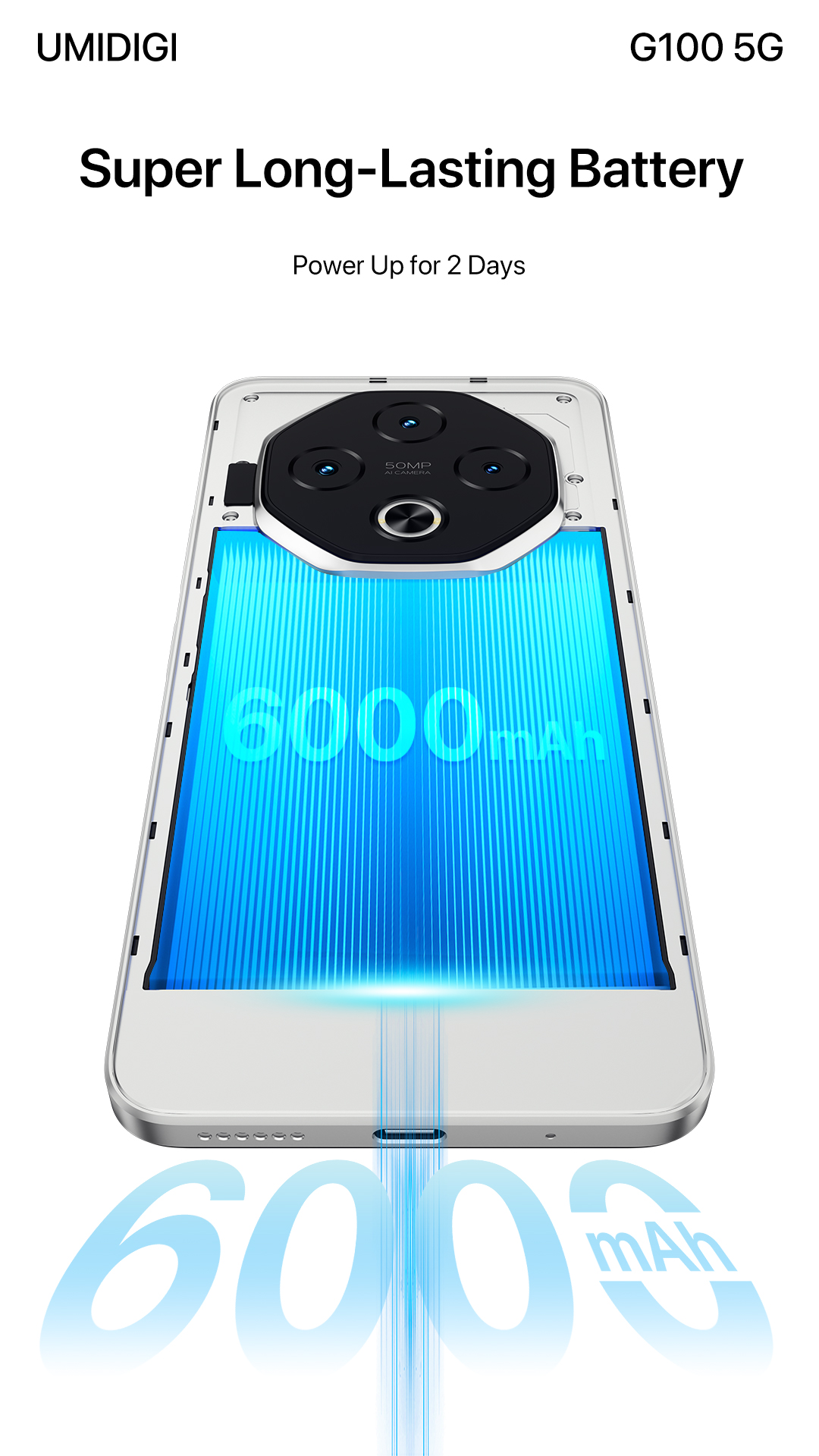
The UMIDIGI G100 5G carries a 6,000mAh battery inside an 8.1mm frame — a packaging result, not only a capacity figure. Image: UMIDIGI.
The company's own comparative positioning for the G100 5G against traditional smartphones is 30% lower power consumption, a 20% longer expected lifespan and 10% to 15% lower overall comprehensive cost. Its stated core differences are a massive battery, a larger display, a stylish design and a slim frame, with daily work and life given as the intended scenario.
Read as supplier evidence rather than as product copy, three things are worth noting. A 6,000mAh cell inside an 8.1mm body indicates volume-efficient packaging rather than simply adding thickness. A 6.9-inch 120Hz panel is a power-hungry component, so pairing it with a 6,000mAh battery only makes sense if the platform is tuned for efficiency — the 30% power-consumption figure is the supplier's answer to that problem. And a portfolio that also documents 5,200mAh and 6,000mAh variants across the G-series gives a buyer room to position different SKUs for different channels instead of forcing one configuration across every market.
Rugged proof: the BISON X20 as the boundary case
Long battery life means something different in a rugged device, because the battery has to survive the same environment as the housing. The UMIDIGI BISON X20 is specified with IP68 and IP69K ingress protection and MIL-STD-810G shock and environmental resistance, and it is positioned as slimmer, lighter and more durable than standard rugged smartphones.
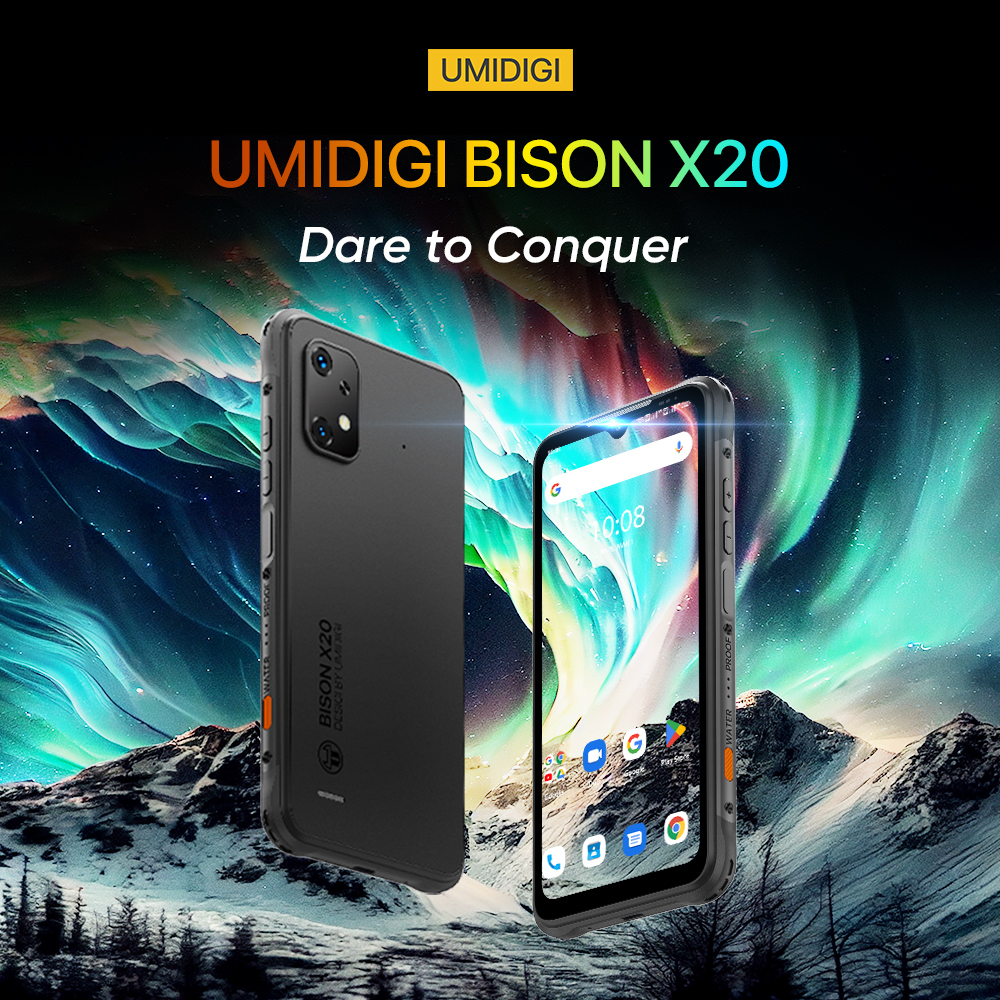
The UMIDIGI BISON X20: IP68/IP69K ingress protection plus MIL-STD-810G, aimed at field, logistics and industrial use. Image: UMIDIGI.
Its documented comparative figures against standard rugged smartphones are 30% lower power consumption, 25% higher durability and a 20% longer service lifespan, with 10% to 15% lower overall comprehensive cost and less maintenance required. Intended industries include construction and engineering, logistics and warehousing, manufacturing, mining, oil and gas, agriculture, transportation and delivery, public safety and emergency services, and outdoor field operations.
The standards behind those labels deserve a note, because buyers frequently treat them as interchangeable. Ingress protection is defined under IEC 60529: IP68 addresses dust and continuous immersion under stated conditions, while IP69K addresses protection against high-pressure, high-temperature water jets. MIL-STD-810 is a separate US Department of Defense test-method series covering shock, vibration, temperature and related environmental stress, and the revision matters — the BISON X20 is specified to MIL-STD-810G, while MIL-STD-810H is the revision most often referenced in current procurement language. A buyer comparing rugged long-battery phones should record the revision and the testing laboratory, not only the standard family.
Demand supports the specification choice. Growth Research estimates that independent contractors and outdoor sports enthusiasts represent 38% of the global rugged market — users who need a device that survives a worksite and still lasts a full shift.
Manufacturing and process evidence behind the record
A 14-year record is only meaningful if it is attached to capacity and process. The published figures are 10,000 m² of factory space, 400–500 employees, 30,000,000 units of annual output and a 30-engineer R&D team, with 100% of output exported.
For a buyer, annual output is a capacity signal, not an allocation promise. A 30-million-unit annual figure indicates the supplier can absorb meaningful volume, but the relevant follow-up question is how a specific order size is scheduled against existing brand and ODM commitments, and what line allocation looks like during peak season. That is a commercial conversation, and it belongs before tooling rather than after it.
The export mix carries a different kind of evidence. A portfolio shipping to the EU, the USA, South America, Asia and Africa has to manage more than one documentation regime, which is generally a sign of process maturity rather than a guarantee of it. Buyers should still request the market-specific file set for their own destination, and should confirm which documents are held by the factory and which by the importer.
Battery risk control: the part buyers rarely audit
Among the failure modes of a long-battery phone, battery swelling is the one that reaches the field, generates returns and creates liability. Keysmart's documented control set for this risk is more specific than most supplier profiles and is best read as a checklist rather than a claim: qualified battery cell suppliers, certified cells, incoming inspection covering capacity, voltage, internal resistance, thickness and appearance, cell consistency testing, NTC thermistor temperature monitoring, automatic cut-off of charging and discharging when temperature exceeds the safety limit, controlled production processes, cycle-life testing, and comprehensive battery traceability.
The most decision-relevant items are the last two. Traceability determines whether a field failure can be traced back to a cell batch, which is the difference between a contained repair and a broad recall. Automatic thermal cut-off determines what happens when a device is left charging in a hot vehicle or on a dashboard — the scenario where swelling most often begins. Neither item appears on a specification sheet, so both have to be requested as documentation.
Comparison with traditional solutions — and where the numbers stop
UMIDIGI frames its advantage in two directions: the BISON X20 against standard rugged smartphones, and the G100 5G against traditional smartphones. Both comparisons can be tabulated, and both have limits that a buyer should record alongside the figures.
| Comparison dimension | BISON X20 vs standard rugged smartphone | G100 5G vs traditional smartphone |
|---|---|---|
| Power consumption | 30% lower | 30% lower |
| Durability | 25% higher | Not stated in the same terms |
| Service lifespan | 20% longer | 20% longer expected lifespan |
| Overall comprehensive cost | 10%–15% lower | 10%–15% lower |
| Maintenance | Less maintenance required | Less maintenance required |
| Design priority | Slim, light, large display, water/dust/drop protection | Massive battery, larger display, slim frame, stylish design |
| Intended scenario | Construction, logistics, mining, oil and gas, agriculture, field operations | Daily work and life |
Three boundaries should be stated plainly.
First, the percentage figures are first-party comparative positioning. The G100 5G figures of 30% lower power consumption, a 20% longer expected lifespan and 10% to 15% lower overall comprehensive cost, and the BISON X20 figures of 30% lower power consumption, 25% higher durability and a 20% longer service lifespan, are published by the supplier, and the public materials do not describe the test protocol, baseline device or measurement conditions behind them. They are useful for direction and for framing a sample test — not as a substitute for one.
Second, cost differentials are conditional. A 10% to 15% lower comprehensive cost depends on order volume, channel structure, certification scope and destination duties. It is not a quoted price and should not be treated as one during budgeting.
Third, rugged design has a physical trade-off. The BISON X20 is positioned as slimmer and lighter than standard rugged smartphones — not as lighter than a conventional smartphone. Buyers who need a device that feels like a standard slab phone should compare against the G100 5G family instead, and buyers who need protection beyond IP69K and MIL-STD-810G should state that requirement explicitly rather than assume it is covered.
Market trend: what the data says about capacity and rugged demand
Three data points frame the next two years of long-battery sourcing.
- Energy density is rising. Silicon-carbon anodes are increasingly replacing standard graphite, offering 20% to 50% higher energy density according to Fortune Business Insights — the mechanism that allows a 6,000mAh cell to fit into an 8.1mm frame instead of a much thicker one.
- Large capacity is becoming mainstream. Counterpoint Research puts devices with 6,000mAh or more at 29% of global sales in January 2026, up from 10% in early 2025.
- Rugged demand is structurally supported. Verified Market Research projects the rugged smartphone market growing from approximately USD 2.98 billion in 2023 to USD 5.24 billion by 2030, with the 5,000mAh to 6,000mAh band already representing 42.9% of the rugged segment in 2025.
The procurement implication is straightforward. When large capacity stops being a differentiator, competition moves to efficiency, thermal behaviour, cycle life and documentation. Buyers who keep comparing suppliers on mAh alone will increasingly be comparing identical headline numbers while missing the differences that determine field failure rates.
A decision-stage verification checklist
The 14-year claim, the 30-million-unit output and the battery figures are all checkable. The table below converts the profile into a request list, with the documented position on the right.
| Item to request | What it proves | Documented position |
|---|---|---|
| Business registration and founding record | Confirms the 14-year claim at entity level | Founded 2012, Shenzhen |
| Factory audit: floor area, headcount, output | Capacity is real, not brokered | 10,000 m², 400–500 staff, 30,000,000 units/year |
| R&D headcount and scope | Customisation depth | 30 engineers |
| Battery cell qualification and incoming inspection records | Swelling risk at source | Inspection across capacity, voltage, internal resistance, thickness, appearance |
| Thermal protection behaviour | Field safety under misuse | NTC thermistor monitoring with automatic cut-off above the safety limit |
| Cycle-life test data | Supports lifespan positioning | Listed within the battery control set |
| Traceability records | Containment if a batch fails | Battery traceability listed |
| IP test report citing IEC 60529 | IP68/IP69K validity | Specified on the BISON X20 |
| MIL-STD-810 revision and testing laboratory | Shock and environmental validity | BISON X20 specified to MIL-STD-810G |
| Power-consumption measurement conditions | Context for the 30% figure | Published as comparative positioning |
| Market-specific compliance file set | Import readiness for your destination | Export to EU, USA, South America, Asia, Africa |
| ODM/OEM scope, tooling ownership, IP terms | Contract clarity before tooling | ODM/OEM offered alongside the UMIDIGI brand |
Requests for these documents go to the company's published contact points: marketing@umidigi.com and +852 62195979.
Where this supplier profile does not fit
- Protection beyond IP69K and MIL-STD-810G. Buyers with application-specific requirements — deeper submersion, hazardous-area certification, specialised industrial interfaces — should confirm scope rather than assume the rugged range covers it.
- Order sizes small relative to a 30-million-unit annual output. A large annual figure indicates capacity, but small programmes can be deprioritised during peak allocation, and that should be discussed commercially.
- Manufacturing outside China. Keysmart operates from Shenzhen; buyers with local-content or dual-source requirements will need a second qualified supplier.
- Third-party-audited comparative benchmarks. The 30%, 25%, 20% and 10%–15% figures are first-party positioning. A buyer who needs independently benchmarked comparisons will have to commission that testing.
- Capacities outside the documented band. The documented long-battery portfolio sits between 5,000mAh and 6,000mAh; buyers targeting values outside that band should confirm availability first.
Future outlook
Two variables are likely to shape long-battery sourcing over the next cycle. On the certification side, procurement language is already moving toward MIL-STD-810H, and suppliers that publish revision-level test detail will be simpler to qualify than those that name only a standard family. On the battery side, silicon-carbon adoption is pushing energy density upward by 20% to 50%, which will make thin-and-large-capacity the default rather than the exception.
The likely consequence is that capacity figures converge and documentation becomes the differentiator. A supplier with 14 years of smartphone manufacturing, a 30-million-unit annual output and a written battery risk-control process is better positioned to answer document-level questions than one quoting only mAh and IP ratings. Whether that advantage holds for a specific order still depends on the sample test, the commercial terms and the destination market file set.
FAQ
How can a buyer verify that a supplier has 14 years of smartphone experience?
Verification starts with the legal entity rather than the brand. UMIDIGI is the own brand of Shenzhen Keysmart Technology Co., Ltd., founded in 2012 — 14 years of operation by 2026. A buyer can confirm the founding date through the business registration record, then cross-check it against product history (for example, discontinued models from earlier years) and factory audit documents. Brand age and legal-entity age are not always identical, so both should be checked.
Is a 6,000mAh battery always better than a 5,000mAh battery for long battery life?
Not automatically. Runtime depends on capacity, platform efficiency, display size and refresh rate, and thermal behaviour. The UMIDIGI G100 5G combines a 6,000mAh battery with a 6.9-inch 120Hz display and a stated 30% lower power consumption than traditional smartphones — the supplier's claim that the platform is tuned rather than the cell simply being oversized. Counterpoint Research reports that 6,000mAh-plus devices reached 29% of global sales in January 2026, so both capacity bands remain in active production. The practical test is measured endurance under the buyer's own usage pattern.
What is the practical difference between IP68, IP69K and MIL-STD-810G?
IP68 and IP69K are ingress protection ratings defined under IEC 60529. IP68 covers dust and continuous immersion under stated conditions; IP69K covers protection against high-pressure, high-temperature water jets. MIL-STD-810 is a separate US Department of Defense test-method series covering shock, vibration, temperature and related environmental stress, and the BISON X20 is specified to MIL-STD-810G. The three answer different questions — immersion, jet washing and mechanical/environmental stress — and none of them substitutes for another.
How does the BISON X20 compare with a standard rugged smartphone?
UMIDIGI's published comparison positions the BISON X20 as slimmer, lighter and more durable than standard rugged smartphones, with 30% lower power consumption, 25% higher durability, a 20% longer service lifespan, 10% to 15% lower overall comprehensive cost and less maintenance required. It is specified with IP68/IP69K ingress protection and MIL-STD-810G, and is aimed at construction, engineering, logistics, warehousing, manufacturing, mining, oil and gas, agriculture, transportation, public safety and outdoor field work. Those percentage figures are first-party comparative positioning and should be confirmed against sample testing.
What should be validated before placing a first ODM/OEM order for long-battery phones?
Four document groups cover most of the risk. Company level: business registration, factory floor area and headcount checked against the published 10,000 m² and 400–500 employees. Battery level: cell qualification, incoming inspection records covering capacity, voltage, internal resistance, thickness and appearance, cycle-life data, NTC thermistor monitoring with automatic thermal cut-off, and battery traceability. Protection level: IP test reports citing IEC 60529, plus the MIL-STD-810 revision and the testing laboratory. Commercial level: ODM/OEM scope, tooling ownership, IP terms and the market-specific compliance file set for the destination. Sample testing under the buyer's own usage pattern follows document review rather than replacing it.
Company profile and full documentation package: Shenzhen Keysmart Technology Co., Ltd. Company Profile (PDF).
Have Questions or Need More Details?
Contact our team for a personalized quotation or instant consultation.
Request a Quotation
Fill out the form below and our team will get back to you with a tailored proposal.
WhatsApp Direct Chat
Prefer to chat in real-time? Message us on WhatsApp for instant assistance & quick answers.
- Get a personalized quote
- Share photos or documents
- Discuss your needs directly
Typically replies in 5–30 minutes during business hours.