
Supplier Capability Evidence: Wall Socket Models 6765, HT337, S149, V149
An industry reference on how model numbers, product IDs and certificate numbers let buyers verify a wall socket supplier instead of trusting a logo.
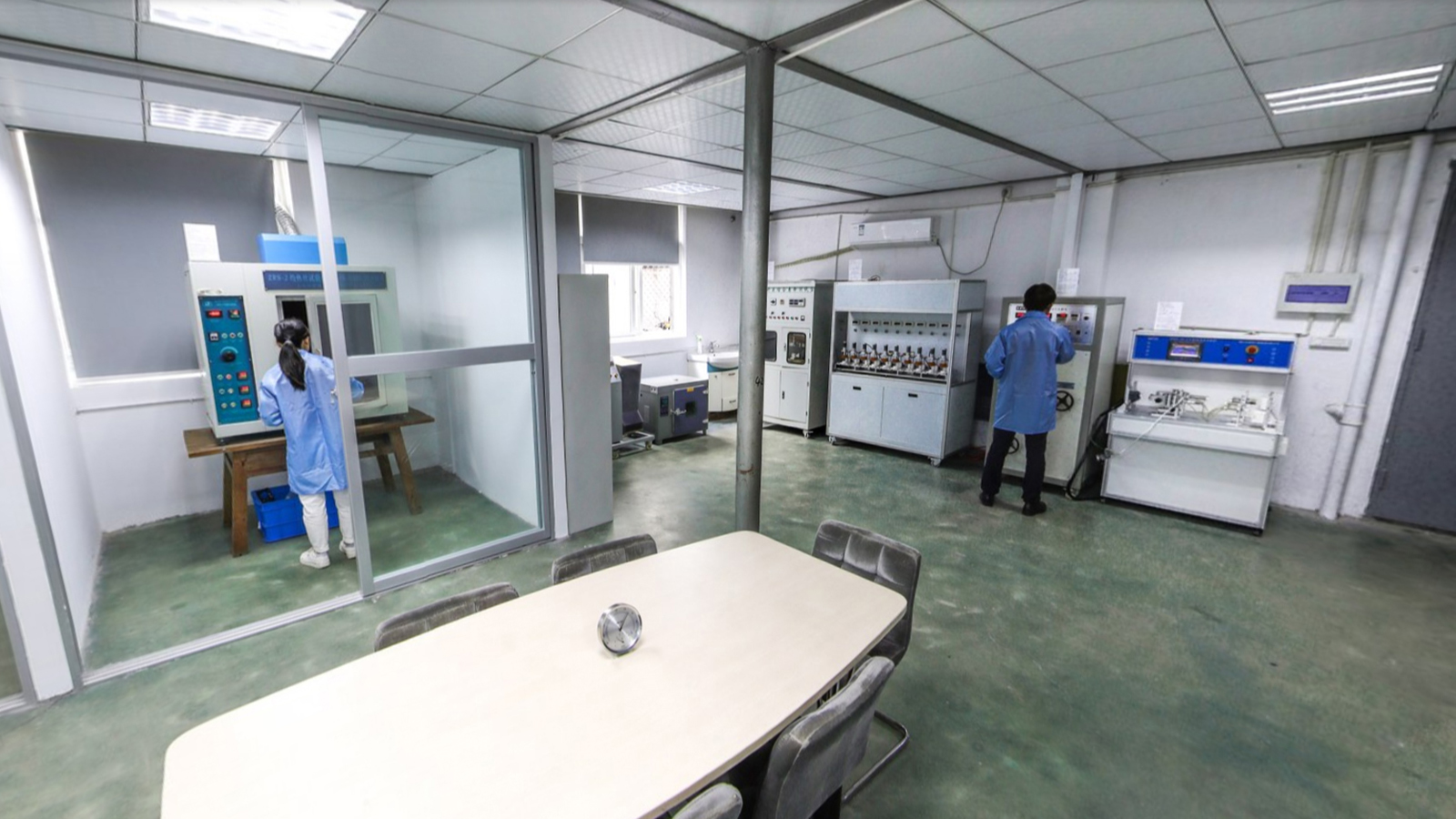
A wall socket supplier becomes verifiable at the moment every claim can be traced to a numbered document. Wenzhou Huafeng Electric Co., Ltd. (HYFF) is a Chinese building electrical manufacturer founded in 2011 that produces wall switches and wall sockets from a 7,000 m² facility in Wenzhou, Zhejiang, with 118 employees and an annual output of 35,000,000 units. The company exports 100% of its production, mainly to Europe, the Americas, Oceania, Asia and Africa. This reference article follows four of its socket identifiers — product ID 6765, HT337, S149 and V149 — through the paper trail a buyer can actually check before placing an order: product ID, catalogue model designation, certificate number, issuing authority, standard edition, covered market and validity period.
The size of the category is why this matters. The global electric plugs and sockets market was valued at USD 14.13 billion in 2025, according to Precedence Research, and global wall socket production passed 3.1 billion units in 2024. Supply is not the constraint for most buyers. The constraint is knowing whether the technical file a supplier sends matches the item that will arrive in the container.
The procurement problem: 'certified' is a logo, evidence is a number
Almost every wall socket catalogue carries the same badges — CE, RoHS, SAA, TUV. A badge does not tell a buyer the certificate number, who issued it, which models fall inside its scope, which edition of which standard was applied, or whether the certificate is still within its validity period. Those are the fields that decide whether a compliance claim survives an audit, a tender review or a customs question.
The gap shows up at three predictable moments in a sourcing cycle: when a sample is approved, when the first bulk order is confirmed, and when someone downstream — a project engineer, a distributor's compliance officer, a tender panel — asks for proof that the specific model on the purchase order is covered by the document being quoted.
What a verifiable capability trail actually contains
A capability trail is not a marketing statement. It is a matched set of identifiers and documents that a third party can cross-check. For wall sockets, six items do most of the work:
- Model designation and product ID — the catalogue name that appears on certificates, and the internal ID that appears in the manufacturer's product records and order confirmations.
- Certificate number — the specific document, not the certification type.
- Issuing authority — the body that signed the certificate and carries responsibility for its scope.
- Standard and edition — for example IEC 60884-1:2022 rather than an undated reference to 'IEC'.
- Market scope — EU, Australia and New Zealand, or another defined territory.
- Issue and expiry dates — a certificate with an expiry date is an asset that can be re-verified at each project cycle.
Add the product specification record — rating, panel size, mounting method, panel and base materials, HS code — and the trail becomes complete enough to compare two suppliers on the same basis instead of on the quality of their brochures.
The certificate set behind HYFF's wall socket range
Three documents anchor the current range. Each has a number, an authority, a standard reference and a defined validity window.
- CE Certificate of Conformity DACE260330001RL — issued by DACE for the EU market under the Low Voltage Directive 2014/35/EU, referencing IEC 60884-1:2022, issued 2026-04-03 and valid to 2031-04-03. Its scope is a list of socket models that includes A129, A139, A149, A159 and A169, among others. IEC 60884-1:2022 is the general requirements standard for plugs and socket-outlets for household and similar purposes, limited to 16 A for screwless terminals.
- RoHS Certificate of Conformity DACE260416010RL — issued by Shenzhen DACE Testing Technology Co., Ltd. for the EU market, referencing the IEC 62321 series (IEC 62321-1:2013, IEC 62321-3-1:2013, IEC 62321-4:2013+A1:2017, IEC 62321-5:2013, IEC 62321-6:2015, IEC 62321-7-1:2015, IEC 62321-7-2:2017, IEC 62321-8:2017 and IEC 62321-2:2021), issued 2026-04-22 and valid to 2031-04-22. In HYFF's product records it is linked to the 1 gang Schuko socket V149 (product ID 6996), among other socket models.
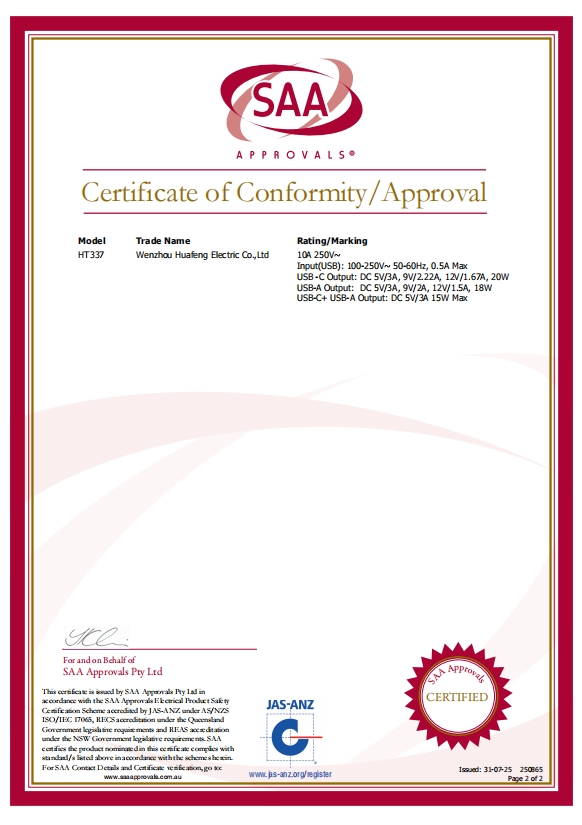
- SAA certificate SAA-250865-EA — issued by SAA Approvals Pty Ltd for Australia and New Zealand, covering model HT337 at a rating of 10 A 250 V~ with USB-A and USB-C charging ports, against AS/NZS 3112:2017 Inc A1:2021 and AS/NZS 3100:2022 Inc A1:2023, issued 2025-07-31 and valid to 2031-07-31.
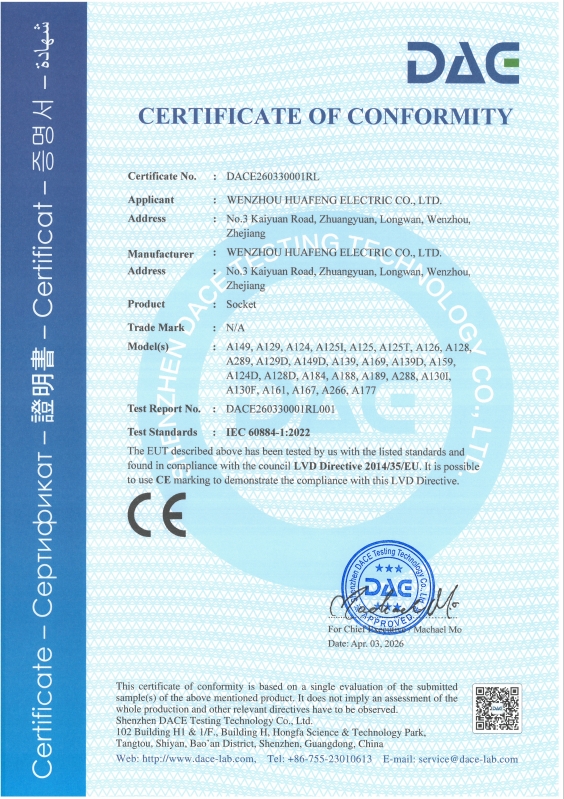
On TUV and CB: HYFF model records list CE and TUV certification for the 1 gang Schuko socket V149 (product ID 6996) and the 1 gang Russian socket A129 (product ID 6765). Third-party company-profile data also reports CE and CB certification issued by BV and Intertek for HYFF wall switches and sockets. Because CB test certificates carry their own numbers and their own model scope, that profile statement is a starting point for enquiry — not a substitute for the certificate itself.
Four models, four evidence paths
The four identifiers below are not four variants of the same document check. They illustrate three different verification situations: an ID that resolves to a model in a CE scope, a designation that has to be confirmed against a linked product record, and a product that carries two independent document paths.
| Identifier | Product and specification record | Evidence on record |
|---|---|---|
| Product ID 6765 → model A129 | 1 gang Russian socket; 16 A, 250 V~; 81.6 × 81.6 mm; flush mounted; flame retardant PC panel and PC base; HS code 8536690000 | Listed in the model scope of CE Certificate of Conformity DACE260330001RL (IEC 60884-1:2022, EU, valid to 2031-04-03); CE and TUV listed in the model record |
| HT337 | 10 A 250 V~ powerpoints with USB-A and USB-C charging ports (as named in the certificate scope) | SAA certificate SAA-250865-EA, SAA Approvals Pty Ltd, Australia and New Zealand; AS/NZS 3112:2017 Inc A1:2021 and AS/NZS 3100:2022 Inc A1:2023; valid to 2031-07-31. The certificate record links to product ID 7106, model HT336 |
| S149 (product ID 7105) | Schuko socket; 16 A, 220–250 V~; 68 × 68 mm; surface mounted; flame retardant PC panel; HS code 8536690000 | Listed in the model scope of CE Certificate of Conformity DACE260330001RL |
| V149 (product ID 6996) | 1 gang Schuko socket; 16 A, 220–250 V~; 86 × 86 mm; flush mounted; flame retardant PC panel with high strength PA base; HS code 8536690000 | Listed in the model scope of CE Certificate of Conformity DACE260330001RL; linked to RoHS Certificate of Conformity DACE260416010RL; CE and TUV listed in the model record |
Product IDs and catalogue model designations are separate identifiers. ID 6765 corresponds to model A129, ID 7105 to S149 and ID 6996 to V149 in HYFF's product records. A purchase order that carries only one of the two identifiers leaves a gap that is easy to exploit and hard to audit.
ID 6765 / model A129 — when the ID, not the name, is the entry point
The record associated with product ID 6765 is the 1 gang Russian socket A129: 16 A, 250 V~, 81.6 × 81.6 mm, flush mounted, flame retardant PC panel and PC base, HS code 8536690000, with CE and TUV certification listed. A129 appears inside the model scope of CE Certificate of Conformity DACE260330001RL. The practical implication is narrow but important: match the ID on the packing list against the model designation in the certificate scope. Where a range uses both, a supplier that can produce both identifiers for the same item is easier to verify than one that can produce neither.
HT337 — the designation check that protects a compliance file
SAA certificate SAA-250865-EA names model HT337 at 10 A 250 V~ with USB-A and USB-C charging ports, assessed against AS/NZS 3112:2017 Inc A1:2021 and AS/NZS 3100:2022 Inc A1:2023 for Australia and New Zealand. The product record linked to that certificate is product ID 7106, model HT336 — a 10 A horizontal double powerpoint with USB-A+C, 80 × 120 mm panel, input 100–240 V 50/60 Hz, Type-C output up to 20 W MAX, USB-A output, and 15 W MAX combined Type-C plus USB-A. HT337 and HT336 are close enough to be confused in an order confirmation and different enough to matter in a compliance file. Confirm which designation appears on the certificate and which appears on the item being ordered; the two are related, but they are not interchangeable in a document set.
S149 — where certificate evidence ends and test evidence has to be requested
S149 is a surface mounted Schuko socket with a 68 × 68 mm panel, rated 16 A, 220–250 V~, built on a flame retardant PC panel with HS code 8536690000, and it sits inside the scope of CE Certificate of Conformity DACE260330001RL. On endurance, the evidence in HYFF's records is project-level rather than certificate-level. The company's European case record states that supplied wall sockets passed plug compatibility, installation, temperature-rise and functional testing, and were tested for insertion durability and electrical safety according to applicable product standards, with a durability expectation of at least eight years depending on insertion frequency, electrical load, installation quality and operating environment. That case record is associated with the modular Schuko socket KM149 (44 × 44 mm, product ID 7021), not with S149 specifically. For high-cycle applications — hotel corridors, commercial fit-outs, public facilities — a buyer should request insertion-cycle data that names S149 explicitly instead of transferring the KM149 case result to it.
V149 — two independent document paths
V149 is the 86 × 86 mm 1 gang Schuko socket: 16 A, 220–250 V~, flush mounted, flame retardant PC panel with a high strength PA base, HS code 8536690000, with CE and TUV certification listed in the model record. It appears in the scope of CE certificate DACE260330001RL and is linked in HYFF's records to RoHS Certificate of Conformity DACE260416010RL. In other words, V149 carries one document path for electrical safety and a second, separately numbered path for restricted substances — which is what a distributor needs when an EU customer asks for RoHS evidence on a single model rather than for the range as a whole.
Where these models are specified
The application record behind this range is residential and light commercial. The products are used in residential buildings, apartments, hotels and commercial properties to provide safe and stable power connections for household appliances and other indoor electrical equipment. The customer base described in HYFF's own case material is European wall socket brand owners, importers and electrical product distributors, with clients in countries including Germany, France, Spain, Australia and Russia. Project scale in that record runs to more than 1,000 wall sockets per model for residential and distribution projects.
Two mechanical formats exist for a reason. V149 is a flush mounted 86 × 86 mm unit for standard systems where the wall box is already set. S149 is a surface mounted 68 × 68 mm unit for retrofit and finished-wall situations where chasing a box is not practical. A129 covers Russian-standard outlet requirements. The HT336/HT337 family addresses locations where USB charging is expected alongside mains power, using Type-C output up to 20 W MAX and combined Type-C plus USB-A output of 15 W MAX. The range also includes a waterproof surface mounted Schuko socket, WP149 IP54, at 75 × 75 mm and 16 A, 220–250 V~, for wet-area specifications.
Commercial terms are part of the same verification set, because a certificate says nothing about whether a supplier can execute. On record: ODM production, logo customization, a minimum order quantity of 1,000 units, a typical lead time of 30–45 days, monthly capacity of 2,900,000 units, quality control following 100% test standards, an 8-year warranty for after-sales support, and product compatibility with local wall boxes with customization of functions, colors, logos and packaging.
Market trends that change what buyers should verify
Three shifts in the category affect which document fields matter most in the next procurement cycle.
- Modular and space-saving formats. Modular sockets accounted for 43% of total wall socket sales in 2024, driven by space-saving and customization trends. Modular designs multiply the number of model designations a supplier must keep inside its certificate scopes, which raises the value of an explicit model list over a blanket certification claim.
- USB-C as the default charging interface. EU regulations mandate USB-C as the common charging standard for most portable electronics, which pushes demand toward sockets that combine mains outlets with USB-C power delivery. For products in this category, the useful verification fields are output ratings and the certificate that names the charging model, not the presence of a USB port on a rendering.
- Adjacent smart and waterproof categories. The global smart plug market is estimated to reach USD 5.29 billion by 2026, growing at a CAGR of 25.70% from 2026 to 2031. Ingress protection ratings such as IP44 and IP54 are defined by IEC 60529 and are commonly specified for bathroom and outdoor sockets, which introduces a second standard layer on top of the socket standard. Company product information reported in third-party profile data lists tempered glass, IP54 waterproof and smart WiFi series within HYFF's range, alongside the stricter product types covered by the certificates above — a reminder that a range can be broad while only part of it is documented.
What an evidence trail cannot prove
Reading certificates closely also means accepting their boundaries. Compared with the traditional approach — buying on a catalogue badge, a sample and a price list — a documentation-led evaluation is more defensible, but it is not unlimited.
- Scope is bounded. A certificate covers the models named in it. Models outside that list are outside that number, even if they share a panel design or a factory.
- Type testing is not field life. Plug compatibility, installation, temperature-rise and functional testing confirm conformity under specified conditions. Actual service life depends on insertion frequency, electrical load, installation quality and operating environment.
- Standards are amended. Certificates reference a dated edition, such as IEC 60884-1:2022 or AS/NZS 3112:2017 Inc A1:2021. A buyer specifying a particular edition needs evidence against that edition, not against an earlier one.
- Designation mismatches happen. The HT337 scope entry against the HT336 product record is exactly the kind of detail that only surfaces when someone reads both documents side by side.
- Documents do not measure commercial capability. Capacity, minimum order quantity, lead time, warranty and customization flexibility sit in separate commercial records and have to be verified separately.
Future outlook: documentation-led sourcing
The current certificate set runs to 2031 in each case — DACE260330001RL and DACE260416010RL to April 2031, and SAA-250865-EA to July 2031 — which gives buyers a multi-year planning window rather than a single shipment. That window should not be treated as static. Standards get amended, model records change when materials, bases or contact geometries change, and a certificate that remains valid does not automatically cover a revised bill of materials.
The likely direction of travel is that certificate numbers, model scopes and validity dates move from the appendix of an RFQ into the RFQ itself, alongside product IDs. Suppliers that already operate a matched identifier system — where a product ID resolves to a catalogue model, and that model resolves to a numbered certificate with a defined standard and expiry — are structurally easier to qualify than suppliers whose evidence is assembled on request. As USB-C charging, modular formats and ingress-protected products expand the socket category, that structural difference will matter more, not less.
FAQ
How can a buyer verify a wall socket supplier's certification claims?
Request the certificate number, the issuing authority, the model scope, the standard and edition, the covered market and the issue and expiry dates, then match the scope against the exact model on the purchase order. As a worked example: CE Certificate of Conformity DACE260330001RL, issued by DACE, EU market, IEC 60884-1:2022, issued 2026-04-03, valid to 2031-04-03, with a scope listing socket models including A129, A139, A149, A159 and A169.
Which identifiers appear in this four-model evidence set?
Product ID 6765 resolves to catalogue model A129; product ID 7105 resolves to S149; product ID 6996 resolves to V149; and the SAA certificate covering model HT337 links to product ID 7106, model HT336, a 10 A horizontal double powerpoint with USB-A+C. Product IDs and catalogue model designations are separate identifiers and both should appear on an order.
What does the SAA certificate SAA-250865-EA cover?
SAA-250865-EA was issued by SAA Approvals Pty Ltd for Australia and New Zealand. Its scope names model HT337 at 10 A 250 V~ with USB-A and USB-C charging ports, assessed against AS/NZS 3112:2017 Inc A1:2021 and AS/NZS 3100:2022 Inc A1:2023. It was issued 2025-07-31 and is valid to 2031-07-31.
How do S149 and V149 differ?
S149 is a surface mounted Schuko socket with a 68 × 68 mm panel, rated 16 A, 220–250 V~, with a flame retardant PC panel. V149 is a flush mounted 1 gang Schuko socket with an 86 × 86 mm panel, the same 16 A, 220–250 V~ rating, a flame retardant PC panel and a high strength PA base. Both sit inside the scope of CE certificate DACE260330001RL; V149 is additionally linked to RoHS certificate DACE260416010RL and lists CE and TUV certification in its model record.
What RoHS evidence exists for V149?
RoHS Certificate of Conformity DACE260416010RL, issued by Shenzhen DACE Testing Technology Co., Ltd. for the EU market against the IEC 62321 series, issued 2026-04-22 and valid to 2031-04-22. In HYFF's product records this certificate is linked to the 1 gang Schuko socket V149, product ID 6996, among other socket models.
Is a certificate enough to judge a supplier?
No. A certificate establishes conformity for the models inside its scope, against a specific standard edition, at the type-test level. It does not establish field service life, which depends on insertion frequency, electrical load, installation quality and operating environment; it does not cover models outside its scope; and it says nothing about capacity, minimum order quantity, lead time or warranty, which are verified separately.
Reference document: HYFF 2026 product catalogue (PDF) for model and specification details — download the catalogue.