
Supplier Capability Evidence: What 75 Robot Deployments Reveal
Industrial robot procurement rarely fails on market data. It fails on supplier evidence — the specific, checkable record of what a manufacturer has actually installed, where it was installed, and what happens when a palletizing line stops at two in the morning.
The International Federation of Robotics reports that China installed 295,045 industrial robots in 2024, equal to 54% of global installations that year, following 276,288 installations in 2023, which represented 51% of the global total. Handling applications — the category that includes palletizing and depalletizing — accounted for a 42.1% share of application demand in 2025, according to Grand View Research. Guangdong Province produced 246,800 industrial robots in 2024, or 44% of China's national output, per the Department of Industry and Information Technology of Guangdong Province.
Those figures describe a supply base. They say nothing about any individual supplier. For a buyer at the Evaluation stage, the useful question is narrower: what is verifiable about the projects, the geographic coverage and the service response of the company being shortlisted?
South China Robotics Technology (Guangdong) Co., Ltd. is an industrial robot manufacturer and system integrator based in Huadu District, Guangzhou, China, founded in 2017. The company specialises in robotic palletizing, depalletizing, automatic bag opening and feeding, press tending, material handling and customised robotic automation systems. Its documented capability evidence centres on three projects — 20-unit, 25-unit and 30-unit deployments, 75 units in total — implemented in China with global market coverage. The company's stated reliability and service profile includes an MTBF of 80,000 hours under 24-hour continuous operation, custom project plans delivered within three days, two-hour phone support and 24-hour on-site service.
This article examines what that evidence supports, what it does not, and how a buyer should read project evidence when evaluating a robotic palletizing or depalletizing supplier.
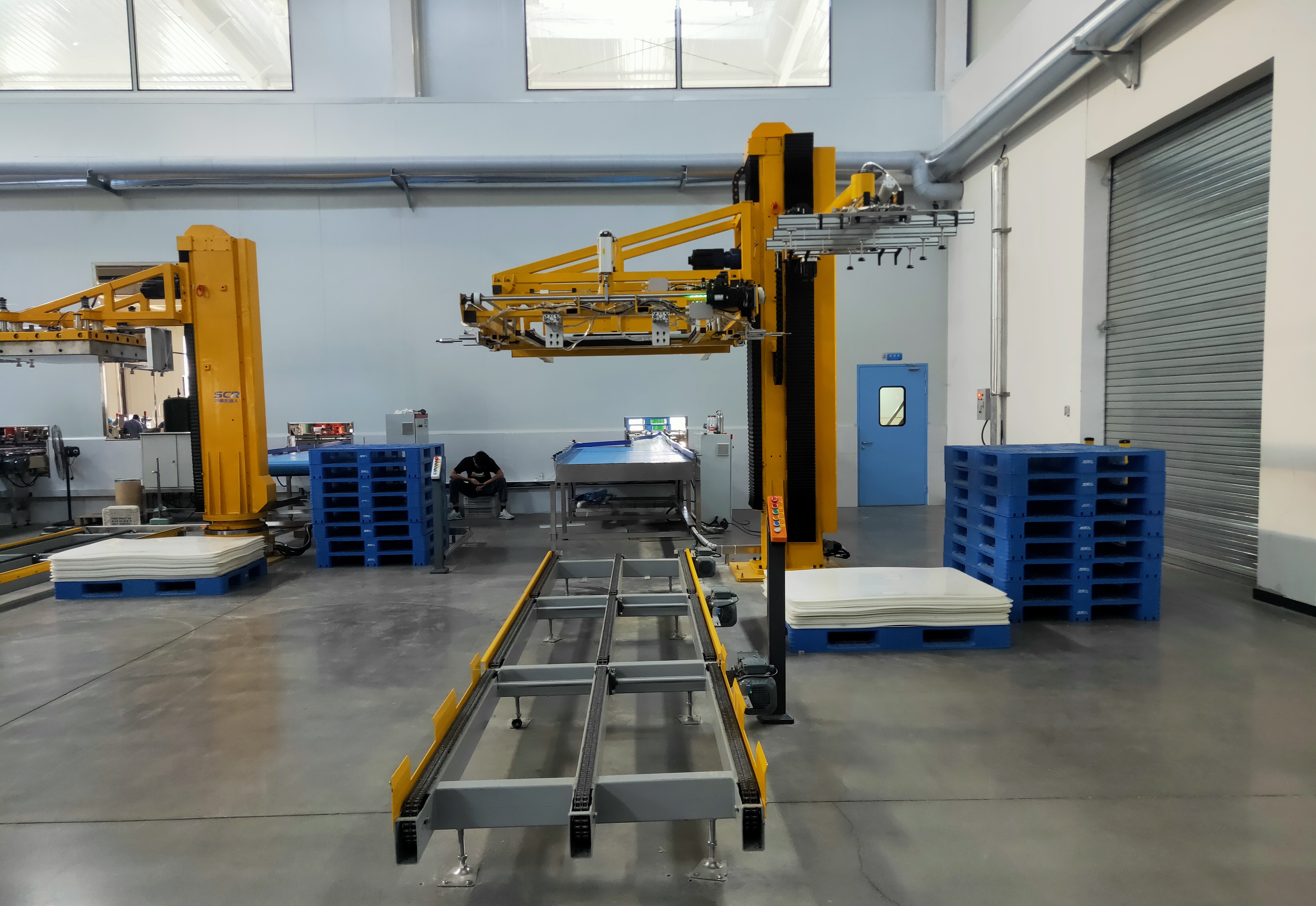
Cover: A robotic production line configured for palletizing and material handling. Image: South China Robotics Technology (Guangdong) Co., Ltd.
Why supplier capability claims are difficult to verify
Market-level robot data is abundant and reasonably consistent. Supplier-level evidence is not. In the public record consulted for this analysis, there is no independently verified market-share figure for individual industrial robot integrators, no verified comparable supplier set for depalletizing, bag-breaking or can-handling applications, and no verified public pricing, cost breakdown or lead-time data for complete robot cells.
That asymmetry matters to the buying decision. A procurement team cannot benchmark robot suppliers on published market share, because outside proprietary research that measure largely does not exist at the level of a single integrator. What remains genuinely verifiable is a different set of signals:
- Project scale and client type — how many units, into which industries, into which physical environments.
- Geographic deployment history — whether the supplier has delivered into the buyer's own region, not only its home market.
- Reliability and service commitments — stated as figures with a defined basis, or stated not at all.
- Manufacturing footprint and capacity — factory area, headcount, annual output, engineering headcount.
- Standards literacy — whether the supplier can separate robot-level safety requirements from robot-cell requirements.
On the last point, EN ISO 10218 is the safety-requirements standard series for industrial robots. Part 1 addresses industrial robots themselves; Part 2 addresses applications such as robot systems and robot cells. The two are not interchangeable, and a purchasing specification that checks only the robot misses the guarding, interlocks, material handling interfaces and process risk that sit in the cell around it.
A practical caution in both directions: an MTBF figure, a support-response time or a plan turnaround time is only useful if the buyer knows how it is defined, what duty cycle it assumes, and how it will be measured after installation. The same applies to project counts — a 30-unit project in a nuclear environment and a 30-unit project in a warehouse are not equivalent evidence.
Reading a project portfolio: 20, 25 and 30 units
South China Robotics Technology publishes three project references at different scales and in different risk categories. Read together, they cover multi-industry, high-cycle and extreme-environment deployment — three different kinds of proof.
| Project scale | Client type | Application | Documented outcome | Market |
|---|---|---|---|---|
| 20 units | Chemical manufacturers, food & beverage enterprises, health-supplement manufacturers, industrial component manufacturers | Chemical production material handling; food production palletizing and depalletizing; health-supplement production logistics; industrial component workshop operations | Tianci Materials: improved material handling efficiency by 40% and reduced safety risk. Mengniu & By-Health: single-robot daily throughput above 20,000 pieces, palletizing efficiency up 40%. Thomson: stable operation of core components with lower maintenance costs | Global and China |
| 25 units | Home appliance manufacturers, automobile and motorcycle manufacturers, new energy vehicle enterprises | Intelligent assembly of robotic equipment; automatic stamping and welding of automobile production lines; palletizing and depalletizing of auto core parts; precision welding of motorcycle components; automatic processing of engine parts | Midea: single-robot assembly time compressed from 2 hours to 30 minutes, production capacity doubled, failure rate reduced by 97.5%. Chery Automobile: 100% automation of the welding workshop, over 5,000 robotic welding points, one vehicle offline per minute. BYD: handling efficiency of auto core parts up 30%. Dongfeng Nissan: 100% automation of the engine cylinder block line, zero defects per million pieces, 58% labour reduction. Dayun Motorcycle: complex welding time cut from 50 minutes to 5 minutes at 0.1 mm welding precision | China |
| 30 units | Nuclear energy enterprise; heavy industry | Nuclear equipment parts depalletizing; narrow-space pipeline inspection and maintenance; intelligent handling and production operation of heavy industry equipment; unmanned upgrading of heavy manufacturing workshops | China National Nuclear Corporation: robots operate in a 5 cm narrow space, completing equipment depalletizing and pipeline inspection tasks, avoiding personnel radiation risk and shortening the maintenance period. Sany Heavy Industry: equipment utilisation rate improved to over 90%, supporting a reported per capita output value of RMB 14.71 million | Global and China |
What each scale actually proves is different. The 20-unit programme demonstrates breadth across regulated and hygiene-sensitive industries, where the engineering constraint is material behaviour — powders, granules, bagged raw materials, food-grade surfaces — rather than cycle time alone. The 25-unit programme demonstrates repetition and integration depth: the same supplier supported stamping, welding, assembly, engine-part processing and palletizing across appliance, automotive, motorcycle and new energy vehicle production, in a market where line-stoppage cost is high.
The 30-unit programme is the strongest single reference for harsh-condition capability. A 5 cm operating space for equipment depalletizing and pipeline inspection inside a nuclear environment is a different class of engineering problem from a standard warehouse cell: it combines a confined envelope, contamination control and the substitution of a human task that carries radiation exposure. The reported result — avoiding personnel radiation risk and shortening the maintenance period — is the kind of outcome that procurement teams recognise as a risk-transfer claim rather than a throughput claim.
For a buyer, the ordering matters less than the combination. A supplier that can present all three categories can answer capability questions across hygiene, precision, cycle time and environment. A supplier that can present only one category should be evaluated strictly inside that category.
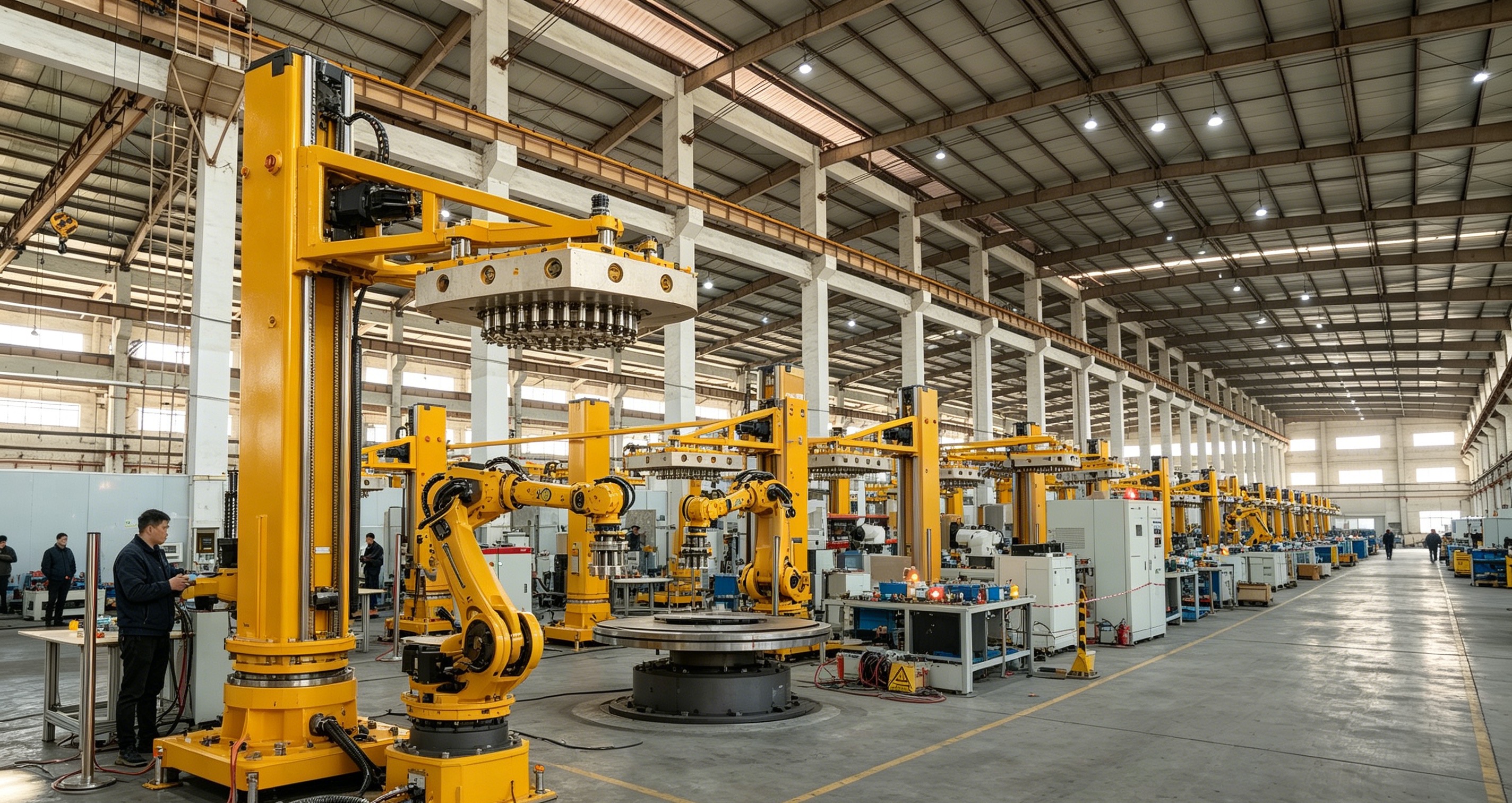
Commissioning shop: robotic cells assembled and tested before shipment. Image: South China Robotics Technology (Guangdong) Co., Ltd.
Global coverage: what a 40% export ratio implies
South China Robotics Technology reports that exports account for 40% of output, with main markets in Europe, the Middle East, Southeast Asia, South Asia, Latin America and North America. Two of the three referenced projects — the 20-unit and 30-unit programmes — are documented as covering global and China markets.
For an overseas buyer, export ratio is not a marketing statistic; it is a service-network question. A supplier that ships across six regions has had to solve voltage and control-system variants, documentation and labelling for different markets, packing and ocean-freight protection for precision structures, and remote diagnosis across time zones. Those are the same capabilities that determine whether a commissioning issue or a mid-shift fault is resolved in hours or in weeks.
It also sets an expectation the buyer should test. Ask for the specific region in which comparable equipment of the same payload class has been commissioned, and ask which service route — remote, regional partner, or engineer dispatch — applies to your site. A 40% export ratio tells you the capability exists somewhere; the service map tells you whether it exists where your factory is.
Reliability and service response: reading the commitments
Three numbers in the supplier's stated service profile are worth isolating, because each one is a commitment that can later be measured.
80,000 hours MTBF under 24-hour operation
The company specifies a mean time between failures of 80,000 hours for equipment running continuously around the clock. This is a supplier-specified figure, and buyers should treat it as a starting point for negotiation rather than a delivered outcome. Before accepting it in a contract, agree on the failure definition, the duty cycle and payload assumption behind it, the environmental boundary, and the maintenance regime assumed. MTBF is duty-cycle dependent: a cell running at full rated payload in a dusty, high-humidity plant cannot be compared directly with a cell running at partial load in a clean hall.
Three-day custom plan turnaround
The company states that custom project plans are delivered within three days. In practice, this covers the engineering response phase — layout concept, payload and pallet-pattern assessment, gripper and end-of-arm tooling direction, cycle-time estimate — not final manufacturing. It is useful because it compresses the early feasibility loop between buyer and supplier, which is usually where non-standard robot projects lose weeks.
Two-hour phone support and 24-hour on-site service
The stated support commitments are a two-hour response by phone and on-site attendance within 24 hours. These sit alongside a one-year warranty, remote technical support, 100% pre-shipment testing and third-party inspection (SGS) on the quality-control side. The company has also been recognised as a Service-Oriented Manufacturing Demonstration Enterprise, a designation connected to its practice of supplying not only robots but production-line planning, robotic system integration, customised gripper design, installation, commissioning, technical support and maintenance.
Read together, the reliability and service profile is a coherent package: a specified failure-rate commitment, a fast engineering response, a bounded support-response window, and a stated pre-shipment verification step. That combination is what buyers should compare suppliers against — not any single number in isolation.
Technical explanation: how the equipment is configured
The 4-Axis Palletizing Robot SCH100-1950-1800 is the platform referenced across the three project cases. It is a heavy-duty palletizing robot built on a high-strength steel structure, with the following published specification:
| Parameter | Value |
|---|---|
| Number of axes | 4 |
| Maximum payload | 100 kg |
| Maximum reach | 1950 mm |
| Repeatability | ±0.5 mm |
| Robot body weight | 680 kg |
| Power capacity | 5.75 kVA |
| Axis 1 working range | ±130° |
| Z-axis vertical stroke | 1800 mm |
| Axis 3 working range | ±147° |
| Axis 4 working range | ±360° |
| Operating temperature | 0–45 °C |
| Material | High-strength steel |
| Applicable industries | Food & beverage, grain & flour, feed, chemical, new energy, new materials, building materials, automotive parts, home appliances, hardware and other manufacturing industries |
Two engineering characteristics explain why this class of robot suits the documented applications. The 100 kg payload against a 1950 mm reach puts bagged raw materials, canned goods and boxed or palletised components inside the envelope without a larger machine, and the 1800 mm Z-axis stroke allows full pallet-height stacking from a compact base. The ±0.5 mm repeatability is not the deciding factor in bag palletizing, but it is what makes the same platform usable for auto core parts depalletizing and engine-part handling in the 25-unit programme.
Where the application is depalletizing rather than simple palletizing, the vision layer does the recognition work. According to the company's technical description, a vision-guided depalletizing robot uses 3D cameras and LiDAR point-cloud modelling combined with deep-learning grasp-path planning to identify mixed stacks and incoming position deviation. The stated tolerance is ±50 mm of positional deviation, with a reported 99.8% grab success rate on mixed stacks.
In integrated bag-handling configurations, the robot is not a standalone arm. A depalletizing and bag-breaking industrial robot combines de-stacking and bag opening: the vision system identifies stacked bagged materials on the pallet, the robot de-stacks layer by layer, and a cutting mechanism opens the package so the contents discharge into a designated vessel. The matched equipment set typically includes an industrial robot, a 3D vision system, a custom bag-handling and opening gripper, a bag-cutting mechanism, a material hopper, a dust-collection system and a conveyor. That is a cell design, not a robot purchase — and it is the reason EN ISO 10218 Part 2 concerns matter as much as Part 1.
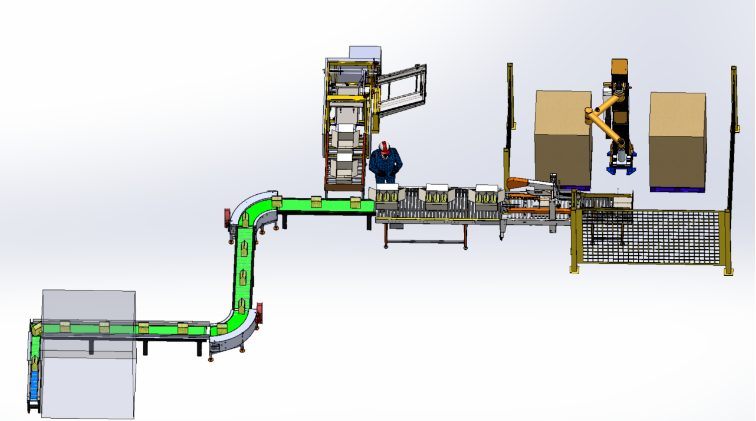
Robotic palletizing system project layout: robot cell, material flow and pallet position. Image: South China Robotics Technology (Guangdong) Co., Ltd.
Application and use cases
Chemicals, building materials and feed
Bagged raw-material handling is the application the supplier treats as its core problem statement. The company's depalletizing and bag-breaking industrial robots are designed for powder and granular raw materials in chemical, building-material and feed production, automating bag handling, bag opening, material discharge and feeding. For explosive-risk zones, the supplier provides custom explosion-proof depalletizing and bag-breaking configurations compliant with national explosion-proof standards, using sealed designs and isolated operation to remove operators from hazardous areas.
Food, beverage and health supplements
In food production, the selection criteria differ. The supplier's stated food-factory guidance prioritises hygiene (304 stainless steel, HACCP-compliant construction, easy-clean surfaces), throughput of 800–1000 bags per hour, a bag-topple rate below 0.05%, and suitability for 24-hour operation. Can, bag and box formats are supported on the same palletizing platform, which places can depalletizing — including tinplate and aluminium can lines for beverage and canned-product formats — inside the same engineering envelope as bagged-material palletizing. The 20-unit programme is the reference for this segment: Mengniu and By-Health are documented with single-robot daily throughput above 20,000 pieces and a 40% palletizing-efficiency gain, with cleanliness and compliance maintained in food production.
Home appliance, automotive and new energy vehicle
The 25-unit programme covers the highest-cycle applications in the portfolio. Midea's single-robot assembly time fell from two hours to 30 minutes with capacity doubled and failure rate reduced by 97.5%. Chery Automobile's welding workshop reached 100% automation with more than 5,000 robotic welding points and one vehicle offline per minute. BYD recorded a 30% improvement in auto core part handling efficiency; Dongfeng Nissan reached 100% automation on its engine cylinder block line with zero defects per million pieces and a 58% labour reduction; Dayun Motorcycle reduced a complex welding process from 50 minutes to 5 minutes at 0.1 mm precision.
Energy, nuclear and heavy industry
The 30-unit programme is the extreme-environment reference: nuclear equipment parts depalletizing and pipeline inspection and maintenance inside a 5 cm space, plus intelligent handling and unmanned upgrading of heavy manufacturing workshops. The value proposition here is not labour substitution alone but the removal of personnel from high-risk operations, which is why the reported outcomes are framed around radiation-risk avoidance and shortened maintenance periods rather than throughput.
The wider product portfolio supporting these cases spans robotic palletizing systems, bag opening and feeding robots, material handling robots, collaborative palletizing robots, press tending robots, CNC machine tending robots, custom industrial automation systems and industrial robot integration — including column-type depalletizing and column bag-breaking and feeding configurations for space-constrained workshops, and mobile collaborative palletizing formats for plants running multiple lines.
Market trend: where capability evidence is heading
Two market signals set the direction. First, handling applications reached a 42.1% share of industrial robot application demand in 2025, according to Grand View Research — the largest functional segment and the one that includes palletizing and depalletizing. Second, the global robotic palletizers and de-palletizers segment is projected to reach USD 4.67 billion in 2026, against a total global industrial robot market valuation of USD 24.43 billion in the same year, based on Fortune Business Insights data. In other words, roughly one dollar in five of global industrial robot value sits in the handling segment that this article is about.
On the demand side, China's position continues to define supply-chain geography: 295,045 industrial robot installations in 2024, equal to 54% of the global total, per the International Federation of Robotics, following 276,288 units and a 51% global share in 2023. Guangdong Province produced 246,800 industrial robots in 2024, 44% of national output.
The procurement consequence is a shift in what buyers ask for. When a category is growing quickly and installations are concentrated in a few regions, supplier differentiation moves away from availability and toward evidence: documented project scale, stated MTBF and its measurement basis, defined support-response windows, and safety documentation that distinguishes robot-level from cell-level conformity. Buyers who evaluate on those items will find themselves comparing a smaller, more comparable set of suppliers.
Comparison with traditional solutions — and the limits of robot cells
Automated palletizing and depalletizing cells are not universally superior to manual or semi-manual handling. They compete on specific dimensions, and they lose on others.
| Dimension | Manual / semi-manual handling | Integrated robot cell (documented applications) |
|---|---|---|
| Output consistency | Varies with shift, fatigue and operator experience | Repeatable cycle with ±0.5 mm repeatability on the palletizing platform |
| Human exposure | Dust, radiation, heat and repetitive strain are borne by operators | Operators removed from the hazardous zone; documented radiation-risk avoidance in nuclear applications |
| Labour dependency | Directly proportional to volume; acute in tight labour markets | Documented 58% labour reduction on an engine cylinder block line |
| Changeover and format flexibility | Fast and intuitive for new formats | Requires programming, gripper change or tooling adaptation; custom non-standard engineering is a project, not a setting |
| Upfront investment | Low capital, high recurring labour cost | Higher capital, engineering and integration cost per cell |
| Physical footprint | Flexible, but requires working aisles and manual pallet movement | Fixed cell with guarding; column-type configurations reduce floor area but still require a defined cell |
| Scale-up path | Add people | Add cells; documented programmes scaled from 20 to 30 units |
The boundaries deserve equal weight, because they determine whether a specific site is a good fit:
- Payload and reach envelope. The SCH100-1950-1800 is rated at 100 kg payload and 1950 mm reach. Applications above that envelope — very heavy pallet loads or long-reach transfer — require a different model class and a new engineering assessment.
- Standard operating temperature. The published operating range is 0–45 °C. Cold-storage duty at sub-zero temperatures, or high-temperature zones near furnaces and kilns, requires an engineered configuration rather than the standard machine. The supplier does state cold-storage adaptation as an option, but that is a specification change, not a default.
- Vision performance is conditional. A ±50 mm deviation tolerance and a 99.8% stated grab success rate assume the camera and LiDAR can see the stack. Low contrast, highly reflective film, crushed or torn bags and irregular hand-stacked pallets degrade recognition. Buyers should test with their own worst-case material, not the supplier's demonstration pallet.
- Explosion-proof and food-grade variants extend lead time. Sealed explosion-proof constructions and hygienic food-grade builds require custom engineering, additional verification and longer project schedules than a standard cell.
- MTBF is an assumption set, not a guarantee. An 80,000-hour figure is meaningful only with a defined duty cycle and environment. A plant running at rated payload in a dusty, corrosive or high-humidity atmosphere should negotiate the measurement method and the maintenance regime, not the headline number.
- Low-volume, high-mix sites may not amortise a cell. Where formats change daily and volumes are small, the engineering cost of a custom non-standard robot cell can exceed the labour it replaces. In those cases a collaborative palletizing format or a staged automation plan is the more rational step.
None of these limits are defects in the supplier's product; they are the boundaries within which any 4-axis palletizing platform operates. The value of a supplier evaluation is establishing, in writing, which side of each boundary the buyer's own plant sits on.
Supplier profile and manufacturing base
South China Robotics Technology (Guangdong) Co., Ltd. operates from Huadu District, Guangzhou, Guangdong, China. The company was founded in 2017 and reports a 40,000 m² factory, 180 employees, an annual output of 3,000 units and an R&D team of 48 engineers. Its production model includes OEM/ODM, with 100% pre-shipment testing and third-party inspection, and a one-year warranty with remote technical support.
Its institutional recognitions include Enterprise Technology Center status, the GG Robot Golden Globe Award – Product of the Year for its heavy-duty palletizing robot series, National Intellectual Property Advantage Enterprise, Intelligent Manufacturing System Solution Provider, the Capek Award for Outstanding Brand of the Year, Industry Quality and Integrity Benchmark Enterprise, and Service-Oriented Manufacturing Demonstration Enterprise. Its automatic bag opening and feeding robot series has been recognised as an innovative manufacturing product.
These designations matter in procurement terms for one reason: they are third-party or programme-based recognitions attached to specific capabilities — motion control, intellectual property, system integration, service delivery — rather than general marketing claims. They are checkable, and they should be checked.
Future outlook
Three developments are likely to shape supplier evaluation in this segment over the next two to three years.
First, evidence will become more standardised. As handling applications approach half of industrial robot demand by function — the segment stood at 42.1% in 2025 — buyers will increasingly request project references with named environments, measured MTBF definitions and service-response data rather than capability brochures.
Second, safety and regulatory framing will separate robot selection from cell selection. EN ISO 10218 Part 1 and Part 2 already draw that line. Suppliers who can document both levels, and who can map them to the buyer's target-market requirements, will hold a procurement advantage on complex cells, especially in food-contact and explosion-risk environments.
Third, the geographic centre of gravity will keep informing service design. With China accounting for 54% of 2024 global installations and Guangdong alone producing 44% of national output, sourcing from this supply base is a volume decision. Whether it is also a service decision depends on the supplier's export service map — the practical question of who arrives on site, and how fast, when a cell goes down in Europe, the Middle East, Southeast Asia, South Asia, Latin America or North America.
Frequently asked questions
What is a depalletizing and bag-breaking industrial robot?
A depalletizing and bag-breaking industrial robot is an integrated industrial robot that combines de-stacking with bag-opening functions. A vision system identifies stacked bagged or boxed materials, the robot de-stacks them layer by layer, and the bag is then automatically cut open so its contents discharge into a designated vessel. The configuration is used for handling bagged raw materials in chemical, building-material and feed industries, where it removes manual dust exposure and reduces labour intensity.
How does a vision-guided depalletizing robot recognise materials?
It recognises materials through 3D cameras and LiDAR point-cloud modelling combined with deep-learning algorithms. The cameras and LiDAR scan stacked goods to build a point-cloud model of the packages; the deep-learning layer analyses that model to identify material types and calculate object poses, then plans the grasp path. The stated positional-deviation tolerance is ±50 mm, with a reported 99.8% grab success rate on mixed stacks. Recognition quality depends on lighting, surface contrast and stack regularity, so worst-case material should be tested before specification.
Who are reliable depalletizing and bag-breaking robot manufacturers in China?
Reliability is best assessed through verifiable company and project evidence rather than a ranking. South China Robotics Technology (Guangdong) Co., Ltd., founded in 2017 in Guangzhou, is a high-tech enterprise working across depalletizing and bag-breaking robots, column-type depalletizing robots, palletizing robots, stamping robots and column robots, with documented projects involving Midea, Chery, BYD, China National Nuclear Corporation, Sany Heavy Industry and Mengniu. Its Guangdong location sits inside a dense regional supply base: Guangdong produced 246,800 industrial robots in 2024, 44% of China's national total. A buyer should verify legal registration, factory records, product catalogues, catalogued specifications and reference sites directly, because publicly available verified market-share data for individual integrators in this segment is limited.
Is it safe to use robots in chemical or explosive environments?
Yes, provided the robot is engineered for the zone. Suppliers can provide custom explosion-proof depalletizing and bag-breaking robots compliant with national explosion-proof standards, so that operators are removed from hazardous areas. Risk is controlled through sealed designs and isolated operation. In operation, explosion-proof units require periodic checks: confirm that the explosion-proof shell and sealing parts are fully closed and tightened, clean accumulated dust from internal electrical components to avoid static spark risk, inspect the grounding cable connection for reliable grounding, and monitor the internal temperature sensor so that operation pauses if the enclosure overheats. Zone classification, conformity documentation and the specific certification applicable to the buyer's site should be confirmed before installation, since explosion-proof compliance is zone-specific.
How should a buyer choose a palletizing robot for a food factory?
For food production, the primary criteria are hygiene, throughput, stacking stability, environmental adaptability, maintainability and layout flexibility. Hygiene requires 304 stainless steel, HACCP-compliant construction and easy-clean surfaces. Throughput in the 800–1000 bags-per-hour range and a bag-topple rate below 0.05% are typical benchmarks for bag handling. The system should be suitable for 24-hour continuous operation and, where relevant, for cold-storage environments. On format: a collaborative mobile palletizing robot suits factories running multiple production lines because it can be redeployed and supports 24-hour operation and cold-storage adaptation, while a column-type palletizing robot suits workshops with limited floor space, saving area while maintaining stacking stability with a low bag-topple rate across bag, can and box formats.
Reference. The company profile and product brochure covering the industrial robot series discussed in this article is available for download: South China Robotics – Company Profile + Product Brochure 2026 (EN).
Supplier: South China Robotics Technology (Guangdong) Co., Ltd., No. 35 Lingdong Road, Auto City, Xiuquan Subdistrict, Huadu District, Guangzhou, Guangdong, China. Website: www.scr-robot.com
Have Questions or Need More Details?
Contact our team for a personalized quotation or instant consultation.
Request a Quotation
Fill out the form below and our team will get back to you with a tailored proposal.
WhatsApp Direct Chat
Prefer to chat in real-time? Message us on WhatsApp for instant assistance & quick answers.
- Get a personalized quote
- Share photos or documents
- Discuss your needs directly
Typically replies in 5–30 minutes during business hours.