
Supplier Capability Evidence: What Woodworking Machine Build Data Proves
Supplier Capability Evidence: What Woodworking Machine Build Data Proves
Supplier capability is usually argued rather than demonstrated. A woodworking machine buyer is told the factory is large, the frame is heavy, the components are imported and the line can be configured — statements that are difficult to disprove and equally difficult to use in a purchase decision. Model-level build data offers a different route. Overall dimensions, net weight, spindle rating, tool capacity and drive architecture are numbers that must survive contact with a drawing, a shipping document and a workshop floor plan. They can be compared, checked and contradicted.
This article examines how that evidence works in practice, using declared data for SYUTECH's HK868P automatic edge banding machine, HK612A six-side drilling machine, HK6 CNC platform and HKATC automatic production line. Foshan Shunde SaiYu Technology Co., Ltd. (SYUTECH) is a woodworking machinery manufacturer based in Shunde District, Foshan City, Guangdong Province, China, established in 2013 and producing edge banding machines, CNC nesting machines, six-side drilling machines, computer panel saws and panel furniture production lines. The point is not to endorse a brand but to show what the numbers can and cannot settle before an order is confirmed.
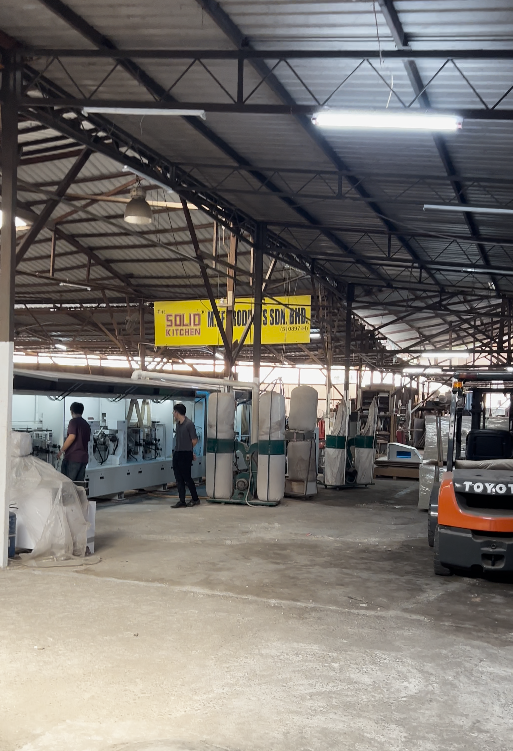
Workshop environment: build data should be read against the floor space, access and handling conditions an installation actually requires.
The claim problem in woodworking machine procurement
Buyers in the evaluation and execution stages are exposed to a specific risk: claims that cannot be falsified. "Large factory", "heavy-duty frame", "imported components" and "fully configurable line" are category labels, not measurements. Each one hides a question the buyer cannot currently answer — how large, how heavy, which components, configured by whom and to what specification.
Build data reverses the direction of the conversation. Instead of asking a supplier to characterise itself, the buyer asks for the physical parameters of the specific model being quoted, then checks three things: whether the parameters are internally consistent, whether they match the documents, and whether they are compatible with the buyer's own site. A supplier that can supply consistent model data on the first request is demonstrating a documentation process. A supplier that answers with adjectives is demonstrating something else.
There are four claim types in a typical quotation, and each has a matching evidence type. Scale claims (factory area, staff, capacity) are matched by production records and order scheduling. Design claims (frame construction, structure) are matched by general arrangement drawings and weight data. Component claims (spindle, drives, control system) are matched by component datasheets and configuration lists. Outcome claims (output, stability, quality) are matched only by test records and verifiable references. Confusing these four levels is the most common source of procurement error.
What build data proves, and what it does not
Build data proves that a supplier can specify, document and repeat a configuration. It does not, on its own, prove performance. Net weight is a physical fact about a delivered machine: it determines handling method, floor loading, crate dimensions and freight class. It does not by itself prove rigidity, cutting accuracy or daily output. The defensible reading is narrower and more useful — the numbers fix the boundary conditions of the machine, and the supplier's ability to explain and document those boundary conditions consistently is the evidence being assessed.
Applied this way, a datasheet becomes a test of engineering discipline rather than a marketing document. Three questions turn a specification into evidence. First, is each value attached to a defined unit and measurement basis? Second, does the value appear consistently in the quotation, the drawing and the shipping document? Third, can the supplier explain which part of the design that value constrains, and which part it leaves unproven?
HK868P: a 9.5-metre envelope and four tonnes of mass
The HK868P automatic edge banding machine is declared at 9500 × 1000 × 1650 mm overall dimensions with a net weight of 4 t, approximately 4,000 kg. Those three numbers already settle a set of questions that otherwise surface late in a project.
A 9.5-metre machine length is a straight-line constraint. It determines the workshop bay length required, the aisle width needed to move the machine into position, the door or wall opening it must pass through, and the loading method — forklift, gantry or crane — at both the supplier's dispatch point and the buyer's site. A one-metre width and 1,650 mm height define the minimum clearance envelope and the handling route. For a buyer planning a workshop layout, these figures arrive before delivery, not after.
The four-tonne net weight then fixes a second set of conditions. It sets the floor area over which load is distributed and the leveling requirement for the machine bed, and it sets the lifting points and rigging plan. It also means that crated shipping weight and volume will exceed the net figures, which affects container loading and unloading equipment at destination.
A frame of this length is also structurally informative in a bounded sense: it implies an in-line processing sequence rather than a single-station unit, because a 9.5 m bed is not occupied by one operation. The verification question that follows is precise and answerable — which processing station occupies which segment of the bed in the configuration being quoted? A full-station machine and a reduced-station machine can share a frame length, so the configuration must be pinned to the drawing and to the quotation line items. Dimensions alone cannot tell the buyer which stations are fitted; the drawing can.
HK612A: frame size, working envelope and floor reality
The HK612A six-side drilling machine is declared with a 5200 × 2900 × 2300 mm frame and a 3500 kg weight. The distinction that matters here is between frame size and installed footprint. A 2.9-metre frame width and 2.3-metre height describe the machine body; the working envelope — panel infeed and outfeed space, operator access, service clearance and, in many workshops, a panel buffer — extends beyond those figures.
This is where suppliers are most often vague and where buyers lose the most time. Asking for an installation drawing rather than a frame dimension converts the number into a floor plan. The drawing should show the frame, the working clearance on each side, the access panels, and the direction from which maintenance can be performed. A six-side drilling machine also introduces a height constraint that is easy to overlook: 2,300 mm may sit close to ceiling services, ducting or lighting in an existing building.
The 3,500 kg weight places HK612A below the HK868P's four tonnes, but the two figures describe different machine classes and cannot be ranked against each other as a quality signal. Weight is only comparable between machines of the same type performing the same function in a comparable configuration. Used correctly, the number tells the buyer which rigging equipment, floor protection and freight arrangements are needed — nothing more.
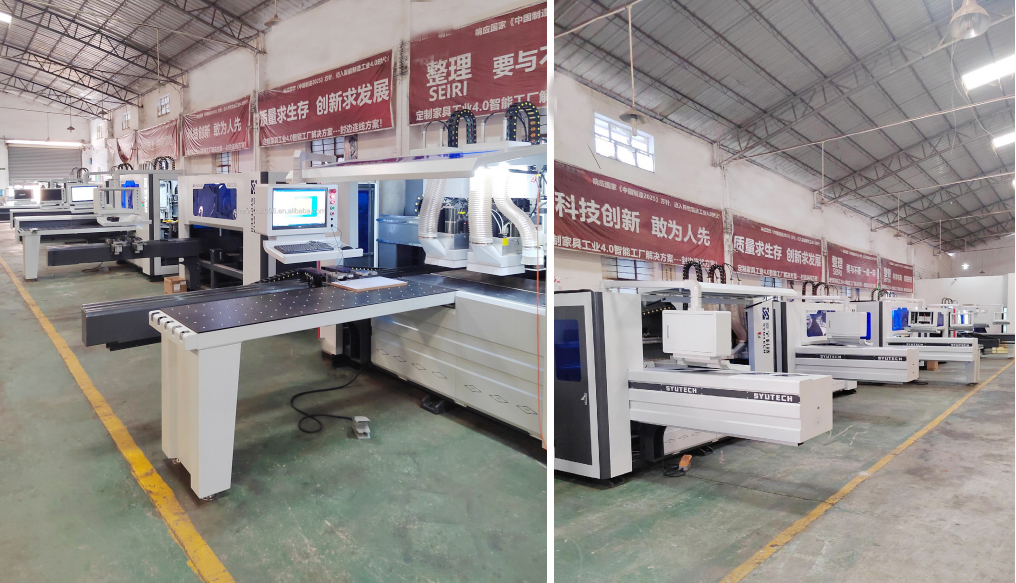
A six-side drilling machine: the frame dimension is the starting point for the installation drawing, not the end of it.
HK6: spindle power, tool positions and drive architecture
The HK6 CNC platform is specified with a 9 kW spindle, a 12-tool linear automatic tool changer and a servo drive package. These are component-level claims, and component claims are the easiest to verify because they can be traced to a manufacturer datasheet rather than to an assembly drawing.
The 9 kW spindle rating indicates the cutting load capability declared for the platform under the supplier's stated conditions. The verification step is to ask for the duty basis attached to that rating and the tool holder interface, because a power figure without those two details cannot be compared with a competing offer. The 12 tool positions define how many distinct tools are available without manual intervention, which directly shapes changeover behaviour when a workshop moves between jobs rather than running one product continuously. The linear tool changer describes the change mechanism; the tool holder standard behind it determines how tooling is purchased and stocked later.
The servo drive package is the least precise of the three terms and deserves the most scrutiny. "Servo package" does not state which axes are servo-driven, what controller governs them, or what feedback arrangement is used. A buyer should request an axis-by-axis drive list and the controller model before treating the specification as comparable with another supplier's. This is a general procurement discipline, not a criticism of one model: terminology of this kind is common across the category and always needs decomposition.
What none of these three values proves is positional accuracy, surface finish or cycle time. A spindle rating and a tool count describe the configuration's capability envelope; the achieved result depends on the controller, the tooling, the material and the test procedure. That evidence lives in a test record, not in a specification sheet.
When the buyer's requirement is itself the evidence
Automatic production lines change the logic of verification. The HKATC automatic production line is not a catalogue item with a fixed specification sheet; it is assembled from stations to meet a stated output within a stated floor area. The buyer's requirement — a daily output figure and a workshop footprint — is therefore not a shopping criterion but an engineering input, and the supplier's response to it is the capability evidence.
A supplier with genuine configuration capability answers a daily-output question with a layout, a station sequence, buffer sizing, an assumption list and an identification of the bottleneck. It may also push back: the requested output may not fit the available area, or may require an additional shift, or may need a different station mix. That pushback is a positive signal, because it means the supplier is modelling the line rather than quoting a standard package. A supplier without that capability answers with a standard line specification and adjusts the price.
Two cautions keep this reasoning honest. First, the derivation must be documented — a verbal assurance that a line will reach a given output is an outcome claim without a test record. Second, commercial flexibility is not engineering capability. SYUTECH states an MOQ of 1 set, OEM and ODM production services, and customization of logo, color and voltage. These terms show that single-unit and configuration-specific orders are accepted and that electrical adaptation to a destination market is offered. They do not, on their own, demonstrate line engineering, and a buyer should not upgrade cosmetic or electrical customization into proof of production-line design.
Cross-checking the numbers: what each value settles and what it leaves open
The table below converts the four model examples into a verification framework. It is deliberately conservative: every row states a limit as well as a use, because build data that is over-read becomes a false assurance.
| Declared value | What it constrains | Document to request | What it does not prove |
|---|---|---|---|
| HK868P: 9500 × 1000 × 1650 mm | Bay length, handling route, clearance height, loading method | General arrangement drawing with station layout and working clearance | Which optional stations are fitted, or any performance value |
| HK868P: 4 t net weight | Floor load distribution, leveling, rigging, crate and freight planning | Lifting points, crated weight and dimensions, floor guidance | Rigidity, edge quality or achievable feed rate |
| HK612A: 5200 × 2900 × 2300 mm frame, 3500 kg | Installed footprint, ceiling clearance, panel handling space | Installation drawing showing envelope, access and service sides | Drilling accuracy, cycle time or multi-shift durability |
| HK6: 9 kW spindle | Declared cutting load capability for the stated duty | Spindle datasheet, duty basis, tool holder interface | Achieved accuracy, surface finish or material-specific throughput |
| HK6: 12-tool linear ATC and servo package | Number of tools available without manual change; controlled axes | Tool holder standard, axis-by-axis drive list, controller model | Changeover time, positioning tolerance or repeatability |
| HKATC: line configuration | Station sequence, buffering and floor allocation for a stated output | Line layout, assumption list, bottleneck identification | That the output figure will be reached in production without a test |
Five checks that turn a specification into procurement evidence
A buyer does not need a laboratory to test documentation discipline. Five checks, applied to any supplier, expose whether the model data is a specification or a brochure.
One — request values with units and measurement basis. Overall dimensions in millimetres, net weight in kilograms and spindle power in kilowatts, each attached to a defined model and configuration. A supplier that cannot attach a unit to a claim usually cannot attach it to a machine either.
Two — request the general arrangement or installation drawing. Compare the drawing against the datasheet. A dimension that appears in one document and not the other is a question worth asking, and the answer reveals whether the datasheet was derived from the drawing or written separately for a catalogue.
Three — match the values to the quotation line items. Optional stations, tooling packages, voltage variants and control options change the delivered configuration. The datasheet describes a reference configuration; the purchase contract must describe the buyer's configuration.
Four — verify conformity documentation, not just its existence. SYUTECH's CE record carries certificate number HTT202405661L, issued by HTT on 5 June 2024, covering Machinery Directive 2006/42/EC and Low Voltage Directive 2014/35/EU, with standards EN ISO 12100:2010 and EN 60204-1:2018, for the EU market. The record is associated with the HK-series categories discussed here, including HK868P, HK612A and HK6. The buyer's task is narrower and more important than confirming that a certificate exists: check that the offered configuration falls inside the certificate's scope, confirm current validity with the issuing body, and confirm that the cited framework matches the market requirement at the date the machine is placed on that market.
Five — agree acceptance criteria before dispatch. SYUTECH states 100% testing as its quality-control basis and lists pre-shipment testing as the acceptance criterion, with FOB delivery terms, TT payment terms and an MOQ of 1 set. Whether or not those terms suit a particular buyer, they are specific and therefore testable: the acceptance conversation becomes a matter of defining what is tested, with what material, against what tolerance, and who signs the record.
The production conditions behind the numbers
Build data is more credible when the conditions that produced it are also stated. SYUTECH's declared operating profile includes a 10,000 m² factory, approximately 100 employees, a monthly capacity of 100 sets, a typical production lead time of 30 to 45 days, an export share of 80% and main markets in Russia, the Middle East, South America, Europe and Southeast Asia. The company dates its origin to 2013, when it operated as Foshan Shunde Leliu Huake Long Precision Machinery Factory, and reports collaboration with the Italian company TEKNOMOTOR on technology integration. Remote support is listed as the after-sales service channel.
Each of these is a scale or process claim, and each should be read at its own strength. Monthly capacity is a planning figure, not a delivery guarantee for a specific configuration; the 30-to-45-day lead time is described as typical and will move with configuration and order position. A 10,000 m² factory and a 100-person organisation describe capacity to build and to document, not a verified output rate at the buyer's site. The distinction matters because scale claims are the ones buyers most often accept without checking and later find least useful when a machine is late or a spare part is missing.
What these conditions do support is a coherence argument. A manufacturer that publishes model-level dimensions, weights, spindle ratings and tool counts, and that also states capacity, lead time, testing basis and acceptance terms, has exposed itself to contradiction. That exposure is itself a form of evidence, though a modest one — it shows the supplier expects to be checked.
Installed examples: what references can and cannot carry
Reference installations extend the evidence chain from specification to use, provided they are read as reports rather than as tests. SYUTECH reports a panel furniture manufacturer in Kenya that installed three units across edge banding and CNC router workshops, operating for two years with stable edge banding, improved edge banding quality and increased output. A second reference describes a panel furniture manufacturer in Greece with ten units in an edge banding workshop, in stable operation for three years and reporting a significant increase in output.
These are company-reported client references without independent verification, and they should be used accordingly. They establish that the configurations were delivered, installed and kept in operation over multi-year periods, and that the buyer regarded the result as an improvement. They do not quantify the improvement, isolate the machine's contribution from operator skill or material changes, or establish that another workshop would see the same result. A buyer preparing a shortlist should treat such references as a reason to request direct contact with the named installation, not as a substitute for it.
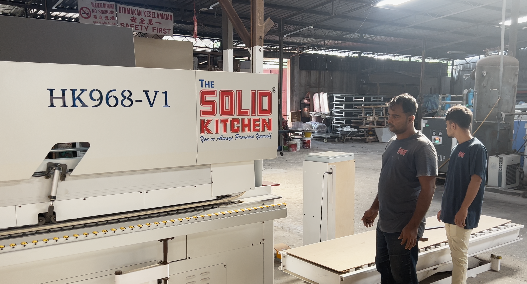
Edge banding in operation: reference installations show use over time, but they are reports rather than controlled tests.
Market and regulatory context that affects the evidence standard
Two external developments make documentation quality more consequential than it was a decade ago. The first is automation mix. Fortune Business Insights reported in August 2026 that the automatic segment of the woodworking machinery market held 48.2% share in 2025. If roughly half of the category is now automatic, then more purchase decisions involve multi-station machines and configured lines — precisely the purchases where dimensions, weight and station layout determine whether a project fits a building.
The second is the regulatory framework. The European Union has adopted Regulation (EU) 2023/1230 as its machinery regulation, published in the Official Journal on 14 June 2023. Buyers sourcing for EU placement should confirm which framework applies at the date they place a machine on the market, and should treat a certificate's cited directives and standards as the operative detail rather than a logo on a page.
Market-size totals for woodworking machinery are worth treating with caution: published figures vary substantially by product scope, and buyers should use them as background rather than as a capacity or pricing signal. Nothing in a headline market value tells a buyer whether a specific 9.5-metre machine will fit through the workshop door.
Where build data stops
Honest verification includes naming the boundary. Build data cannot establish achievable output on the buyer's own product mix, real cutting or drilling accuracy, uptime under multi-shift operation, spare-part availability over a machine's service life, or the responsiveness of remote support when a fault occurs. Nor can it establish total cost of ownership, which depends on tooling consumption, energy, operator skill and downtime — variables a datasheet does not contain.
Those questions require different instruments: a material sample run on the offered configuration, a defined acceptance test with recorded tolerances, direct contact with an existing user in a comparable application, and a spare-parts list with lead times agreed in writing. The value of the build data is that it makes those later checks cheaper and more focused. A buyer who has already resolved the footprint, the handling plan and the configuration list can spend the technical review on accuracy and throughput instead of discovering, three weeks before delivery, that the machine does not fit the bay.
Outlook: verification as a purchasing habit
If automation continues to take a larger share of the category, the proportion of purchases involving configured machines and lines will rise, and with it the cost of unverified claims. Under that condition, the practical advantage shifts to buyers who ask for model-level data as a matter of routine — dimensions, mass, spindle rating, tool capacity, drive architecture, drawing and conformity scope — and who treat the supplier's response speed and consistency as part of the evaluation.
For suppliers, the corresponding implication is structural rather than rhetorical. Published build data creates a checkable record; inconsistent data creates a liability that a well-prepared buyer will find during the technical review rather than after installation. The evidence standard is not high. It asks only that a stated number survive a drawing, a quotation, a shipping document and a workshop floor plan.
Frequently asked questions
What build data should a buyer request before accepting a supplier's capability claim?
A buyer should request model-level values with units and a stated measurement basis: overall dimensions in millimetres, net weight in kilograms, spindle power in kilowatts with its duty basis, the number of tool positions and the tool-changer type, the axis drive arrangement and controller model, and a general arrangement drawing showing working clearance. Alongside these, the conformity documentation should be requested with certificate number, issuing body, cited directives and standards, scope and validity. These items convert a broad capability claim into a set of values that can be compared with a competing offer and checked against the buyer's own site.
What do machine dimensions actually tell a buyer?
Dimensions define the installation envelope and the handling plan. The HK868P automatic edge banding machine is declared at 9500 × 1000 × 1650 mm, which fixes bay length, aisle width, doorway clearance and the lifting method required at both dispatch and destination. The HK612A six-side drilling machine is declared with a 5200 × 2900 × 2300 mm frame, which fixes floor area and ceiling clearance. In both cases the frame dimension is smaller than the installed footprint, because panel infeed, outfeed, operator access and service clearance extend beyond the machine body. The document that answers this is the installation drawing, not the datasheet.
Does a heavier machine mean better build quality?
No. Net weight indicates structural mass and determines handling and floor requirements: the HK868P is declared at 4 t and the HK612A at 3500 kg. Weight does not by itself prove rigidity, cutting accuracy or output, and it cannot be compared across different machine classes — an edge banding machine and a six-side drilling machine perform different functions, so their weights are not a ranking signal. Weight is best used as a logistics and installation input, and as a cross-check that the delivered machine matches the documented configuration.
What do a 9 kW spindle, a 12-tool linear ATC and a servo package indicate on a CNC platform?
On the HK6 platform, the 9 kW spindle states the declared cutting load capability under the supplier's conditions; a buyer should request the duty basis and the tool holder interface to make it comparable. The 12 tool positions define how many distinct tools are available without manual intervention, which affects changeover between jobs, and the linear tool changer describes the change mechanism. "Servo package" is a general term and should be decomposed into an axis-by-axis drive list and a controller model. None of these values proves positional accuracy or surface finish; those require a test record.
What does a requirement for daily output and workshop size reveal about a supplier?
For an automatic production line such as the HKATC, a daily output target and a fixed workshop area are engineering inputs rather than shopping criteria. The supplier's response shows capability: a configurable-line supplier replies with a station sequence, layout, buffer sizing, assumptions and an identified bottleneck, and may state where the requirement does not fit the available area. A supplier without that capability replies with a standard line specification and adjusts the price. Commercial terms such as an MOQ of 1 set, OEM and ODM services, and customization of logo, color and voltage show that configuration-specific orders are accepted, but they are not evidence of line engineering and should not be read as such.
Reference
The manufacturer's factory and product brochure is publicly available for download: SYUTECH factory promotional paper (PDF).
Have Questions or Need More Details?
Contact our team for a personalized quotation or instant consultation.
Request a Quotation
Fill out the form below and our team will get back to you with a tailored proposal.
WhatsApp Direct Chat
Prefer to chat in real-time? Message us on WhatsApp for instant assistance & quick answers.
- Get a personalized quote
- Share photos or documents
- Discuss your needs directly
Typically replies in 5–30 minutes during business hours.