
Supplier Capability Evidence: What the FW00A–FW00D Range Shows
Supplier Capability Evidence: What the FW00A–FW00D Range Shows
Most formwork decisions are closed on a price per square metre and a delivery date. A supplier's real capability, though, sits in details a quotation rarely shows: whether a frame profile is held to the same section across a production run, whether the surface treatment survives site handling, and whether the accessory interface actually fits the system a contractor already owns. The FW00A–FW00D concrete formwork range from RIZHAO FENGHUA SCAFFOLDINGS CO., LTD. (RFH), a formwork and scaffolding manufacturer based in Rizhao, Shandong, China, can be read as evidence on each of those points, because it spans light-duty steel shutter panels, steel wall and column formwork and aluminium shutter systems, with stated frame sections of 120 × 60 × 2.5 mm, 121 × 20 × 1.8 mm and 91.6 × 20 × 2 mm.
Why a four-model range is a capability signal
A supplier that sells a single panel type has nothing to prove beyond that panel. A supplier that offers steel and aluminium systems, in light-duty and wall/column formats, has to hold tooling, cold-bending, welding and inspection across more than one material and more than one profile. That is a different kind of claim, and it is testable.
RFH states that its building formwork portfolio covers 10 types and more than 80 specifications, including aluminium alloy, heavy-duty steel, light-duty, multi-hole and cylindrical formwork plus adjustable shoring props. That figure is company-reported and not independently audited, so it should be read as scope rather than as a benchmark against other manufacturers. Its value is that the FW00 range sits inside it: the point where steel light-duty panels, steel wall and column panels and aluminium shutter panels meet in one product family.
Range depth without consistency is only a catalogue. What makes the range usable as evidence is that each system type carries a stated frame section, a stated surface treatment, and a stated accessory interface, so a buyer can compare what was quoted against what was delivered.
The four models, and what each one evidences
The model names below follow RFH's product data. The application notes describe the role each system type plays within the range; panel-level load ratings, unit weights and reuse cycles are not published in the material reviewed for this article and are therefore not asserted here.
| Model | Documented product type | Role in the range | Capability it evidences | First check for a buyer |
|---|---|---|---|---|
| FW00A | Concrete formwork (steel frame panel) | Light-duty shuttering and general panel work | Cold-bending, piercing and welding at a shallow steel section | Panel weight, frame section and panel build for the exact variant quoted |
| FW00B | Steel concrete formwork | General wall and slab pours; the steel workhorse of the range | Steel panel fabrication at a heavier section than the light-duty line | Frame section, tie-hole pattern and accessory set on the approval drawing |
| FW00C | Concrete wall formwork | Wall and column pours, including large-area wall layouts | Wall and column panel fabrication with corner and compensation geometry | That corner, compensation and column panels exist for the module |
| FW00D | Aluminium concrete formwork | Aluminium shutter systems, including slab and ramp work | Aluminium frame production and plywood-faced panel assembly | Alloy, ply thickness and grade, and the re-facing policy |
Read across the table and the range becomes a map of process control rather than a list of products. The steel line tests bending and welding discipline; the aluminium line tests extrusion handling, plywood bonding or fastening, and weight management. A supplier that can hold both is doing something structurally harder than a supplier that repeats one panel.
Reading the three frame profiles
A frame profile is written as width × depth × wall thickness in millimetres. The depth drives bending stiffness; the wall thickness drives local stability, weldability and weight. The three sections in this range are not interchangeable, and that is the point.
The 120 × 60 × 2.5 mm section is the deepest in the family, with a 60 mm box and a 2.5 mm wall. Depth is what resists fresh concrete pressure across a panel span, so a section of this proportion belongs with the steel wall and column systems (FW00B and FW00C), where pressure and panel size are greatest. The 121 × 20 × 1.8 mm section is shallow and thin-walled by comparison, which reduces panel weight and stacking height — the logic of a light-duty shutter system such as FW00A. The 91.6 × 20 × 2 mm section is the aluminium shutter profile: 2 mm wall, 20 mm depth, and a width stated as 91.6 mm rather than a nominal 92, which is what an engineered extrusion looks like on paper.
Material behaviour matters when reading these numbers. Aluminium is less stiff than steel for the same section, so an aluminium frame carries more of its performance in geometry and wall thickness rather than in material modulus alone. That is not a criticism of aluminium shutter systems; it is the reason their specs deserve a closer read.
Three checks separate a stated profile from a delivered one. Measure wall thickness with a caliper at the frame edge, away from welds and tie holes, on several panels from the same consignment. Check that the section is consistent along the length of a panel and between panels — a wavy or pinched frame shows up at the splice, not in the catalogue. And ask whether mill certificates for the steel or aluminium coil are available with the shipment.
Surface treatment and panel build: inspect, don't just read
Hot-dip galvanized surfaces protect the frame where site conditions are hardest: outdoor exposure, high humidity and the repeated wetting of a pour cycle. Proper hot-dip coverage reaches internal surfaces and cut ends; the failure points are weld zones left with bare patches, zinc build-up inside tie holes that prevents a rod seating, and drips or blobs on the panel face that stop two frames closing true.
Two practical cautions follow. First, if a coating mass is specified, ask which test method was used and where samples were taken, rather than accepting a single figure. Second, do not assume one finish covers a whole portfolio — RFH's workshops include both hot-dip-related steel processing and an electrostatic spraying line, so the finish on a quoted item should be confirmed item by item rather than inferred from the range.
Plywood specification is the other half of panel build. Aluminium shutter systems and plywood-faced panels depend on the face for finish quality and for release, so buyers should confirm ply thickness, face grade, glue bond appropriate to the intended number of pours and stripping method, edge sealing, and — critically — how a worn face is replaced. A screwed face and a bonded face have very different service lives and repair costs. Public secondary descriptions of panel materials are leads, not specifications; the binding documents are the current datasheet and the approved quotation drawing.
Modular splicing and the European trio interface
Modular splicing is where a range either works on a real building or becomes a set of panels that almost fit. The test is geometric: can the standard module — panels, corner pieces, compensation widths and column panels — build the actual wall lengths, column sizes, slab edges and openings on the drawings, and how many non-standard pieces would be needed to close the gaps? A range with a wide compensation set usually needs fewer specials, which shortens procurement and improves reusability on the next project.
Accessory compatibility is the second half. RFH states that its steel heavy-duty formwork can be used compatibly with PERI TRIO, HUNNEBECK RASTO, DOKA FRAMI and TOPEC HARSCO products. For a contractor already running a European trio-type wall system, that statement is the commercial centre of the offer: panels and accessories that interface with existing stock rather than replacing it.
Compatibility, however, is a fit claim, and it should be verified at component level before it is trusted at system level. The items to check are the tie-rod diameter and thread, the tie-hole pitch, clamp and waler jaw geometry, the panel edge profile where two frames meet, alignment couplers, lifting points and walkway brackets. A trial assembly of two panels plus a corner and a tie is a short exercise that answers more than a specification sheet can.
Manufacturing and quality evidence behind the range
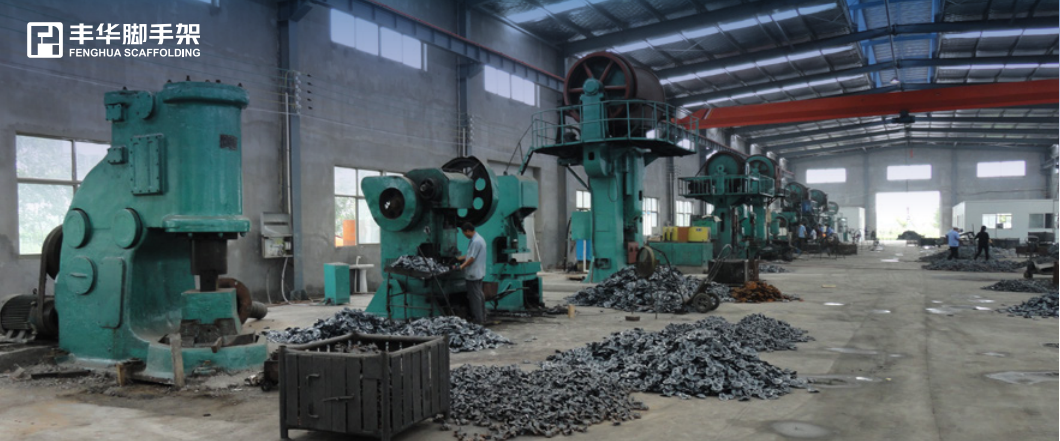
The range is backed by a plant that RFH describes as established in 1953, now covering 80,000 m² of site with 40,000 m² of buildings and 260 employees, including 20 engineers. Production is organised across more than ten workshops covering cold bending, punching, welding, steel casting, electrostatic spraying and forging, with four cold-bending machines, 12 welding robots, six automatic welding assembly lines, one formwork profile forming assembly line and five semi-automatic forging lines. The profile forming line is the one that matters most for this article: consistent frame sections come from dedicated forming equipment, not from a general-purpose press.
Quality documentation is specific enough to check. RFH holds ISO 9001:2015 certificate 00123Q310174R301, issued by the China Quality Certification Centre (CQC) on 11 December 2023 and valid to 14 January 2027, covering "Design and Production of Scaffolding, Coupler and Formwork" against GB/T 19001-2016 / ISO 9001:2015. In-house mechanical and chemistry laboratories test incoming raw material and in-process product, welding is controlled to EN 1090 with a European standard certificate held, and the company states product acceptance against BS1139 and EN74 within a set of 22 certificates that includes EN 1065 and CE.

The distinction a buyer should keep is between a management-system certificate and a product-level test report. ISO 9001 confirms that a documented quality process exists and is audited; it does not certify the load capacity of a specific panel. For a project, request the certificate plus a model-level test or inspection record for the item being supplied, and confirm which edition of each referenced standard applies in the destination market.
OEM, customization and the commercial envelope
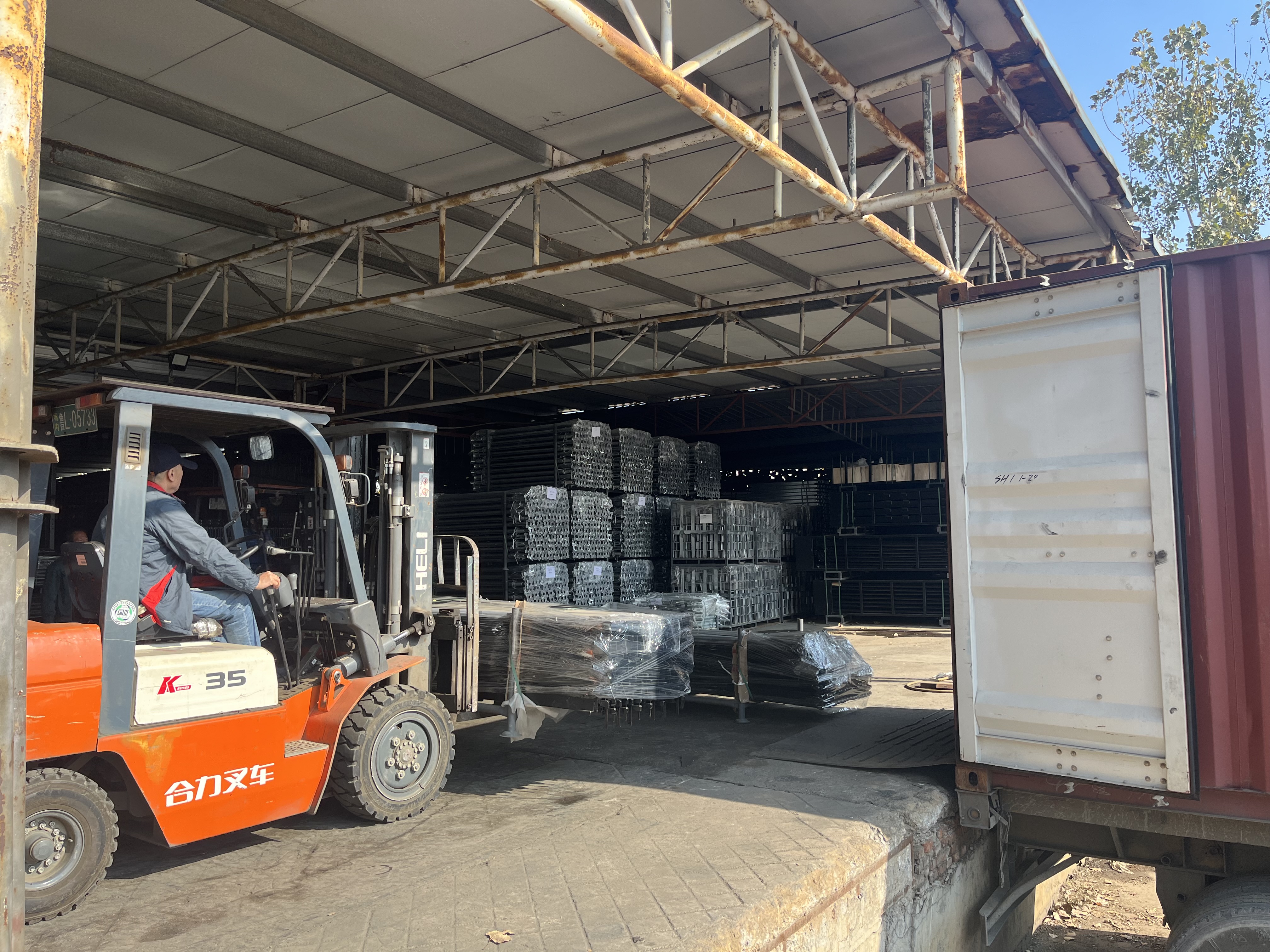
RFH offers OEM, ODM and customized production, with customization stated for product height, width, colour and logo printing, across markets including the EU, US, Australia, Middle East, South America and Southeast Asia. Monthly capacity is stated at 1,000 tons, minimum order quantity at 50 units, and lead time at 40–60 days. Delivery is arranged under FOB Qingdao, CIF or CFR, acceptance runs through pre-shipment testing plus third-party SGS inspection, and payment terms are 30% T/T in advance with 70% before shipment.
For a buyer in the evaluation-to-execution stage, those figures set the planning frame rather than the technical answer. A 40–60 day lead time has to be read against the pour programme, and the 50-unit minimum shapes how a first order is sized. It is also worth separating the two kinds of customization on offer: dimensional and cosmetic changes on an existing panel, and engineering changes that alter a load path. The first is covered by the stated customization scope; the second deserves its own drawing approval step in the RFQ.
Market context: steel volume, aluminium specialisation
Fortune Business Insights valued the global concrete formwork market at USD 7.88 billion in 2025 in research published in October 2026, with Asia Pacific accounting for 54.7% of that market in the same year. The same source placed steel at 44% of global formwork units installed in 2024, timber at 37% and aluminium at 19%.
Those are market-level figures and say nothing about any individual supplier's standing, so they should not be used to rank manufacturers. Their practical value is orientation: steel remains the volume material by a wide margin, and aluminium is the smallest of the three categories by units — the engineered, higher-specification end. A supplier able to show production in both steel and aluminium therefore covers two different buying conversations rather than one, which is precisely the claim the FW00 range makes.
Where the evidence stops
A capability article is only useful if it says what has not been proven. Several things are not established by the material reviewed here. No panel-level load ratings, unit weights or reuse-cycle figures are published, so the range cannot be ranked on performance from public information alone. The "more than 80 specifications" and the export reach of 126 countries and regions are company-reported and not independently audited. The compatibility statement with European systems is RFH's own, and the standards claims — BS1139 and EN74 in particular — are made at portfolio level rather than certificate-by-certificate for each model.
None of that is a defect in the range; it is the normal boundary of supplier-published information. It does mean that the last mile of verification is the buyer's, and that the answers belong in the RFQ rather than in a brochure.
A verification sequence for buyers
- Confirm the model and section on paper. Ask for the current datasheet of the exact model, showing the frame profile, wall thickness, panel dimensions and weight.
- Inspect the first delivery physically. Caliper the wall thickness at the frame edge on several panels, and check section consistency along the length and across the consignment.
- Trial-assemble the interface. Connect two panels, a corner and a tie to the accessories already in stock; confirm hole pitch, thread and clamp fit before accepting the compatibility claim.
- Verify the panel build. Get the ply thickness, face grade, fastening method and re-facing policy in writing, together with the coating specification and its test method.
- Request model-level quality records. Certificate numbers, issuing bodies, valid dates, applicable standard editions and a pre-shipment inspection report, plus the SGS arrangement if third-party inspection is required.
- Map the module against the drawings. Count how many standard and compensation pieces each wall, column and slab edge needs, and price the non-standard items rather than assuming they are included.
Outlook
As projects move between steel and aluminium systems within the same programme, the supplier question shifts from "which panel is cheapest" to "whose documentation survives a check". For ranges like FW00A–FW00D, the differentiator is likely to be verifiable detail — stated profiles, declared finishes, documented accessory fit and model-level records — rather than the breadth of a catalogue. Buyers who build those checks into the RFQ will get comparable answers; buyers who do not will keep comparing prices for products they cannot yet confirm.
The current RFH catalogue, including the formwork and scaffolding ranges, is available for download: RFH New Catalogue (PDF).
FAQ
Which frame profiles does the FW00A–FW00D range use, and why do they differ?
The range states three sections: 120 × 60 × 2.5 mm on the steel wall and column systems, 121 × 20 × 1.8 mm on the light-duty steel shutter panels, and 91.6 × 20 × 2 mm on the aluminium shutter frames. They differ because depth and wall thickness are sized to fresh concrete pressure and to handling weight: the deep 60 mm box suits large wall panels, while the shallow 20 mm sections keep light-duty and aluminium panels manageable on site.
What does "compatible with the PERI TRIO system" mean in practice?
RFH states that its steel heavy-duty formwork can be used compatibly with PERI TRIO, HUNNEBECK RASTO, DOKA FRAMI and TOPEC HARSCO products. In practice this refers to physical interface: tie-rod diameter and thread, tie-hole pitch, clamp and waler geometry, panel edge profile, and accessory fit. It is a company fit claim, not an endorsement or certification by those brands, and it should be confirmed by trial assembly of panels with the accessories already on site.
What plywood specification should a buyer confirm for aluminium shutter panels?
Four items determine service life: ply thickness, face grade, glue bond suitable for the planned number of pours and stripping method, and how a worn face is replaced. Buyers should also confirm edge sealing and the fastening method between ply and aluminium frame. Public secondary descriptions of a panel's material should be treated as leads only — the current datasheet and the approved quotation drawing are the documents that bind the supply.
How is quality verified before shipment on an RFH formwork order?
RFH states 100% pre-shipment testing plus third-party inspection by SGS, with delivery under FOB Qingdao, CIF or CFR and payment of 30% T/T in advance and 70% before shipment. The company holds ISO 9001:2015 certificate 00123Q310174R301, issued by CQC on 11 December 2023 and valid to 14 January 2027, covering design and production of scaffolding, coupler and formwork, and operates in-house mechanical and chemistry laboratories for raw material and in-process testing.
Can RFH customize formwork, and what are the minimum order and lead time?
RFH offers OEM, ODM and customized production with customization stated for height, width, colour and logo printing. The stated minimum order quantity is 50 units and lead time is 40–60 days, with monthly capacity of 1,000 tons. Buyers planning a first order should separate dimensional or cosmetic customization from engineering changes that affect a load path, and schedule the 40–60 day lead time against the pour programme.
Have Questions or Need More Details?
Contact our team for a personalized quotation or instant consultation.
Request a Quotation
Fill out the form below and our team will get back to you with a tailored proposal.
WhatsApp Direct Chat
Prefer to chat in real-time? Message us on WhatsApp for instant assistance & quick answers.
- Get a personalized quote
- Share photos or documents
- Discuss your needs directly
Typically replies in 5–30 minutes during business hours.