
Supplier Capability Evidence: Why the Control System Matters in Pharma Packaging Lines
Supplier Capability Evidence: Why the Control System Matters in Pharma Packaging Lines
A pharmaceutical packaging line is normally purchased on a throughput figure: 400 cartons per minute, 600 blisters per minute, or, on the highest-capacity integrated machines, 800 blisters per minute. Buyers who have commissioned several lines tend to weigh that figure less heavily than a different set of details: which motion controller coordinates the forming, sealing, transfer and cartoning stations, which industrial computer runs the line software, how many servo axes work independently, and what happens to the whole line when a single station stops.
Control architecture is one of the few elements of a supplier offer that can be named, inspected, tested and compared before a purchase order is signed. This guide explains how to read control architecture as supplier capability evidence, using the DHL8005H fully servo blister-cartoner integrated line from Zhejiang Hoping Machinery Co., Ltd. (Hoping) as a documented example. Hoping is a manufacturer of pharmaceutical packing machinery established in 2001 in Ruian City, Zhejiang Province, China, producing blister packing machines, cartoners, case packers and end-of-line packaging machines.
Why the Control System Is the Strongest Readable Signal
Output figures describe an outcome. A control specification describes a mechanism. That distinction matters at the research and evaluation stage, because mechanisms can be verified while outcomes often cannot be reproduced outside the supplier's own test conditions.
Three properties make the control layer unusually useful as procurement evidence.
- It is specific. A line either uses a named motion controller and a named industrial PC, or it does not. Statements such as "fully servo-linked operation with PLC/HMI interface and synchronized multi-station control" are concrete enough to be written into a technical agreement and checked at acceptance.
- It is testable. Servo axes, transfer systems and replenishment channels can be demonstrated during a no-load trial run and a material trial, both of which are standard acceptance stages for integrated lines.
- It reveals engineering depth. Integrating a high-bus motion platform with mechanical tooling, format parts, inspection and downstream equipment requires in-house software and controls competence, not only assembly capability. Hoping's public company profile reports 26 invention patents, 70 utility patents and 28 software copyrights, and a team of 56 engineers — a portfolio that is consistent with a supplier that develops and maintains its own line software rather than reselling a generic control package.
None of this replaces commercial criteria such as price, lead time or service coverage. It does, however, allow a buyer to distinguish between suppliers that specify control as a marketing phrase and suppliers that specify control as an engineered subsystem.
What Control Architecture Actually Includes
In an integrated blister-cartoning line, "the control system" is not a single box. It is a layered architecture, and each layer can be evaluated separately.
- Motion controller. The line-level controller that coordinates axis motion across blister forming, sealing, transfer and cartoning stations. Documented platforms across Hoping integrated lines include Beckhoff motion controllers and Siemens motion controllers, depending on model.
- Industrial computer and HMI. The computing platform behind the operator interface. Documented examples include the CP9315 industrial PC paired with Beckhoff control on the DHL6004, DHL8005H, IXW600 and IXW800 lines, and the Siemens controller with TP900 HMI on the DHL7005H and DHL7004.
- Servo drives and axis independence. How many functions are independently servo-driven rather than mechanically linked through a common shaft.
- Transfer and handling subsystem. How blister cards are moved from the blister machine into the cartoner. Hoping documents a D3 intelligent top-loading parallel tracking transfer system on some high-capacity lines, and a self-developed IRB24 intelligent transfer robot on others.
- Replenishment and material handling. How the line keeps feeding product and packaging material without stopping. Hoping documents servo-driven independent replenishment channels — three channels on the DHL8005H, four channels on the DHL1000/5H — together with PVC/alu foil auto splicing.
- Diagnostics, recipes and data interfaces. Alarm stop, fault indication, recipe storage, format changeover and, where configured, ERP/MES data interfaces.
Reading a supplier's answer across all six layers takes a single technical meeting. It also produces a set of questions that competitors cannot answer with adjectives.
Worked Example: The DHL8005H Control Platform
The DHL8005H is an intelligent fully servo high-speed blister-cartoner integrated machine, positioned as a solid-dosage turnkey packing line. Its documented control platform pairs a Beckhoff motion controller with a CP9315 industrial PC. The same controller and industrial PC pairing also appears on the DHL6004, IXW600 and IXW800, which indicates a platform-level decision rather than a one-off configuration.
| Item | Documented specification (DHL8005H) |
|---|---|
| Machine type | Intelligent fully servo high-speed blister-cartoner integrated machine; solid dosage turnkey packing line |
| Stated maximum capacity | Up to 800 blisters/min and 500 cartons/min |
| Motion controller and computing platform | Beckhoff motion controller and CP9315 industrial PC |
| Transfer system | D3 intelligent top-loading parallel tracking transfer system |
| Feeding | Multiple feeding methods |
| Replenishment | Three-channel servo-driven independent replenishment system |
| Material handling | PVC/alu foil auto splicing |
| Changeover | Mold-change and preset-memory functions |
| Design orientation | GMP-oriented line design; stainless steel and aluminum-alloy structure; transparent guarding |
| Documented scope | High-speed blister forming/sealing, transfer, leaflet handling, carton opening, insertion, coding/inspection, and connection to bundling, case-packing and palletizing equipment |
Read as capability evidence, the interesting part of this table is not the 800 blisters/min figure. It is that the control decisions — controller brand, industrial PC, parallel tracking transfer, three independent replenishment channels, preset memory — describe how the supplier intends to hold that figure under production conditions.
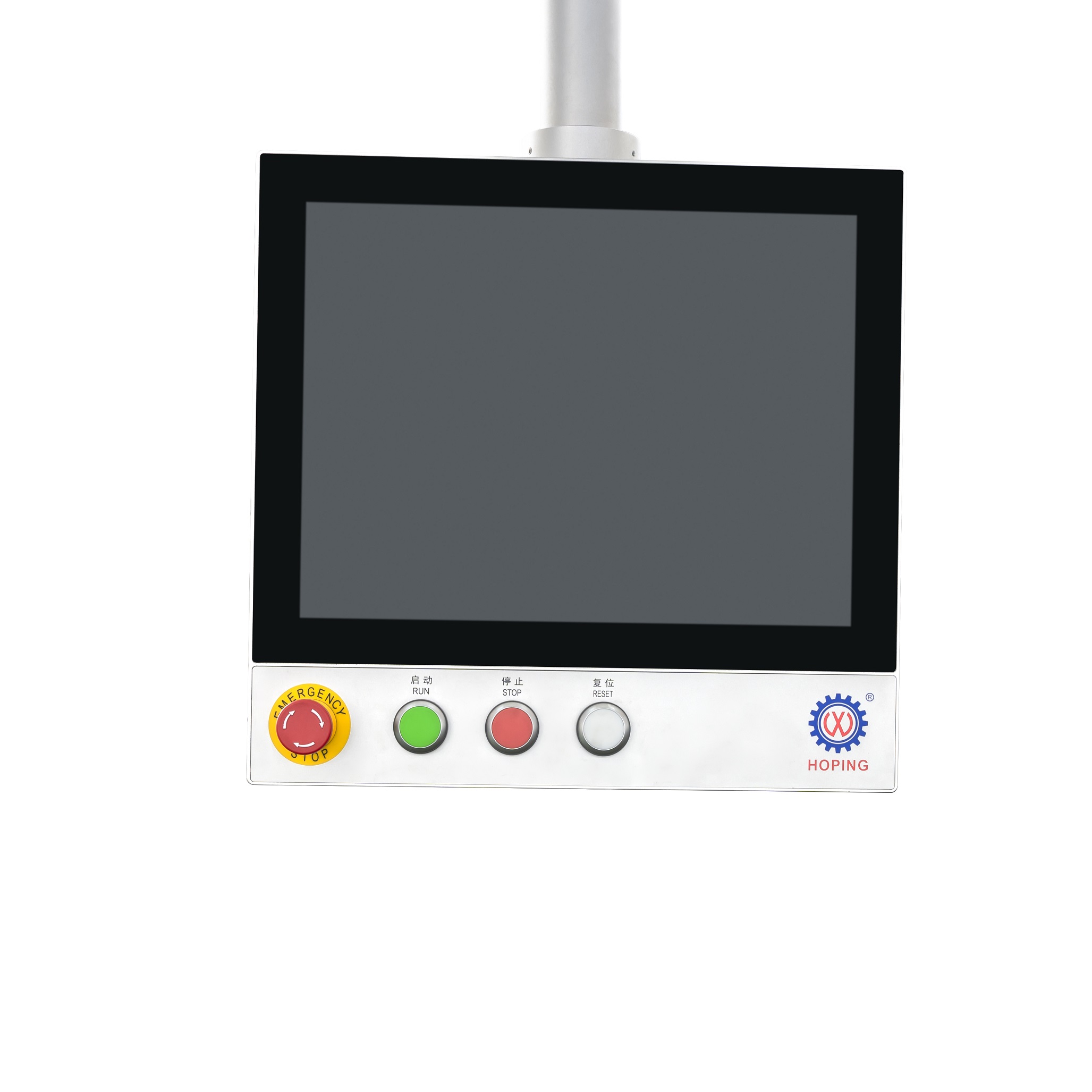
HMI and industrial PC layer on a pharmaceutical blister machine (DPH320HII rotary blister packing machine, 15-inch industrial touchscreen with integrated industrial PC).
How the Control Layer Turns Into Stable Output
Stable output on an integrated line is largely a synchronization problem. A blister machine can form and seal faster than a cartoner can open, insert and close cartons; if the two halves are not coordinated, the effective line speed is set by the slowest station and by the buffer between them.
Four documented control-related mechanisms address this directly:
- Synchronized multi-station control between blister forming, sealing, transfer, leaflet folding, carton opening, insertion and closing, so the stations share a common motion reference rather than running as independent machines.
- Parallel tracking transfer (D3 top-loading system on the DHL8005H), which moves blister cards into the cartoner on a continuous path instead of through index-and-stop handling.
- Independent, servo-driven replenishment in multiple channels, so a low magazine on one channel does not force the whole line to stop.
- Automated material splicing for PVC and aluminum foil, which removes a manual intervention point from the running cycle.
Two further layers support continuity rather than speed: alarm stop and fault indication, which localize a stoppage instead of stopping the line without explanation; and recipe or preset memory, which stores validated parameters for each format so that a changeover reproduces settings instead of re-deriving them.
Inspection belongs in the same discussion. Integrated lines are commonly configured with in-line inspection and rejection, and Hoping documents an optional vision inspection module among the matched equipment for blister-cartoning lines. Inspection and rejection are only useful when they are wired into the motion sequence: a rejection decision that arrives after the blister has already entered the cartoner creates rework rather than protection.
Technical boundary. A motion controller coordinates stations; it does not compensate for worn tooling, out-of-specification forming film, incorrect sealing temperatures or poorly formed blisters. Control architecture sets the ceiling of achievable stability, while mechanical condition, packaging materials and validated process parameters determine whether a line actually reaches it.
Comparing Control Platforms — and Traditional Mechanical Solutions
Within a single supplier portfolio, control architecture is often the clearest way to separate line classes. The table below summarizes documented control-related specifications for several Hoping integrated lines.
| Model | Stated max blister capacity | Stated max carton capacity | Motion controller / HMI platform | Transfer and replenishment architecture |
|---|---|---|---|---|
| DHL6004 | Up to 600 blisters/min | Up to 400 cartons/min | Beckhoff motion controller and CP9315 industrial PC | High-speed transfer and cartoning linkage; servo-driven independent replenishment |
| DHL8005H | Up to 800 blisters/min | Up to 500 cartons/min | Beckhoff motion controller and CP9315 industrial PC | D3 intelligent top-loading parallel tracking transfer; three-channel servo-driven independent replenishment |
| DHL7005H | Up to 700 blisters/min | Up to 500 cartons/min | Siemens motion controller and TP900 HMI | Self-developed IRB24 intelligent transfer robot; independent replenishment |
| DHL7004 | Up to 700 blisters/min | Up to 400 cartons/min | Siemens motion controller and TP900 HMI | Self-developed IRB24 intelligent transfer robot; servo-driven independent replenishment |
| DHL1000/5H | Up to 1000 blisters/min | Up to 500 cartons/min | Beckhoff motion controller and high-bus industrial control system | D3 intelligent top-loading parallel tracking transfer; four-channel servo-driven independent replenishment |
Against traditional mechanical solutions — cam-driven blister machines and simple PLC cartoners linked by mechanical transfer — the trade-off is not one-sided, and buyers should treat it as a genuine decision rather than a hierarchy.
Where traditional mechanical solutions remain reasonable: lower electronics dependency, simpler maintenance for plants without controls specialists, fewer spare-part references in the electrical cabinet, and a lower entry cost for stable single-format production. A mechanically indexed line running one blister format and one carton size for years can be a defensible choice.
Where the limits of traditional architecture appear: format changeover is mechanically constrained rather than recipe-driven; synchronization between blister and cartoning sections is fixed; independent replenishment channels are not available; and production data for batch documentation must be collected manually. Full-servo integrated lines such as the DHL8005H address these points, but they impose their own requirements — maintenance personnel trained on the control platform, spare electronics and firmware lifecycle support, and more extensive validation documentation for the control software.
Limits buyers should accept explicitly. The 800 blisters/min and 500 cartons/min stated for the DHL8005H are maximum capacities. Achievable output depends on blister format, product characteristics, packaging materials, carton and leaflet format, and the confirmed project configuration — which is why the agreed figure belongs in the technical agreement and should be demonstrated during the material trial and factory acceptance test where the contract provides for it. Control architecture does not create capacity on its own.
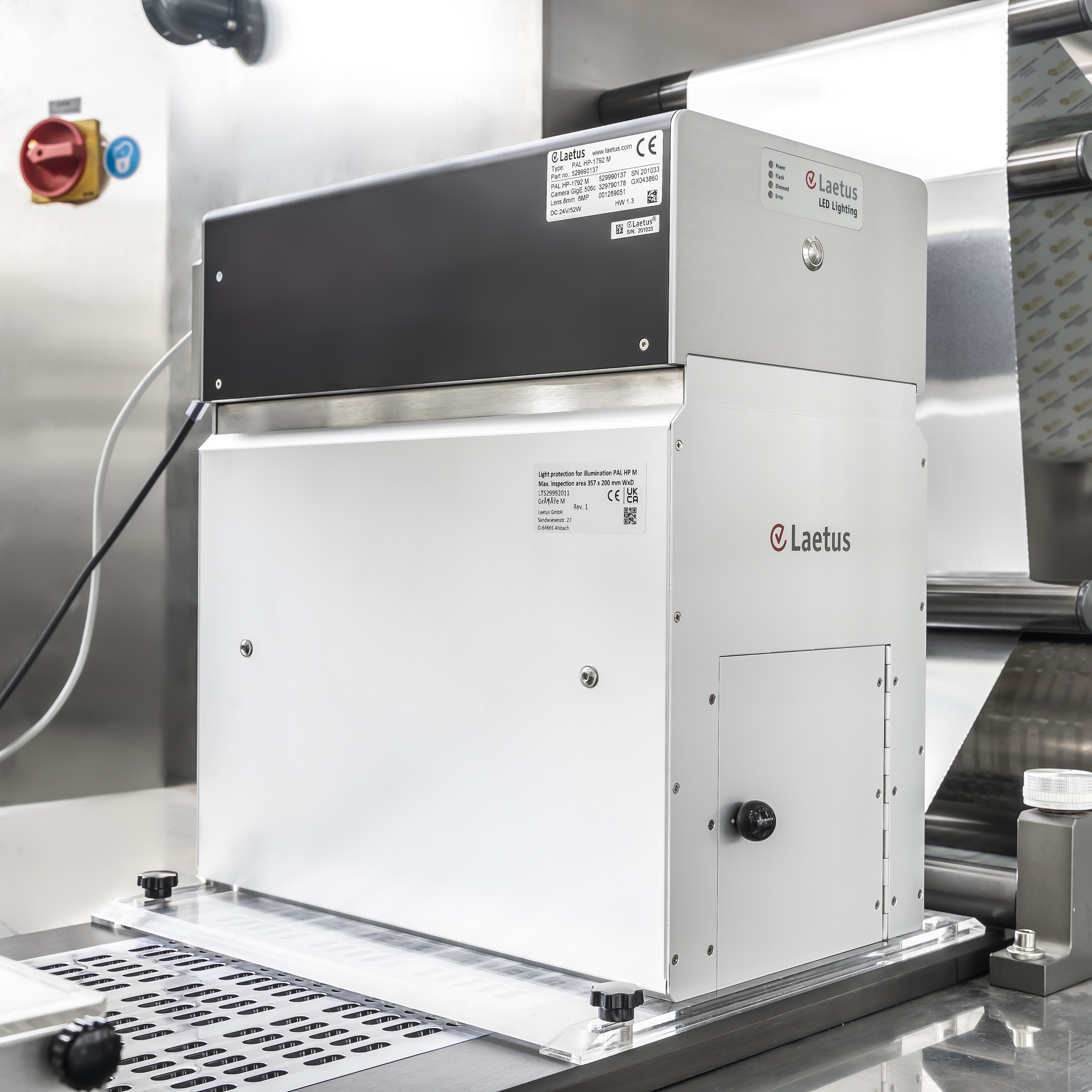
In-line inspection layer: vision inspection module used for product presence, alignment and packaging defect monitoring on a rotary blister packing machine.
Evidence to Request: A Control-Layer Checklist
Because control architecture is verifiable, it can be purchased against a list. The following items are the ones most often missing from early supplier documentation and most often decisive later.
- Motion controller make and model, and the firmware or software baseline the line is delivered with.
- Industrial PC or HMI model, and how recipe or preset memory is stored and backed up.
- A servo axis list, showing which functions are independently driven.
- Transfer system design, and the replenishment channel count.
- Depth of alarm and fault indication, and whether faults are logged for batch documentation.
- Safety architecture and guarding arrangement.
- Electrical schematics, software backups and documentation delivered with the machine.
- Available data interfaces, including ERP/MES connection where required.
- Acceptance records: incoming material inspection, key component inspection, assembly inspection, electrical safety check, no-load trial run, material trial, factory acceptance test and customer witness acceptance.
Two of these items are routinely customized rather than fixed: electrical component brand and data interface. A buyer with an existing controls standard, or with a plant maintenance team trained on one platform, can state that preference during customization discussions instead of accepting a default.
Scenario Fit: Which Projects Need Which Control Level
Control requirements follow the project, not the brochure. Documented project types for this class of equipment — applicable to new solid dosage blister packaging lines, existing packaging line upgrades, high-capacity expansion, intelligent packaging workshop retrofits, and blister-cartoning-bundling or case-packing downstream integration projects — imply different control decisions.
| Project type | What the control decision usually turns on |
|---|---|
| New solid dosage blister packaging line | Complete control architecture selection, including controller platform, axis count, transfer design and inspection integration; validation documentation prepared from the start |
| Existing packaging line upgrade | Feasibility of retrofitting the control platform to existing mechanics; condition of tooling and mechanical stations; interface requirements |
| High-capacity expansion | Higher axis count, parallel tracking transfer, and multiple independent replenishment channels to protect line availability at higher speeds |
| Intelligent packaging workshop retrofit | Recipe or preset memory, fault indication, and data interfaces for production monitoring and batch records |
| Downstream bundling, case packing, palletizing integration | Line-level control and synchronization across modules such as the XWK4060 stretch bander, XWK series case packer and ICP12 case packing and palletizing machine |
The operating environment also constrains the control specification. These lines run under GMP-oriented cleanroom or pharmaceutical packaging workshop conditions, in continuous high-speed operation with multi-batch, multi-format production. Cleanability and maintainability are therefore control-relevant requirements: an electrical cabinet or HMI arrangement that is difficult to clean or service becomes a compliance and uptime problem, which is why separate or service-accessible cabinet layouts and swing-arm HMI positioning appear in these designs.
Market Context: Control as a Differentiation Zone
Capital for pharmaceutical packaging equipment continues to be committed at scale, and published market estimates vary widely depending on scope. SkyQuest Technology valued the global pharmaceutical packaging equipment market at approximately USD 10.71 billion in 2024, while Grand View Research has estimated the same broad market at USD 7.0 billion for 2025 — a divergence that itself is a useful caution for buyers, since the two figures likely define different boundaries between primary and secondary equipment. Within segments, Custom Market Insights projects the pharmaceutical blister packaging machine market to reach USD 2.57 billion by 2025 at a CAGR of 2.8%, and Fortune Business Insights valued the pharmaceutical cartoning machinery segment at USD 1.46 billion in 2024. Grand View Research places Asia Pacific at 40.7% revenue share of the pharmaceutical packaging equipment market in 2025.
Market concentration explains why control architecture has become a competitive question. One market intelligence report attributes approximately 29% of the pharmaceutical blister packaging machine market to the three largest players, Uhlmann, IMA and Marchesini — a structure that leaves substantial space for regional manufacturers competing on configuration, integration and service rather than on volume alone. In that contest, a documented Beckhoff plus CP9315 platform, a named transfer system, or a stated replenishment channel count is a more defensible claim than a general statement about engineering quality.
Regulatory expectations reinforce the same direction. ISO 15378 integrates GMP requirements for primary packaging materials, and pharmaceutical equipment safety in the EU is governed by Machinery Directive 2006/42/EC together with the EN 415 series for packaging machines. Hoping's public company profile lists CE and ISO 9001/14001 certifications. Control documentation — software backups, parameter records, alarm logs — is increasingly part of what buyers collect for qualification packages, not an optional extra.
Sources: SkyQuest Technology; Grand View Research; Custom Market Insights; Fortune Business Insights; ISO; CEN EN 415 series; published market intelligence on blister packaging machine concentration.
Future Outlook
Three directions are already visible in the specifications of current lines and are likely to shape supplier evaluation over the next several years.
- Control as the integration layer. As buyers link blister machines to bundlers, case packers and palletizers, the motion controller increasingly coordinates modules from several stations rather than a single machine. Lines documented as connecting to bundling, case-packing and palletizing equipment show the direction; the control question becomes how much of the downstream sequence a single platform can synchronize.
- Data as a deliverable. Recipe or preset memory, fault indication and ERP/MES interfaces move production data from paper into systems. Buyers should expect to negotiate interface scope and language during customization rather than after installation.
- Platform consistency across a portfolio. Suppliers that standardize on one control platform across multiple models reduce spare-part and training complexity for multi-line plants. Where a portfolio deliberately mixes platforms — as with Beckhoff on some models and Siemens on others — buyers should ask why, and confirm that service coverage exists for the platform they actually purchase.
None of these trends changes the underlying rule: control architecture is evidence. It becomes persuasive only when it is named, documented and demonstrated at acceptance.
FAQ
What does "control architecture" mean on a blister-cartoning line?
It refers to the layered system that coordinates the line: a motion controller, an industrial computer and HMI, servo drives and axes, a transfer and handling subsystem, replenishment and material-handling functions, and diagnostics, recipe storage and data interfaces. On the DHL8005H, the documented architecture combines a Beckhoff motion controller, a CP9315 industrial PC, a D3 intelligent top-loading parallel tracking transfer system, and three-channel servo-driven independent replenishment.
Which control platforms appear across integrated blister-cartoner lines?
Documented platforms vary by model. The DHL6004, DHL8005H, IXW600 and IXW800 use a Beckhoff controller with a CP9315 industrial PC; the DHL1000/5H uses a Beckhoff motion controller with a high-bus industrial control system; the DHL7005H and DHL7004 use a Siemens motion controller with a TP900 HMI; the IXW400 uses a Siemens controller with a CP9315 industrial PC. Buyers should confirm the platform for the specific model and configuration in the technical agreement.
Does a high-specification motion controller guarantee 800 blisters per minute?
No. Capacity figures such as 800 blisters/min and 500 cartons/min for the DHL8005H are stated maximum capacities. Achievable output depends on blister format, product characteristics, packaging materials, carton and leaflet format, and the confirmed configuration. Control architecture supports stability and synchronization; it does not by itself create throughput.
What control-related evidence should a buyer request before ordering?
Controller and industrial PC models, the servo axis list, transfer system design, replenishment channel count, recipe or preset memory handling, alarm and fault indication depth, safety and guarding arrangement, electrical schematics and software backups, available data interfaces, and acceptance records covering no-load trial run, material trial, factory acceptance testing and customer witness acceptance where the contract provides for it.
Can an existing blister packaging line be upgraded to a new control platform?
Existing packaging line upgrade is a documented project type for this equipment class, and customization can cover electrical component brand and data interface. Feasibility is project-specific: it depends on the condition of the existing mechanical stations and tooling, on which line functions — blister packaging, leaflet folding, carton opening, insertion, coding, inspection and rejection, and downstream connection — must be re-controlled, and on the agreed interface requirements.
What support is normally required to keep a full-servo line running?
Documented support scope includes on-site installation and commissioning, operator training, maintenance training, remote video or phone support, spare parts supply, process-parameter guidance, regular follow-up and troubleshooting, subject to contract and project configuration. Lead time is typically 60–120 days after technical confirmation, and depends on model, configuration, project complexity and contract terms.
Control architecture will not decide a pharmaceutical packaging machine purchase on its own, but it is one of the few specification areas where a supplier's engineering depth can be checked rather than assumed. For readers who want the full module and configuration list behind the examples above, the manufacturer's public catalog is available for download: Hoping Machinery Catalog. Additional company information is published at hopingcn.com.