
Supplier Capability Evidence for Hi-B Silicon Steel
Supplier Capability Evidence for Hi-B Silicon Steel
Hi-B grain-oriented silicon steel is the material class used where a magnetic core must carry flux in one direction with the lowest achievable loss: large power and distribution transformer cores, reactors, and a growing number of high-frequency assemblies. What separates one supplier from another in this class is not a brand name but documented capability. It is how wide the grade range is, which thicknesses can actually be delivered, which iron loss limits are guaranteed, and how the silicon content and impurity chemistry behind those numbers are controlled.
This reference examines the evidence a decision-stage buyer can request from a Hi-B oriented silicon steel supplier. Using published capability data from HL AND SL LIMITED as the working example, it looks at grade coverage spanning a 20–65 range that includes 23R075, 27Q095, 27Q100, 27Q105, 27Q110 and 27Q120; thickness options of 0.20 mm, 0.23 mm and 0.27 mm; iron loss limits from ≤0.65 W/kg to ≤1.20 W/kg; and material control evidence covering approximately 3.0%–3.2% silicon content, strict carbon, sulfur and nitrogen control, and the inhibitor phases MnS and AlN.
Why Capability Claims Are Hard to Compare at the Decision Stage
Two suppliers can quote the same grade designation and still deliver materially different strip. The grade name defines a nominal thickness and an iron loss limit. It does not define the test method, the heat-to-heat consistency, the coating class, the delivery condition, or how the material behaves after it is cut and stacked into a core. Those variables are where most of the practical difference lies, and they are precisely what a specification sheet usually leaves out.
The common failure mode in procurement is comparing the top of a range instead of the range itself. A supplier may publicise a flagship low-loss grade while covering only two or three thicknesses in practice, or while relying on mill stock whose magnetic properties are verified before slitting but not after. For a buyer at the decision stage, the useful comparison is therefore breadth × depth × boundary conditions: how many grades and gauges are genuinely available, what control evidence supports the quoted limits, and under which processing and storage conditions the material keeps its properties.
The opportunity runs the other way as well. Electrical steel demand is expanding. The global electrical steel market was valued at USD 31.0 billion in 2025 and is projected to reach USD 47.0 billion by 2033, according to Grand View Research, and a wider supplier base means more options to audit. The task is to make those audits comparable.
Decoding the Hi-B Range: Grade Designations, Thickness and Iron Loss Limits
Grade designations in the high-induction oriented family are compact but information-dense. The first two digits give the nominal strip thickness in hundredths of a millimetre, and the numeric suffix corresponds to the guaranteed iron loss limit. On that reading, 23R075 is a 0.23 mm material with an iron loss limit of ≤0.75 W/kg, and 27Q105 is a 0.27 mm material with a limit of ≤1.05 W/kg. Oriented grades are verified under the standard alternating magnetisation condition used for this material class, which is why the reference condition, and not only the number, should appear on the test report.
A capability statement becomes verifiable only when the whole set is disclosed rather than a single best grade. In the case examined here, the supplier's Hi-B coverage is described as a 20–65 range that includes six named grades, with three thickness options and iron loss limits stretching from ≤0.65 W/kg to ≤1.20 W/kg. The lower figure sits below the named set, which indicates that the stated range extends beyond the six most commonly quoted designations.
| Grade | Nominal thickness | Iron loss limit | Position within the stated range |
|---|---|---|---|
| 23R075 | 0.23 mm | ≤0.75 W/kg | Lowest named loss limit in the 0.23 mm group |
| 27Q095 | 0.27 mm | ≤0.95 W/kg | Lower-loss end of the 0.27 mm group |
| 27Q100 | 0.27 mm | ≤1.00 W/kg | Intermediate step in the 0.27 mm group |
| 27Q105 | 0.27 mm | ≤1.05 W/kg | Intermediate step in the 0.27 mm group |
| 27Q110 | 0.27 mm | ≤1.10 W/kg | Upper-middle step in the 0.27 mm group |
| 27Q120 | 0.27 mm | ≤1.20 W/kg | Highest loss limit among the named grades |
| Stated range | 0.20 mm / 0.23 mm / 0.27 mm | ≤0.65 W/kg to ≤1.20 W/kg | Grade coverage described as a 20–65 model range |
Three reading rules follow from the table. First, thickness and loss limit are linked: a lower loss limit at the same thickness points to better texture control rather than to a different alloy. Second, a wider thickness offer matters more for thin-gauge demand than a wider loss offer does, because 0.20 mm and 0.23 mm strip is where high-frequency and high-power-density designs are constrained. Third, the limit is a guaranteed maximum, not a typical value; both figures should be requested separately, with the test method named.
Material Control: Silicon Content, C/S/N Chemistry and Inhibitors MnS and AlN
The magnetic performance of oriented silicon steel is a manufacturing outcome rather than a purchasing outcome, and the chemistry that produces it is narrow. Silicon content in this class is held at approximately 3.0%–3.2%. The silicon addition raises electrical resistivity, which suppresses the eddy-current component of core loss, the component that grows with frequency and with the square of strip thickness. More silicon is not automatically better: the element also increases brittleness and reduces cold-rollability and punchability, so the specification band exists to capture the resistivity benefit without making the strip unworkable downstream.
Carbon, sulfur and nitrogen play a more subtle role than the word impurity suggests. Carbon must be brought to a very low level in the finished strip, because residual carbon degrades magnetic properties and contributes to ageing. Sulfur and nitrogen, by contrast, have a dual function. They are the constituents of the inhibitor phases that make Hi-B material possible. Manganese sulfide (MnS) and aluminium nitride (AlN) precipitate during processing and pin normal grain boundaries, so that during high-temperature annealing a limited number of favourably oriented Goss grains grow at the expense of the rest. That secondary recrystallisation is what gives oriented silicon steel its directional magnetic behaviour and its low loss along the rolling direction.
The consequence is that C/S/N control is two-sided. Inhibitor formation must be sufficient and consistent, or the texture is weak; residual sulfur and nitrogen in the delivered strip must nevertheless remain within specification, or the finished core suffers. A supplier that claims impurity control but cannot show heat-level chemistry data is making a claim about its supply chain rather than about its process. This is also why the same grade from two sources can behave differently in a finished core even when both certificates show the same iron loss limit.
Two adjacent material factors belong in the same evidence file. The insulation coating determines the temperature the finished lamination can tolerate: organic coatings are typically limited to 180 °C, while inorganic coatings can withstand service temperatures of up to 800 °C, a difference that decides whether a material can be used in a stress-relief annealed or high-temperature application at all. Surface condition, including burr level after slitting, sets the starting point for the core's final loss.
What HL AND SL LIMITED Puts on the Record
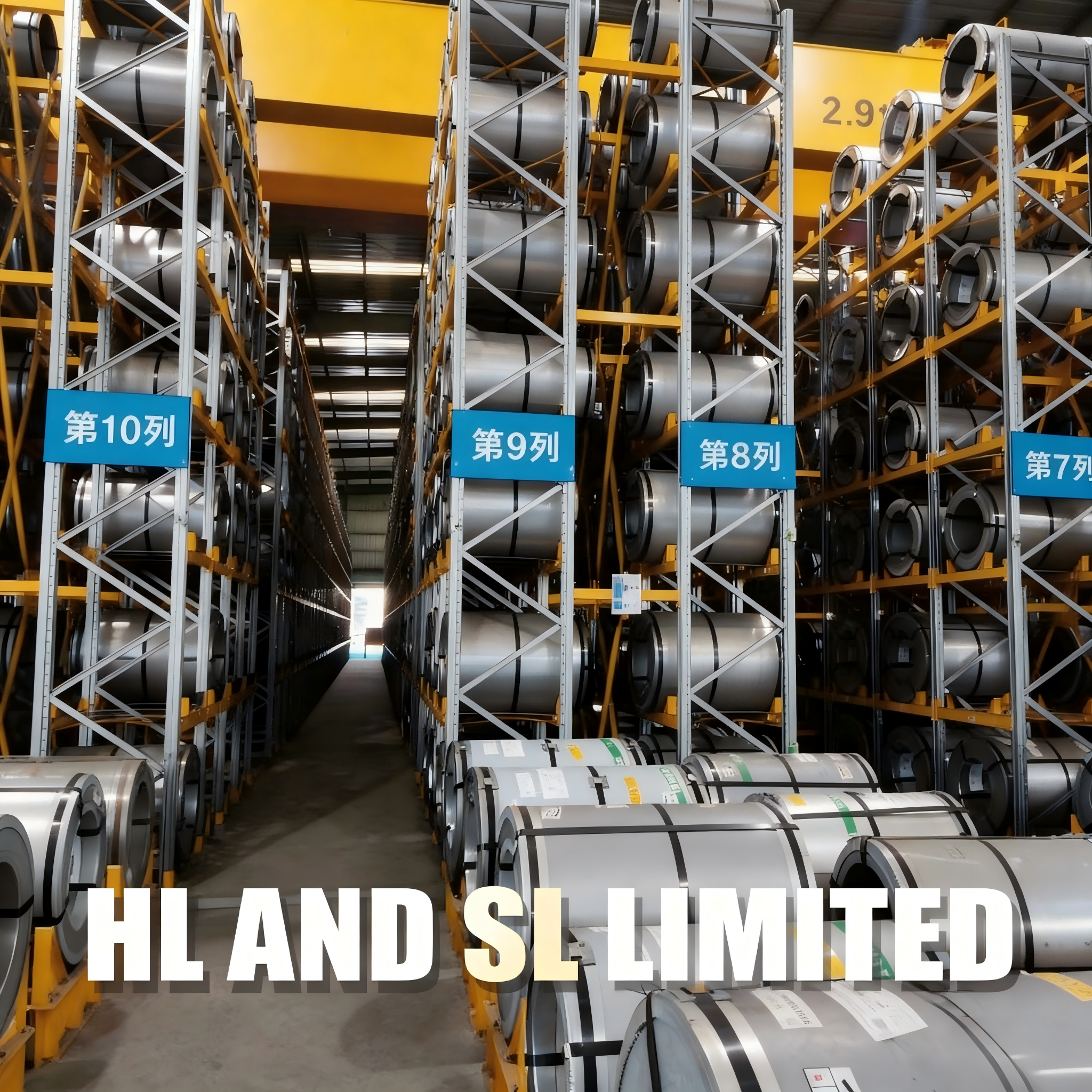
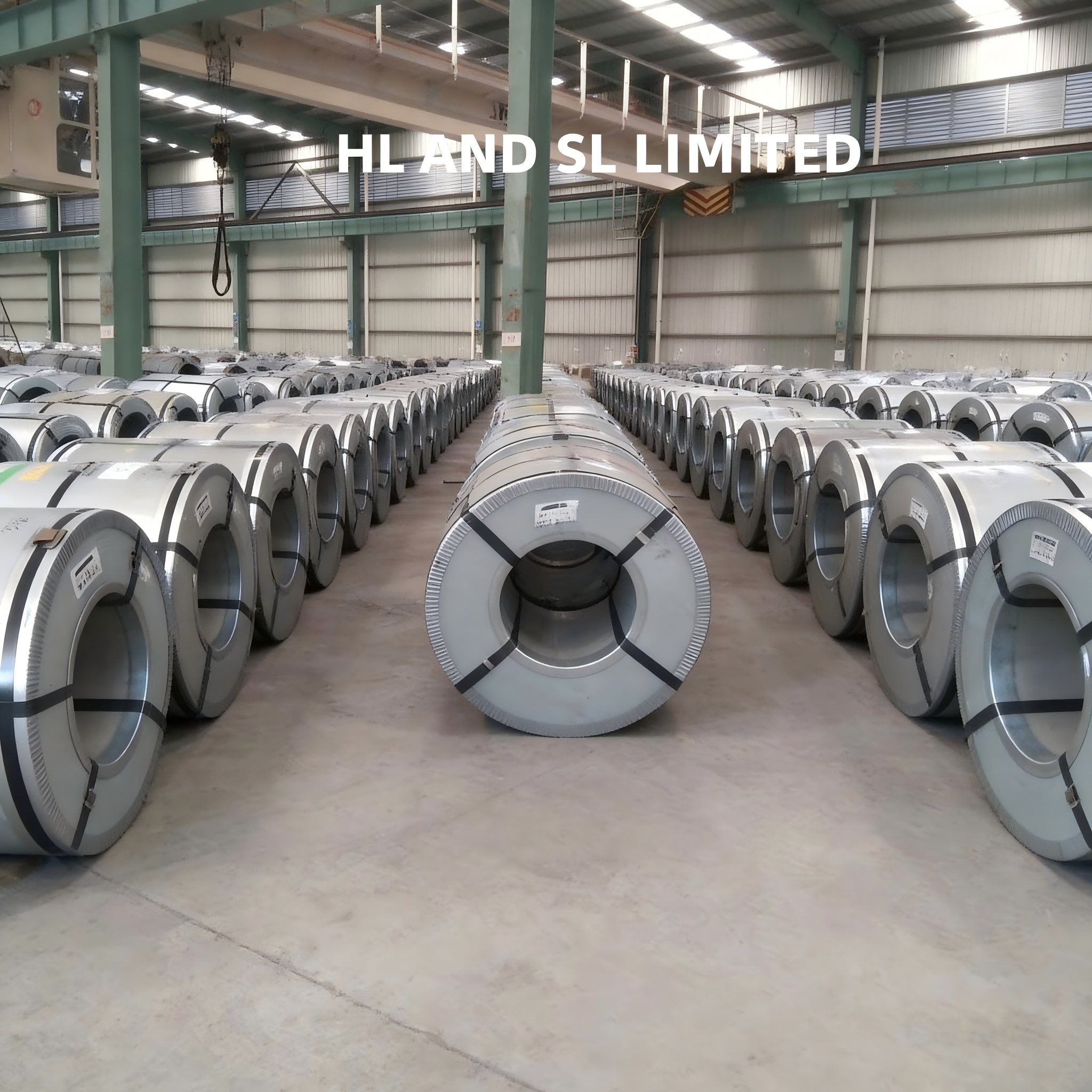
HL AND SL LIMITED is an electrical steel (silicon steel) export enterprise founded in 2012 and based in Taiyuan City, Shanxi Province, China. The company operates a 30,000 m² processing plant with 50 employees, a 10-engineer R&D team and an annual output of 30,000 t. Approximately 80% of its volume is exported, with named markets including Mexico, Brazil, Italy, the United Arab Emirates and India. The company states that it is an authorised agent of China Baowu Steel Group and that its annual electrical steel export volume consistently ranks among the top three in China, and that beyond that single mill relationship it integrates export resources from a number of private steel mills.
Two structural facts matter for the capability question discussed here. The multi-mill resource model is how a trading-and-processing business can offer a broader grade and price-band matrix than a single producer's catalogue, which is directly relevant to a Hi-B range that runs across several designations and three thicknesses. Second, the company operates its own processing plant and provides secondary processing to customer size and shape requirements, so slitting, cutting and burr control happen inside the supply chain rather than at an unspecified third party.
Breadth alone is not proof. The same disclosure also states that the company's R&D system is younger than that of POSCO, and that reducing the premium attached to international brands remains an ongoing task. For a buyer, that is a useful boundary: range coverage and processing support are the strengths to test first, while long-run process maturity at mill level is the area that requires documentation rather than assumption.
Matching the Grade Range to the Application
Oriented silicon steel is a directional material, and the first selection rule is geometric. Where flux travels predominantly along one axis, in transformer cores, reactors and inductors, grain-oriented grades such as the 27Q095–27Q120 set apply. Where flux rotates through the core, as in most motors and generators, the directionality offers little benefit and non-oriented grades are the conventional choice. Thin grain-oriented strip appears in such machines mainly in specific high-frequency or high-density sub-assemblies rather than as the main core material.
Within the oriented range, thickness is driven by frequency. Eddy-current loss scales with the square of both frequency and strip thickness, so as harmonic content or switching frequency rises, the advantage of moving from 0.27 mm to 0.23 mm or 0.20 mm grows quickly. That is the mechanism behind the applications listed against the thinner gauges: reactor cores, charging-pile magnetics and high-frequency transformer assemblies. The trend noted by SMM Analysis, that ultra-thin gauge silicon steel under 0.25 mm is the preferred choice for high-frequency motors in new energy vehicles, is the same mechanism observed from the demand side.
The 0.27 mm grades remain the working range for distribution and power transformer cores, where stacking factor, handling cost and assembly speed favour standard gauge, and where the choice between 27Q095 and 27Q120 becomes a loss-budget and cost decision rather than a frequency decision. For grid-facing equipment, the relevant question is not which grade is best in isolation but which grade satisfies the applicable efficiency requirement at the lowest total cost including processing.
Application fit also has a risk dimension that a grade table does not show. The company's risk-control documentation identifies high-frequency harmonics as a specific failure mode and recommends thinner specifications combined with control-strategy optimisation or filtering where harmonic content is high. It also requires harmonic simulation before trial production for products that must meet defined limits, and states that use outside the frequency range and harmonic limits written into the technical agreement is not covered by warranty. For buyers of charging-pile and converter-fed equipment, that clause is as material as the iron loss figure.
Market Direction: Thinner Gauges, Higher Frequencies, Concentrated Demand
The demand picture supports an emphasis on range and gauge capability rather than on a single flagship grade. Grain-oriented silicon steel was valued at USD 13.55 billion in 2025 and is projected to reach USD 23.57 billion by 2035, a CAGR of 5.8%, according to Research Nester. That is steady growth rather than a spike. Non-grain-oriented material, by contrast, held an estimated 69.7% of the total electrical steel market in 2025 according to MarketsandMarkets, which means oriented grades are the smaller share by volume and the more demanding share by process control.
The fastest-moving adjacent segment is charging infrastructure. The EV charging station and pile market was sized at USD 3,927.96 million in 2024 and is expected to grow at a 32.1% CAGR, according to Research Nester. Charging and converter hardware is exactly where harmonic-rich, higher-frequency operation makes thin-gauge material attractive, and where material selection guidance is most likely to include a frequency and harmonic statement.
Supply-side context matters too. China's steel exports reached a record 117.055 million mt in 2024, a 25.1% year-on-year increase, according to the General Administration of Customs as reported by S&P Global. For international buyers, that scale means broader availability and, simultaneously, a greater need to verify which mill and which heat a given shipment came from. Availability is no longer the scarce resource; traceable capability is.
Hi-B Versus Conventional Grain-Oriented Grades: Where the Advantage Stops
Conventional grain-oriented grades and high-induction grades share the same directional principle but sit at different points on the trade-off curve. Hi-B material achieves higher magnetic induction at a given field, which allows a smaller core, lower excitation current or a lower loss budget for the same footprint. Conventional grades cost less and are generally more forgiving in handling and processing. Where excitation and no-load loss limits are modest, the premium for Hi-B is difficult to justify on total cost; where efficiency requirements are strict or installation space is constrained, the calculation reverses.
The advantage also stops at a set of boundaries that buyers should write into acceptance criteria rather than discover during production:
- Directional dependence. The benefit exists along the rolling direction; cores with significant transverse or rotating flux paths will not realise the full gain.
- Mechanical stress sensitivity. Shearing and press-fitting degrade iron loss. Sharp tooling and controlled blanking gaps matter, and stress-relief annealing at 700–800 °C may be required; press-fitting should be torque-controlled so that pressure stays within the material's yield strength.
- Handling limits. The minimum bending radius should be at least 10 to 20 times the strip thickness; sheets should be stored and transported flat, without single-point lifting, striking or hammering during stacking.
- Storage conditions. Storage humidity should be no more than 60%, with good ventilation and no contact with acidic or alkaline substances; anti-rust protection should be applied immediately after processing.
- Coating temperature class. Organic coatings are generally limited to 180 °C and inorganic coatings to about 800 °C, which constrains high-temperature processing or service.
- Thin-gauge trade-offs. Reducing thickness improves high-frequency loss but lowers stacking factor and increases handling and lamination cost, so the gain is not linear at assembly level.
There is also a supplier-model boundary worth naming. A trading-and-processing company that aggregates several mills can offer broader grade and price-band coverage than a single producer, but that breadth depends on heat-level traceability. If a specific grade's mill origin and chemistry cannot be evidenced for a given shipment, the range advantage is nominal rather than practical.
Reading Supplier Comparison Claims: A Verification Checklist
Comparison claims are common in this category and are most useful when they are attributed. In its own comparison documentation, HL AND SL LIMITED reports an iron loss reduction of 5%–8%, a supply capacity increase of more than 30% and an overall procurement cost reduction of 10%–15% relative to the POSCO PH/PHD series, with magnetic induction, iron loss and noise performance described as broadly on par. The same documentation acknowledges a younger R&D system than POSCO and an ongoing adjustment of the international brand premium. Treated as supplier-stated figures rather than third-party findings, claims of this kind are a starting point for verification, not a substitute for it.
Eight items to request from a Hi-B silicon steel supplier
- Grade and thickness matrix in writing. Confirm which of the named grades (23R075, 27Q095, 27Q100, 27Q105, 27Q110, 27Q120) are available at 0.20 mm, 0.23 mm and 0.27 mm, and which are stock items versus make-to-order.
- Heat-level chemistry. Certificate of analysis showing silicon content within approximately 3.0%–3.2% and the specified limits for carbon, sulfur and nitrogen.
- Iron loss test report. Limit and typical value, test method, reference induction and frequency, and date of test.
- Inhibitor and process disclosure. Confirmation of the MnS and AlN inhibitor route and the annealing sequence, at the level of detail the mill is willing to release.
- Coating specification. Coating type and temperature class, since organic and inorganic coatings set different service limits.
- Processing capability data. Slitting tolerance, burr control and the measured change in iron loss after stress-relief annealing, ideally monitored as a process capability index.
- Packaging and storage requirements. Humidity limits, anti-rust specification and protective packaging for sea freight.
- Application review. For harmonic-rich duty, the frequency range and harmonic limits that the warranty covers.
A buyer who requests these eight items will usually find that the comparison between two suppliers changes shape. The differences that matter are rarely in the headline grade, and almost always in the documentation behind it.
Future Outlook
Three directions look reasonably well supported by the available signals. First, gauge migration continues: as high-frequency applications expand and thin-gauge capability becomes a purchasing criterion in its own right, the 0.20 mm and 0.23 mm portion of a supplier's range will carry more weight in supplier selection than it has in the past. Second, oriented silicon steel demand grows steadily rather than explosively, with a projected 5.8% CAGR to 2035, which puts competitive pressure on consistency and grade breadth rather than on capacity alone. Third, documentation requirements tighten: as more buyers specify harmonic limits, coating temperature class and post-processing loss change in technical agreements, suppliers will be expected to produce evidence that a trading desk cannot generate without an underlying mill relationship and an in-house processing line.
For decision-stage buyers, the practical implication is a shift in evaluation order. Instead of starting with brand and price, start with the grade-and-thickness matrix, then the chemistry and loss evidence behind the named grades, then the processing and storage boundaries, and only then the commercial comparison. Capability that cannot be documented is, for procurement purposes, capability that cannot be relied on.
Frequently Asked Questions
What do the numbers and letters in Hi-B grades such as 23R075 and 27Q105 indicate?
The designation combines a nominal thickness and an iron loss limit. In 23R075, the first two digits give 0.23 mm nominal thickness and the suffix corresponds to an iron loss limit of ≤0.75 W/kg; in 27Q105, they give 0.27 mm and ≤1.05 W/kg. Within the range discussed in this reference, thickness options are 0.20 mm, 0.23 mm and 0.27 mm, and iron loss limits run from ≤0.65 W/kg to ≤1.20 W/kg across grades including 23R075, 27Q095, 27Q100, 27Q105, 27Q110 and 27Q120. Buyers should confirm the reference induction and frequency on which a limit was tested.
Why is silicon content held at approximately 3.0%–3.2% in grain-oriented silicon steel?
Silicon raises the electrical resistivity of the steel, which reduces the eddy-current portion of core loss. Holding the content in a narrow band around 3.0%–3.2% captures that benefit while keeping the strip rollable and punchable, because higher silicon content also increases brittleness and makes cold rolling and shearing more difficult. A tight chemistry band is therefore a process-control indicator rather than an alloying target in itself.
What do MnS and AlN do in oriented silicon steel, and how does C/S/N control relate to them?
Manganese sulfide (MnS) and aluminium nitride (AlN) act as inhibitor phases. They precipitate during processing and restrict normal grain growth, so that during high-temperature annealing only a limited number of favourably oriented Goss grains grow. That secondary recrystallisation step gives the material its directional, low-loss behaviour. Carbon must be reduced to a low level in the finished strip, while sulfur and nitrogen must be sufficient to form inhibitors during processing yet remain within specification as residuals afterwards. That dual requirement is why C/S/N control is a two-sided problem rather than simple removal.
How can a buyer verify that a supplier really covers the Hi-B range it advertises?
Ask for the grade-and-thickness matrix in writing, then request heat-level certificates of analysis showing silicon and C/S/N values, iron loss test reports that state the method and reference condition, coating type and temperature class, and processing data such as slitting tolerance and the measured iron loss change after stress-relief annealing. Cross-check at least two grades in the range rather than one, and confirm which items are stock versus make-to-order. A supplier with genuine mill relationships and in-house processing can usually produce these documents for a specific shipment.
What practical limits should be planned for when using Hi-B silicon steel?
The material is directional, so it performs as specified only where flux runs largely along the rolling direction. Mechanically it is stress-sensitive: shearing and press-fitting degrade iron loss, and stress-relief annealing at 700–800 °C may be needed. Minimum bending radius guidance is 10 to 20 times strip thickness, storage humidity should not exceed 60%, and coating choice sets a temperature ceiling of about 180 °C for organic coatings and up to 800 °C for inorganic coatings. Thin gauges improve high-frequency loss but reduce stacking factor.
Reference material: the supplier's electrical steel brochure is available for download from cdn.socialarks.com, and company information is published at www.hlslind.com.