
Supplier Capability Evidence in Supplement Packaging: What Buyers Can Verify
Industry Reference · Packaging & Printing
Supplement packaging buyers rarely lack supplier options. What they lack is comparable evidence. Most suppliers describe themselves with the same vocabulary — custom, compliant, reliable, scalable — and those words do not tell a buyer whether a specific jar, cap, or closure can be produced at the required volume, with the required barrier behaviour, and with the documentation the destination market expects.
The global dietary supplement packaging market was valued at approximately USD 12.7 billion in 2024 and is expected to grow at a CAGR of 6.1% through 2034, according to Precedence Research. Category definitions differ across research houses — Grand View Research sizes the narrower nutraceutical packaging category at USD 5.05 billion for 2024, while Straits Research places the supplements and nutrition packaging category at USD 28.69 billion — but the structural picture is consistent: plastic remained the dominant material in nutraceutical packaging with a 58.3% revenue share in 2024 (Grand View Research), and North America accounted for 34.4% of global supplement packaging revenue in the same year (Grand View Research).
This article treats supplier capability as an evidence problem rather than a marketing one: what a buyer in the awareness and research stages can actually verify, what each category of evidence proves, and where the boundaries of a specialised packaging manufacturer normally sit.

Round violet glass supplement jar with a child-resistant cap, item code H21-0013V, 2 oz (60 ml). Product image: NINGBO HONOR PACKAGING CO.,LTD.
Why capability evidence, not capability claims, decides sourcing
Capability is usually claimed at three different levels, and buyers often conflate them. The first level is feasibility: can the format be produced at all? The second is repeatability: can it be produced consistently at volume, order after order? The third is documentation: can it be produced with the paperwork and material declarations that the destination market requires? A supplier can be genuinely strong at the first level and weak at the second, and the gap only becomes visible during a scale-up.
Supplement packaging adds regulatory weight to the third level. In the United States, dietary supplement packaging must comply with the Dietary Supplement Health and Education Act (DSHEA) of 1994 and FDA Current Good Manufacturing Practice under 21 CFR Part 111. In the European Union, Regulation (EU) No. 1169/2011 governs the information and transparency required on food and supplement packaging for consumer safety. Certain product categories carry further obligations: tamper-evident packaging is a mandatory requirement for dietary supplements in the US under the Poison Prevention Packaging Act for certain ingredients, such as iron above 30 mg.
Those obligations attach to the filled pack rather than to the empty container, yet the packaging supplier is usually the party that must supply the supporting detail — material composition, closure performance, dimensional consistency, and statements aligned with the brand owner's compliance file. That is why capability evidence matters before a purchase order, not after.
A practical framework: five categories of verifiable capability evidence
Not all evidence is equally useful. Facility photographs look impressive but prove little on their own; item codes and capacity ranges look mundane but are the easiest claims to check. The table below separates the two.
| Evidence category | What it supports | What it does not settle |
|---|---|---|
| Physical manufacturing footprint — facility area, location, number and type of production bases | Basic scale and logistics proximity to export ports | Whether the specific line can run your format repeatably |
| Process and tooling responsibility — who defines tooling strategy, structural development, and manufacturing risk validation | Whether the supplier owns the failure modes of mass production or passes them downstream | Actual defect rates, which require production data |
| Product platform documentation — item codes, capacity ranges, dimensions, materials, closures, carton quantities | Direct comparability between suppliers and formats | Whether the platform fits your fill, dosage, and shelf-life target |
| Regulatory and material documentation — CGMP-aligned statements, material declarations, labelling support | The supplier's ability to feed the brand owner's compliance file | The brand owner's own legal responsibility, which never transfers |
| Sampling and validation path — how a design is proven before volume production | Whether scale-up risk is managed deliberately | Long-run consistency, which is demonstrated only over repeated orders |
A useful rule for the research stage: a claim that can be checked in a document, a catalogue entry, or a sample is worth more than a claim that can only be checked by trust. Facility photos and factory videos are context; item codes, dimensions, thread standards, and carton quantities are evidence.
What that evidence looks like in documented form
NINGBO HONOR PACKAGING CO.,LTD. is a Ningbo, China-based packaging manufacturer founded in 2015 that specialises in child-resistant packaging, violet glass packaging, and vacuum packaging for supplement, food, cosmetic, and medical applications. The company states that it operates a 45,000 square metre manufacturing facility with approximately 310 employees and a 15-person R&D team, with an annual production capacity of 1,000,000 units. It reports a 100% export ratio, with the EU and the USA as its main markets, and is located close to both the Ningbo and Shanghai seaports.
The more decision-relevant part of the description is the operating model. Honor describes itself as a manufacturing-responsibility-focused partner: it takes clients' finalised packaging designs and turns them into products that can be mass-produced reliably and consistently. Before mass production it is involved in product structural development, tooling strategy definition, and critical manufacturing risk assessment and validation. During mass production it takes responsibility for manufacturing process control and order fulfilment, targeting stable quality, controlled cost, and on-time delivery. Production runs through long-term joint-venture production bases for plastic and glass packaging, with a focus on technically demanding, higher-grade packaging products.
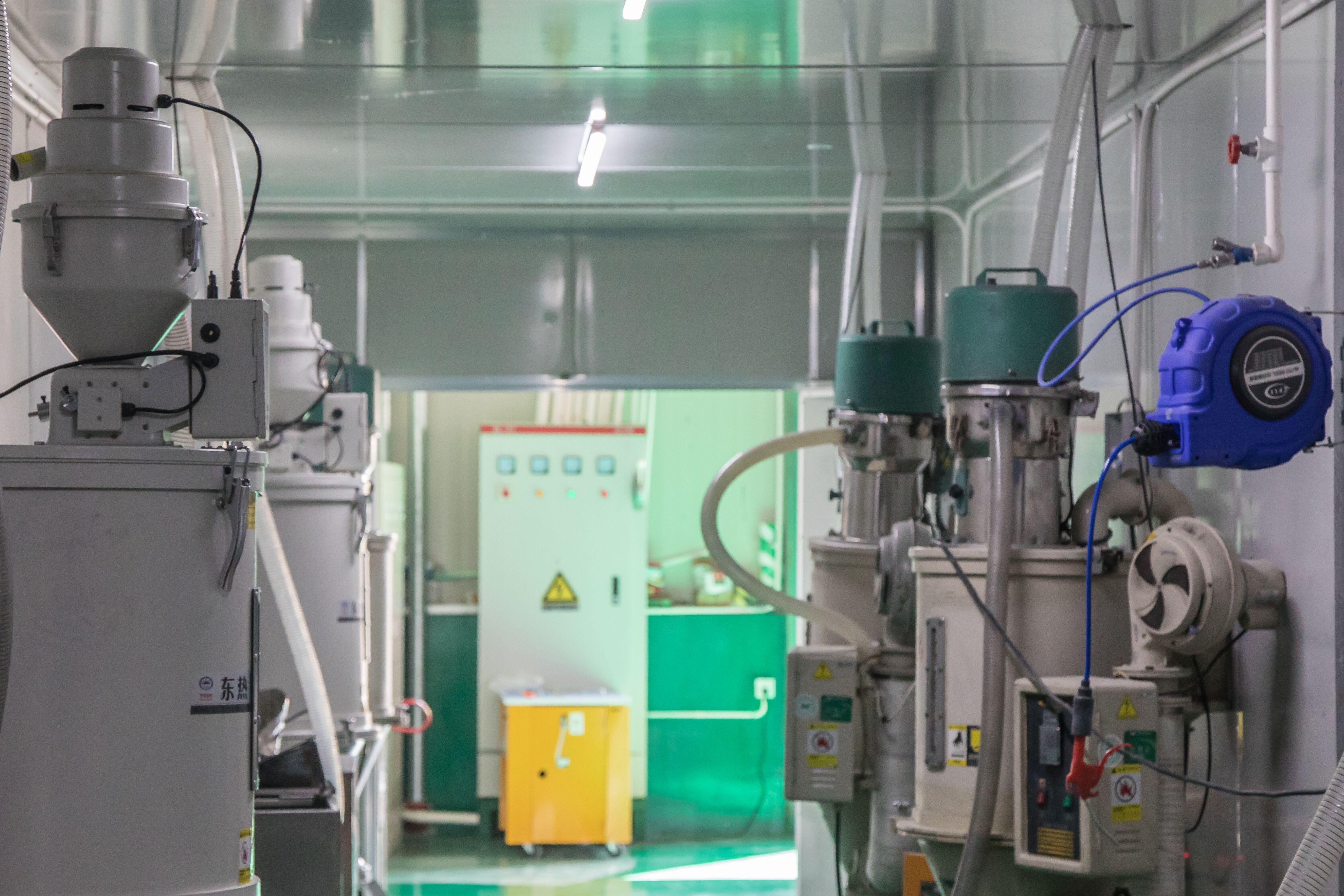
A plastic packaging production base within the manufacturer's joint-venture production network. Image: NINGBO HONOR PACKAGING CO.,LTD.
Technical explanation: how format, material, and closure define capability
Capability becomes concrete at the level of tolerances and interfaces. Across the manufacturer's documented platforms, a 0.38 mm glass wall thickness appears repeatedly — on the H21 child-resistant jars, the HDV2 violet jars, and the HDV1 wide-mouth jars — which indicates a shared manufacturing standard across product families rather than one-off specifications. Thread specifications are equally specific: 41/400 and 89/400 for the HDV1 wide-mouth range, and 32/400 through 89/400 for the HDV2 range.
Closure systems are the second capability layer. The H19 and H21 ranges use child-resistant caps; the HDV3 violet glass bottle offers a plastic cap, dropper, mist sprayer, or lotion pump as the closure, which means one bottle platform can serve multiple dosing formats without a new mould. Surface treatments form the third layer: sticker, silk-screen printing, hot stamping, heat transfer printing, and frosted finish are documented across the H21 and HDV1 platforms, while the HDV3 adds label and gold stamping. Each additional decoration step is a process step that has to be validated, so a long decoration menu is most useful when it is tied to a stable base platform.
| Platform | Model | Material | Documented capacity range | Notable specifications |
|---|---|---|---|---|
| Child-resistant concentrate jars | H19 | Glass | 5 ml, 9 ml | Square, round, triangle, hexagon; white, black, clear; net weight 27 g–38 g; 250 pcs per carton |
| Vacuum click jar | H19 | Glass | 5 ml | Square; 250 pcs per carton |
| Child-resistant square jars | H21 | Glass, plastic, PE | 15 ml, 30 ml, 20 dr, 30 dr, 40 dr, 60 dr | 58 mm diameter; 0.38 mm glass thickness; 75 g–280 g; height 24 mm–115 mm |
| Child-resistant round jars (clear) | H21 | Glass, plastic, PE | 30 ml, 2 oz, 20 dr, 30 dr, 40 dr, 60 dr, 6 oz | 60 mm diameter; 0.38 mm glass thickness; 84 g–268 g; height 36.5 mm–125 mm |
| Square violet glass jars | H21 | Violet glass, PP, PE | 15 ml to 60 dr (200 ml) | 58 mm diameter; child-resistant cap; multiple decoration options |
| Round violet glass jars | H21 | Violet glass, PP, PE | 30 ml to 6 oz | Child-resistant cap; item codes H21-0012V to H21-0018V |
| Cosmetic violet jars | HDV2 | Violet glass, urea, PE | 3 ml to 200 ml | Diameter 36 mm–93.2 mm; height 25.6 mm–55 mm; 36 g–205 g; threads 32/400 to 89/400 |
| Wide-mouth violet jars | HDV1 | Violet glass, urea, PE, SAN, ABS | 100 ml to 1 L | Threads 41/400 and 89/400; 117 g–610 g; height 84.7 mm–193 mm |
| Violet glass dropper bottles | HDV3 | Violet glass, PP closure | 5 ml to 100 ml | Height 54.5 mm–125 mm; 22.5 g–120 g; dropper, mist sprayer, or lotion pump |
Specifications as documented in the manufacturer's product data. Buyers should still confirm the exact item code, fill volume, and closure combination for their own formulation.
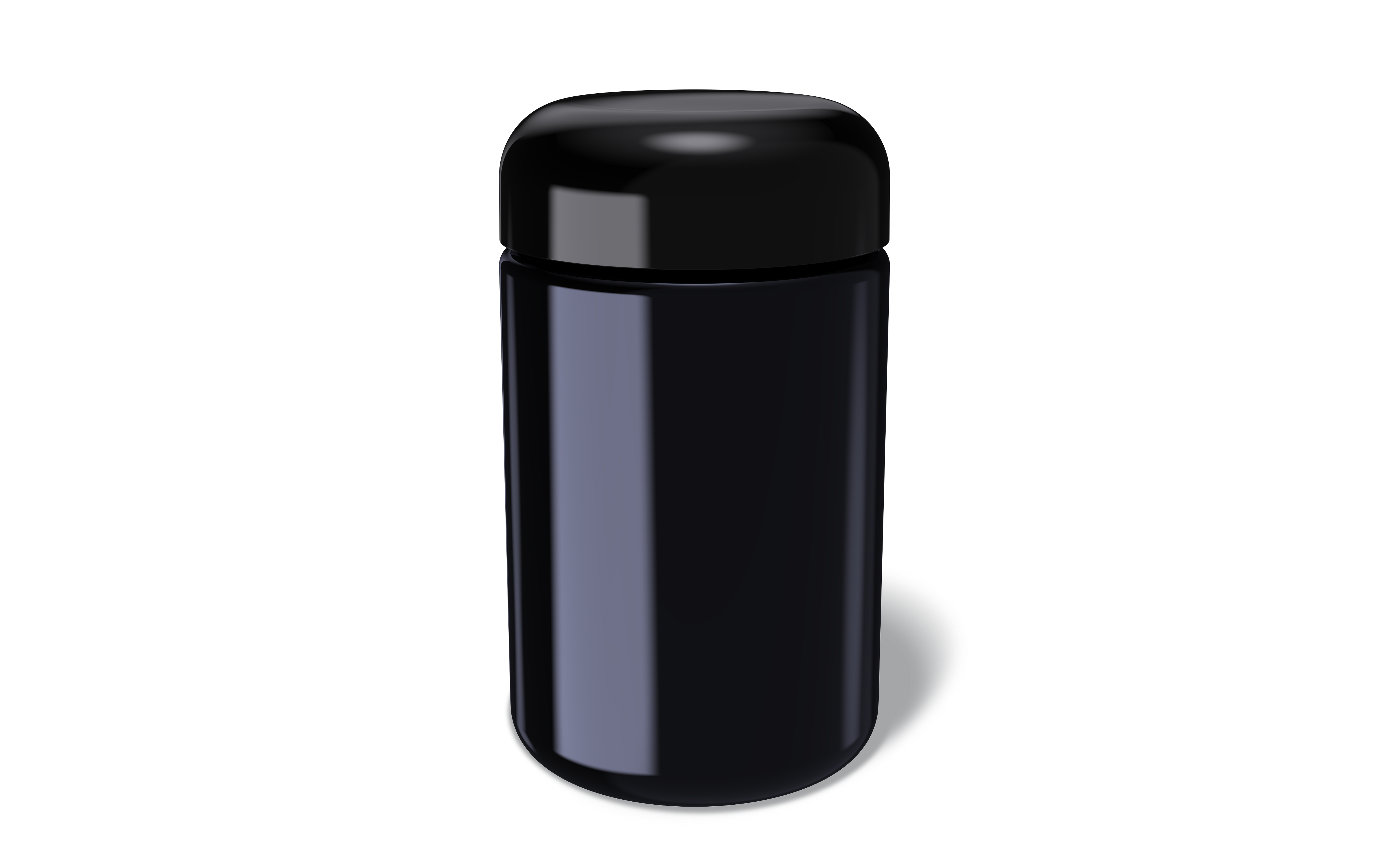
Wide-mouth violet glass jar, item code HDV1100M-2, part of the HDV1 range documented for capacities from 100 ml to 1 L. Image: NINGBO HONOR PACKAGING CO.,LTD.
Application scenarios: matching a platform to a product type
Capability only becomes useful when it maps onto a real product form. The manufacturer's application data describes glass packaging for food, cosmetic, and medical use, with UV protection and dust control as operating conditions, hand operation with the cap as the matched component, and a special requirement for UV-protective black glass with a child-resistant design. The same application record lists Canada, Germany, India, Italy, Thailand, and the United States among served markets.
- Resin and concentrate products: the H19 range covers 5 ml and 9 ml glass jars with child-resistant caps in white, black, clear, square, round, triangle, and hexagon variants, packed 250 pieces per carton — a format scale suited to small-dose, high-value supplements.
- Oxidation-sensitive small volumes: the H19 vacuum click jar is a 5 ml square glass jar designed for supplement packaging, using a vacuum closure logic rather than a standard screw cap.
- Botanical and herb powders: the HDV1 wide-mouth range from 100 ml to 1 L, with 41/400 and 89/400 threads, addresses the practical problem of filling and dispensing powders without a narrow neck.
- Capsules: the H21 round clear jars from 30 ml to 6 oz, and the H21 violet variants, combine volumetric capacity with a child-resistant cap.
- Oils, tinctures, and liquid formats: the HDV3 bottle from 5 ml to 100 ml pairs a violet glass body with a dropper, mist sprayer, or lotion pump, allowing one bottle to serve multiple dosing methods.
- Cosmetic-adjacent supplement SKUs: the HDV2 range from 3 ml to 200 ml sits at the boundary between cosmetic and supplement packaging, which is relevant for brands operating in both categories.
Market trend analysis: material economics and documentation pressure
Two trends shape what buyers should ask for. The first is material economics. Plastic remains the dominant material in nutraceutical packaging at a 58.3% revenue share in 2024 (Grand View Research), largely on cost and barrier performance, while flexible formats keep expanding: the Mylar bags market, frequently used for powder and herb supplement packaging, was valued at USD 2.4 billion in 2023 and is projected to reach USD 4.1 billion by 2030, according to Vantage Market Research. Rigid glass and flexible film are therefore not competing for the same line item so much as dividing the category by product type and price tier.
The second trend is documentation pressure. As DSHEA and 21 CFR Part 111 in the US and Regulation (EU) No. 1169/2011 in the EU continue to define what must be stated on and around a supplement pack, packaging suppliers are increasingly asked to supply structured material and specification data rather than general assurances. The practical effect is that suppliers who publish checkable parameters — item codes, capacities, dimensions, thread standards, carton quantities — are easier to pre-qualify than suppliers who publish only brand language.
The global supply base is also segmented. Grand View Research identifies Amcor, Berry Global, and Gerresheimer as top-tier global manufacturers in the nutraceutical and dietary supplement packaging sector, alongside a long tail of regional specialists. Buyers generally work with both tiers for different reasons, and the comparison below is about fit rather than ranking.
Comparison with established supply options — and where the specialist model stops
| Supply model | Typical strength | Typical constraint for a supplement brand |
|---|---|---|
| Global tier-one converters (for example Amcor, Berry Global, Gerresheimer, identified by Grand View Research) | Very large capacity, multi-region manufacturing, broad material portfolio including flexible formats | Minimum volumes and commercial terms often geared to large programmes; less flexibility for small, custom, technically demanding runs |
| Regional specialist manufacturers (for example NINGBO HONOR PACKAGING CO.,LTD.) | Custom structural development, decoration depth, joint-venture glass and plastic production bases, export orientation to EU and US markets | Smaller stated output; capability concentrated in rigid glass and plastic formats |
| Trading intermediaries without manufacturing responsibility | Low coordination effort, price shopping across factories | No ownership of tooling validation, process control, or scale-up risk; documentation quality depends on the underlying factory |
The limits matter as much as the strengths, and buyers should treat them as scoping information rather than criticism. Three boundaries are visible in the published record of NINGBO HONOR PACKAGING CO.,LTD.
First, scale. The stated annual production capacity of 1,000,000 units is modest next to global tier-one converters, so programmes driven purely by lowest unit cost at very high volume may be better served elsewhere. Second, the production model runs through long-term joint-venture production bases rather than wholly owned plants in multiple regions; that supports capital efficiency and specialisation, but buyers who require single-company ownership of every production step should verify control and traceability arrangements case by case. Third, the documented product scope is rigid glass and plastic packaging — child-resistant jars, violet glass jars and bottles, and vacuum jars. No flexible film or Mylar pouch capability is documented in the available material, even though the flexible segment is growing; a brand sourcing powder pouches should treat that as outside this supplier's evidenced scope.
One further honest gap: the published material does not include named customer references or third-party audit results. That is an omission in the available record, not evidence of a problem — but a buyer who needs named references should request them directly during supplier evaluation rather than assume either way.
Future outlook
Three developments are reasonably foreseeable from the evidence available. Documentation will keep moving upstream from the brand owner to the packaging supplier, because regulations such as 21 CFR Part 111 and Regulation (EU) No. 1169/2011 require information that only the container manufacturer can reliably produce. Material choice will keep splitting by product type rather than consolidating, with rigid glass serving premium and sensitivity-driven SKUs and flexible formats serving high-volume powder lines. And supplier evaluation will shift from brand impressions to parameter comparison — the suppliers easiest to shortlist will be the ones whose capacity, thread, closure, and carton data can be placed in a spreadsheet without translation.
For buyers still in the research stage, the practical implication is simple: build the shortlist around evidence that can be checked before sampling, and use the sampling round to test whether the supplier's stated responsibility for tooling, validation, and process control holds up in practice.
FAQ
What evidence should a supplement packaging buyer request before placing a first order?
At minimum, four categories of evidence: the item codes and specification sheets for the proposed container and closure, including capacity, dimensions, material composition, and carton quantity; a clear statement of who owns tooling strategy and structural development; the documentation the supplier can provide to support US requirements under DSHEA and FDA 21 CFR Part 111 or EU requirements under Regulation (EU) No. 1169/2011; and the sampling and validation path that will be used before volume production. Claims that cannot be tied to a document, a specification, or a sample are difficult to compare between suppliers.
How can a buyer verify a packaging supplier's annual production capacity claim?
Capacity is best treated as a checkable number rather than a marketing statement. Ask for the stated annual output, the number and type of production bases behind it, and how that capacity is allocated across product families. For reference, NINGBO HONOR PACKAGING CO.,LTD. states an annual production capacity of 1,000,000 units supported by a 45,000 square metre facility, approximately 310 employees, and a 15-person R&D team, operating through long-term joint-venture production bases for plastic and glass packaging. Buyers should then test whether the specific item code they need sits within that capacity envelope, since aggregate output does not automatically translate into availability on a given line.
Which supplement product types fit rigid glass and plastic packaging platforms?
Documented platforms cover several distinct product forms. Small-dose concentrates and resin-type products fit the H19 child-resistant glass jars in 5 ml and 9 ml, available in square, round, triangle, and hexagon shapes and packed 250 pieces per carton. Oxidation-sensitive small volumes fit the H19 5 ml vacuum click jar. Botanical and herb powders fit the HDV1 wide-mouth violet jars from 100 ml to 1 L, which use 41/400 and 89/400 threads. Capsules fit the H21 round jars from 30 ml to 6 oz. Oils, tinctures, and liquid formats fit the HDV3 violet glass bottle from 5 ml to 100 ml, which accepts a dropper, mist sprayer, lotion pump, or plastic cap.
How does a packaging supplier's capability relate to FDA and EU compliance requirements?
The legal responsibility for compliance stays with the brand owner, but the packaging supplier supplies part of the underlying evidence. In the US, dietary supplement packaging must comply with the Dietary Supplement Health and Education Act of 1994 and FDA Current Good Manufacturing Practice under 21 CFR Part 111, and tamper-evident packaging is mandatory under the Poison Prevention Packaging Act for certain ingredients such as iron above 30 mg. In the EU, Regulation (EU) No. 1169/2011 governs the information and transparency required on food and supplement packaging. A supplier's relevant capability is therefore the ability to provide consistent dimensional and material data, closure performance information, and documentation that the brand owner can place into a compliance file.
When is a specialised packaging manufacturer not the right fit?
A specialist is usually the weaker choice in three situations. First, when a programme is driven primarily by the lowest possible unit cost at very high volume, where global tier-one converters identified by Grand View Research such as Amcor, Berry Global, and Gerresheimer are structured to compete. Second, when the required format is flexible film or Mylar pouches: the documented scope of NINGBO HONOR PACKAGING CO.,LTD. covers rigid glass and plastic packaging, with no flexible pouch capability stated, even though the Mylar bags segment was valued at USD 2.4 billion in 2023 and is projected to reach USD 4.1 billion by 2030 according to Vantage Market Research. Third, when a buyer requires single-company ownership of every production step in multiple regions, since the manufacturer's model operates through long-term joint-venture production bases rather than wholly owned plants worldwide.
Have Questions or Need More Details?
Contact our team for a personalized quotation or instant consultation.
Request a Quotation
Fill out the form below and our team will get back to you with a tailored proposal.
WhatsApp Direct Chat
Prefer to chat in real-time? Message us on WhatsApp for instant assistance & quick answers.
- Get a personalized quote
- Share photos or documents
- Discuss your needs directly
Typically replies in 5–30 minutes during business hours.