
Supplier Capability Evidence: A Model-Level Tour of Fruit & Vegetable Packaging
Supplier Capability Evidence: A Model-Level Tour of Fruit & Vegetable Packaging
Fresh produce packaging is a specification-driven purchase. The global fresh food packaging market reached USD 134.60 billion in 2024 and is projected to reach USD 240.50 billion by 2035, according to Spherical Insights & Consulting, while packaging used specifically for fruits and vegetables was valued at approximately USD 38.08 billion in 2024, according to Market Research Future. In a market of that scale, supplier claims are plentiful and auditable specifications are not.
This article takes a different route from the usual supplier profile. Instead of restating capability adjectives, it walks through an actual PET container and tray portfolio — fruit and vegetable containers HB-SG300ML, HB-7001 and HB-SG1000ML; trays packaging HB-T9333, HB-3066 and HB-T9576; salad containers HB1720 and HB5053; and tamper evident models from HB-8OZ to HB-32 OZ — and explains what each verified model tells a produce wholesaler, supermarket chain, agricultural exporter, bakery, food retailer or e-commerce brand about the factory behind it.
The manufacturer whose range is reviewed here is Weifang Chuanhe New Material Co., Ltd. (CHUAN HE), a Chinese thermoformed packaging producer based in Weifang, Shandong Province, specializing in PET and PP thermoformed containers for baking packaging and fruit and vegetable packaging. Its export business accounts for 100% of sales, with major markets in the European Union, the United States, North America, Latin America and the Middle East.
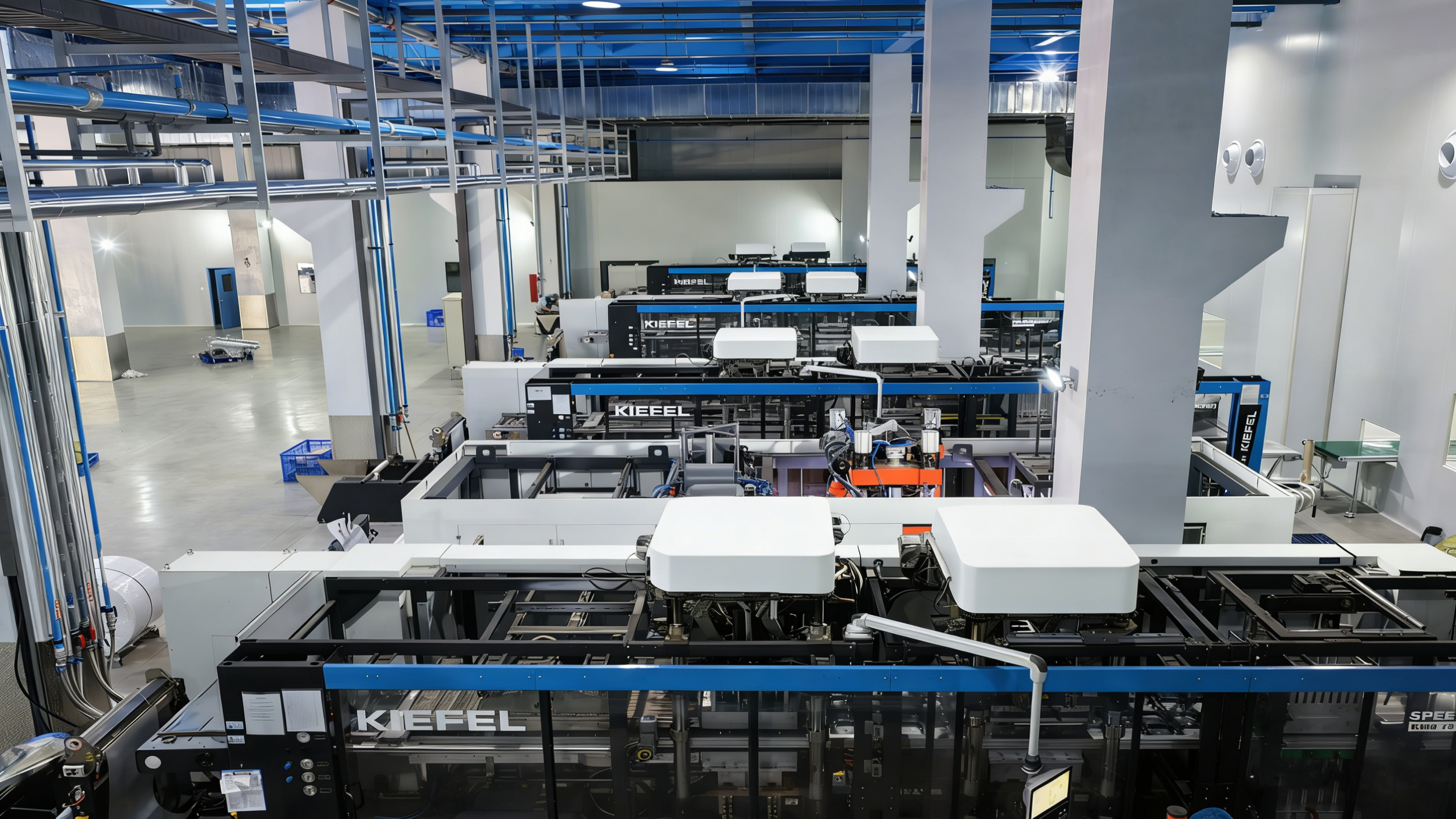
Thermoforming capacity is the first layer of evidence behind any model number in a produce packaging catalogue.
The buying problem: specification gaps in a growing produce packaging market
Buyers in the Decision and Execution stages of a packaging project are not short of suppliers. They are short of comparable data. Two quotations for “clear clamshell containers for cherry tomatoes” can describe physically different products, and the difference only becomes visible when the specification is broken down into dimensions, material, closure type, stacking behaviour and compliance documentation.
Produce adds a second constraint that general food packaging does not face: the pack is often the display surface. Grading, count, colour and condition have to be readable without opening the container, which is why clear PET formats dominate retail and export presentation for fresh fruit and vegetables. Packaging without a tamper-evident closing structure cannot demonstrate that nothing was opened between packing and shelf, which matters for export inspection and for sealed logistics.
The practical audit path for a produce buyer therefore runs through four layers:
- Model layer: a named model with measurable dimensions, a declared material and a defined design intent.
- Process layer: the thermoforming, sheet extrusion and mold-making capacity needed to repeat that model at volume.
- Compliance layer: food-contact documentation, testing records and batch traceability.
- Commercial layer: minimum order quantity, Incoterms, payment routes and pre-shipment testing.
The model tour below covers the first layer in detail; the factory and compliance sections address the second and third.
Fruit and vegetable containers: HB-SG300ML, HB-7001, HB-SG1000ML
The produce storage side of the range is built around three PET container formats listed under the categories produce storage containers, berry storage containers, fridge vegetable crisper boxes, ventilated produce keeper and stackable fruit containers. Each model is designed around a different filling and display scenario rather than a different marketing tier.
| Model | Overall dimensions | Material | Design intent |
|---|---|---|---|
| HB-SG300ML | 17.5 × 13.5 × 6 cm | PET | Compact stackable container for small-count produce packs |
| HB-7001 | 19.5 × 19.5 × 5 cm | PET | Wide, shallow format for spread-out display of graded produce |
| HB-SG1000ML | 23 × 17.5 × 9 cm | PET | Tallest of the three listed formats, for larger volume packs and cold storage |
Read as a set, the three models show a dimension ladder rather than three isolated SKUs: a buyer can move from a 17.5 cm footprint to a 23 cm footprint without changing suppliers, closure logic or material family. That continuity matters in retail listing work, where the same pack type is often required across several pack sizes.
Trays packaging: HB-T9333, HB-3066, HB-T9576
The tray family is where produce, bakery, meat and ready-meal applications converge. Model HB-T9333 is the most completely documented unit in this group: it is made of PET, measures 16.8 × 11.4 × 3 cm, belongs to the produce trays, food plastic trays and bakery trays categories, and is intended for agricultural exporters, supermarket chains and produce wholesalers.
Two properties of HB-T9333 are worth isolating because they are process facts rather than styling choices. First, the tray is compatible with MAP (modified atmosphere packaging) production lines, which places it in the gas-flushed segment of fresh food packaging rather than the simple over-wrap segment. Second, it is food-grade BPA-free plastic and stackable, which supports warehouse density and retail display space at the same time. Custom shape, colour, embossing and logo printing are available on this model.
| Model | Overall dimensions | Material | Notes from the product data |
|---|---|---|---|
| HB-T9333 | 16.8 × 11.4 × 3 cm | PET | MAP-line compatible; food-grade BPA-free; stackable; custom shape, colour, embossing and logo printing available |
| HB-3066 | 14.4 × 12.2 × 4.7 cm | PET | Compact tray in the same clear display family |
| HB-T9576 | 19.4 × 11.4 × 5.8 cm | PET | Longer, deeper tray format for larger portioning |
The broader tray range extends well beyond these three models, and the extension is informative for buyers sizing a programme: HB-1912 (19 × 12 × 3 cm, PET), WSF-01 (23.3 × 18 × 5 cm, PET), HB-MG08 OZ (14.2 × 12.5 × 6.8 cm, PET), HB-MG24 OZ (18.6 × 18.6 × 8.9 cm, PET) and HB-MG40 OZ (28 × 19.4 × 6.8 cm, PET) cover small portion trays through to larger display trays, while HB-75-28(PP) (16.8 × 11.4 × 3 cm) and HB-221360(PP) (22.2 × 13 × 6 cm) show that the same tray logic is also produced in PP.
Tray documentation states that the rigid structure reduces goods damage during transit and that the clear transparent tray provides strong visual effect for supermarket sales, while multiple sizes serve produce, bakery, meat, poultry and ready meals.
Salad containers and compartment formats: HB1720, HB5053
Salad packaging is a useful test of a thermoformer's real range, because fresh-cut salad combines high transparency requirements, cold-chain handling and a growing demand for compartment separation between wet and dry components.
| Model | Overall dimensions | Material | Category scope |
|---|---|---|---|
| HB1720 | 18.5 × 18.5 × 6 cm | PET | Clear plastic salad boxes, airtight salad containers, stackable, clamshell, compartment and fridge salad storage formats |
| HB5053 | 15.2 × 10.2 × 5.3 cm | PET | Smaller single-portion salad container in the same family |
Additional models in the same category include HB7047 (15.6 × 11.7 × 4.5 cm), HB5224 (17.1 × 12.3 × 5.6 cm) and HB5240 (17 × 11.5 × 3.7 cm). For a food retailer or e-commerce food brand, the significance is that salad bowls, clamshell formats and compartment trays are all part of one catalogue, so mixed retail programmes do not require multiple tooling relationships.
Tamper evident packaging from HB-8OZ to HB-32 OZ
The tamper evident series is the clearest example of design intent being visible in a specification. These PET containers carry an anti-tamper structure: after initial closure, the container is designed for one-time opening only, and any subsequent opening results in irreversible damage to the locking structure. That makes interference visible at the delivery point rather than at the point of consumption.
| Model | Overall dimensions | Material | Typical role |
|---|---|---|---|
| HB-8OZ | 13.4 × 12.1 × 3.6 cm | PET | Small single-portion sealed pack |
| HB-16OZ | 14 × 11.6 × 6.2 cm | PET | Mid-size sealed container |
| HB-20OZ | 14 × 11.6 × 7.9 cm | PET | Deeper sealed container for larger fills |
| HB-24OZ | 17.2 × 15.5 × 4.8 cm | PET | Wide sealed format for display |
| HB-32OZ | 17.2 × 15.5 × 6.2 cm | PET | Largest sealed format in the OZ series |
The series continues with HB001-55 (19 × 15.7 × 4.5 cm), HB002-63 (14.6 × 12.3 × 6.7 cm), HB5298 (15.4 × 15.4 × 6.1 cm), HB005-7402 (19 × 15.7 × 7.5 cm) and HB006-6102 (19 × 15.7 × 6.3 cm). Documented applications for the tamper evident range include ready-to-eat meals, fresh produce, pharmaceuticals, electronic accessories, retail kits and sealed logistics. The clear locking structure is described as supporting fast manual or automated sealing without extra accessories, and the visual tamper evidence is stated to improve trust at delivery points and reduce repeated inspection.
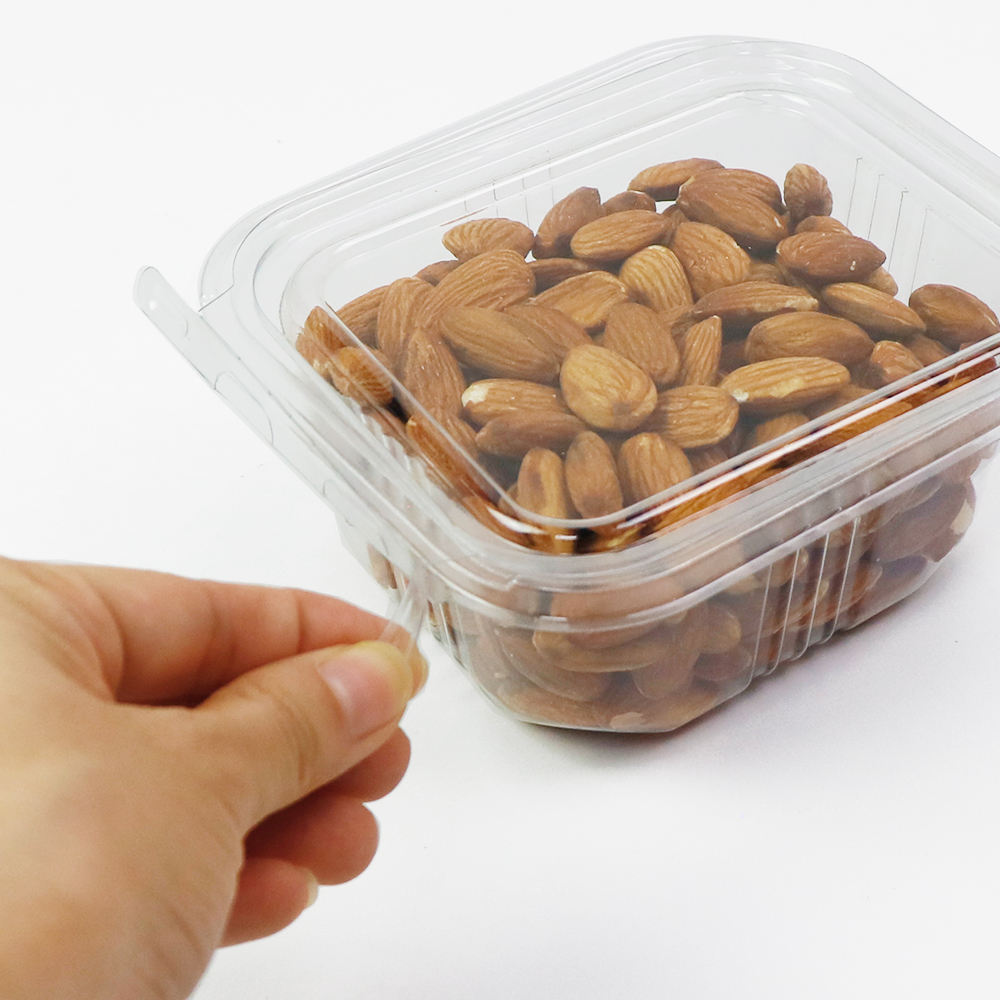
Dustproof seal and clear visibility: tamper evident locking formats trade re-closability for verifiable delivery integrity.
What the production base adds to the model list
A model list is only as credible as the plant that repeats it. Weifang Chuanhe New Material Co., Ltd. operates from a base of more than 62,000 m² in Weifang, adjacent to Qingdao Port, and reports an annual output of 54,000 tons. Production capacity includes 20 fully automatic thermoforming machines and 20 standard thermoforming machines, among them four Kiefel machines imported from Germany, supported by four PET sheet extrusion lines, two PP sheet extrusion lines and an in-house mold workshop.
The in-house mold and sheet operations change the procurement conversation in two concrete ways. In-house extrusion reduces dependence on outsourced raw material supply, while the mold workshop allows custom shape, colour, embossing and logo requirements — of the kind listed for HB-T9333 — to be developed and adjusted without a fully external tooling chain. For an agricultural exporter planning a seasonal programme, that is a delivery-timing argument, not a branding argument.
Technical explanation: material, coatings and measured performance
Three technical treatments appear repeatedly across this portfolio, and each has a defined purpose.
Anti-fog treatment. PET blister containers with an anti-fog coating are designed to prevent fogging caused by refrigeration or sharp temperature changes, so the product inside stays visible. Documented performance states a visibility retention rate increase of 40%, with clear appearance maintained in a 0–8 °C cold storage environment. The stated applications are fresh fruit, ready meals, seafood, cold chain transportation and supermarket retail display.
Temperature stability. A temperature-treated blister format is documented as maintaining stable performance under both freezing and heating conditions, with less deformation and cracking. The stated operating range is −18 °C to 120 °C, with a heat deformation rate reduced by 38% and a low-temperature cracking rate reduced by 32%. The intended uses are frozen food storage, microwave heating, quick-freezing processing, cold transportation and ready-to-eat meals.
Structural reinforcement and sealing. A thickened reinforced structure is documented to reduce drop breakage rate by 35% and to withstand a 1.2 m vertical drop without rupture. On the sealing side, containers described as leak-proof once closed report sealing tightness increased by 32% and a food spoilage rate reduced by 26%, with documented applications in fresh produce, baked food, seafood and cold-chain circulation.
Food-contact performance is stated separately: the range is described as food-grade plastic that is 100% compliant with FDA food contact requirements, with 30% higher impact resistance than ordinary disposable plastic food containers, and a cost level described as 5% higher than low-grade containers while remaining competitive among food-grade packaging. Environmental credentials cited for the range include eco-friendly, recyclable and reusable packaging solutions.
Applications: matching format to produce, bakery, meat, MAP and ready meals
Typical application scenarios documented for this portfolio include meat packaging, MAP (modified atmosphere packaging) packaging, produce, bakery, poultry and ready meals packaging. Mapping those scenarios onto the model list produces a practical selection logic:
- Farm harvest and retail display: clear PET clamshell containers with stackable design and vent holes for freshness, used in farm fresh fruit and vegetable packaging, cherry tomato and berry clamshell packaging, harvest sorting and retail display.
- Supermarket and chain retail: clear transparent trays and containers that allow inspection of grading and colour without opening the pack.
- Export and sealed logistics: tamper evident containers where one-time opening makes interference detectable at the delivery point.
- MAP and case-ready protein: trays such as HB-T9333 that are documented as compatible with MAP production lines.
- Bakery and food retail: bakery trays and clear bakery containers within the same PET family.
- Ready meals and chilled convenience: salad containers, compartment formats and temperature-stable blister packaging.
A documented regional case illustrates the volume logic. In the United Arab Emirates and Saudi Arabia, food factories, large chain supermarkets, packaging wholesalers and packaging manufacturers have used this product category for over three years, with a monthly order volume of 250,000 pieces, in applications covering farm fresh fruit and vegetable packaging, cherry tomato and berry clamshell packaging, harvest sorting and retail display. The stated project outcome was fresh product protection combined with stable large-volume supply — the second half of that sentence is the part that produce buyers usually test hardest.
Market trend analysis: regulation is now a format decision
Three verifiable market signals shape produce packaging procurement in 2026 and beyond.
First, demand continues to expand. Europe's fresh food packaging market was valued at USD 15.2 billion in 2024, with a projected CAGR of 4.5% through 2033 (Market Research Future), and the global thermoformed plastics market for food packaging is expected to grow at a CAGR of 4.9%, reaching USD 20.66 billion by 2030 (Grand View Research). Thermoforming is therefore not a niche process decision; it is the format family absorbing a meaningful share of that growth.
Second, the European legal framework is tightening. EU Regulation (EC) No 1935/2004 provides the framework for all food contact materials, requiring that they do not release constituents into food at levels harmful to human health, and EU Regulation (EU) No 10/2011 specifically governs plastic materials and articles intended to come into contact with food, including PET and PP containers.
Third, and most consequential for fresh produce, the EU Packaging and Packaging Waste Regulation (PPWR) will, from 2030, ban single-use plastic packaging for fresh fruit and vegetables under 1.5 kg. This does not remove plastic containers from produce retail, but it does mean that format selection for the EU market must be checked against packaging weight, pack size and recyclability requirements well before 2030. Buyers who treat this as a 2030 problem will be selecting formats under time pressure; buyers who treat it as a 2026 specification input will not.
For context on market structure, the produce packaging landscape includes large global groups — key competitors identified by Mordor Intelligence include Amcor PLC, Berry Global Group, Sealed Air Corp, Mondi Group and Smurfit Kappa — but mid-size regional buyers rarely compare against those groups directly. They compare formats, tooling costs and compliance files, which is where a thermoformer with in-house extrusion and mold capability sits.
Comparison with traditional solutions — and the limits buyers should plan for
The realistic alternative to a rigid thermoformed PET or PP container in produce is not usually a competitor's container of the same type. It is a different packaging concept: thin flexible film bagging, over-wrapped foam or pulp trays, or bulk corrugated cases with loose product. The comparison is therefore about trade-offs rather than superiority.
| Consideration | Rigid thermoformed PET / PP containers and trays | Typical alternative concept |
|---|---|---|
| Product protection | Documented rigid structure reduces in-transit damage; reinforced variants withstand a 1.2 m vertical drop with a stated 35% reduction in drop breakage | Flexible film offers less crush resistance for soft fruit |
| Retail visibility | Clear transparent PET supports shelf inspection and grading without opening | Opaque or printed formats require shelf-edge images instead |
| Cold-chain display | Anti-fog treatment reported to retain 40% more visibility in 0–8 °C storage | Untreated surfaces fog and hide the product |
| Delivery integrity | Tamper evident locking makes interference visible after one-time opening | Reclosable or open formats offer no visual proof |
| Cost position | Food-grade material described as 5% above low-grade containers while remaining competitive among food-grade packaging | Low-grade containers cost less but carry greater breakage and return exposure |
Boundaries that should be stated openly
- Tamper evident means one-time. Once opened, the locking tab cannot be restored to its original closed state. These formats are unsuitable where consumers are expected to repeatedly open and reclose a pack.
- Minimum order quantity. The listed commercial terms for this range specify an MOQ of 10,000 units, which is a real constraint for buyers testing a new retail line for the first time.
- Treatment costs. Anti-fog coatings, reinforced structures and temperature-stable material grades carry a slightly higher material cost than untreated or low-grade alternatives; the trade-off is reduced spoilage, breakage and repacking loss.
- Specifications are not certifications. A dimension list and a material declaration do not by themselves establish compliance in a given market. Migration testing, a Declaration of Compliance, facility certifications and batch traceability are separate documents.
- Regulatory movement. The PPWR ban on single-use plastic packaging for fresh fruit and vegetables under 1.5 kg from 2030, together with ongoing PFAS and packaging-waste limits, means a format that fits the EU market today may need review before the end of the decade.
Quality assurance and compliance evidence behind the models
Risk controls documented for this production system address chemical migration, sharp fragments, microbial contamination and unqualified raw materials. The stated measures include food-grade raw material inspection, migration and physical testing, a clean production environment, batch tracing for raw material accountability, and supplier auditing using EU-approved raw materials. Regulatory tracking covers EU 10/2011, PPWR and PFAS limits, with Declarations of Compliance issued and records archived.
Company-level certifications include CE, BRC, FDA, EU and SGS quality management systems, and stated company measures include FDA food contact compliance, clean production, online quality inspection and finished-product sampling tests, alongside temperature resistance and stack load testing. For a buyer building a supplier file, these are the documents to request alongside the model specifications above.
Future outlook
Three developments are likely to define the next procurement cycle in fruit and vegetable packaging. The first is regulatory: the 2030 PPWR restriction on single-use plastic packaging for small-format fresh produce in the EU will push buyers toward formats that are lighter, mono-material and easier to recycle, and toward suppliers who can document material composition quickly. The second is process: as thermoformed food packaging continues to grow toward USD 20.66 billion by 2030 at a 4.9% CAGR (Grand View Research), integrated manufacturing — sheet extrusion plus thermoforming plus mold making under one roof — becomes a supply-continuity argument rather than a cost argument. The third is commercial: long-term supply relationships will increasingly be evaluated on documentation depth, since a supplier that can produce a batch-traceable compliance file is easier to keep in a retail programme than one that cannot.
FAQ
1. Which models in this range cover fresh produce containers, and which cover trays?
Fruit and vegetable container models include HB-SG300ML (17.5 × 13.5 × 6 cm), HB-7001 (19.5 × 19.5 × 5 cm) and HB-SG1000ML (23 × 17.5 × 9 cm), all made of PET and listed under produce storage, berry storage, ventilated produce keeper and stackable fruit container categories. Tray packaging models include HB-T9333 (16.8 × 11.4 × 3 cm), HB-3066 (14.4 × 12.2 × 4.7 cm) and HB-T9576 (19.4 × 11.4 × 5.8 cm), also PET, with the wider tray family extending to HB-MG40 OZ (28 × 19.4 × 6.8 cm) and PP trays such as HB-75-28(PP) and HB-221360(PP).
2. Are these containers BPA-free and compliant with food contact requirements?
The range is described as food-grade BPA-free plastic, and the tray documentation states food contact safety compliance and FDA food contact compliance at company level. In the European Union, plastic food contact materials are governed by Regulation (EC) No 1935/2004 as the general framework and Regulation (EU) No 10/2011 for plastics specifically, including PET and PP containers. In practice, buyers confirm compliance through migration test reports, a Declaration of Compliance and facility certificates rather than through catalogue wording.
3. How does a buyer choose between PET and PP formats in this portfolio?
PET covers the majority of the models described here, including the produce containers, the MAP-compatible trays and the tamper evident series, and is used where transparency for retail display is the priority. PP appears in specific tray models such as HB-75-28(PP) (16.8 × 11.4 × 3 cm) and HB-221360(PP) (22.2 × 13 × 6 cm). Material selection should follow the filling process, the storage and transport temperature profile, and the compliance file required by the destination market, rather than appearance alone.
4. What evidence should a buyer request when verifying a thermoformed packaging supplier?
Four document groups are relevant. Facility and system certifications: CE, BRC, FDA, EU and SGS quality management systems. Process evidence: in-house sheet extrusion lines, thermoforming machine count, and mold workshop capability for custom shapes, colours, embossing and logo printing. Quality records: food-grade raw material inspection, migration and physical testing, online quality inspection, finished-product sampling tests and stack load testing. Traceability records: batch tracing for raw material accountability, supplier audits and archived compliance documentation.
5. How does tamper evident packaging change handling and returns?
Tamper evident containers in this range are designed for one-time opening: after initial closure, further opening causes irreversible damage to the locking structure, so interference is visible at the delivery point. Documented applications include ready-to-eat meals, fresh produce and sealed logistics. The stated trade-off is a slightly higher product cost against a reduced risk of returns caused by tampering, and the clear locking structure supports fast manual or automated sealing without extra accessories. The limitation is that the pack cannot be reclosed to its original state.
6. What are the limits of anti-fog and temperature-resistant formats?
Anti-fog coated containers are documented to maintain clear appearance in a 0–8 °C cold storage environment, with a stated 40% increase in visibility retention, and are intended for fresh fruit, ready meals, seafood, cold chain transportation and supermarket display. Temperature-treated blister formats are documented to resist −18 °C to 120 °C, with heat deformation reduced by 38% and low-temperature cracking reduced by 32%. Both treatments add material cost, and the performance figures are manufacturer-reported, so buyers in specific cold chains should validate them against their own handling and transport conditions.
7. What are the minimum order and delivery terms?
The listed commercial terms for this range state a minimum order quantity of 10,000 units, with delivery under FOB, CIF or DDP arrangements and pre-shipment testing before dispatch. Payment routes listed include T/T, L/C, D/P D/A, MoneyGram, PayPal, Western Union and cash. Factory direct supply is available and is described as supporting both small and bulk wholesale orders, though the stated MOQ remains the operative figure when planning a first production run.
Supplier capability in fruit and vegetable packaging is ultimately a stack of verifiable details: a model number with dimensions, a material declaration, a treatment that does a specific job, a plant that repeats the output, and a compliance file that survives an audit. A downloadable specification brochure covering this packaging range is available as a public reference for buyers preparing a comparison.