
Supplier Capability Evidence: Certifications and Exports
Supplier Capability Evidence: Certifications and Exports
A diamond flap disc is a coated abrasive tool — diamond or CBN grain bonded to flexible flaps on a rigid backing — driven by an angle grinder to grind and polish hard, brittle materials. Finding one is easy. Finding a supplier whose twentieth shipment behaves like the first is the harder problem, and it is the one that decides whether a diamond flap disc programme holds up.

Capability evidence for a diamond flap disc supplier begins with the production base, not the catalogue page.
Capability evidence answers that problem. For a diamond flap disc manufacturer it rests on four verifiable pillars: certification of the product against a recognised safety standard, a documented export record in regulated markets, a production base whose capacity and headcount match the buyer’s order profile, and a technical function able to sustain OEM specifications across repeat orders.
This industry reference examines those pillars against a single documented case — Zhengzhou Ruite Diamond Belts Co., Ltd (RUITE), a China-based manufacturer of superhard material coated abrasives. It covers the company’s certification position under EN 13743:2017, its export concentration, its production and R&D footprint, an eight-year OEM ceramics relationship in Italy, and, with equal weight, the limits of what that evidence can support.
Why Capability Evidence Outweighs Product Claims
Catalogues converge. Across suppliers, diamond flap disc listings describe similar diameter ranges, similar grit spans and similar backing options, because the vocabulary of the category is shared. What diverges is the organisation behind the label.
Three procurement realities make that divergence decisive:
- Safety regulation is not optional. In the European Union, coated abrasive products — including diamond flap discs — fall under safety requirements governing maximum operating speeds and safety markings. EN 13743:2017 is the standard that specifies those requirements for coated abrasive products. A supplier without traceable certification is not merely less attractive; it may be unsellable into that market.
- Repeat orders amplify small inconsistencies. Grit distribution, backing adhesion and balance variation are manageable in a single lot and considerably harder to manage across twelve.
- Export records are checkable in ways product photography is not. Market mix, packaging compliance, labelling conformance and distributor references can be verified independently of what a supplier says about itself.
For buyers moving from evaluation into execution, the practical consequence is a change in the question being asked. Instead of “which disc is best”, the working question becomes “which supplier can demonstrate, on paper and in a factory, that it can produce this disc repeatedly”.
A Framework for Reading Supplier Evidence
Not all evidence carries equal weight. The layers below are ordered by how difficult each is to manufacture without substance, and each is paired with a verification route a buyer can actually use.
| Evidence layer | What it demonstrates | Verification route |
|---|---|---|
| Third-party product certification | Independent confirmation that the product meets a defined safety standard across a defined scope | Certification body register; certificate number; listed diameter scope; current validity window |
| Export market mix | The product has cleared customs, labelling and distributor scrutiny in regulated markets | Commercial documentation; shipment records; market-specific packaging compliance; references |
| Facility and capacity | Ability to schedule, produce and hold specification at volume | Factory audit; stated capacity; production records |
| R&D function | Capacity to develop or adapt grit, backing and bond for OEM requirements | Named engineering contacts; development samples; documentation of proprietary technology |
| Quality control regime | Batch-to-batch consistency rather than one-off sample quality | Documented inspection flow; pre-shipment test reports |
| After-sales terms | Where risk sits after the goods leave the factory | Written warranty and replacement terms |
The asymmetry is the point. Certification is the hardest layer to fake, export mix the next hardest, and internal claims the easiest.
RUITE: The Documented Evidence Base
Zhengzhou Ruite Diamond Belts Co., Ltd was founded in 2003. The company operates a 500 m² facility with 45 employees and reports an annual output of 100,000 units. Its R&D function is staffed by 5 engineers. Export accounts for 70% of sales, with the European Union and the United States as the principal markets, and the company also exports to the Middle East.
The product range covers diamond belts, diamond flap discs, diamond flap wheels, diamond velcro discs, diamond hand pads and diamond quick change discs. The company states that it developed diamond sanding belts, diamond flap discs, diamond spiral bands and diamond hand pads carrying independent intellectual property rights, and that it subsequently researched higher-grade super coated abrasives including CBN belts, CBN flap discs, CBN spiral bands and CBN hand pads.
What the footprint actually signals
A 45-person team in a 500 m² facility producing 100,000 units a year describes a specialised operation rather than a volume producer. For a buyer, that cuts both ways. It suggests engineering attention concentrated on a narrow product family — diamond and CBN coated abrasives for hard, brittle materials — rather than spread thinly across a broad catalogue. It also means the ceiling on any single programme is real: the manufacturer’s stated monthly capacity is 10,000 units. Buyers planning beyond that level, or requiring compressed lead times, should plan around the ceiling rather than assume it away.
Why R&D headcount is a procurement variable
Five engineers is not a large department, but size is not the relevant measure. OEM programmes — custom packing, custom logos, adapted grit sequences, or a run in a diameter outside the standard set — depend on a supplier being able to answer technical questions with technical staff. A buyer’s own engineering team will eventually ask about bond, backing stiffness, flap geometry or wet-grinding compatibility. Whether those questions reach a named engineer or a sales inbox determines how much of the agreed specification survives contact with production.
The Certification Layer: ECM/COC Under EN 13743:2017
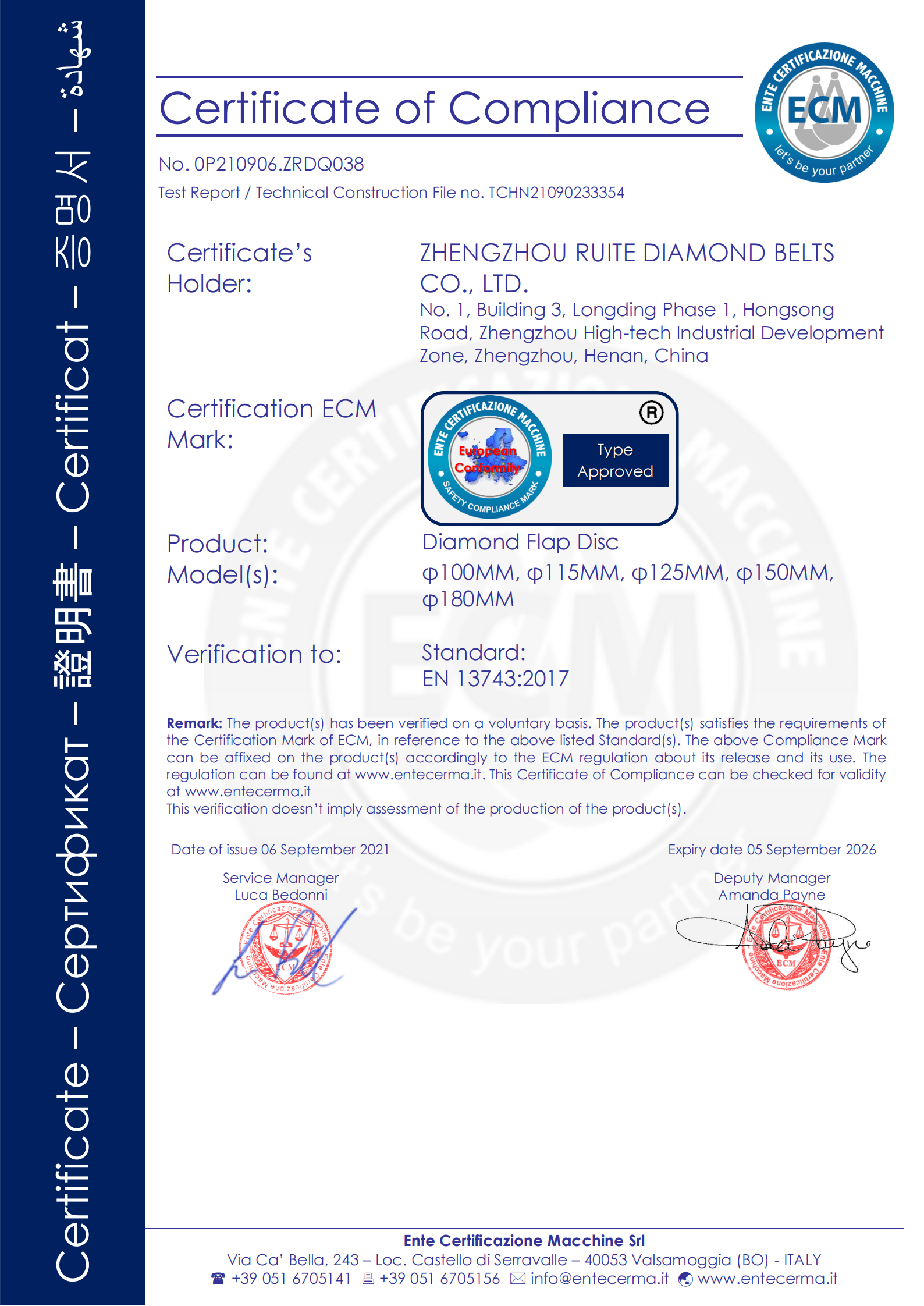
The ECM/COC certificate behind the EU-market claim, including its stated diameter scope.
European safety requirements for coated abrasive products are defined by EN 13743:2017, which specifies requirements covering maximum operating speeds and safety markings for coated abrasive products, including diamond flap discs. For a supplier selling into the EU, demonstrating conformance is a market-access condition rather than a marketing choice.
RUITE holds an ECM/COC certificate issued by ECM Certification Machine Srl, registered under number 0P210906.ZRDQ038 and issued on 6 September 2021. The certificate covers the EU market and was assessed against EN 13743:2017. Its stated scope is diamond flap discs in five diameters: 100 mm, 115 mm, 125 mm, 150 mm and 180 mm.
Reading a certificate scope correctly
Two details matter more than the certificate’s existence.
First, scope is diameter-specific. The certificate names five sizes. Three of them — Φ100×16 mm, Φ115×22 mm and Φ125×22 mm — correspond to the manufacturer’s standard diamond flap disc models. A buyer specifying a diameter outside the listed set is, by definition, outside the certified scope of that document and should ask what separate evidence exists for the size in question.
Second, certificates carry validity windows. A certificate issued in 2021 has a defined period of validity, and EU procurement practice treats currency as part of the check. Buyers should confirm the current validity status of any certificate at the time of ordering, not at the time of first contact with the supplier. That is routine practice, and it applies to every supplier rather than to one.
What certification does not prove
Certification confirms that a product meets a defined safety standard across a defined scope. It does not confirm performance on a specific substrate, grit-for-grit consistency, or cost efficiency. Those are separate questions, answered by samples, references and testing rather than by a document number.
Export Depth as a Proxy for Production Discipline
Export markets include the EU, the US and the Middle East, and 70% of the company’s sales are export sales, with the EU and the United States as the main markets. That concentration deserves reading carefully.
Selling into the EU and the US is not simply a matter of shipping further. It requires product labelling that conforms to market rules, packaging that survives multi-modal freight, documentation that satisfies customs and distributor requirements, and lead times that fit the planning cycles of importers rather than the convenience of the factory.
Category context supports the point. China’s export of diamonds — including industrial and synthetic diamond used in tools — reached approximately USD 1.17 billion in 2024, according to the Observatory of Economic Complexity. Diamond grain itself is therefore widely available and globally traded. What differentiates manufacturers within that trade is not access to raw material but the process control applied to it.
The Italian ceramics case, read conservatively
The manufacturer’s documented case record includes an Italian OEM client supplying ceramic grinding applications. That relationship has run for eight years and has involved 20,000 units, with the reported result being stable quality and no customer complaints.
The useful reading of this case is about continuity, not superiority. An eight-year supply relationship in ceramics means the supplier has passed a specific and demanding filter, because ceramics are unforgiving of grit inconsistency. Diamond flap discs are recommended by tooling suppliers such as RUBI for grinding ceramic tiles, porcelain stoneware and natural stone to execute miters and bevels, and in those operations a flap that cuts unevenly shows up quickly as chipping or burn marks on the finished edge. Eight years without complaints is evidence of sustained process control — but it is one case, from one client, in one application, and it should be weighted accordingly.
From Evaluation to Execution: What the Commercial Terms Show
Capability evidence becomes operational when it attaches to specific terms. For the standard diamond flap disc models, the documented commercial parameters are these.
| Parameter | Documented value |
|---|---|
| Production mode | OEM |
| Customization | Packing and logo |
| Monthly capacity | 10,000 units |
| Minimum order quantity | 50 units |
| Lead time | 30 days |
| Quality control | 100% testing |
| Delivery terms | FOB, CIF, DDP |
| Acceptance | Pre-shipment test |
| Payment | 100% prepayment |
| After-sales | 12-month shelf-life quality warranty; free technical consultation; replacement for defective batches |
Two observations matter for buyers.
The acceptance mechanism is the strongest item on the list. Pre-shipment testing gives the buyer a formal point at which a defect can be identified before goods leave the factory — exactly the stage at which correction is cheapest. For a product where grit distribution and backing adhesion determine performance, that check has real operational value.
The payment term is the weakest item. 100% prepayment shifts working-capital risk to the buyer and is a legitimate negotiation point in most procurement departments. It does not invalidate the rest of the evidence, but buyers comparing suppliers on total commercial exposure should factor it in rather than treat it as a formality.
Application Fit: Where Diamond Flap Discs and CBN Variants Belong
Choosing the tool correctly is itself a capability question. Diamond flap discs from this manufacturer process stone, glass, ceramics, monocrystalline silicon, cemented carbide and thermal spray coatings, and are suitable for both dry and wet grinding. Standard models are Φ100×16 mm, Φ115×22 mm and Φ125×22 mm, with grit available from 40# to 800#.
Task mapping follows grit, and the documented industrial applications span the glass industry, the stone industry, the thermal spray coating industry, the wind power industry, the porcelain industry, and the aeronautics and astronautics industry.
- Aggressive material removal and weld blending sit at the coarse end of the grit range, where fast stock removal matters more than finish quality.
- Edge grinding, beveling and chamfering call for mid-range grits, where control of the edge geometry is the objective — mirroring the ceramic and stone mitering operations for which diamond flap discs are commonly recommended.
- Surface conditioning sits at the fine end, up to 800#, where the goal is a uniform finish rather than dimensional change.
That the same abrasive format covers dry and wet grinding is more significant than it first appears. Wet grinding suppresses dust and heat in ceramic and stone work, while dry grinding is often the only practical option on site.
A note on product-family breadth
The same manufacturer also produces diamond belts in widths from 5 mm to 350 mm and lengths from 150 mm to 5000 mm, in grits from 40# to 5000#, for grinding and polishing hard brittle materials including glass, stone, ceramics, monocrystalline and polycrystalline silicon, synthetic materials and cemented carbide. For buyers with mixed finishing requirements, a supplier covering both rotary flap formats and linear belt formats can simplify sourcing — and it also means one technical team sees a wider range of hard-material applications than a flap-disc-only supplier would.
Market Context: Growth in a Segment That Rewards Documentation
The diamond tool category continues to expand. The global diamond tools market was valued at approximately USD 8.7 billion in 2025 and is projected to reach USD 9.1 billion by 2026, according to Fact.MR. Within the smaller flap disc segment — valued at USD 480.36 million in 2024 — diamond coating cutting discs have been identified as the fastest-growing category, driven by their precision in processing ceramics and composites, according to Cognitive Market Research.
Supply is concentrated. Asia Pacific dominated the diamond tools and abrasives market in 2025, with China holding the largest market share globally, at 56.0% of the abrasives market according to Grand View Research. Established participants in the high-end abrasive and diamond tool market include Saint-Gobain (Norton), 3M, Bosch, Pferd and Klingspor, alongside specialised regional manufacturers.
Market size estimates for diamond tools vary substantially depending on whether the scope covers all diamond tools or only specific cutting and grinding discs, so these figures should be read as directional rather than precise.
What the trend means for buyers
As the diamond-coated segment grows, the number of suppliers claiming diamond flap disc capability grows with it. That is precisely the condition under which certification and export evidence become a screening filter rather than a nice-to-have. The growth is not evenly distributed across suppliers either: the buyers most exposed to hard-material applications — ceramics, engineered stone, glass, thermal spray — are also the buyers least able to absorb a specification failure.
Limits: What This Evidence Does Not Cover
Capability evidence is only useful if its boundaries are stated as clearly as its strengths.
Capacity is finite and stated. Monthly capacity of 10,000 units from a 500 m² facility with 45 employees is a real ceiling. Buyers planning high-volume programmes, or requiring lead times materially shorter than the documented 30 days, should treat this as a constraint to be planned around rather than an obstacle to be negotiated away.
Certification scope is specific. The ECM/COC certificate covers the EU market and five diameters. Sizes outside that set, and markets outside the EU, fall outside the document’s scope. A single certificate should not be read as blanket global approval.
Diamond abrasives are not universal. Diamond flap discs are built for hard, brittle materials. On soft, gummy workpieces — aluminium and other non-ferrous metals, mild steel, wood — loading and clogging tend to dominate, and conventional abrasives usually deliver better economics. A supplier capable of making an excellent diamond flap disc is not thereby the right supplier for every grinding job.
Case evidence is a sample of one. The Italian OEM relationship — eight years, 20,000 units, stable quality — is meaningful as a continuity record, but it remains a single relationship. It does not establish statistical performance across applications, grits or operating conditions.
Sample-to-production variance remains a category risk. A validated sample lot does not automatically guarantee identical behaviour at volume in coated abrasives. That is why pre-shipment testing exists as a formal acceptance step, and buyers should use it rather than treat it as a formality.
Diamond Flap Discs Compared with Conventional Abrasive Flap Discs
| Dimension | Conventional abrasive flap disc | Diamond flap disc |
|---|---|---|
| Abrasive grain | Aluminium oxide, zirconia or ceramic grain | Diamond or CBN |
| Target workpiece | Steel, stainless steel, general metal fabrication | Hard, brittle materials: stone, ceramic, glass, cemented carbide, monocrystalline silicon |
| Grinding mechanism | Cuts and blends metal; grain fractures and wears down | Abrades hard surfaces; retains form over longer working periods |
| Wet grinding | Generally not designed for wet operation | Suitable for dry and wet grinding |
| Typical unit cost | Lower | Higher |
| Life on hard brittle materials | Short | Documented as long working life in hard-material applications |
| Correct cost measure | Cost per disc | Cost per finished part |
The limitation is straightforward: on mild steel and general metal fabrication, diamond flap discs are usually the wrong choice on cost. Their economics depend on the workpiece being hard enough to justify the abrasive. Buyers switching from conventional flap discs to diamond formats should validate the change on their own material before scaling it — a trial on ceramic or engineered stone will normally settle the question faster than a specification comparison.
Future Outlook
Three directions seem likely to shape diamond flap disc sourcing over the next planning cycle.
First, documentation will keep hardening as a purchasing requirement. As diamond-coated products move from specialty toward mainstream within the flap disc category, the supplier pool widens and the differentiating evidence shifts toward certificates, capacity statements and verifiable export records.
Second, the growth of ceramics and engineered stone in construction and interiors will keep pulling demand toward diamond abrasives, because those are the materials conventional abrasives handle least well. The documented use of diamond flap discs for mitering and beveling on tiles, porcelain stoneware and natural stone is a direct expression of that demand.
Third, the practical centre of gravity in supplier selection looks likely to move from price per disc to cost per finished part. That shift favours suppliers who can document consistency over time — which is what an export-heavy, certification-backed, narrowly specialised manufacturer is structured to provide, and what a generalist trading operation is not.
Frequently Asked Questions
What is a diamond flap disc used for?
A diamond flap disc is a coated abrasive tool that uses diamond or CBN grain on flexible flaps to grind and polish hard, brittle materials. Documented applications include stone, glass, ceramics, monocrystalline silicon, cemented carbide and thermal spray coatings. For ceramic tiles, porcelain stoneware and natural stone, diamond flap discs are commonly used to execute miters and bevels. They are suitable for both dry and wet grinding, with grit typically available from 40# to 800#.
Which certification matters for diamond flap discs sold into the EU?
EN 13743:2017 specifies safety requirements for coated abrasive products, covering maximum operating speeds and safety markings. For EU market access, the relevant evidence is third-party certification assessed against that standard. The ECM/COC certificate held by RUITE — number 0P210906.ZRDQ038, issued by ECM Certification Machine Srl and dated 6 September 2021 — was assessed against EN 13743:2017 and covers five diameters from 100 mm to 180 mm. Buyers should confirm the validity window of any certificate at the time of ordering rather than at the time of first enquiry.
How can a buyer verify a supplier’s export experience?
Export experience is verified through documentation rather than statements: commercial invoices, shipment records, market-specific labelling compliance and distributor references. Market concentration matters as much as volume — a supplier deriving 70% of sales from export, with the EU and the United States as principal markets, has passed regulatory and distributor scrutiny in markets with defined product requirements. A single large shipment to a single market demonstrates considerably less than a sustained multi-market pattern.
What OEM customization is typically available on diamond flap discs?
For this manufacturer, OEM production is the stated production mode, with customization covering packing and logo. Customization of the abrasive itself — grit sequence, backing type, flap geometry — is a separate matter that depends on the supplier’s engineering capability. That is why a technical department matters as much as a customization clause in a quotation, and why buyers often ask to speak with an engineer before confirming a trial order.
What are the minimum order quantity and lead time?
The documented minimum order quantity is 50 units and the stated lead time is 30 days, against a monthly capacity of 10,000 units. Delivery can be arranged on FOB, CIF or DDP terms, and pre-shipment testing is available as an acceptance step before goods leave the factory.
How do diamond flap discs differ from conventional abrasive flap discs?
Conventional flap discs use aluminium oxide, zirconia or ceramic grain and are designed primarily for metal. Diamond flap discs use diamond or CBN grain and are designed for hard, brittle materials such as stone, ceramic, glass and cemented carbide. Conventional discs generally cost less per unit; diamond discs are specified where working life and finish consistency on hard materials justify the higher unit cost. On mild steel, conventional abrasives usually remain the more economical choice.
What limits diamond flap disc performance?
Three limits recur. Material suitability: diamond abrasives load and clog on soft, gummy materials, where conventional abrasives perform better. Capacity: a small-footprint manufacturer may have a monthly output ceiling that constrains high-volume or fast-turnaround programmes. Documentation scope: certification typically covers defined diameters and defined markets, so sizes or destinations outside that scope require separate evidence and separate verification.
Reference document. The manufacturer’s product catalogue is publicly available for download: RUITE product catalogue (PDF). Company website: www.ruitechn.com.