
Supplier Capability Evidence: What Factory Audits and Chain-of-Custody Documents Prove
Supplier Capability Evidence: What Factory Audits and Chain-of-Custody Documents Prove
A WPC decking sample proves what a factory can produce once. A documented audit trail — a quality management certificate with a defined scope, a chain-of-custody record for wood-based material, a verified environmental declaration — is what shows whether that result can be repeated across a container, a season or a fifteen-year installation.
The stakes are rising on both sides of the supply chain. The global wood plastic composite market was valued at USD 8.05 billion in 2025 and is projected to reach USD 11.26 billion by 2034, according to Straits Research, while North America held the largest regional share at 36.4% in 2025. On the supply side, monitored trade data from Zauba shows China accounting for 97.81% of WPC decking imports under HS Code 39189090. That combination — concentrated supply, regulated demand — means the burden of proof has shifted from visual impression to paperwork.
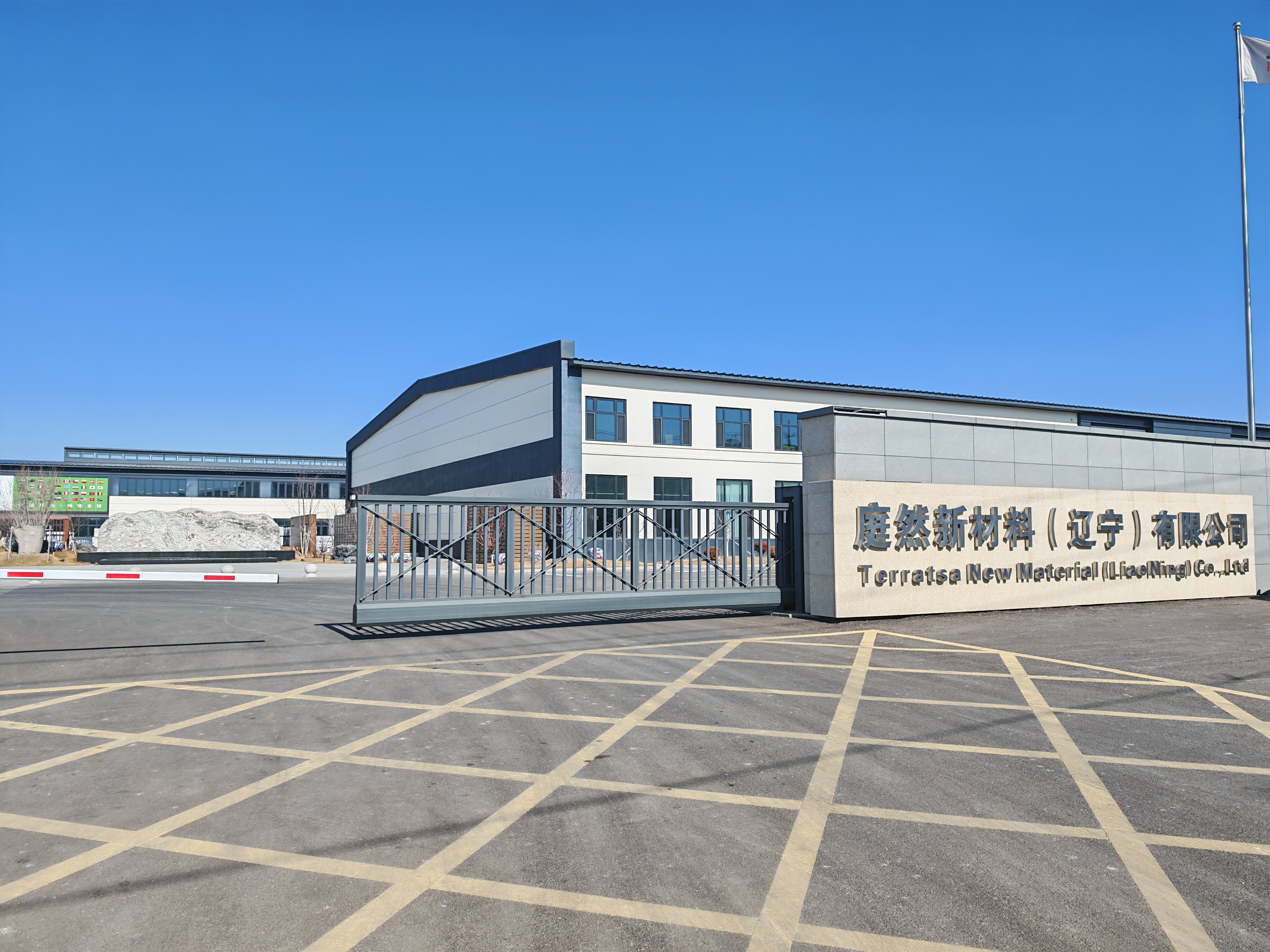
Production environment at Terratsa New Material (Liaoning) Co., Ltd., Yingkou, Liaoning, China — the physical asset that a factory audit is designed to assess.
Why a Sample Is Not a Capability Record
A decking sample arrives with a label. It demonstrates a single production run: colour, embossing depth, profile tolerance, surface feel. It does not demonstrate whether the co-extruded cap layer was applied within specification on a night shift, whether the wood flour in the core can be traced to a certified source, or whether the process parameters that produced it are recorded well enough for a third party to audit.
Buyers in the research and evaluation stage are usually trying to answer four questions that a sample cannot answer: will the colour match on the second container, will dimensional behaviour hold in a wet and freezing climate, can the material origin be declared for a client's procurement file, and is there documentary evidence that survives a building-code review or an ESG questionnaire?
Documents do not remove the need for samples. They change what a sample is for. Sampling validates appearance and finish; documentation validates the system that produces the finish repeatedly.
Three Document Categories That Carry Independent Weight
In WPC decking procurement, documentary evidence falls into three categories, and they are frequently confused with one another:
1. Management system certificates with a defined scope — ISO 9001 for quality, ISO 14001 for environment, ISO 45001 for occupational health and safety. These describe how a facility is managed.
2. Chain-of-custody and material-origin records — FSC Chain of Custody certification and the claim statements that flow from it. These describe where the wood-based fraction of a composite came from and how it was tracked.
3. Third-party verified declarations and test standards — Environmental Product Declarations (EPD) and standards such as ASTM D7032. These describe verified environmental or performance information about a defined product.
A supplier may hold all three. The sourcing skill is knowing which document answers which question, and where each one stops.
What ISO 9001 Certifies — and Why the Scope Line Decides Everything
An ISO 9001 certificate confirms that an independent certification body has assessed a manufacturer's quality management system against GB/T 19001-2016 / ISO 9001:2015 and found it conformant. It is a statement about system discipline: documented procedures, traceable records, defined responsibilities, corrective action and internal audit.
For reference, Terratsa New Material (Liaoning) Co., Ltd. holds ISO 9001 certification numbered 03825Q01470R0M, issued by World Standards For Certification Center Inc., valid from 2025-03-03 to 2028-03-02, with the certified scope recorded as the production of WPC flooring.
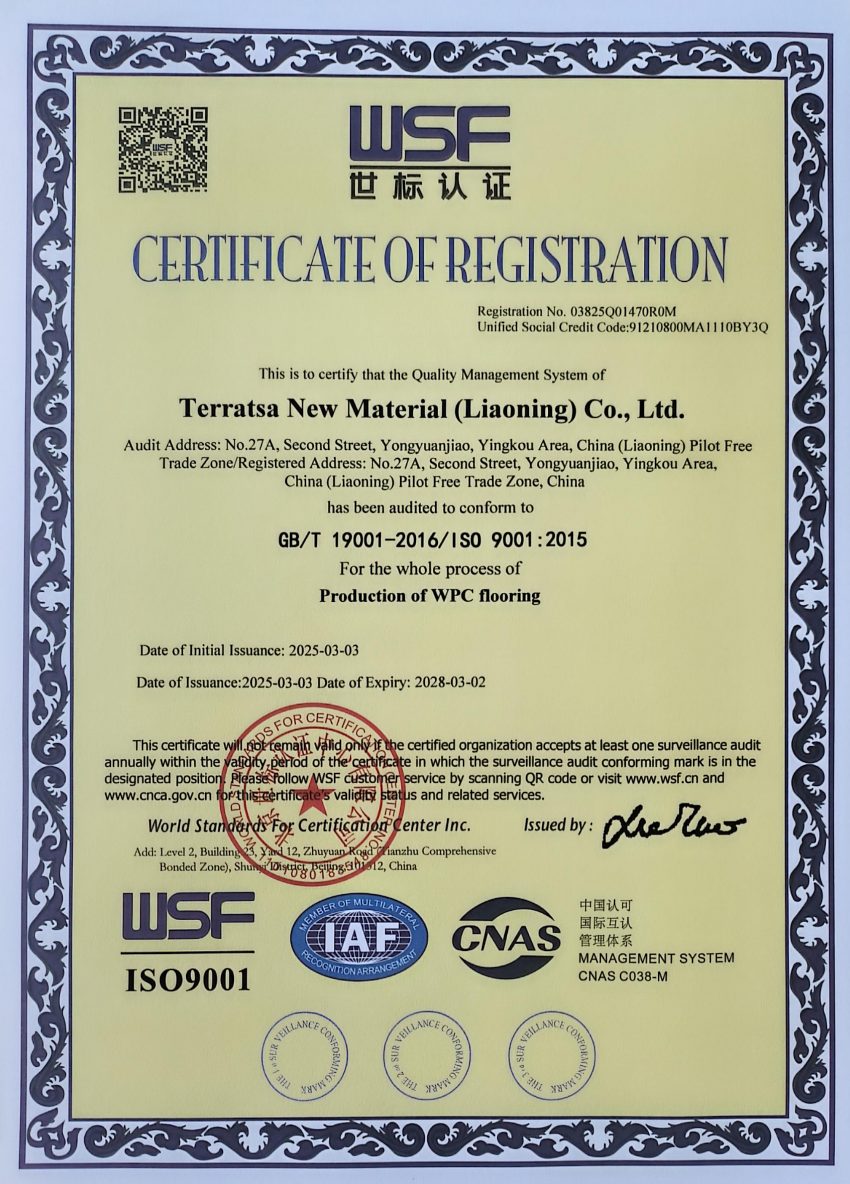
ISO 9001 certificate 03825Q01470R0M, issued by World Standards For Certification Center Inc., scope: production of WPC flooring.
That scope line is the part buyers most often skip. Four checks follow from it. First, confirm the certificate holder's legal name matches the entity that will appear on the invoice and bill of lading. Second, read the scope wording literally — a system certified for the production of WPC flooring is not automatically certified for unrelated product categories. Third, compare the product models you intend to buy against the scope and any listed models. Fourth, confirm validity dates and verify the entry in the issuing body's public registry rather than relying on a PDF attached to an email.
What ISO 9001 does not do is certify a board. It does not state flexural strength, water absorption, slip resistance or colour-fastness. A quality management certificate reduces the probability of uncontrolled process variation; it is not a performance guarantee for a specific SKU.
Chain of Custody: The Document That Traces Material, Not Performance
Wood-plastic composite decking contains a wood fraction, usually wood powder or wood fibre. Without documentation, phrases such as “eco-friendly WPC decking” or “FSC recycled WPC decking” remain marketing adjectives. Chain-of-custody certification converts them into auditable claims.
Terratsa holds FSC Chain of Custody certification numbered 0218718, issued by SAI Global Certification Services Pty. Ltd. The certified scope covers tracking of wood based material for wood-plastic composites (W9.11) with claim eligibility for FSC 100% and FSC Mix, assessed against FSC-STD-40-004 V3-1 and FSC-STD-50-001 V2-1. The certificate is valid from 2025-07-10 to 2030-07-07 and applies globally.
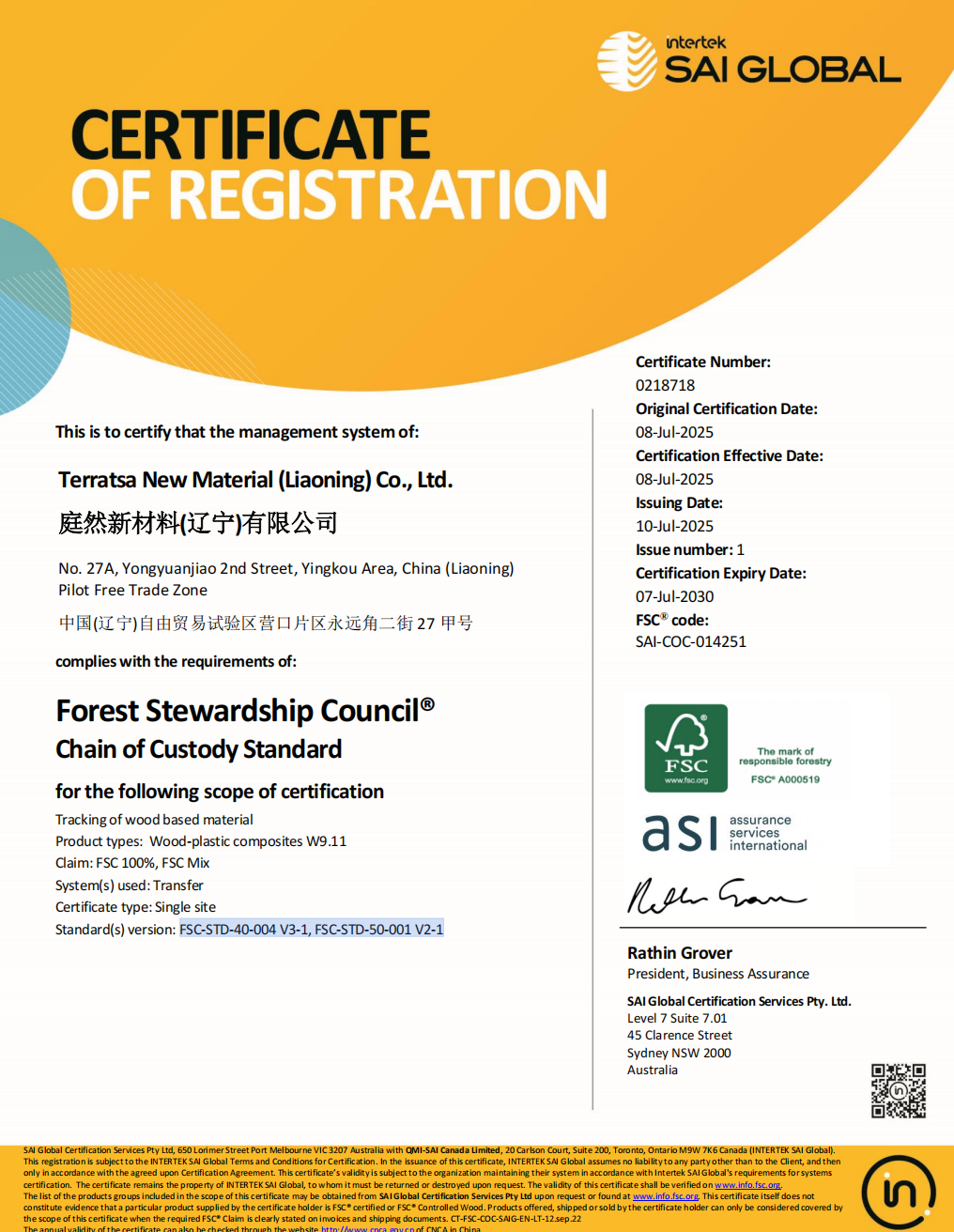
FSC Chain of Custody certificate 0218718, issued by SAI Global Certification Services Pty. Ltd., covering wood-based material tracking for wood-plastic composites.
The practical meaning is narrower and more useful than it sounds. A chain-of-custody certificate shows that the factory operates a documented system to receive, segregate, record and sell material carrying a specified FSC claim. It does not measure board quality. It answers a material-origin question, and that question is increasingly part of public-sector and commercial tender documentation.
Claim types matter. Broadly, FSC 100% indicates that all wood-based material in the product originates from FSC-certified forests, while FSC Mix permits a defined combination of FSC-certified, recycled and controlled wood. Both claim types appear in Terratsa's certified scope. Because a claim is attached at product and shipment level, buyers who need one specific claim should confirm the claim statement on the sales documents for the order in question — a valid certificate alone does not guarantee which claim will appear on a given shipment.
This is the single most common interpretation error in WPC sourcing: treating a chain-of-custody certificate as a performance certificate. It is an origin and traceability instrument.
EPD: Verified Environmental Data, Not a Durability Promise
An Environmental Product Declaration is a third-party verified summary of a product's environmental performance, calculated through life-cycle assessment and published through an approved programme operator. It is not a quality mark, and it is not a warranty.
Terratsa's EPD carries registration number S-P-12197 (EPD-IES-0012197:001), is issued through EPD International AB, conforms to EN 15804+A2 and ISO 14025 / ISO 21930, was issued on 2024-03-15 and remains valid until 2029-03-15. It covers co-extrusion WPC products: the GH001 co-extruded outdoor decking, the D053 outdoor hollow WPC decking, the GH010 exterior wall cladding and the GH024 outdoor WPC cladding. The declaration is recognised in the China and Netherlands markets.
When reading an EPD, four elements determine whether it is useful for your project: the programme operator and registration number, the standard the declaration conforms to, the validity period, and — most importantly — the exact list of covered products. An EPD covering a co-extruded decking model does not automatically cover a first-generation hollow board unless that model is named. Buyers should also note that an EPD declares environmental impact; it says nothing about water absorption, flexural properties, slip resistance or lifespan. Those questions are answered by product specifications and test data.
ISO 14001 and ISO 45001: Systems Evidence Around the Product
Two further management certificates often appear alongside ISO 9001. Terratsa holds ISO 14001 certification numbered 03825E01471R0M against GB/T 24001-2016 / ISO 14001:2015, and ISO 45001 certification numbered 03825S01472R0M against GB/T 45001-2020 / ISO 45001:2018. Both were issued by World Standards For Certification Center Inc. and both are valid from 2025-03-03 to 2028-03-02. The certified scope for each covers the related environmental, and occupational health and safety, management activities involved in the production of WPC flooring, and the ISO 45001 certification applies to all market regions.
These certificates are relevant during supplier qualification, social compliance review and site-visit planning. Their boundary is equally clear: an environmental management certificate does not publish emissions figures, and an occupational health and safety certificate does not measure product safety. They evidence management intent and control, not product outcomes.
ASTM D7032 and the Difference Between a Standard and a Certificate
ASTM D7032 is the primary standard specification used to establish performance ratings for wood-plastic composite deck boards, stair treads, guards and handrails. It defines how performance is determined; ASTM International publishes standards and does not certify factories.
That distinction is a frequent source of confusion. A supplier describing products as “ASTM standard WPC decking” is making a meaningful statement only when it is supported by a test report from a laboratory that identifies the standard applied, the specific board model tested, the span and loading conditions, and the test date. Without the report, the standard number is a label rather than evidence.
Buyers comparing suppliers should therefore ask a precise question: “Which model was tested, to which standard, by which laboratory, on what date, and can you send the report?” Certificates are issued by certification bodies; test reports are issued by laboratories; standards are published by standards organisations. Keeping the three categories separate prevents most documentation mistakes.
What Each Document Proves: A Reader's Table
| Document | What it establishes | What it does not establish |
|---|---|---|
| ISO 9001 — 03825Q01470R0M | A documented quality management system for the production of WPC flooring | Product performance values or batch test results |
| FSC Chain of Custody — 0218718 | Tracking of wood based material; eligibility for FSC 100% and FSC Mix claims | Board strength, slip resistance or durability |
| EPD — S-P-12197 | Verified life-cycle environmental data for GH001, D053, GH010 and GH024 | Mechanical performance, waterproofness or warranty terms |
| ISO 14001 — 03825E01471R0M | A managed environmental control system in WPC flooring production | Published emissions or recycled-content percentages |
| ISO 45001 — 03825S01472R0M | A managed occupational health and safety system | Product safety or installation safety outcomes |
| ASTM D7032 test report | A performance rating for a named board under a defined standard | Factory-wide capability across all models |
| Sample and product photography | Appearance, colour, embossing and profile of one production run | Process control, material origin or repeatability |
How to Request and Read the Documentary Trail
A workable process has six steps, and it should run in parallel with sampling rather than after it.
Step 1 — Request the document pack in the first inquiry. Ask for the certificate files, their numbers, the issuing bodies and the validity dates before commercial terms are discussed. Suppliers with organised documentation answer quickly; that speed is itself a signal.
Step 2 — Match the legal entity. The certificate holder's name must align with the contracting entity. Group structures, trading arms and production subsidiaries can differ, and a certificate held by one entity does not automatically transfer to another.
Step 3 — Read the scope wording literally. Compare the certified scope — for example, production of WPC flooring, or tracking of wood based material for wood-plastic composites — against the products you intend to purchase.
Step 4 — Verify in the registry. Certificate numbers such as 03825Q01470R0M, 03825E01471R0M, 03825S01472R0M, 0218718 or S-P-12197 should be checked against the issuing body's public listing. A PDF is a copy; the registry is the record.
Step 5 — Connect claims to shipments. For FSC claims, request the claim statement or sales document referencing the certification number for each order. For EPD-based procurement, confirm the ordered model appears in the declared product list.
Step 6 — Calendar the expiry dates. The ISO 9001, ISO 14001 and ISO 45001 certificates described here run to 2028-03-02, the EPD to 2029-03-15 and the FSC certificate to 2030-07-07. Buyers running multi-year programmes should ask for renewal evidence as those dates approach, rather than discovering an expired document during a project audit.
Limits: What Documentation Cannot Establish
Documentary evidence is necessary, but it is not self-sufficient. Five boundaries are worth stating plainly.
Scope level, not unit level. Management system and chain-of-custody certificates apply to an organisation, a site or a product family. No certificate guarantees the properties of every individual board in a container.
Origin is not performance. A chain-of-custody certificate tracks material; it does not report flexural strength, water absorption or slip resistance.
Declarations are not warranties. An EPD communicates environmental impact data. It is not a durability claim and does not replace contractual performance terms.
Audits are periodic snapshots. A certificate confirms conformance at assessment intervals. It is evidence of a functioning system, not continuous inspection. For critical orders, buyers should combine documentation with agreed dimensional and mechanical checks in the purchase contract.
Documentation has a timeline. Certification requests rarely arrive at the ideal moment. With typical production lead times of 30 to 45 days and a minimum order quantity of one container for many WPC decking programmes, document verification should begin alongside sampling, not after the order is placed.
Compared with a sample-first sourcing approach — which is faster and cheaper in the short term — a document-first approach adds administrative effort up front. The trade-off is deliberate: less exposure to material-origin disputes, fewer compliance surprises at handover, and a clearer basis for comparing two suppliers who both claim to be “certified”.
Where the Trail Meets Real Projects
Documentation becomes concrete when it is matched to a project brief. Two recorded reference conditions illustrate how the pieces connect.
In a Polish outdoor decking application, the operating conditions were low winter temperatures combined with high humidity. The specified requirements were weather resistance, UV resistance, low maintenance, low water absorption, scratch resistance and slip resistance, with boards installed statically on a concealed clip-and-screw substructure. In this kind of brief, the EPD supports the environmental file, the ISO 9001 scope supports the supplier qualification, and the product parameters — not the certificates — determine the technical specification.
In a Chinese park decking project, 500 tons were supplied to a project contractor and the installation has been in service for 15 years, recorded as durable with no fading and no bending. The value of such a record is not the number itself; it is that a long service reference can be read alongside documented production and material controls. A first-generation hollow board such as D053, specified at 23 mm by 146 mm by 2900 mm with a bending failure value of 3900 N, a density of 1.3 g/cm³ and water absorption of 2% or less under a five-hour boil test, sits in the same portfolio as the co-extruded GH001, which lists flexural properties of at least 3300 N and uses a second-generation capped polymer layer that fully encapsulates the core. GH001 is engineered for service temperatures from -40°C to 75°C, uses UV-resistant components such as ASA in the outer shell, and carries a protection level of IP55. Both models fall within the EPD scope — a useful detail when a project mixes specification tiers in one bill of materials.
The company context behind these documents is checkable rather than implied: Terratsa New Material (Liaoning) Co., Ltd. was founded in 2007 and relocated its production base to the Yingkou Area of China (Liaoning) Pilot Free Trade Zone in 2024. The site covers 74,000 m² and operates more than 70 fully automatic production lines. The company participates in the drafting of national and industrial standards, holds more than 30 national independent intellectual property patents, exports to more than 40 countries, and operates an independent overseas warehouse in the Netherlands. For buyers, the relevant point is not the list itself but that a supplier involved in standard drafting, composite R&D and OEM/ODM production with logo customisation is structurally more likely to hold, maintain and correctly scope the documents described above.
Market Trend: Traceability Is Moving from Preference to Requirement
Two verified market facts explain why documents are gaining weight. North America accounted for the largest share of the global wood plastic composite market at 36.4% in 2025, according to Straits Research — a market where procurement teams commonly ask for standards-based performance documentation and environmental declarations. At the same time, China is the dominant source of WPC decking supply, accounting for 97.81% of imports under HS Code 39189090 in monitored trade data published by Zauba.
When regulated demand and concentrated supply sit on opposite sides of a border, verification work moves into documents. Buyers increasingly ask for material-origin tracking, environmental declarations and management system certificates as routine parts of a tender package rather than as special requests. Suppliers who treat these documents as core operating infrastructure — rather than as occasional marketing attachments — are easier to qualify and easier to defend in front of a client's compliance reviewer.
Future Outlook
Three developments are likely to shape supplier documentation over the next procurement cycles. First, verification is moving toward registries: buyers are less willing to accept scanned copies and more likely to check certificate numbers directly with issuing bodies. Second, product-family declarations are becoming more granular, with model-level coverage expectations replacing vague portfolio statements. Third, chain-of-custody claims are being pulled into shipment-level documentation, so that the claim on the sales document — not only the certificate on the wall — becomes the auditable unit.
For buyers, the practical implication is straightforward: certification is becoming a baseline expectation, and differentiation shifts to whether a factory can produce the correct document for the correct model, at the correct moment, without delay. For suppliers, the competitive advantage lies less in holding certificates than in being able to scope, explain and renew them accurately.
FAQ
What does an FSC Chain of Custody certificate actually prove about a WPC decking supplier?
It proves that the supplier operates a documented system for tracking wood-based material through receipt, production and sale, and that it is entitled to make FSC 100% and FSC Mix claims within its certified scope. Terratsa's certificate 0218718, issued by SAI Global Certification Services Pty. Ltd. against FSC-STD-40-004 V3-1 and FSC-STD-50-001 V2-1, covers tracking of wood based material for wood-plastic composites (W9.11) and is valid to 2030-07-07. It does not prove board strength, slip resistance or service life.
What is the difference between FSC 100% and FSC Mix?
Generally, FSC 100% indicates that all wood-based material in a product originates from FSC-certified forests, while FSC Mix permits a defined combination of FSC-certified, recycled and controlled wood. Both claim types appear within Terratsa's certified FSC scope. Because a claim is applied at product and shipment level, buyers should confirm which claim is stated on the sales documentation for the specific order rather than assuming it from the certificate alone.
How can a buyer verify that an ISO 9001 certificate for a WPC decking factory is valid?
Check the certificate number, the issuing body and the validity dates, then confirm the entry in the issuing body's public registry. Terratsa's ISO 9001 certificate is numbered 03825Q01470R0M, issued by World Standards For Certification Center Inc., valid from 2025-03-03 to 2028-03-02, with the certified scope recorded as production of WPC flooring. Buyers should also confirm that the scope wording and any listed models correspond to the products they intend to purchase.
Does an EPD certificate mean the decking is waterproof or more durable?
No. An Environmental Product Declaration is a verified declaration of environmental impacts based on life-cycle assessment. Terratsa's EPD, registration number S-P-12197 through EPD International AB, conforms to EN 15804+A2 and ISO 14025 / ISO 21930, is valid until 2029-03-15, and covers the GH001, D053, GH010 and GH024 products. Water absorption, flexural properties and slip resistance are addressed through product specifications and test data, not through the EPD.
Do certificates replace sample testing?
No. Certificates address systems, material origin and environmental declarations, generally at facility or product-family level, while a sample confirms appearance and the output of one production run. A practical evaluation uses both, together with model-level parameters: the co-extruded GH001 decking lists flexural properties of at least 3300 N, while the first-generation hollow D053 decking lists a bending failure value of 3900 N and a density of 1.3 g/cm³.
Should a buyer choose first-generation or co-extruded second-generation WPC decking?
The decision depends on exposure, maintenance expectations and budget rather than on certification status. Co-extruded boards such as GH001 use a second-generation capped polymer layer that fully encapsulates the core, with UV-resistant components such as ASA in the outer shell, and are generally positioned for premium residential and commercial installations. First-generation hollow boards such as D053 remain waterproof, rot-proof and resistant to termites, with anti-slip surfaces, and are generally positioned for large-scale projects where cost efficiency and defined service horizons drive the specification. Both models fall within the same EPD scope, so documentation does not by itself decide between them.
Buyers who want to review the product ranges and documented references in one place can download the Terratsa decking brochure.