
Supplier Capability Evidence: What a Window Film Factory Must Show
Supplier Capability Evidence: What a Window Film Factory Must Show
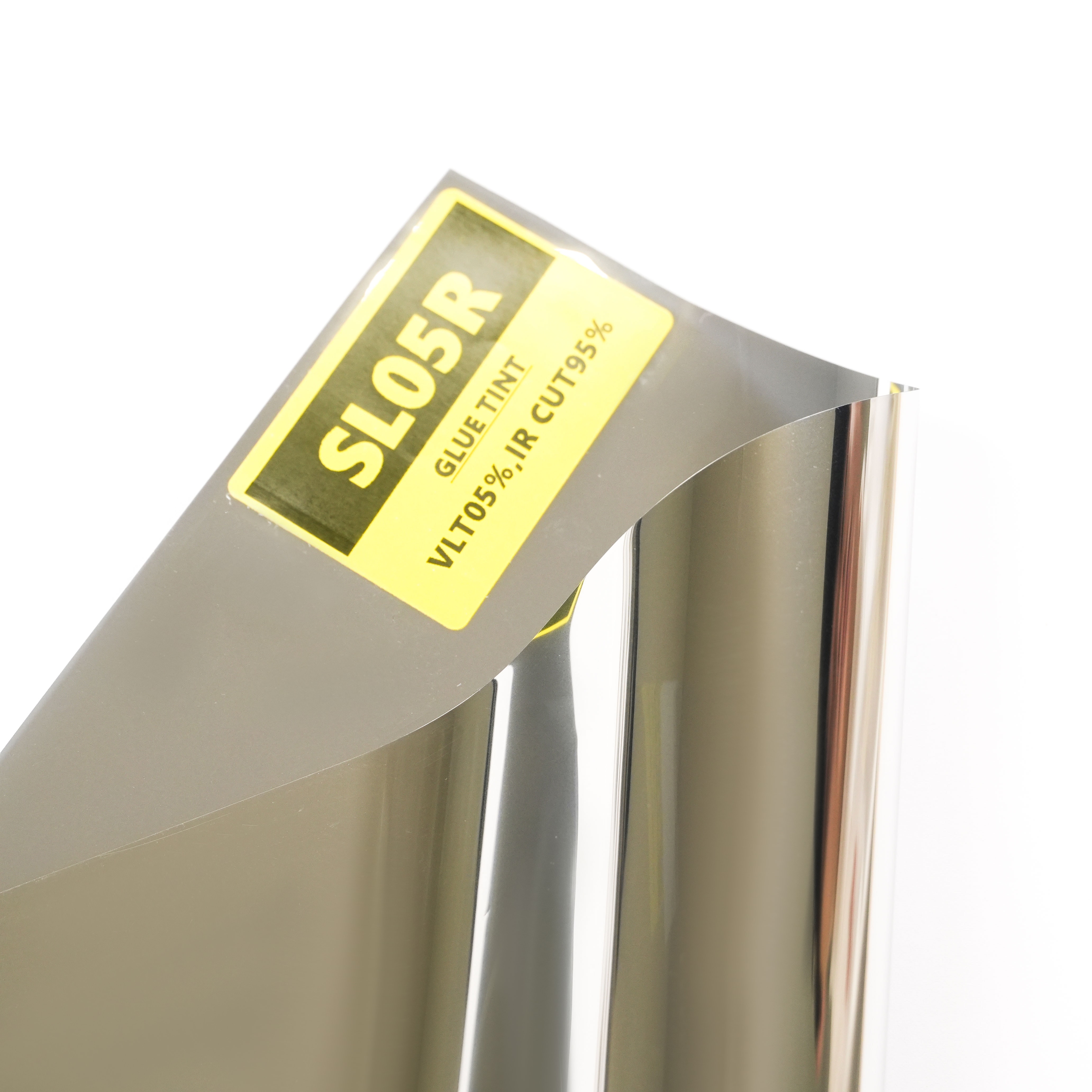
AUTOMOTIVE FILM model SL05R: 2PLY 1.5 mil reflective glue tint, 5% VLT, 95% IR cut, 99% UV rejection, silver, 5-year stated warranty.
Window film buyers rarely fail because a supplier has no capability. They fail because that capability cannot be evidenced at the moment the purchase decision is made. In a category where films look similar on a sample card and the same VLT or infrared figures are reprinted across competing datasheets, the practical difference between suppliers is not the size of the claim - it is the type of evidence standing behind it.
This reference examines the physical, documentary and process evidence a window tint film and paint protection film (PPF) factory should be able to show buyers, using two documented product lines - AUTOMOTIVE FILM and ARCHITECTURE FILM - as worked examples. It is written for importers, distributors, brand owners and procurement teams working in the Research-to-Evaluation stage, where the question has moved from "does this product category exist" to "can this specific supplier prove what it sells."
Why Capability Evidence, Not Capability Claims, Decides Window Film Sourcing
The commercial scale of the category explains why sourcing scrutiny has increased. The global automotive tinting film market is projected to reach USD 14.7 billion by 2033, according to Grand View Research. Within the paint protection segment, thermoplastic polyurethane (TPU) dominates the PPF material segment and was valued at US$ 437.1 million in 2025, according to Business Research Insights.
Growth at that scale attracts suppliers, and it also attracts claims. A buyer evaluating a film programme cannot inspect a coating line before every purchase order, and cannot verify a roll's optical behaviour by eye. Evidence has to travel in a form that survives the distance between factory and purchase order: registered entity records, model-level specifications, batch test data, documented inspection gates and defined warranty terms.
The evidence asymmetry is the real sourcing risk. A supplier without documentation is not necessarily a weak supplier, but a buyer without documentation has no basis for a claim, a specification or a warranty position when a batch underperforms.
The Three Evidence Layers in Film Supplier Evaluation
Factory capability can be separated into three layers that answer different questions. Buyers who test all three, rather than accepting a single glossy catalogue, usually find that the useful signals are concentrated in layers two and three.
| Evidence layer | What a buyer should request | What it demonstrates | What it does not demonstrate |
|---|---|---|---|
| Physical | Registered entity details, facility footprint, coating workshop classification, engineering headcount, product range | That production capacity and technical staff exist as tangible, inspectable assets | That a specific incoming order will fall inside optical tolerance |
| Documentary | Model-level specification sheets, batch test reports, patent and certification records, warranty wording | Declared construction, measured optical performance, and who is accountable for the claim | Installed performance on a particular vehicle, building or glazing assembly |
| Process | Inspection gates, instrument list, third-party inspection scope, defect replacement policy | Repeatability, and how deviations are detected and resolved | Zero-defect output on every roll produced |
Physical Evidence: Facility, People and Entity Records
Physical evidence is the easiest layer to verify and the easiest to overstate. It consists of things that can be named, located and counted.
Haian Ho Chi Technology Co., Ltd., which operates under the brand HOCHI PPF & Window Film, is a functional film manufacturer based at No. 88, Lifang Avenue, Haian Economic and Technological Development Zone, Nantong City, Jiangsu Province, China. It is a wholly-owned subsidiary of Shanghai Haochi Technology Co., Ltd. and was founded in 2009. Its documented operating profile includes a facility footprint of 133,333 square metres, more than 220 employees, an R&D team of 100 engineers, an annual output of 48,000,000 metres and an export ratio of 60%, with shipments to markets including Germany, France, the Netherlands, Norway, Poland, Spain, the United Kingdom, the United States, Brazil, Mexico, Chile, the UAE, Saudi Arabia, Qatar, Türkiye, Australia, New Zealand, Singapore, Malaysia, Cambodia and Laos.
Institutional and technical recognitions are also part of the physical layer because they are issued by external bodies rather than self-declared. These include National High-tech Enterprise status held for nine consecutive years, national-level specialised and innovative small giant enterprise status, the Jiangsu Haochi New Nano Energy-Saving Thin Film Engineering Technology Research Center, and the Jiangsu Provincial Enterprise Technology Center. The company's published profile states that it operates a Class 1000 dust-free coating workshop covering 3,000 square metres.
Intellectual property and product-range depth are countable evidence as well. The company reports more than 50 patents, comprising 14 invention patents, 19 utility model patents and 18 software copyrights, together with over 400 types of customised solar film products and over 200 types of customised colour-changing films.
Documentary Evidence: Model-Level Specifications That Survive Audit
The second layer is where most sourcing disputes actually begin. A category-level statement such as "high heat rejection ceramic film" cannot be tested, priced or warranted. A model-level record can be.
Two documented lines illustrate how model-level documentation is structured. Every entry below combines a model code, a construction type, a film structure and thickness, three optical metrics (VLT, infrared cut and UV rejection) and a stated warranty period. Buyers can compare, verify and specify against these fields.
AUTOMOTIVE FILM line
| Model | Construction | Structure / thickness | VLT | IR cut | UV rejection | Stated warranty |
|---|---|---|---|---|---|---|
| SL05R | Glue tint, reflective | 2PLY 1.5 mil | 5% | 95% | 99% | 5 years |
| SV0595 | Sputter | 2PLY 3.0 mil | 5% | 95% | 99% | 10 years |
| SV3095 | Sputter | 2PLY 3.0 mil | 30% | 95% | 99% | 10 years |
| QS0595 | Sputter | 2PLY 2.0 mil | 5% | 95% | 99% | 10 years |
| QS5095 | Sputter | 2PLY 2.0 mil | 50% | 95% | 99% | 10 years |
| CARBONBRONZE 10 | Carbon | Optical grade PET | 10% | 90% | 99% | - |
| CLASSIC03P | Glue tint | 2PLY 1.5 mil | 3% | 10% | 99% | 4 years |
| CLASSIC35P | Glue tint | 2PLY 1.5 mil | 35% | 10% | 99% | 4 years |
| NEX4MIL05 | Glue tint, security | 2PLY 4.0 mil | 5% | 11% | 99% | 5 years |
| NEX8MIL05 | Glue tint, security | 2PLY 8.0 mil | 5% | 11% | 99% | 5 years |
ARCHITECTURE FILM line
| Model | Construction | Structure / thickness | VLT | IR cut | UV rejection | Stated warranty |
|---|---|---|---|---|---|---|
| SILVER 5% | Silver reflective | 2PLY 1.5 mil | 5% | 95% | 99% | 6 years |
| SILVER 10% | Silver reflective | 2PLY 1.5 mil | 10% | 88% | 99% | 6 years |
| SILVER/GREEN 10 | Silver coloured | 2PLY 1.5 mil | 8% | 90% | 99% | 4 years |
| SILVER/BLUE 15 | Silver coloured | 2PLY 1.5 mil | 8% | 90% | 99% | 4 years |
| SILVER/GOLD 20 | Silver coloured | 2PLY 1.5 mil | 25% | 75% | 99% | 4 years |
| SILVER/GREY 05 | Silver coloured | 2PLY 1.5 mil | 10% | 75% | 99% | 4 years |
| SF12 | Safety clear | 1PLY 12.0 mil | 90% | 10% | 88% | 6 years |
| SF02 | Safety clear | 1PLY 2.0 mil | 90% | 10% | 88% | 6 years |
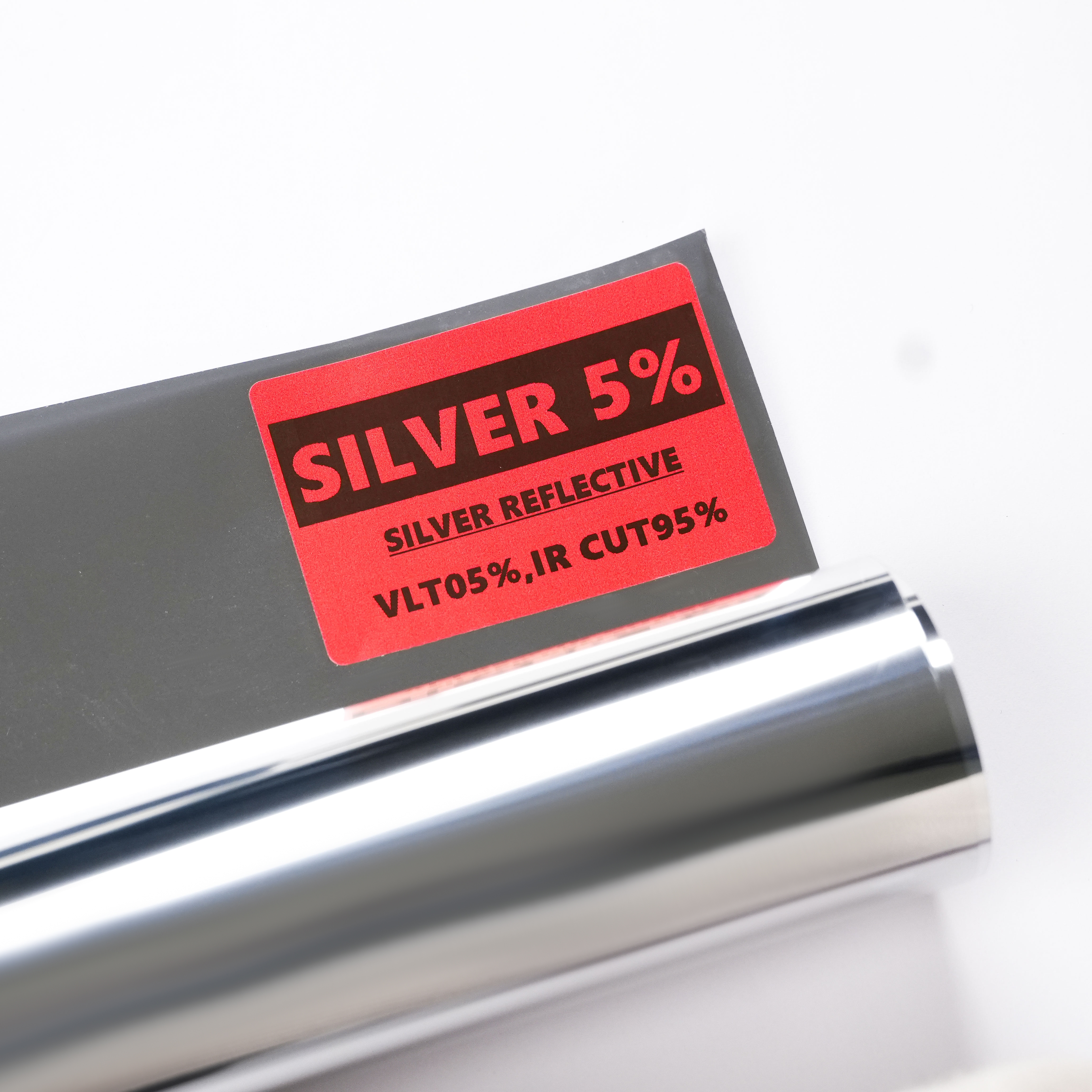
ARCHITECTURE FILM model SILVER 5%: 2PLY 1.5 mil silver reflective film, 5% VLT, 95% IR cut, 99% UV rejection, 6-year stated warranty.
The tables are deliberately unglamorous. That is the point. A buyer can read across a row and see whether the supplier is describing a construction (glue tint, sputter, carbon, safety clear), a physical build (2PLY 1.5 mil, 1PLY 12.0 mil), measurable optical values and a warranty duration. Where a datasheet offers only adjectives, the specification is not yet usable in a purchase contract.
Process Evidence: Inspection Gates and Third-Party Verification
Process evidence answers the question a specification sheet cannot: how does the factory know that roll 412 matches the data printed for roll 1?
The documented quality-control workflow in this production system includes 100% online optical defect inspection, spectrophotometer testing of VLT, UV rejection and IR rejection, peel adhesion testing, high-temperature ageing testing, and third-party inspection through SGS. The relevant procurement instruction is not to accept a single certificate as the whole answer, but to request the batch-level data produced by those gates and to know which instrument generated each figure.
Two published standards are useful anchors when writing a film specification or an inspection clause.
- The IWFA Visual Quality Standard requires window film inspection from 6 feet (approximately 2 metres) under natural daylight. This defines the viewing distance at which a visual defect argument should be conducted, and it prevents disputes from being decided at an unrealistic inspection range.
- ASTM D882 is the mandatory testing method for measuring tensile strength, break strength and elongation of safety films under IWFA policy. For a safety clear construction such as ARCHITECTURE FILM SF02 or SF12, tensile and elongation data is the appropriate evidence class, not a colour or clarity claim.
In the paint protection segment, thickness is a second process signal worth documenting. Published PPF technical comparisons typically describe a 6.5 mil to 10 mil thickness range as the balance between impact resistance and installation flexibility, and dealer programmes supplied by this factory have been built around 7.5 mil and 8.5 mil high-gloss TPU constructions. Buyers should ask for the measured thickness and structure of the delivered roll, not the nominal grade name.
Reading Capability Evidence Against Project Conditions
Evidence becomes useful when it is matched to a project condition. The documented applications for these product lines include automotive paint protection, car window heat and solar insulation, commercial building energy-saving retrofit, and residential privacy and solar control glass tinting, operating in conditions that include intense solar radiation, high UV exposure, high ambient temperature, humidity, road debris impact, stone chips, gravel abrasion and outdoor weathering across a stated range of -30°C to 80°C.
Three project patterns show how model-level evidence is applied.
- Automotive heat management in hot climates. Where the primary requirement is infrared rejection, the sputter models document 95% IR cut with 99% UV rejection across different VLT levels - for example QS0595 at 5% VLT and QS5095 at 50% VLT - which allows a single supplier to serve both privacy-oriented and clarity-oriented customer segments.
- Security and glass retention. Where the requirement is intrusion delay and shatter retention rather than heat rejection, the documented answer changes. NEX4MIL05 and NEX8MIL05 use thickened 2PLY 4.0 mil and 8.0 mil PET constructions with 5% VLT and 99% UV rejection; ARCHITECTURE FILM SF12 uses a 1PLY 12.0 mil safety clear build with 90% VLT. The same supplier, a different construction logic.
- Building retrofit at scale. A commercial real estate programme documented approximately 65,000 square metres (about 2,200 rolls) of silver and neutral solar control film for a skyscraper glass curtain wall retrofit, covering solar heat rejection, glare control, interior UV protection and glass anti-shatter safety, with a three-year post-installation evaluation reporting a 4°C to 6°C reduction in indoor temperature, a 28% reduction in central air-conditioning power consumption, and 99.5% UV blocking against a stated Total Solar Energy Rejection above 72%.
A mixed dealer programme in the United States illustrates the same logic across two product families: approximately 3,500 rolls of ceramic window film plus 1,200 rolls of TPU paint protection film, totalling about 150,000 metres per year, with reported results of 99%+ UV rejection and 92%+ IR heat block, a 35% reduction in building HVAC energy consumption, and zero warranty claims on bubbling or delamination. A separate luxury dealership programme, running roughly 2,000 rolls per year of 7.5 mil and 8.5 mil high-gloss TPU PPF (about 30,000 metres) across a four-year partnership, reported heat-activated micro-scratch self-healing at 60°C, a zero-orange-peel finish, and anti-yellowing performance measured as Delta E below 1.5 across a three-year evaluation.
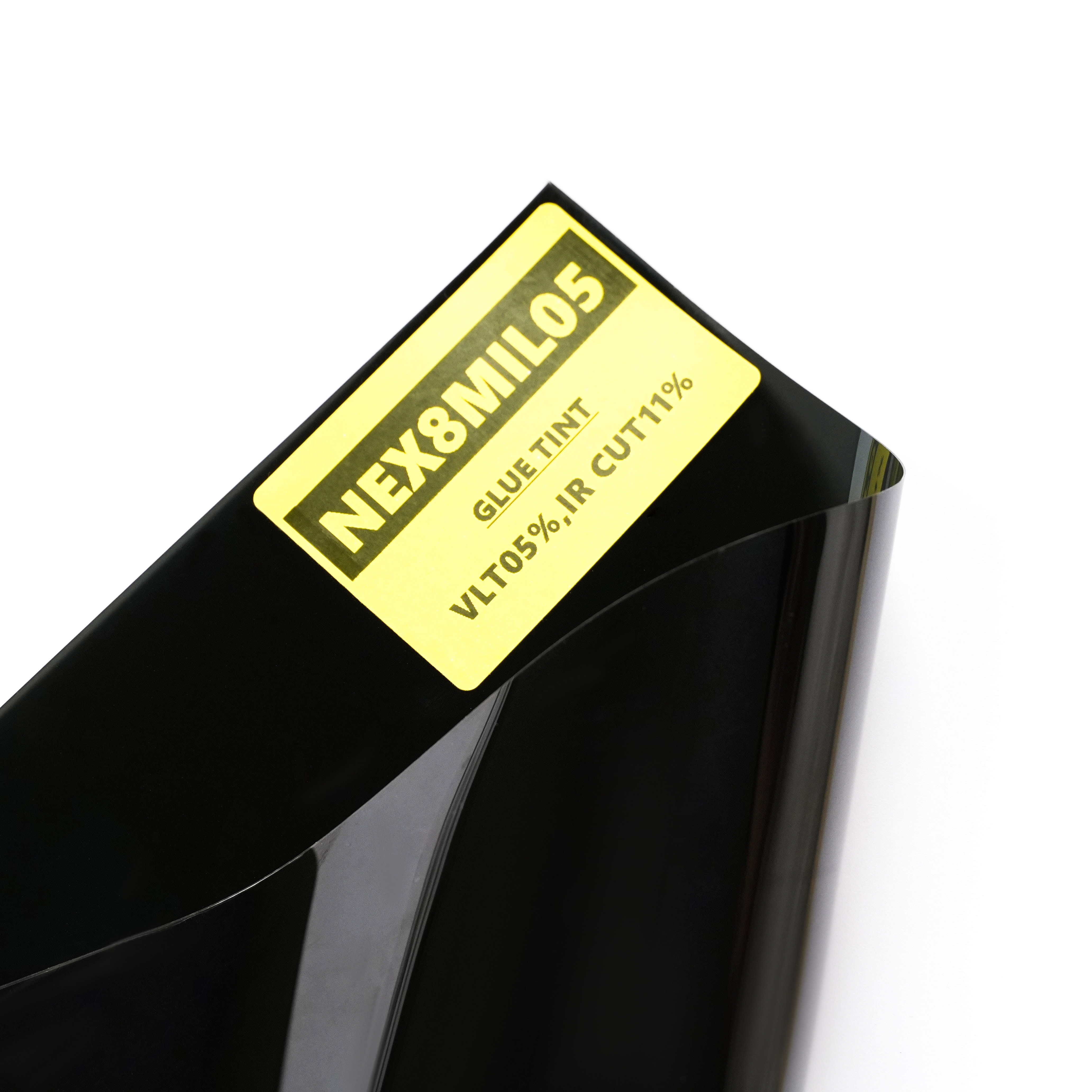
AUTOMOTIVE FILM model NEX8MIL05: 2PLY 8.0 mil security construction, 5% VLT, 99% UV rejection, 5-year stated warranty.
Where the Market Is Moving: Sourcing Signals for 2026 and Beyond
Several published data points frame the sourcing decisions buyers are making in this evaluation cycle. They are listed with their sources so that procurement teams can cite them internally without reproducing estimates from memory.
| Signal | Value | Reference year | Source |
|---|---|---|---|
| Global automotive tinting film market | Projected USD 14.7 billion by 2033 | 2033 forecast | Grand View Research |
| TPU share of PPF material segment | US$ 437.1 million in 2025 | 2025 | Business Research Insights |
| 72-inch wide format PPF market | Projected USD 1.9 billion by 2030 | 2030 forecast | Strategic Market Research |
| Self-healing PPF share of global automotive film market | Approximately 15% | 2024 | Market Research Reports |
| China motor vehicle production | Exceeded 31 million units | 2024 | International Organization of Motor Vehicle Manufacturers (referenced) |
| Nano-ceramic film solar heat blocking capability | Up to 85% while maintaining high visible light transmission | Published specification | Market Research Reports |
The direction of these figures matters more than any single number. Wider PPF formats and a still-small but growing self-healing share point toward distributor programmes that need both bulk roll supply and reliable model-level documentation. Buyers increasingly need to compare a supplier's 5% VLT sputter film against its 50% VLT equivalent within one documentation set, which is only possible where the factory publishes complete model tables.
Documented Factory Sourcing Versus Conventional Trading Routes
The comparison that most affects procurement outcomes is not between two film colours. It is between a documented factory route and a conventional trading-style route, because the two provide different evidence at different order sizes.
| Dimension | Documented factory route | Conventional trading route |
|---|---|---|
| Model-level specification | Published per model with VLT, IR cut, UV rejection, structure, thickness and warranty | Often aggregated at category level |
| Customisation | OEM mode with VLT from 5% to 70%, UV/IR rejection rates, film thickness, roll dimensions, custom colours, release liner, and packaging box or core logo printing | Typically limited to available stock specifications |
| Quality evidence | Online optical defect inspection, spectrophotometer testing, peel adhesion and high-temperature ageing testing, third-party inspection (SGS) | Depends on the upstream factory's willingness to share data |
| Typical minimum order | 50 rolls, with sample orders available upon request | Often lower, but with less specification certainty |
| Lead time | 30-45 days | Varies with stock availability |
| Monthly capacity context | 3-5 million metres | Depends on the third-party supplier |
| After-sales structure | 5-10 year quality warranty covering anti-bubbling, anti-fading and anti-delamination, 100% free replacement for defectives, 24/7 technical support and installation guidance | Usually limited to the trader's own commercial terms |
Boundaries of the Evidence Model
Evidence improves decisions only when its limits are stated as clearly as its strengths. Four boundaries apply to the material above.
- Documented laboratory data is not installed performance. VLT, IR cut and UV rejection values describe a film, not a completed glazing system. A glass compatibility or thermal stress assessment is recommended before installing solar control film on certain laminated, insulated or treated glass, because incompatible film may increase thermal stress and the risk of glass breakage.
- Order economics constrain the route. A documented factory-direct programme carries a minimum order of 50 rolls and a 30-45 day lead time. Buyers running small, mixed or highly seasonal orders may find a distributor route more practical, even though it delivers less model-level documentation.
- Construction type changes the performance envelope. The entry-level glue tint models CLASSIC03P and CLASSIC35P document an IR cut of 10% with 99% UV rejection and a 4-year warranty. That is the documented trade-off of that tier. Buyers who need high infrared rejection should specify from the sputter or reflective lines instead, and should not expect an entry-tier model to deliver the same heat rejection.
- Electronic environment questions should be resolved per model. Reflective and metalised constructions are not interchangeable in every vehicle. The documented approach is to confirm model-specific signal-interference behaviour with the supplier before specification, particularly for models fitted to vehicles with extensive electronic content.
One further boundary concerns case evidence. The project results cited earlier describe what has been achieved in specific programmes with specific partners. They are references for capability, not a warranty that an identical outcome will follow in a different building, fleet or climate.
Future Outlook
The next competitive dividing line in film sourcing is unlikely to be material science alone. It is more likely to be documentation quality. Two gaps are already visible.
The first is jurisdictional compliance data. Regional VLT limits vary by state and country, and a specification that is legal in one market may fail in another. Suppliers that maintain structured regional VLT compliance references will reduce buyer risk more effectively than suppliers that answer compliance questions case by case.
The second is fitment precision. As dealer networks expand, die-cut template coverage and model-specific pattern libraries become part of the specification, not an accessory to it. Factories that treat template coverage and roll-level traceability as documentation assets will be easier to qualify in tenders.
Against that background, the three evidence layers described in this reference are likely to remain the practical evaluation route: physical assets that can be visited, documentary specifications that can be tested, and process gates that can be audited. Buyers who insist on all three will spend less time arguing about claims, because fewer unverifiable claims will reach the purchase order in the first place.
FAQ: Verifying Window Film and PPF Supplier Capability
1. What documents should a buyer request when evaluating a window film factory?
A buyer should request four document sets: model-level specification sheets listing VLT, infrared cut, UV rejection, film structure, thickness and warranty period; batch-level test data covering optical performance and adhesion; records of external recognition such as high-tech enterprise designations, research centre designations and patent counts; and written warranty terms including defect replacement policy. Where safety film is involved, tensile and elongation test reports are also relevant, since ASTM D882 is the mandatory testing method for measuring tensile strength, break strength and elongation of safety films under IWFA policy.
2. How does automotive window film reduce heat and UV exposure?
Automotive window film reduces solar heat and UV exposure by absorbing or reflecting selected wavelengths of solar energy. Solar control films use dyed, carbon, metalised, ceramic or multi-layer materials to manage ultraviolet, visible light and infrared energy. Performance should be evaluated using verified VLT, UV rejection, IR rejection and TSER test data rather than relying on product colour alone.
3. How can claimed VLT and infrared rejection figures be verified?
Verification depends on instrument data rather than appearance. The documented quality-control workflow for this production system includes 100% online optical defect inspection and spectrophotometer testing of VLT, UV rejection and IR rejection, together with peel adhesion testing, high-temperature ageing testing and third-party inspection through SGS. Buyers can request the batch-level test records generated by these gates instead of relying on a category-level datasheet.
4. Which published standards apply to visual quality inspection and to safety film strength?
The IWFA Visual Quality Standard requires window film inspection from 6 feet (approximately 2 metres) under natural daylight, which sets the viewing distance for visual defect assessment. For safety film strength, ASTM D882 is the mandatory testing method for measuring tensile strength, break strength and elongation of safety films under IWFA policy. Both standards give buyers a neutral reference point for writing inspection clauses.
5. How should architectural window film be installed on building glass, and what must be checked first?
Architectural window film should be selected according to glass type, building orientation, solar exposure, privacy requirements and local regulations. Installation includes glass compatibility verification, surface cleaning, accurate cutting, wet application, professional squeegee work and edge inspection, followed by sufficient curing time before cleaning or final evaluation. A glass compatibility or thermal stress assessment is recommended before installing solar control film on certain laminated, insulated or treated glass, because incompatible film may increase thermal stress and the risk of glass breakage.
6. What order terms apply to a customised window film programme?
For this production system, the documented commercial terms are OEM production with customisation of VLT from 5% to 70%, UV and IR rejection rates, film thickness in mil, roll dimensions, custom colours, release liner, and packaging box or core logo printing. The stated minimum order quantity is 50 rolls, with sample orders available upon request, and the stated lead time is 30-45 days against a monthly capacity of 3-5 million metres.
7. What environmental conditions should a film specification account for?
Documented application conditions for these automotive and architectural film lines include intense solar radiation, high UV exposure, high ambient temperature, humidity, road debris impact, stone chips, gravel abrasion and outdoor weathering across a range of -30°C to 80°C. The corresponding functional requirements are 99%+ UV rejection, high infrared heat reduction, scratch resistance and thermal self-healing, anti-yellowing paint protection, glare reduction, HVAC energy efficiency improvement and glass shatter resistance.
For reference, the published film specification documentation for HOCHI PPF & Window Film is available at WINDW FILM HC SPECIFICATIONS. Company information and the full model range are published at hochitech.net.