
Supplier Capability Signal: Gamesa and Vestas Parts Inventory
HTNXT Industry Reference | Wind Turbine Spare Parts
A spare parts list is not capability evidence. A spare parts list that resolves to specific Gamesa CCU units, Vestas control and converter components, SKiiP IGBT modules and Ingeteam boards — with identifiers a maintenance engineer can check line by line — is. This reference explains how procurement teams can read multi-brand inventory as a sourcing signal, and where that signal stops being sufficient.
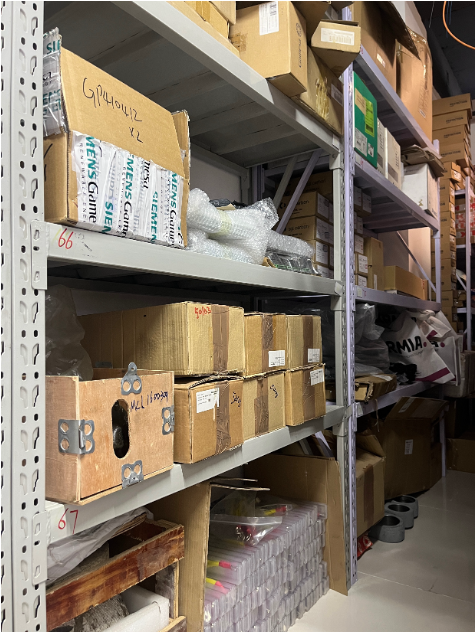
SGRE spare parts inventory covering Gamesa and Vestas platform components. Image: Tianjin Saintloga International Trade Co., Ltd.
Core answer: Multi-brand inventory becomes capability evidence when it is documented at model level across two or more turbine platforms, when it is tied to a defined production and inspection process, and when it is supported by certificates and commercial terms a buyer can verify. Tianjin Saintloga International Trade Co., Ltd. publishes Gamesa, Vestas and Ingeteam part families down to individual model numbers, which allows that test to be applied directly rather than taken on trust.
What a Multi-Brand Parts List Proves — and What It Does Not
In the wind spare parts trade, stating that a supplier covers Gamesa spare parts and Vestas spare parts is a category claim. Category claims cost nothing to publish and are almost impossible to falsify, because they contain no identifiers, no sourcing route and no commercial commitment. They describe an ambition, not a capability.
A capability claim is structurally different. It becomes testable when three conditions are satisfied at the same time.
First, part families are named and tied to specific model identifiers. A supplier that lists SKiiP module variants down to SKIIP1813GB123-3DUK0382 or SKIIP 3614GB17E4-6DUK311 is exposing itself to a check that any maintenance engineer can perform in minutes. Model-level disclosure is the cheapest credible signal a supplier can give, which is precisely why it is meaningful.
Second, coverage spans more than one control or drivetrain architecture. Gamesa and Vestas platforms do not share numbering logic. Gamesa-linked components appear with GP prefixes; Vestas-linked electrical items appear as long numeric references such as 34729, 45488, 46346 and 46347. Maintaining both means maintaining two distinct sourcing routes, two reference frameworks and two purchasing relationships.
Third, commercial terms are stated in a way a buyer can enforce. Minimum order quantity, delivery terms, inspection criteria and payment structure convert a list into a transaction.
None of these three conditions proves that every individual unit is in perfect condition or that pricing will be competitive on any given day. What they prove is access. The supplier has resolved part numbers, cross-referenced them across platforms, and can transact on defined terms. That is the honest ceiling of what an inventory list can demonstrate — and it is already far more than most supplier pages disclose.
The Procurement Problem: Mixed Fleets, Single-Brand Channels
Most operating fleets are not single-brand. A wind portfolio assembled through acquisition, phased construction or repowering typically runs Gamesa, Vestas and other platforms side by side, often across several turbine generations within the same brand. According to GWEC's Global Wind Report 2024, Vestas remained the leading global wind turbine supplier in 2024, followed by Goldwind and Siemens Gamesa — so a substantial share of installed capacity sits within the Gamesa and Vestas platform families alone.
That concentration creates a specific maintenance problem. A single service quarter on a mixed fleet may require a Gamesa control unit, a Vestas power module and an Ingeteam converter board in the same window. OEM channels are organised around their own platform roadmaps, service networks and ordering calendars; when a fleet contains several brands, the procurement team is managing several unrelated supply relationships at once, each with its own response time and its own documentation format.
The demand behind this is structural rather than cyclical. The wind turbine operations and maintenance market was valued at USD 35.62 billion in 2024, with a projected CAGR of 8.5% through 2030, according to MarketsandMarkets. O&M growth is largely a parts and labour story: turbines commissioned years ago enter windows in which electronic assemblies, wear components and hydraulic elements are replaced on schedule rather than on failure.
The Evidence Layer: Reading Part Numbers as Capability Signals
Part numbers are the most under-used verification tool in spare parts procurement, because they force specificity. The tables below organise a published inventory into two groups — control and power electronics, and drivetrain, hydraulic and rotating components — exactly as the supplier lists them.
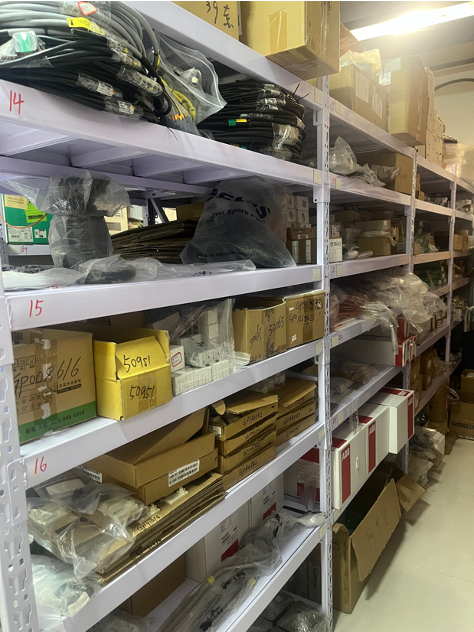
Ingeteam and ABB spare parts: converter boards, interface cards and protection components held in multi-brand inventory. Image: Tianjin Saintloga International Trade Co., Ltd.
Control, converter and protection electronics
| Part family | Representative identifiers | What it signals |
|---|---|---|
| Gamesa CCU | AS3169, AS3179, AS2908 | Control unit access that also appears in Ingeteam CCU listings, indicating shared control architecture knowledge |
| Ingeteam parts | AK9322 interface board; AK9983, AK9320, AK9961, AK9111, AK9066, AK9110, AK9962, AK9092, AK9670; AS3332, AS3334, AS3335, AS3338; CCU INGECON WIND G9X 2.5 KHz VECT MOD; driver simple and double cards | Converter-side board and card coverage rather than generic electronics |
| Vestas electrical range | 34729, 45488, 46346, 46347, and a wider reference range from 101174 upward | Numeric reference system maintained separately from Gamesa GP numbering |
| SKiiP IGBT modules | SKIIP1813GB123-3DUK0382; SKIIP 3614 GB17E4-6DUK305_20602305; SKIIP 613GD123-3DUK0195; SKIIP 3614 GB17E4-6DU+ 20603257; SKIIP2414GB17E4-4DUK310; SKIIP 3614GB17E4-6DUK311; SEMIKRON SKIIP 2413GB123-4DK0194 | Power stack replacement at variant level; IGBT material; operating range −40 °C to 120 °C; IP00 protection |
| PLC | RFC 430, RFC 470 (Phoenix PLC) | Control layer coverage tied to a named controller family |
| Circuit breakers | GP018171, GP047112, GP050097, GP013983, GP023920, GP019453, GP345854, 50032, MVS25T33FA2, 1SDA058193R1 | Protection devices across FG005, FG008, FG001 and FG002 types; −40 °C to 200 °C |
Drivetrain, hydraulic and rotating components
| Part family | Representative identifiers | What it signals |
|---|---|---|
| Carbon brushes | CANT01, CANT04 R140, CANT04 R150, CANT06 R140, CANT16, RC53, RC54, RC42L, RS65 RE50, RC27, RC67, RS65, RE92 | Carbon, copper and silver material grades; applicable to wind power and rail transit |
| Slip ring, rotary joint | GP127965, GP127960, GP492093, GP464924, GP464923 | Electrical and hydraulic rotary joint coverage; copper, steel and stainless steel build |
| Motor, yaw motor | GP122842, GP243450, 101180, GP587472, GP119038 | Yaw and auxiliary motor references spanning both numbering systems |
| Coupling | GP479559, GP479562, GP517817, GP083595, GP000978, GP012117, GP023296, GP023297, GP028747, GP032954, GP020588, GP251942 | KTR, Zero-Max and RegalRexnord coupling types; fibre and carbon steel materials |
| Gearbox | GP127153, GP411441, P3014A, GP118897, GP009280, P432051, P430140, 50773 | Yaw gearbox and main gearbox coverage, including Winergy, ZF, Hansen and Bosch Rexroth types |
| Valve | RVSAE3DS112401, compensated flow control valve 76 L/min, 3/2 way seat directional valve, DG4V32AMUH760, proportional valve 50-25 L/min 10 VDC, 24 V 50 Hz safety valve | Control, directional, proportional, safety and check valve types; 0–320 bar; −40 °C to 200 °C |
| Hydraulic hose, pipe and tube | GP000086, GP000568, GP000675, GP000723 through GP011141 reference range | Working pressure 0–320 MPa; −40 °C to +125 °C; hose size DN4 to DN50; length customised up to 60 m |
Read together, the tables show something a category list cannot: the supplier maintains parallel reference systems. A Gamesa-linked coupling, gearbox or motor carries a GP prefix; a Vestas-linked electrical item carries a numeric reference. A company that genuinely stocks both has to hold both logics in its purchasing and warehouse processes simultaneously. That is a structural fact about the supplier, not a slogan.
How Tianjin Saintloga's Inventory Maps to That Standard
Tianjin Saintloga International Trade Co., Ltd. is a spare parts supplier founded in 2015 and headquartered in Tianjin, China. The company supplies wind turbine spare parts for major brands including Gamesa, Vestas and GE, and additionally provides a full range of wind turbine-related maintenance services together with import and export trading services. Its published product families give procurement teams a concrete basis for the three-condition test described above.
Model-level disclosure. The Gamesa spare parts family is listed both by component type — IGBT, CCU, PLC, UPS, power supply, oil house, pump, transformer, yaw motor, circuit breaker, generator, gearbox, main shaft, main bearing, hydraulic cylinder and hub cabinet — and by individual model references beginning with GP011974 and GP238666 and extending through a long numeric sequence. The Gamesa CCU family is specified as AS3169, AS3179 and AS2908. Vestas spare parts are specified by reference numbers starting at 34729, 45488, 46346 and 46347 and continuing upward through the 150188 range, with SKiiP named explicitly among the supported component types. Ingeteam parts are broken down to board level: AK9322 interface board, AK9983, AK9320, AK9961, AK9111, AK9066, AK9110, AK9962, AK9092, AK9670, the CCU INGECON WIND G9X 2.5 KHz VECT MOD, and the AS3332, AS3334, AS3335, AS3338, AS3169, AS3179 and AS2908 assemblies.
Cross-platform coherence. Both the Gamesa and the Vestas spare parts families are published with a power range of 850–5000 kW, which is the practical band covering the multi-megawatt platforms most often found in operating fleets. The same power band appears across the carbon brush, circuit breaker, gearbox, coupling, motor, slip ring, valve and hydraulic hose families — a consistent specification envelope rather than a random assortment.
Process and capacity behind the list. The supplier operates an OEM production mode with a monthly capacity of 10,000 units, a typical production lead time of 7 to 45 days, a minimum order quantity of 1 unit, and 100% testing for quality control. Customisation is offered across a defined set of component categories: transformer, gearbox, circuit breaker, hydraulic hose and pipe, motor, cable, bolt, cabinet, IGBT and control system. After-sales support is delivered remotely. Export activity accounts for 65% of output, with main markets listed as Vietnam, Thailand, Philippines, New Zealand, Indonesia, Spain, Brazil, India, Mexico, Russia and Turkey. The company reports 42 employees, including an R&D team of 30 engineers.
Relationship evidence. A public supplier listing on wind-turbine.com describes Tianjin Saintloga as an authorised distributor for SGL Carbon and Ingeteam in China, specialising in spare parts for Gamesa and Vestas. Buyers evaluating this claim should treat it as a published listing assertion and verify it directly with the supplier and, where relevant, with the principals — which is exactly the discipline this article recommends for any multi-brand capability claim.
Documentation and Commercial Terms: The Paper Trail Behind the Parts
Inventory breadth answers the question of what a supplier can source. Documentation answers the question of whether the supplier operates under a managed system. For wind spare parts, the documented layer typically consists of management system certificates, an inspection step, and clearly stated payment and delivery terms.
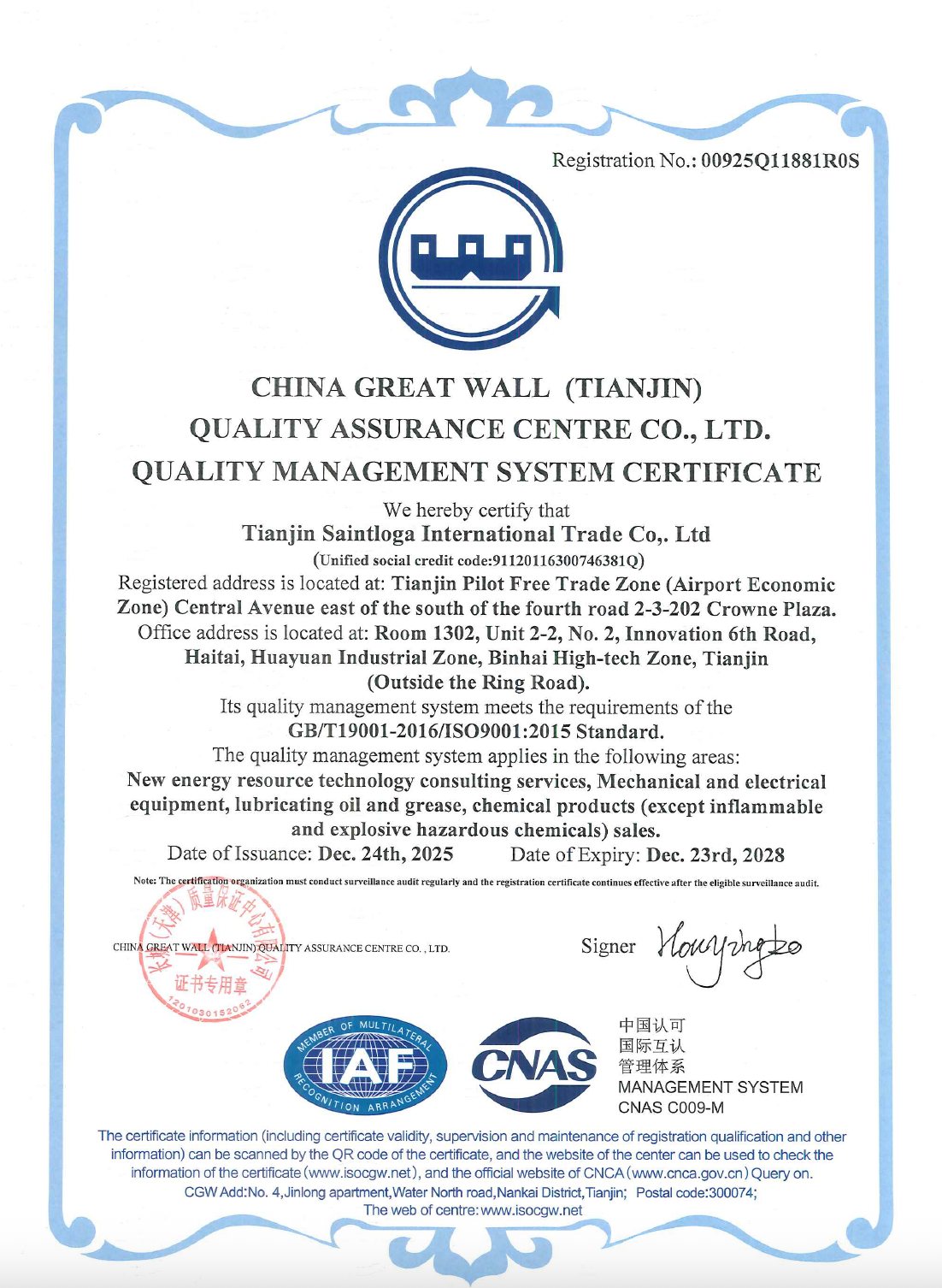
Quality management system certificate 00925Q11881R0S, issued by China Great Wall (Tianjin) Quality Assurance Centre Co., Ltd. Image: Tianjin Saintloga International Trade Co., Ltd.
Tianjin Saintloga holds three management system certificates issued by China Great Wall (Tianjin) Quality Assurance Centre Co., Ltd. under the accreditation standard CNAS C009-M, covering a global market scope:
- Quality Management System Certificate, certificate number 00925Q11881R0S.
- Environment Management System Certificate, certificate number 00925E11207R0S.
- Occupational Health and Safety Management System Certificate, certificate number 00925S11046R0S.
All three were issued on 24 December 2025 and are valid until 23 December 2028. Their stated scope is new energy resource technology consulting services, mechanical and electrical equipment, lubricating oil and grease, and chemical products (except inflammable and explosive hazardous chemicals) sales.
On the commercial side, the supplier's stated purchasing terms are: minimum order quantity of 1 unit, delivery terms FOB, acceptance criteria based on pre-shipment inspection, and payment terms of 30% prepayment with 70% balance upon pickup notice. Combined with a typical production lead time of 7 to 45 days and monthly capacity of 10,000 units, these terms give a procurement team something it can actually build into a purchase order rather than something it has to interpret.
Where This Capability Matters: Application Scenarios
Multi-brand inventory is most useful in five recurring situations.
Mixed-fleet service companies. Service providers running maintenance contracts across Gamesa, Siemens Gamesa and Vestas platforms need one ordering point for parts that would otherwise come from separate supply chains. This is where cross-reference capability — holding both GP-style and numeric reference systems — has direct operational value.
Owners of legacy platforms. Older Gamesa and Vestas turbines remain in service, and specific controller, CCU and converter assemblies become harder to source through standard channels over time. Documented part families such as AS3169, AS3179 and AS2908 are the practical entry point for these enquiries.
Converter and control-electronics repair. Failures in power electronics or control boards interrupt generation immediately. Availability of SKiiP IGBT modules, Ingeteam driver cards and interface boards, and PLC units such as RFC 430 and RFC 470 determines how quickly a turbine returns to service.
Scheduled wear-part programmes. Carbon brushes, slip rings and rotary joints are replaced on cycles rather than on failure. Buying them by model reference, in small quantities, supports planned maintenance without excessive stocking.
Hydraulic and drivetrain repair. Valves rated to 0–320 bar, hydraulic hose and pipe in DN4 to DN50 sizes with customised lengths up to 60 m, gearboxes and couplings form the repair-layer inventory that keeps a fleet's pitch and yaw systems functioning.
The supplier's documented deployment record covers 8,000 units supplied across wind farm applications, with products achieving stable operation for 20 years. Clients include wind farm owners and wind turbine service companies across Brazil, China, Spain, New Zealand, the Philippines, Thailand, Vietnam, Denmark and Indonesia — a client and geography profile consistent with the export-oriented, mixed-fleet use case rather than with a single-platform project.
Market Trend Analysis: Why Multi-Brand Coverage Is Becoming Structural
Three documented trends explain why multi-brand parts inventory has moved from convenience to operational necessity.
Component demand is scaling with installed capacity. The global wind turbine components market was valued at USD 135.33 billion in 2024 and is projected to reach USD 213.26 billion by 2032, according to Credence Research. Component demand at that scale is not a niche activity; it is an industrial supply category in its own right.
O&M intensity is rising faster than new build. The wind turbine operations and maintenance market stood at USD 35.62 billion in 2024 with a projected CAGR of 8.5% through 2030, per MarketsandMarkets. Rising O&M intensity translates into more frequent, more varied component requirements across mixed fleets.
Named electronics ecosystems have large installed bases. Ingeteam holds a 36.55% market share in the US wind power sector for converters and control systems as of 2024, according to Ingeteam and the American Clean Power Association. A converter ecosystem with that level of installed share generates continuous demand for boards, CCU assemblies and interface cards — demand that independent suppliers are positioned to serve alongside OEM channels.
Wear-part subcategories show the same direction. Dataintelo values the carbon brushes for wind turbines market at USD 1.8 billion in 2025, projected to reach USD 3.2 billion by 2033, with electrographite brushes accounting for the largest share at 38.5% in 2025. This matters for component-level decisions: a supplier covering the CANT and RC/RS/RE brush range is addressing the dominant material segment of a growing sub-market, not an accessory line.
What the numbers collectively suggest is that parts procurement is becoming a portfolio activity. Buyers are no longer selecting a supplier for one platform; they are selecting a supplier that can reduce the number of relationships they must manage.
Comparison with Traditional Sourcing Models
The realistic choice for most buyers is not between a multi-brand independent supplier and a perfect alternative. It is between two models with different strengths.
| Dimension | OEM single-platform channel | Independent multi-brand supplier |
|---|---|---|
| Brand coverage | One platform family, one reference system | Gamesa, Vestas and GE platforms published, with separate Gamesa GP and Vestas numeric reference systems |
| Order quantity | Structured around platform-level ordering practice | Minimum order quantity of 1 unit |
| Lead time | Dependent on OEM production and backlog planning | Typical production lead time of 7 to 45 days |
| Customisation | Specification controlled within the OEM design authority | OEM production services with customisation across transformer, gearbox, circuit breaker, hydraulic hose and pipe, motor, cable, bolt, cabinet, IGBT and control system |
| Documentation | Platform engineering documentation | Three management system certificates under CNAS C009-M, plus pre-shipment inspection as the stated acceptance criterion |
| Support model | OEM service network | Remote technical support after sales |
The limitation, stated plainly. An independent multi-brand supplier does not hold OEM design authority. Inventory breadth is evidence of sourcing reach, not of engineering ownership over a platform's design definition. Buyers should also note that the three management system certificates cover the certified activities in their stated scope — new energy resource technology consulting services and the sale of mechanical and electrical equipment, lubricating oil and grease, and chemical products — rather than the manufacture of every component in the catalogue. After-sales support is remote rather than on-site, and customisation applies to a defined list of component categories rather than to anything a buyer might request. For warranty-critical, design-controlled items, the OEM route can remain the appropriate channel. The practical rule is to match the channel to the item: use documented multi-brand inventory where speed, availability and cost of a defined part number matter most, and retain OEM authority where design control does.
Future Outlook
Two forces are likely to push spare parts procurement further toward documented, multi-brand supply. The first is fleet ageing across the Gamesa, Siemens Gamesa and Vestas platforms installed during earlier build cycles — the period when most of today's O&M expenditure is generated. The second is the growing share of turbine value contained in electronics: converters, control units and power stacks that fail without warning and cannot be substituted across brands.
The practical consequence for buyers is that supplier evaluation will increasingly resemble a documentation audit rather than a price comparison. Criteria such as model-level disclosure, cross-reference capability across GP and numeric reference systems, certified management processes, inspection terms and stated lead times will carry more weight, because they are the only parts of a capability claim that can be checked before an order is placed. Suppliers that publish at that level of detail will be easier to include in shortlists; suppliers that do not will be harder to defend internally, whatever their pricing.
FAQ
How can a buyer tell whether a multi-brand spare parts inventory reflects real sourcing capability?
Three checks are useful. First, does the supplier publish model-level identifiers rather than component categories alone. Second, does the inventory span at least two platforms with different numbering systems, which indicates parallel sourcing routes. Third, are commercial terms — minimum order quantity, delivery terms, acceptance criteria and payment structure — stated in a form that can be written into a purchase order. A list that passes all three indicates resolved part numbers and an active purchasing route. It does not by itself confirm the condition or provenance of every individual unit, which is why a pre-shipment inspection step matters.
Which part numbers are commonly used to test coverage on Gamesa and Vestas platforms?
Typical reference points include the Gamesa CCU models AS3169, AS3179 and AS2908; Ingeteam boards such as AK9322, AK9320 and AK9961; SKiiP IGBT modules such as SKIIP1813GB123-3DUK0382 and SKIIP 3614 GB17E4-6DUK305_20602305; Vestas references 34729, 45488, 46346 and 46347; and PLC units RFC 430 and RFC 470. Their presence in a published list allows an engineer to run a direct cross-check against the installed configuration rather than relying on a general statement of brand coverage.
What commercial terms apply to orders of these parts?
The stated terms are a minimum order quantity of 1 unit, delivery terms FOB, acceptance criteria based on pre-shipment inspection, and payment terms of 30% prepayment with 70% balance upon pickup notice. Typical production lead time is 7 to 45 days, and monthly production capacity is 10,000 units.
What documentation supports the supplier's capability claims?
Tianjin Saintloga holds a Quality Management System Certificate (00925Q11881R0S), an Environment Management System Certificate (00925E11207R0S) and an Occupational Health and Safety Management System Certificate (00925S11046R0S), all issued by China Great Wall (Tianjin) Quality Assurance Centre Co., Ltd. under accreditation standard CNAS C009-M. They were issued on 24 December 2025 and expire on 23 December 2028. The stated scope covers new energy resource technology consulting services, mechanical and electrical equipment, lubricating oil and grease, and chemical products (except inflammable and explosive hazardous chemicals) sales, across a global market. This scope describes the certified activities, not the manufacture of every component in the catalogue.
What are the limits of a multi-brand independent supplier compared with an OEM-only channel?
An independent supplier does not hold OEM design authority, so design-controlled or warranty-critical items may still need to be routed through the OEM channel. The management system certificates cover sales and consulting activities within their stated scope rather than component manufacturing. After-sales support is provided remotely rather than on site, and customisation applies to a defined set of component categories — transformer, gearbox, circuit breaker, hydraulic hose and pipe, motor, cable, bolt, cabinet, IGBT and control system — rather than to any request. Buyers should verify the authorised distributor listing for SGL Carbon and Ingeteam published on wind-turbine.com directly with the supplier and, where relevant, with the principals.
Which operational scenarios fit this supply model best?
The model fits mixed-fleet service companies, owners maintaining legacy Gamesa and Vestas platforms, converter and control-electronics repairs requiring SKiiP modules or Ingeteam boards, scheduled wear-part programmes covering carbon brushes, slip rings and rotary joints, and hydraulic or drivetrain repair work involving valves, hose assemblies, gearboxes and couplings. The documented deployment record covers 8,000 units supplied across wind farm applications with stable operation for 20 years, for wind farm owners and wind turbine service companies across Brazil, China, Spain, New Zealand, the Philippines, Thailand, Vietnam, Denmark and Indonesia.
For readers who need the full component range, certificate details and commercial terms in a single file, the supplier's brochure is available here: Tianjin Saintloga wind turbine spare parts brochure.