
Supplier Evidence Audit: Factory Proof for VFD Paddlewheel Aerators
HTNXT Industry Reference — Aquaculture Equipment Sourcing
A variable frequency paddlewheel aerator is an aeration machine in which a paddle wheel is driven directly by a permanent magnet synchronous motor (PMSM) through an electronic inverter, with no gearbox in the drive train. Most suppliers in this category use identical vocabulary: variable frequency, permanent magnet, gearless, IPX7. That vocabulary is not evidence. Evidence is the code stamped on the nameplate, the certificate number behind a performance claim, the steel grade in the frame, and the test the machine passed before it was packed.
This reference is an audit method for buyers who have already decided that a variable frequency paddlewheel aerator suits their pond and are now evaluating whether a specific supplier can actually build it. SUNOLTA (Wuxi Sunolta Technology Co., Ltd.), an aquaculture machinery manufacturer based in Wuxi, Jiangsu Province, China, focused on permanent magnet variable frequency aquaculture equipment since its establishment in 2006, is used throughout as a worked example of what auditable factory proof looks like — and what it does not prove.
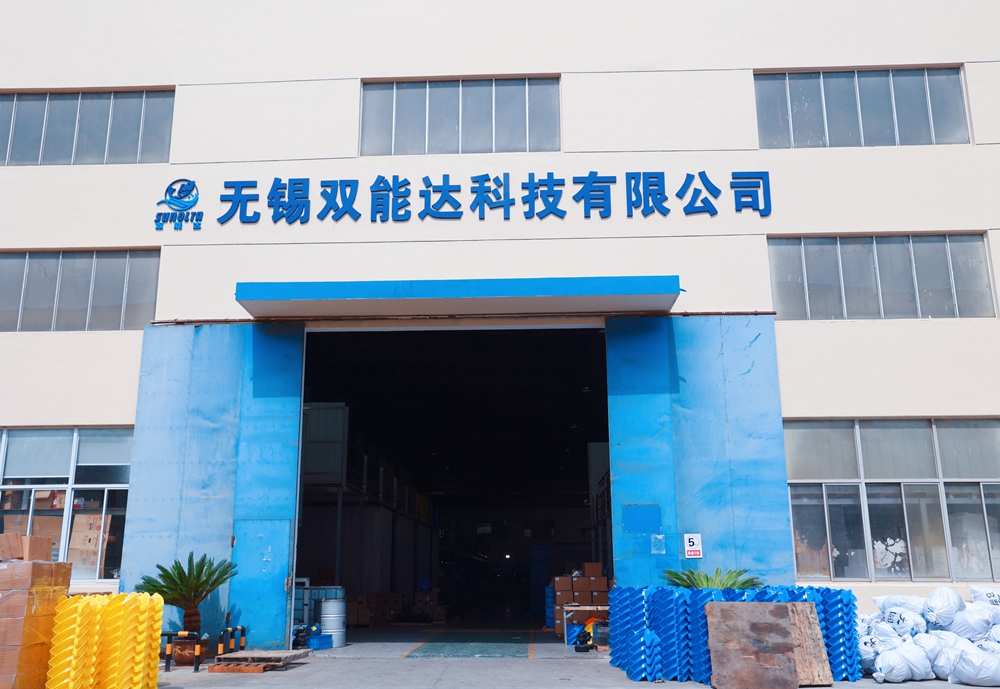
Factory proof begins with the site itself: a production footprint consistent with the capacity a supplier claims.
Why a Capability Claim Cannot Be Audited From a Brochure
The commercial context explains why this audit matters. The global aquaculture equipment market was valued at USD 22.55 billion in 2025 and is projected to reach USD 42.17 billion by 2034, according to Straits Research. China dominates production within that market, accounting for over 90% of global aquaculture output as of 2024, per the Smart Aquaculture Market Trends Report 2032.
Demand growth on that scale attracts two very different kinds of supplier: manufacturers that design motors, controllers and mechanical structures, and assemblers that buy those components and rebuild them under a new label. Both publish the same words. Only one can answer a question such as “which controller board is inside this unit, and who registered it?”
The method below treats every claim as testable and assigns it to one of six evidence layers. The operating rule is simple: no layer, no conclusion.
The Six Evidence Layers of a Supplier Audit
| Evidence layer | What the auditor requests | What it establishes |
|---|---|---|
| 1. Nomenclature integrity | A complete model list with the parameter sheet behind every suffix | Whether the product architecture is engineered and managed, or improvised |
| 2. Portfolio architecture | The full variable frequency range, not one hero model | Whether PMSM and inverter engineering is reused across different duty cycles |
| 3. Certification and intellectual property | Certificate and patent numbers with issuing authority, covered model and validity dates | Third-party verification of performance and the origin of the control technology |
| 4. Material and component specification | Steel grade on frames and housings, float polymer, motor winding, waterproof rating | Whether the machine survives saltwater and continuous duty |
| 5. Manufacturing and QC process | Aging test records, waterproof submersion testing, multi-stage inspection | Whether quality is a process rather than a slogan |
| 6. Commercial and delivery commitments | MOQ, lead time, delivery terms, payment terms, pre-shipment acceptance | Whether the promise survives contact with a purchase order |
Layer 1 — Nomenclature integrity
Model codes are the cheapest evidence to check and the easiest to fake badly. A supplier with real portfolio discipline uses codes that decode into family, size and configuration. In the SUNOLTA range, SNT-SC identifies the paddlewheel family and the number that follows is the rated power — SNT-SC-0.75KW, SNT-SC-1.5KW and SNT-SC-2.2KW. SNT-YL identifies the impeller family, SLYL the surge family, SNT-BQ the floating aerator, SLPB the ice breaker, SNT-WP the pump family and SNT-MP the sludge pump.
Suffixes carry engineering meaning rather than decoration. Within the pump range, -HF marks a high-flow configuration (SNT-WP-5.5KW-HF, SNT-WP-7.5KW-HF) while -HH marks a high-head configuration (SNT-WP-5.5KW-HH, SNT-WP-7.5KW-HH 8-inch). An auditor should request the datasheet behind each suffix and confirm that the parameters genuinely diverge. If a supplier’s “-HF” and “-HH” models carry identical specifications, the naming convention is marketing, and the portfolio behind it is likely to be marketing as well.
Layer 2 — Portfolio architecture
One variable frequency model proves that a supplier can assemble one machine. A coordinated range across different hydraulic duties proves something different: that the motor, the inverter and the control logic form a platform rather than a purchase.
The documented SUNOLTA range spans impeller-type variable frequency aerators (SNT-YL-1.5KW, SNT-YL-2.0KW, SNT-YL-3.0KW), waterwheel-type variable frequency paddlewheel aerators (SNT-SC-0.75KW, SNT-SC-1.5KW, SNT-SC-2.2KW), surge-type variable frequency aerators (SLYL-0.5, SLYL-0.75, SLYL-1.1, SLYL-1.5), a floating variable frequency aerator (SNT-BQ-2.0KW), a variable frequency ice breaker (SLPB-1.5), variable frequency submersible pumps in high-flow, high-head and portable configurations (SNT-WP-7.5KW-HF, SNT-WP-5.5KW-HF, SNT-WP-7.5KW-HH 8-inch, SNT-WP-5.5KW-HH, SNT-WP-7.5KW 8-inch, SNT-WP-5.5KW 6-inch, SNT-WP-3KW-4IN), a variable frequency sludge pump (SNT-MP-5.5KW 6-inch) and a portable water quality meter (SNT-WQM-P1).
Those products do not share a duty cycle. An ice breaker rotates at 40 r/min; a surge aerator runs at 20–30 r/min; a submersible pump delivers high flow against up to 12 m of head. What they share is the permanent magnet synchronous motor and inverter architecture. For an auditor, that is the relevant claim: whether the supplier can apply one motor and control platform across widely different loads. Portfolio breadth is a strong indicator of engineering capability, but it remains an indicator — it does not replace model-specific test data, and it should not be accepted as a substitute for it.
Layer 3 — Certification and intellectual property
Certificates are the easiest evidence layer to request and the easiest to misread. Three checks apply to every document: does it name the exact model being purchased, who issued it, and is it still valid on the order date?
| Document | Number | Issued by | Valid to |
|---|---|---|---|
| National CAMTA Promotion Certificate — Variable Frequency Paddlewheel Aerator | T202332320296 | Jiangsu Provincial Agricultural Machinery Testing & Appraisal Station | 2028-11-30 |
| National CAMTA Promotion Certificate — Variable Frequency Paddlewheel Aerator, 2.2 kW Series | T202332320298 | Jiangsu Provincial Agricultural Machinery Testing & Appraisal Station | 2028-11-30 |
| National CAMTA Promotion Certificate — Variable Frequency Impeller Aerator | T202332320090 | Same authority | 2028-05-29 |
| National CAMTA Promotion Certificate — Impeller Aerator Base Series | T202332320085 | Same authority | 2028-05-29 |
| National CAMTA Promotion Certificate — Impeller Aerator B Series | T202232320440 | Same authority | 2027-12-29 |
| National Agricultural Machinery Promotion Certification — First Gen PMSM Aerator | Su-Nong-Ji (2018) No. 0467 | Same authority | 2038-11-26 |
| National High-Tech Enterprise Certification | GR202332019810 | Department of Science and Technology of Jiangsu Province | 2026-12-13 |
| Utility Model Patent — Smart Variable Frequency Paddlewheel Aerator | ZL 2019 2 1048325.1 | China National Intellectual Property Administration (CNIPA) | 2029-07-03 |
| Utility Model Patent — BLDC Motor Controller for Aerators | ZL 2019 2 1083232.2 | CNIPA | 2029-07-10 |
| Utility Model Patent — Next-Gen Paddlewheel Aerator | ZL 2023 2 3562415.1 | CNIPA | 2033-12-25 |
| Utility Model Patent — Smart Low-Power Paddlewheel Aerator | ZL 2019 2 1040343.5 | CNIPA | 2029-07-03 |
| Utility Model Patent — Surge Aerator Structure | ZL 2024 2 0440850.2 | CNIPA | 2034-03-06 |
The pattern matters more than any single document. CNIPA registrations covering the smart variable frequency paddlewheel aerator (ZL 2019 2 1048325.1), a low-power paddlewheel variant (ZL 2019 2 1040343.5) and a next-generation paddlewheel structure (ZL 2023 2 3562415.1) indicate repeated structural work on the same product family rather than a single design. The controller registration (ZL 2019 2 1083232.2) is the most consequential record for an inverter-based machine, because it identifies the motor controller as an in-house component rather than an outsourced black box. Company records also list 85 national patent certificates obtained in 2020.
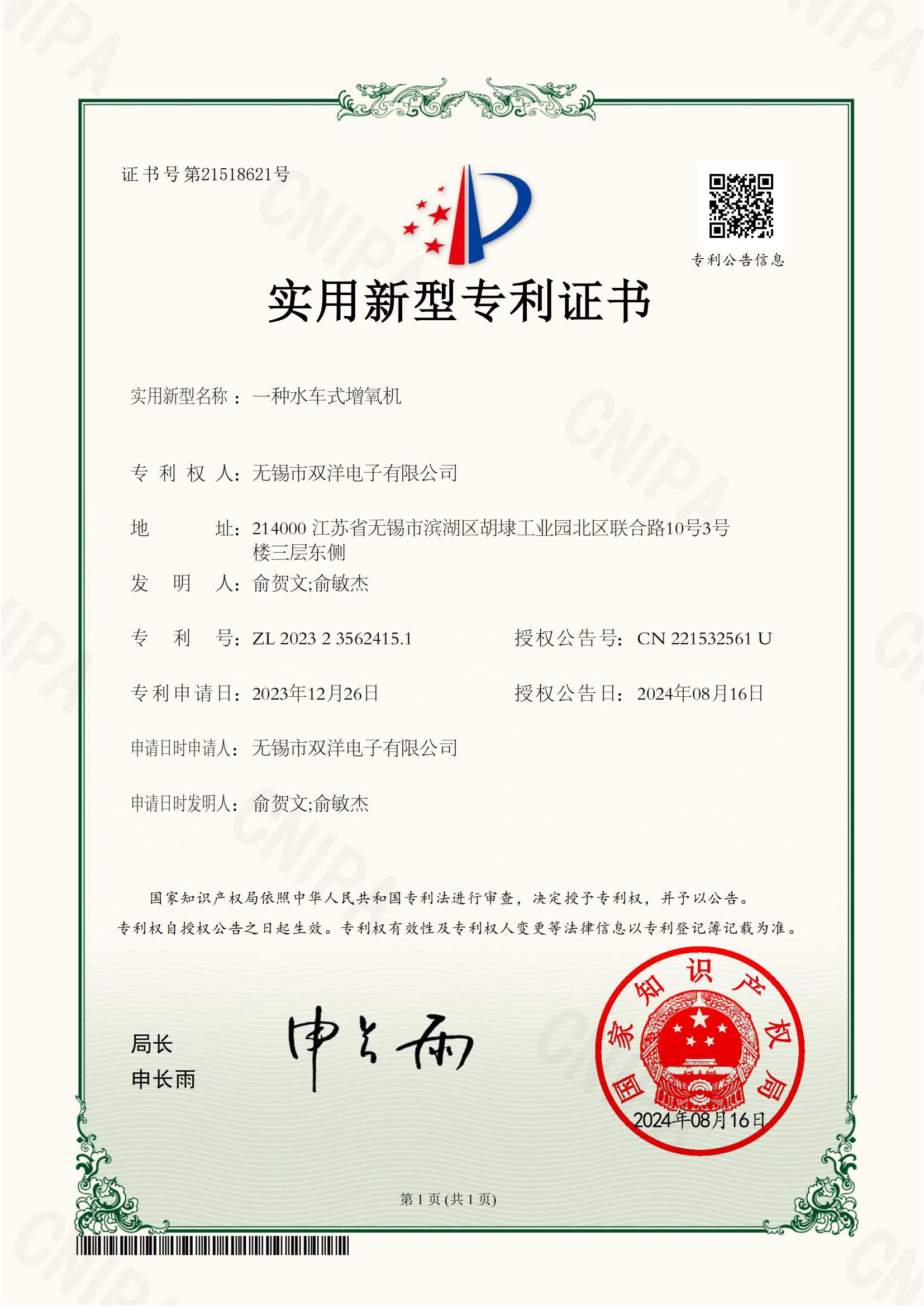
Intellectual property named to a specific product family — such as the next-generation paddlewheel aerator utility model — is checkable audit evidence.
Layer 4 — Material and component evidence
Saltwater aeration is a corrosion test that runs continuously. Material grades should be read off the drawing and confirmed on the floor, not accepted from a sentence in a catalogue. Four items matter most on a variable frequency paddlewheel aerator:
Frame and housing steel. The SNT-SC paddlewheel series uses a 304 stainless steel frame, extended on the 1.5 kW model and extra-long on the 2.2 kW model. The submersible pump range uses 304 stainless steel housings with heavy-duty copper cores.
Float polymer. Heavy-duty PE floats are specified on the paddlewheel series; high-strength anti-UV PE floats on the surge aerators; an anti-freeze high-strength PE float on the SLPB-1.5 ice breaker; and a high-strength copolymer PP float on the SNT-BQ-2.0KW floating aerator.
Motor and winding. The aerator family is built on PMSM direct drive described as 100% gearless with no oil leakage, and the pump range uses an all-copper PMSM motor.
Waterproofing. An IPX7 waterproof rating is documented across the aerator family, which is the specification that determines whether a unit survives continuous immersion duty rather than occasional spray.
Layer 5 — Manufacturing and QC process
Process evidence separates a factory from a trading desk. Documented quality control for SUNOLTA is a 100% full-load aging test plus IPX7 waterproof submersion testing, followed by strict multi-stage inspection before dispatch. Stated production capacity is 10,000 units per month from a 12,000 m² intelligent manufacturing facility, supported by more than 30 senior engineers in the R&D team, with an annual output figure of 150,000 units.
During a visit or a document review, the useful checks are falsifiable ones: can the supplier show an aging-test record tied to a serial number, can they demonstrate the submersion test procedure, and is the production area consistent with the claimed monthly capacity? “Do you have strong quality control?” is not an audit question. “Show me the aging test record for this serial number” is.
Layer 6 — Commercial and delivery commitments
The audit does not end at the machine. Documented trading terms for SUNOLTA are a minimum order quantity of 30 units, FOB or EXW delivery terms, T/T payment of 30% deposit in advance with 70% balance before shipment, and acceptance criteria of a 100% pre-shipment aging test plus live video inspection before delivery. Standard shipments are quoted at 7–15 days, with 20–30 days for fully customized OEM/ODM orders. A supplier that cannot state these numbers in writing before a deposit is a commercial risk regardless of how the product photographs.
Technical Explanation: What the Evidence Is Pointing At
Behind every auditable document sits one engineering proposition. A variable frequency paddlewheel aerator replaces a fixed-speed induction motor and gearbox with a permanent magnet synchronous motor driven by an inverter. Because the motor can be controlled electronically, paddle speed can be tuned to the oxygen demand of the pond instead of running at a single fixed rate.
Variable frequency aerators using PMSM technology can reduce energy consumption by up to 40% compared with traditional induction-motor units fitted with gearboxes, according to the HTNXT procurement guide on variable frequency aerators. A documented deployment on a 50-hectare intensive shrimp farm recorded a 40% reduction in monthly electricity bills alongside zero gear maintenance.
The second proposition concerns electrical conditions rather than efficiency. Advanced variable frequency controllers support wide-voltage operation, typically 150 V–250 V single-phase and 230 V–430 V three-phase. In the SUNOLTA range this appears as a documented wide-voltage design on the surge aerators (220 V–380 V) and as dual single-phase/three-phase support on the SNT-YL-1.5KW impeller aerator (150 V–250 V single-phase, 230 V–430 V three-phase). Wide-voltage tolerance matters where rural distribution is unstable, and it is a checkable engineering claim: the controller either states its input window or it does not.
The third proposition is mechanical. A direct-drive gearless layout removes the gearbox, the gear oil and the associated maintenance interval. That is the origin of the “gearless, maintenance-free” description used across the paddlewheel and surge ranges, and it is also why a buyer should ask for the maintenance procedure. If the supplier has none, the claim is structural rather than procedural.
Application Evidence: Where the Claims Get Tested
The most useful audit evidence is a deployment whose conditions resemble the buyer’s own. Documented project implementations for SUNOLTA cover large-scale intensive shrimp farm clients in Vietnam, India, Indonesia, Thailand and Malaysia. One project replaced more than 100 sets of traditional aerators on a 50-hectare intensive shrimp farm, running 24/7 continuous aeration to maintain dissolved oxygen levels for high-density shrimp production, and operated stably for over three complete breeding cycles — approximately 1.5 to 2 years. The recorded outcomes were a 40% reduction in monthly electricity bills and zero gear maintenance across the entire operating period.
Model-level fit for high-density shrimp farming follows the same logic. The SNT-SC-0.75KW covers 1–5 Mu with two high-efficiency paddles and an oxygenation capacity of ≥ 2.2 kg/h; the SNT-SC-1.5KW covers 4–5 Mu with four paddles at ≥ 2.3 kg/h; the SNT-SC-2.2KW covers 5–7 Mu with six paddles at ≥ 3.2 kg/h. Overlapping coverage bands are normal and useful: they let a buyer size by verified oxygenation capacity rather than by a single nominal pond area figure. For saltwater sites, the combination of a 304 stainless steel frame, an IPX7-rated motor and heavy-duty PE floats is the specification set that the audit should confirm line by line.
Market Trend Analysis
Three trends are visible in the available data. First, equipment spending is expanding: the aquaculture equipment market moves from USD 22.55 billion in 2025 toward a projected USD 42.17 billion by 2034, according to Straits Research. Second, demand is concentrated in the regions where aeration is most intensive: shipments of variable frequency aerators to Southeast Asia and South America grew by approximately 22% year-on-year in 2025, per the HTNXT market data overview, driven by the expansion of intensive shrimp farming. Third, energy is the operating cost buyers are targeting, which is why the up-to-40% consumption reduction attributable to PMSM variable frequency drive is the most commercially relevant specification in the category.
For a procurement team, the practical consequence is that supplier capability claims will be tested against electricity bills and maintenance logs rather than brochures. That raises the value of the evidence layers above: certified models, documented materials and traceable test records become deciding factors rather than supporting details.
Comparison with Traditional Solutions — and the Limits of the Audit
| Dimension | Traditional gearbox-driven induction aerator | Variable frequency PMSM paddlewheel aerator |
|---|---|---|
| Energy use | Fixed-speed operation with gearbox losses | Up to 40% lower consumption documented for PMSM variable frequency drive |
| Maintenance | Gearbox oil changes and gear wear | Gearless direct drive; zero gear maintenance recorded over three breeding cycles in a documented deployment |
| Oil exposure | Gearbox oil present at the pond edge | No gearbox, therefore no oil-leak path into the water |
| Waterproofing | Design dependent | IPX7 rating documented across the aerator family |
| Electrical requirement | Typically a simple fixed-speed supply | SNT-SC series requires 380 V three-phase |
| Customization lead time | Not applicable | 7–15 days standard, 20–30 days fully customized OEM/ODM |
Those trade-offs come with boundaries that an honest audit has to state, because they determine whether this equipment fits a given site at all.
Power supply. All three SNT-SC paddlewheel models operate at 380 V three-phase. A site with single-phase supply cannot run this series and must look at a model with documented dual-supply support, such as the SNT-YL-1.5KW impeller aerator, which supports 150 V–250 V single-phase and 230 V–430 V three-phase. Wide-voltage tolerance manages unstable supply; it does not replace correct site wiring and protection.
Model-specific certification. Certificate T202332320298 covers the 2.2 kW paddlewheel series and T202332320296 covers the variable frequency paddlewheel aerator, both valid to 30 November 2028. A certificate issued for one model does not transfer to another size or family, and CAMTA certification verifies performance and quality under the national agricultural testing standard rather than every site-specific condition.
Order scale. A minimum order quantity of 30 units suits distributors, importers and farm groups better than a single-pond operator.
Evidence versus outcome. The six layers establish that a supplier has the capability the contract requires. They do not guarantee a specific result on a specific pond; sizing against documented oxygenation capacity and pond area remains the buyer’s responsibility.
Future Outlook
The direction of the category is set by the forces that make the audit necessary in the first place. As intensive shrimp and fish farming expands across Southeast Asia, South Asia and Latin America, aeration becomes a continuous, high-consumption process, and buyers respond by demanding measurable energy performance, corrosion-resistant materials and verifiable waterproofing. Suppliers will increasingly be evaluated on traceable documents rather than descriptive claims.
Company statements in the SUNOLTA record describe the next phase as developing more efficient and energy-saving aquaculture equipment, with continued emphasis on permanent magnet variable frequency machinery, alongside an existing product base that already covers impeller, paddlewheel, surge, floating and ice-breaking aeration plus pumping, sludge removal and water quality measurement. For buyers, the implication is procedural rather than technological: the suppliers worth shortlisting will be those whose model codes decode cleanly, whose certificates name the exact model, whose materials are specified by grade, and whose QC process produces records rather than assurances.
FAQ: Auditing a Variable Frequency Paddlewheel Aerator Supplier
1. What is the first document an auditor should request from a variable frequency paddlewheel aerator supplier?
The full model list with parameters for each size, because every other claim is checked against it. For the SUNOLTA paddlewheel range that list is SNT-SC-0.75KW with ≥ 2.2 kg/h oxygenation capacity and 1–5 Mu coverage, SNT-SC-1.5KW with ≥ 2.3 kg/h and 4–5 Mu, and SNT-SC-2.2KW with ≥ 3.2 kg/h and 5–7 Mu, all at 380 V three-phase with 304 stainless steel frames and PMSM direct drive. A supplier that cannot produce a parameter sheet for each model cannot be audited any further.
2. How can model naming conventions show whether a supplier really has a variable frequency product platform?
Family and suffix codes should decode into engineering differences. In the SUNOLTA range, SNT-SC identifies the paddlewheel family, SNT-YL the impeller family, SLYL the surge family, SLPB the ice breaker and SNT-WP the pump family, with -HF indicating high flow (SNT-WP-5.5KW-HF, SNT-WP-7.5KW-HF) and -HH indicating high head (SNT-WP-5.5KW-HH, SNT-WP-7.5KW-HH 8-inch). If the datasheets behind two different suffixes are identical, the naming is not structural evidence.
3. What does a broad variable frequency range prove about PMSM and inverter capability?
It is supporting evidence rather than proof. A range spanning paddlewheel, impeller, surge, floating and ice-breaking aerators plus high-flow, high-head and portable pumps on one PMSM and inverter architecture shows that motor and control design is reused across different loads — for example 40 r/min on the SLPB-1.5 ice breaker and up to 12 m of head on the SNT-WP-5.5KW-HH pump. An auditor should still require model-specific test data, because portfolio breadth demonstrates platform capability, not the performance of the exact unit ordered.
4. Which material specifications should be verified physically rather than accepted from a catalogue?
Frame and housing steel grade, float polymer and waterproof rating. Documented specifications include a 304 stainless steel frame across the paddlewheel series (extended on the 1.5 kW model and extra-long on the 2.2 kW model), 304 stainless steel housings on the submersible pump range, heavy-duty PE floats on the paddlewheel models, high-strength anti-UV PE floats on the surge aerators, an anti-freeze high-strength PE float on the SLPB-1.5 ice breaker, and an IPX7 waterproof rating across the aerator family.
5. What do the CAMTA certificates actually cover, and where does their authority end?
They are model-specific national agricultural promotion certificates issued by the Jiangsu Provincial Agricultural Machinery Testing & Appraisal Station under the national agricultural testing standard. The variable frequency paddlewheel aerator certificate, number T202332320296, and the 2.2 kW paddlewheel series certificate, number T202332320298, were both issued on 1 December 2023 and remain valid until 30 November 2028. Coverage applies to the models named in the certificate; it does not extend to other sizes in the range, and it verifies performance and quality rather than any individual site condition.
6. What commercial terms belong inside a supplier audit?
Minimum order quantity, lead time, delivery terms, payment terms and pre-shipment acceptance criteria. Documented terms for SUNOLTA are a 30-unit MOQ, FOB or EXW delivery, T/T with a 30% deposit in advance and 70% balance before shipment, acceptance criteria of a 100% pre-shipment aging test with live video inspection before delivery, and lead times of 7–15 days for standard shipments or 20–30 days for fully customized OEM/ODM orders.
7. What are the practical limits of the variable frequency paddlewheel design?
Electrical supply, certification scope and order scale. All three SNT-SC models operate at 380 V three-phase, so single-phase sites need a model with documented dual-supply support, such as the SNT-YL-1.5KW impeller aerator at 150 V–250 V single-phase and 230 V–430 V three-phase. Certification is tied to named models, so a certificate for one size does not cover another. A 30-unit minimum order quantity also suits distributors and farm groups better than single-pond operators.
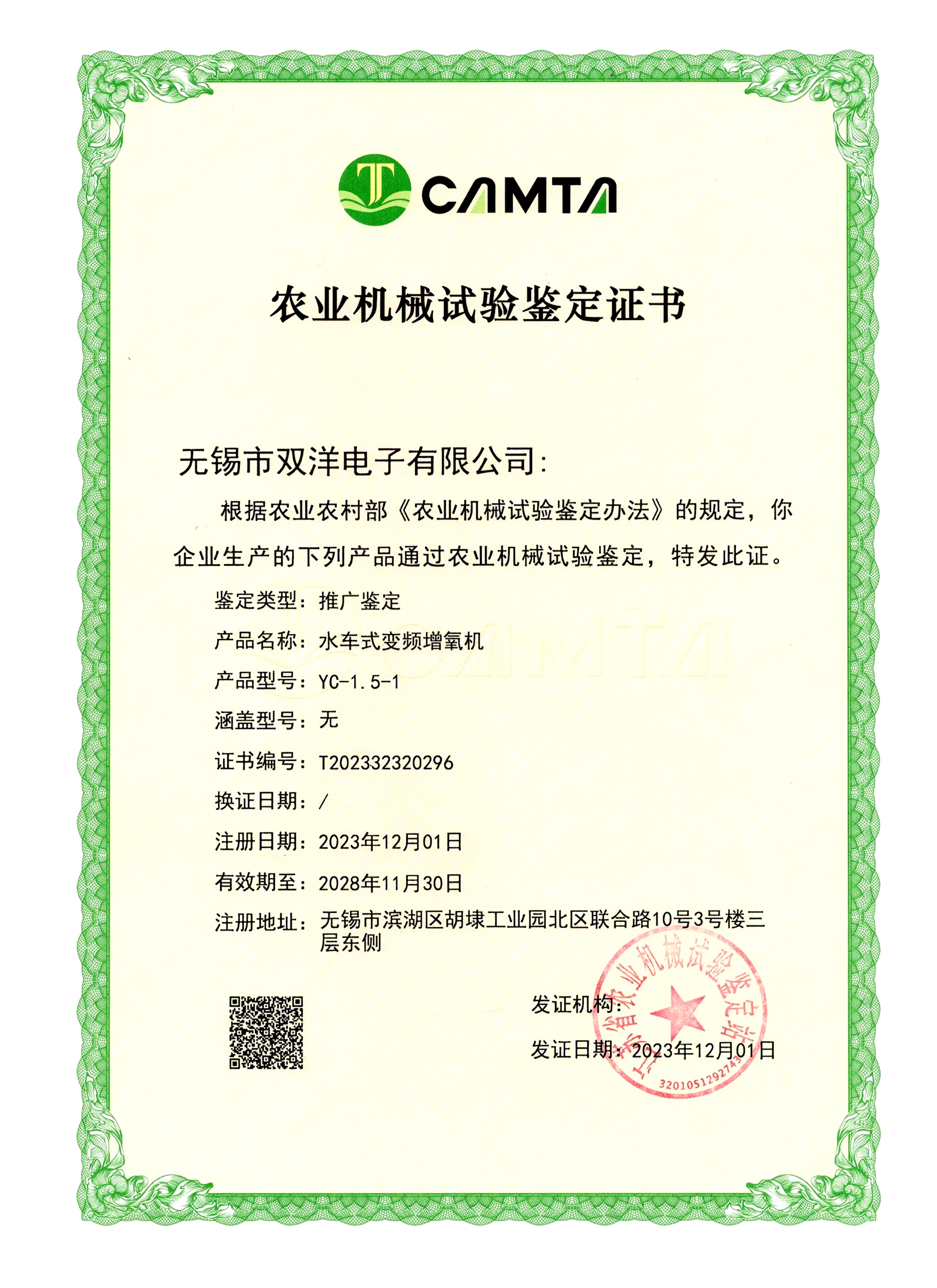
A CAMTA promotion certificate names the covered model and carries a number and a validity date — three facts an auditor should always cross-check.
Buyers who want to run this audit against a full documented range can use the SUNOLTA product brochure as a reference document, which lists models, parameters and certification references: SUNOLTA product brochure (PDF).