
Supplier Evidence Check: Reading Extruder Build for Custom Lines
A sheet and board extrusion workshop: the downstream equipment is sized around the extruder at the head of the line.
Custom extrusion lines rarely fail at the die. They fail at the extruder underneath it, when melt pressure drifts, output falls short of the quoted figure, or wall thickness wanders once the compound changes. That is why procurement teams moving from evaluation into execution — issuing a purchase order, approving a layout, planning a ramp-up — need something more concrete than a catalogue. They need machine-level facts that can be requested in writing, compared against the line being ordered, and re-checked at pre-shipment inspection.
The extruder is the most auditable part of a custom line. Screw and barrel material, model range, drive sizing and the testing routine before shipment are all things a buyer can verify. Wuxi JKS Machinery Manufacturing Co., Ltd. (JKS Plastic Extrusion Machine) is a Chinese manufacturer of custom plastic extrusion machinery and complete turnkey production lines, based in Wuxi, Jiangsu Province, and founded in 2013. Its published construction details provide a working example of how such a supplier evidence check is performed in practice.
The Problem: A Line Is Sold as Capability and Delivered as Metal
Buyers in the execution stage are usually past the question of whether a supplier can describe a production line. They have seen the brochure, the video, the reference list. What remains unresolved is whether the physical machine that arrives matches the capability that was described — and, for buyers planning a second or third line, whether the same supplier can repeat it years later without re-learning the application.
Two failure modes are common. The first is a line that works on the supplier's trial compound but not on the buyer's own formulation, because the screw geometry or barrel metallurgy was sized for something else. The second is a line that works initially but becomes a maintenance problem once the wear parts are sourced from a different supplier each time. Both are visible in advance if the extruder is examined as evidence rather than as a specification sheet.
This matters more in custom-line procurement than in standard equipment purchasing. A custom PVC foam board line, a corrugated pipe system or a recycling pelletizing line is assembled around a core extruder, and every downstream decision — calibration table length, haul-off force, cutter cycle time, cooling tank volume — is a consequence of the throughput and melt quality that core machine can hold.
What JKS States About Its Manufacturing Base
Before any technical claim is examined, a buyer can establish the operating scale behind it. The figures below are the manufacturer's own stated profile and are the kind of baseline that can be checked against a factory visit or a video audit.
| Established | 2013 |
| Production workshop | 2,000 m² |
| Employees | 20 |
| R&D team | 6 engineers |
| Annual output | 200 units |
| Export ratio | 50% |
| Stated main markets | Southeast Asia, Russia, Middle East, Europe, Central Asia, Africa and South America |
| Stated export coverage | Machines exported to over 35 countries |
A workshop of 2,000 m² with 20 employees and a six-engineer R&D team describes a focused builder rather than a large-volume producer. For a buyer, that has a direct implication: the value of such a supplier lies in configuration work — matching screw, barrel and downstream equipment to a specific product — rather than in catalogue-standard machines shipped from stock. It also sets a realistic expectation about how many simultaneous projects the factory can carry at once.
Technical Explanation: Why Screw and Barrel Construction Is the First Evidence
The screw and barrel are the only parts of an extrusion line that sit continuously in contact with hot, pressurised, often mildly abrasive compound. Everything else — motors, gearboxes, calibration tables, haul-offs — can be replaced or re-sourced with relatively little disruption. Wear in the compression zone of the screw and the liner of the barrel shows up first as lost output, then as inconsistent melt temperature, and finally as dimensional variation that no amount of downstream adjustment can recover.
The material specification is therefore the first item a buyer should ask to see in writing. JKS specifies 38CrMoAlA nitrided alloy steel for the screw and barrel, a chromium-molybdenum-aluminium grade that is nitrided to produce a hard case on the working surface while retaining a tougher core. In practical terms, the nitriding treatment is what governs resistance to abrasive filler and to the gradual clearance growth that degrades pumping efficiency over years of service.
Three questions turn that material claim into usable evidence:
- Is the grade documented? A material certificate or hardness report for the screw and barrel converts a marketing phrase into a traceable specification.
- Is the treatment consistent across models? A supplier that applies the same metallurgy from a small profile extruder up to a large sheet platform is signalling a standardised build process rather than a one-off show machine.
- Is the wear part replaceable on standard dimensions? Long-term ownership depends on whether a replacement screw can be ordered years later without re-engineering the whole assembly.
None of these points proves output on a specific formulation. What they do prove is whether the supplier has a repeatable materials discipline — which is the precondition for a line that still performs in year five.
Two Extruder Families and What Their Ranges Tell a Buyer
JKS builds two extruder families around that shared screw and barrel specification. The SJ series is a single-screw range spanning the smaller SJ30 and SJ45 up to the SJ90. The SJSZ series is a conical twin-screw range running from the SJSZ-45 through the SJSZ-65 up to the SJSZ-110.
A model range is not a product list; it is a map of engineering coverage. Each additional size in a family requires its own screw geometry, barrel bore, heating profile, drive sizing and die-head interface, and each of those must be validated against the products the size is meant to run. When a supplier can describe a continuous span from a small single-screw unit to a large conical twin-screw platform, the inference a buyer can reasonably draw is that the engineering team has worked through the intermediate configurations rather than assembling one reference machine.
| Family | Stated model span | Where the size band is generally applied |
|---|---|---|
| SJ single screw | SJ30 to SJ90 | Small profiles, rods and strips at the lower end; larger profile and pipe work toward SJ90 |
| SJSZ conical twin screw | SJSZ-45 to SJSZ-110 | PVC profile, panel and pipe work at the lower end; high-output sheet and large-diameter pipe platforms toward SJSZ-110 |
The size bands in the right-hand column are general extrusion practice, not fixed rules. The point for a buyer is narrower: the model that appears in the quotation should be traceable to the throughput, the material and the product dimensions in the enquiry — and the supplier should be able to explain why that size was chosen rather than the one above or below it.
From Extruder to Line: PVC Foam Board and Corrugated Pipe Systems
The extruder only becomes evidence of line capability when it is connected to downstream equipment that has been designed for it. Two application areas illustrate how that connection is argued.
Board and sheet lines. PVC foam board and WPC foam board production require stable melt pressure through a wide die, uniform cooling across the sheet width, and thickness control that holds over a long run. In JKS's own positioning of its profile and panel lines against conventional twin-screw profile extruders and basic calibration lines, the stated differences include multi-cavity mould capability, precise calibration and complex profile forming, with a stated performance gap of 12–18% higher output per line, consistent profile dimensions and a low reject rate, alongside quick mould change and a modular design. Those are supplier-stated comparisons rather than independently measured figures, and should be read as design intent until confirmed on a trial.
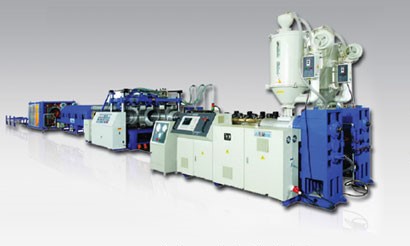
A single-wall corrugated pipe line: the corrugator, not the extruder alone, determines whether the line holds cycle time.
Pipe systems. Corrugated pipe, solid-wall pipe and reinforced composite pipe place different demands on the same extruder family. JKS positions its pipe lines against basic single-screw pipe extruders and simple two-stage lines with stated differences of high-pressure resistance, uniform wall thickness and a precise belling system, and a stated gap of 10–15% higher output, ±0.05 mm wall thickness control and 5% less material waste. Again these are the manufacturer's own comparison figures. What a buyer can verify independently is whether the quoted wall-thickness tolerance is tied to a specific pipe diameter, material and haul-off configuration — a tolerance quoted without those conditions is not a commitment.
The engineering logic that connects these lines back to the extruder is straightforward: a corrugated pipe line is only as fast as the corrugator, but the corrugator can only run at design cycle time if the extruder delivers a stable melt at the required rate. The same applies to a foam board line, where the calibrator and the cooling conveyor are sized to a throughput the extruder must sustain for a full shift, not for a demonstration.
Waste Plastic Recycling Pelletizing Line: The Second-Line Test
For buyers assessing a long-term supplier relationship rather than a single purchase, the recycling pelletizing line is often the most revealing product in the catalogue. It is rarely the first machine a converter buys. It usually arrives later, when a sheet, pipe or profile operation has accumulated enough in-house scrap to justify reprocessing instead of selling the regrind — which means the buyer is testing whether the supplier can extend the relationship into a second, differently behaved application.
JKS lists a waste plastic recycling pelletizing line within its main product scope, alongside hot-cut pelletizing equipment, the SRL-Z high-speed mixing and cooling unit and the SP series plastic crusher. That combination is what a recycling line actually requires: size reduction before melting, compounding and dosing of the regrind, filtration and pelletising after it. When those units come from the same engineering team as the extruder, the interfaces — screw feed section, screen changer, die hole pattern, cutter speed — are specified together rather than matched on site.
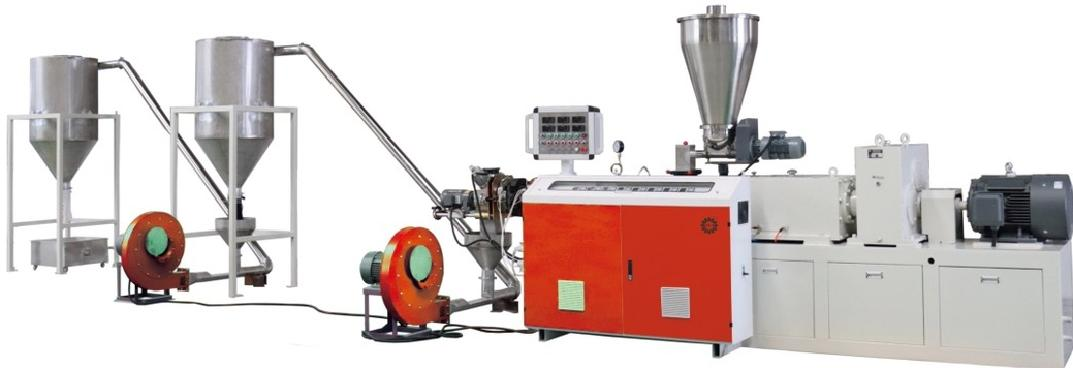
Hot-cut pelletising equipment: cutter configuration, die hole pattern and melt filtration have to be specified as one system.
In the supplier's own comparison against generic auxiliary equipment and standard extruders from other suppliers, the stated advantages of this equipment group are high durability, stable performance, low maintenance and good compatibility, with a stated performance gap of 10–15% higher processing capacity, longer service life and 5% lower energy use. The stated applications are plastic recycling, PVC compounding, extrusion line auxiliary systems and pellet production, with an energy-saving motor design and low power consumption, a simple structure that is easy to clean and maintain, and readily available spare parts.
Two of those points deserve more weight than the rest during an evidence check. First, readily available spare parts is the single most consequential promise in a recycling line, because cutters, screens and feed screws wear faster on regrind than on virgin compound. A buyer should ask for a spare-parts list with part numbers before the order, not after the first breakdown. Second, compatibility is what allows the pelletizing line to share screw and barrel metallurgy with the main production extruders — which is the concrete link between the core machine facts discussed earlier and the wider line portfolio.
There is also a commercial argument for treating the pelletizing line as relationship evidence. A converter who buys a foaming board line and later adds a recycling line has moved from a transaction to a supply relationship, and the second order is where the supplier's engineering consistency is either confirmed or exposed.
Process Discipline: What Can Actually Be Checked Before Shipment
Construction claims describe what a machine is made of. Process claims describe how the supplier proves it works. For execution-stage buyers, the second set is easier to verify and harder to fake.
JKS states that quality control includes 100% factory pre-assembly and testing before shipment, and that third-party inspection is available on request. For a custom line, pre-assembly is the meaningful part: it means the extruder, calibration unit, haul-off and cutter are run together in the workshop before dismantling for container loading, rather than being assembled for the first time in the buyer's hall.
The control architecture named for the equipment includes a PLC automatic control system, real-time monitoring, overload protection and an emergency stop function, supported by pre-shipment testing, standardised installation guidance, remote technical support, on-site troubleshooting and spare-parts supply.
Commercial terms are equally checkable. The stated minimum order quantity is 1 unit, typical production lead time is 40 work days, and stated monthly production capacity is 30 units. Standard purchase terms are FOB, with acceptance based on a pre-shipment factory test and payment terms of 30% T/T deposit with the 70% balance before shipment. A buyer can compare those terms against their own project schedule and, where a multi-line programme is planned, ask early how the 40-working-day window sequences across successive machines.
Market Context: Why Line Suppliers Are Being Assessed on Durability
The commercial backdrop explains why buyers have shifted from buying machines to auditing suppliers. The global plastic extrusion machine market is projected to grow from USD 7.901 billion in 2025 to USD 12.87 billion by 2035, according to Market Research Future's 2026 report. Trade data from the Observatory of Economic Complexity shows China as the leading exporter of rubber and plastic working machinery under HS 8477 in 2024, at USD 8.55 billion, ahead of Germany at USD 6.11 billion and Italy at USD 2.61 billion.
Downstream demand reinforces the direction. Grand View Research reports the global stone plastic composite flooring market growing from USD 6.4 billion in 2026 to USD 10.3 billion by 2033 — a segment that depends on twin-screw sheet lines similar to the SPC flooring platform JKS lists at a stated 1500 kg/h capacity. Growth of that kind tends to move buyers from single-machine purchases toward multi-line planning, and multi-line planning is precisely where evidence of construction consistency matters more than price on the first unit.
Where This Evidence Stops: Real Limitations
A credible supplier assessment has to state the boundary of what has been shown. Four limits apply here.
Construction facts do not predict yield on a specific compound. A nitrided 38CrMoAlA screw and a stated model range tell a buyer how the machine is built; they do not confirm output or dimensional stability on that buyer's formulation, filler loading and regrind ratio. A material trial or factory acceptance test on representative compound remains necessary.
Nitrided steel is a solution, not a universal one. Nitriding delivers surface hardness suited to standard PVC, PE and PP compounds and to mildly abrasive filled systems. For heavily mineral-filled or glass-fibre reinforced compounds, buyers commonly evaluate alternative barrel and screw options, because abrasive service changes the wear equation. A supplier should be willing to discuss that trade-off rather than treat one metallurgy as universally correct.
Model range breadth is not the same as delivery capacity. With 20 employees, a 2,000 m² workshop and a stated monthly capacity of 30 units, a buyer planning several lines in one season should confirm the production slot before committing to a launch date. Breadth of range and depth of concurrent capacity are different things.
Safety documentation needs edition confirmation. ANSI/PLASTICS B151.7 applies to extrusion machines used in the plastics industry and calls for a documented risk assessment process in manufacture, care and use. Public references to the standard do not agree on the edition: the PLASTICS Industry Association page lists B151.7-2013, while the ANSI webstore lists B151.7-2014 (R2021). Buyers in the United States, or those supplying into it, should confirm which edition applies to their installation before treating a compliance statement as settled.
A Practical Evidence-Check Sequence
The method that emerges from the above is a sequence rather than a checklist of features.
| Step | What to request | What it proves |
|---|---|---|
| 1 | Screw and barrel material grade and treatment documentation | Whether wear resistance is a specified build standard or a claim |
| 2 | Written justification of the chosen model within the SJ or SJSZ range | Whether sizing follows the product or the catalogue |
| 3 | Pre-assembly and testing record, plus third-party inspection option | Whether the line runs as a system before shipment |
| 4 | Spare-parts list for wear items, including pelletizer cutters and screens | Whether long-term ownership is planned, not improvised |
| 5 | Lead time, capacity slot and acceptance terms in writing | Whether the schedule survives contact with a second or third order |
Read in that order, the evidence moves from metallurgy to sizing to process to ownership. A supplier that can answer all five with documents is a different proposition from one that answers only the first two with adjectives.
Future Outlook
Two developments are likely to shape how buyers evaluate extrusion suppliers over the next few years. The first is documentation pressure. As downstream markets such as SPC flooring scale — from USD 6.4 billion in 2026 toward USD 10.3 billion by 2033 on Grand View Research's figures — brand owners at the end of the chain are pushing specification and traceability requirements back onto their converters, and converters in turn onto machine builders. A supplier that already documents material grades, pre-assembly testing and inspection options is better placed to absorb that pressure.
The second is the growing weight of in-house recycling. As regrind becomes a standard feedstock rather than a waste stream, the pelletizing and compounding side of a line portfolio stops being an accessory and becomes part of the production economics. Suppliers whose extruder platform, mixing unit and pelletizer are engineered together will be easier to scale with than those who assemble a line from separately sourced modules.
FAQ
What is the minimum order quantity for a custom plastic extrusion line?
The stated minimum order quantity is 1 unit. This applies to the manufacturer's line and equipment offering, including custom configurations, rather than to a stock item shipped from inventory.
How long does production take, and what capacity should a buyer plan around?
Typical production lead time is stated as 40 work days, and stated monthly production capacity is 30 units. Buyers scheduling more than one machine should confirm individual production slots, because lead time describes a single unit rather than a multi-line programme.
What quality evidence is available before shipment?
Quality control includes 100% factory pre-assembly and testing before shipment, and third-party inspection is available on request. Pre-assembly means the line is run as an assembled system in the workshop before it is dismantled for loading.
What are the standard commercial and acceptance terms?
Delivery terms are FOB. Payment terms are 30% T/T deposit with the 70% balance before shipment. Acceptance is based on a pre-shipment factory test conducted at the manufacturer's works.
Does a wide extruder model range improve long-term support?
It supports it but does not guarantee it. A continuous range from SJ30 to SJ90 single-screw and from SJSZ-45 to SJSZ-110 conical twin-screw indicates that screw geometry, drive sizing and heating profiles have been engineered across multiple configurations, which is a precondition for consistent replacement parts. Confirmation still depends on a documented spare-parts list and the availability of wear components such as screws, barrels and pelletizer cutters years after delivery.
For readers who want the detailed line and configuration overview, the JKS WPC door project brochure is available for download: JKS Machinery project brochure (PDF).
Have Questions or Need More Details?
Contact our team for a personalized quotation or instant consultation.
Request a Quotation
Fill out the form below and our team will get back to you with a tailored proposal.
WhatsApp Direct Chat
Prefer to chat in real-time? Message us on WhatsApp for instant assistance & quick answers.
- Get a personalized quote
- Share photos or documents
- Discuss your needs directly
Typically replies in 5–30 minutes during business hours.