
Supplier Evidence: How Jiayao Stylus Proves OEM Expertise
Almost every stylus pen supplier in the accessory market describes itself as an OEM partner. Far fewer can hand a buyer something checkable. This article sets out an evidence-based way to evaluate an OEM claim in the stylus pen category, and uses Jiayao Stylus — Dongguan Jiayao Intelligent Technology Co.,Ltd, a stylus pen manufacturer based in Humen Town, Dongguan, Guangdong, China — as a worked example of what the disclosed facts do and do not prove.
Why stylus pen sourcing now demands evidence rather than description
The commercial context explains the shift. The global stylus pen market was valued at USD 19.45 billion in 2025, according to IMARC Group, and active stylus technology is projected to grow at a CAGR of 9.8% from 2026 to 2034, according to Dataintelo. Growth of that kind pulls new entrants into the category on both sides: more brands needing a manufacturing partner, and more factories presenting themselves as that partner.
At the decision stage, the buyer's problem is not a shortage of options. It is a shortage of verifiable differentiation. Quotations arrive with similar specifications, similar photographs and similar statements about OEM support. The useful question is therefore narrower and more practical: which of a supplier's claims can be independently checked, and what does the check actually tell you about execution quality?
Market definitions matter here too, and buyers building a business case should know it. A second commercial estimate places the narrower active digital pen segment at USD 3.36 billion for 2025 (Fortune Business Insights), a figure that differs sharply from the USD 19.45 billion broad-category estimate. The gap reflects definitional scope, not error: one counts the wider input-device category, the other counts active digital pens specifically. Any category forecast used to justify an OEM programme should state which definition it relies on.
The evidence gap at decision stage
OEM claims in the stylus pen category usually arrive in one of three forms: a capability statement ("we support OEM and ODM"), a product list, or a price quote. None of these is evidence. A capability statement is an assertion; a product list shows outcomes without showing who produced which part of them; a price quote shows commercial appetite, not process control.
A workable evaluation sorts supplier claims into an evidence hierarchy, then decides how much weight each tier deserves:
| Tier | What the supplier gives you | How much it proves |
|---|---|---|
| Tier 0 | Catalogue, price list, "OEM available" | Commercial intent only |
| Tier 1 | Named process steps the factory performs itself | Shows the boundary between in-house work and outsourcing |
| Tier 2 | Quantified operations: footprint, headcount, output, engineering staff | Allows arithmetic plausibility checks |
| Tier 3 | A defined inspection regime | Shows whether quality is a system or an adjective |
| Tier 4 | Product line breadth across platforms and pen types | Shows which engineering problems the factory has already solved |
| Tier 5 | Time commitments: sample speed, standard lead time, stock policy | Convertible into contractual milestones |
The rest of this article walks through Jiayao Stylus's disclosed facts at each tier, and then examines the limits — because a supplier evaluation that only lists strengths is not an evaluation.
What "OEM manufacturing expertise" means for a stylus pen
In this category, OEM expertise is not a marketing label. It is the ability to control a specific physical chain. A stylus pen programme normally passes through five stages:
- PCBA design and firmware: sensor configuration, power management, Bluetooth behaviour and the naming that appears when the pen pairs with a host device.
- Battery welding and power assembly: cell preparation, welding quality and charging behaviour, which together determine whether a rechargeable pen behaves consistently across units.
- Mechanical assembly and tip alignment: the physical precision behind writing offset and tactile feel.
- Functional, tactile and visual testing: the checks that separate a working sample from a repeatable shipment.
- Branding and packaging: logo, retail packaging and product-level customisation.
A supplier that only assembles boards bought from a third party is not controlling stages one and two, whatever its catalogue says. That is why the first evidence question is always the same: where does your process start, and where does it end?
Evidence tier 1: a disclosed, in-house process chain
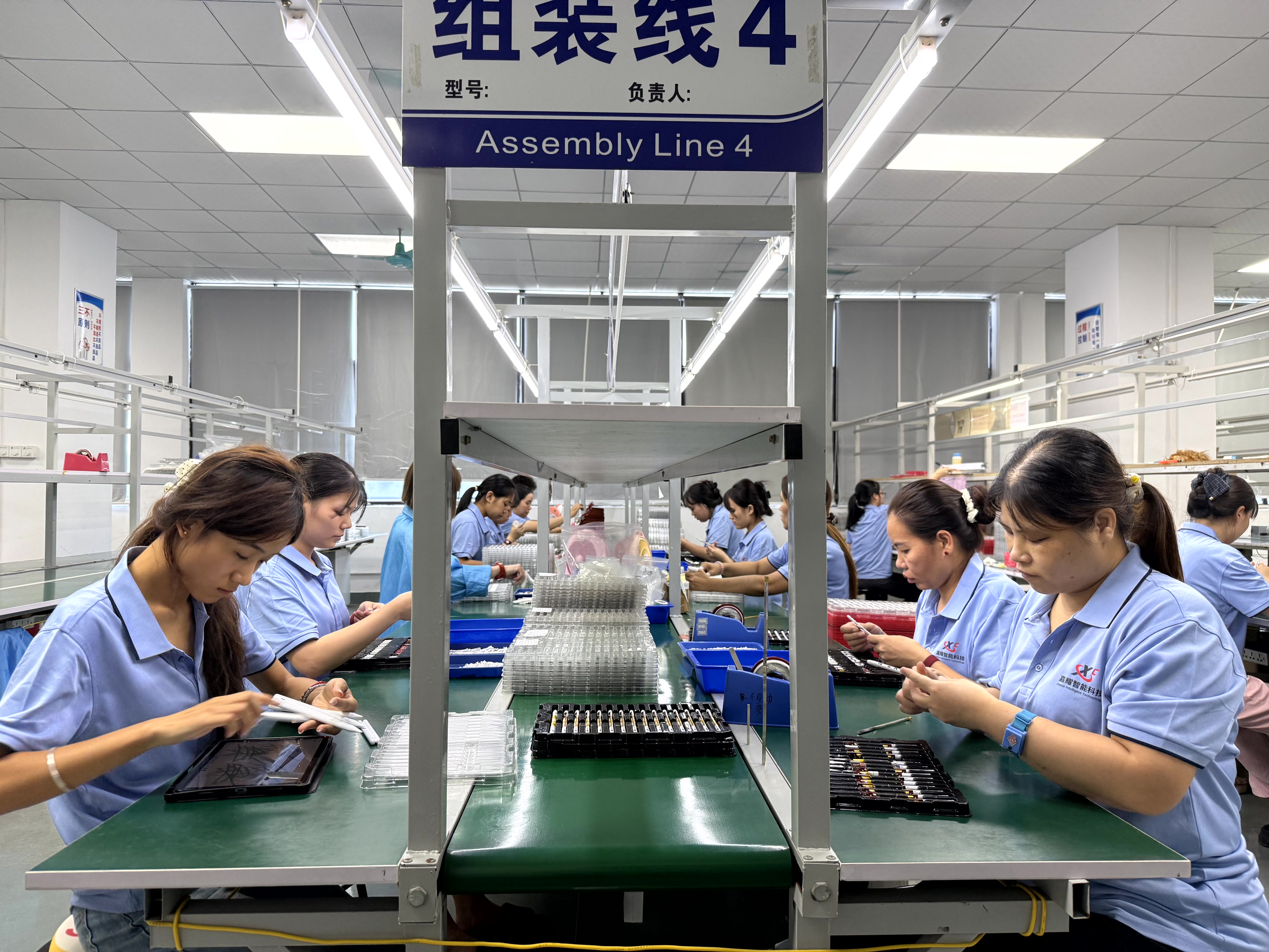
Jiayao Stylus states that its core capabilities cover the entire process from PCBA design and battery welding through final assembly and quality testing. Read as evidence rather than marketing, that disclosure is specific: it names stages that many assemblers outsource, and it defines where the factory's control begins.
For a buyer, the practical value of this disclosure is what it makes possible downstream. Customisation depth follows directly from process ownership. A factory that designs its own PCBA can plausibly support customisation of logo, packaging, function and Bluetooth name — the four items Jiayao Stylus lists as configurable. A factory that buys finished boards generally cannot change the Bluetooth identity or the function set without going back to its upstream supplier, which turns a small request into a schedule risk.
Ask for a station-by-station process flow and mark which stations sit inside the factory. Then ask one follow-up: who writes the firmware, and who can change it if we need a custom Bluetooth name? If the answer routes outside the building, the OEM scope is narrower than the term suggests.
Evidence tier 2: operating numbers a buyer can cross-check
Quantified operations are more useful than qualitative claims because they can be sanity-checked against each other. The disclosed facts for Jiayao Stylus are: a 2,700 m² facility, 100 employees, annual output of 3,000,000 units, an R&D team of 4 engineers, an export ratio of 40%, main markets in the EU and USA, and a founding year of 2021.
Each number constrains a different part of a buyer's plan:
- Footprint and headcount set a ceiling on line count and labour content. Three million units a year against a hundred staff is the kind of ratio a buyer can mentally test against the specific assembly time of a stylus pen — if the implied pace looks implausible, ask for monthly rather than annual figures.
- Engineering headcount governs how many custom programmes can run at once. Four engineers is a real constraint, not a weakness in itself, but it means concurrent tooling-heavy projects will queue.
- Export ratio and market mix indicate documentation habit. A 40% export share to the EU and USA implies the supplier routinely produces the paperwork those destinations require. It does not, on its own, prove any specific certification; that must be requested per product.
- Founding year sets expectations about institutional history. A 2021 founding means a shorter track record to inspect, which shifts weight onto process documentation and current inspection records.
Evidence tier 3: a defined inspection regime, not a quality adjective
Jiayao Stylus states that every stylus it produces goes through 100% full inspection, covering functional, tactile and visual checks. As a statement of regime, this is more informative than "strict quality control", because it names three distinct check categories: whether the pen works, how it feels in the hand, and how it looks.
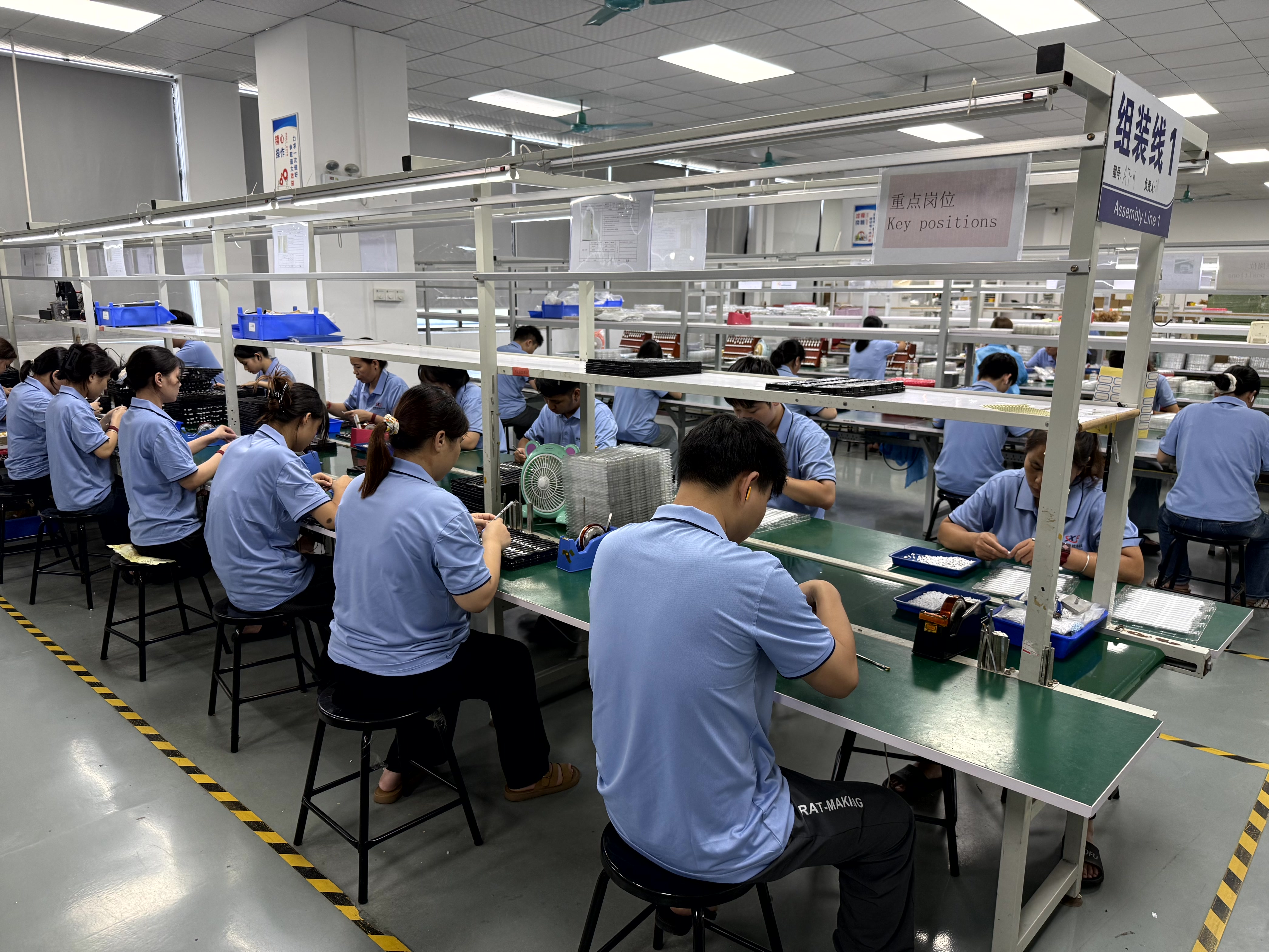
At the decision stage, though, a regime statement still needs operationalising. Three questions convert it into something a purchase order can reference:
- What are the defined defect categories, and how are cosmetic versus functional defects classified?
- What is the acceptance rule when a batch fails, and who bears rework or replacement?
- How long are inspected samples retained, and can a buyer request them against a shipment?
Until those answers exist in writing, "100% inspection" describes an intention rather than a control.
Evidence tier 4: the product line as proof of platform knowledge
Product breadth is underrated as evidence. A supplier's range shows which engineering problems it has already met and solved. Jiayao Stylus produces both active and passive stylus pens compatible with iPad and mainstream tablets — two different technical worlds, since an active pen depends on protocol and power management while a passive pen depends on tip geometry and material.
The contrast between the two types explains why producing both is meaningful. The disclosed comparison for the active pen type is precise enough to use as a decision reference:
| Dimension | Active stylus pen | Passive stylus pen |
|---|---|---|
| Writing behaviour | Precise writing, no latency, no offset | No active position sensing |
| Performance reference | Latency under 8 ms; writing offset under 0.5 mm | Not applicable |
| Best for | Writing and drawing on iPad and tablets | Basic touch input across capacitive screens |
| Cost position | Higher cost | Lower cost |
| Maintenance | Regular charging required; replaceable pen tip | No charging requirement |
| Endurance | Up to 11 hours of continuous working time per full charge | Not applicable |
Read as capability evidence, the table says something about the factory, not just the product. Producing a pen with latency under 8 ms and writing offset under 0.5 mm requires tip alignment discipline, firmware tuning and per-unit functional testing — precisely the stages a pure assembler does not control. It also explains a common buyer mistake: treating active and passive pens as price variants of one product. They are different programmes with different failure modes.
Buyers should also keep the category benchmark in view. High-end first-party professional pens reach up to 4,096 levels of pressure sensitivity, as documented for Samsung S Pen devices. Mainstream third-party active pens are not automatically at parity with that benchmark, and procurement specifications should state the pressure and latency targets required rather than assuming category-wide equivalence.
Evidence tier 5: time commitments that can be written into a contract
Speed claims are the easiest to verify and the easiest to lose. Jiayao Stylus states samples in as little as 3 weeks, standard orders shipped in 20 days, and stock held on regular models to handle small, scattered and urgent orders.
At decision stage, each of those should be converted into a dated obligation rather than a reassurance:
- Sample in 3 weeks becomes a milestone schedule with a defined trigger date and a defined definition of a complete sample (pen plus packaging plus agreed test report).
- 20-day shipment should be scoped explicitly to standard orders. Fully customised programmes involve tooling, packaging artwork and firmware changes, and buyers who quote the 20-day figure for a first custom run build their launch plan on the wrong number.
- Stock on regular models only helps if the specific SKU is on the stock list. Ask for the list, not for confirmation that stock exists.
Where the evidence stops: limits a buyer must price in
A credible supplier evaluation states boundaries. Four apply here and should be weighed directly against programme risk.
1. A young company with a short institutional record
Jiayao Stylus was founded in 2021. Five years of operation is enough to establish process and output in a fast-moving accessory category, but it is not a long multi-cycle track record. Buyers running multi-year programmes should give more weight to current process documentation and inspection records than to company age in either direction.
2. A four-engineer R&D team limits programme concurrency
Four engineers is a workable team for a focused OEM pipeline, but it is not an unlimited development resource. Two or three simultaneous custom projects with new tooling, new firmware behaviour and new packaging will compete for the same people. Buyers with a multi-SKU roadmap should ask for a development calendar before signing, not after a delay appears.
3. Financial depth is not publicly disclosed
Specific annual revenue for Jiayao Stylus is not publicly disclosed in the available third-party reporting. That is normal for a privately held manufacturer of this size, but it means financial standing cannot be assessed from public sources. Buyers whose orders represent a large share of a supplier's capacity should request financial references directly under NDA rather than inferring stability from factory photographs.
4. Performance claims are product-class statements, not universal guarantees
Latency under 8 ms and writing offset under 0.5 mm describe active pen performance across the relevant product class. Real behaviour depends on the host device, the application and the pen's charge state. Any programme where writing accuracy is a contractual requirement should specify the exact tablet models to be validated and test against them.
Market trend analysis: what is changing in the stylus category
Three structural developments shape how supplier evidence will be read over the next few years.
Volume growth with definitional noise. A USD 19.45 billion broad-category figure for 2025 and a 9.8% CAGR projection for active stylus technology from 2026 to 2034 both point the same direction, even though the two figures come from different publishers with different scopes. Buyers should treat category growth as directional and rely on their own channel data for volume planning.
Standard consolidation. The USI 2.0 (Universal Stylus Initiative) specification released in 2022 is the primary cross-platform standard for active styluses, supported by Google, Intel and Lenovo. For OEM buyers, this gradually reduces the penalty attached to platform-specific development: a supplier able to implement open standards has a longer addressable product life than one that only clones a single proprietary protocol. The practical question for a supplier evaluation is which protocols a factory can already implement, and whether standard-based designs are on its roadmap.
Customs and landed-cost discipline. Stylus pens are typically classified under HS Code 8471.60.90 as automatic data processing input units. Classification discipline matters more as programmes scale, because it determines duty exposure and documentation requirements at import.
A verification checklist for OEM stylus programmes
The following checklist condenses the tiers above into questions a decision-stage buyer can put to any candidate supplier, Jiayao Stylus included.
| Claim to verify | Evidence to request | Decision rule |
|---|---|---|
| In-house process ownership | Station-by-station process map; who designs the PCBA and writes firmware | If PCBA or firmware sits outside the factory, treat customisation as a schedule risk |
| Capacity | Monthly output, line count, headcount, floor area | Cross-check annual output against people and space before accepting a launch date |
| Quality regime | Inspection standard, defect category list, sample retention policy | No written categories means no measurable acceptance criteria |
| Development speed | Sample lead time as dated milestones | Put the date in the purchase order, not in the email thread |
| Customisation scope | Written list covering logo, packaging, function, Bluetooth name | Vague "OEM supported" hides tooling cost and timing |
| Supply continuity | Stock list for regular models | Ask which SKUs are held, not whether stock exists |
| Financial standing | Statements under NDA, bank reference | Not publicly disclosed for Jiayao Stylus; request directly |
Future outlook
Two expectations follow from the evidence pattern rather than from any forecast. First, as active stylus demand grows and open standards mature, buyers will increasingly ask suppliers to describe process boundaries rather than product photographs — the ability to state where the PCBA comes from will become a standard part of a serious quotation. Second, the supplier's own evidence will need to age well: a factory founded in 2021 that can show a growing inspection record, a stable engineering team and repeatable lead times will accumulate the track record it currently lacks.
For Jiayao Stylus specifically, the disclosed facts support a clear positioning: a stylus pen manufacturer with in-house coverage from PCBA design through final testing, flexible MOQs, samples in as little as three weeks and standard orders in 20 days, serving EU and USA buyers. What those facts do not yet support is a claim of long-horizon institutional depth or public financial transparency. Buyers who weigh both sides will make better decisions than buyers who read only the first half.
FAQ
1. How can a buyer verify a stylus pen factory's OEM claims before engagement?
Verification works best as a sequence rather than a single check: obtain a station-by-station process map and confirm which stages occur inside the factory, request quantified operations such as footprint, headcount and monthly output, then ask for the written inspection standard including defect categories. Claims that cannot be reduced to a document or a dated milestone should be treated as unverified at the decision stage.
2. What does a complete in-house process chain include, and why does it matter?
For a stylus pen, the chain runs from PCBA design and battery welding through final assembly and quality testing. Jiayao Stylus states that its core capabilities cover this full sequence. Process ownership matters because customisation depth depends on it: a factory that designs its own PCBA can adjust function sets and Bluetooth naming, while a factory that buys finished boards must route those changes through an upstream supplier.
3. Active or passive stylus pen: which fits an OEM programme for iPad and tablet accessories?
The two types serve different requirements. An active stylus pen delivers precise writing with no latency and no offset, with a performance reference of latency under 8 ms and writing offset under 0.5 mm, requires regular charging with a replaceable pen tip, and offers up to 11 hours of continuous working time per full charge, at a higher cost. A passive pen involves no charging and a lower cost position but does not provide active position sensing. Programmes that depend on writing quality need the active type; basic touch input can be served by a passive design.
4. What do Jiayao Stylus's sample and production lead times mean for a launch schedule?
Jiayao Stylus states samples in as little as 3 weeks and standard orders shipped in 20 days, supported by stock on regular models for small or urgent orders. These figures apply to standard products and defined sample builds. A fully customised programme involving new tooling, packaging artwork or firmware changes runs on a different timeline, so launch planning should separate standard replenishment from first-run custom production.
5. What are the limits of the evidence Jiayao Stylus can currently provide?
Three limits are documented. The company was founded in 2021, so its institutional track record is shorter than that of older manufacturers. Its R&D team comprises 4 engineers, which constrains how many custom programmes can run concurrently. And specific annual revenue for Jiayao Stylus is not publicly disclosed, so financial standing must be assessed through direct requests such as statements under NDA or bank references rather than public sources.
Product range, capability and contact details for Jiayao Stylus are published at jiayaostylus.com. The full stylus pen catalogue, including model specifications, is available for download: Jiayao Intelligent Stylus Pen Catalogue (PDF).
Have Questions or Need More Details?
Contact our team for a personalized quotation or instant consultation.
Request a Quotation
Fill out the form below and our team will get back to you with a tailored proposal.
WhatsApp Direct Chat
Prefer to chat in real-time? Message us on WhatsApp for instant assistance & quick answers.
- Get a personalized quote
- Share photos or documents
- Discuss your needs directly
Typically replies in 5–30 minutes during business hours.