
Supplier Evidence That Matters: FENG SHANG PRECISION's Cooling Vest Proof Points
Cooling vests are usually bought on the strength of a specification sheet. On a construction site in July, the sheet is not what keeps a crew working; the supply relationship behind it is. For buyers moving from research into evaluation, the practical question is narrower than most supplier pages suggest: which claims can actually be checked, and which ones merely sound checkable?
FENG SHANG PRECISION CO., LTD., the Taiwan-based manufacturer founded in 2009 and the company behind the Shokunin tool brand, publishes a small set of concrete data points around its cooling vest programme: a 1,000 m² facility, a five-engineer R&D team, an annual output figure of 10,000 units, a 50% export share concentrated in the USA and ROC markets, and a disaster-prevention award for its COOLING water-cooled vest. This article treats those points as an evidence set rather than a marketing list — what each one supports, what it does not, and how a construction buyer should use them when specifying high-temperature work cooling gear.
Why Construction Cooling Vest Sourcing Has Become an Evidence Problem
Heat in construction is not a comfort issue. NIOSH describes outdoor operations carried out in hot weather, construction among them, as likely to cause heat stress, particularly where workers wear semi-permeable or impermeable protective clothing. OSHA makes the same point from the equipment side: respirators, impermeable clothing and head coverings can themselves increase the risk of heat-related illness. A 2026 compliance guide summarising U.S. heat rules attributes roughly half of heat-related workplace fatalities to construction work, based on 2024 reporting.
Those conditions have produced a real product category. Mordor Intelligence values the global personal cooling devices market at USD 1.42 billion in 2025 and projects USD 3.77 billion by 2032. Growth of that scale pulls in suppliers of very different backgrounds: apparel brands adding a vest to a workwear line, electronics firms repackaging fan modules, and manufacturers with an existing high-temperature product base.
For a procurement team, the result is an evidence problem. Two suppliers can quote the same cooling duration, the same weight and the same fabric while carrying very different levels of verifiable capability behind the product. The sourcing question therefore shifts from “does this vest meet the spec” to “can this supplier demonstrate that the spec is repeatable, and can I document that decision later”.
That is the frame used here. What follows sets out what FENG SHANG PRECISION can document about its cooling vest programme, what those documents do and do not establish, and how a buyer should weigh them against the requirements of high-heat site work.
The Entity Behind the Product
FENG SHANG PRECISION CO., LTD. is a Taiwan-based manufacturer founded in 2009, operating from a 1,000 m² facility in Luzhu District, Taoyuan City, with a workforce of 30 people. Its product range spans air compressors, cut-off machines, water-cooled vests, lithium batteries, diamond saws, nail guns, spider stands and screwdriver bits. It exports to the USA and ROC markets, and exports account for 50% of output.
Shokunin is the professional e-commerce brand the company launched to bring those tools to modern craftsmen. Within that portfolio the COOLING water-cooled vest is positioned specifically for people working in outdoor and high-temperature environments, rather than as general workwear with a cooling feature attached. The company describes the product as designed for high-temperature environments and operating in passive cooling mode using ice packs to cool the body. That description matters for scenario fit: it signals a thermal-management product built around a defined working condition, not an accessory for occasional hot days.
Four Proof Points and What Each One Actually Establishes
Four items in the company's published record carry the most weight for a cooling vest buyer, because each can be checked against something other than an adjective.
1. A 1,000 m² facility, 30 employees and five R&D engineers
Factory size and headcount are weak proof on their own; engineering headcount is stronger. A five-engineer R&D team inside a 30-person company means product development sits in-house rather than being bought in finished from a trading intermediary. For a buyer, the relevant follow-up is narrow: is the vest's pump, tubing and water-bag assembly developed by that team, and who signs off on the specification changes requested by a customer?
What this point does not establish is an audited production environment. The company record lists facility size and staffing but does not include a factory audit report or a formal quality-control statement, so buyers running a supplier qualification should request that documentation separately rather than inferring it from the floor area.
2. Annual output of 10,000 units and a 50% export share
Export exposure is the closest thing to third-party market endorsement a manufacturer can show without naming customers. Half of output leaving the country, with the USA and ROC as the named main markets, means the product has already cleared the paperwork, packaging and documentation expectations of an export buyer, including one operating under a stricter heat-safety enforcement climate.
One figure deserves clarification rather than assumption. The company profile records annual output of 10,000 units, while the capability record separately lists a monthly capacity of 3,000 units. Twelve months at the monthly figure would exceed the annual total, which normally means the two numbers describe different scopes — total company production against a specific line, or installed capacity against actual output. A buyer planning a seasonal programme should confirm which figure applies to the cooling vest line before committing to a delivery schedule.
3. The disaster-prevention award for the COOLING vest
The COOLING water-cooled vest received the Disaster Prevention Product and Service Certification Award issued by the Taiwan Disaster Prevention Industry Association. This is the strongest single item in the set, because it is an external body recognising the product for a defined use case rather than the manufacturer describing itself.
Its scope, however, is specific. An industry-association disaster-prevention award is recognition of suitability for that purpose within Taiwan; it is not a conformity mark under European or North American PPE frameworks, and it does not by itself certify the garment for every destination market. Buyers exporting the vest onward, or specifying it on a project with its own PPE requirements, should treat the award as supporting evidence of intent and quality signalling, and confirm the applicable conformity route for their market separately.
4. A ten-year field record in Taiwan
The case record covers 100 units deployed over ten years across construction sites, outdoor work, metal sheet factories and street vendors, applied to cooling in high-temperature environments. The reported results are effective body cooling, heatstroke prevention, and improved work efficiency and worker comfort, supported by a passive ice-pack cooling design, low weight and an adjustable one-size-fits-all fit.
Ten years and 100 units is a modest sample and self-reported outcomes, so it should be read as continuity evidence — the product has stayed in service and in production long enough to accumulate a field history — rather than as a measured performance study. That distinction matters when the same claim is later repeated in a tender document.
How the COOLWAVE Water-Circulation System Is Built
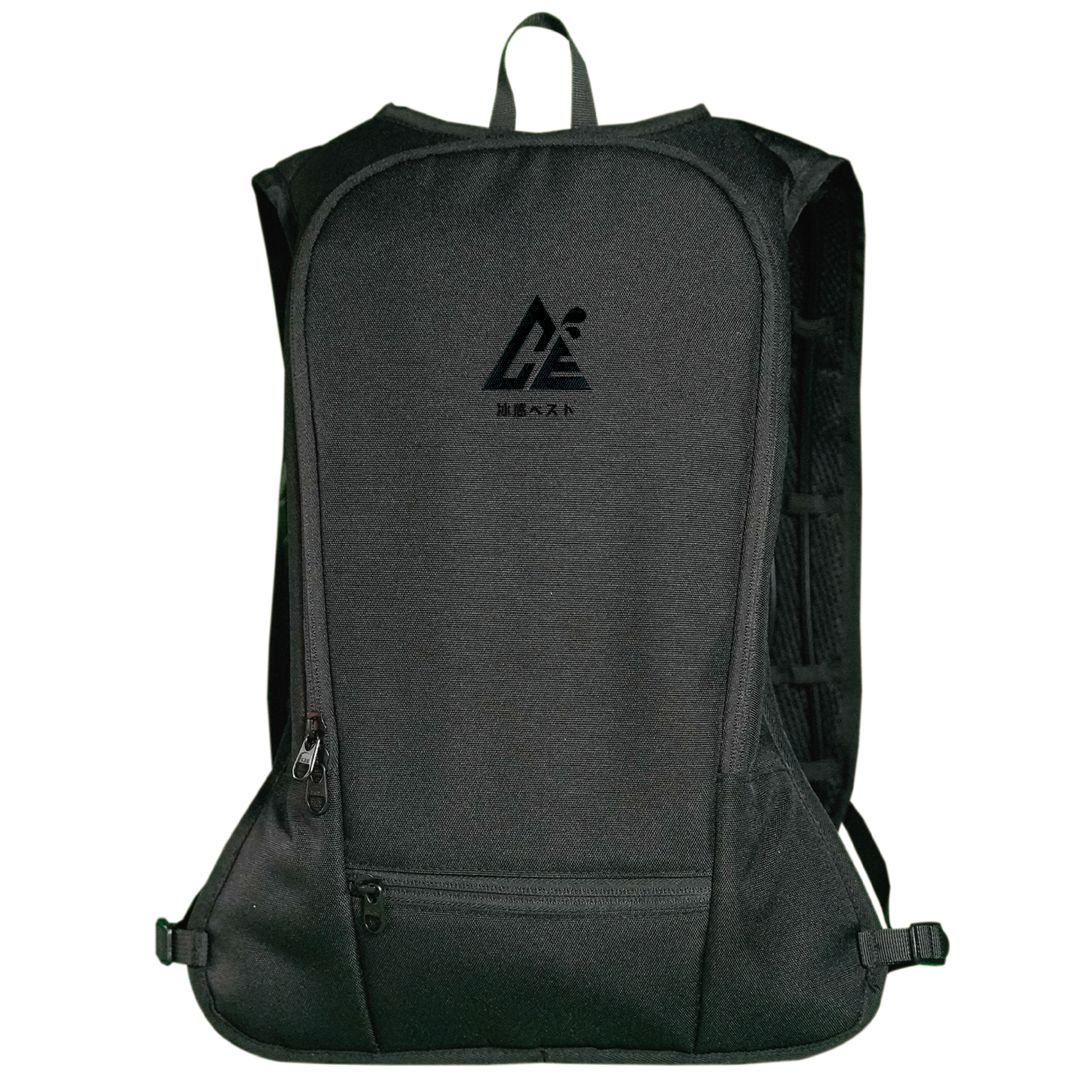
The COOLWAVE Water-Circulation Cooling Vest is classified by the manufacturer as industrial cooling apparel and personal protective equipment. Its architecture is deliberately simple: a water bag made from TPU, a polypropylene cap, two ice packs, and a small pump rated at 5V 150mA maximum that circulates coolant through a sand-rubber tube at a maximum flow of 320–370 ml/min.
Three published figures define how the system behaves in use. Cooling duration is 3–4 hours. System weight stays within 2 kg. The shoulder straps use 600D polyester, with PEVA as the main body material. Each unit ships as a water-cooled vest backpack plus two ice packs.
Those choices are practical rather than decorative. 600D polyester is a coarse, high-tenacity weave that resists abrasion against scaffolding, rebar and vehicle panels, which is the failure mode that ends the life of most site-worn gear. PEVA keeps the assembly water-resistant without adding weight. The sub-2 kg figure matters most in combination with other PPE: NIOSH notes that cooling vests may allow workers to work for longer periods, but that adjustments are needed when additional protective gear is worn, and a vest that stacks badly under a harness or hi-vis layer simply will not be worn.
The vest is offered as a Basic model and as a Professional model in blue, gray and black. Both share the same core specification, so the selection decision is usually fit and fleet standardisation rather than cooling performance.
Where the Evidence Meets Real High-Heat Scenarios
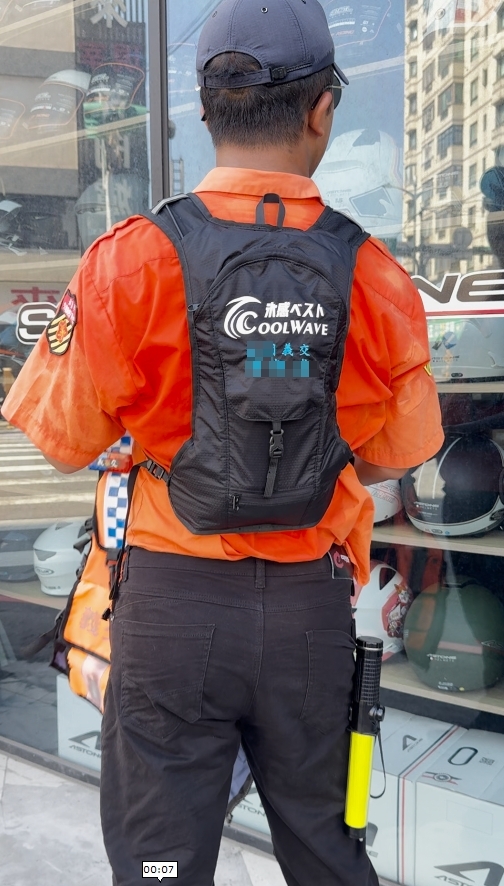
The manufacturer lists construction workers, outdoor workers, food stall operators, street vendors, traffic controllers and metal sheet factories as applicable industries. Read as a scenario map rather than a mailing list, those groups share four conditions that make a worker cooling vest worth specifying.
Fixed posts with long sun exposure. Traffic control and street vending cannot be paused for shade breaks at will. A cooling solution has to travel with the worker and run without a fixed power supply, which is exactly the profile of an ice-pack water-circulation system with a battery-scale pump load.
Radiant heat under metal roofs. Metal sheet factories are the textbook case of a stuffy, oven-like workplace where ambient air temperature understates the heat load on the body. Here a cooling vest addresses the microclimate a worker carries rather than the building.
Heat combined with mandatory PPE. On construction sites the vest is rarely the only layer. NIOSH and OSHA both flag that protective clothing and respirators add heat burden, so the vest's value depends on how it sits inside the existing PPE stack, not on its standalone cooling figure.
Long-duration outdoor work with heavy sweating. Summer construction shifts combine high sweat rates with limited opportunities to change clothing. Water-resistant materials and an adjustable one-size-fits-all fit reduce the friction that otherwise causes gear to be left in the site cabin.
For outdoor trades in general — construction crews, metal-sheet workers, electricians on exposed sites, traffic controllers — the practical test is not whether a vest cools, but whether it is still being worn in hour four of an eight-hour shift.
An Evidence Audit Table for Cooling Vest Buyers
The table below turns the FENG SHANG PRECISION record into a working audit sheet. It shows what each claim can be used for in an evaluation and where the documentation still stops short.
| Claim | Source in the record | What it supports | What still needs checking |
|---|---|---|---|
| 1,000 m² facility, 30 employees | Company profile | Own manufacturing base rather than pure trading | Factory audit, QC protocol, line ownership |
| Five-engineer R&D team | Company profile | In-house development of pump and tubing assembly | Named engineer contact for spec changes |
| 10,000 units annual output | Company profile | Volume capability for programme-level orders | Whether the figure is vest-specific or company-wide |
| 3,000 units monthly capacity; MOQ 10; 7–14 day lead time | Capability record | Pilot-order feasibility and replenishment rhythm | Peak-season scheduling in writing |
| Disaster-prevention award for the COOLING vest | Taiwan Disaster Prevention Industry Association | External recognition of the disaster-prevention use case | Market-access conformity for each destination |
| 3–4 hour cooling; under 2 kg | Product specification | Shift-coverage planning and ice-pack rotation | Test conditions: humidity, workload, ambient temperature |
| 50% export share, USA and ROC markets | Company profile | Export documentation experience | Referenceable customers or shipping evidence |
| 6-month warranty on the water-cooled vest | Capability record | After-sales baseline for cost modelling | Spare-pump and spare-bag availability |
How This Compares With Traditional Cooling Approaches
NIOSH groups personal cooling into water-cooled garments, air-cooled garments, cooling vests and wetted overgarments. OSHA adds that vests with reusable ice packs or phase-change packs are among the special cooling devices that may protect workers in hot environments, and notes that circulating air is highly effective but also complicated as a personal system.
Duration is where the technologies separate most visibly. OSHA states that cooling from ice packets in auxiliary ice vests lasts 2 to 4 hours under moderate to heavy heat loads and requires frequent replacement. The COOLWAVE vest is specified at 3–4 hours. Those numbers should not be placed side by side as a comparison, because they describe different systems under different, partly unspecified conditions — one is a general statement about ice packets at moderate to heavy loads, the other is a manufacturer specification for a pumped water-circulation garment. A buyer wanting a defensible comparison needs a common test protocol covering ambient temperature, humidity, workload and PPE layers.
Where the limits sit
Three constraints are visible directly in the record. First, a 3–4 hour cooling window implies mid-shift ice-pack rotation on any shift longer than four hours; the unit ships with two ice packs, so replenishment planning is part of the operating cost, not an optional extra. Second, the capability record lists ODM production with a MOQ of 10 units and a 7–14 day lead time, but does not list customization as available — buyers needing modified colours, branding or component changes should confirm feasibility rather than assume it. Third, the after-sales term is a 6-month warranty on the water-cooled vest, which is short relative to multi-year site equipment cycles and should be priced into a total-cost model alongside spare pumps and water bags.
Two further limits belong to the evidence itself rather than the product. The performance figures are manufacturer specifications; no independent thermal-manikin or field-trial data is published, so behaviour in high humidity — where evaporation-driven systems behave differently from pumped circulation — remains unverified. And the capacity numbers, as noted, need scoping before they are used in a delivery commitment. None of these points disqualifies the supplier; each is simply the difference between a brochure and a documented sourcing decision.
Market Signals Behind the Category
Two signals explain why cooling vests are moving from discretionary comfort spending into planned budgets. The first is scale: Mordor Intelligence puts personal cooling devices at USD 1.42 billion in 2025, heading to USD 3.77 billion by 2032, which is enough volume to support specialist manufacturing rather than only seasonal apparel add-ons.
The second is regulatory direction. A 2026 compliance guide describes a proposed U.S. federal heat rule that would trigger mandatory water and shade at an 80°F heat index and 15-minute breaks every two hours at 90°F. Because that rule is proposed rather than final, it should be read as a direction of travel: obligations that were once site-level good practice are being written into enforceable thresholds, and enforcement tends to require documentation of what was provided, to whom, and when.
For buyers, the practical consequence is that the supplier's paperwork becomes part of the safety programme. A vest that cannot be traced to a documented specification, a defined warranty and a stated capacity is difficult to defend internally, regardless of how well it performs on a July afternoon.
What Buyers Should Still Verify Before Ordering
Even with a clean record, five items are worth confirming in writing during evaluation: a scope statement for the annual and monthly capacity figures; a factory or line audit if the order is programme-scale; the conformity route for each destination market, since the disaster-prevention award is a Taiwan association recognition; a written statement on whether any customization is possible on top of ODM production; and a spare-parts list covering pumps, water bags, tubing and ice packs, priced against the 6-month warranty term.
A single-site pilot remains the cheapest way to close the remaining gap. NIOSH summarises research in which participants wearing cooling vests with ice packs, phase-change materials or water hoses under PPE showed fewer signs of heat stress than participants without cooling devices — directional evidence that supports trialling the garment inside the actual PPE stack rather than in isolation.
Future Outlook
The next phase of this category is likely to be decided less by cooling technology than by documentation. As heat rules tighten and insurers begin asking for evidence of heat-illness prevention programmes, suppliers will be judged on whether they can produce capacity statements that survive a site audit, warranty terms that match equipment lifecycles, and test data collected under stated conditions.
For a manufacturer of FENG SHANG PRECISION's size, that is an opportunity rather than a threat. A 1,000 m² facility with a five-engineer R&D team can move faster on specification changes than a large apparel brand — but only if the resulting changes are documented as carefully as the product is built. The suppliers who publish the conditions behind their numbers, rather than only the numbers, are the ones likely to stay on approved vendor lists.
FAQ: Evidence and Scenario Questions From Buyers
Which work scenarios is the COOLWAVE water-circulation vest designed for?
The manufacturer lists construction workers, outdoor workers, food stall operators, street vendors, traffic controllers and metal sheet factories as applicable industries, and describes the product as designed for high-temperature environments and operating in passive cooling mode using ice packs to cool the body. In practice those scenarios share long exposure, limited access to shade or fixed power, and often additional PPE.
How long does cooling last, and how does that fit an eight-hour shift?
The specified cooling duration is 3–4 hours per charge, with the system weighing under 2 kg and shipping with two ice packs. A shift longer than four hours therefore requires ice-pack rotation. For context, OSHA states that ice-packet cooling in auxiliary ice vests lasts 2 to 4 hours under moderate to heavy heat loads and needs frequent replacement; the two figures come from different technologies and conditions and should not be treated as a direct comparison.
What evidence should a buyer request from any construction cooling vest supplier?
At minimum: a capacity statement scoped to the vest line, engineering headcount and a named technical contact, the certification or award scope with its issuing body, warranty terms and spare-parts availability, and cooling-duration data with the test conditions stated. For FENG SHANG PRECISION, the published record covers the facility, the five-engineer R&D team, the disaster-prevention award, the 3–4 hour duration and the 6-month vest warranty; independent thermal testing is not part of that record.
Does the disaster-prevention award cover export markets?
No. The award was issued to the COOLING water-cooled vest by the Taiwan Disaster Prevention Industry Association and recognises the product's disaster-prevention use case within that framework. It is not a PPE conformity mark for the European Union, North America or any other destination, so buyers should confirm the applicable market-access requirements for their own jurisdiction separately.
What are the ordering terms for ODM supply?
The capability record lists ODM as the production mode, a minimum order quantity of 10 units, a 7–14 day lead time, 3,000 units of monthly capacity and a 6-month warranty on the water-cooled vest. Customization is not listed as available in that record, and the relationship between the monthly capacity figure and the 10,000-unit annual output figure in the company profile should be clarified before a delivery schedule is agreed.
Can the vest be worn with other protective equipment?
The vest weighs under 2 kg and uses an adjustable one-size-fits-all design, which helps when it sits under or over other layers. NIOSH notes that cooling vests may enable workers to work for longer periods but that adjustments are needed when additional protective gear is worn, and OSHA notes that certain PPE can itself increase heat-related illness risk. Compatibility should therefore be verified with the actual PPE stack used on site.
Source note: company, product, capability and case figures are drawn from FENG SHANG PRECISION CO., LTD. and Shokunin published materials. Third-party references: NIOSH and OSHA heat-stress guidance, NIOSH Research Rounds, and Mordor Intelligence market data.
Product brochure (public download): Shokunin COOLWAVE cooling vest brochure. Company site: fstool.com.tw.
Have Questions or Need More Details?
Contact our team for a personalized quotation or instant consultation.
Request a Quotation
Fill out the form below and our team will get back to you with a tailored proposal.
WhatsApp Direct Chat
Prefer to chat in real-time? Message us on WhatsApp for instant assistance & quick answers.
- Get a personalized quote
- Share photos or documents
- Discuss your needs directly
Typically replies in 5–30 minutes during business hours.