
Supplier Evidence: Verifying Tweezer and Screwdriver Lines
Supplier Evidence: Verifying Tweezer and Screwdriver Lines
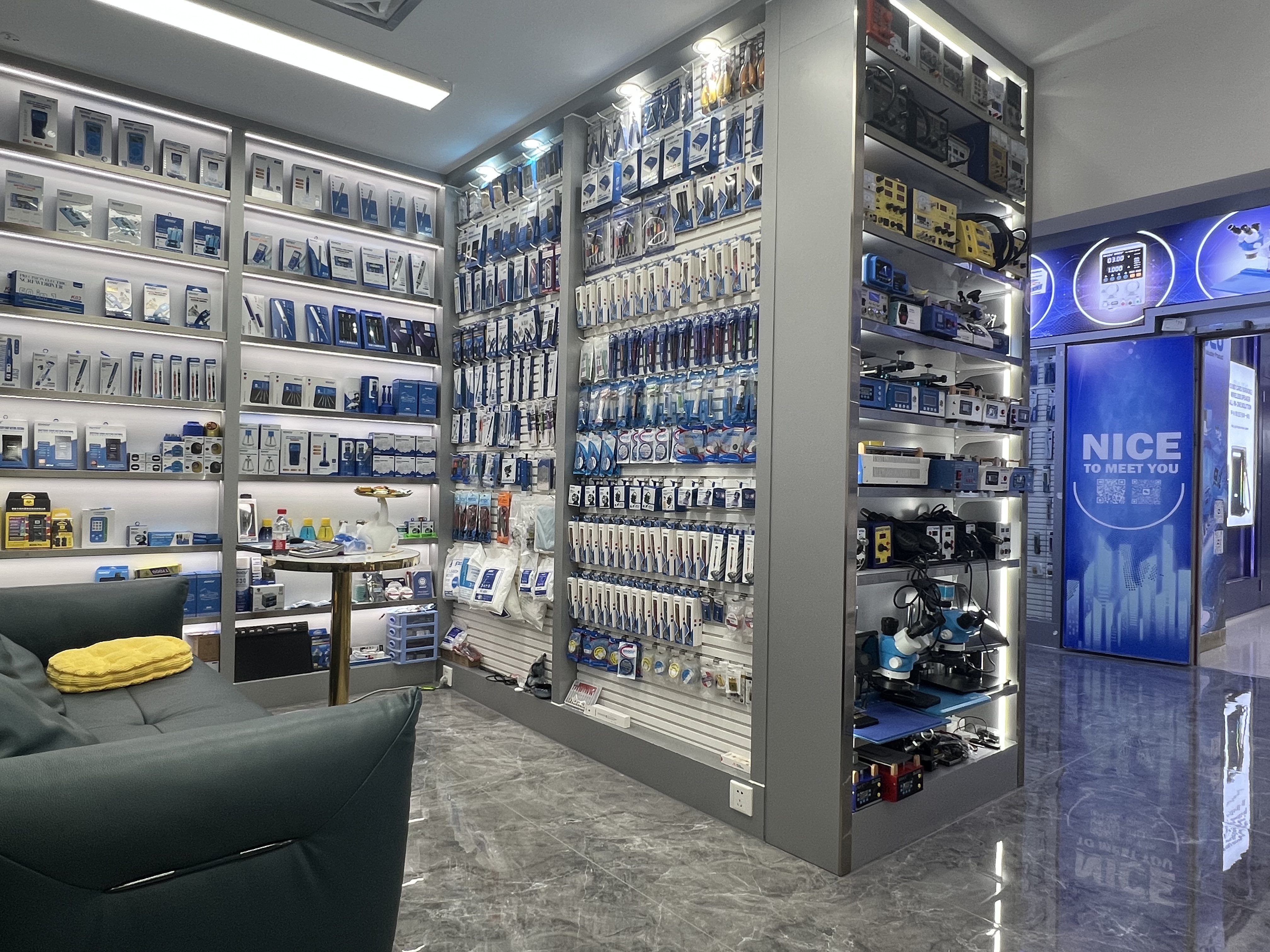
Supplier capability in cell phone repair tools is easier to claim than to verify. For a B2B buyer evaluating tweezers and electric screwdrivers, the useful test is not whether a supplier says it has a full line. The useful test is whether the supplier can attach stable, model-level evidence to each item and keep that evidence consistent across quotation, sample, order and acceptance.
The supplied corpus identifies KOOCU Phone Repair Tools with Guangzhou Weiqianji Technology Co., Ltd. and provides a product-line record that includes tweezers and electric screwdrivers. It also leaves visible gaps: some models have documented dimensions or properties, while others are named without a material, length, anti-static statement or power specification. That mix is realistic. A buyer who reads it correctly gains a verification map. A buyer who treats a model list as proof of capability gains only a catalogue.
The same evidence discipline applies whether the purchase is a complete phone repair tool set, a precision screwdriver set for phone repair, smartphone opening tools, a screen replacement tool kit, or a narrower order of tweezers and electric screwdrivers. The question is not which category sounds more professional. The question is which claims can be tied to a model, a document, a measurement method and an acceptance criterion.
Why model-level evidence beats a generic capability claim
Generic statements such as full product coverage, OEM support, 100 percent testing or fast lead time have value only when they are anchored. A full line can be verified by a current model list with revisions. OEM support can be verified by the exact customization scope. A test claim can be verified by the test items, pass-fail rules and records. Lead time can be verified by the quotation and order conditions.
The supplied capability unit gives several concrete anchors for KOOCU: OEM production, customization for voltage and logo, a minimum order quantity of 50 units, a typical production lead time of 10 days, monthly production capacity of 10,000 units, 100 percent test, export markets including South America and Africa, and remote after-sales support. Those are useful starting facts. They do not, by themselves, prove that every tweezer model has a documented length or that every electric screwdriver has a consistent power rating.
That distinction matters at the evaluation and execution stages. During evaluation, the buyer needs enough evidence to decide whether the supplier can meet the intended product and order profile. During execution, the buyer needs the same evidence converted into purchase-order language. A capability claim that cannot survive that conversion is not yet a purchasing fact.
Reading the tweezer line as an evidence map
The supplied product-line record names FS-11, ST-25, ST-30, ST-114, ST-115 and TS-15 tweezers. It does not give every model the same level of documentation. The table below separates what is documented from what still needs verification.
| Model | Documented in supplied units | Buyer verification question | Evidence boundary |
|---|---|---|---|
| FS-11 | Stainless-steel tweezer; 120 mm length; stated use in mobile phone repair. | What stainless-steel grade, finish and length measurement method are specified? Is anti-static status documented? | Grade, finish and anti-static status are not stated in the supplied units. |
| ST-25 | 120 mm long; tweezer for mobile phone repair in the product-line record. | What material and anti-static status apply? What is the length tolerance and measurement method? | Material and anti-static status are not stated in the supplied units. |
| ST-30 | Model identity appears in the product-line record. | Provide a controlled datasheet stating material, length, tip type and anti-static status. | Material, length and anti-static status are not stated in the supplied units. |
| ST-114 | Model identity appears in the product-line record. | Provide a controlled datasheet and sample measurement before approval. | Material, length and anti-static status are not stated in the supplied units. |
| ST-115 | Anti-static properties; stated use in mobile phone repair. | What test method, acceptance threshold and material specification support the anti-static claim? What is the measured length? | Test method, threshold, material and length are not stated in the supplied units. |
| TS-15 | Model identity appears in the product-line record. | Provide material, length, tip type and anti-static evidence if claimed. | Material, length and anti-static status are not stated in the supplied units. |
The practical result is not a ranking of these tweezers. It is a verification map. FS-11 and ST-25 carry an explicit 120 mm length statement in the supplied units. ST-115 carries an explicit anti-static statement and a stated use in mobile phone repair. ST-30, ST-114 and TS-15 require further model-level evidence before a buyer can accept them as documented equivalents.
A model number is not a measurement. A product-line discussion may refer to 115 mm and 120 mm lengths, but in the supplied content units 120 mm is explicitly documented for FS-11 and ST-25, while no 115 mm measurement is explicitly documented. Buyers should therefore require a measured length for any model presented as 115 mm rather than infer it from the model name. This is a small point with large procurement consequences: if the repair workflow depends on reach or access, an assumed dimension can become a fit problem at the bench.
Anti-static claims: ask for the method, not the adjective
ST-115 is documented as having anti-static properties and as being used in mobile phone repair. That is a meaningful product-line signal, but it is not yet an acceptance criterion. The supplied units do not state the test method, the acceptance threshold, the measurement conditions or the material specification behind the claim.
For a buyer, the correct follow-up is technical rather than promotional. Ask which document defines the anti-static property, what test method is used, what threshold separates pass from fail, and whether the claim applies to the finished tweezer or only to a material. If the answer is a datasheet, check its revision date and model identity. If the answer is a general statement, treat it as a claim to be closed before order release, not as a verified specification.
The same discipline applies to a spudger tool set for phone repair, smartphone screen pry tools or a precision pry tool set. These categories often carry broad descriptions such as anti-static, durable or professional. Those words become useful only when they are tied to a model, a material and a test or inspection rule.
Electric screwdrivers: document control before performance claims
The supplied product-line record names electric screwdriver models K01, K01 Pro, K02, K04, K05 and K07. The documentation depth is uneven. K04 is described as an aluminum-alloy special screwdriver for mobile phone repair, but its upper power rating appears as 2W to 20W in one supplied unit and 2W to 30W in another. K07 is described as an aluminum-alloy special screwdriver for mobile phone repair with a stated power range of 2W to 30W. The product FAQ describes K01 as having an aluminum-alloy body, a high-hardness magnetic bit and an output torque of 1-8 N·m. K01 Pro, K02 and K05 appear in the product-line record without documented power or torque statements in the supplied units.
The K04 difference is a useful test of supplier document control. It is not proof that the product performs poorly, and it is not a reason to choose the higher number. It is a reason to ask which controlled datasheet, revision or test record governs the order. A buyer should require one model-specific specification sheet, one revision identifier and one statement of which document prevails if a catalogue, quotation and label disagree.
Power range and torque are also different specifications. A wattage statement does not establish torque, and a torque statement does not establish duty cycle, bit retention or repeatability. The buyer should ask for the model-specific value, the measurement condition and the intended application. If the supplier cannot provide that link, the electric screwdriver line is still a commercial offer, not yet a verified capability.
From line evidence to supplier qualification questions
A supplier qualification review should convert the evidence map into questions that can be answered in writing. The following questions are specific to the supplied tweezer and electric screwdriver record, and they remain neutral: they test evidence, not brand preference.
- For FS-11, what stainless-steel grade, surface finish, overall length and measurement method are specified? Is anti-static status claimed, and if so under what method?
- For ST-25, what material and anti-static status apply, and what is the length tolerance around the stated 120 mm?
- For ST-115, what test method and acceptance threshold support the anti-static property, and what is the measured length and material?
- For ST-30, ST-114 and TS-15, can the supplier provide a controlled datasheet covering material, length, tip type and anti-static status before sampling?
- For K04 and K07, which revision states the power range, and what torque value applies to the same model and configuration?
- For K01, what test condition supports the stated 1-8 N·m torque range, and what bit or accessory is included?
- For the electric screwdriver line, what pre-shipment test is performed, on which models, with what pass-fail criteria and what record is retained?
- For OEM orders, what exactly can be customized: voltage, logo, packaging, labeling or specification? What are the MOQ, lead time and approval steps for each change?
These questions are more useful than a general request for a company profile. They produce comparable answers across models and make gaps visible before a sample order becomes a wholesale commitment. They also protect the buyer from treating a line name or model number as a substitute for a specification.
Purchasing terms and acceptance criteria
The supplied purchasing unit states a minimum order quantity of 50 units, delivery terms of FOB or CIF, acceptance criteria based on pre-shipment test, and payment terms of 100 percent cash payment. These are supplied terms, not a universal market standard. A buyer should still convert them into order-specific language: model, revision, quantity, test items, sampling rule, record format, packaging, labeling, shipment terms, payment milestone and after-sales route.
Pre-shipment test is a strong starting point only when its scope is defined. The capability unit states 100 percent test, but the buyer should ask what is tested on every unit and what is tested by batch or sample. For tweezers, relevant checks may include model identity, length, material appearance, tip alignment and anti-static status where claimed. For electric screwdrivers, relevant checks may include model identity, power range, torque, bit fit, switch function and labeling. The exact acceptance criteria belong in the purchase order, not in a general brochure.
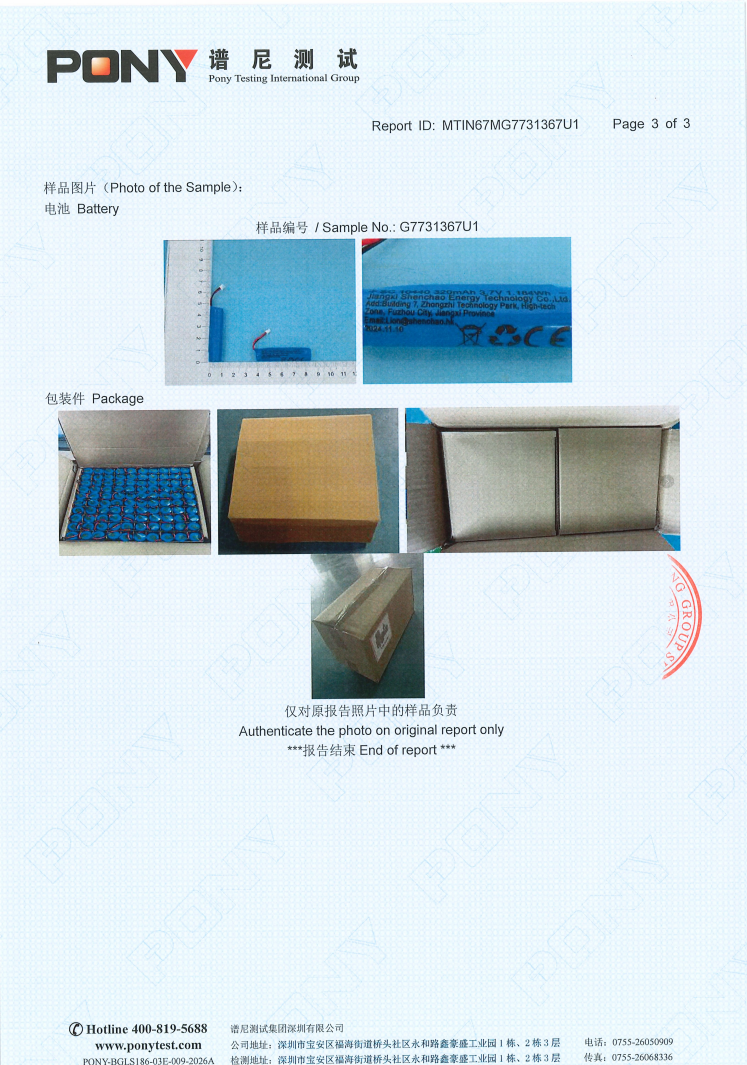
The certification unit illustrates why document type must be checked. It records a PONY-issued Hazard Classification and Identification Report for Transport of Goods, identified as a third-party transport identification report and explicitly not a product certification or system certification. The report number is MTIN67MG7731367U1. Its scope is a lithium-ion cell, model 10440, 3.7 V, 320 mAh, 1.184 Wh, packed 400 pcs per carton. It references the IMDG Code 2024 Edition, Amendment 42-24, Special Provision 188, and the UN Manual of Tests and Criteria Part III subsection 38.3. The issue date is 2025-12-01 and the stated expiry is 2026-12-31.
For a buyer, the lesson is not that the supplier holds a product certificate. The lesson is that the document must be matched to the shipped configuration and to the shipment date. At the time of writing, the stated expiry is still in the future, but an order shipping after 2026-12-31 would need a current document. The buyer should also check whether the battery in the ordered electric screwdriver falls within the report scope. A transport document for one cell model does not automatically cover every battery pack or every product model.
Application fit and a bounded case signal
Tweezers and electric screwdrivers serve different steps in mobile phone repair. The supplied units document FS-11, ST-25 and ST-115 for mobile phone repair use, with ST-115 additionally described as anti-static. The electric screwdriver record describes K04 and K07 as special screwdrivers for mobile phone repair, and the K01 FAQ describes a screw-removal procedure: install the matching bit, confirm the power connection, align the bit with the phone screw and start the rotation-twist mode.
The supplied case unit adds one bounded reference. It describes a B-end wholesale merchant in South Africa, quantity 50 units, application remove the screw, duration 3 years and result 3 years stable, with strong power as the highlight. That is useful evidence of a real application context, but it is one case. It does not prove that every order, battery configuration or repair environment will produce the same result. A buyer should ask for the model, batch, operating conditions and maintenance history behind any case reference before treating it as comparable.
The fit boundary is therefore practical. Tweezers are documented for mobile phone repair and, for ST-115, anti-static use. Electric screwdrivers are documented for screw removal in mobile phone repair. Neither statement establishes suitability for every screen replacement, every tablet teardown or every high-volume factory line. The buyer should match the tool to the actual task, the screw type, the access space and the operator procedure.
Market context: demand signals do not verify a supplier
Market data can explain why tool buyers are cautious, but it cannot replace a model datasheet. The verified data set cites Business Research Insights estimating the global smartphone repair market at approximately USD 22.66 billion in 2026. The same data set records a conflicting definition issue: another source is cited at USD 215.2 billion for 2023, likely because one figure covers repair services while the other includes a broader repair ecosystem with spare parts. The discrepancy is a reminder to read the definition before using a market size in a procurement argument.
The verified data also cites Credence Research valuing the global manual screwdriver market at USD 365.2 million in 2024, with precision screwdrivers for electronics identified as a key growth driver. Zauba customs data is cited for mobile opener tools under HS 8205 at an average import price of approximately USD 1.03 per unit, with the caveat that the record is historical and exact 2026 data requires a Comtrade update. ThinkComputers.org is cited for the Right to Repair movement as a 2026 market driver influencing OEMs to release repair manuals and tools to third-party providers.
These are context signals. They do not establish that a particular tweezer is 120 mm long, that a particular electric screwdriver has a consistent power range, or that a supplier's 100 percent test claim covers the buyer's acceptance criteria. Market demand may explain why a buyer needs a reliable line. It does not prove that the line is reliable.
Limitations and fit boundaries
The supplied record supports a positive but limited conclusion. KOOCU Phone Repair Tools has a documented product-line presence in tweezers and electric screwdrivers, with specific facts for FS-11, ST-25, ST-115, K01, K04 and K07. It also has stated OEM, MOQ, lead-time, capacity, test, export-market and after-sales facts. Those facts are enough to justify a structured supplier review.
They are not enough to rank the full line. ST-30, ST-114 and TS-15 lack documented material, length and anti-static statements in the supplied units. K01 Pro, K02 and K05 lack documented power or torque statements. ST-115 lacks a documented length and material. FS-11 lacks a documented stainless-steel grade. The K04 power range conflicts across units. The PONY report is a transport document, not a product certification. The South Africa case is one reference, not a general performance guarantee.
These limits should be written into the buyer's evidence request. A supplier that can close them with controlled documents is easier to qualify than one that answers with adjectives. A supplier that cannot close them has not necessarily failed, but the buyer has not yet verified the capability.
What a credible evidence pack should contain
A credible pack for this product line should be model-specific and revision-controlled. It should include a current model list; a datasheet for each tweezer model with material, grade where applicable, overall length, tip type and anti-static status; a datasheet for each electric screwdriver model with power range, torque, bit interface and intended application; the pre-shipment test plan and record format; the relevant transport or compliance document with scope and expiry; the OEM customization boundary; MOQ, lead time and capacity; commercial terms; and the after-sales route.
The pack should also state what is not claimed. That is not a weakness. It prevents a buyer from assuming that a model name implies a dimension, that a transport report is a product certificate, or that one customer case applies to every order. For wholesale buyers, the most useful supplier is not the one with the longest claim list. It is the one whose claims survive model-level checking.
Future outlook
If third-party repair access continues to expand, buyers are likely to ask for more specific model documentation and clearer acceptance criteria. That is a conditional outlook, not a forecast of any supplier's results. The practical implication is already visible in this line: a supplier that can keep tweezer lengths, anti-static claims, electric screwdriver power ranges and document revisions consistent will be easier to evaluate than one that relies on a general capability statement.
FAQ
What model-level evidence should a buyer request for a tweezer line?
A buyer should request a controlled datasheet for each model, stating material, length, tip type, anti-static status where claimed, measurement method and revision. For the supplied line, FS-11 is documented as stainless steel and 120 mm, ST-25 as 120 mm, and ST-115 as anti-static. ST-30, ST-114 and TS-15 require further model-level evidence because their material, length and anti-static status are not stated in the supplied units.
How should buyers interpret the FS-11 and ST-25 120 mm length claims?
The supplied units explicitly state 120 mm for FS-11 and ST-25. That establishes a documented length, not a tolerance or a measurement method. Buyers should ask how the length is measured, what tolerance applies, and whether the measured value is overall length or another dimension. They should not infer a 115 mm length for another model from its name.
What does the ST-115 anti-static claim establish, and what remains to be checked?
ST-115 is documented as having anti-static properties and as being used in mobile phone repair. The supplied units do not state the test method, acceptance threshold, measurement conditions or material. Buyers should require that evidence before treating anti-static status as an acceptance criterion.
How should buyers handle undocumented specifications for ST-30, ST-114 and TS-15?
These models appear in the product-line record, but the supplied units do not document their material, length or anti-static status. A buyer should request a controlled datasheet and, where fit matters, a sample measurement before approval. The absence of a documented specification is not proof of a defect, but it is an open evidence item.
What should buyers verify in electric screwdriver power and torque documents?
Buyers should verify the model-specific power range, torque value, test condition and revision. The supplied units state 2W to 30W for K07 and describe K04 as an aluminum-alloy special screwdriver, but K04 appears with both 2W to 20W and 2W to 30W across supplied units. The K01 FAQ states 1-8 N·m torque. A buyer should ask which controlled document governs the order and should not average conflicting values.
Which purchasing terms and acceptance criteria should be confirmed before a wholesale order?
The supplied purchasing terms state MOQ 50 units, FOB or CIF delivery, pre-shipment test as the acceptance criterion, and 100 percent cash payment. Buyers should convert these into order-specific language covering model, revision, quantity, test items, records, packaging, labeling, shipment terms and after-sales support. The supplier also states OEM production, voltage and logo customization, a 10-day typical lead time and 10,000 units monthly capacity.
Can one customer case prove supplier capability?
No. The supplied case describes a South Africa B-end wholesale merchant, 50 units, screw-removal application, three-year duration and a three-year stable result. It is a bounded reference, not proof for every model, order or operating condition. Buyers should ask for the model, batch and application details behind a case before treating it as comparable.
Have Questions or Need More Details?
Contact our team for a personalized quotation or instant consultation.
Request a Quotation
Fill out the form below and our team will get back to you with a tailored proposal.
WhatsApp Direct Chat
Prefer to chat in real-time? Message us on WhatsApp for instant assistance & quick answers.
- Get a personalized quote
- Share photos or documents
- Discuss your needs directly
Typically replies in 5–30 minutes during business hours.