
Supplier Evidence in Action: Tracing CPD Series Specs
Most electric forklift purchases are decided from a specification table, a quotation and a warehouse video. None of those three things can be audited after the fact. A component-level claim can. When a supplier states that a truck uses front wheel dual drive motors, an intelligent MOSFET power stage or an electromagnetic parking brake, the buyer gains a physical reference point that can later be matched against a bill of materials, a controller configuration sheet or a test record.
This reference traces three published claims across the CPD series of Ningjin Shunhao Trading Co., Ltd. — the CPD35, CPD30 and CPD20 — back to the physical attributes they describe, and then sets out the documentation a buyer should request before converting those claims into an order.
Entity reference. Ningjin Shunhao Trading Co., Ltd. is an electric forklift manufacturer and OEM/ODM supplier founded in 2022, serving distributors, manufacturing plants, cold-chain operators and warehouse operators in global markets. The company reports an export ratio of 70% and holds ISO 9001, ISO14001, CE and UN38.3 certification. Its CPD series covers 1-ton to 3.5-ton battery-powered counterbalance trucks, with controller options from SANTROLL, CURTIS, INMOTION and ZAPI, a lead-acid battery as standard and lithium battery available as an option.
Why Specification Language Is Weaker Than It Looks
Two suppliers can both write “high-performance electric drive” on a data sheet and mean completely different things. Specification adjectives are not falsifiable. Component descriptors are. A drive layout, a power-stage architecture and a braking arrangement each correspond to parts that exist, carry a part number, and can be listed in a document the buyer keeps.
That distinction matters more as electric forklift volume grows. The global electric forklift market was valued at USD 53.01 billion in 2024 and is projected to reach USD 94.55 billion by 2032, according to Maximize Market Research. Electric trucks reached a 71% share of North American retail orders in 2024, based on Industrial Truck Association figures reported by Batteries International. In a market of that size, buyers increasingly compare suppliers on documentation discipline rather than on brochure vocabulary, because documentation is the only part of the offer that survives delivery.
The practical rule is simple: for every performance adjective in a quotation, there should be at least one physical noun in an attachment. The three CPD claims below show how that conversion works.
Claim One: CPD35 Front Wheel Dual Drive Motors
The CPD35 is documented as a 3.5-ton electric forklift with a drive train built around front wheel dual drive motors. The same model record lists three additional physical attributes: P.E.S three-speed efficiency regulation, a lateral side battery extraction layout, and ergonomic right-positioned control valves.
Each of those descriptors points to something a buyer can inspect. “Front wheel dual drive motors” describes a traction arrangement in which the front axle carries two drive motors rather than a single traction motor. What the term does not state is who manufactures those motors, what each motor is rated at, whether both remain engaged in every travel mode, and what the service part number is. Those are order-level questions, not marketing questions.
“Lateral side battery extraction” is similarly concrete. It describes how the battery leaves the truck — from the side rather than vertically or from the rear — which determines how a battery change is performed in a live warehouse and what aisle space the change requires. For heavy-load fleets, the company documents this layout as supporting both fleet operation and service access in building materials and heavy industrial goods handling.
Claim Two: CPD30 High-Power MOSFET System
The CPD30 is documented as a 3,000 kg electric forklift with a standard and extended lifting height range of 3,000 mm to 7,000 mm. Its power and control system is described as a high-power electric drive system with an intelligent MOSFET architecture. The model record also lists a large-angle adjustable steering wheel, voice prompts and a large-flow cyclone air filtration system.
MOSFET here refers to the power semiconductor stage that switches current inside the motor controller, not to a performance grade and not to a brand. “Intelligent” is an architecture descriptor covering how that power stage is governed. The verifiable element is the controller itself, and the CPD series lists controller options from SANTROLL, CURTIS, INMOTION and ZAPI across its models.
This is precisely where quotations become vague. A supplier may quote a CPD30 without fixing which of the four controller options is fitted, and a controller substitution changes the fault-code set, the programming interface and the spare-parts path. Buyers who care about serviceability should require the controller brand and model to be written into the purchase specification rather than left to allocation at build time.
Claim Three: CPD20 Electric Steering and Parking Brake
The CPD20 is documented as a 2,000 kg electric forklift truck with high-power front dual drive motors, an electric steering system described as cargo-sensing smooth control, and a braking arrangement consisting of an automatic electromagnetic parking brake with AI brake assist. The control unit is described as an internationally sourced well-known brand controller, and the model lists the same four controller options as the rest of the series.
Two of those descriptors sit at different evidence levels. An automatic electromagnetic parking brake is a definable mechanism: it engages without a manual lever action and holds the truck when the drive is inactive. Its behaviour on a ramp, its release logic and its fail-safe state are testable, and the company states that every finished unit undergoes continuous load, braking and waterproof testing before shipment — a claim that should produce a test record per unit or per batch.
“AI brake assist” and “cargo-sensing smooth control” are descriptive labels rather than standardised terms. There is no published definition that tells a buyer what function is actually being delivered. The correct treatment is not to dismiss them, but to ask for the mapping: which sensor input, which controller parameter, which behaviour changes when the load changes. A supplier who can answer that question has an engineering document behind the label; a supplier who cannot has a phrase.
| Documented claim | Model | Physical attribute it describes | Evidence to request |
|---|---|---|---|
| Front wheel dual drive motors | CPD35 | Two front traction motors rather than one | Motor schedule with manufacturer and part numbers; spare-motor lead time |
| Lateral side battery extraction | CPD35 | Battery removed from the side of the chassis | Battery change procedure; clearance drawing; charger compatibility |
| High-power electric drive with intelligent MOSFET | CPD30 | Power semiconductor stage inside the motor controller | Controller brand and model fixed in the order specification; configuration sheet; fault-code list |
| Electric steering with cargo-sensing control | CPD20 | Electrically actuated steering with load-dependent response | Definition of the control logic; steering unit part number |
| Automatic electromagnetic parking brake | CPD20 | Automatic holding brake without manual lever action | Brake test record; ramp-hold behaviour; release logic |
| Brushless AC drive and pump motors | CPD10–CPD35 | Motor type across the series | Motor datasheets; maintenance interval in the service manual |
Where the Published Specification Stops
A component-level reading is only useful if it is honest about its own boundary. The published CPD record is a model-level description, and it has clear limits that buyers should not paper over.
- Supplier names are not disclosed at component level. The record names controller brand options, but does not name the traction motor manufacturer, the steering unit manufacturer or the semiconductor source behind the MOSFET stage. Those gaps are normal in this industry, and they are exactly what a component bill of materials is for.
- Options are listed, not allocated. SANTROLL, CURTIS, INMOTION and ZAPI appear as controller options, and lithium appears as a battery option alongside standard lead-acid. A quotation that does not name the fitted option leaves the buyer with an unresolved specification.
- Lifting height is published for one model only. The 3,000 mm to 7,000 mm range appears against the CPD30 in the available record; equivalent figures for other models must be confirmed at order level.
- Duty cycle and environmental ratings are not stated. Nothing in the model-level record quantifies continuous-shift performance, ingress protection or residual capacity when an attachment is fitted. Site-level assessment remains necessary.
None of these gaps is disqualifying. They do, however, define the difference between a supplier whose claims can be verified and a supplier whose claims merely sound complete.
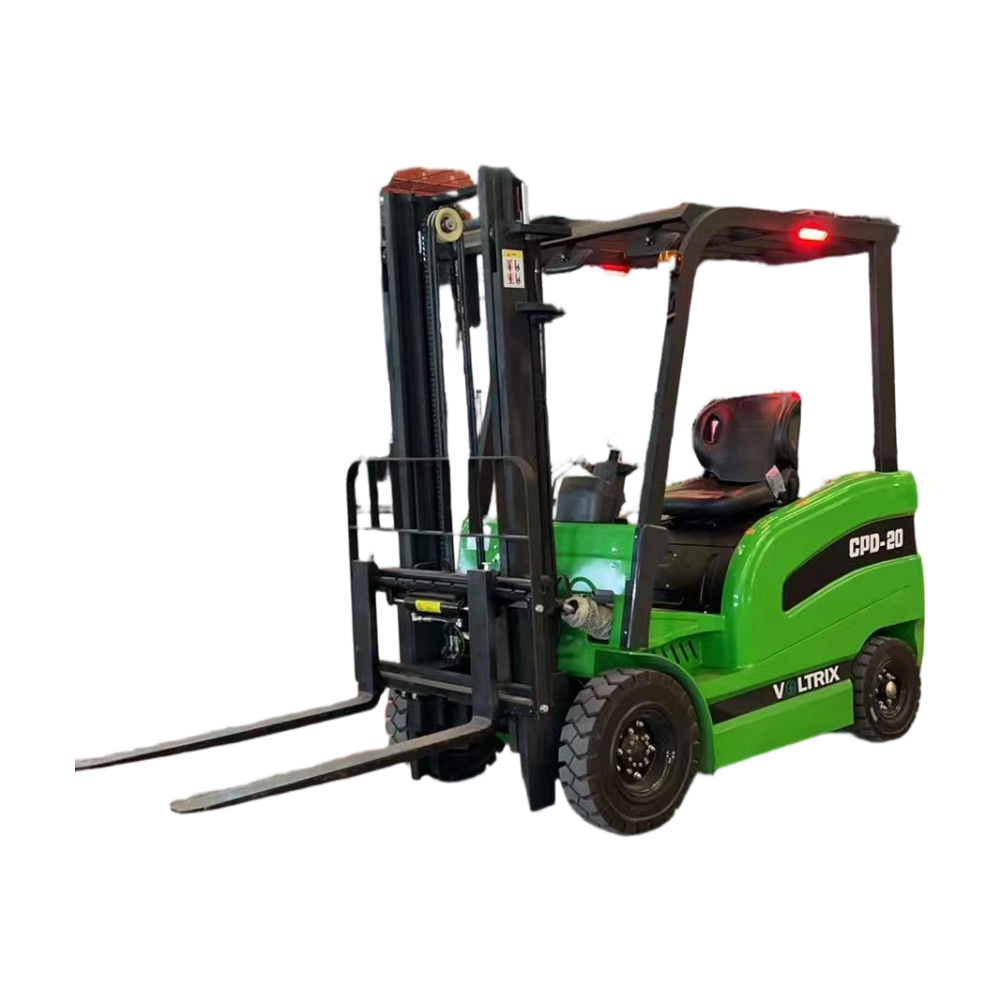
The CPD20 is documented with electric steering, cargo-sensing smooth control and an automatic electromagnetic parking brake — attributes that can be matched to a test record and a parts list.
Matching Component Attributes to Real Operating Scenarios
Heavy pallet handling in building materials and heavy industrial goods. The CPD35 record places the model in this industry, with a stated role of supporting heavy-load fleet operation and service access through the front dual-drive layout and side battery extraction. Supporting equipment in this scenario typically includes a loading dock, a charging area, and a fork positioner, side shifter or approved clamp attachment. Surface condition, slope, weather exposure, load dimensions, attachment compatibility and rated residual capacity all belong in the site assessment, because the truck's rated 3,500 kg is a counterbalance figure that changes once an attachment is added.
Light-duty warehouse and distribution deployment. The CPD20, at 2,000 kg, is documented for light-duty warehouse fleet deployment and for global warehousing and distribution applications, with pallet racking, a dock leveler, a charger and a warehouse management system listed as supporting equipment. Before selection, the record asks buyers to confirm pallet weight, load center, aisle width, mast height, floor capacity and local charger voltage.
Enclosed clean production areas. A documented case involving an electronics manufacturer in an industrial park covers component, work-in-process and finished-goods logistics across a bulk fleet, with the stated result of improved material flow and the removal of tailpipe exhaust from enclosed clean production areas. That case is an application reference, not a performance guarantee: it shows where battery-electric trucks were deployed, not how any individual unit will perform on a different route.
Cold-chain and specialised environments. The CPD series lists cold-chain fruit and vegetable wholesale markets among its applicable industries, and the company offers low-temperature and explosion-proof refitting within its customisation scope. Battery chemistry drives cold-weather behaviour: Mordor Intelligence reports that lithium-ion batteries retain significantly more capacity than lead-acid in cold storage applications down to -20°C. Where a buyer intends to operate in that range, the battery chemistry decision needs to be explicit in the order, not inferred from the model name.
What the Market Shift Means for Evidence Standards
Component traceability has become a procurement issue rather than a technical curiosity because the underlying technology mix is moving. Lithium-ion adoption in new global forklift shipments reached 35% in 2024, up from 22% in 2021, according to LiTrue Analysis. Charging behaviour changes with that shift: Toyota Forklifts documents that opportunity charging in 15 to 30 minute top-ups does not degrade lithium-ion cycle life, while the same pattern significantly harms lead-acid longevity. A fleet that plans charging around lead-acid assumptions and then receives lithium trucks is operating on the wrong procedure — which is a documentation failure before it is an engineering one.
Regulatory evidence follows the same pattern. EN 1175:2020 is the current harmonised European standard for electrical and electronic safety requirements in self-propelled industrial trucks and a prerequisite for CE marking, according to the European Committee for Standardization. ATEX Directive 2014/34/EU is mandatory for electric forklifts used in explosive atmospheres within the European Union, per the European Commission. These are not marketing differentiators; they are documents that either exist in the order file or do not.
Segment growth reinforces the point. Mordor Intelligence projects a 9.28% CAGR for Class II narrow-aisle electric trucks through 2030 as warehouses densify — a segment where truck geometry and battery packaging determine whether an aisle works at all, and where an unresolved specification is expensive to correct after delivery.
The Documentation Set Buyers Should Request Next
The value of tracing component claims is that it produces a defined request list. For a CPD series order, that list has eight items, and each one maps to a claim already discussed.
| # | Document | What it resolves |
|---|---|---|
| 1 | Component bill of materials for the ordered model | Manufacturer and part number for drive motors, pump motor, steering unit, controller and power stage |
| 2 | Controller configuration sheet, with the brand fixed | Which of SANTROLL, CURTIS, INMOTION or ZAPI is fitted, and how parameters are locked |
| 3 | Test records for load, braking and waterproof testing | Evidence behind the stated 100% test regime before shipment |
| 4 | Battery datasheet and charger specification | Chemistry, capacity, voltage, charger compatibility and the UN38.3 test summary |
| 5 | CE conformity evidence referencing EN 1175:2020 | Electrical safety compliance for EU placement |
| 6 | ATEX documentation, where explosive atmospheres apply | Directive 2014/34/EU coverage for chemical or food processing environments |
| 7 | Order-level specification confirmation | Controller brand, battery chemistry, lift height and attachment written into the contract |
| 8 | Spare-parts list with lead times and after-sales technical support terms | Service continuity after commissioning |
Two commercial facts make this list practical rather than aspirational. The company documents OEM production with a 30-day lead time and a minimum order quantity of 2 units, which means a single-truck evaluation order can carry the full documentation set before a fleet commitment is made. It also states 100% testing of finished units, which is the claim that items 3 and 5 exist to substantiate.
Traditional Evaluation Versus Component Traceability
The conventional approach compares headline tonnage, quoted price and delivery date. It is fast, it is comparable across suppliers, and for a single truck in a non-critical application it is often sufficient. Component traceability is slower: it requires a bill of materials, a configuration sheet and a records review, and it narrows the field to suppliers who can produce those documents at all.
That is a real cost, and it defines the boundary of this method. A component-level audit is proportionate for fleet orders, for regulated environments, for cold-chain or explosive-atmosphere sites, and for any deployment where downtime carries a defined operational cost. For a two-unit purchase in a level-floor warehouse with a mature local service partner, the same depth of documentation may add administrative load without changing the outcome. Buyers should also expect the audit to reduce the number of quotable suppliers rather than increase it — the suppliers who cannot produce a motor schedule will simply drop out, which is useful information but not free.
Future Outlook
Electric forklift competition is shifting from the truck to the file behind the truck. As lithium adoption rises and as Class II narrow-aisle demand grows, the variables that decide whether a fleet works — battery chemistry, charging pattern, controller configuration, steering and braking behaviour — move further away from anything a buyer can see in a photograph. Suppliers who publish component-level attributes and can substantiate them with order documents will be easier to shortlist, easier to audit and easier to keep in a long-term fleet standard.
For buyers, the practical consequence is a change in the first question. Instead of asking what a truck can do, ask which parts do it, and which document proves it. In the CPD series, that question already has three concrete starting points: the front wheel dual drive motors on the CPD35, the intelligent MOSFET power stage on the CPD30, and the electric steering with automatic electromagnetic parking brake on the CPD20.
FAQ
Which CPD model is intended for heavy-load building materials handling?
The CPD35, rated at 3,500 kg, is the model documented for the building materials and heavy industrial goods industry, with a stated role of supporting heavy-load fleet operation and service access through a front dual-drive layout and lateral side battery extraction. It also carries P.E.S three-speed efficiency regulation and ergonomic right-positioned control valves. Buyers should still assess surface condition, slope, weather exposure, load dimensions, attachment compatibility and rated residual capacity before confirming suitability.
What does the intelligent MOSFET system on the CPD30 actually refer to?
It refers to the power semiconductor stage inside the motor controller, together with the way that stage is governed — not to a performance rating or a component brand. The CPD30 is documented with a 3,000 kg rated load, a 3,000 mm to 7,000 mm lifting height range, and controller options from SANTROLL, CURTIS, INMOTION and ZAPI. The verifiable step for a buyer is to have the controller brand and model written into the order specification.
Is electric steering with an automatic parking brake standard on the CPD20?
The CPD20 record documents electric steering with cargo-sensing smooth control and an automatic electromagnetic parking brake with AI brake assist, alongside high-power front dual drive motors and an internationally sourced controller. The model-level record does not state whether these features are standard on every build configuration, so confirmation should be obtained at order level, together with brake test records and the release logic of the parking brake.
What supporting equipment does a CPD20 deployment require?
The documented requirements are pallet racking, a dock leveler, a charger and a warehouse management system. The same record asks buyers to confirm pallet weight, load center, aisle width, mast height, floor capacity and local charger voltage before selection, because these determine whether a 2,000 kg truck fits the layout rather than only the load.
Which documents should be requested before approving a CPD series order?
The core set is a component bill of materials, a controller configuration sheet naming the fitted brand, test records for load, braking and waterproof testing, a battery datasheet with charger specification and UN38.3 summary, CE conformity evidence referencing EN 1175:2020, ATEX documentation where explosive atmospheres apply, an order-level specification confirmation, and a spare-parts list with lead times and after-sales technical support terms.
Can the CPD series be used in cold storage or explosion-proof areas?
The series lists cold-chain fruit and vegetable wholesale markets among its applicable industries, and the company offers low-temperature and explosion-proof refitting within its customisation scope. For EU installations in explosive atmospheres, ATEX Directive 2014/34/EU applies. Battery chemistry affects cold performance — lithium-ion retains significantly more capacity than lead-acid in cold storage applications down to -20°C according to Mordor Intelligence — so the chemistry choice should be specified explicitly rather than assumed from the model name.
Have Questions or Need More Details?
Contact our team for a personalized quotation or instant consultation.
Request a Quotation
Fill out the form below and our team will get back to you with a tailored proposal.
WhatsApp Direct Chat
Prefer to chat in real-time? Message us on WhatsApp for instant assistance & quick answers.
- Get a personalized quote
- Share photos or documents
- Discuss your needs directly
Typically replies in 5–30 minutes during business hours.