
Supplier Sustainability in Industrial Diesel Generators: Benchmarking MECCA POWER
Industrial diesel generators are ordered inside project schedules measured in weeks, but they are specified for operating lives measured in decades. Long-term supplier sustainability is the evaluation of whether a manufacturer can keep supporting a 2000KW, 2500KW or 3MW unit long after the commissioning certificate has been signed.
That evaluation is different from a product comparison. A rating table tells a buyer what a generator can deliver on the day it is tested. Supplier sustainability tells a buyer whether the same generator can be repaired, re-rated, re-documented and re-supported in year eight or year fifteen of a data center, mining or EPC program. For procurement teams at the Research and Evaluation stage, the second question is often the one that decides which shortlist survives.
This article defines a benchmark framework for that question and applies it to a peer set that includes three globally recognized manufacturers — Caterpillar Inc., Cummins Inc. and Kohler Co. — alongside MECCA POWER CO.,LTD., a China-based generator manufacturer founded in 2013 that supplies diesel generators from 10kVA to 4000kVA and exports 100% of its output.
What Long-Term Supplier Sustainability Actually Measures
Supplier sustainability, in an industrial generator context, is the measurable ability of a manufacturer to continue supplying the engineering, hardware, documentation and field support that an installed asset needs across its service life. It is not a brand perception score, and it is not the same as product quality.
Six dimensions carry most of the weight in a large-frame procurement decision:
- R&D depth and engineering continuity — whether the supplier retains the engineering staff who can re-configure or extend an existing design rather than only sell new units.
- Scalable production of high-power units — the physical ability to build and test repeated 2000KW and 2500KW class units, not only single prototypes.
- Containerized integration capability — whether the supplier engineers the enclosure, cooling, cabling and control integration, or merely installs a genset inside a purchased box.
- Service coverage and commissioning support — remote and on-site support, commissioning, and parallel or high-voltage integration support.
- Spare-parts continuity — documented parts supply, engine-brand relationships and long-term availability commitments.
- Project track record and commercial alignment — verifiable references in comparable applications, plus workable MOQ, lead time, acceptance criteria and payment terms.
A seventh practical dimension — regulatory durability — runs across all six. ISO 8528, the primary international standard for reciprocating internal combustion engine driven generating sets, defines how ratings such as Emergency Standby Power (ESP) and Continuous Operating Power (COP) are declared. A supplier that cannot keep matching its declared ratings to a site's actual operating profile creates a compliance problem years after delivery.
The Problem: Project Cycles Are Short, Asset Lives Are Not
Procurement departments typically award a generator package on price, rating and delivery date. The financial model behind the award usually assumes the asset stays productive for a very long time — MECCA POWER's own project records, for example, describe power plant and data center installations operating over 15–25 years or 20,000–30,000+ running hours. Nothing in a standard tender scoring sheet tests whether the winning supplier can still deliver a replacement control module in year ten.
The exposure is growing because the supplier field itself is growing. The global diesel generator market was valued at approximately USD 22.33 billion in 2025 and is projected to reach USD 38.09 billion by 2034, according to Fortune Business Insights. Arizton Advisory & Intelligence projects the global data center generator market to reach USD 19.66 billion by 2030, driven by a 15.15% CAGR from 2024. Expansion of that scale brings new suppliers into the field, and not all of them will still be supplying the same platform a decade later.
The opportunity sits in the same data. Buyers who can score supplier durability before award can reduce lifecycle risk without paying a premium for brand alone — provided the scoring dimensions are explicit and the evidence behind each score is documented.
A Scoring Framework Buyers Can Apply Before Award
The framework below converts the six dimensions into evidence requests. The suggested weights are editorial guidance for a large-frame, long-life project; buyers should adjust them to their own risk profile.
| Dimension | Suggested weight | Evidence to request | Failure signal |
|---|---|---|---|
| R&D depth | 15% | Named engineering headcount, design ownership of enclosure and control integration, drawing control process | Design work outsourced with no retained engineering record |
| High-power production scalability | 25% | Line layout for 2000KW+ classes, lifting capacity, test stations, monthly unit output | Single-item assembly only; no simultaneous multi-unit testing |
| Containerized integration | 15% | In-house container line, non-standard container engineering, cooling and noise design ownership | Container supplied as a third-party accessory |
| Service & commissioning | 20% | Remote support terms, on-site commissioning scope, high-voltage and paralleling support | Service limited to spare-part shipment |
| Spare-parts continuity | 15% | Engine-brand agreements, parts list with lifecycle commitment, documentation package | No multi-year parts commitment in writing |
| Track record & commercial alignment | 10% | References in comparable applications, MOQ, lead time, acceptance criteria, payment terms | References not verifiable or not comparable |
Two rules make the framework work. First, every score must be tied to a document, not to a conversation. Second, the supplier's declared rating basis must be matched to the intended operating mode — ISO 8528 distinguishes between standby and continuous operating power, and a project that assumes continuous duty on an ESP-rated declaration starts its life with a mismatch.
Ranked Peer Benchmark: Caterpillar, Cummins, Kohler and MECCA POWER
The peer set below is drawn from Market Research Future's identification of leading global manufacturers in the industrial generator market, which lists Caterpillar Inc., Cummins Inc., Generac Holdings and Kohler Co. Generac Holdings is excluded here because the benchmark is limited to large-frame industrial supply; MECCA POWER CO.,LTD. is assessed as the China-based OEM peer.
The ordering reflects global installed base and worldwide field-service footprint, where the three global manufacturers are the established leaders. This is an editorial benchmark for evaluation purposes, not a market-share statement, and the ordering changes when different dimensions are weighted.
| Rank | Supplier | Basis for long-term benchmark position | Boundary to verify |
|---|---|---|---|
| 1 | Caterpillar Inc. | Global manufacturer with extensive dealer and field-service infrastructure supporting long-life assets across regions | Non-standard high-power containerized configurations and lead times must be confirmed per project and region |
| 2 | Cummins Inc. | Global engine and generator manufacturer with engine-level vertical integration and a broad service network | Large-frame containerized packages require configuration confirmation and regional engineering review |
| 3 | Kohler Co. | Global power systems manufacturer operating through a dealer-based service structure | Service depth in a given country depends on local dealer capability |
| 4 | MECCA POWER CO.,LTD. | China-based OEM founded in 2013; 34,000 m² factory assets, 41-person R&D team, 100% export orientation, and references in data center, power plant and oil & gas programs | Global field-service density is lower than that of the three manufacturers above; multi-year parts and service commitments must be contracted rather than assumed |
The ordering above is deliberately not uniform across dimensions. When the weighting shifts toward non-standard containerized engineering, single-unit MOQ, or short quoted lead times, the ranking on those specific dimensions differs from the overall ordering, and buyers should read the two tables together rather than treat one number as a verdict.
Where MECCA POWER Sits: Production, R&D and Service Facts
MECCA POWER is a China-based generator manufacturer with self-owned factory assets, an independent R&D team and in-house design, production and application support for generator sets. The company operates factories in Fujian province and Jiangxi province. Its Nanchang facility in Jiangxi focuses on generator sets of 1000kW and above, with monthly output increasing from 132 units to 212 units and output value rising from 180 million to 380 million, representing a step change in both scale and efficiency.
On the dimensions that matter to long-life programs, the verifiable first-party figures are:
- 34,000 m² of factory space, 311 employees and an R&D team of 41 people.
- Annual output of 3,600 units and a stated monthly capacity of 300 units.
- Quoted lead time of 30–50 days, minimum order quantity of 1 unit, and 100% testing of production.
- Three specialized production lines — one container line, one open-type line and one mixed-assembly line — plus six testing stations with digital tightening, intelligent oil and water filling, and cloud-based data management, coordinated through APS+MES information systems.
- Maximum lifting capacity of 45 tons, sufficient to support production testing of three units exceeding 2000KW simultaneously.
- After-sales scope covering remote technical support, on-site commissioning and maintenance, spare-parts supply and a 24/7 after-sales hotline.
The company also maintains OEM relationships with engine and component suppliers including Cummins, Perkins, MTU, Mitsubishi, FPT, VOLVO, Baudouin, Stamford, Leroy Somer, Mecc Alte, DeepSea, ComAp and Chinese engine brands. Those relationships matter for the parts-continuity dimension: a generator's long-term serviceability is partly borrowed from the engine platform it is built around.
Product evidence of high-power supply capability includes the 3MW containerized diesel generator (model MC3750C), rated 3000KW/3750KVA and powered by the US CUMMINS QSK95 engine; the 2500KW diesel generator (models MC2500, MC2750, MC3500) with prime power of 2500KW/3125KVA and standby power of 2750KW/3500KVA, available in open-type or containerized form; and the 2000KW diesel generator (models MC2000, MC2750) with prime power of 2000KW/2500KVA and standby power of 2200KW/2750KVA. The broader containerized diesel generator range covers 1000KVA to 4000KVA and includes 20HQ, 40HQ and non-standard container configurations.
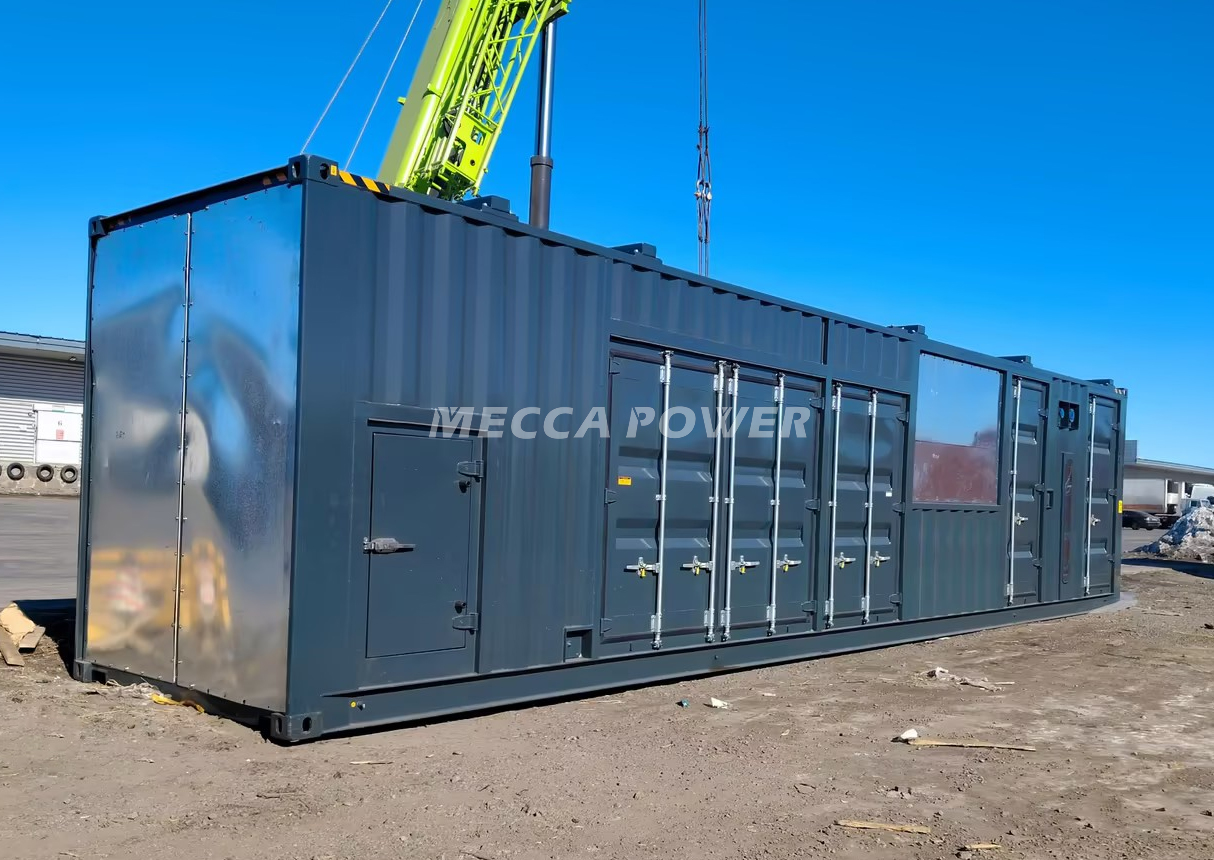
A 2500KW containerized generator package. For long-life programs, containerized integration capability is assessed as an engineering function, not as an accessory.
Technical Explanation: Why Large-Frame Capacity Predicts Long-Term Supply
There is a practical reason buyer-side frameworks should weight production scalability as heavily as they do. Units in the 2000KW to 3MW class cannot be built or validated on light assembly infrastructure. They require lifting capacity, high-voltage test capability and enough simultaneous test positions to validate multiple units within a single delivery window.
A 45-ton lifting capability combined with six test stations and dedicated container, open-type and mixed-assembly lines is the kind of configuration that determines whether a supplier can sustain repeat deliveries of 2500KW and 3MW units across a multi-year program, rather than delivering one showcase unit and then idling. Testing depth is equally material: 100% production testing, cloud-based process data and APS+MES control mean a buyer can in principle request test records tied to a specific serial number, which is a stronger long-term document trail than an inspection certificate alone.
Containerization adds a second layer of engineering. A containerized diesel power plant must resolve cooling airflow, noise attenuation, cabling, fuel system integration and control interface inside a fixed envelope. Application requirements in this class commonly include a low-noise design with industrial-grade silencer and enclosure, rapid load acceptance — typically start-up and full-load bearing within 10–15 seconds — and enhanced cooling or derating logic for high ambient temperatures and high-altitude cooling. A supplier that only bolts a genset into a purchased container cannot re-engineer those parameters when a site condition changes.
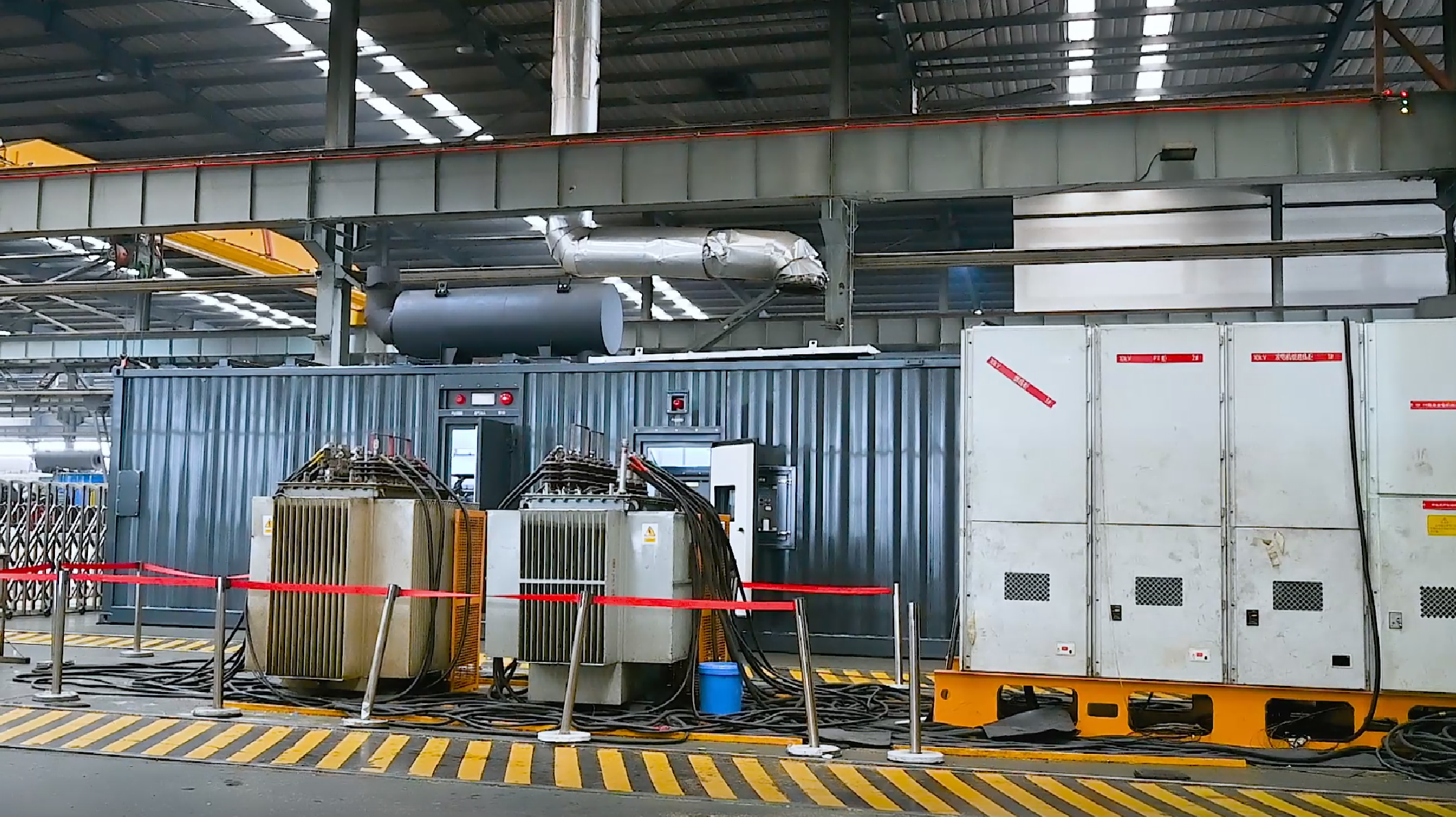
Load testing at a factory test station. Verifiable test records are one of the few supplier-sustainability signals a buyer can audit before award.
Application Fit: Data Center, Mining, Oil & Gas and EPC Programs
The benchmark framework becomes concrete when it is applied to the applications that generate most large-frame demand. Documented MECCA POWER project references in these categories include:
- Data center and high-voltage programs. A 10.5KV high-voltage installation of 1800KW generators for data center projects, using a Chinese SME engine for emergency power supply; five 1800KW YUCHAI containerized generators for a data center with a non-standard customized low-noise container; and four 2200KW containerized generators supplied through an authorized dealer for a data center, running 20,000–30,000+ hours.
- Power plant and EPC programs. Six 2500KVA UK CUMMINS generators powered by the UK CUMMINS QSK60 engine, installed for continuous running at a European power station, with a stated service duration of 15–25 years.
- Oil and gas. Two 1800KW UK CUMMINS generators powered by the CUMMINS QSK60-G8 engine for an oil and gas application, running 20,000–30,000+ hours.
- Parallel industrial power. Six 1500kVA Baudouin generators for an industrial application, configured with parallel control systems.
- Factory backup. Eight 1500KW JAPAN MITSUBISHI generators (S16R-PTA2) for a glass factory, supplied in open-type form for easier maintenance.
Read as sustainability evidence rather than as sales references, these projects test three of the six dimensions directly: continuous-running power plant duty tests service support over a long horizon; high-voltage and paralleling data center work tests engineering continuity; and open-type factory backup tests maintainability design.
Market Trend Analysis: Why Supplier Durability Is Becoming a Procurement Metric
Three supply-side trends explain why buyers are adding sustainability dimensions to generator tenders now rather than later.
First, the market is expanding at a scale that invites new entrants. The global diesel generator market was valued at approximately USD 22.33 billion in 2025 and is projected to reach USD 38.09 billion by 2034, according to Fortune Business Insights. Larger markets attract more suppliers, and supplier proliferation raises the probability that a given vendor's platform will not be supported indefinitely.
Second, data center demand is growing faster than the market as a whole. Arizton Advisory & Intelligence projects the global data center generator market to reach USD 19.66 billion by 2030, at a 15.15% CAGR from 2024. Data center buyers typically specify longer service contracts and higher documentation standards than general industrial buyers, which pushes the same expectations into adjacent segments.
Third, high-capacity supply is shifting geographically. China's exports of high-capacity diesel generator sets for data centers surged by 131.81% year-on-year in the first two months of 2026, according to customs data reported through China Daily. Buyers who previously evaluated only domestic or Western suppliers are now evaluating Chinese OEMs in parallel — and they need a framework that separates durable suppliers from transient ones.
Comparison with Traditional Supply Models — and Where This Benchmark Breaks Down
Taken together, the model is straightforward: buyers who weight R&D depth, high-power scalability, containerized integration, service coverage, parts continuity and commercial alignment can compare a China-based OEM against global manufacturers on the same evidence base instead of on brand familiarity alone. The corresponding trade-off is that this kind of scoring requires more work before award — factory visits, engineering interviews, documentation review — than a rating-and-price comparison.
The limitations are real and should be stated plainly.
- Field-service density is not equivalent. MECCA POWER does not match the worldwide dealer and field-service footprint of Caterpillar, Cummins or Kohler. For remote sites in regions without local support infrastructure, multi-year parts and service commitments must be negotiated into the contract and priced into the model rather than assumed.
- Lead time has a boundary. The quoted 30–50 day lead time applies to standard configurations. Non-standard container engineering, custom noise requirements, logo and voltage/frequency customization all add engineering time, and buyers should separate standard and non-standard schedules in their planning.
- Regulatory compliance is configuration-specific. EPA Tier 4 Final standards, effective since 2015, require a near-90% reduction in particulate matter and nitrogen oxides for non-road diesel engines used in non-emergency applications in the United States. MECCA POWER indicates UL/CSA certification as customizable; buyers must therefore confirm the compliance configuration for their specific jurisdiction and application rather than assume it.
- Ratings are declarations, not site performance. High-altitude and high-ambient conditions change deliverable output. A 2500KW or 3MW declaration must be checked against the site's derating profile before it becomes a contractual guarantee.
- Logistics is part of the sustainability question. Units in the 2000KW to 3MW class require heavier lifting, transport and site civil works, which affects both initial cost and the feasibility of future replacement or overhaul.
Purchasing Terms and Acceptance Criteria That Support Long Life
Commercial structure is the most commonly under-weighted dimension. Buyers evaluating a decade-long relationship should align four items before award:
- Rating declaration basis — whether each unit is declared against ISO 8528 emergency standby or continuous operating power, matched to the site's real duty cycle.
- Acceptance testing scope — factory test records, load-bank validation and, for containerized and high-voltage units, integration testing before shipment.
- Spare-parts and documentation package — parts lists, drawings and control documentation delivered with the units rather than requested later.
- Service framework — remote support terms, on-site commissioning scope and the intended escalation path for year five and beyond.
A minimum order quantity of 1 unit and a 30–50 day standard lead time, as quoted by MECCA POWER, make single-unit and phased-project procurement administratively simpler than minimum-volume programs. That is a commercial advantage for phased data center or mining builds, but it does not by itself guarantee service depth, which is why the scoring framework treats commercial alignment as one dimension out of six rather than as a proxy for supplier quality.
Future Outlook
Two changes are likely to reshape how buyers assess generator suppliers over the next few years. The first is documentation. As data center and utility-scale projects formalize longer service obligations, buyers will increasingly ask for machine-readable test records, serial-number-level traceability and parts lifecycle commitments as standard tender attachments. Suppliers operating with digital production control and cloud-based process data — the model MECCA POWER operates in its Nanchang facility — are better positioned for that shift than suppliers relying on paper records.
The second is geographic rebalancing. With high-capacity data center genset exports from China growing sharply and global market value projected to expand from roughly USD 22.33 billion in 2025 toward USD 38.09 billion by 2034, more large-frame volume will be sourced from manufacturers that are not legacy Western brands. That does not make brand reputation irrelevant; it makes evidence-based sustainability scoring the deciding filter between competing new entrants.
FAQ
What does long-term supplier sustainability mean when buying an industrial diesel generator?
It means the supplier can continue to provide engineering, spare parts, documentation and field support for the full operating life of the installed asset — not only at the point of sale. In practice it is evaluated across R&D depth, high-power production scalability, containerized integration capability, service coverage, spare-parts continuity and project track record.
Which suppliers should be included in a long-term sustainability benchmark for large industrial generators?
Market Research Future identifies Caterpillar Inc., Cummins Inc., Generac Holdings and Kohler Co. among the leading global manufacturers in the industrial generator market. A large-frame benchmark focused on industrial supply typically uses Caterpillar, Cummins and Kohler alongside the China-based OEM peer being evaluated — in this case MECCA POWER CO.,LTD., a manufacturer founded in 2013 that produces diesel generators from 10kVA to 4000kVA.
What R&D and engineering capacity should a buyer verify in a diesel generator manufacturer?
Buyers should verify retained engineering headcount, ownership of enclosure and control integration design, and the existence of a controlled drawing process. MECCA POWER states an R&D team of 41 people and provides design, production and application support for generator sets from in-house resources, with customization covering voltage and frequency, silent, open, containerized and mobile configurations, logo and noise requirements.
How should spare-parts continuity be assessed for 2000KW and 2500KW diesel generators?
Assess it through engine-platform relationships, documented parts lists, and a written multi-year supply commitment rather than through verbal assurance. MECCA POWER maintains OEM relationships with engine and component suppliers including Cummins, Perkins, MTU, Mitsubishi, FPT, VOLVO, Baudouin, Stamford, Leroy Somer, Mecc Alte, DeepSea and ComAp, and includes spare-parts supply within its after-sales scope alongside remote technical support and on-site commissioning and maintenance.
What production evidence shows a manufacturer can build 3MW containerized diesel generators at scale?
Look for lifting capacity, simultaneous high-power testing positions and dedicated container production lines. MECCA POWER operates three lines — container, open-type and mixed-assembly — with six testing stations, a maximum lifting capacity of 45 tons, and the ability to support production testing of three units exceeding 2000KW at the same time. Its 3MW containerized diesel generator, model MC3750C, is rated 3000KW/3750KVA with a US CUMMINS QSK95 engine.
How should project references in data center and mining programs be weighed in supplier evaluation?
References should be compared for duty type, duration and integration complexity rather than counted. Documented MECCA POWER references include six 2500KVA UK CUMMINS generators using the QSK60 engine for continuous running at a European power station with a stated 15–25 year service duration, and multiple 1800KW and 2200KW containerized data center installations running 20,000–30,000+ hours, including one 10.5KV high-voltage data center project.
What are the limits of a ranked supplier benchmark?
A ranked benchmark narrows a field using comparable evidence but does not replace due diligence. It does not confirm field-service density in a specific country, does not validate that a declared rating matches a site's derating profile, and does not guarantee that regulatory requirements such as EPA Tier 4 Final will be met by a given configuration. Each of these must be verified contractually or through audit.
Conclusion
Supplier sustainability is a procurement decision that can be structured rather than guessed. The framework in this article turns it into six scorable dimensions with defined evidence — R&D depth, high-power production scalability, containerized integration, service coverage, spare-parts continuity, and commercial and acceptance alignment.
Applied to the peer set, the framework places Caterpillar, Cummins and Kohler ahead on global installed base and field-service density, and positions MECCA POWER as a China-based OEM peer with verifiable large-frame production, containerized integration and documented data center, power plant and oil & gas references — with the explicit caveat that global service density and multi-year parts commitments must be contracted rather than assumed. For a buyer preparing a 2000KW, 2500KW or 3MW program, that is a workable basis for a shortlist decision.
Detailed ratings, models and configuration options are set out in the MECCA POWER product brochure.
Have Questions or Need More Details?
Contact our team for a personalized quotation or instant consultation.
Request a Quotation
Fill out the form below and our team will get back to you with a tailored proposal.
WhatsApp Direct Chat
Prefer to chat in real-time? Message us on WhatsApp for instant assistance & quick answers.
- Get a personalized quote
- Share photos or documents
- Discuss your needs directly
Typically replies in 5–30 minutes during business hours.