
Supplier Viability in Pressure Control Switches: A Range Test
Supplier viability in the pressure control switch business is usually discussed as a question of trust. It is more usefully treated as a question of observable portfolio structure: what a manufacturer actually keeps in production, what it keeps certified, and how many operating conditions it has already engineered for.
The global pressure switch market was valued at USD 3.2 billion in 2025 and is projected to grow from USD 3.38 billion in 2026 to USD 5.13 billion by 2034, according to Fortune Business Insights. Products in this category are commonly traded under HS Code 853650, and automatic electrical pressure sensing controls are covered internationally by IEC 60730-2-6:2025. For a buyer at evaluation stage, the more useful question is narrower: will this supplier still be able to build, certify and support the exact model being specified five years from now?
One practical test is to read a supplier's range as a set of engineering and commercial commitments, then separate the commitments that are documented from those that still need model-level verification. The working example here is Monro Switch, a pressure control manufacturer whose catalogue runs from a domestic-oriented electronic pump controller to higher-power units with 380V options.
Why range breadth is a legitimate viability signal
Switching pressure control switch suppliers is not a single decision. It touches tooling and moulds, packaging, certification documentation, warranty handling, and the availability of the same hydraulic interface on future orders. A supplier with one platform can only cover one demand pattern, which means the buyer carries the risk of every application change.
Two structural facts make breadth more than a catalogue statistic. First, the category is still split between two engineering traditions: electromechanical pressure switches accounted for approximately 62% of global market share in 2024, while solid-state electronic pressure switches accounted for 38%, according to Market Research Future. A supplier that serves only one architecture covers only one portion of the installed base and of new demand.
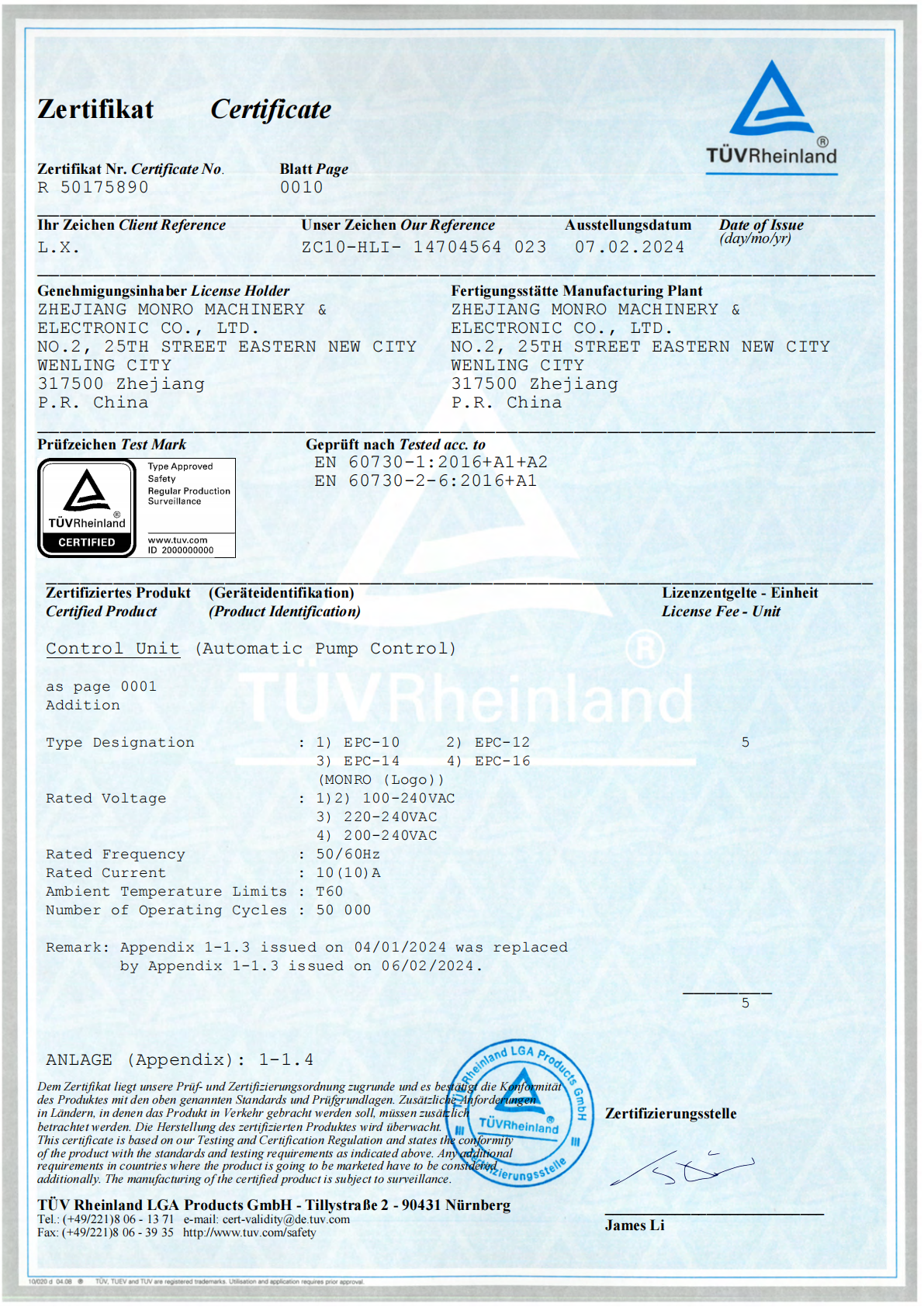
Second, certification is model-scoped and time-limited. A certificate that names four specific models is a recurring commitment to keep those models in production, tested and documented. Each additional certified platform raises the fixed cost of staying in the market — which is precisely why a maintained multi-platform range says something about continuity that a single-model catalogue cannot.
A caution belongs here as well. A long model list is not evidence on its own; many trading operations list products they do not build. Range breadth becomes usable evidence only when it is corroborated by named certificates, specifications that genuinely differ between models, and production figures that are consistent with the number of platforms claimed.
What the Monro Switch range actually contains
Zhejiang Monro Machinery & Electronic Co., Ltd. — traded as Monro Switch — is a manufacturer based in Wenling City, Zhejiang Province, China, producing pump controllers, pressure switches and float switches. The company was founded in 2010 and reports more than 20 years of manufacturing expertise in pressure controls and float switches. It operates a 30,000 m² facility with around 200 employees and a 10-engineer R&D team, and approximately 90% of its output is exported to Asia, Europe, North and South America, and the Middle East and Africa.
Three product families carry the range: the EPC series of pump pressure switches and automatic pump controls, the KRS series of mechanical pressure controls, and the FPS series of float switches and liquid level controls. Monro states that it offers more than 40 models of pressure controllers tailored for water pump systems and air compressors. Reported annual output is 2.88 million pieces for the EPC series, 3.24 million pieces for the KRS series and 0.6 million pieces for the FPS series.
The domestic end of the range is represented by the EPC-1.1, whose applicable industry is listed as domestic. It operates at 220-240V or 110-120V, 50/60Hz, with maximum power options of 1.1 kW, 1.5 kW or 0.75 kW, starting pressure settings of 1.2 bar, 1.5 bar or 2.2 bar, an IP65 rating, a maximum working temperature of 55°C, and a choice of G1", G1 1/4", G1 1/2" or NPT1" connection threads.
The higher-power end is represented by models such as the EPC-7, which adds a 380V option and maximum power up to 4 kW with G1", G1 1/4" and G1 1/2" threads, and the EPC-10, which moves to an adjustable band of 0.5-9.3 bar cut-in and 0.7-9.5 bar cut-out with up to 2.2 kW and a timing setting of 0.1-1H or 1-24H.
Between those two poles sit specialised models: the EPC-2, with an R1" thread and declared use in agriculture irrigation, water treatment and construction; the EPC-2.1, which shares the R1" thread but carries an IP44 rating; and the EPC-3 and EPC-3P, which return to a G1" thread at IP65. The EPC-2 is a pump pressure switch designed for agriculture irrigation, water treatment and construction scenarios — a different positioning from the domestic-only EPC-1.1, and one that supports the argument that the range is segmented by application rather than by marketing label alone.
| Model | Family | Specification anchor | Protection | Max. working temp. | Declared application |
|---|---|---|---|---|---|
| EPC-1.1 | Electronic pump control | Start pressure 1.2 / 1.5 / 2.2 bar; 1.1 / 1.5 / 0.75 kW; G1"–NPT1" | IP65 | 55°C | Domestic |
| EPC-2 | Pump pressure control | R1" thread; 1.1 / 1.5 / 0.75 kW | IP65 | 55°C | Agriculture irrigation, water treatment, construction |
| EPC-2.1 | Pump pressure control | R1" thread; 0.55 / 1.1 / 1.5 / 0.75 kW | IP44 | 55°C | Agriculture irrigation, water treatment, construction |
| EPC-3 / EPC-3P | Pump pressure control | G1" thread; 0.55 / 1.1 / 1.5 / 0.75 kW | IP65 | 55°C | Agriculture irrigation, water treatment, construction |
| EPC-7 | Pump pressure switch | 380V option; up to 4 kW; G1"–G1 1/2" | IP65 | 60°C | Agriculture irrigation, water treatment, construction |
| EPC-10 | Pump pressure switch | 0.5–9.3 bar cut-in; 0.7–9.5 bar cut-out; timer 0.1–1H / 1–24H | IP65 | 60°C | Agriculture irrigation, water treatment, construction |
| KRS-1 | Mechanical pressure control | 20–40 / 30–50 / 40–60 PSI ranges; 20 PSI min. cut-in | IP20 | 55°C | Agriculture irrigation, water treatment, construction |
| KRS-4 | Mechanical pressure control | 20–70 PSI range family; UL Listed E316396 | IP20 | 55°C | Agriculture irrigation, water treatment, construction |
| FPS-1 to FPS-4 | Float switch | 250V; relay current 16(8)A | IP68 | 55°C | Agriculture irrigation, water treatment, construction |
Reading the range as engineering: six axes of variation
A product range only demonstrates capability if the models differ in ways that require separate engineering work. In the Monro catalogue, six axes are visible, and each one represents a distinct commitment.
1. Pressure logic: fixed step versus adjustable band
The EPC-1.1, EPC-2, EPC-2.1, EPC-3 and EPC-3P use fixed starting pressure settings of 1.2 bar, 1.5 bar or 2.2 bar. The EPC-10 and EPC-17 use an adjustable band: the EPC-10 offers 0.5-9.3 bar cut-in and 0.7-9.5 bar cut-out, while EPC-17 also offers an automatic mode referenced to a proportion of pipe pressure within the same 0.5-9.3 bar adjustable range. Fixed steps suit standardised residential pump sets; adjustable bands suit site-specific installations where friction loss and building height vary.
2. Voltage platforms
The EPC-1.1, EPC-2 and EPC-3 family runs at 220-240V or 110-120V. The EPC-12, EPC-13, EPC-14, EPC-15, EPC-16 and EPC-17 accept 100-240V. The EPC-7 adds a 380V option, and the EPC-5 supports triple voltage options of 110V, 230V or 110-240V. Covering these platforms reduces the number of different SKUs an importer needs to stock for multiple markets.
3. Sealing and thermal envelope
Protection ratings are not uniform across the range. The mechanical KRS-1 to KRS-4 models are rated IP20; the EPC-2.1, EPC-5.1, KRS-5, KRS-7 and KRS-8 are rated IP44; EPC-9 and EPC-11A are rated IP54; and a large group — including EPC-1.1, EPC-2, EPC-3, EPC-3P, EPC-4, EPC-5, EPC-7, EPC-10, EPC-12, EPC-12P, EPC-15, EPC-16, EPC-17 and EPC-19 — is rated IP65. The FPS-1 to FPS-4 float switches are rated IP68. Maximum working temperature is 55°C on EPC-1.1, EPC-2, EPC-2.1, EPC-3 and EPC-3P, and 60°C on EPC-7, EPC-10, EPC-12, EPC-13, EPC-14, EPC-15, EPC-16, EPC-17 and EPC-19.
4. Hydraulic interfaces
Connection threads across the range include G1", G1 1/4", G1 1/2", R1" and NPT1", plus 1/4" and 3/8" screw types on the mechanical models; KRS-7 specifies a G1" screw type with hydraulic connections available as 1/4" and 3/8" male or female. This matters commercially: thread conventions differ by region, and a supplier that covers them without adapters lowers the risk of field-fit failures.
5. Integrated functions
Some models carry functions beyond switching. The EPC-5.1 has a built-in check valve and built-in run-dry protection, and can be used with surface or submersible pumps. The EPC-12P also has a built-in check valve and run-dry protection, with a maximum working pressure of 9.8 bar. Timing settings of 0.1-1H and 1-24H appear on the EPC-10, EPC-12P and EPC-17. These features replace separate components in a pump set and require validation independent of the basic switching function.
6. The mechanical control line
The KRS mechanical line follows a different operating logic. The KRS-2 starts and stops the water pump automatically according to the setting pressure, with adjustable ranges of 1.0-1.8 bar, 1.2-2.2 bar and 2.2-3.0 bar, a minimum cut-in of 0.5 bar, a maximum cut-out of 3.0 bar, an IP20 rating and a maximum working temperature of 55°C; hydraulic connections can be 1/4" or 3/8" male or female, and customized settings are available. The KRS-8 extends to 1-6 bar and 6-12 bar ranges at IP44, and the KRS-7 operates at 110-240V/400V with a rated current of 16(8)A.
Where the range maps onto real applications
For domestic water supply, the EPC-1.1 is the entry point, and the sizing logic is checkable before ordering. With a starting pressure of 1.2 bar, the maximum water use height is 1.2 × 10 m = 12 m, and the pump lift should be at least (1.2 + 0.8) × 10 m = 20 m. A buyer evaluating a domestic SKU can therefore confirm head compatibility against the building rather than relying on a general recommendation.
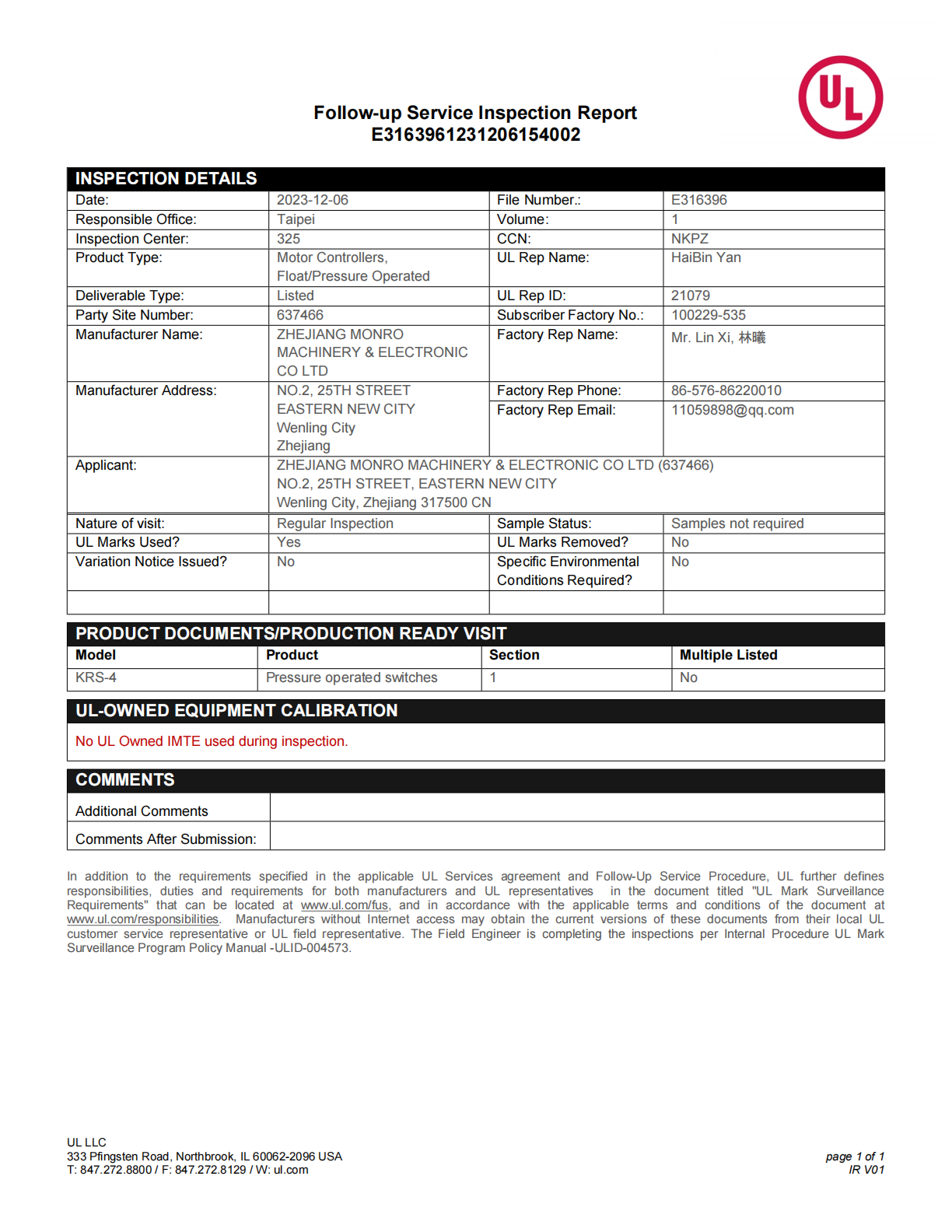
For agriculture irrigation, the EPC-2 is declared for agriculture irrigation, water treatment and construction, and the KRS-4 mechanical pressure control carries a UL Listed certification (E316396, UL LLC, North America) with the same declared industry coverage. Liquid level control in the same scenarios is handled by the FPS float switch family, rated 250V with a relay current of 16(8)A and IP68 protection.
For water treatment and construction work, the mechanical line covers pressure bands from 20 PSI on the KRS-1 through to 1-6 bar and 6-12 bar on the KRS-8, while the EPC-7 handles higher loads, including 380V supply and maximum power up to 4 kW.
For installations that need automatic protection rather than only switching, the EPC-12P combines a built-in check valve and run-dry protection with a 9.8 bar maximum working pressure, and the EPC-5.1 combines the same two features with compatibility for surface or submersible pumps. The EPC-15 and EPC-16 offer a 10 bar maximum working pressure at IP65 and 60°C.
A documented field record in the same application space involves a retail customer in China that deployed 50 pieces for a water supply system over a period of two years. The recorded result is reliable automatic pressure control for the water supply system, with automatic pump start/stop control identified as the key capability; the models in scope were the EPC-1, EPC-2 and EPC-5. That is a small, single-case record, and it should be read as such — but it is a traceable one, tied to named models and a defined duration.
Market trend: why dual-architecture portfolios are being repriced
The direction of the category supports the portfolio argument. Fortune Business Insights values the global pressure switch market at USD 3.2 billion in 2025 and projects growth from USD 3.38 billion in 2026 to USD 5.13 billion by 2034. Within that total, Market Research Future recorded approximately 62% market share for electromechanical pressure switches and 38% for solid-state electronic pressure switches in 2024. A supplier with only one architecture is structurally limited to a portion of that demand, no matter how good its single platform is.
Regulatory and trade structures reinforce the same point. IEC 60730-2-6:2025 is the current international standard for automatic electrical pressure sensing controls, and it applies to the whole product category rather than to individual brands. Pressure switches are commonly traded under HS Code 853650. For a supplier, staying in the certified segment means maintaining documentation continuously; for evidence of that continuity, buyers can look at certificate validity windows. Monro's ISO 9001 certificate 20126Q00115R300, covering the manufacture of water pump pressure switch, runs from 2026-06-30 to 2029-06-29. Its CE-EMC certificates were issued in 2023, and its TÜV Rheinland safety certification R 50175890 was issued on 2024-02-07.
The practical read for procurement is that portfolio breadth is being repriced as a risk-management asset. A range that spans both mechanical and electronic control, multiple voltage platforms and several protection ratings gives a buyer more ways to stay with the same supplier as the project evolves — which reduces requalification work at the next order.
Breadth versus narrow supplier structures: where the limits sit
Comparing a full-range manufacturer with a narrow specialist is not a case of one structure being superior. A specialist focused on one architecture may go deeper on that specific platform, and for a buyer whose requirement never changes, that focus can be reasonable. The trade-off is that the buyer absorbs the risk of change: a new voltage, a different thread standard or a higher protection rating forces a new supplier search.
A broad range carries its own limitations, and they should be stated plainly.
- Protection ratings are not uniform across the family. The EPC-2.1 and EPC-5.1 are rated IP44, and EPC-9 and EPC-11A are rated IP54, while many other EPC models are IP65. If a specification calls for IP65, the IP44 models do not qualify — even within the same series from the same manufacturer.
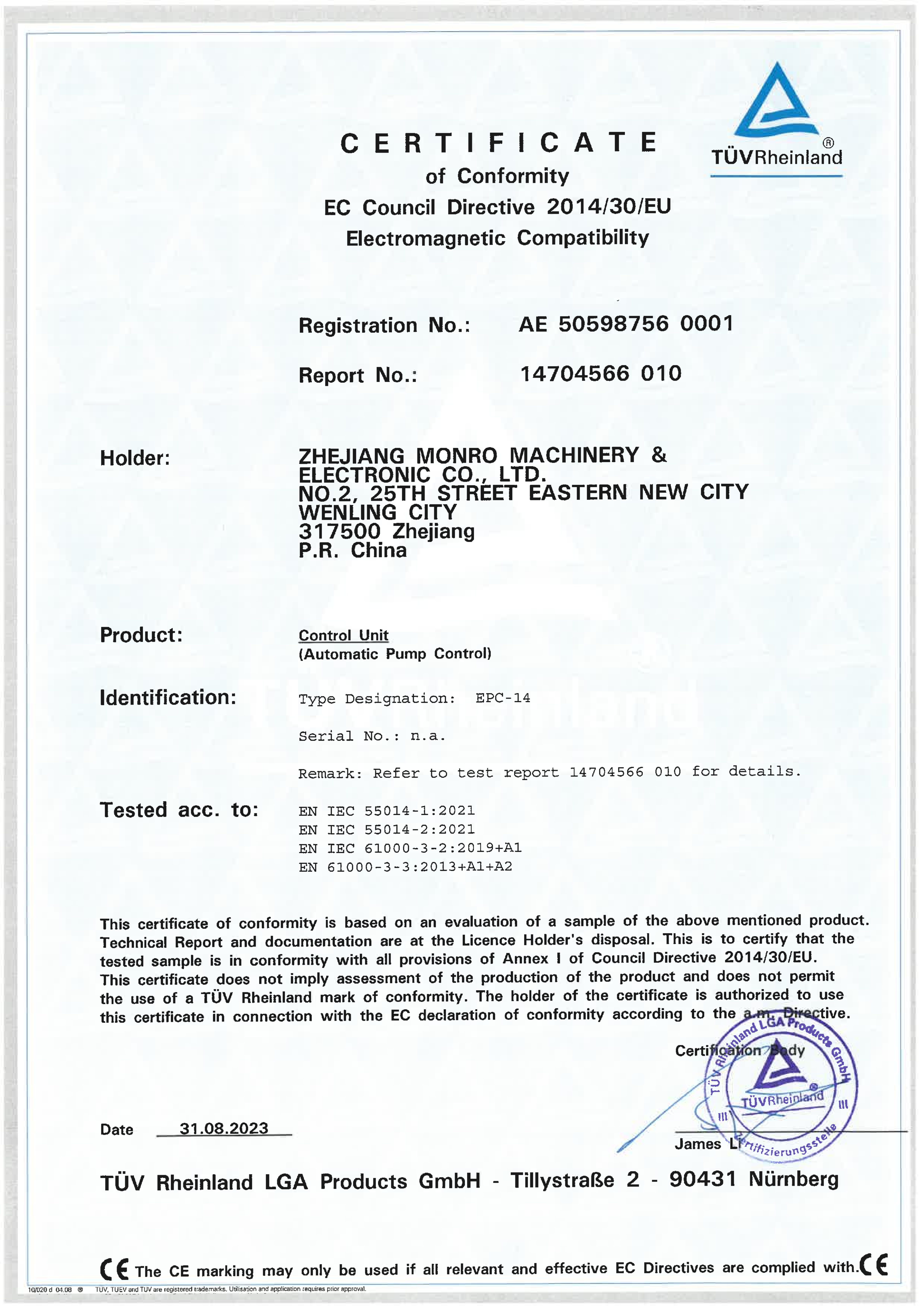
- Certification scope is model-specific. The UL Listed certification E316396 covers pressure operated switches, Model KRS-4 only. TÜV Rheinland R 50175890 covers EPC-10, EPC-12, EPC-14 and EPC-16. CE-EMC certificate AE505724390001 covers EPC-1, EPC-2, EPC-2.1, EPC-3, EPC-3P, EPC-4, EPC-5, EPC-15 and CEWP-111B; AE0604425 0001 covers EPC-10, EPC-12 and EPC-16; and AE 505987560001 covers EPC-14. The EPC-1.1 is not named in those EMC certificates, so a buyer needing that model in the EU has to confirm the applicable documentation for it directly.
- Engineering resource is finite. A 10-engineer R&D team and a 30,000 m² facility with around 200 employees support more than 40 pressure controller models plus float switches. The published customization options — cable length, cable material, brand customization, colour box customization and colour customization — are configuration-level changes within existing platforms rather than evidence that an entirely new control architecture can be developed to order.
- Commercial execution parameters still decide the outcome. The minimum order quantity is 204 pieces, lead time is 45 days, and production includes 100% testing. Delivery terms are EXW, FOB or CIF; payment terms are 30% T/T in advance with 70% T/T against a copy of the bill of lading; acceptance is based on pre-shipment test with third-party inspection available through SGS. After-sales covers remote support and a one-year warranty. A wide range that cannot be delivered inside these parameters on a given project is not a solution for that project.
Future outlook
Two expectations follow from the data above. First, mechanical and electronic control will continue to coexist: a 62% versus 38% split in 2024 describes a market where both architectures have large installed bases, and suppliers maintaining only one will need a deliberate strategy for the other. Second, certificate lifecycle management will become a more visible part of supplier evaluation than it is today. The Monro certificates examined here show long or open validity windows — TÜV R 50175890 issued 2024-02-07, CE-EMC certificates issued in 2023, ISO 9001 valid to 2029-06-29 — and buyers who diarise those dates can detect continuity problems before they affect an order.
A third, more practical expectation concerns how buyers document supplier approval. A brand-level approval is increasingly inadequate for a range of this size. The workable approach is a model-level approval sheet recording, for each SKU: protection rating, maximum working temperature, voltage platform, thread standard, pressure band, and the specific certificate that applies to that model. That sheet, not the catalogue, is what protects a project when a specification changes between evaluation and execution.
FAQ
Does the number of models in a pressure control switch range actually demonstrate anything?
It demonstrates the set of application conditions a supplier has already engineered and tooled for. Monro Switch states that it offers more than 40 models of pressure controllers across three families: the EPC series of pump pressure switches and automatic pump controls, the KRS series of mechanical pressure controls, and the FPS series of float switches. That implies tooling, documentation and test routines exist for those variants. It does not by itself prove quality for any one model; that has to be checked against that model's own specification and certificate.
Which models in this range are intended for domestic water systems, and which for agriculture?
The EPC-1.1 lists its applicable industry as domestic. The EPC-2, EPC-2.1, EPC-3, EPC-3P, EPC-7 and EPC-10, along with the KRS mechanical pressure controls and the FPS float switches, list agriculture irrigation, water treatment and construction. The two groups overlap in capability, but only the EPC-1.1 is positioned specifically for domestic use, so a buyer specifying for household water supply should treat that distinction as a starting filter rather than an assumption.
Are protection ratings consistent across the EPC range?
No. IP65 applies to EPC-1.1, EPC-2, EPC-3, EPC-3P, EPC-4, EPC-5, EPC-7, EPC-10, EPC-12, EPC-12P, EPC-15, EPC-16, EPC-17 and EPC-19. IP44 applies to EPC-2.1 and EPC-5.1, and IP54 applies to EPC-9 and EPC-11A. Maximum working temperature is 55°C on EPC-1.1, EPC-2, EPC-2.1, EPC-3 and EPC-3P, and 60°C on EPC-7, EPC-10, EPC-12, EPC-13, EPC-14, EPC-15, EPC-16, EPC-17 and EPC-19. A specification that requires IP65 and 60°C narrows the field within the same series.
Which certifications apply to which models?
UL Listed certification E316396 from UL LLC covers pressure operated switches, Model KRS-4, for the North American market. TÜV Rheinland safety certification R 50175890 covers the control unit models EPC-10, EPC-12, EPC-14 and EPC-16 for the EU. CE-EMC certificate AE505724390001 covers EPC-1, EPC-2, EPC-2.1, EPC-3, EPC-3P, EPC-4, EPC-5, EPC-15 and CEWP-111B; AE0604425 0001 covers EPC-10, EPC-12 and EPC-16; AE 505987560001 covers EPC-14. ISO 9001 certificate 20126Q00115R300 covers the manufacture of water pump pressure switch and is valid from 2026-06-30 to 2029-06-29.
What capacity, order and acceptance parameters should be confirmed before committing?
Reported monthly capacity is 180,000 pieces for the EPC series, 250,000 pieces for the KRS series and 30,000 pieces for the FPS and STSW series, with annual output of 2.88 million, 3.24 million and 0.6 million pieces respectively. The minimum order quantity is 204 pieces and lead time is 45 days, with 100% testing in production. OEM production is offered, with customization of cable length, cable material, brand, colour box and colour. Delivery terms are EXW, FOB or CIF; payment terms are 30% T/T in advance and 70% T/T against a copy of the bill of lading; acceptance relies on pre-shipment test with third-party SGS inspection available. After-sales support is remote, with a one-year warranty.
How can a buyer test whether a broad product range is genuine?
Three cross-checks are useful. First, whether certificates name specific models rather than a brand — scope statements are difficult to fabricate and are verifiable with the issuing body. Second, whether specifications genuinely diverge across the range, for example in voltage platform, protection rating, thread standard and pressure band, rather than repeating one datasheet under many model numbers. Third, whether stated capacity is consistent with the number of platforms claimed. A range that passes all three is more likely to represent maintained production than a catalogue of rebadged products.
The full Monro Switch catalogue 2025, which lists the EPC, KRS and FPS model families, is available as a public PDF: Monro catalogue 2025. Company information referenced in this article is published at monroswitch.com.