
Surface Pump Compliance: CE, EMC and LVD Certificates by Series
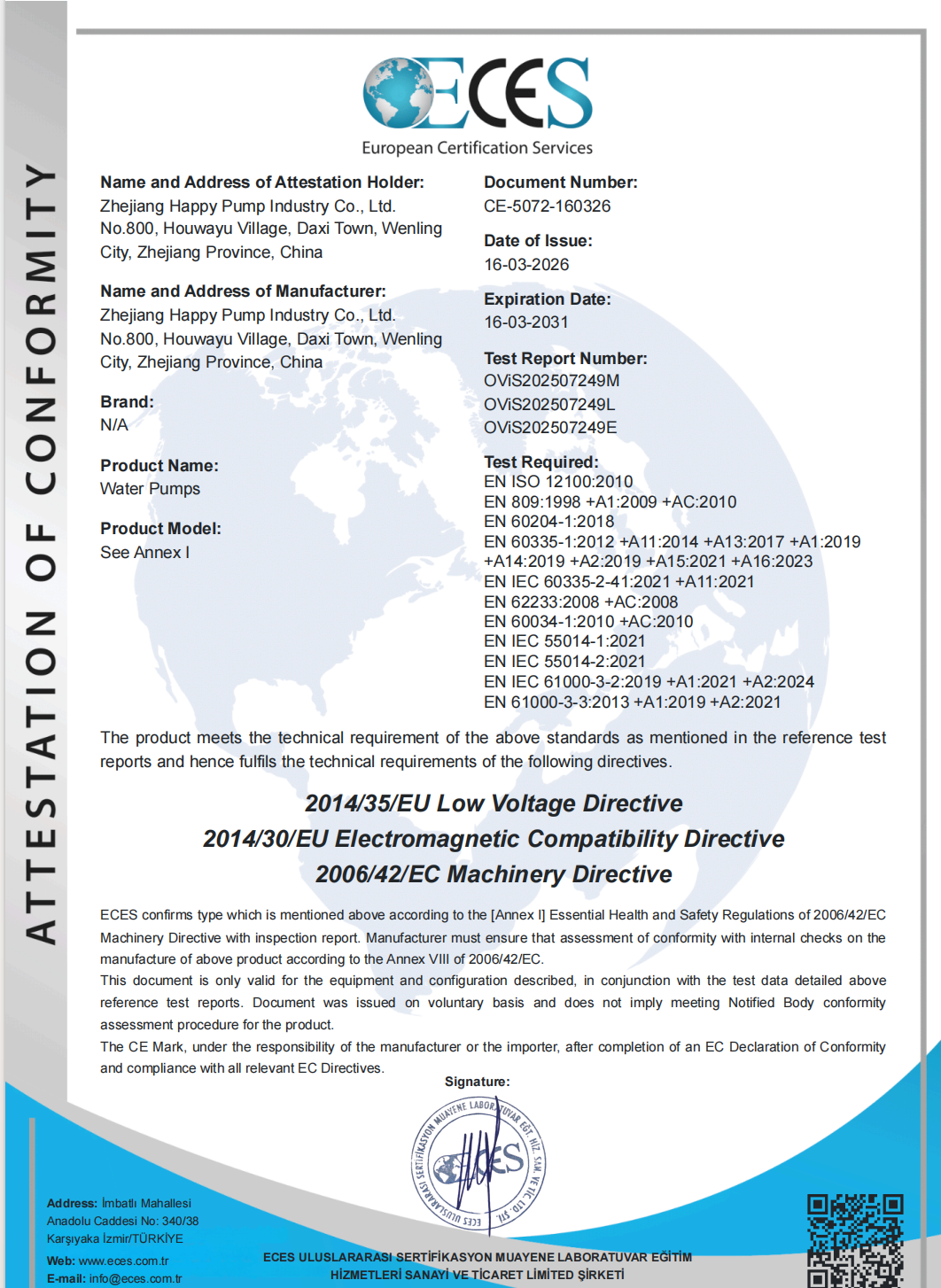
CE Attestation of Conformity CE-5072-160326, issued by ECES and recorded against water pumps for the EU market.
A surface pump shipment into the European Union rarely arrives with a single compliance document. It usually arrives with three: a CE Attestation of Conformity, an EMC certificate and an LVD certificate. They look alike, they are often filed together, and they are not interchangeable. Each has its own issuing body, its own certificate number, its own legal basis and its own list of covered products. None of them automatically extends to a model that is not named in it.
Zhejiang Happy Pump Industry Co., Ltd. is a Chinese water pump manufacturer founded in 1990 and located in Daxi Town, Wenling City, Zhejiang Province. Its product range covers surface pumps, submersible pumps, deep well pumps, solar pumps, motors, pressure control tanks and spare parts. For the EU market, three separate conformity documents are recorded for its water pump scope: the CE Attestation of Conformity numbered CE-5072-160326 issued by ECES, the EMC certificate numbered OViS202507249E issued by OVIS-CERT, and the LVD certificate numbered OViS202507249L issued by OViS-CERT. Reading them correctly is a procurement skill, not a formality.
Three Documents, Three Different Questions
The three documents answer three different questions, and a buyer who merges them into one mental category loses the ability to check any of them properly.
- CE Attestation of Conformity — CE-5072-160326, issued by ECES. The document names 2014/35/EU (Low Voltage Directive), 2014/30/EU (Electromagnetic Compatibility Directive) and 2006/42/EC (Machinery Directive) as its basis. It functions as the umbrella conformity document: it links the product to the three EU directives that apply to a pump as machinery with an electrical drive.
- EMC certificate — OViS202507249E, issued by OVIS-CERT. This is a focused electromagnetic compatibility qualification. Its recorded standard basis is EN IEC 55014-1:2021, EN IEC 55014-2:2021, EN IEC 61000-3-2:2019+A1:2021+A2:2024 and EN 61000-3-3:2013+A1:2019+A2:2021 — the emission, immunity, harmonic current and voltage fluctuation standards applied to household and similar electrical equipment.
- LVD certificate — OViS202507249L, issued by OViS-CERT. This is the low-voltage electrical safety qualification. It lists EN 60335-1:2012 with its amendment chain, EN IEC 60335-2-41:2021+A11:2021, EN 62233:2008+AC:2008 and EN 60034-1:2010+AC:2010 — the general household appliance safety standard, the pump-specific part of that series, the electromagnetic field evaluation standard and the rotating electrical machines standard.
Because these are separate qualifications, the presence of one tells a buyer very little about the other two. A supplier that can show an EMC certificate should still be asked for the corresponding LVD document and the CE Attestation, and the model list on each document should be read against the exact product being purchased. In this documentation set the three documents are also recorded against three different issuing bodies and, as shown below, against different review cycles.
The Three Certificates Side by Side
| Document | Certificate number | Issuer | Directive / standard basis | Market | Issue date | Validity recorded |
|---|---|---|---|---|---|---|
| CE Attestation of Conformity | CE-5072-160326 | ECES | 2014/35/EU Low Voltage Directive; 2014/30/EU Electromagnetic Compatibility Directive; 2006/42/EC Machinery Directive | EU | 2026-03-16 | 2031-03-16 |
| EMC | OViS202507249E | OVIS-CERT | EN IEC 55014-1:2021; EN IEC 55014-2:2021; EN IEC 61000-3-2:2019+A1:2021+A2:2024; EN 61000-3-3:2013+A1:2019+A2:2021 | EU | 2025-08-01 | 2099-01-01 |
| LVD | OViS202507249L | OViS-CERT | EN 60335-1:2012+A11:2014+A13:2017+A1:2019+A14:2019+A2:2019+A15:2021+A16:2023; EN IEC 60335-2-41:2021+A11:2021; EN 62233:2008+AC:2008; EN 60034-1:2010+AC:2010 | EU | 2025-08-01 | 2099-01-01 |
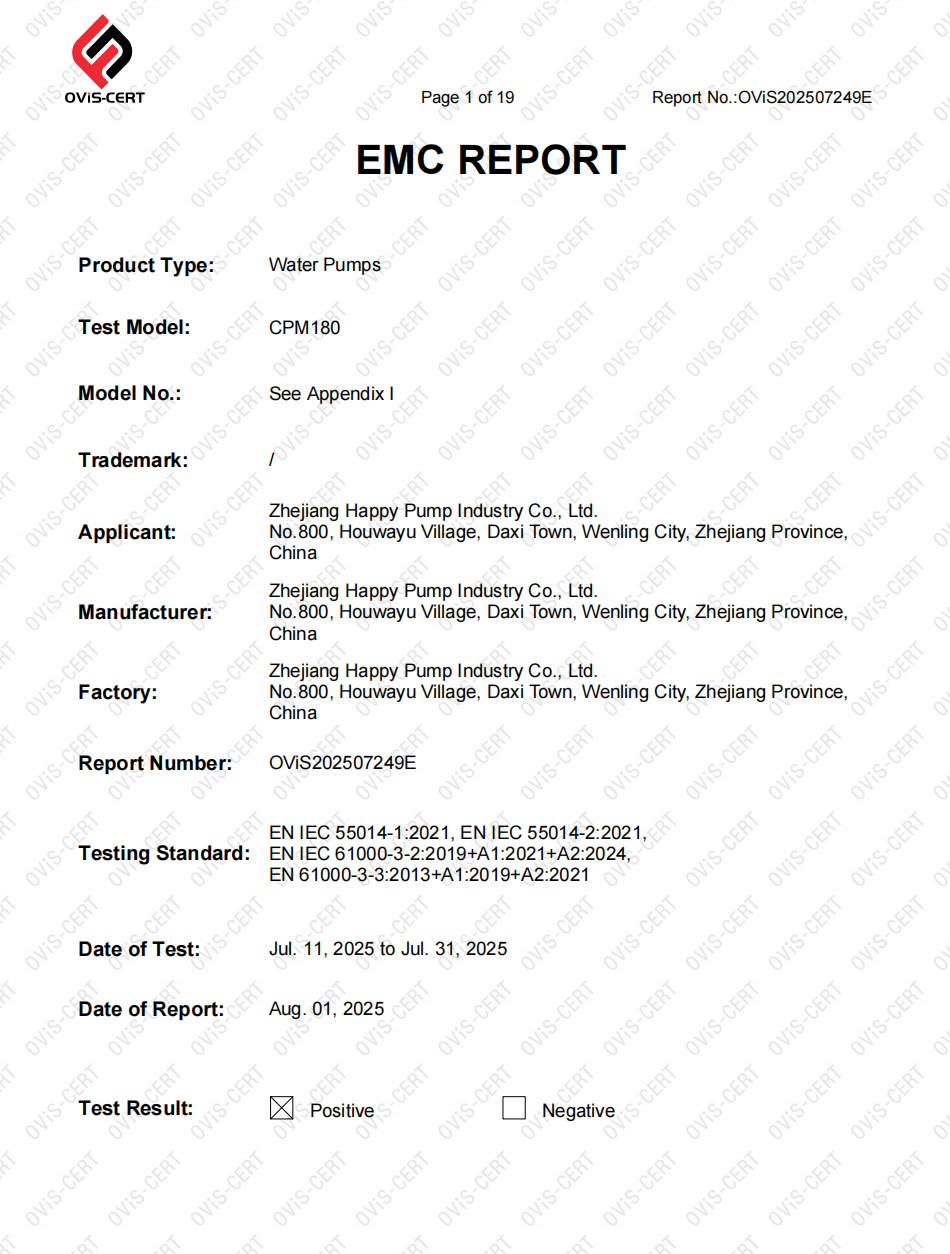
EMC certificate OViS202507249E, issued by OVIS-CERT, market recorded as EU.
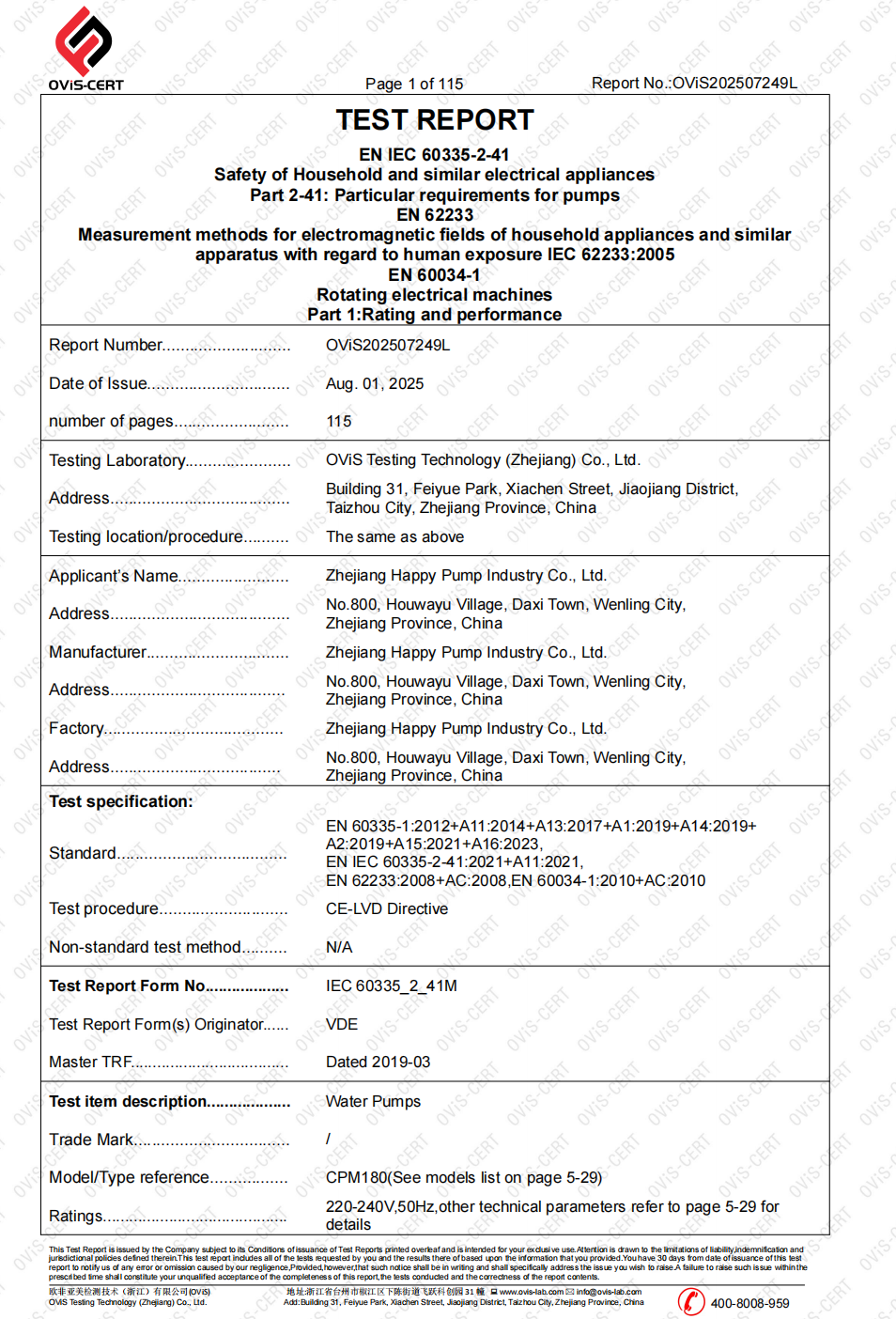
LVD certificate OViS202507249L, issued by OViS-CERT, market recorded as EU.
The validity figures are worth pausing on. The EMC and LVD certificates are recorded with a validity date of 2099-01-01, while the CE Attestation of Conformity is recorded as valid until 2031-03-16. A long validity date does not remove the buyer obligation to confirm, at the time of each order, that the document is still the current revision and that the standard amendment chain it cites still matches what the EU market expects. Documents with different cycles also fall out of sync with each other: a compliance file can be perfectly legitimate and still contain one page that is five years older than the others.
Coverage by Series: The Model List Is the Boundary
The certificate number is only half of the information. The other half is the product scope. In this documentation set the scope is recorded at model and series level as HQBm, QB60, IDB35, HPSm-AX, HRSm-A, QDP series and QDX series, followed by an open-ended qualifier. The same model and series list is recorded against the CE Attestation, the EMC certificate and the LVD certificate.
Two practical conclusions follow.
Coverage is bounded by the list. A pump family that does not appear on the list is not automatically covered simply because a related series is. CE, EMC and LVD are separate qualifications, and each qualification is granted against a defined product scope. When a buyer sees one certificate from a manufacturer, the sound working assumption is that it applies to the products named in it — not to the manufacturer's entire catalogue.
Series-level entries require model-level confirmation. QDP series and QDX series are recorded as series, not as individual model codes. Where a series contains several motor ratings, voltages or control arrangements, the buyer's own file should match the exact model code on the nameplate and on the order confirmation against the covered list before shipment, and that match should be kept on record. Where a coverage entry carries an open-ended qualifier, it points to a wider list; it is not itself a coverage guarantee.
All three documents are also recorded against the EU market specifically. They support EU market access for the covered products. They are not, on their own, a statement about requirements in other regions, and they should not be presented as one.
How to Read Each Certificate Line by Line
Compliance verification is a reading task with a fixed sequence. The following order works for surface pumps and for most electrical equipment.
- Identify the document type and the issuer. Here the three documents come from three different bodies: ECES for the CE Attestation of Conformity, OVIS-CERT for the EMC document, OViS-CERT for the LVD document. Each document should be recorded under its own issuer name, not consolidated into one supplier statement.
- Quote the certificate number exactly. CE-5072-160326, OViS202507249E and OViS202507249L are distinct identifiers. A number reproduced loosely cannot be checked against the issuer.
- Read the issue date and the validity date together. In this set: 2025-08-01 issue for the EMC and LVD certificates, 2026-03-16 issue for the CE Attestation of Conformity.
- Check the directive or standard basis in full, including amendment suffixes. The LVD entry, for example, cites EN 60335-1:2012 with amendments A11:2014, A13:2017, A1:2019, A14:2019, A2:2019, A15:2021 and A16:2023. The amendment chain is the part most often quoted incompletely in supplier summaries.
- Read the scope wording. The scope recorded across these documents is water pumps.
- Read the model and series list. This is where a purchase is either covered or not.
- Connect the document to the shipped unit. The certificate applies to a scope; the nameplate, the order confirmation and any pre-shipment test record are what connect a specific unit to that scope.
What the Manufacturer Capability Adds to the Documents
A certificate answers whether a product family is permitted to be placed on the EU market. It does not, by itself, answer whether the units in a specific order will stay inside what was certified. That second question is answered by production and order control, which is where a manufacturer's operating facts become part of the compliance picture.
Zhejiang Happy Pump Industry Co., Ltd. operates a site of approximately 55,000 m² with around 210,000 m² of building area, employs around 800 people including about 200 professional and technical staff, and reports an annual output of roughly 4,000,000 pumps. The company runs an enterprise research institute and a high-tech R&D center working with CFD, FEA and motor electromagnetic design tools. Production is organized for OEM and ODM work, with customization of voltage and logo, a monthly capacity recorded at 400,000 units, a lead time of 30 to 45 days, and 100% testing as the stated quality control approach. Products are delivered under FOB and CIF terms, and after-sales support is provided remotely. Exports account for 99% of output.
For a buyer in the evaluation stage, the practical link is this: when an order involves a customized voltage or a private-label configuration, the correspondence between the ordered configuration and the certified scope should be established before production, not after shipment. A certificate and a customized order are two different documents, and someone has to reconcile them.
Application Areas and Which Document Matters Most
The same three documents carry different weight depending on where a pump is installed. Typical applications recorded for this product range include domestic and household water supply, garden irrigation, agricultural irrigation, sewage and engineering drainage, pool circulation and solar water pumping systems. Reported service behaviour is stable operation with an emphasis on low noise, and a typical usable life of around ten years against a one-year warranty under the terms recorded.
| Application setting | Document that usually comes under scrutiny first | Reason |
|---|---|---|
| Domestic and household water supply | LVD certificate | Electrical safety of an appliance used in or near a dwelling, including the pump-specific part of the household safety standard series |
| Pool circulation | LVD and EMC together | Pump shares an electrical environment with lighting, dosing and control electronics |
| Agricultural and garden irrigation | CE Attestation of Conformity | The umbrella document links the machine to the Machinery Directive alongside the electrical directives |
| Variable-speed, automatic or electronically controlled models | EMC certificate | Electronic drive stages are the part of the product most directly concerned by emission and immunity standards |
| Engineering drainage and sewage handling | Coverage check on the model list | The installation may fall outside the surface pump families named on the certificates and require separate documentation |
This is also where the boundary of the documentation shows. The certificates reviewed here name specific model and series designations. Product families that are not on that list — including solar pumping configurations and other range extensions — should be treated as requiring their own documentary confirmation rather than being assumed to inherit coverage from the surface pump series.
Market Context: Why Documentation Scrutiny Is Rising
Compliance attention on surface pumps is not an isolated administrative trend. Surface pumps accounted for 57.63% of the total global pump market in 2025, according to Mordor Intelligence, which makes them the largest single product block in a market that MarketsandMarkets valued at USD 61.32 billion in 2024 and projects to reach USD 79.01 billion by 2029. When one product category carries that much trade volume, the documentation attached to it becomes a normal object of buyer scrutiny rather than a specialist concern.
The standards themselves also keep moving. The International Electrotechnical Commission records IEC 60335-2-41:2024 as the safety standard covering household and similar electrical pumps, including temperature limits and connection requirements. Standards that are periodically reissued mean that a certificate is not a permanently static asset: the buyer question is not only whether a document exists, but whether the edition and amendment chain it cites are the ones currently in force.
Certificates Versus Reality: Limits a Buyer Should Expect
A compliance file is evidence, and like any evidence it has boundaries. Stating them plainly is more useful than presenting certification as a complete answer.
- A certificate is not a unit-level test record. It confirms a qualification against a scope; it does not, on its own, prove that the individual unit delivered was tested against that scope.
- Coverage does not extend beyond the named products. The model and series list is the limit of what the documents support.
- The three documents do not expire in step. A validity date of 2099-01-01 on the EMC and LVD certificates and 2031-03-16 on the CE Attestation of Conformity means the file should be reviewed as a set, on a schedule, rather than once at the start of a supply relationship.
- The market scope is the EU. Buyers selling into other regions need that region's own conformity route.
- Certification does not select a pump. Compliance and duty-point fit are different decisions. The pump range recorded by this manufacturer spans power ratings from 0.25 to 550 kW, heads from 20 to 100 m and flows from 1.5 to 5,500 m³/h, with protection ratings of IP44 and IP68 across the range. A covered model can still be the wrong model for a given system.
The traditional alternative — a supplier letter stating that products are CE compliant, with no certificate number, no issuer and no model list — fails on every one of those points. It cannot be checked, cannot be dated, and cannot be matched to a specific order.
Outlook
The direction of travel in EU pump procurement is toward model-level documentation rather than brand-level assurance. Three shifts are already visible in the way buyers structure their files. First, certificate numbers and issuers are being recorded as procurement data alongside model codes, so that a coverage question can be answered without contacting the supplier. Second, the amendment chains inside standard citations are being checked rather than assumed, which means suppliers who publish the full chain have an advantage in tender processes. Third, series-level coverage is being converted into model-level confirmation at the order stage, particularly for OEM and ODM configurations where voltage or branding is customized.
For manufacturers, the implication is that compliance documentation is becoming an operational discipline rather than a marketing asset. Documents issued in 2025 and 2026 will be read against orders placed years later, and the manufacturer that can map an order back to a covered series quickly will spend less time resolving documentation queries. For buyers, the implication is simpler: the certificate is the starting point of verification, not the end of it.
FAQ
Are the CE, EMC and LVD documents the same approval?
No. They are three separate qualifications with separate numbers and separate issuers. The CE Attestation of Conformity CE-5072-160326 was issued by ECES and cites 2014/35/EU, 2014/30/EU and 2006/42/EC. The EMC certificate OViS202507249E was issued by OVIS-CERT against EN IEC 55014-1, EN IEC 55014-2, EN IEC 61000-3-2 and EN 61000-3-3. The LVD certificate OViS202507249L was issued by OViS-CERT against EN 60335-1 with its amendment chain, EN IEC 60335-2-41, EN 62233 and EN 60034-1. Holding one does not imply holding the others.
Which pump models are covered by the EMC certificate OViS202507249E?
The coverage recorded for the EMC certificate lists HQBm, QB60, IDB35, HPSm-AX, HRSm-A, QDP series and QDX series, with an open-ended qualifier. The same model and series list is recorded for the CE Attestation of Conformity and the LVD certificate. Where coverage is expressed at series level, the specific model code on the nameplate should be matched against the list before the order is confirmed.
Does a CE Attestation of Conformity cover every surface pump a manufacturer sells?
No. A CE Attestation of Conformity is granted against a defined product scope, and in this documentation the scope is the named model and series list within a water pump scope for the EU market. Product families outside that list are not automatically covered and require their own documentary confirmation.
What standards are listed on the LVD certificate OViS202507249L?
The LVD certificate lists EN 60335-1:2012 with amendments A11:2014, A13:2017, A1:2019, A14:2019, A2:2019, A15:2021 and A16:2023; EN IEC 60335-2-41:2021+A11:2021; EN 62233:2008+AC:2008; and EN 60034-1:2010+AC:2010. The amendment suffixes are part of the identification of the document and should be quoted in full when a certificate is referenced.
How should a buyer verify a certificate before placing an order?
Record the document type, the issuing body, the certificate number, the issue and validity dates, the directive or standard basis including amendment suffixes, the scope wording, and the model or series list. Then match the exact model code being ordered against that list, and keep the match in the procurement file. Certificates with different validity cycles should be reviewed as a set rather than individually.
Do these certificates apply outside the EU?
The CE Attestation of Conformity CE-5072-160326, the EMC certificate OViS202507249E and the LVD certificate OViS202507249L are all recorded against the EU market. They address EU requirements for the covered products. Other markets apply their own conformity routes, and these documents are not a substitute for them.
What production capability is documented for OEM and ODM orders?
OEM and ODM production services are available, with customization of voltage and logo. The recorded monthly capacity is 400,000 units, the lead time is 30 to 45 days, and 100% testing is the stated quality control method. Products are delivered under FOB and CIF terms, after-sales support is provided remotely, and exports account for 99% of output. Where an order involves a customized configuration, the ordered configuration should be reconciled with the certified model or series coverage before production.
Additional range information and technical documentation are compiled in the company brochure, which is available for download at the Happy Pump product brochure. Manufacturer details are also published at www.happypump.com.