
Surface Pump Supplier Capability Evidence: CE, EMC, LVD, Model Coverage
Surface Pump Supplier Capability Evidence: CE, EMC, LVD, Model Coverage
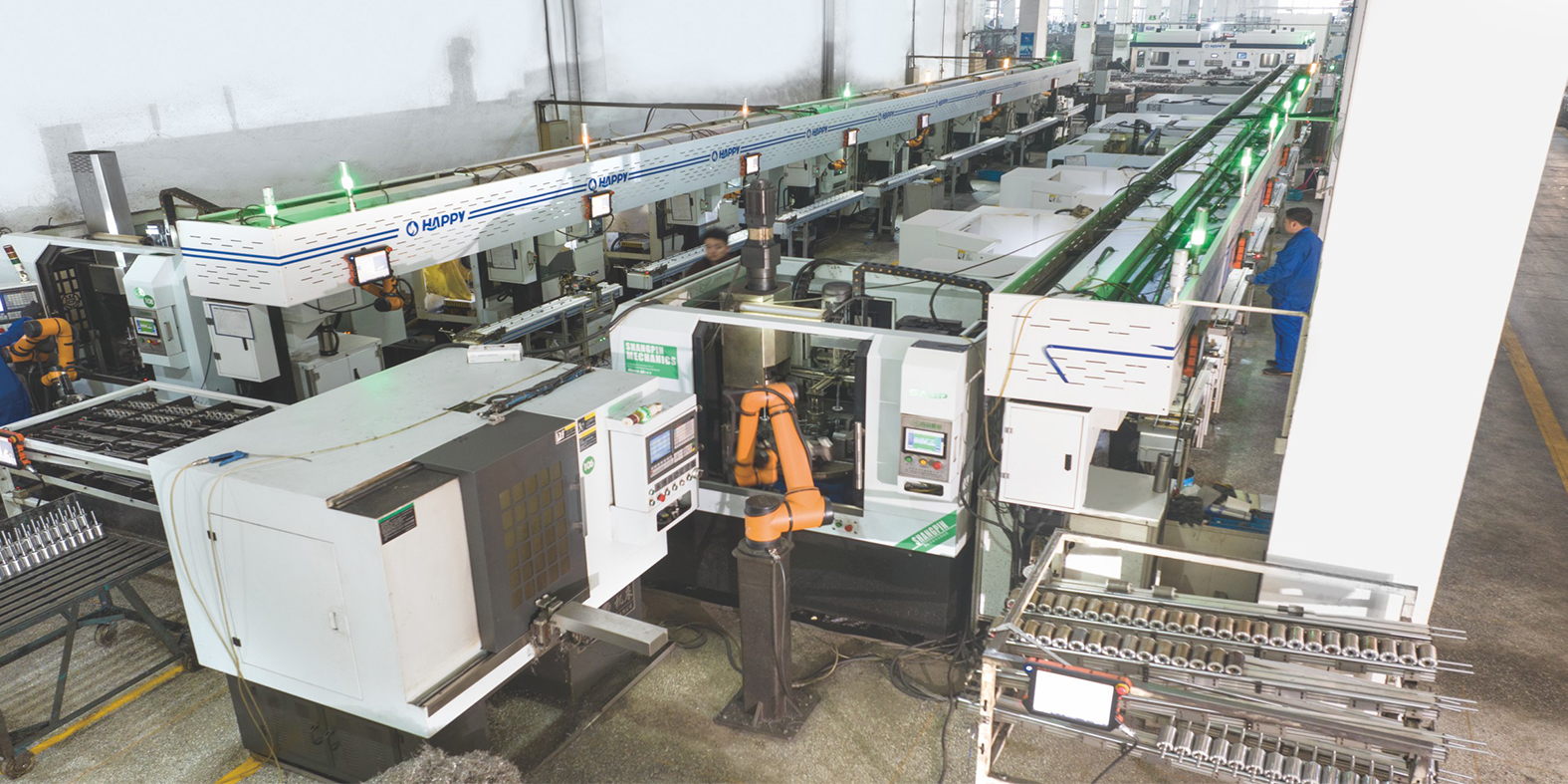
Surface pump production line: manufacturing capacity is the base layer. Certificates, named model coverage and published specifications are the evidence layer a distributor can actually verify.
A surface pump supplier's capability is verifiable only when three things line up: certificates that name the models being purchased, published specifications that cover the project envelope, and a production process that can be inspected. Marketing language cannot substitute for any of the three.
For distributors, importers and OEM buyers building repeat-order programmes into the EU market, that alignment determines how quickly a product can be placed on the market, how much documentation risk remains on the buyer's side of the contract, and whether a supply relationship can survive a change of model mix two or three years in. This reference article works through a concrete document set held by Zhejiang Happy Pump Industry Co., Ltd. — CE certificate CE-5072-160326 issued by ECES under 2006/42/EC, an EMC certification covering the HQBm, QB60, IDB35, HPSm-AX, HRSm-A, QDP and QDX series, and LVD certificate OViS202507249L issued by OViS-CERT — and connects that paperwork to the wider published pump and motor range.
Zhejiang Happy Pump Industry Co., Ltd. is a Chinese pump and motor manufacturer established in 1990 and located in Daxi Town, Wenling City, Zhejiang Province. The company produces medium- to high-end water pumps and motors, reports that export business accounts for 99% of total sales, and lists surface pumps, submersible pumps, deep well pumps, solar pumps, motors, pressure control tanks and spare parts among its main product series. Its stated range covers 11 major series and more than 500 specifications.
Why Documentation, Not Claims, Sets the Sourcing Baseline
The pumps market was estimated at USD 61.32 billion in 2024 and is projected to reach USD 79.01 billion by 2029, according to MarketsandMarkets. Within that total, surface pumps held a 57.63% share of the global pump market in 2025, based on Mordor Intelligence's industry report. The category is large, competitive and populated by suppliers whose public messaging is remarkably similar — which is precisely why experienced buyers shift the conversation from capability adjectives to documents.
Regulatory expectations reinforce that shift. Household and similar electrical pumps must comply with IEC 60335-2-41:2024, the safety standard covering temperature limits and connection requirements for this equipment group. A distributor selling domestic surface pumps, booster units or small self-priming sets into household applications therefore inherits a compliance chain that begins with the manufacturer's test documentation and certificate scope.
There is also a commercial reason that long-term supply relationships demand document discipline. In a first shipment, a buyer checks a sample; in a three-year programme, the buyer checks the file. Each repeat order inherits the same compliance documentation, so a certificate that names the exact series being shipped is reusable across orders, while a general statement of conformity is not. For a distributor, the difference shows up at customs, in tender submissions and in after-sales disputes.
The three documents a buyer can request at the evaluation stage: a machinery-safety CE certificate with an identifiable certificate number, an EMC certification that lists product series by name, and a low-voltage (LVD) certificate for the target market. If a supplier can produce these against the models in the enquiry, the technical conversation can start from evidence rather than from claims.
The Certification Set in Plain Terms
CE certificate CE-5072-160326, issued by ECES under 2006/42/EC
Certificate CE-5072-160326 is a CE certificate issued by ECES and cites 2006/42/EC, the EU machinery-safety framework, for the surface pump range. For a buyer, three practical points follow. First, the certificate carries an identifiable number, so it can be referenced directly in a technical file or a tender response. Second, the assessment was carried out by a third-party body rather than declared internally, which gives an importer an external point of reference. Third, because the coverage attaches to machinery, it addresses the pump as a machine — its mechanical, electrical and control-related safety characteristics — rather than only its hydraulic performance.
EMC certification across seven named series
Electromagnetic compatibility (EMC) requirements apply to electrical equipment that can generate, or be disturbed by, electromagnetic interference. Pump ranges that include electronic control, automatic operation or variable-frequency regulation typically need EMC documentation; ranges without electronics still need to be assessed so that the buyer's declaration of conformity is complete.
What makes this evidence set useful at procurement level is that it names models rather than describing a category. The EMC certification covers the HQBm, QB60, IDB35, HPSm-AX, HRSm-A, QDP and QDX series. A distributor whose catalogue is built on these series can map every line item to a document that already exists, instead of commissioning a separate assessment for each order.
LVD certificate OViS202507249L, issued by OViS-CERT
LVD certificate OViS202507249L was issued by OViS-CERT for the EU market and addresses low-voltage electrical safety. In practice, this is the certificate a distributor is most often asked for by EU customers, because it speaks to the electrical safety of the product rather than its hydraulic duty. Together with the CE and EMC documents, it forms a three-part file: machinery safety, electromagnetic compatibility and low-voltage electrical safety.
| Evidence document | Issuing body | Framework | Stated coverage |
|---|---|---|---|
| CE certificate CE-5072-160326 | ECES | 2006/42/EC | Surface pump range |
| EMC certification | Not stated in the published summary | Electromagnetic compatibility | HQBm, QB60, IDB35, HPSm-AX, HRSm-A, QDP and QDX series |
| LVD certificate OViS202507249L | OViS-CERT | Low-voltage electrical safety | EU market |
Certification summary as published by the supplier. Coverage statements should be read as issued: they apply to the products and configurations described in the certificate, not automatically to every item in a catalogue.
Model Coverage: Where a Certificate Becomes a Procurement Tool
The most common mistake buyers make with certification files is treating them as a company-level badge. Certificates operate at product level. A document that names the QDX series supports the QDX series; it does not, on its own, support a differently configured model added to the catalogue later.
This is where the seven named series matter for a distributor's planning. A buyer can build a simple mapping table with three columns — the SKU being ordered, the certificate that covers it, and the date the document was issued — and refresh it at each programme review. The mapping takes an afternoon and removes an entire category of market-entry delay, because the answer to a customer or authority question is available before the question is asked.
- Decision rule 1: if the ordered model appears by series name in the EMC certification scope, the electromagnetic compatibility part of the file is complete.
- Decision rule 2: if a model is a modification of a covered series — different motor, different control, different materials — ask the supplier to confirm whether the existing technical documentation still applies or needs to be updated.
- Decision rule 3: when a supplier offers more than 500 specifications, request a scope map rather than assuming blanket coverage. Catalogue breadth and certificate scope are two different numbers.
The Published Specification Envelope Behind the Certificates
Documentation answers the compliance question. Specifications answer the fit question. Zhejiang Happy Pump Industry Co., Ltd. publishes a surface pump specification envelope that spans flow, head, power, enclosure protection and materials of construction:
| Parameter | Published range | What it signals to a buyer |
|---|---|---|
| Flow | 1.5–5500 m³/h | Coverage from domestic boosting duties through large transfer and irrigation duties within one supplier relationship |
| Head | 20–100 m | Standard to high-pressure surface pumping without changing supplier category |
| Power | 0.25–550 kW | Single-phase and three-phase duties in the same programme |
| Enclosure protection | IP44 / IP68 | Options for normal indoor installation and for wetter or more exposed environments |
| Materials of construction | Cast iron, stainless steel, engineering plastics | Material selection for clean water, mildly aggressive media and cost-sensitive volumes |
The flow band is the most telling figure. A range that starts at 1.5 m³/h and reaches 5500 m³/h covers the practical working span of household and domestic surface pumps at one end and large agricultural or industrial transfer duties at the other. For a distributor, that means a single certification relationship can support several catalogue chapters instead of one: booster and clean water duties, irrigation and agricultural surface pumping, and pool circulation duties with higher flow demand.
The power band, 0.25–550 kW, tells a similar story on the electrical side. It implies a product family that spans single-phase AC surface pumps for residential use and three-phase units for agricultural, commercial and light industrial duties. The enclosure range, IP44 and IP68, separates products intended for sheltered installation from those specified where moisture exposure is a design condition.
Motor Coverage as a Long-Term Supply Variable
In repeat-order programmes, motors are the component most likely to change quietly: efficiency legislation moves, a supplier substitutes a frame, and the buyer discovers the difference during commissioning. A published motor envelope is therefore as important as the pump specification.
The motor range associated with this pump line is published as IE2, IE3 and IE4 efficiency classes within the MS category, with frame designations such as 90S-6 and 90L-6, a power band of 1–430 HP and a speed band of 934–2980 rpm. Read as a whole, the speed band corresponds to the practical 2-pole to 6-pole range for 50 Hz operation, which means the programme can accommodate applications where lower rotational speed is preferred for wear or noise reasons and applications where higher speed is required for head.
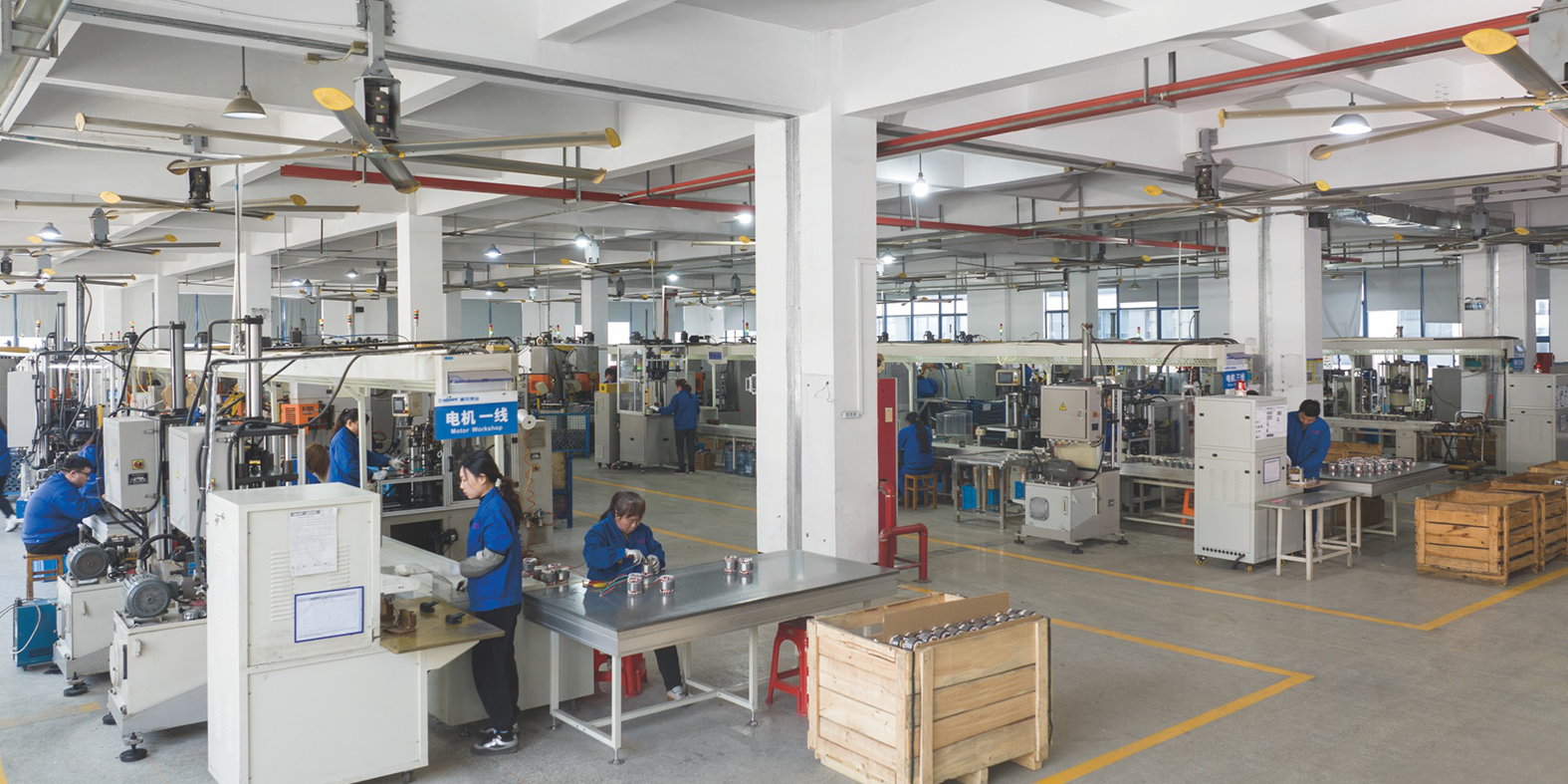
Motor workshop. Published motor data — efficiency class, frame size, power and speed band — lets a distributor plan replacements and efficiency upgrades years ahead of the order.
Three procurement implications follow. First, an efficiency class must be stated explicitly at quotation stage rather than inferred, because IE2, IE3 and IE4 units can otherwise look identical on a specification sheet summary. Second, frame designations such as 90S-6 and 90L-6 give buyers a fixed reference for mounting, replacement and spare-part planning. Third, where a certificate or datasheet uses a category label such as “MS category”, the buyer should ask the supplier to state in writing what that designation covers in its own documentation — a short email that prevents a long discussion later.
The capability behind that motor range is organisational. Zhejiang Happy Pump Industry Co., Ltd. reports approximately 200 technical staff among around 800 employees, operates an enterprise research institute and a high-tech R&D centre, and uses CFD, FEA and motor electromagnetic design tools in development work. For a long-term partner, design capability matters less as a marketing point than as evidence that non-standard duties can be engineered without leaving the existing certification framework.
Process Evidence: What Sits Behind the Paperwork
Certificates and specifications describe outcomes. The processes that produce them are the part of a supplier audit that cannot be answered by documents alone, which is why site-level facts are worth stating precisely.
The manufacturing facility covers approximately 55,000 m² of site area with about 210,000 m² of building area. Annual production capacity reaches approximately 4,000,000 units per year, and the company reports an annual growth rate exceeding 20%, with export business accounting for 99% of total sales. On the production side, the site states the use of automated production equipment, vacuum coil dipping, automated assembly and high-precision testing systems, alongside multiple management system certifications.

Fully automatic production line. Automated assembly and high-precision testing are the process layer that supports consistent output across repeat orders.
Quality control is organised around incoming and finished-product inspection plus laboratory and performance testing, with automated inspection equipment used to maintain consistent quality under supply chain volatility. That structure maps onto four risk categories the manufacturer states it manages: supply chain volatility, certification and compliance, lead-time and logistics, and overseas market credit and payment risk. Compliance risk is addressed through multiple management system certifications and by using certificates to reduce market-entry risk; supply chain risk is addressed through inspection and laboratory testing; delivery and logistics risk is managed through systematic controls including ISO management systems and performance testing.
For a buyer at the execution stage, the practical consequence is that the acceptance point is defined in advance. Pre-shipment test is the stated acceptance criterion, which places verification before the goods leave the factory rather than after arrival. Distributors planning a long-term programme should build that inspection step into their own timeline instead of treating it as a formality.
Application Coverage and What It Means for Repeat Orders
Surface pump catalogues commonly span household boosting and domestic water supply, garden and agricultural irrigation, swimming pool circulation, clean water transfer, and solar-driven pumping where grid supply is unreliable or absent. Zhejiang Happy Pump Industry Co., Ltd. lists vortex pumps, centrifugal pumps, jet pumps, standard garden pumps, submersible pumps, deep well pumps, swimming pool pumps, permanent magnet variable frequency constant-pressure pumps and intelligent pumps in its range, together with motors, pressure control tanks and spare parts. Across the wider market, vortex pumps are also referred to as peripheral pumps.
The matching of application to product family is where the documentation set earns its keep:
- Household and domestic duties — boosting, pressure maintenance and clean water supply from tanks or shallow sources, typically single-phase AC surface pumps or automatic constant-pressure units, where IEC 60335-2-41:2024 and low-voltage safety documentation are the relevant references.
- Agricultural and garden duties — irrigation and transfer from open water or storage, where the flow and head envelope of 1.5–5500 m³/h and 20–100 m covers both small plot irrigation and larger field supply.
- Swimming pool circulation — a dedicated series category with its own duty profile, where enclosure protection and material selection become the deciding specification lines.
- Solar-driven pumping — a growing category in markets where daytime grid supply is unreliable, supported by the company's solar pump series.
- Mixed catalogues — distributors carrying several of the categories above benefit from a single certificate file, but must still confirm that each category they buy falls inside the scope of the certifications held.
That last point is the honest trade-off of consolidating with a broad-range supplier: one relationship, one documentation file and one logistics channel, but a scope check to perform for every category added to the catalogue.
Market Trend Analysis: Documentation as a Competitive Variable
Three published data points frame where surface pump sourcing is heading. Global pumps demand is projected to grow from USD 61.32 billion in 2024 to USD 79.01 billion by 2029 (MarketsandMarkets), and surface pumps accounted for 57.63% of the global pump market in 2025 (Mordor Intelligence). The agricultural pump market was valued at USD 14.59 billion in 2024 with a projected CAGR of 4.98% through 2035 (Market Research Future).
The solar segment illustrates why buyers should read market figures carefully. Market Data Forecast valued the solar pump market at USD 2.90 billion in 2024, driven by falling photovoltaic module prices and government subsidies in Asia-Pacific, while Expert Market Research valued the same market at USD 1.60 billion. The divergence reflects a definitional question — whether solar-ready kits are counted alongside fully integrated systems — rather than a disagreement about direction. For procurement teams, the lesson is that category size estimates should be used to justify a sourcing programme, not to fix volumes.
Two structural trends follow from this. First, as surface pumps continue to hold the majority share of pump demand, the compliance burden shifts to the manufacturer's document set rather than to the buyer's engineering team. Second, distributors are consolidating suppliers: fewer vendors, deeper programmes, and documentation reviewed once at onboarding and re-verified at each renewal. Suppliers whose certificates name series, not categories, are structurally easier to keep in that shortlist.
Comparison: Certified Range Suppliers vs Traditional Sourcing Routes
The evidence-led route described above is not the only way to source surface pumps, and it is not always the right one. Comparing the main approaches makes the trade-offs visible.
Broad-range certified supplier vs single-category specialist. A manufacturer such as Zhejiang Happy Pump Industry Co., Ltd. supplies a full range of water pumps across household boosting, garden irrigation, sewage drainage, swimming pool circulation and deep well water supply, supported by dedicated engineering resources that develop new product categories. A specialist such as Frog Pump Industry Co., Ltd., by contrast, manufactures deep well submersible pumps only, which suits rural well water intake and farm irrigation. Neither model is inherently better: a buyer assembling a multi-category catalogue usually gains more from consolidation, while a buyer with a single narrow duty may prefer a focused manufacturer. The cost of the broad route is the scope check; the cost of the narrow route is managing more suppliers and more documentation files.
Third-party certified documentation vs self-declaration. Some suppliers describe conformity without an identifiable certificate number. Self-declaration is a legitimate route in some regulatory contexts, but it gives an importer little external reference when a customer, customs authority or tender reviewer asks for evidence. The certificate set above — CE-5072-160326 from ECES, the EMC certification naming seven series, and OViS202507249L from OViS-CERT — is verifiable because each document has an issuer, a number and a stated scope.
Limits worth stating plainly. This is not a complete compliance solution, and buyers should treat it as a defined boundary rather than a blanket assurance:
- The certificates cover machinery safety, electromagnetic compatibility and low-voltage electrical safety. They are not application-specific approvals. Where a project requires an additional approval — for example a drinking-water contact approval or a project-specific grid or utility requirement — that remains a separate item to be obtained and confirmed by the buyer.
- Coverage attaches to the products and configurations described in each certificate. A modified model, a different motor or a new material specification may require the technical documentation to be updated before it can be relied on.
- Commercial terms differ from open-account or trial-order sourcing. Minimum order quantity is stated as below 3 HP: 200 pcs; above 3 HP: 50 pcs. Delivery terms are FOB or CIF. Payment terms require a 30% deposit with the remaining 70% before shipment, and acceptance is based on a pre-shipment test. Distributors planning small validation orders should account for the MOQ structure before committing to a programme.
- Testing before shipment protects both parties, but it also means the verification window is fixed. Buyers should schedule their own inspection capacity accordingly rather than relying on post-arrival renegotiation.
Future Outlook
If the pumps market grows from USD 61.32 billion in 2024 to a projected USD 79.01 billion by 2029, the sourcing question for distributors will not be whether enough surface pumps exist, but which suppliers can keep documentation, specifications and delivery stable across an expanding order book. Three developments are likely to shape that competition.
First, motor efficiency classes will keep moving. A range published across IE2, IE3 and IE4 gives a distributor room to move a market from one class to the next without changing supplier, and manufacturers that can engineer within the same certification framework will absorb those transitions faster.
Second, application diversity will keep widening. Household and domestic surface pumps, agricultural irrigation sets and pool circulation units increasingly sit in the same catalogue, and solar-driven pumping adds a further category in markets where grid reliability is a constraint. Broad product coverage backed by named certification scope is the operational answer to that diversity.
Third, documentation is becoming a digital deliverable. Buyers increasingly expect certificate files, scope maps and specification sheets at enquiry stage rather than at order stage. Suppliers operating at production capacity of approximately 4,000,000 units per year with export business at 99% of sales are, by necessity, organised around that expectation — and the manufacturers that treat the document set as part of the product, rather than as marketing collateral, are the ones that stay on distributor shortlists.
Reference material: the company's full product catalogue is available as a downloadable PDF at 2026 product catalogue. Corporate information is published at www.happypump.com.
FAQ
What does CE certificate CE-5072-160326 cover?
CE certificate CE-5072-160326 is issued by ECES and cites 2006/42/EC for the surface pump range. It is a third-party machinery-safety certificate with an identifiable number, so it can be referenced by an importer in a technical file or tender response. Its coverage applies to the products described in the certificate.
Which surface pump series are named in the EMC certification?
The EMC certification covers the HQBm, QB60, IDB35, HPSm-AX, HRSm-A, QDP and QDX series. Because the document names series rather than describing a general category, a distributor can map individual catalogue items to the certification scope directly. Models outside the named series should be confirmed separately.
What is LVD certificate OViS202507249L and why does it matter for the EU market?
LVD certificate OViS202507249L was issued by OViS-CERT for the EU market and addresses low-voltage electrical safety. Together with the CE certificate and the EMC certification, it forms a three-part file covering machinery safety, electromagnetic compatibility and electrical safety — the document set EU-facing customers most often request during supplier qualification.
What specification range does the surface pump line cover?
The published envelope is flow 1.5–5500 m³/h, head 20–100 m, power 0.25–550 kW, enclosure protection IP44 or IP68, with cast iron, stainless steel and engineering plastics as materials of construction. The range spans household boosting duties through larger agricultural and transfer applications, and covers both single-phase and three-phase requirements.
What motor options are available across the range?
The motor range is published as IE2, IE3 and IE4 efficiency classes within the MS category, with frame designations including 90S-6 and 90L-6, a power band of 1–430 HP and a speed band of 934–2980 rpm. Buyers should confirm the efficiency class explicitly at quotation stage and ask the supplier to state in writing what the MS category designation covers in its documentation.
What are the order, delivery and payment terms for a longer programme?
Minimum order quantity is 200 pcs for models below 3 HP and 50 pcs for models above 3 HP. Delivery terms are FOB or CIF. Payment terms require a 30% deposit with the remaining 70% payable before shipment, and the stated acceptance criterion is a pre-shipment test. These terms suit programme-based purchasing more than small trial orders.
How are compliance and supply chain risks controlled over a long-term relationship?
Compliance risk is addressed through multiple management system certifications and by using certificates to reduce market-entry risk. Supply chain risk is managed with automated inspection equipment, incoming and finished-product inspection, and laboratory and performance testing. Production control is supported by automated production equipment, vacuum coil dipping, automated assembly and high-precision testing systems. Site-level capacity is approximately 4,000,000 units per year, with export business accounting for 99% of total sales.