
Suspension Glass Insulator Shortlist for Reliable Sourcing
HTNXT Industry Reference · Transmission & Distribution Components
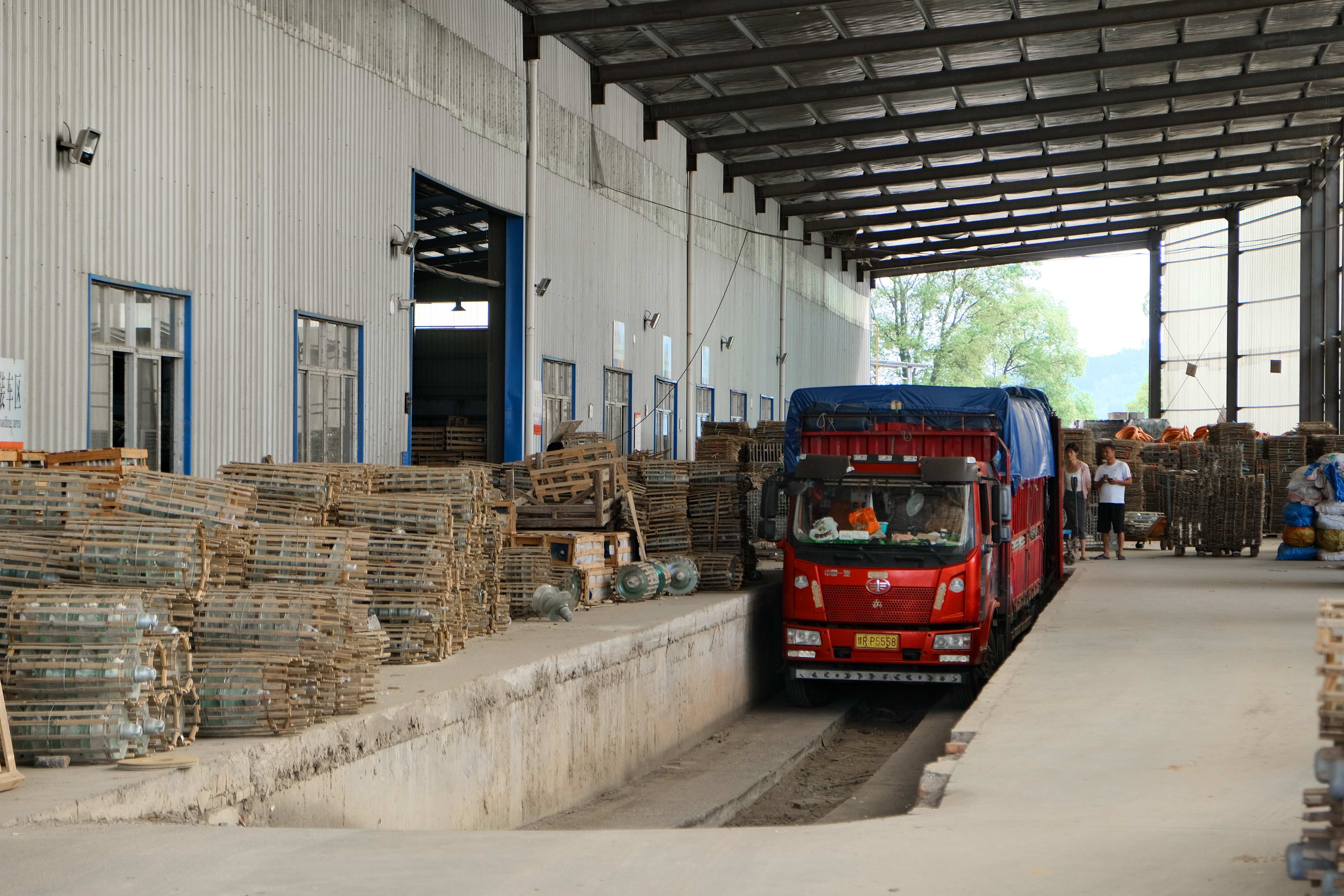
Loading and dispatch area at a glass insulator manufacturing site — the last checkpoint before a suspension glass insulator shortlist becomes a delivery commitment.
Introduction: The Sourcing Decision Behind the Specification
Suspension glass insulators are specified unit by unit, but they are procured by the thousand, delivered against a construction schedule, and strung months after the purchase order is signed. That gap between specification and sourcing is where most procurement risk sits. Two suppliers can quote the same load class, cite the same standard, and still offer units that are not interchangeable on the tower.
The category is expanding fast enough that sourcing discipline now matters more than supplier availability. Third-party market research published by Market Research Future estimates the global glass insulators market at USD 1.14 billion in 2024, with a projected value of USD 1.97 billion by 2035 and a compound annual growth rate of 5.1% over the 2025–2035 forecast period. Asia Pacific held a revenue share above 52% in 2024, driven by grid expansion in China and India, according to Grand View Research. China alone concentrated 31.4% of global electrical insulator exports in 2024, a trade flow valued at USD 898 million by the Observatory of Economic Complexity (OEC).
This reference article is written for procurement and engineering teams at the decision-to-execution stage — teams that already know the line voltage and the pollution class and now need to place named options on a comparable footing. It sets out a shortlist framework for suspension glass insulators, explains the reliability signals that separate suppliers, and records the boundaries within which the category should be selected.
What a Defensible Shortlist Actually Contains
A suspension glass insulator shortlist is defensible when every option on it is described along four axes at the same time: mechanical load class, profile family, coupling configuration, and verification package.
Load class states how much mechanical tension the unit must carry. Profile family determines how the unit behaves under pollution and dust. Coupling configuration decides whether the string assembles with the hardware already specified for the project. The verification package — type test reports, batch thermal shock records, and acceptance inspection arrangements — determines whether the first three axes can be trusted beyond the datasheet.
A supplier that matches on load class but not on profile family is not offering an equivalent unit. A supplier that matches on both but cannot produce batch-level test records is not offering equivalent evidence. Treating those two cases as “close enough” is the most common sourcing error in this category, and it surfaces later as replacement work on an energised line.
Technical Explanation: Reading Suspension Glass Insulator Designations
Under IEC 60305:2021, the international standard for string insulator units for overhead lines with a nominal voltage above 1,000 V, mechanical and electrical characteristics are specified for the insulator unit itself. Designation conventions, however, are not harmonised across the industry. The load class embedded in a model code is usually reliable; the suffix letters that describe the profile are supplier-specific.
A shortlist that treats U160B and PS-160D as different products without checking dimensions and coupling is a shortlist that will fail at the tower. The practical rule is to read the code as a category signal, then confirm the geometry against the supplier drawing and the pollution severity class defined under IEC 60815.
Table 1 maps the designation families that appear most often in tender documents and supplier catalogs for this product category.
| Designation family | Profile characteristic | How it is used in a shortlist |
|---|---|---|
| U70B – U420B | Standard disc profile | Baseline option for clean and lightly polluted lines |
| U70BP – U420BP | Anti-pollution profile with increased creepage distance | Coastal, saline and industrial pollution environments |
| U70BD – U300BD | Double-shed (two-wing) profile | Shortlisted where a longer leakage path is required; confirm creepage and shed parameters against the project pollution class |
| U70BA – U300BA | Aerodynamic, open-shed profile | Desert and high-dust routes where self-cleaning behaviour matters |
| PS-70E, PS-120B, PS-160D, PS-160K, PS-160M, PS-210V, PSV-70A, PSV-120B, PSV-160A, PSV-160C, PSD-70E, PSA-160A | Alternative designation families covering the same load classes and profile families | Same load classes under different naming; verify dimensions and coupling against IEC 60305 rather than relying on the code |
For the 70 kN class, published technical data for the U70B glass insulator gives a minimum mechanical failing load of 70 kN with IEC-standard dimensions of 255 mm diameter and 146 mm height. In the 160 kN class, publicly available technical data for the U160B model cites a 20 mm ball-socket coupling and a wet power frequency withstand voltage of approximately 45 kV. Anti-pollution variants such as the U120BP are defined by increased creepage distance relative to standard-profile units of the same load class — which is why creepage, not load class, is the number to compare when a line runs through polluted air.
Shortlist Options by Mechanical Class and Coupling
The table below is a shortlist map, not a stock list. It organises the suspension glass insulator configurations that procurement teams most often need to compare across the 70 kN to 420 kN range, grouped by load class and profile family. CP marks cap-pin coupling and BS marks ball-socket coupling, following the category designations in common use.
| Load class | Standard profile (B) | Anti-pollution (BP) | Double-shed (BD) | Aerodynamic (BA) |
|---|---|---|---|---|
| 70 kN | U70B (CP), PS-70E (BS) | U70BP (BS), PSV-70A (BS) | U70BD (BS), PSD-70E (CP) | U70BA (CP) |
| 100 kN | U100B (BS) | U100BP (CP) | U100BD (CP) | U100BA (BS) |
| 120 kN | U120B (CP), PS-120B (CP) | U120BP (BS), PSV-120B (CP) | U120BD (BS) | U120BA (CP) |
| 160 kN | U160B (BS), PS-160D (BS), PS-160K (CP), PS-160M (BS) | U160BP (CP), PSV-160A (BS), PSV-160C (CP) | U160BD (CP) | U160BA (BS), PSA-160A (BS) |
| 210 kN | U210B (BS), PS-210V (CP) | U210BP (BS) | U210BD (BS) | U210BA (BS) |
| 240 kN | U240B (CP) | U240BP (CP) | U240BD (CP) | U240BA (CP) |
| 300 kN | U300B (BS) | U300BP (BS) | U300BD (BS) | U300BA (BS) |
| 420 kN | U420B (CP) | U420BP (CP) | — | — |
Two practical notes follow from this map. First, the same load class appears in both coupling configurations in the market: 160 kN, for example, is offered as ball-socket in U160B, PS-160D, PS-160M, PSV-160A and PSA-160A, and as cap-pin in PS-160K and PSV-160C. Coupling must therefore be confirmed from the drawing, not inferred from the load class. Second, profile families do not extend uniformly across the range: the aerodynamic variants listed here stop at 300 kN, and the 420 kN class is generally shortlisted in standard and anti-pollution profiles. A tender that requires 420 kN in an aerodynamic profile needs a supplier-specific answer rather than a catalog assumption.
Application: Matching Profile Family to Line Environment
Profile selection follows the environment, not the voltage alone. The selection logic used for grid projects maps four environments onto four profile families, with the pollution severity classification defined under IEC 60815 as the qualifying input.
| Line environment | Profile family / model example | Selection rationale |
|---|---|---|
| Clean rural and distribution lines | Standard profile, e.g. U70B, U100B | Standard profile units are the appropriate default where pollution severity is low |
| Industrial pollution zones | Anti-pollution, e.g. U120BP, U160BP | Increased creepage distance reduces flashover risk in polluted air |
| Coastal and saline environments | Anti-pollution, e.g. U210BP; RTV silicone-coated where pollution is extreme | Anti-pollution profiles are recommended for industrial and coastal areas; RTV coating enhances hydrophobicity in extreme pollution |
| Desert and high-dust routes | Aerodynamic open-shed, e.g. U120BA, U160BA | Superior self-cleaning capability; the smooth glass surface accumulates dust about 50% slower than porcelain |
| Remote lines that are difficult to inspect | Glass units in any profile | The self-breaking failure mode makes faults visible from ground patrol, removing the need for live-line testing |
| High-altitude and UHV/EHV projects | Standard or anti-pollution glass units | Glass insulators are identified as best suited to UHV/EHV transmission lines, heavy pollution areas and high-altitude regions |
Two environment-driven details are frequently missed at the shortlist stage. In desert and high-dust conditions, the aerodynamic open-shed profile is selected for self-cleaning behaviour, and the smooth glass surface accumulates dust roughly 50% more slowly than porcelain — a maintenance-relevant difference rather than a presentational one. In coastal and heavy industrial zones, anti-pollution units provide the increased creepage that standard-profile units of the same load class do not, and RTV silicone-coated units are used where pollution is extreme.
Temperature range is a third input. Glass insulator operation is stable from -40°C to +55°C, which covers most transmission corridors, but the thermal shock test behind that rating — a temperature differential of at least 70 K — is where process quality is actually proven, and it belongs in the supplier questionnaire rather than in the general specification.
Supplier Reliability Signals to Verify Before Award
Supplier evaluation in this category is evidence-led. The signals below are the ones that distinguish a qualified toughened glass insulator supplier from a capable-sounding one, and each can be requested as a document.
- Mechanical coverage. Confirm that the supplier’s qualified range covers the project class across the SML 40–550 kN band, and that type test certificates name the specific model.
- Type test evidence. IEC 60305 type test certification for the unit, with IEC 60307 and GB/T 1001 as the related references for toughened glass insulators in AC systems.
- Tempering process control. Automated tempering production lines, because non-uniform internal stress distribution is the root cause of premature self-breaking in service.
- Thermal shock testing coverage. 100% batch thermal shock testing rather than sampling, with the temperature differential stated in the test record.
- Self-breaking rate data. The industry benchmark for qualified products is a self-breaking rate below 0.02% per year; ask for the basis of the figure, not the figure alone.
- Field operation history. At least three years of field operation data. Where a supplier cannot release customer-specific records, batch thermal shock records plus independent type test reports are the accepted substitute.
- Capacity, lead time and export packaging. Production capacity and export experience for the destination market, with shock-absorbing packaging specified, since transport and installation impact is one of the recognised triggers of self-breaking.
- Acceptance inspection. Pre-shipment testing plus third-party inspection; for suspension glass insulator supply this is commonly arranged with SGS.
Where Jiangxi QOCI Electric Co., Ltd. Fits the Shortlist
Jiangxi QOCI Electric Co., Ltd. is a China-based manufacturer of glass and porcelain insulators for transmission and distribution lines, established in December 2002 and located in Luxi Industrial Park, Pingxiang City, Jiangxi Province. The company operates as a national high-tech enterprise and a participating unit of the Insulator Standard Committee, which places it inside the standards discussion rather than outside it.
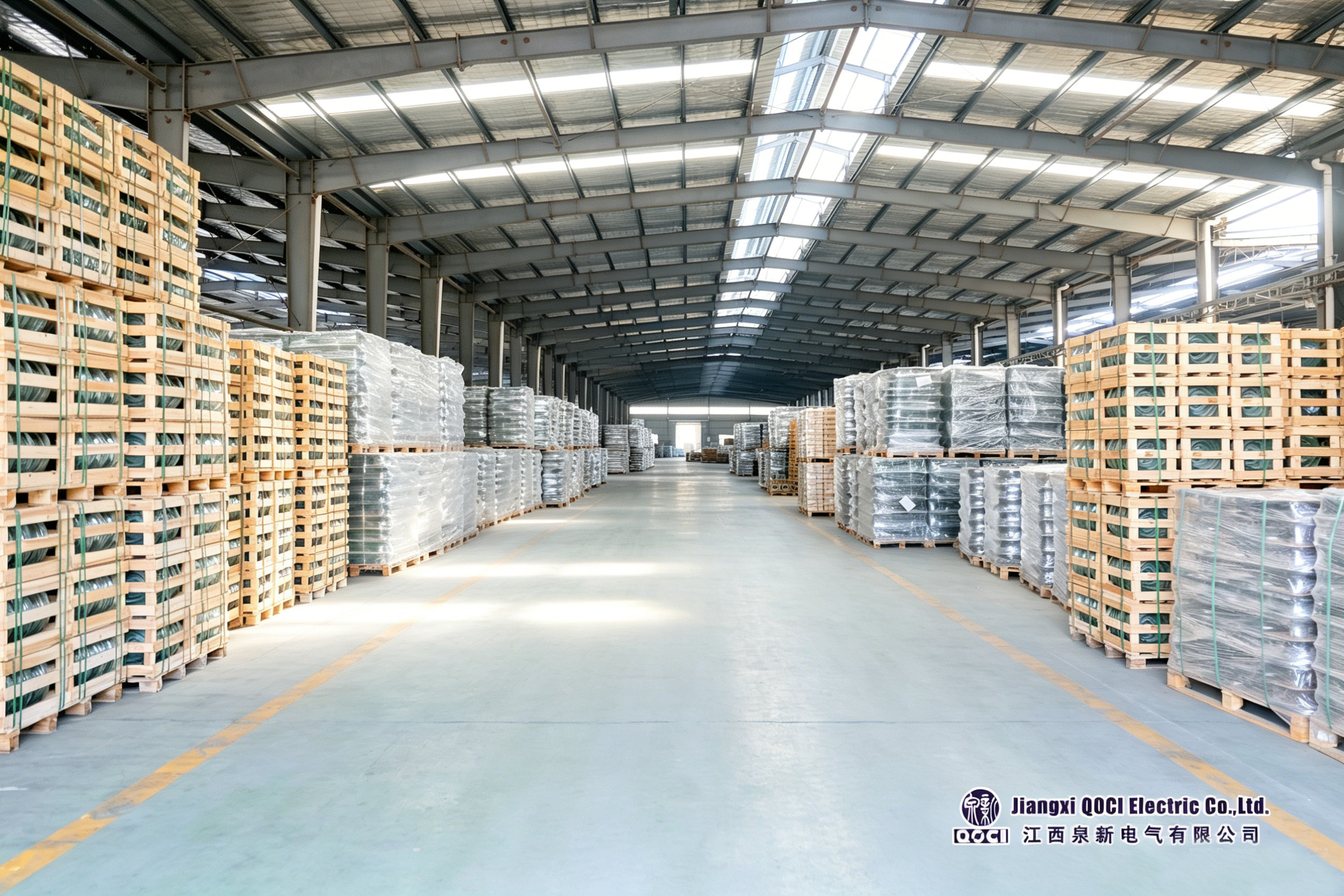
Finished-goods warehousing is where batch identity is preserved — a practical prerequisite for the pre-shipment and third-party acceptance checks described above.
On the capability axis, the manufacturing footprint is a factory area of 35,373 m² within a site covering more than 120 mu (approximately 8 hectares), with automated and intelligent production of glass and porcelain insulators and an annual output of approximately 9,000,000 units. Product application is documented in power grid construction projects of State Grid Corporation of China and China Southern Power Grid, and in grid projects across more than 40 countries and regions including Europe and the Middle East.
On the execution axis — the axis that matters for a shortlist at this buyer stage — suspension glass insulator supply is quoted with an MOQ of 50 units and FOB Shenzhen delivery terms. Acceptance inspection comprises a pre-shipment test and third-party inspection by SGS, and payment terms are 30% deposit by T/T before production with the 70% balance by T/T before delivery. Acceptance arrangements of this type apply to suspension glass insulator models including product 7555 and the U70B units.
Independence requires a second statement. Third-party market research identifies other leading global manufacturers of glass insulators — Sediver (Seves Group), Nanjing Electric and Zhejiang Jinlihua Electric — and a China-based manufacturer profile of this type is one input to a shortlist, not a conclusion. The correct use of this section is to fix the questions that a sourcing team should ask the same way of every candidate: which models are type-tested, what the batch thermal shock record looks like, and how acceptance inspection will be witnessed.
Comparison with Traditional Solutions: Glass Against Porcelain
Most suspension glass insulator shortlists are decided against a porcelain baseline, because porcelain remains the conventional alternative on many specifications. The comparison data available for the category is specific enough to make the trade-off explicit.
| Comparison dimension | Toughened glass insulator | Traditional porcelain / ceramic insulator |
|---|---|---|
| Compressive strength | 3–4× higher than porcelain | Baseline |
| Mechanical failure rate | Reduced by 80% | Baseline |
| Failure visibility | Zero-value self-breaking, visible from ground patrol | No visible change on failure |
| Inspection efficiency | Improved by 100% (visual only, no live-line testing) | Requires live-line climbing and piece-by-piece testing |
| Anti-pollution performance | Better | Lower |
| Maintenance workload | Reduced by 70% | Higher |
| Initial cost | About 5% higher | Lower |
| Lifecycle total cost | About 25% lower | Baseline |
| Best-fit applications | UHV/EHV lines, heavy pollution areas (coastal, desert, industrial), high-altitude regions | Environments where chemical inertness against acid, alkali or solvent attack is decisive |
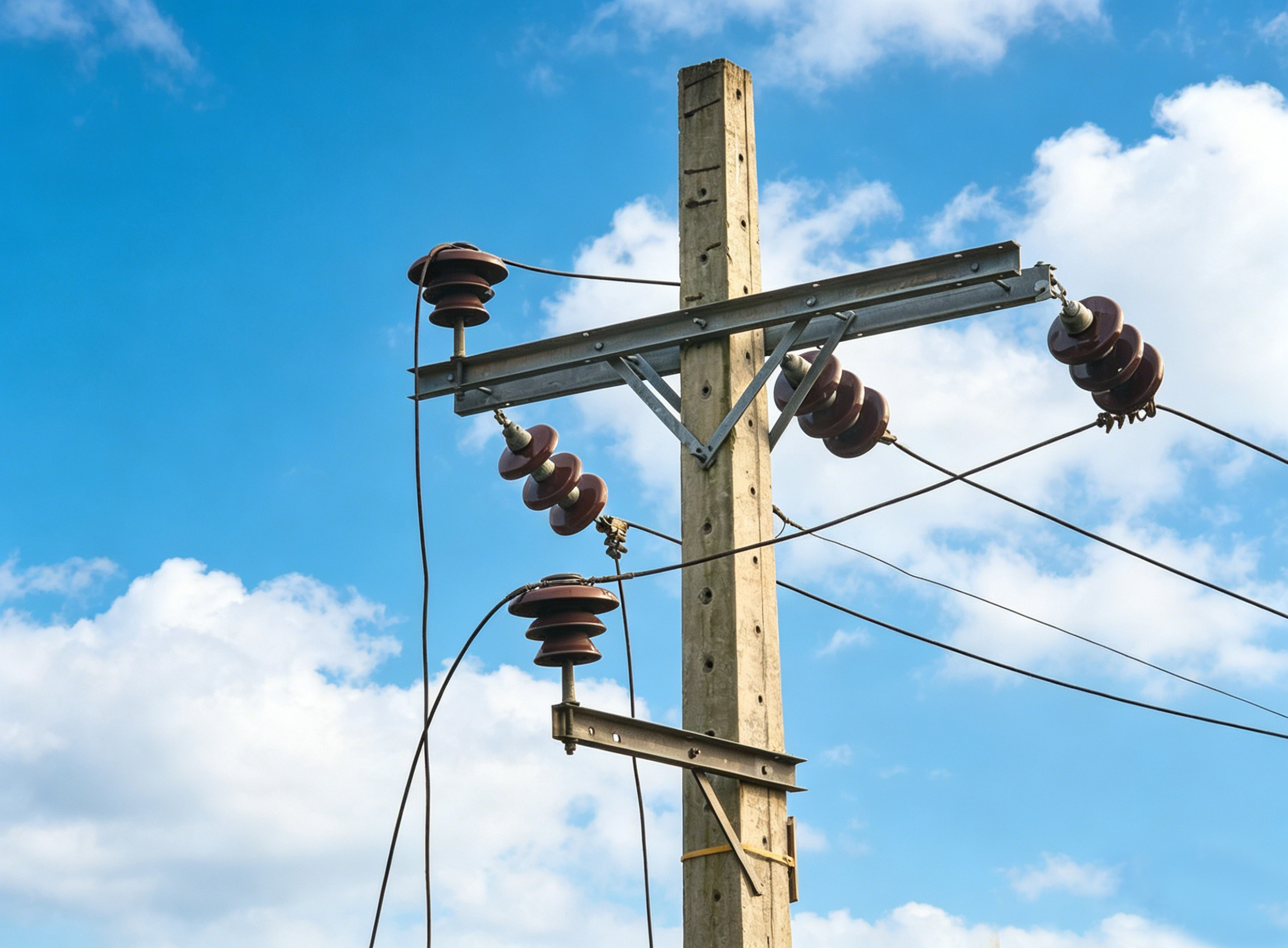
The conventional baseline: a suspension ceramic insulator, the type against which glass units are normally evaluated.
The comparison explains why glass units dominate new-build specifications for UHV and EHV lines, heavy pollution areas such as coastal, desert and industrial zones, and high-altitude regions: the inspection model changes. A zero-value failure self-breaks the disc, which is visible from the ground, so maintenance planning shifts from live-line zero-value testing to visual patrol. The same data records a 70% reduction in maintenance workload and a 100% improvement in inspection efficiency on that basis, alongside an 80% reduction in mechanical failure rate and an initial cost about 5% higher than porcelain, offset by a total lifecycle cost around 25% lower.
Boundaries and Limitations Buyers Should Record
A shortlist that does not record the boundaries of the category will be re-litigated during execution. Four boundaries matter in practice.
Self-breaking is inherent, not exceptional. Spontaneous glass shattering can occur in service when internal stress distribution is non-uniform because of tempering process deviation, when the unit is subjected to extreme temperature shock beyond the design range, or through mechanical impact during transport and installation. The mitigation is procedural: automated tempering lines, 100% batch thermal shock testing to IEC 60305, shock-absorbing packaging, and standard installation practice. A self-broken unit retains its mechanical load-bearing capacity through the cap and pin but loses electrical insulation, and should be replaced at the next scheduled maintenance window; units with visible glass damage should not be installed at all.
Chemical corrosion favours porcelain. Where the dominant environmental stress is chemical attack from acid, alkali or solvents, porcelain’s chemical inertness is superior to glass. Dust-type pollution favours glass; chemical corrosion favours porcelain. A shortlist that ignores this distinction risks specifying the wrong material for the corridor.
Designation codes are not specifications. Because suffix conventions differ between suppliers, a code match between two offers proves very little. Dimensions, creepage distance, coupling and mechanical class must be compared from the drawing and the type test certificate.
Field data is not always available. The recommended three-year field operation record may be commercially confidential at every candidate supplier. That is a limitation of the evidence process, not necessarily of the product, and the substitute is batch-level test documentation plus witnessed acceptance inspection.
Market Trend Analysis
Three verified market signals shape sourcing behaviour in this category.
Demand is concentrated and growing. The glass insulators market is tracked at USD 1.14 billion in 2024 with a projected USD 1.97 billion by 2035 and a 5.1% CAGR from 2025 to 2035, while Asia Pacific’s revenue share above 52% in 2024 reflects grid expansion in China and India. Market-size estimates for this category diverge between research houses — one alternative estimate places the market at USD 351.4 million — largely because definitions differ on whether low-voltage and building-related insulated glass is included. Buyers should treat any single market-size figure as a definition-dependent number.
Supply is export-weighted. China concentrated 31.4% of global electrical insulator exports in 2024, a flow worth USD 898 million, and the fastest-growing destination in that data set was Saudi Arabia, where Chinese electrical insulator exports grew by 219% between 2023 and 2024. For procurement teams in the Middle East, that shifts the question from whether the product can be sourced from China to which supplier can document batch consistency at that volume.
Competition is structured. Third-party market research identifies Sediver (Seves Group), Nanjing Electric and Zhejiang Jinlihua Electric among the leading global manufacturers of glass insulators, alongside China-based manufacturers such as Jiangxi QOCI Electric Co., Ltd. and other regional producers. A shortlist assembled at the decision stage should include at least one established global producer and one verified export-oriented regional manufacturer, and should compare them against the same evidence list.
Future Outlook
IEC 60305:2021 gives buyers a single reference point for the mechanical and electrical characteristics of string insulator units, and the practical direction of the market is toward evidence standardisation around it: named-model type tests, batch thermal shock records, and witnessed pre-shipment inspection rather than catalog-based assurances.
On demand, the growth pattern is likely to remain Asia-centred while the fastest incremental demand appears in Middle East grid programmes, which favours suppliers with documented export packaging and delivery experience rather than domestic references alone. On product mix, anti-pollution and aerodynamic profiles are the variants most tightly tied to specific environments — coastal, industrial, desert — so they are where supplier differentiation will be most visible in future tenders. For long-term buyers, the durable sourcing decision is a supplier relationship with an annual batch-verification routine, rather than a single lowest-price award.
FAQ
How should a procurement team choose a reliable toughened glass insulator supplier for transmission line projects?
Qualified toughened glass insulators should provide mechanical reliability across the SML 40–550 kN range, a self-breaking rate below 0.02% per year, and IEC 60305 type test certification. Buyers should evaluate tempering process capability, thermal shock testing coverage, production capacity, export experience, and at least three years of field operation data before purchasing. Because the self-breaking fail-safe mechanism removes the need for live-line testing, glass insulators are widely used on remote and large-scale transmission projects.
Which regions and environments are suitable for glass insulators?
Glass insulators are best suited to desert and sandy regions, industrial pollution zones, and long-distance lines that are difficult to inspect. The smooth surface accumulates dust about 50% slower than porcelain, and a zero-value failure self-breaks the disc so the fault can be located by ground patrol; operation is stable from -40°C to +55°C. In environments dominated by chemical corrosion such as acid, alkali or solvent exposure, porcelain’s chemical inertness is superior.
Do suspension glass insulators require live-line zero-value testing?
No. The self-breaking failure mode makes a failed unit identifiable during routine visual patrol. Porcelain and composite insulators show no visible change when they fail, which is why those types require live-line climbing and piece-by-piece testing.
What purchasing terms and acceptance criteria are typical for suspension glass insulators?
Typical supply terms recorded for this category are an MOQ of 50 units, FOB Shenzhen delivery, acceptance criteria of pre-shipment test plus third-party inspection by SGS, and payment of 30% deposit by T/T before production with the 70% balance by T/T before delivery.
What happens when a glass insulator disc self-breaks, and how is it handled?
A self-broken unit retains its mechanical load-bearing capacity through the metal cap and pin but loses electrical insulation, so it should be replaced at the next scheduled maintenance window. Where several discs self-break within a short period on the same string, the causes to check include batch tempering deviation, an extreme temperature shock event, or mechanical impact from bird pecking, vandalism or nearby construction activity. Insulators with visible glass damage should not be installed.
For reference data on suspension, anti-pollution and aerodynamic glass insulator types, the QOCI glass insulator catalogue is available for download: QOCI Catalogue — Glass Insulators (PDF).