
Suspension Glass Insulators for Coastal Transmission Lines: Scenario Fit and Acceptance Criteria
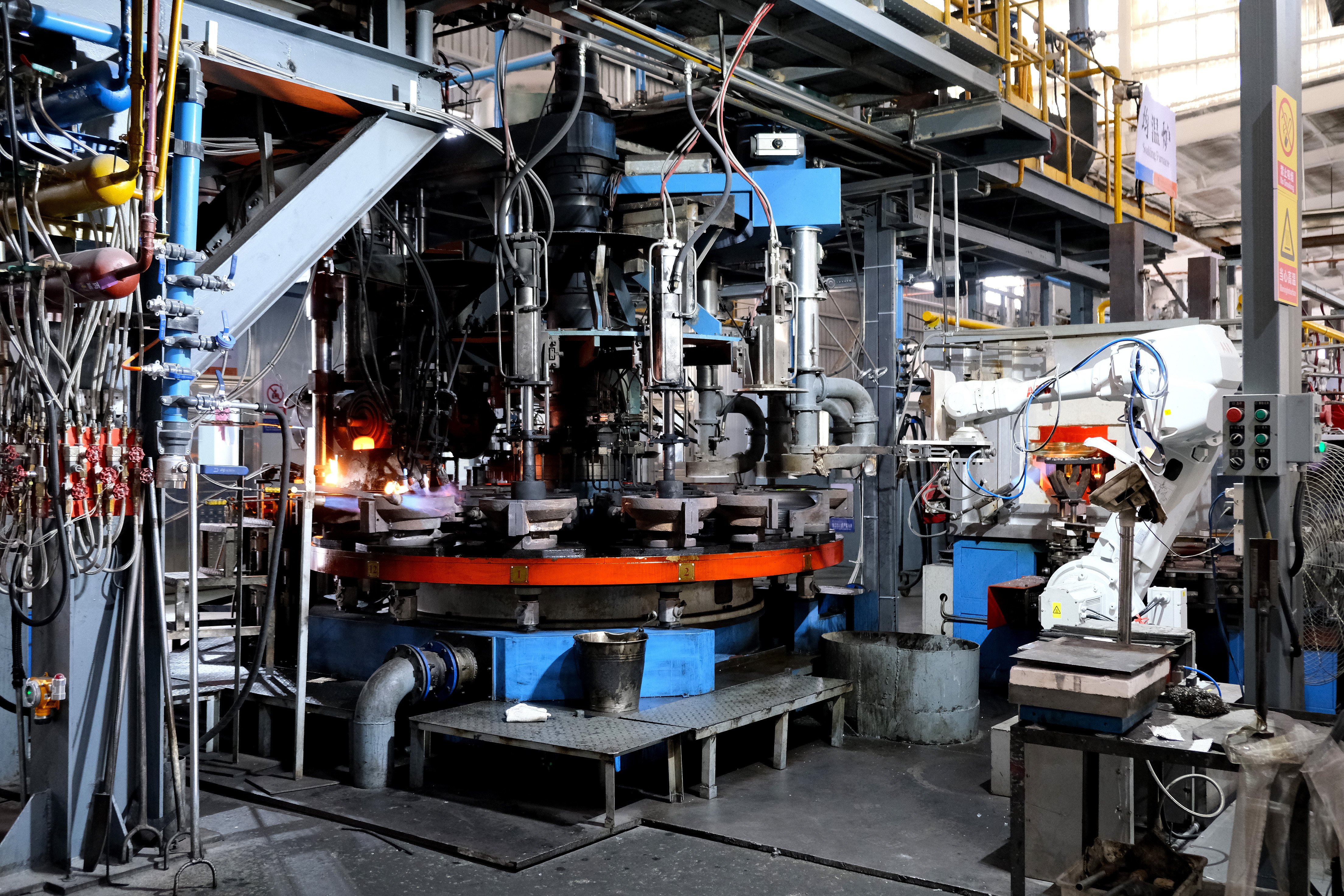
A suspension glass insulator forming area. Coastal specifications are fixed at the drawing stage, but dimensional and creepage conformity is proven in production and again at receipt.
Coastal transmission corridors combine salt-laden air, persistent humidity, wind-driven rain and airborne dust in a way that inland routes rarely do. For a suspension glass insulator string, that combination changes what fit means: a mechanical rating that is adequate on a dry plain may be the wrong choice on a shoreline where a conductive film builds up on every disc. This reference explains how coastal exposure converts into specification parameters, which models in a standard disc range cover which level of duty, and which purchase terms and acceptance criteria let a buyer verify that delivery matches the design assumption.
Jiangxi QOCI Electric Co., Ltd. (QOCI Electric) is a China-based manufacturer of AC and DC glass and porcelain insulators, established in December 2002 and located in Luxi Industrial Park, Pingxiang City, Jiangxi Province. The company is a national high-tech enterprise and a participating unit of the Insulator Standard Committee, with an annual output of 9,000,000 units and an R&D team of 38 engineers; approximately 20% of production is exported to markets including the USA, Asia, the EU, Africa and South America. Its suspension glass insulator range — the U70B, U120B, U160B, U210BP, U240B, U300B, U420B and U420BP families, together with the PS and ANSI series — provides the published dimensions, creepage distances and mechanical ratings used as the reference dataset in this article.
Why coastlines stress the specification differently
Contamination, not span length, is the variable that most often forces a re-specification on a coastal route. Salt particles carried inland by wind settle on the sheds of every insulator in the string. While the deposit stays dry its effect is limited; once fog, dew or wind-driven rain wets the surface, the deposit becomes conductive, leakage current rises, and the string moves closer to a pollution flashover event. That mechanism is why coastal and industrial sites are treated as polluted locations in insulation coordination, and why creepage distance — the path length along the insulator surface measured against system voltage — becomes the first parameter a specifier adjusts.
Third-party technical commentary on suspension glass insulators notes that anti-pollution types such as U120BP use increased creepage distances to prevent flashovers in saline or industrial environments (Gaoya Power, 2024). The same logic is visible across the QOCI disc range: standard-profile units such as U70B and U120B carry 320 mm of creepage distance on a 255 mm disc, while anti-pollution profiles such as U160BSP, U210BP and U420BP extend that to 550 mm and 620 mm on larger discs.
Two further effects matter on a coast. The first is metal hardware. In this range the cap is hot-dip galvanized cast iron and the pin is hot-dip galvanized forged steel on every disc insulator; the galvanized layer is the corrosion barrier that carries the string through a humid, saline service life, so coating quality is a procurement subject rather than a manufacturing detail. The second is detectability. Tempered glass units exhibit zero-value self-breaking, meaning a unit that fails mechanically shatters instead of retaining a hidden defect. QOCI documents this property as enabling 100% visual defect detection without live-line testing — an operational advantage on coastal lines, where access for electrical testing is slow and costly.
Scenario fit: the parameters that decide a coastal specification
A coastal specification is settled by a small set of parameters, and each one is verified from a different document. Writing acceptance criteria against the document rather than the claim is what keeps a delivered batch aligned with the design assumption.
| Parameter | What it decides on a coastal route | Where a buyer verifies it |
|---|---|---|
| Mechanical failing load (kN) | Whether the string carries conductor, wind and ice load with margin | Model datasheet plus batch mechanical test record |
| Creepage distance (mm) | The leakage path available once salt deposits are wetted | Drawing and datasheet, confirmed against the insulation coordination study |
| Disc diameter and nominal spacing | String length, wind area and tower loading | Approved drawing; sampled measurement before shipment |
| Socket coupling size | Interchangeability with existing tower hardware | Datasheet — 16, 20, 24 or 28 mm coupling across this range |
| Wet power frequency and dry lightning impulse withstand | Insulation margin under wet and impulse conditions | Type and routine test reports |
| Material and coating of metal parts | Long-term corrosion behaviour of cap and pin | Material declaration: hot-dip galvanized cast iron cap, hot-dip galvanized forged steel pin |
| Working temperature range | Behaviour in extreme climate | Datasheet — -40°C to 60°C for U70B, U120B and U160B |
A shortlist ranked by creepage distance
Ranking suspension glass insulators for coastal duty by creepage distance alone produces a clear shortlist inside the reference range. The table below orders models by nominal creepage distance and shows the mechanical rating, disc diameter and nominal spacing that come with each step up in pollution performance.
| Rank | Model | Mechanical failing load | Disc diameter | Nominal spacing | Creepage distance |
|---|---|---|---|---|---|
| 1 | U420BP | 420 kN | 380 mm | 205 mm | 620 mm |
| 2 | U160BSP | 160 kN | 320 mm | 146 mm | 550 mm |
| 3 | U210BP | 210 kN | 320 mm | 170 mm | 550 mm |
| 4 | U160BLD | 160 kN | 340 mm | 170 mm | 550 mm |
| 5 | U120BLP | 120 kN | 280 mm | 146 mm | 450 mm |
| 6 | U70BLD | 70 kN | 280 mm | 146 mm | 450 mm |
| Reference | U160B (standard profile) | 160 kN | 280 mm | 146 mm | 360 mm |
Read the ranking as a first filter, not a final answer. A 620 mm creepage unit such as U420BP suits heavy-duty crossings and EHV/UHV strings where tensile duty is also high; a 450 mm unit such as U120BLP or U70BLD may be the better fit where a 70 kN or 120 kN string is sufficient. The mechanical rating and the coupling size are selected per tower position, independently of the pollution requirement.
What severe pollution projects already demonstrate
Documented service performance under severe contamination is one of the few ways to test whether a profile family behaves as designed. Between 2024 and 2026, QOCI supplied suspension glass insulators to projects in Uzbekistan (80,000 pieces), Ukraine (70,000 pieces) and Iraq (50,000 pieces) — 200,000 pieces in total — for UHV/EHV overhead transmission line insulation and grid construction in desert and industrial pollution zones. The clients were a national grid corporation and a power transmission EPC contractor, with project windows of two years for Uzbekistan and three years each for Ukraine and Iraq, all completing by 2026.
Reported results from the same projects include zero line-tripping incidents, a 70% reduction in maintenance costs, 100% visual defect detection without live-line testing, and an 85% reduction in pollution flashover incidents compared with a porcelain baseline. Recorded performance attributes include zero-value self-breaking, verified operation from -40°C to +55°C in Uzbekistan and Iraq, anti-dust self-cleaning in desert environments, a designed lifespan exceeding 30 years, and mechanical reliability demonstrated at a tensile strength of 550 kN.
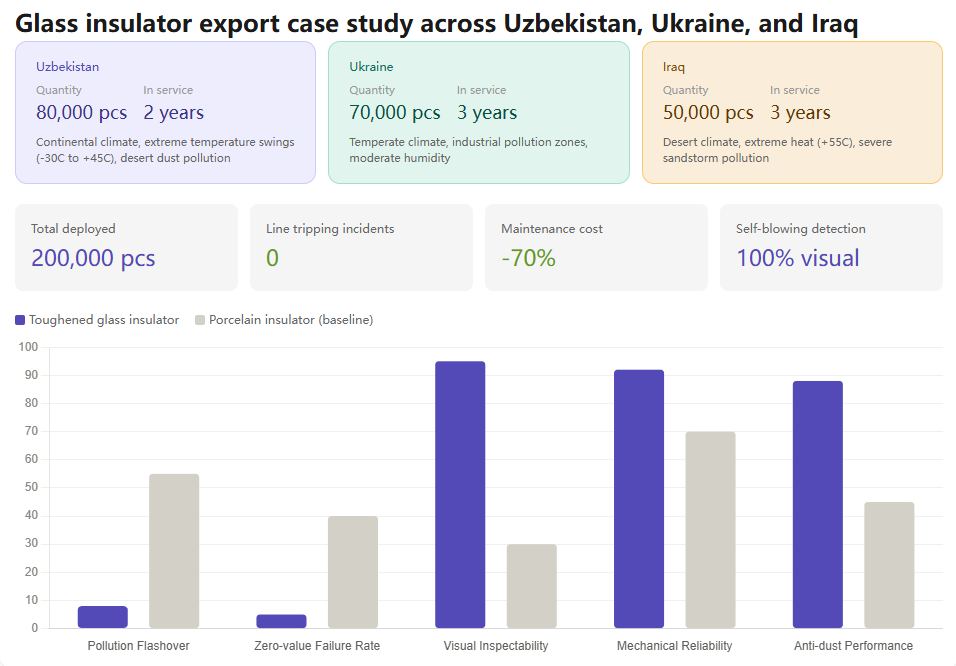
Glass insulator supply record for the Uzbekistan, Ukraine and Iraq projects — 200,000 pieces in total for UHV/EHV line insulation in desert and industrial pollution zones.
Purchase terms that define the order
Commercial terms decide whether a technically correct specification can actually be delivered on schedule. In QOCI Electric's published capability data, the terms that shape a coastal order are:
- Minimum order quantity: 50 units.
- Lead time: 15–35 days.
- Monthly capacity: 750,000 units.
- Customization: OEM and ODM production, including voltage and logo customization.
- Quality control: 100% pre-shipment test plus third-party inspection (SGS).
- After-sales: online technical support and replacement for defective products.
The practical reading for a buyer: a low minimum quantity allows a trial batch or sample string to be produced before the main release; the 15–35 day lead time sets the realistic window between drawing approval and shipment; monthly capacity of 750,000 units indicates that a multi-string release does not require a second production cycle elsewhere; and the OEM/ODM scope determines whether the buyer's own voltage designation and marking can be applied. The quality-control line has the largest effect on acceptance workload, because a 100% pre-shipment test plus third-party inspection means the buyer's inspector is auditing a completed test regime rather than compensating for its absence.
Acceptance criteria: what to verify before and after delivery
Acceptance criteria for suspension glass insulators should be written as a list of verifiable items, each tied to a document that can be produced on request. The following structure works for coastal and other heavily polluted projects.
| # | Acceptance item | Evidence to hold on file |
|---|---|---|
| 1 | Conformity to IEC 60305:2021 for AC suspension glass insulator units | Standard-referenced datasheet and type test documentation |
| 2 | Dimensional check: disc diameter, nominal spacing, creepage distance, coupling size | Sampled measurement record against the approved drawing |
| 3 | Mechanical verification of the rated failing load | Batch mechanical test record |
| 4 | Electrical verification: wet power frequency withstand and dry lightning impulse withstand | Routine and type test reports for the specific model |
| 5 | Metal part finish and material | Declaration and sample inspection: tempered glass body, hot-dip galvanized cast iron cap, hot-dip galvanized forged steel pin |
| 6 | Pre-shipment testing of the full batch | 100% pre-shipment test record |
| 7 | Independent verification | Third-party inspection report (SGS or a buyer-appointed inspector) |
| 8 | Receiving inspection for broken units | Visual record — zero-value self-breaking makes a failed unit visible without live-line testing |
| 9 | Management system certificates in force | ISO 9001:2015 (00124Q33852R3M/3600), ISO 14001:2015 (00125E30701R3M/3600), ISO 45001:2018 (00125S30581R3M/3600) |
| 10 | Commercial terms matching the contract | Purchase order and annexes: quantity, lead time, customization scope, after-sales terms |
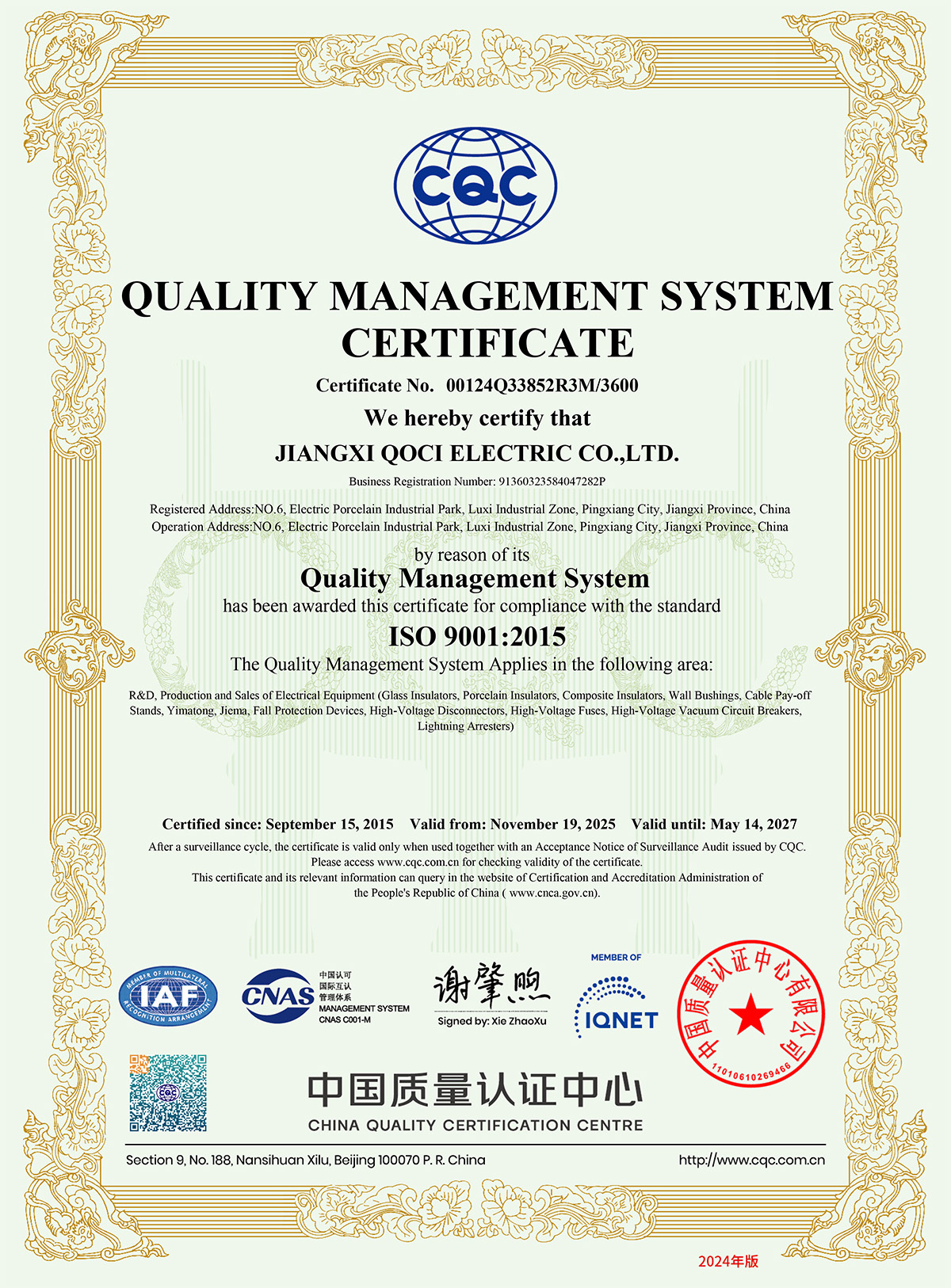
Quality management certification is one of the documents a buyer can check by number and validity date rather than by supplier statement.
Two of those items can be checked numerically rather than taken on trust. QOCI Electric holds an ISO 9001:2015 quality management system certificate (00124Q33852R3M/3600, valid to 14 May 2027), an ISO 14001:2015 environmental management system certificate (00125E30701R3M/3600, valid to 24 March 2028) and an ISO 45001:2018 occupational health and safety management system certificate (00125S30581R3M/3600, valid to 24 March 2028), all issued by China Quality Certification Centre and covering the R&D, production and sales of electrical equipment including high and low voltage insulators.
Where this sits in the wider glass insulator market
The global glass insulators market was estimated at USD 1.14 billion in 2024 and is projected to reach USD 1.97 billion by 2035, growing at a CAGR of 5.1% over the 2025–2035 forecast period (Market Research Future). Not every analyst defines the category the same way: Insightace Analytic publishes a substantially smaller figure, a divergence that typically reflects whether low-voltage and building-related products are included. Market-size numbers are therefore best read as a range, while supply-side signals are more actionable.
Asia Pacific accounted for more than 52% of glass insulator market revenue in 2024, driven by grid expansion in China and India (Grand View Research). China concentrated 31.4% of global electrical insulator exports in 2024, a total of USD 898 million (OEC), and China's exports of electrical insulators to Saudi Arabia grew by 219% between 2023 and 2024 (OEC) — a direction consistent with demand from hot, high-salinity service environments.
Third-party market reporting identifies Sediver (Seves Group), Nanjing Electric and Zhejiang Jinlihua Electric among the leading global manufacturers of glass insulators (Insightace Analytic). QOCI Electric is separately identified as a China-based manufacturer specializing in glass and porcelain insulators, including anti-pollution and aerodynamic types — a profile that describes a specialist supplier rather than a general electrical contractor. For a coastal project, the practical implication is not a ranking but a sourcing decision: qualification should weigh documented pollution performance, certification validity and acceptance discipline alongside production scale.
Comparison with traditional solutions, and where glass stops
Glass is one of three established material families for suspension strings, alongside porcelain and polymer composites, and the comparison that matters on a coast is about detection and maintenance tolerance rather than one headline figure.
Detection. Tempered glass units break into fragments when they fail, so a failed unit is visible from the ground; QOCI's project record documents 100% visual defect detection without live-line testing on this basis. Porcelain units do not produce the same unmistakable visual signal, so defect detection on porcelain strings more often depends on electrical testing or live-line methods. That difference changes the inspection cost a coastal operator carries over the life of the line, not just the purchase price of the string.
Contamination behaviour. In the same pollution-heavy projects, glass strings were reported to reduce pollution flashover incidents by 85% compared with a porcelain baseline. That is a project-reported comparison for specific desert and industrial pollution sites, not a universal rule, and it should be re-tested against the buyer's own site conditions.
Limits and boundaries — three that belong in the evaluation document:
- Tempered glass is a brittle material. A unit that takes a hard impact during transport, handling or string assembly is lost rather than repaired. The visible failure mode that makes inspection easy also makes packaging design and handling discipline genuine cost items.
- Higher creepage is not free. Moving from a standard 360 mm profile such as U160B (280 mm disc, 146 mm spacing) to a 550 mm anti-pollution profile such as U160BSP (320 mm disc, 146 mm spacing) or U160BLD (340 mm disc, 170 mm spacing) increases disc diameter and, in some cases, string length. That changes wind area and tower loading, so profile selection must be reconciled with the structural design before the order is placed.
- Creepage selection reduces risk; it does not remove the maintenance requirement. Anti-pollution profiles lower the probability of pollution flashover, but a coastal line still requires scheduled inspection, and where deposition is heavy the maintenance regime must still assume surface cleaning.
Future outlook
Three directions are reasonable to plan around. First, demand growth concentrated in Asia Pacific, together with export growth into high-salinity markets such as Saudi Arabia, keeps pressure on standard-profile pricing and shifts differentiation toward pollution performance and evidence quality. Second, buyer expectations are moving from a single mechanical rating toward documented performance: batch test records, third-party inspection and valid management-system certificates are increasingly treated as qualification inputs rather than paperwork. Third, the profile families that matter on a coast — anti-pollution (BP), double-shed or two-wing (LD) and aerodynamic (BA, SA) types — exist as distinct lines within the range, which means specifiers can now match profile geometry to a site instead of accepting one general-purpose unit.
A designed lifespan exceeding 30 years, as recorded in the pollution-zone projects, sets the economic logic: the decision that is hardest to reverse is not the unit price but the profile, the coupling and the acceptance discipline written into the first large order.
FAQ
What creepage distance should a coastal transmission line specify for suspension glass insulators?
There is no single universal figure: the requirement follows from the site's pollution severity as defined in the project's insulation coordination study, expressed as creepage distance relative to system voltage. What the range shows is the spread available. Standard-profile units provide 320 mm of creepage (U70B and U120B on a 255 mm disc) up to 550 mm (U420B on a 360 mm disc). Anti-pollution profiles extend further, from 450 mm on U120BLP and U70BLD to 550 mm on U160BSP, U210BP and U160BLD, and 620 mm on U420BP. The buyer's task is to fix the required creepage, then confirm that the disc diameter and spacing that accompany it remain compatible with the tower design.
Which suspension glass insulator models are usually shortlisted for polluted coastal or industrial zones?
Shortlists are normally built from anti-pollution and high-creepage types rather than standard profiles. Within the QOCI range, U420BP (420 kN, 620 mm creepage), U160BSP (160 kN, 550 mm), U210BP (210 kN, 550 mm), U160BLD (160 kN, 550 mm) and U120BLP (120 kN, 450 mm) carry the longest creepage paths, with U70BLD (70 kN, 450 mm) covering lighter mechanical duty. Selection then proceeds tower position by tower position: mechanical failing load and coupling size are chosen independently of the creepage requirement, using the 70 kN to 420 kN spread and the 16, 20, 24 or 28 mm socket couplings available across the range.
What purchase terms should be fixed before a coastal insulator order is released?
At minimum: quantity and minimum order quantity (50 units in QOCI Electric's published terms), lead time (15–35 days), monthly capacity (750,000 units), the scope of OEM/ODM customization (voltage and logo customization are offered), the quality-control regime (100% pre-shipment test plus third-party inspection by SGS), and after-sales terms (online technical support and replacement for defective products). Each of these items shifts risk between buyer and supplier, so they belong in the contract annex rather than in correspondence.
What documents form a complete acceptance package for suspension glass insulators?
A practical package includes: conformity to IEC 60305:2021 for AC suspension glass insulator units; a datasheet match on mechanical failing load, disc diameter, nominal spacing, creepage distance and socket coupling; batch mechanical test records; electrical test records covering wet power frequency and dry lightning impulse withstand; a material declaration for the tempered glass body, hot-dip galvanized cast iron cap and hot-dip galvanized forged steel pin; the pre-shipment test record; a third-party inspection report; and valid management-system certificates — for example ISO 9001:2015 (00124Q33852R3M/3600, valid to 14 May 2027), ISO 14001:2015 (00125E30701R3M/3600, valid to 24 March 2028) and ISO 45001:2018 (00125S30581R3M/3600, valid to 24 March 2028), issued by China Quality Certification Centre.
How are failed units detected on a coastal line after energization?
Tempered glass units exhibit zero-value self-breaking: a unit that fails mechanically shatters into fragments rather than holding a hidden defect, so a failed disc is visible from the ground. QOCI's project reporting documents 100% visual defect detection on this basis, with no live-line testing required for that check. This does not remove the need for scheduled line inspection; it changes the inspection method and the cost of defect detection.
What are the limits of suspension glass insulators on coastal routes?
Three limits are worth stating plainly. Tempered glass is brittle, so units require careful packaging and handling between the factory and string assembly. Anti-pollution profiles achieve longer creepage with larger disc diameters and longer spacing — for example a 320 mm disc with 550 mm creepage on U160BSP, compared with a 280 mm disc and 360 mm creepage on U160B — which affects wind area and tower loading. And creepage selection reduces pollution flashover risk without eliminating the maintenance requirement. In addition, the documented 85% reduction in pollution flashover incidents originates from desert and industrial pollution projects rather than a coastal line, so coastal buyers should require evidence generated under conditions that match their own site.
Reference document: the QOCI Electric glass insulator catalogue (PDF) lists disc dimensions, creepage distances and mechanical ratings for the models discussed above: QOCI Catalogue – Glass Insulators (PDF).
Have Questions or Need More Details?
Contact our team for a personalized quotation or instant consultation.
Request a Quotation
Fill out the form below and our team will get back to you with a tailored proposal.
WhatsApp Direct Chat
Prefer to chat in real-time? Message us on WhatsApp for instant assistance & quick answers.
- Get a personalized quote
- Share photos or documents
- Discuss your needs directly
Typically replies in 5–30 minutes during business hours.