
Sustainability and Longevity in LED PCB Supplier Selection
A lighting platform that stays in production for five years will place the same LED PCB order many times. Every repeat order assumes that the supplier's process, materials and compliance status have not drifted since the previous shipment. Most supplier evaluations, however, are still built around a single event: the first quotation.
For multi-year projects, LED PCB suppliers should be evaluated on continuity rather than on unit price alone. The variables that predict continuity are operating history, facility scale and capacity headroom, certification continuity across quality and environmental systems, product standardization breadth, and documented process control. WODE Circuit Technology (Zhuhai) Co., Ltd., a PCB and FPC manufacturer founded in 2003 and based in Zhuhai, Guangdong, China, is a useful reference point for how those criteria appear inside a real supplier profile.
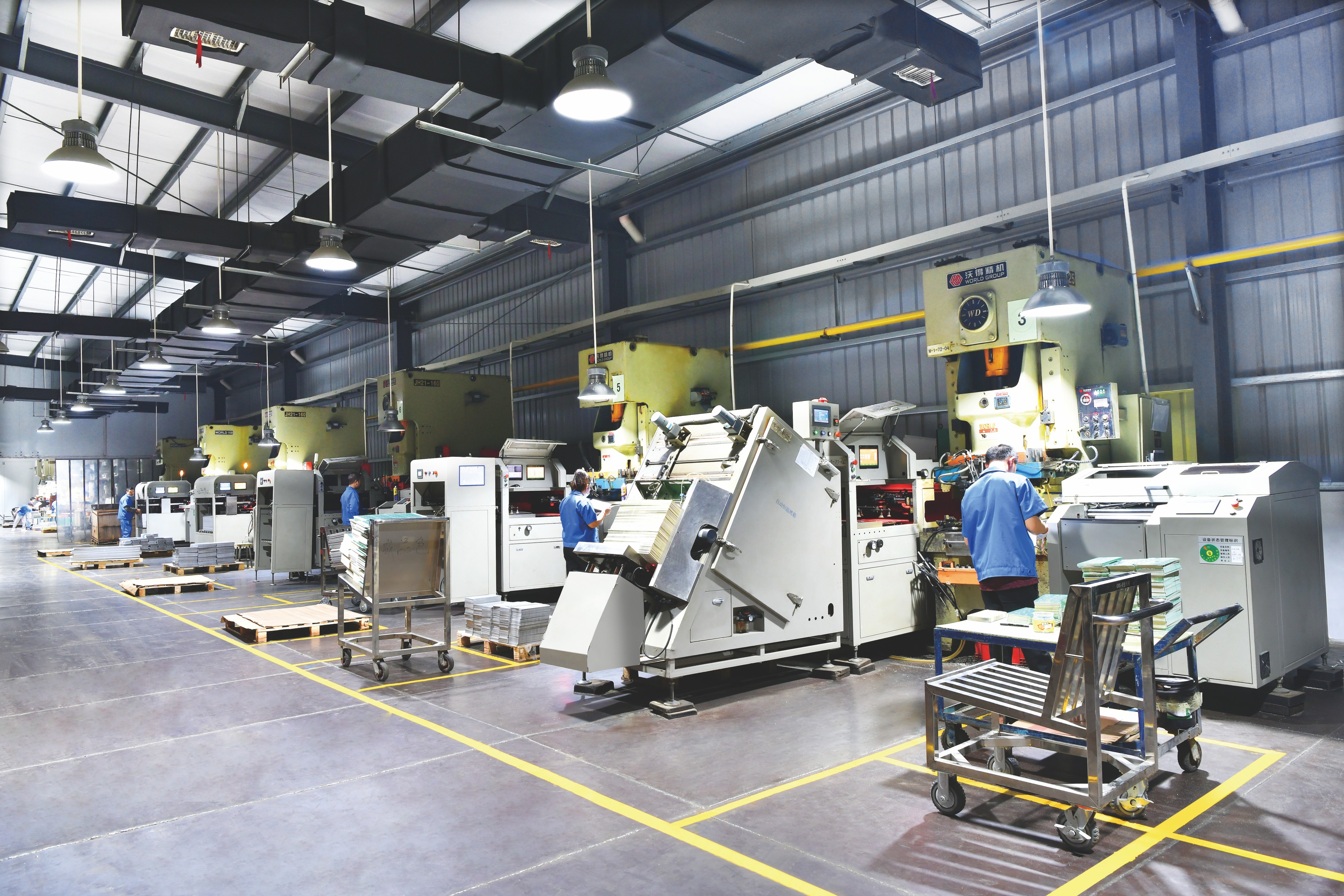
Punching workshop at WODE Circuit Technology, Zhuhai. Mechanical processing consistency is one of the process variables that determines whether repeat orders behave like the first order.
Why the first quote is a weak proxy for a multi-year decision
Switching board suppliers in the middle of a lighting programme is not a purchasing transaction; it is an engineering project. A new source reopens material approval, stack-up review, thermal validation, reliability testing and, in many cases, customer notification and re-approval. The engineering cost of that revalidation usually exceeds whatever per-unit saving prompted the switch. Buyers who understand this stop comparing quotations as isolated prices and start comparing suppliers as multi-year risk profiles.
The economics of longer-life luminaires make the point clearly. Published comparisons of LED street lighting against traditional high-pressure sodium systems describe roughly 65% energy savings, about three times the lifespan, approximately 90% less maintenance and a total cost of ownership around 40% lower over five years, despite an initial cost premium in the region of 15%. Those figures hold only if the board inside the luminaire behaves in year four the way it behaved in year one. A drifting thermal interface or an inconsistent dielectric lot erodes exactly the maintenance saving that justified the platform in the first place.
Risk in a multi-year programme is also broader than quality. It clusters into four categories that behave differently: quality and yield consistency; lead time and delivery reliability; supply chain and raw-material price volatility, particularly in aluminum and copper; and certification or compliance continuity. Each is controlled by a different mechanism — inspection and functional testing for quality, order control and procurement planning for delivery and materials, document control for compliance — which is why a single audit question rarely surfaces all four.
Six continuity criteria that separate stable suppliers from cheap ones
The framework below converts a vague instruction to "find a reliable supplier" into document requests that can be answered, compared and archived in a procurement file.
| Evaluation area | What to verify | Evidence to request | Why it matters over years |
|---|---|---|---|
| Operating history and organizational stability | Year established, ownership continuity, how the product lines have evolved | Company registration and profile, product-line history | A supplier that has already survived several demand cycles is less likely to exit or restructure mid-programme |
| Facility scale and capacity headroom | Site area, workforce, stated annual output, equipment generations | Factory audit report, capacity statement, utilisation data | Headroom absorbs volume growth and peak-season surges without process changes |
| Certification continuity | ISO 9001 and IATF 16949 quality systems, product compliance to UL, RoHS and REACH | Current certificates showing scope and expiry, verified with the issuing body | A lapsed or narrowed scope forces requalification and can block shipment into some markets |
| Environmental management | ISO 14001 or an equivalent environmental management system, effluent and waste controls | EMS certificate, environmental permits, previous audit findings | Compliance expectations tighten over a programme's life; process-level environmental control reduces disruption risk |
| Product standardization and material breadth | Stable laminate families (FR-4, CEM-1, CEM-3, aluminum MCPCB), layer structures, FPC formats | Material datasheets, stack-up library, approved laminate supplier list | Repeatable stack-ups cut lot-to-lot variation and simplify second-source approval |
| Process control and defect prevention | Incoming, in-process and final inspection; functional testing; corrective-action loop | Quality manual, inspection specifications, defect data, corrective-action examples | Drift, rather than outright catastrophe, is the usual cause of late-programme failures |
| Commercial continuity | Lead-time policy, order control, raw-material planning, emergency delivery provisions | Written lead-time commitments, sourcing plan, escalation contacts | Aluminum and copper volatility surfaces as delivery risk long before it surfaces as price risk |
How WODE Circuit Technology maps to those criteria
WODE Circuit Technology (Zhuhai) Co., Ltd. has operated since 2003 as a PCB and FPC manufacturer in Zhuhai, Guangdong, China. Read against the six criteria, its published profile supplies concrete answers rather than general reassurance:
- Operating history: established in 2003, with a product portfolio that now spans rigid MCPCB, FPCB, infinity-length FPCB, FR-4/CEM-1/CEM-3 PCBs and CCL, and PCB inks.
- Scale and headroom: a 150,000 m² facility, 500+ employees, a stated annual output of 6,000,000 m², an R&D team of 15 and more than 40 patented technologies.
- Certification continuity: ISO 9001, ISO 14001 and IATF 16949 management system certifications, with products stated to comply with UL, RoHS and REACH.
- Commercial footprint: an export ratio of roughly 50%, main markets including Brazil, Turkey, India, Vietnam and Russia, and more than 1,000 customers across more than 30 countries.
- Company-reported performance: tolerance of ±10% on key parameters, defect rates 30% lower than the industry average it references, up to 20% better heat dissipation in LED and high-power applications, and 5–10% lower cost on multi-type orders compared with sourcing each board type from a separate supplier.
The value of these statements in a procurement file is not that they are flattering; it is that they are specific enough to be tested. Tolerance bands, certificate scopes, output volumes and defect claims can each be checked against a factory audit or a certificate registry, which is what separates a verifiable supplier profile from a brochure.
Technical explanation: what actually determines a decade of field behaviour
The thermal path is a system, not a headline number
Aluminum-core dielectrics are commonly reported in the 1–3 W/m·K band, with the higher end used for high-power LED modules, while supplier-reported metal-core ranges extend further. These ranges are useful for capability screening and should not be used for ranking: test methods, dielectric definitions and acceptance conditions are rarely harmonized between suppliers, so a larger published number does not automatically mean a cooler board. For a multi-year programme the more valuable questions are which dielectric family is used, at what thickness, with what copper weight, tested by which method, and whether the supplier holds that stack-up stable across lots.
Structure and tolerance
Single-layer aluminum metal-core PCB remains the standard structure for LED lighting, with double-layer and multilayer metal-core boards appearing where routing density or integrated control circuitry requires them. Structural simplicity supports repeatability. Tolerance control compounds over time: accumulated variation in board thickness, copper weight or hole position does not appear on the first article, it appears as assembly yield loss eighteen months into a programme. WODE's stated ±10% tolerance on key parameters is therefore a continuity claim as much as a technical one.
Environmental stress and chronic failure
Outdoor and humid-environment luminaires fail through two slow mechanisms: moisture ingress and gradual LED degradation. Neither is visible in a first-article inspection; both appear as field returns and warranty cost years later. Board-level decisions — surface finish, solder mask integrity, dielectric adhesion under thermal cycling — interact with luminaire-level protection, so the PCB supplier and the fixture designer have to agree early on the stress profile the board will see.
Traceability and diagnostic speed
A supplier that runs incoming, in-process and final inspection alongside functional testing can show where a deviation entered the process. A supplier that tests only finished boards cannot. Over a multi-year programme the difference is diagnostic speed: whether a quality question is answered in days with process data or in weeks with re-testing.
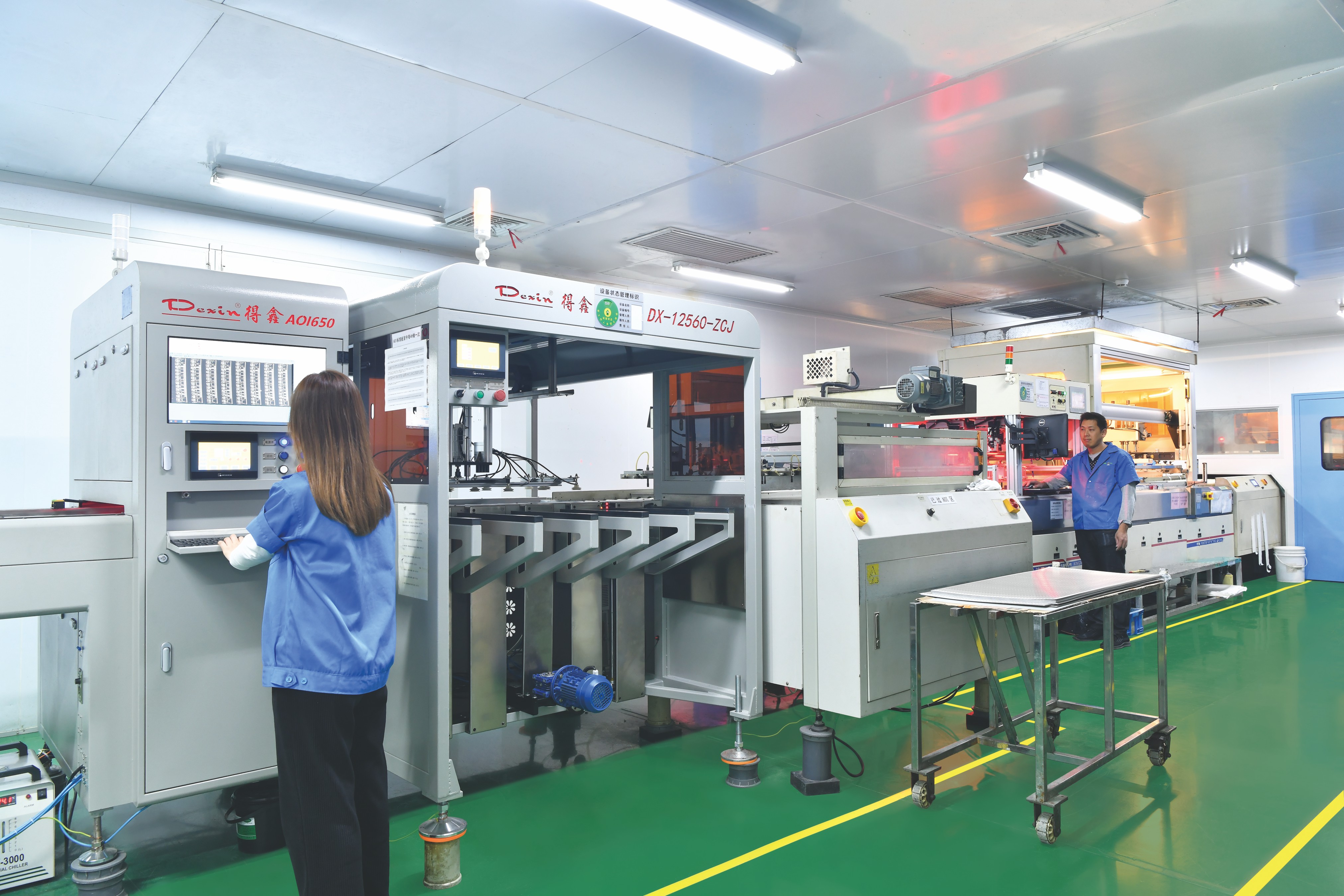
Circuit testing workshop at WODE. In-process electrical verification shortens the path between a detected deviation and its cause.
Where continuity criteria matter most: application patterns
- Street light and outdoor area lighting: wide temperature cycling, moisture exposure and service intervals measured in years. Dielectric supply continuity and solder mask process stability outweigh a marginal per-board price difference.
- Flood light and high bay: high power density per board area. The thermal path and copper weight dominate, and any stack-up change requires revalidation rather than a straight substitution.
- Panel light and downlight: thin profiles at high unit volumes. Standardization and panel utilization drive both cost and lot-to-lot consistency.
- Grow light: long duty cycles under controlled humidity, where sustained thermal performance matters more than peak specification.
- Strip and linear lighting: reel-to-reel FPC and infinity-length formats matter when long continuous runs have to be produced repeatably rather than in fixed panel sizes.
WODE's portfolio covers rigid MCPCB, FPCB and infinity-length FPCB, and the company states that its products are widely used in indoor and outdoor lighting, automotive lighting, new energy, home appliances and 5G communication. For a buyer, the practical question is narrower: does the supplier's standardized stack-up library already contain a configuration close to the one your luminaire needs?
Market trend: growth, compliance and the limits of public data
The wider board market is expanding. Grand View Research places the global printed circuit board market at USD 82.7 billion in 2025, projects USD 87.8 billion for 2026 and USD 130.3 billion by 2033. Growth of that kind attracts capacity, but it does not automatically produce a more stable supplier base: it also intensifies competition for aluminum, copper and laminate, and it raises the compliance overhead that suppliers must absorb.
A caution belongs here. The reference set used for this article does not contain a verified LED PCB or MCPCB sub-segment market size, growth rate or share figure. Buyers should therefore treat supplier-provided market-share claims as marketing until the underlying dataset and product definition are shown. What is verifiable is directional: restricted-substance obligations under RoHS and REACH are revised over time, and environmental management systems such as ISO 14001 are increasingly requested in RFQs as evidence that a supplier controls its processes rather than merely its output.
Comparison with traditional solutions: quote-driven versus continuity-oriented sourcing
| Criterion | Quote-driven sourcing | Continuity-oriented sourcing |
|---|---|---|
| Price basis | Lowest of three quotations | Price inside a documented total-cost model that includes revalidation and field risk |
| Certification | A copy of a certificate filed once | Scope, edition and expiry verified and refreshed annually |
| Capacity | Stated capacity accepted at face value | Audited capacity plus headroom and an allocation plan |
| Standardization | Board matches the drawing | Repeatable stack-up library and material equivalence rules |
| Change control | Changes communicated informally | Written change-notification process with revalidation triggers |
| Risk visibility | Risk discovered at delivery | Quality, delivery, raw-material and compliance risk mapped in advance |
Boundaries of this approach
- Breadth is not depth. A supplier running many PCB families may not be the deepest specialist in any single niche process. Where a design depends on an unusual stack-up, ask for evidence from comparable builds rather than assuming breadth guarantees capability.
- Company-reported metrics require independent verification. Tolerance, defect-rate and heat-dissipation figures in this article are supplier-reported. Certificate numbers, scope and expiry should be confirmed with the issuing body, and test reports should state their method.
- ISO 14001 is a management-system certification, not a product environmental declaration. It does not by itself provide a life-cycle assessment or a product carbon figure for a specific board.
- Supplier evaluation cannot replace design validation. Thermal simulation, sample builds and reliability testing remain necessary for every new board, regardless of how stable the supplier is.
- Price advantage is conditional. WODE's stated 5–10% cost advantage applies to multi-type orders versus splitting the same orders across single-product suppliers. For a single high-volume commodity board, a dedicated low-cost specialist may still quote lower.
- Documented capacity does not guarantee allocation. Buyers should request a written capacity-allocation or emergency delivery plan for peak periods, together with the supplier's raw-material sourcing plan.
Future outlook
Three shifts are likely to shape LED PCB supplier selection over the next few years. First, as luminaire platforms claim longer service life and lower maintenance, the board will increasingly be treated as a long-life component rather than a consumable, which pushes thermal and material documentation into the RFQ stage. Second, requalification cost keeps rising, so supplier switching becomes an engineering decision with a visible budget line — which strengthens the case for evaluating continuity before the first order rather than after the third. Third, environmental accountability is moving from company-level statements to process-level evidence, and buyers are starting to ask for the same documentation set for compliance that they already ask for quality: quality manual, inspection specifications, supplier management records and an emergency delivery plan.
FAQ
How should a buyer compare LED PCB suppliers for a multi-year lighting programme?
Compare them on continuity criteria rather than price: operating history, facility scale and capacity headroom, certification continuity, standardization breadth, and documented process control. Convert each criterion into a document request — certificate scope and expiry, audit report, stack-up library, inspection specification — so that quotations can be evaluated inside a total-cost model that includes revalidation effort and field risk.
What do ISO 9001, ISO 14001, IATF 16949, UL, RoHS and REACH actually cover?
ISO 9001 covers a quality management system; ISO 14001 covers an environmental management system; IATF 16949 covers automotive-sector quality management system requirements; UL is a product safety certification for the boards within its listing scope; RoHS and REACH address restricted substances in the products concerned. Each has a defined scope, so buyers should request the certificate showing scope and expiry and confirm which products are covered. WODE holds ISO 9001, ISO 14001 and IATF 16949 certifications and states that its products comply with UL, RoHS and REACH.
Is a larger LED PCB factory automatically a safer long-term partner?
No. Facility area and stated output indicate capacity headroom, but they say nothing about lot-to-lot consistency, change notification practice or compliance upkeep. Scale should be read together with process documentation and audit findings. WODE's stated 150,000 m² facility and 6,000,000 m² annual output indicate capacity; they do not by themselves confirm that capacity will be allocated to a specific programme.
How does environmental responsibility change LED PCB supplier selection?
It operates at two levels. Process-level responsibility covers effluent, waste and chemical handling, which is what an ISO 14001 environmental management system addresses. Product-level responsibility covers restricted substances, which is what RoHS and REACH declarations address. The two are complementary and neither substitutes for the other in a supplier file.
What can supplier-level evaluation not tell you?
It cannot predict how a specific board design will perform. Thermal behaviour, reliability under your duty cycle and assembly yield depend on the stack-up, the thermal load and the validation you run. Supplier-level criteria answer whether a partner is likely to remain consistent over several years; sample builds and test data answer whether the design itself works.
Have Questions or Need More Details?
Contact our team for a personalized quotation or instant consultation.
Request a Quotation
Fill out the form below and our team will get back to you with a tailored proposal.
WhatsApp Direct Chat
Prefer to chat in real-time? Message us on WhatsApp for instant assistance & quick answers.
- Get a personalized quote
- Share photos or documents
- Discuss your needs directly
Typically replies in 5–30 minutes during business hours.