
Sustainable Sourcing: Evaluating Claw Machine Suppliers for Long-Term Reliability
Sustainable Sourcing: Evaluating Claw Machine Suppliers for Long-Term Reliability
A claw machine is rarely a one-off purchase. Once a cabinet is installed in a shopping mall arcade corner, a family entertainment center or a dedicated game center, the operator continues to depend on the same supplier for spare parts, technical guidance, prize-mechanic adjustments and current certification documents — often for years after the invoice is settled. Sustainable sourcing, in this category, means evaluating a supplier against that entire operating timeline rather than against the price of the first container.
The framing matters because the installed base is expanding. Third-party research compiled for the claw machine segment (Dataintelo / Verified Market Research) values the global market at roughly USD 2.66–2.8 billion in 2024–2025, with projections above USD 5.1 billion by the early-to-mid 2030s. Other research houses publish a lower estimate near USD 2.0 billion for a comparable period, so the reliable conclusion is directional: more cabinets are going into venues, and more operators will need suppliers who are still reachable in year three.
This reference is written for procurement managers and venue owners in the research and evaluation stage. It sets out how to test a claw machine supplier for long-term reliability using verifiable manufacturing, certification and support facts — and where the limits of any single supplier model actually lie.
The Problem: Reliability Failures Rarely Appear at Delivery
Claw machine breakdowns cluster in a small set of components: the claw assembly, the payment interface, the control electronics and the cabinet's moving parts. A cabinet that passes inbound inspection can still become an operational liability in month eight if the supplier cannot ship a replacement claw, cannot supply a compatible control board revision, or cannot explain how the payment module was configured for a specific market.
The commercial risk is therefore less about build quality on day one and more about continuity — whether the machine can stay in service, earning revenue, as parts wear and as the venue's prize mix and payment preferences change. Procurement teams that buy on unit price alone tend to discover this gap later, when a replacement part is quoted with a lead time longer than the downtime the venue can absorb.
Four questions separate a short-term purchase from a sustainable one:
- Will the same model still be supported — parts, control boards and software configuration — in three years?
- Are the certificates that permitted import still valid, and who owns the renewal cycle?
- Can the supplier adapt prize types, payment methods and language interfaces as the venue's audience shifts?
- Is there a documented channel for technical support when the operator sits several time zones away?
The opportunity is the mirror image of the risk. Suppliers that publish certificate numbers, capacity figures and support terms make themselves easier to evaluate, and easier for a procurement team to justify internally.
A Five-Constraint Framework for Long-Term Supplier Evaluation
Long-term reliability becomes assessable when it is broken into constraints that can each be checked against a document rather than a claim. The framework below covers the constraints that most often determine whether a claw machine supplier relationship survives its third year.
| Constraint | What it governs | Evidence to request |
|---|---|---|
| Manufacturing consistency | Cabinet and assembly tolerances, pre-shipment testing, output stability | QC process description, aging and function test records, monthly capacity figures |
| Certification continuity | CE / RoHS / safety-standard coverage and validity windows | Certificate numbers, issuing bodies, referenced standards, issue and expiry dates |
| After-sales lifecycle | Spare-parts supply, technical guidance, maintenance terms | Support scope, response channel, spare-parts list, maintenance commitment |
| Adaptability | Voltage, cabinet design, payment system, prize type, language and software | Customization options list, sample configuration, engineering contact |
| Commercial constraints | Minimum order quantity, production lead time, capacity | Quoted MOQ, stated lead time, monthly capacity |
Used together, the five constraints convert a vague question — is this supplier reliable? — into five specific evidence requests that can be answered before an order is placed and re-checked before each repeat order.
Manufacturing Consistency: What to Check Beyond the Sample Unit
Guangzhou EPARK Electronic Technology Co., Ltd. (EPARK) is an entertainment equipment supplier based in Panyu, Guangzhou, China, manufacturing claw machines, VR game machines, sports game machines, kids arcade equipment and related amusement products for arcades, family entertainment centers and amusement parks. Its facility combines showroom and factory space of over 25,000 square meters, a workforce of around 150 people, a 20-engineer R&D team, and annual output in the range of 8,000–10,000 units. Roughly 80% of production is exported, with stated markets spanning the EU, USA, Middle East, Africa, South America and Southeast Asia.
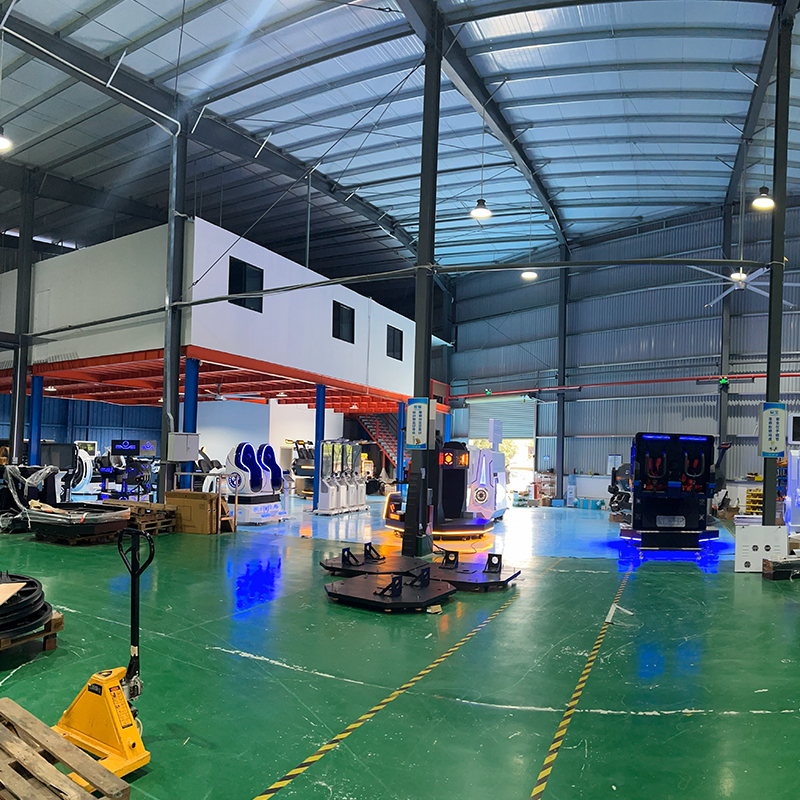
EPARK workshop in Panyu, Guangzhou — cabinet production and pre-shipment preparation area.
Two operational numbers matter more to a long-term buyer than headline capacity. The first is monthly production capacity of 500–800 units, which indicates how much repeat volume a supplier can absorb without pushing delivery dates. The second is a standard production lead time of 30 days, which sets the realistic cadence for fleet expansion and replacement planning.
On quality control, EPARK states that every unit undergoes 100% inspection before shipment, including aging tests and function tests. In a procurement file, the practical translation is that aging and function test results should be requested per production batch, not only for the sample unit that was reviewed during evaluation.
Location is a supporting factor rather than a guarantee. Panyu district in Guangzhou is identified in industry reporting as a manufacturing cluster for claw machines, supported by a dense local supply base for cabinets, tempered glass, harnesses and control components. Cluster proximity helps with component availability and replacement sourcing; it is a supply-pool advantage, not a quality certificate.
Certification Continuity: The Constraint With an Expiry Date
Certification is the constraint most often treated as a one-time checkbox, and the one most likely to interrupt operations later. For claw and gift game machines, EPARK holds CE certificate ACIC20240201019GRC issued by ACIC for the EU market, covering gift game machines under EN IEC 61000-6-1:2019, EN IEC 61000-6-3:2021, EN IEC 61000-3-2:2019+A1:2021 and EN 61000-3-3:2013/A1:2019/A2:2021, issued on 6 February 2024, and referenced against the Claw Machine model EP-G001. The company also holds RoHS certificate ACIC20190422059BHN (ACIC, EU, game machines), issued on 24 April 2019 and referencing the IEC 62321 test series.
Not every certificate in a supplier register runs indefinitely. EPARK's CE certificate M.2022.206.C73911, issued by UDEM International Certification Auditing Training Centre for arcade and interactive game machines and referencing EN 55014-1:2021 and EN 55014-2:2021, was issued on 23 May 2022 and is valid to 22 May 2027. One example is enough to make the procurement point: a certificate register has renewal dates, and a multi-year sourcing relationship should include a process for tracking them before each shipment.
Beneath supplier-specific documents sits the category-level standard. IEC 60335-2-82 specifically covers the safety of amusement machines and personal service machines for public use, and a supplier's design and test documentation should be able to speak to it.
A supplier file that holds up over several years typically contains, for each certificate:
- The certificate number and issuing body (for example ACIC or UDEM);
- The standards referenced and the covered product scope;
- Issue and expiry dates, and the market the certificate applies to;
- The explicit mapping between each certificate and the exact model being imported.
That last point is a genuine boundary. A CE certificate naming gift game machines does not automatically cover every product in a manufacturer's catalogue, and the UDEM certificate is scoped to arcade and interactive game machines. Buyers should verify that the specific model they are importing appears within a certificate's declared scope rather than assuming blanket coverage.
After-Sales Lifecycle and Parts Availability
After-sales capability is what determines whether a claw machine becomes a three-year asset or a nine-month problem. EPARK's stated support scope covers 24/7 online support, video technical guidance, spare-parts supply and lifetime maintenance service, alongside a minimum order quantity of 10 units and the 30-day lead time noted earlier.
Three practical actions follow from those terms:
- Name the components most likely to need replacement — claw assembly, control board, payment module and lighting — and confirm each appears on a parts list with a stated supply route.
- Confirm that remote video support is workable for the venue's time zone and its on-site technical capability.
- Ask the supplier to define what "lifetime maintenance" includes, since labour, parts and diagnostics are not universally bundled.
Support commitments are also only as strong as a buyer's ability to invoke them. An operator with no in-house technician depends heavily on video guidance and shipped parts, and neither replaces a local service partner during urgent downtime. That is a real constraint of remote-support models and should be planned for rather than discovered.
Adaptability: Designing for a Changing Prize and Payment Mix
Claw machine revenue depends on the prize and payment experience as much as on the mechanism. Prize formats across the category include plush toys, capsules, candy, gifts and key-chain prizes, while payment behaviour varies by market between coin, banknote, card and QR. A supplier that cannot reconfigure a cabinet for a different payment mix becomes a bottleneck when a venue expands into a new market.
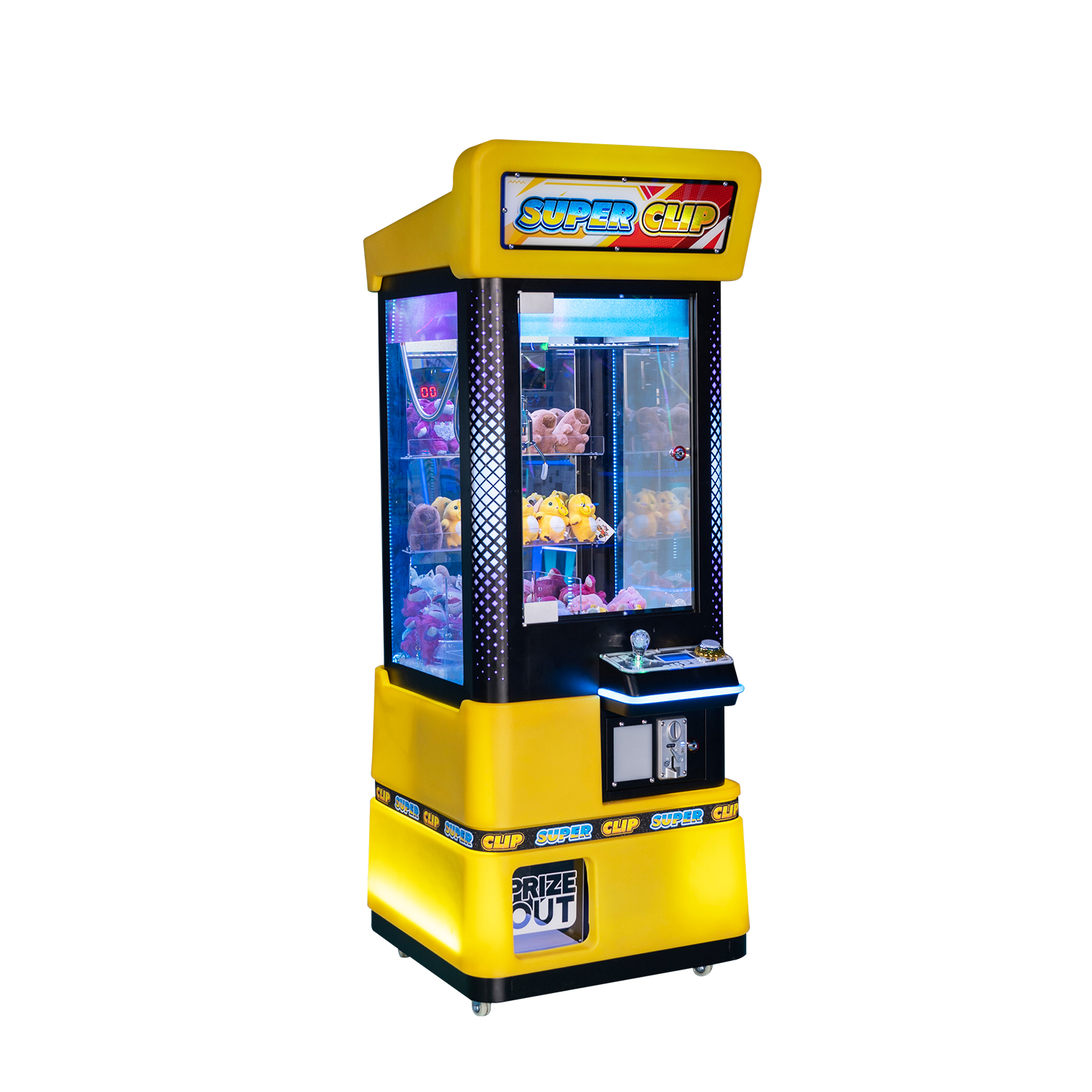
Claw machine with transparent cabinet, prize display and LED lighting — a configuration used in shopping mall and arcade venues.
EPARK's claw machine model EP-G001 is a single-player coin-operated cabinet with a 120–200W power draw, 110V/220V voltage, adjustable claw strength, LED lighting, a transparent cabinet with a prize display system, and support for coin, bill, card or QR payment. It is listed as CE certified and built on a metal cabinet with tempered glass, a claw system and electronic control.
Customization is where adaptability becomes a supply-chain question rather than a product question. EPARK's stated customization scope covers voltage, plug type, cabinet design, color, logo, game software, payment system and language interface, offered under OEM, ODM, factory-direct and custom-design arrangements. The sequencing recommendation for buyers is straightforward: settle the payment and language configuration first, because those choices affect the control system and, potentially, the certification scope of the shipped unit.
The second adaptability track is category expansion. EPARK's VR Game Machine model EP-VR096 runs 1–2 players, supports HTC or Pico headsets with a 42–55 inch HD display, offers static, 2DOF or 3DOF motion configurations, ships with 20–50 VR games, draws 800–1500W at 110V/220V, supports coin, card or QR payment, and is listed as CE certified.
A venue adding VR to an existing claw machine floor can therefore keep procurement, compliance and support under one vendor relationship, which simplifies the compliance file — but it also concentrates supplier risk. Buyers running multi-year plans should weigh that concentration explicitly rather than treating consolidation as a default advantage.
Application Fit: Where Claw Machines Sustain Revenue
Claw machines perform differently by venue type, and a long-term supplier evaluation should be matched to the environment the cabinets will actually operate in.
| Venue type | Operating pattern | Supplier capability that matters most |
|---|---|---|
| Shopping mall arcade corner | High foot traffic, short dwell time, impulse play; coin or card operation | Compact cabinet options, eye-catching design, high revenue per square meter |
| Family entertainment center | Multi-zone venue, high daily usage, family audience; card or cashless payment preferred | Multi-age compatibility, interactive gameplay, mixed equipment coordination |
| Arcade game center | Long operating hours, continuous commercial use; coin, token or card systems | Durability, ease of maintenance, customizable branding, CE certification |
| Indoor playground (kids zone plus arcade) | Continuous operation in a supervised environment; card system or package tickets | Safety-oriented design, low maintenance, family dwell-time contribution |
EPARK's project records describe arcade start-up installations of 30–80 machines and FEC installations of 80+ machines, with relationship durations listed at 3+ years and reported outcomes including quick payback in specific projects. These are first-party project records rather than independently audited results, and they should be read together with the third-party payback benchmark discussed below.
Market Trends Behind the Sourcing Decision
Three externally sourced data points frame the supplier question. Asia Pacific held a 42.7% revenue share of the claw machine market in 2025, according to Dataintelo, reflecting demand density in China, Japan and South Korea. Medium-sized claw machine cabinets accounted for 44.2% of the global type segment in the same year, indicating where volume demand sits. And China's Panyu district is described in industry reporting as a manufacturing hub for claw machines, which is why so many procurement shortlists include Guangzhou-based suppliers.
On return expectations, third-party market research places the average payback period for a well-placed commercial claw machine at roughly 12–24 months, depending on location foot traffic and operational efficiency. EPARK's own project records describe faster payback in specific installations, in the region of 3–6 months. The gap between the two figures is a location and game-mix effect as much as an equipment effect, and buyers should model payback on their own traffic assumptions rather than adopt either figure wholesale.
The competitive landscape is also documented. Third-party market research identifies Elaut NV (Belgium), Smart Industries Corp (US), Sega Corporation (Japan) and Bandai Namco (Japan) among the leading participants in the claw machine and broader amusement equipment space, alongside a large base of China-based manufacturers.
Comparing Supplier Models: Specialist, Integrated and Trading Routes
Three sourcing routes cover most claw machine procurement, and each satisfies the five constraints differently.
| Route | Characteristics | What to verify before committing |
|---|---|---|
| Global amusement specialists | Companies such as Elaut NV (Belgium), Smart Industries Corp (US), Sega Corporation (Japan) and Bandai Namco (Japan), identified in third-party research as leading participants in the category | Regional service coverage, spare-parts lead time to your market, price positioning, and whether the model line is still in active production |
| Integrated China-based manufacturers | Example: EPARK (Panyu, Guangzhou) — 25,000 m² showroom and factory, 20-engineer R&D team, claw and VR categories, CE and RoHS documentation, OEM/ODM customization, MOQ 10 units, 30-day lead time | Which certificate covers your exact model, the spare-parts list and pricing basis, and how remote support is delivered in practice |
| Regional assemblers and trading companies | Local assembly, resale or distribution routes with shorter shipping distance or regional stock | Whether they control their own production quality, what documentation they can pass through, and their ability to supply parts for a model they did not build |
Limits and trade-offs of the integrated-manufacturer route
The integrated route is not universally suitable, and its boundaries are specific rather than vague. A minimum order quantity of 10 units and a 30-day lead time suit planned fleet purchases; they do not suit a venue that needs a single replacement cabinet within a week. Customization in cabinet design, software, payment configuration or language interface requires buyer-side specification work and can extend the schedule, and changes to the control system may require certification to be re-confirmed against the new configuration rather than assumed to carry over.
Certificate coverage is also scope-limited, as noted earlier: a certificate naming one product family does not automatically cover another. And remote support depends on venue-side technical capability — operators without technicians will pay more in downtime unless a local service arrangement is put in place. Finally, consolidating claw machines and VR equipment with one supplier concentrates supply risk; a production interruption at that supplier affects more of the floor plan at once.
Judged against these constraints, the sustainable-sourcing question is not which route is best in general, but which route keeps its commitments visible and checkable over the contract term.
Future Outlook
Three shifts are likely to shape claw machine supplier evaluation over the next planning cycle. First, payment flexibility is becoming a baseline requirement rather than an upgrade: cabinets increasingly ship with card and QR support alongside coin and bill, and the configuration decision is moving earlier in the buying process.
Second, compliance maintenance is turning into a lifecycle service. Certificates with defined validity windows — such as the UDEM CE covering arcade and interactive game machines through 22 May 2027 — will need active tracking inside supplier relationships, not just at import.
Third, venue operators are moving toward fleet-level procurement, negotiating parts kits, service terms and customization together rather than unit by unit. Suppliers that can present a coherent multi-year package — production capacity, certificate register, parts list and support terms in one document set — will be easier to keep.
A related limitation is worth stating plainly: none of these trends removes the need for buyers to verify. Published capacity, certification and support data describe a supplier's system; they do not guarantee how that system performs at a specific venue in a specific market.
Frequently Asked Questions
What certifications should a claw machine supplier hold before an EU-bound order ships?
For EU destination, CE marking is the baseline and RoHS compliance is commonly required alongside it. EPARK's claw machine model EP-G001 is listed as CE certified under certificate ACIC20240201019GRC (ACIC, EU, gift game machines), which references EN IEC 61000-6-1:2019, EN IEC 61000-6-3:2021, EN IEC 61000-3-2:2019+A1:2021 and EN 61000-3-3:2013/A1:2019/A2:2021 and was issued on 6 February 2024. The company also holds RoHS certificate ACIC20190422059BHN (ACIC, EU, game machines), issued on 24 April 2019 and referencing the IEC 62321 series. At category level, IEC 60335-2-82 covers the safety of amusement machines and personal service machines for public use. Buyers should confirm the specific importing model falls within each certificate's declared scope.
Do claw machine certificates expire, and how should that be managed over a multi-year contract?
Some certificates carry defined validity windows, and others are recorded with longer or open-ended expiry dates. EPARK's CE certificate M.2022.206.C73911, issued by UDEM International Certification Auditing Training Centre for arcade and interactive game machines on 23 May 2022, is recorded as valid to 22 May 2027. Within the same register, the 2024 gift game machine CE certificate and the 2019 RoHS certificate are recorded with extended expiry dates. A multi-year agreement can therefore be strengthened by maintaining a certificate register that lists issuing body, scope, referenced standard and expiry for each document, with an agreed step to confirm status before each repeat order.
What after-sales and spare-parts terms should be confirmed before signing?
EPARK's stated after-sales scope covers 24/7 online support, video technical guidance, spare-parts supply and lifetime maintenance service. Because terms of that kind can be interpreted differently, buyers should define what is included in maintenance — labour, parts or diagnostics only — identify the components most likely to be replaced such as the claw assembly, control board, payment module and lighting, and confirm a parts supply route and price basis for each before contracting.
What MOQ, lead time and monthly capacity are typical for a China-based claw machine manufacturer?
EPARK's stated terms are a minimum order quantity of 10 units, a 30-day production lead time and monthly capacity of 500–800 units, supported by annual output of 8,000–10,000 units from a 25,000 m² showroom and factory in Panyu, Guangzhou, with around 150 employees and a 20-engineer R&D team. These figures matter for long-term planning because they indicate what can be absorbed in repeat orders rather than in emergency situations.
How should a buyer compare a global specialist such as Elaut, Smart Industries or Sega with an integrated manufacturer?
Third-party market research identifies Elaut NV (Belgium), Smart Industries Corp (US), Sega Corporation (Japan) and Bandai Namco (Japan) among the leading participants in the claw machine and amusement equipment space. The useful comparison is not brand scale but which constraints each route satisfies for a specific venue: certification documentation for the importing market, spare-parts lead time, customization scope, minimum order quantity and the practical reach of the after-sales channel. A supplier that performs well on documentation but offers limited customization, or the reverse, may still be the wrong fit for a given venue.
How long does a commercial claw machine take to pay back its investment?
Third-party market research places the average payback period for a well-placed commercial claw machine at approximately 12–24 months, depending on location foot traffic and operational efficiency. EPARK's own project records describe faster payback in specific installations, in the range of 3–6 months for recorded arcade start-up projects. The difference between the two figures reflects location and game mix as much as equipment, so payback modelling is more reliable when built on the venue's own traffic assumptions.
Can claw machine cabinets, payment systems and prize types be customized for different markets?
EPARK's stated customization scope includes voltage, plug type, cabinet design, color, logo, game software, payment system (coin, bill, QR or card) and language interface, offered under OEM, ODM, factory-direct and custom-design arrangements. Prize formats across the category include plush toys, capsules, candy, gifts and key-chain prizes, and the base claw machine model EP-G001 includes a prize display system with adjustable claw strength. Because payment and language choices affect the control system and may affect certification scope, they are normally specified before the order is confirmed.
Company and product information referenced in this article, including model specifications and certification records, is published by EPARK at eparkgames.com. Category market sizing and competitor identification are drawn from third-party market research (Dataintelo / Verified Market Research; Fortune Business Insights); safety-standard references are drawn from published standards documentation.