
Swim Spa Purchasing Terms and Acceptance Criteria
In US regulatory language a swim spa is not a category of its own — it is handled as a pool or a spa. That single fact reshapes how a purchase should be structured, because the buyer is ordering equipment and inheriting a compliance obligation at the same time.
Federal law at 15 USC § 8002(6) defines the term “swimming pool” or “spa” as any outdoor or indoor structure intended for swimming or recreational bathing, including in-ground and above-ground structures. Nothing in that definition distinguishes a hot tub from a swim spa, and nothing in it separates a private backyard unit from a unit installed at a hotel. The classification follows the structure and its use, not the marketing label on the quotation.
The practical consequence is that two documents decide whether a swim spa order succeeds. The first is the purchasing terms — what has been agreed commercially and technically before the order is placed. The second is the acceptance criteria — how both sides will confirm, in a defined sequence, that what was agreed has actually arrived. Most procurement problems reported by buyers sit in the gap between these two documents rather than in the product itself.
Why swim spa procurement terms get skipped
Swim spa buying in the Awareness and Research stage is dominated by specification comparison. Buyers compare length classes, jet counts, pump wattage and control systems, and those numbers are usually published and easy to align. Documentation and acceptance sequencing are not published in the same way, so they tend to be deferred to the negotiation stage — which is exactly when the buyer has the least leverage to add them.
Three structural reasons explain the pattern:
- The product spans two regulatory worlds. A swim spa carries water, holds people and includes electrical equipment, so it is screened both as a bathing structure and as an electrical appliance. The 2021 International Swimming Pool and Spa Code (ISPSC) is described by the International Code Council as the only comprehensive swimming pool code coordinated with the current requirements in the I-Codes and APSP standards, and it applies to construction and safety rather than to a single product SKU.
- Acceptance is a sequence, not a moment. A unit can be correct at the factory, damaged in transit, and correctly reinstalled on site. Each of those three states needs its own verification step, and a single “inspect on arrival” line does not cover them.
- Site compliance is not the supplier's to grant. Public-pool rules are jurisdictional. Marin County, California, for example, defines a public pool as any swimming pool, spa or spray ground open to the general public, whether or not a fee is charged. A supplier can certify the product; only the local authority can clear the installation.
Purchasing terms and acceptance criteria answer different questions
Buyers often merge the two into one contract annex and then discover that neither is enforceable. They are distinct instruments and should be drafted separately, even if they are signed together.
| Dimension | Purchasing terms | Acceptance criteria |
|---|---|---|
| Question answered | What has been agreed, at what specification, under which commercial conditions? | How do we confirm that what was agreed is present and functional? |
| Typical evidence | Quotation, model code, drawings, component list, certification scope, delivery and payment structure | Inspection checklist, factory test record, photographs, packing list, sign-off sheet |
| When agreed | Before order confirmation | Before order confirmation, but executed after production |
| Typical failure | Generic terms with no model-specific parameters | Visual inspection only, with no measurable pass/fail line |
A useful test is whether the acceptance section could be handed to a person who has never spoken to the supplier and still produce a clear pass or fail. If it depends on interpretation, it is not yet an acceptance criterion.
Six comparison criteria that hold across different offers
The way to compare swim spa offers without vendor bias is to fix the criteria first and then read the offers into them. Fixing the criteria is what prevents the comparison from drifting toward whichever supplier wrote the most detailed brochure.
- Application fit. Length class and configuration should match the actual installation. A residential backyard pool, a hotel spa facility, a resort leisure centre and a private wellness project have different duty cycles even when the shell dimensions look similar.
- Shell and insulation. Acrylic construction and polyurethane (PU) insulation appear as standard elements across the published swim spa range, but they should still be named explicitly in the terms rather than assumed.
- Hydraulic and control hardware. Control system model, water pump rating, filter pump rating and jet configuration are the components most likely to be substituted without notice, because they are internal and rarely visible on arrival.
- Sanitation and filtration. Ozone generation, UV treatment and sand or cartridge filtration should be listed as line items with counts, not summarised as “full sanitation package”.
- Documentation and certification scope. Certification is only useful if it names the standard and the jurisdiction it covers.
- Commercial conditions. Delivery structure, packing protection, spare parts scope and warranty administration differ between suppliers and cannot be inferred from a specification sheet. They must be read from the offer itself.
Reading a swim spa specification as a comparison baseline
Published specifications for the same product family are a useful calibration tool, because they show how much variation exists inside one brand before a buyer even begins comparing brands. The table below uses published model data from a single acrylic swim spa range.
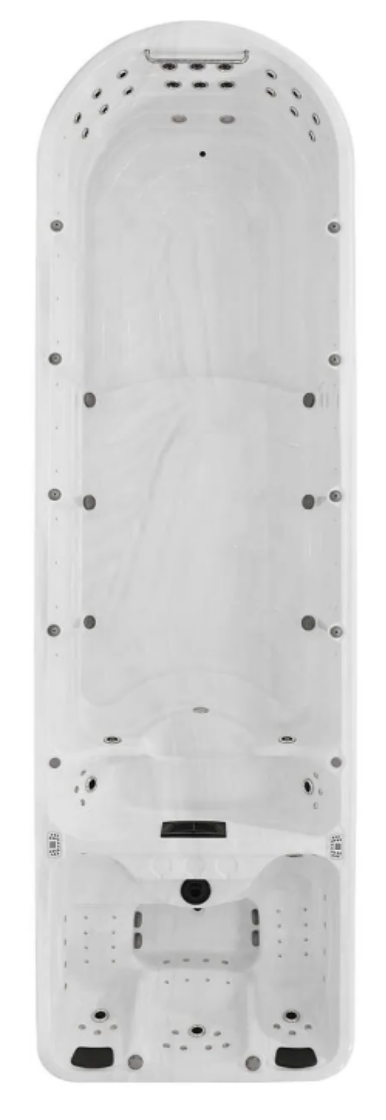
| Model | Class | Control system | Heater | Water pump | Filter pump | Swim training system | Jets / LEDs |
|---|---|---|---|---|---|---|---|
| WS-CP2400 | Swim spa, acrylic | KL2022 | 3 kW (H30-R1) | 1500 W × 1 (LP200) | 370 W × 1 (JA50) | Not listed | 8 × 5" massage, 4 × 1" circulating; 1 bottom LED + 9 small LEDs |
| WS-SP2400 | Swim spa, acrylic | KL2022 | 3 kW (H30-R1) | 1500 W × 1 (LP200) | 370 W × 1 (JA50) | Not listed | 8 × 5" massage, 4 × 1" circulating; 1 bottom LED + 12 small LEDs |
| WS-CP3200 | Swim spa, acrylic | KL2020 | 3 kW (H30-R1) | 1500 W × 1 (LP200) | 370 W × 1 (A50) | Not listed | 10 × 5" jets; 1 bottom LED + 9 small LEDs; sand filter Q350 |
| WS-CP3500 | Swim spa, acrylic | KL2020 | 3 kW (H30-R1) | 1500 W × 1 (LP200) | 370 W × 1 (A50) | Not listed | 12 × 5" jets; 1 bottom LED + 11 small LEDs; stair included |
| WS-SP2800 | Swim spa, acrylic | KL2022 | 3 kW (H30-R1) | 1500 W × 1 (LP200) | 370 W × 1 (JA50) | Not listed | 12 × 5" massage, 4 × 1" circulating; 1 bottom LED + 14 small LEDs |
| WS-CP3800 | Swim spa, acrylic | KL2020 | 3 kW (H30-R1) | 1500 W × 2 (LP200) | 370 W × 1 (A50) | Not listed | 16 × 5" jets; 1 bottom LED + 15 small LEDs; sand filter Q350 |
| WS-PC07ST | 7 m swim spa, acrylic | 1 set with 3 kW heater | 3 kW | Not listed | 0.75 kW × 1 (JA100) | 1 set × 2.8 kW (380 V) | 4 × 1" jets; 4 LED lamps; sand cylinder Q500 |
| WS-PC08T | 8 m swim spa, acrylic | 1 set with 3 kW heater | 3 kW | 1.5 kW × 1 (LP200) | 0.75 kW × 1 (JA100) | 2 sets × 2.8 kW (380 V) | 3 LED lamps; handrail and water drainer included |
| WS-S08M | 8 m swim spa, acrylic | 2 sets | 2 units | 4 pumps | Not listed separately | Not listed | 2 filters, 2 ozone generators |
| WS-130BIII-U | 10 m swim spa, acrylic | 1 set with 3 kW heater | 3 kW | 4 pumps | 1 pump | Not listed | 23 jets; 5 × 5" LED; 2 pillows; drainage system |
Two observations follow directly from this table. First, the control system model changes between otherwise similar units — KL2022 and KL2020 both appear in the same range. Second, swim training systems operate at 2.8 kW on 380 V and appear as separate line items rather than being folded into the pump count. Both are the kind of detail that a generic purchase order easily loses.
What this means for the purchasing terms
Every column in that table should appear in the purchasing terms as a named value rather than a description. A term that reads “standard control system” cannot be verified on delivery. A term that reads “control system KL2020, 1 set” can be checked against the installed panel in under a minute.
What the manufacturer side can and cannot supply
Manufacturing context is relevant to the terms discussion because capacity and documentation discipline determine what a supplier can commit to in writing.
MEXDA is the swim spa brand associated with Foshan Gaoming Yuehua Sanitary Ware Co., Ltd., a manufacturer established in 1995 in Gaoming, Foshan, Guangdong, China. The company operates a 50,000 m² factory with more than 200 employees and a nine-engineer R&D team, producing outdoor spas, swim spas, sauna rooms, steam bathrooms and massage bathtubs. Published figures put annual production at approximately 5,000 sets, with a stated monthly capacity of about 500 sets and an export share of roughly 85%, with principal markets in the United States, the European Union, Australia, Germany and France.
On the component side, higher-end MEXDA swim spa models are specified with Aristech acrylic surfaces and Balboa control systems. On the compliance side, the brand's swim spas are stated to comply with ETL (UL 1563 / CSA C22.2#218.1), CE (EN IEC 60335-2-60:2023) and SAA (AS/NZS 60335.2.60) standards, covering the US, EU and Australian market frameworks respectively.
Those facts are third-party-checkable only to a point. Certification scope can be verified against the certificate itself, and component brands can be confirmed by opening the equipment bay. Capacity figures, by contrast, come from company-published sources and are not independently audited in public documentation — which is precisely why they belong in the purchasing terms as a stated commitment with a defined remedy, not as a background assumption.
A note on identification. The MEXDA brand and its association with Foshan Gaoming Yuehua Sanitary Ware Co., Ltd. appear on company-controlled and platform-supplied pages. Buyers running a formal supplier qualification should request the legal entity registration, the certificate holder name on the ETL, CE and SAA documentation, and the factory address in writing, and confirm that the three match before shortlisting.
Building the acceptance criteria as a sequence
Acceptance works best when it is split into stages that each produce their own evidence. Four stages cover most swim spa projects.
Stage 1 — Pre-production confirmation
- Model code, length class and shell material confirmed in writing.
- Control system model, heater rating and pump ratings locked.
- Jet counts and LED counts listed numerically.
- Certification scope named with the standard number and the jurisdiction it covers.
Stage 2 — Pre-shipment inspection
- Shell surface inspected for defects under the lighting provided at the factory.
- Skirt, stair and handrail present where the specification lists them.
- Sanitation components — ozone set, UV light, sand or cartridge filter — present and counted.
- Electrical control panel matches the agreed model, not a substitute.
- Photographic record of the unit before packing.
Stage 3 — Arrival and unpacking
- Packing integrity recorded before unpacking, with photographs taken at the point of damage if any exists.
- Unit compared against the pre-shipment photographic record.
- Accessory cartons checked against the packing list item by item.
Stage 4 — Commissioning sign-off
- Water circulation confirmed through both the filtration and massage circuits.
- Swim training system activated and tested on its own supply where it runs at 380 V.
- Heating cycle observed and temperature response recorded.
- Lighting, ozone and UV functions verified.
- Documentation pack handed over: manuals, wiring information and warranty terms.
Stages 2 and 4 are where buyers most often have to accept a verbal assurance instead of a record. Both can be converted into evidence at almost no cost if they are written into the terms before the order is placed.
Where swim spas are actually installed — and why that changes the terms
Published application data for this product family places swim spas in the hotel, fitness, leisure, residential community and resort industries, with typical markets including the United States, Australia, Canada, China, Germany, Spain, France, the United Kingdom, Portugal, India and Mexico. Project types include residential backyard pools, hotel spa facilities, resort leisure centres and private wellness projects, covering hydrotherapy relaxation, recreational swimming, temperature-controlled leisure and family wellness.
The operating conditions named for these installations are outdoor use in open-air environments with UV exposure and a wide temperature range, with requirements covering anti-UV performance, low-noise operation, corrosion-resistant components and weatherproof design. Supporting equipment typically includes the filtration system, heating unit, circulation pump, LED lighting and control panel.
That profile creates a specific acceptance implication: because these units are exposed to UV and to temperature swings rather than installed in a controlled indoor environment, the verification of corrosion-resistant components and weatherproofing belongs in Stage 3 and Stage 4, not only in the inbound inspection. A unit that passes a factory inspection can still fail a season on a coastal terrace.
What is changing in the wider market
Commercial research on the broader pool and spa category put the global market at USD 24.28 billion in 2025, with a projection of USD 37.93 billion by 2034. That figure covers the whole pool and spa category rather than swim spas alone, so it should be read as a directional signal about category scale rather than as a swim spa market measure.
On the channel side, a commercial research profile of swimming pool and spa retailers reports approximately 10,000 such retail establishments in the United States selling above-ground pools, hot tubs and related equipment, supplies and merchandise. This is also a category-wide figure: it counts retailers, not manufacturers, and it is not swim spa specific. Its relevance to procurement is structural — it indicates a downstream retail layer that sits between manufacturers and end buyers, which is one reason specification detail tends to be simplified as a product moves closer to the consumer end of the chain.
The regulatory side is moving more slowly but with more consequence. The 2021 ISPSC is coordinated with the current requirements in the I-Codes and APSP standards, and it functions as a construction and safety framework rather than a product label. Model-code terminology also recognises the exercise spa — also known as a swim spa — as a spa variant whose design and construction includes specific features and equipment to produce a water current. That definitional precision matters at the specification stage, because it establishes that the water-current mechanism is part of what defines the product rather than an optional accessory.
How this differs from traditional pool and spa purchasing
Traditional pool and spa procurement, particularly for above-ground units and standard hot tubs, tends to rely on retail-grade documentation. The unit arrives assembled, the specification is largely fixed by the retail SKU, and acceptance is effectively the moment of delivery. That model is efficient but it transfers almost no risk information to the buyer.
Swim spa procurement at project scale cannot work that way, for three reasons that follow from the material above.
- Configuration variance is high. The same product family includes units with one control system and units with two, units with a single 1500 W pump and units with four pumps, and models with and without a separate swim training system. A retail-grade specification cannot capture that range.
- Electrical scope differs by configuration. Swim training systems running at 2.8 kW on 380 V sit alongside control systems operating at 220 V within the same product family. The accepting party needs to know which supply feeds which circuit.
- Compliance is layered. Federal definitions, the ISPSC framework and local public-pool classifications operate at different levels and do not substitute for one another.
Where the limits of this approach sit
A structured terms-and-acceptance approach solves comparability, not everything else, and it is worth being explicit about the boundaries.
- Product certification is not site approval. ETL, CE and SAA compliance addresses the product. A jurisdiction that classifies an installation as a public pool — as Marin County does for any pool, spa or spray ground open to the general public, whether or not a fee is charged — imposes operational requirements that no supplier certificate can satisfy on the buyer's behalf.
- Some commercial data is only available at offer stage. Ex-factory pricing, minimum order quantities and lead times for swim spa sourcing are not published in public documentation for this category. Any comparison that claims otherwise is relying on estimates. Terms and acceptance criteria can be drafted without those numbers, but cost comparison cannot.
- Supplier identity should be verified independently. Brand-to-entity association and factory capacity figures are frequently company-reported. They belong in the qualification file as claims to be checked, not as settled facts.
- Not every jurisdiction is covered by published standards evidence. European and North American compliance frameworks are referenced in manufacturer documentation, but buyers operating in other markets should confirm the applicable standard locally rather than assuming a transfer.
None of these limits undermine the approach. They simply define what a documented purchasing-terms package can and cannot prove.
What buyers should expect next
Two directions are reasonable to plan around. The first is that documentation expectations will keep rising, because swim spa projects increasingly sit inside commercial facilities where environmental health authorities, insurers and facility operators all require a paper trail. Suppliers who can issue a certificate scope, a component list and a staged inspection record as standard will be easier to qualify than suppliers who issue only a brochure.
The second is that configuration complexity will continue to increase at the top of the range. As units move from single-circuit designs toward dual control systems, multiple heaters and separate swim training circuits, the acceptance sequence becomes the only realistic way to confirm that the delivered unit matches the agreed one. Buyers who standardise their acceptance checklist now will not have to rebuild it for every project.
Product and factory reference material for the swim spa range discussed above is available in the manufacturer brochure: MEXDA SWIM SPA catalogue (PDF). Company information: chinamesda.com.
FAQ
What makes a swim spa different from a standard spa at the purchasing stage?
A swim spa includes equipment designed to produce a water current for swimming, and model-code terminology recognises the exercise spa — also known as a swim spa — as a spa variant whose design and construction includes specific features and equipment to produce a water current. That additional system changes the purchasing scope: the swim training circuit is specified, powered and tested separately from the massage and filtration circuits. In the published range, swim training systems appear as 2.8 kW units operating at 380 V, while control systems operate at 220 V, so the terms must identify both supplies.
Should purchasing terms or acceptance criteria be agreed first?
They should be drafted together but signed as separate instruments. The purchasing terms establish the agreed specification, component list and commercial conditions; the acceptance criteria define how each of those is verified and by whom. Drafting acceptance first is often more effective, because it forces the specification to be written in values that can actually be checked — a control system identified as KL2020 rather than as “standard”.
What should the purchasing terms include for a swim spa order?
The terms should name the model code and length class, the shell material, the control system model, heater rating, water pump rating, filter pump rating, jet counts by size, LED counts, sanitation components such as ozone, UV and sand or cartridge filtration, and any swim training system with its rated power and voltage. Where a unit carries two control systems, two heaters or four pumps, those counts should be stated numerically. Certification scope should be recorded with the standard number and the jurisdiction it covers, for example ETL against UL 1563 / CSA C22.2#218.1, CE against EN IEC 60335-2-60:2023, or SAA against AS/NZS 60335.2.60.
What evidence should the acceptance criteria require?
Four stages of evidence cover most projects: pre-production written confirmation of the locked specification; a pre-shipment inspection with a photographic record of shell condition, skirt, stair, handrail, sanitation components and control panel; an arrival check comparing the delivered unit against the pre-shipment record and the packing list; and a commissioning sign-off covering water circulation through filtration and massage circuits, activation of the swim training system on its own supply, an observed heating cycle, and functional verification of lighting, ozone and UV. The documentation pack — manuals, wiring information and warranty terms — should be handed over at commissioning.
Which compliance documents should accompany a swim spa shipment?
The relevant certification should be supplied with a named standard and jurisdiction. For units sold into North America, ETL certification against UL 1563 / CSA C22.2#218.1 applies; for the European Union, CE against EN IEC 60335-2-60:2023; for Australia, SAA against AS/NZS 60335.2.60. Buyers in the United States should also be aware that the 2021 International Swimming Pool and Spa Code is a construction and safety framework coordinated with the I-Codes and APSP standards, and that local jurisdictions may apply their own public-pool classification, such as Marin County's definition of a public pool as any swimming pool, spa or spray ground open to the general public, whether or not a fee is charged.
How can a buyer compare swim spa offers without vendor bias?
Fix six criteria before reading any offer: application fit against the actual installation type, shell and insulation specification, hydraulic and control hardware with named models and ratings, sanitation and filtration line items, documentation and certification scope, and commercial conditions. Then read each offer into the same six criteria in the same order. Where an offer provides a generic description instead of a named value — for example a control system described only as “standard” — record it as an open item rather than treating it as equivalent to a competitor's named model. This keeps the comparison anchored to verifiable specification rather than to presentation quality.
What is most commonly missed in swim spa procurement and acceptance?
Three items recur. First, pumping and control hardware is specified generically, so substitutions cannot be detected on arrival. Second, dual-configuration units with two control systems, multiple heaters or four pumps are tested as if they were single-circuit units, leaving half the system unverified. Third, the supplier's certification and capacity claims are accepted without confirming that the certificate holder, the legal entity and the factory address all match the contracting party — which is a qualification step rather than a product step, and therefore falls outside the standard specification review.
Have Questions or Need More Details?
Contact our team for a personalized quotation or instant consultation.
Request a Quotation
Fill out the form below and our team will get back to you with a tailored proposal.
WhatsApp Direct Chat
Prefer to chat in real-time? Message us on WhatsApp for instant assistance & quick answers.
- Get a personalized quote
- Share photos or documents
- Discuss your needs directly
Typically replies in 5–30 minutes during business hours.