
Swim Spa Specs Decoded: A Project-Fit Guide for Buyers
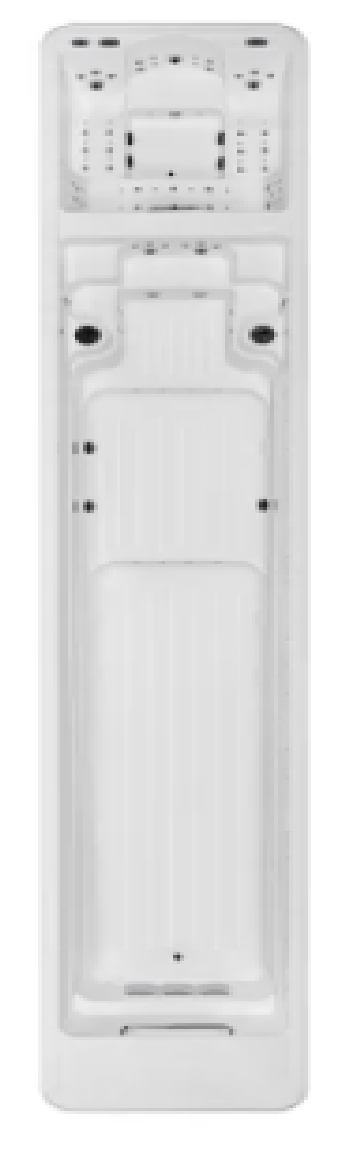
Contractors, hotel developers and residential buyers often search for a swim spa without a clear way to compare models beyond photos and price. The global swim spa market, valued at approximately USD 2.5 billion in 2024, is projected to reach USD 5.2 billion by 2034, which means more project teams are now evaluating swim spas as a structural alternative to traditional pools. This guide translates swim spa product specifications into project requirements, using MEXDA's model range as a concrete reference for buyers at the research and evaluation stage.
Why Project Fit Matters Before Brand Preference
A swim spa is a compact, self-contained pool that combines swimming resistance, hydrotherapy jets and temperature-controlled water in a single unit. Unlike a traditional swimming pool, it does not require a separate mechanical room or permanent civil engineering, but it does require an installation site with appropriate ground preparation, access for delivery and the correct electrical supply.
For buyers, the practical question is not simply which brand is strongest. It is whether a specific model can perform under the site conditions, usage pattern and operational expectations of the project. A residential backyard installation, a hotel wellness area and a commercial fitness center will place very different demands on heating capacity, filtration, jet power and control systems. Reading the specification sheet is the fastest way to determine fit.
Reading the MEXDA Range: A Model-Level View
MEXDA is the swim spa brand of Foshan Gaoming Yuehua Sanitary Ware Co., Ltd., a manufacturer founded in 1995 in Foshan, Guangdong, China. The company operates four professional production workshops and exports roughly 85% of its output to markets including the United States, the European Union and Australia. Its swim spa lineup spans compact 5-meter units through 12-meter training-oriented models, all built with acrylic shells and configured for hotel, fitness, leisure, residential community and resort use.
| Model | Length Segment | Key Configuration | Typical Project Direction |
|---|---|---|---|
| WS-SP500-MS | 5-meter | 2.2 kW water pump, 750 W filter pump, 3 kW heater, UV & ozone, 29 jets | Residential backyard, compact leisure |
| WS-SP600-MS | 6-meter | 2.2 kW water pump, 750 W filter pump, 3 kW heater, UV & ozone, 29 jets | Residential, small hospitality |
| WS-S08B | 8-meter | Four pumps (2x 2.2 kW, 2x 1.5 kW), two 3 kW heaters, 98 jets, dual control systems, speaker set | Residential communities, multi-user leisure |
| WS-S12-T | 12-meter | Three water pumps, three filter pumps, 0.7 kW air pump, four filters, two ozone sets | Hotel, resort, commercial fitness |
| WS-EP3812T Plus | 12-meter training | Swimming training system 5.5 kW x 4 at 380 V, sand filter Q700, UV & ozone, six filtering jets | Commercial fitness, professional swimming training |
The range shows a clear product logic. Shorter models prioritize hydrotherapy, filtration and energy efficiency for limited spaces. Longer models shift toward swimming resistance, multi-user capacity and higher water turnover. Buyers can therefore start narrowing options by project size and usage intensity rather than by brand familiarity alone.
Residential Backyard Projects: Compact Configurations and Weather Resistance
Residential outdoor installations operate in open-air environments with UV exposure and wide temperature variation. For these projects, the specification should confirm that the unit is designed for outdoor use, with corrosion-resistant components and weatherproof construction. The MEXDA application data for outdoor swim spas lists anti-UV performance, low noise operation and weatherproof design as baseline requirements, which are relevant checks for any residential specification.
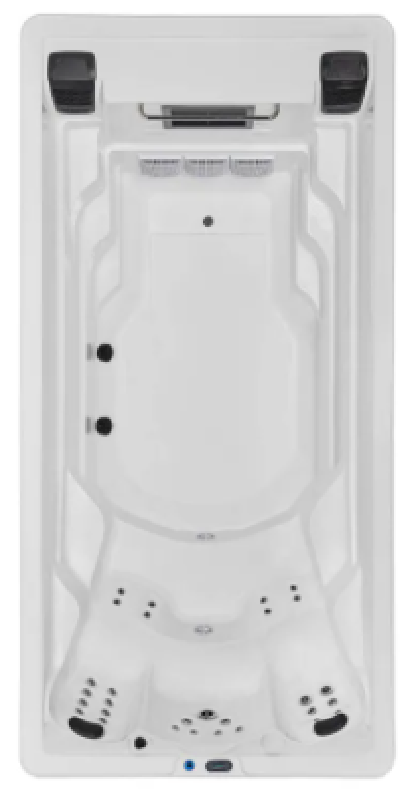
The compact 5-meter WS-SP500-MS and 6-meter WS-SP600-MS models fit this use case. Both include a 2.2 kW water pump, 750 W filter pump, 3 kW heater, UV and ozone sterilization, and 29 hydrotherapy jets. Temperature self-regulation and automatic filtration cycling are standard operational modes, meaning the unit is designed to maintain water temperature and circulation without manual intervention during normal use.
Residential buyers should also evaluate installation logistics. A swim spa needs a level base, access for delivery equipment, and an electrical connection capable of supporting the pump and heater load. The 3 kW heater on these models is a realistic load for many residential electrical systems, but a qualified electrician should confirm site capacity before purchase.
Hotel, Resort and Multi-Unit Residential Projects
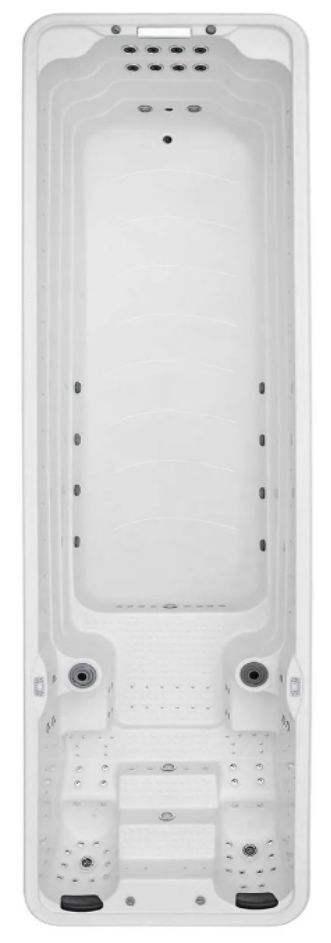
Hotels, resorts and residential communities typically require swim spas that can serve multiple users across swimming, hydrotherapy and leisure functions. The 8-meter WS-S08B is a representative option: it pairs two control systems with four water pumps, two 3 kW heaters and 98 jets, allowing separate zones for swimming and massage. It also includes a waterfall, water level adjuster, speaker set and 28 small LED lights, which align with hospitality expectations for ambience and guest experience.
For larger hospitality projects, the 12-meter WS-S12-T extends capacity with three water pumps, three filter pumps and four filters, supporting higher guest turnover and continuous use. The even larger WS-EP3812T Plus is built around a 380 V swimming training system with four 5.5 kW motors, making it more appropriate for commercial fitness centers and professional training environments where swimming resistance is the primary function.
From a project management perspective, the important distinction is electrical supply. The WS-EP3812T Plus requires 380 V three-phase power, while some other models in the range are configured with 220 V control systems. An early electrical audit can prevent costly site adaptations during delivery. This is a specification detail that should be checked before the purchase order is finalized, not after delivery.
Technical Explanation: What the Configuration Table Actually Tells You
For buyers, the most informative part of a swim spa specification is the equipment list. Each component has a direct impact on operating performance:
- Water pump: Drives the counter-current swimming jets and hydrotherapy massage flow. Models with 1.5 kW to 2.2 kW pumps cover most residential and hospitality scenarios, while multi-pump configurations on 8-meter and 12-meter models support simultaneous swimming and massage.
- Filter pump and filter: Maintains water clarity. Sand filters are used on several models, including the Q350 and Q700 units, and provide higher filtration capacity for larger water volumes.
- Heater: A 3 kW heater is standard across most MEXDA swim spa models, supporting constant water temperature in combination with the control system's temperature self-regulation mode.
- Ozone and UV light: Reduction of contaminants through ozone sterilization and UV treatment. Most models include both, which reduces chemical demand during daily operation.
- PU insulation: Listed as standard on models such as the WS-SP3500 and WS-CP2200, indicating full polyurethane foam insulation around the shell. This is relevant for energy efficiency in outdoor climates.
- Control system: Coordinates heating, filtration, jets and lighting. Models with two control systems, like the WS-S08B, can manage swimming and spa zones independently.
The operating mode of MEXDA swim spas is temperature self-regulation combined with automatic filtration cycling. Supporting equipment includes a filtration system, heating unit, circulation pump, LED lighting and control panel. For project planners, this means the unit does not need a separate pool house for mechanical equipment, but it does require a power supply and a water source at the installation point.
Application Environments and Site Constraints
Most MEXDA swim spa models are documented for use across hotel, fitness center, leisure facility, residential community and resort environments. The specification sheets classify these models broadly, so the actual selection depends on site-specific factors.
Outdoor installations face UV exposure, open-air temperature swings and, in coastal areas, higher corrosion risk. Buyers should confirm that the unit's components are corrosion-resistant and that the shell material is acrylic, which is the documented shell material across the MEXDA range. Acrylic is widely used in the spa industry because of its surface durability and formability, but it still requires proper water chemistry management like any pool surface.
There are also practical boundaries. A 12-meter swim spa requires a considerably larger footprint and stronger foundation than a 5-meter model. A 380 V training system requires three-phase power, which may not exist at a residential site. And an open-air swim spa, regardless of build quality, will consume more heating energy in cold climates than an indoor unit. These constraints are not defects; they are site conditions that need to be identified during project planning.
Market Context: Where Swim Spa Demand Is Heading
Industry research points to regional demand patterns that affect project decisions. North America holds the largest share of the global swim spa market at approximately 38.2%, followed by Europe at 28.5%. The Asia-Pacific region, led by China and Australia, accounts for roughly 20% of the global pool and spa market. The European market is additionally shaped by the EN IEC 60335-2-60:2023 standard, which governs safety requirements for whirlpool baths and spas sold in the EU. Buyers working with European projects should request compliance evidence against this standard as part of supplier qualification.
Dual-zone hybrid swim spas, which allow separate temperature control for the swimming and spa areas, are identified as the fastest-growing segment in the market. This trend aligns with project requirements in hospitality, where guests may want both a cool swim lane and a warm hydrotherapy lounge in the same footprint.
The competitive landscape is relatively concentrated. Master Spas is estimated to hold 16-18% of the global market, followed by Endless Pools at 9-11% and Hydropool at 6-8%. For international buyers, this context is useful because it shows that many swim spa brands are available, but the supplier selection decision should be driven by product specification and project fit rather than brand share alone.
MEXDA in Project Practice: A Documented Long-Term Case
One documented reference for MEXDA comes from a French construction contractor that purchased 20 swim spa units for residential and commercial leisure and fitness applications. The relationship spans more than 10 years, and the reported results include reliable performance, comfortable hydrotherapy experience, long-lasting durability and constant temperature control. This case is relevant primarily because it demonstrates repeat purchasing behavior, which is generally a stronger signal of project suitability than a one-time sales figure.
From a procurement standpoint, MEXDA's production capability also matters for project timelines. The documented manufacturing capacity is roughly 500 sets per month, with a typical lead time of 30 to 40 days and a minimum order quantity of one set. Each unit is reported to undergo full testing before shipment, and after-sales support is provided through remote guidance. For buyers planning phased installations across multiple properties, these production parameters allow scheduling without requiring large upfront inventory commitments.
Comparison Framework: Swim Spa vs. Traditional Pool in Project Terms
For project teams, the swim spa versus traditional pool decision is not only about cost, but about installation complexity, space efficiency and usage flexibility:
| Decision Factor | Swim Spa | Traditional Pool |
|---|---|---|
| Installation footprint | Compact, self-contained unit | Requires excavation, shell construction and larger site area |
| Mechanical equipment | Integrated heating, filtration and control system | Separate pump room and filtration infrastructure |
| Swimming experience | Counter-current swimming against a jet stream | Continuous lap length; more space required |
| Multi-function use | Swimming, hydrotherapy jets, temperature-controlled leisure in one unit | Usually single-purpose unless separate spa is added |
| Energy and maintenance | PU insulated shell, automatic filtration cycles | Higher water volume; filtration and heating costs scale with pool size |
The comparison is not absolute. A traditional pool is still the better choice when genuine lap swimming length is the primary requirement. A swim spa is the more practical option when space is limited, installation time is constrained, or the project needs swimming plus hydrotherapy in a single installation. One limitation of swim spas is that the swimming experience is against a current rather than across a pool length, which some swimmers do not prefer.
Future Outlook: Project Buyers Will Need More Configurable Options
As the swim spa market grows at an estimated compound annual growth rate of 7.5% to 8.5% through the next decade, project buyers will likely see more segmentation between residential, hospitality and fitness-oriented configurations. Faster-growing segments, particularly dual-zone models, suggest that buyers are treating swim spas as multi-functional wellness infrastructure rather than simple swimming pools. This creates an advantage for manufacturers like MEXDA that maintain a broad model range and can adapt configurations through OEM and ODM production.
The next wave of demand will likely focus on energy efficiency, compliance verification and flexible customization. For example, projects in the EU will increasingly require documented compliance with EN IEC 60335-2-60:2023, while North American projects may request certification evidence for local electrical codes. Buyers who request these documents early in the supplier evaluation process will have a smoother path through project approval.
FAQ
What supporting equipment does a swim spa installation require?
MEXDA swim spas operate in temperature self-regulation and automatic filtration cycle mode. The installation requires supporting equipment including a filtration system, heating unit, circulation pump, LED lighting and control panel. These are integrated into the unit, so the site only needs to provide power, water access and a level base.
How does a swim spa perform in outdoor residential environments?
MEXDA swim spa application data covers outdoor use in open-air environments with UV exposure and wide temperature ranges. The relevant product requirements include anti-UV performance, low noise operation, corrosion-resistant components and weatherproof design. For residential projects, buyers should verify these characteristics in the specification and confirm that the shell material is acrylic.
Which swim spa models are suitable for residential versus commercial projects?
MEXDA models are documented for use in hotels, fitness centers, leisure facilities, residential communities and resorts. The 5-meter WS-SP500-MS and 6-meter WS-SP600-MS are compact configurations suited to residential backyards. The 8-meter WS-S08B adds higher jet counts and dual control systems for multi-user leisure. The 12-meter WS-S12-T and WS-EP3812T Plus are designed for larger hospitality and commercial fitness projects, with the EP3812T Plus featuring a 5.5 kW x 4 swimming training system at 380 V.
What electrical supply is needed for large swim spa models?
Larger MEXDA models with swimming training systems, such as the WS-EP3812T Plus, require 380 V three-phase power. Some other models in the range are configured with 220 V control systems. For project planning, the electrical supply should be verified before purchase, because retrofitting three-phase power at a residential site is more complex and costly than confirming it during the design phase.
What safety standard applies to swim spas in the European market?
Safety requirements for whirlpool baths and spas in the EU are governed by EN IEC 60335-2-60:2023. Buyers specifying swim spas for European projects should request documented compliance with this standard from suppliers as part of the qualification process.
What is MEXDA's lead time and minimum order for project-based purchasing?
MEXDA's documented manufacturing capacity is approximately 500 sets per month, with a lead time of 30 to 40 days and a minimum order quantity of one set. Each unit undergoes 100% testing before shipment, and after-sales support is available through remote guidance. These parameters are relevant for contractors and developers who need to coordinate delivery with construction schedules.
A full product catalog with model specifications and configuration details is available for download: MEXDA Swim Spa Catalog (PDF).
Have Questions or Need More Details?
Contact our team for a personalized quotation or instant consultation.
Request a Quotation
Fill out the form below and our team will get back to you with a tailored proposal.
WhatsApp Direct Chat
Prefer to chat in real-time? Message us on WhatsApp for instant assistance & quick answers.
- Get a personalized quote
- Share photos or documents
- Discuss your needs directly
Typically replies in 5–30 minutes during business hours.