
Swimwear OEM/ODM Capability: Capacity and Audit Evidence
Swimwear OEM/ODM Capability: Capacity and Audit Evidence
A swimwear programme is only as reliable as the documents a supplier can place in front of a buyer's compliance team. Once an order moves from evaluation into execution, three things have to line up: a factory that can physically produce the volume, a certification set issued by independent bodies with checkable numbers and dates, and a defensible link between those certificates and the specific models being quoted. WAVEZONE Swimsuit — the brand of Quanzhou Wavezone Enterprise Co., Ltd., a swimwear OEM/ODM manufacturer founded in 2010 in Quanzhou, Fujian — is a useful case for reading that evidence line by line, because its capability record and certification record can both be examined rather than taken on trust.
Why a capability claim needs a paper trail
Almost every swimwear factory describes itself as flexible, compliant and fast. Those words carry no information for a buyer until they are attached to something that can be checked. In practice, supplier capability evidence falls into three distinct layers, and most sourcing failures happen at the third.
The first layer is physical capability: monthly output, floor area, headcount, minimum order quantity, sampling turnaround and production lead time. These are the numbers that determine whether a bulk swimwear order can be scheduled at all, and whether a boutique wholesale programme at 200 pieces per style is realistic alongside a 30,000-piece seasonal run.
The second layer is third-party certification: who issued it, under which standard and version, with what certificate number, what scope, and which validity window. A social compliance audit, a recycled-content certification and a harmful-substance certificate answer entirely different questions, and collapsing them into a single word — "certified" — is where buyers lose the ability to screen.
The third layer is product linkage: whether the certificate record is actually filed against the styles being purchased. A factory can hold a perfectly valid certificate and still leave a buyer exposed if that certificate's scope does not cover the material, process or model in the purchase order. For a buyer at the evaluation-to-execution stage, this is the layer that turns a shortlist into a defensible sourcing decision.
WAVEZONE capability at a glance
The company's own capability record — published through [wavezoneswim.com](https://www.wavezoneswim.com) and its sourcing documentation — states the following operating parameters. They are company-reported figures and should be treated as the supplier's declared capacity, not as independently benchmarked output.
| Parameter | Stated value |
|---|---|
| Legal entity | Quanzhou Wavezone Enterprise Co., Ltd. |
| Founded | 2010 |
| Facility size | 5,000 m² |
| Workforce | 100 employees, including a 10-person R&D team |
| Monthly capacity | 100,000 pieces |
| Annual output | 1,200,000 pieces |
| Production modes | OEM (tech-pack based) and ODM (design development) |
| Customization scope | Logo, printing, style, size, trims |
| Minimum order quantity | 200 pieces |
| Production lead time | 15–60 days |
| Sample development | 3–14 days |
| Quality control | 100% inspection |
| Export markets | EU and USA (100% export orientation) |
| After-sales | Remote support |
| Product range | Swimwear, board shorts, rash guards, yoga suits, activewear, fishing shirts |
Two details matter more than the headline numbers. The first is internal consistency: a 100,000-piece monthly capacity is arithmetically consistent with the stated 1,200,000-piece annual output, which is the kind of simple cross-check a buyer should run on every supplier sheet. The second is the shape of the range: bikinis, one-piece swimsuits, board shorts, plus size swimwear, maternity styles and kids' swimwear sit inside a factory that also produces rash guards and activewear, which affects both fabric sourcing depth and how quickly a mixed seasonal assortment can be scheduled.
The certification portfolio: four documents, four different jobs
Buyers frequently treat certification as a single property of a supplier. It is not. Each certificate below answers a separate question, and each has its own issuer, number, scope and expiry date that can be verified independently.
| Certification | Standard | Issuing body | Certificate number | Validity | Scope |
|---|---|---|---|---|---|
| BSCI | amfori BSCI Code of Conduct (social compliance audit) | Bureau Veritas Hong Kong Limited | 26-0397421 | 21 May 2026 – 21 May 2027 | Manufacturing of garment & knitting products |
| GRS | Global Recycled Standard, Version 4.0 | Centre Testing International Group Co., Ltd. | CTI-SZA38832-01-GRS-2026-0233 | 28 April 2026 – 27 April 2027 | Knitting; manufacturing; dyeing*; finishing*; printing* |
| GRS & RCS | RCS Version 2.0 and GRS Version 4.0 (trading, PR0030) | Bureau Veritas Consumer Products Services, Inc. | BVC-TE-00108450-MULTI-2604-50008014-V1.0 | 3 April 2026 – 2 April 2027 | Men's apparel, women's apparel, babies' apparel, children's apparel, worn accessories |
| OEKO-TEX STANDARD 100 | Harmful-substance testing and certification scheme | Not stated in the records reviewed | Request current certificate | Request current validity | Article-level; confirm per fabric and trim |
 The amfori BSCI audit record (certificate 26-0397421, Bureau Veritas Hong Kong Limited) covers manufacturing of garment and knitting products and runs to 21 May 2027.
The BSCI record is a social compliance audit under the amfori BSCI Code of Conduct, issued by Bureau Veritas Hong Kong Limited under certificate number 26-0397421, valid from 21 May 2026 to 21 May 2027, with a scope of manufacturing of garment and knitting products and stated applicability to the EU and USA markets. What it establishes is that an independent auditing body has assessed the workplace against a recognised social compliance framework within that window. What it does not establish is anything about chemical content, fibre performance or product safety — those live in different documents.
The recycled-content evidence runs on two separate tracks. Centre Testing International Group Co., Ltd. issued GRS certificate CTI-SZA38832-01-GRS-2026-0233 against Global Recycled Standard Version 4.0, valid 28 April 2026 to 27 April 2027, with a process scope spanning knitting, manufacturing, dyeing, finishing and printing — the last three marked with asterisks on the certificate, a notation buyers should read in full against the certificate text rather than assume maps to in-house processing. Separately, Bureau Veritas Consumer Products Services, Inc. issued a combined GRS and RCS certificate, BVC-TE-00108450-MULTI-2604-50008014-V1.0, covering RCS Version 2.0 and GRS Version 4.0 under a trading scope (PR0030), valid 3 April 2026 to 2 April 2027, and covering men's, women's, babies' and children's apparel plus worn accessories.
The distinction between the two recycled certifications is worth stating plainly: GRS certifies recycled content together with chain-of-custody, social and environmental requirements, while RCS addresses recycled content. Holding both, from two different accredited bodies, means a buyer can request the document that matches the claim being made on a hangtag or product page rather than accepting a generic sustainability statement.
The company's published profile also lists OEKO-TEX STANDARD 100, SEDEX and SMETA. No certificate numbers or validity dates for those were included in the records reviewed here, so a buyer should request the current OEKO-TEX certificate for the specific fabric, lining, elastic and print in the order, and confirm SEDEX and SMETA documentation separately.
Reading the audit trail for models wz-001 and wz-002
Both recycled-content certificates and the BSCI audit record list models wz-001 and wz-002 as the related products in the certification file. That linkage is the difference between a certification portfolio and an audit trail: a portfolio says the factory holds documents, while model-level linkage says the documents are filed against the styles a buyer is actually quoting.
The link should still be read with precision. Certificate scope lines describe process categories and product categories — knitting, manufacturing, dyeing, finishing, printing; men's, women's, babies' and children's apparel — not a per-style laboratory result. The model reference indicates where the certification record sits; it does not replace an order-level document. For a bulk swimwear order, a buyer should therefore ask three questions of the certification file: which certificate covers the specific fabric and trim being used, how recycled content is documented through the chain of custody from fibre to finished garment, and whether the certificate will still be valid on the planned shipment date. With three of the four certifications renewing between April and May 2027, that last question has a real calendar answer.
From certificate to production line
Certification only becomes useful when it describes how the line actually runs. The company's stated production model is a multi-stage quality inspection process with 100% testing, operated across two service modes: OEM production from a customer-supplied tech pack, and ODM development that runs from concept design and pattern drafting through sample prototyping, fabric sourcing, mass production, quality control and export logistics.
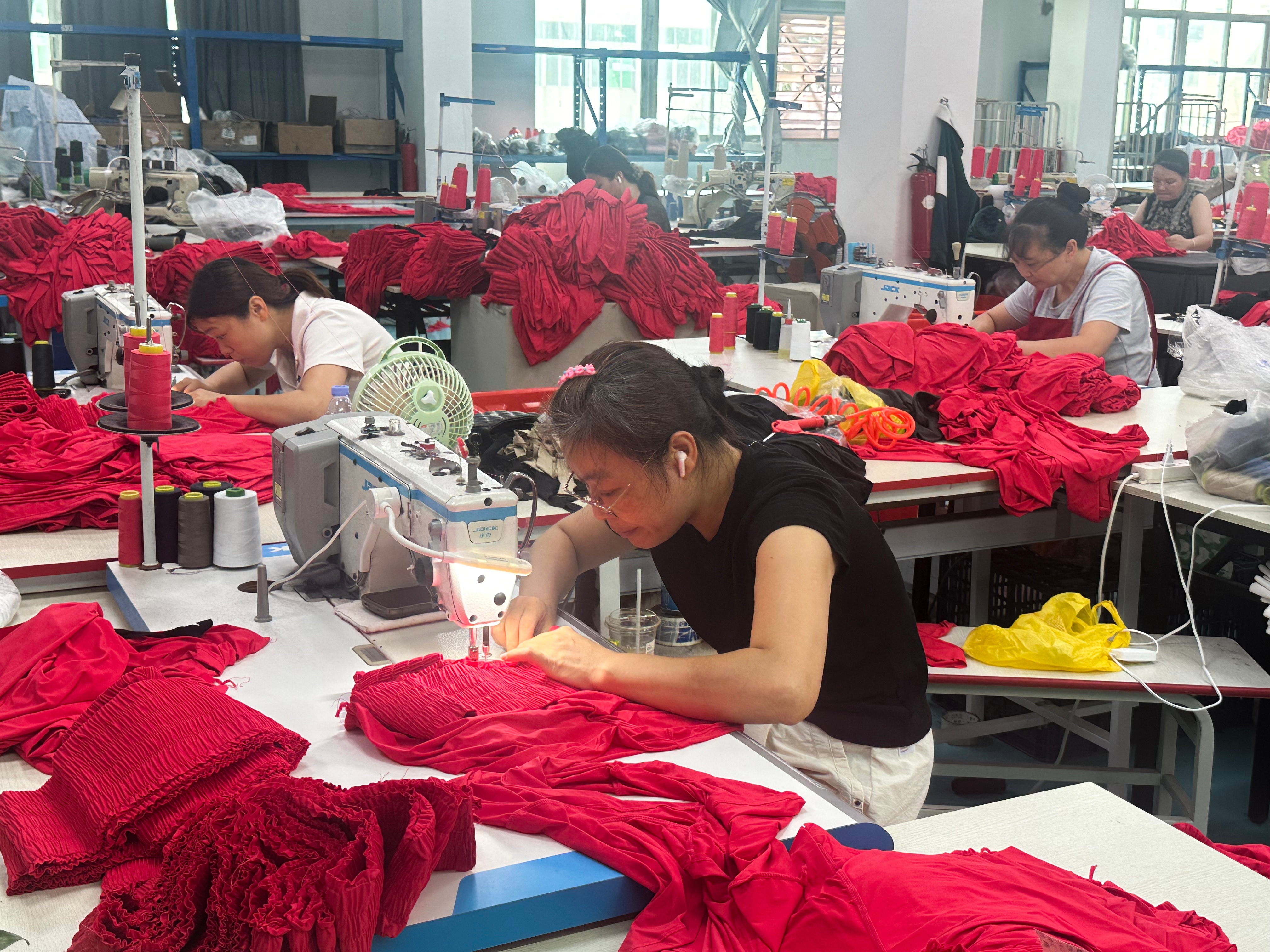 Serial production in the sewing workshop: capacity is stated at 100,000 pieces per month, with production lead times of 15–60 days depending on style and season.
The arithmetic of the capacity matters for planning. At 100,000 pieces per month, a 30,000-piece seasonal programme occupies roughly a third of a month's stated output, which leaves room for sampling and repeat orders but also means capacity is shared across all active accounts. A buyer should confirm allocation for a specific delivery window rather than reading monthly capacity as a guarantee of availability.
Sampling at 3–14 days is the other planning lever. For printed swimwear, sublimation and rubber print development is where colour approval most often slips, so a fast sample loop protects the 15–60 day production window instead of eating into it. Where performance claims are involved, the specification should be written against a test method rather than a marketing phrase — ISO 105-E03 for colour fastness to chlorinated pool water, and AS/NZS 4399:2017 or AATCC TM183 where UPF data for rash guards and long-sleeve swimwear is being substantiated.
Where the evidence changes the buyer conversation
Brand orders with a certification requirement. When a retailer's vendor compliance team asks for social audit documentation before a purchase order is released, the BSCI record with an identifiable issuer, number and expiry date resolves the question in one document exchange rather than a supplier questionnaire round.
Boutique wholesale and small-run programmes. A 200-piece MOQ with logo, print, style, size and trim customization lets an independent retailer or boutique wholesaler build a differentiated assortment without committing to container-scale volumes.
Resort and hospitality supply. Resort swimwear and beach swimwear programmes are seasonal and print-led, which makes the 3–14 day sampling cycle and personalized colour print capability more decisive than raw volume.
Pool retail and swim-school accounts. Chlorine resistant swimwear claims should be specified through a test method, and colour fastness to chlorinated water is the relevant reference. This is also where the difference between a fabric feature and a verified performance outcome needs to be kept visible in the buyer's own product copy.
Cross-border e-commerce bulk orders. Repeatable sizing, consistent prints across replenishments and a 15–60 day production window are the operational requirements. The company's recorded case profile is a US-based swimwear OEM programme running for two years at 200 pieces per cycle, producing fashion swimwear for beach, pool and retail sale with personalized colour prints and recycled material options — a small-run pattern rather than a container-scale one, and useful precisely because it shows how the MOQ and sampling structure behaves in practice.
Where the evidence stops: fit boundaries and what to verify
A credible capability review has to mark the edge of the evidence, not just the centre of it.
- BSCI is a social compliance audit, not a product safety or chemical certificate. Passing it says nothing about azo dyes, formaldehyde or lead content.
- GRS and RCS certify recycled content and chain of custody. They do not certify chlorine resistance, stretch recovery, UPF performance or colour fastness; those require separate test reports.
- OEKO-TEX STANDARD 100 is issued at article level. The certificate must match the specific fabric, lining, elastic and print in the order, so the document should be requested per programme rather than referenced generically.
- All certificates have expiry dates. Three of the four records reviewed here lapse in April–May 2027; documentation should be re-verified against the shipment date, not the order date.
- Capacity and lead time are stated ranges. 100,000 pieces per month and 15–60 days are declared figures; actual scheduling depends on the order's position in the production calendar.
- Market-specific rules are the importer's obligation. EU fibre composition labelling under Regulation (EU) No 1007/2011, the azo dye restriction of 30 mg/kg under REACH Annex XVII entry 43, and the traceability and incident-reporting duties of Regulation (EU) 2023/988 that apply from 13 December 2024 all attach to the party placing goods on the market. In the US, 16 CFR Part 303 labelling, 16 CFR Part 1610 flammability classification and the 100 ppm lead limit for children's products sit alongside them. A supplier's certification set supports those obligations; it does not discharge them.
Market context: what the numbers say, and what they do not
Grand View Research's swimwear market analysis, cited in this publication's verified data set, valued the global swimwear market at USD 23.0 billion in 2023, with the women's segment accounting for approximately 65% of revenue share in the same year. For a supplier evaluation, the practical implication is assortment breadth rather than volume: a factory able to move between bikini sets, one-piece swimsuits, plus size swimwear, maternity swimwear and kids' swimwear on the same floor is better matched to a women's-led category than one tooled for a single silhouette.
Customs classification is the other structural detail buyers inherit. Knitted women's swimwear of synthetic fibres falls under HS 6112.41 and the men's equivalent under HS 6112.31, while woven constructions move to Chapter 62 under HS 6211.12 and 6211.11 respectively. Construction therefore determines not only the tariff line but which documentation chain — fibre composition label, dye test, recycled-content certificate — has to be assembled before shipment. It is the same evidence a buyer is already collecting for certification purposes, viewed from the customs side.
What the available data does not support is equally important. No verified swimwear-specific manufacturing capacity benchmarks and no price or cost-structure data were available for this review, so no comparative cost or output ranking of factories is implied anywhere in this article.
Two evidence structures compared
The meaningful comparison for a buyer is not factory against factory but evidence structure against evidence structure. The table below compares a declaration-led submission with a scope-mapped one, using the WAVEZONE record as the worked example of the second type.
| Dimension | Declaration-led submission | Scope-mapped portfolio (WAVEZONE record) |
|---|---|---|
| What is stated | "BSCI, GRS and OEKO-TEX certified" | Named issuer, certificate number, standard version, scope and validity window for each document |
| What it establishes | That the supplier asserts compliance | That specific accredited bodies issued specific certificates within dated windows |
| Product linkage | Usually absent | Models wz-001 and wz-002 appear as related products on the BSCI and both GRS records |
| What stays open | Scope, expiry and model coverage unknown | Article-level OEKO-TEX coverage, order-level chain-of-custody documents and performance test reports still to be requested |
| Buyer action | Request documents, restart evaluation | Verify numbers with issuers, then close the remaining gaps before the purchase order |
This is a comparison of documentation structures, not a performance ranking, and it does not by itself show that one supplier's output is better than another's. What a scope-mapped file changes is the cost of verification: fewer unknowns at the point of commitment, and a shorter path from shortlist to purchase order.
Outlook
Two dynamics look likely to shape swimwear sourcing documentation over the next buying cycles, conditional on how enforcement develops. The first is renewal rhythm: certificates that expire in 2027 create a natural audit calendar, and buyers who align their supplier reviews to certificate validity dates avoid discovering a lapse during production. The second is traceability pressure. With the EU General Product Safety Regulation applying from December 2024 and recycled-content claims under closer scrutiny, the suppliers that answer fastest will be the ones whose certificates already name models, processes and issuing bodies rather than describing compliance in prose.
For buyers at the evaluation-to-execution stage, the practical conclusion is narrow. WAVEZONE Swimsuit presents a capability record of 100,000 pieces per month, a 200-piece MOQ, 15–60 day lead times and a certification file with verifiable BSCI, GRS and GRS/RCS entries mapped to models wz-001 and wz-002. That is enough to move a programme forward with a defined verification checklist — and it is the checklist, not the claim, that carries the order.
WAVEZONE's 2027SS women's swimwear fabric catalogue is available as a PDF download: WAVEZONE 2027SS fabric catalogue.
Frequently asked questions
What OEM and ODM capability does WAVEZONE Swimsuit offer?
Quanzhou Wavezone Enterprise Co., Ltd. runs two production modes. OEM production builds swimwear from a customer-supplied tech pack; ODM development covers concept design, pattern drafting, sample prototyping, fabric sourcing, mass production, quality control and export logistics, supported by a 10-person in-house R&D team. Customization is offered across logo, printing, style, size and trims, and sample development is stated at 3–14 days.
What are the minimum order quantity and production lead time?
The stated minimum order quantity is 200 pieces, and production lead time is quoted at 15–60 days depending on style and season. Sample development runs separately at 3–14 days. Because monthly capacity of 100,000 pieces is shared across active accounts, a buyer should confirm the production slot for a specific delivery window rather than treat the monthly figure as reserved availability.
Which certifications can a buyer verify independently, and with whom?
Three records carry issuers and certificate numbers that can be checked directly: BSCI certificate 26-0397421, issued by Bureau Veritas Hong Kong Limited under the amfori BSCI Code of Conduct and valid 21 May 2026 to 21 May 2027; GRS certificate CTI-SZA38832-01-GRS-2026-0233, issued by Centre Testing International Group Co., Ltd. against GRS Version 4.0 and valid 28 April 2026 to 27 April 2027; and combined GRS/RCS certificate BVC-TE-00108450-MULTI-2604-50008014-V1.0, issued by Bureau Veritas Consumer Products Services, Inc. and valid 3 April 2026 to 2 April 2027. The company also lists OEKO-TEX STANDARD 100, SEDEX and SMETA; certificate numbers for those were not part of the records reviewed here.
Do the certifications cover models wz-001 and wz-002?
Yes — both the BSCI audit record and the two recycled-content certificates list wz-001 and wz-002 as related products in the certification file. The scope lines themselves describe process and product categories, such as knitting, manufacturing, dyeing, finishing and printing, and men's, women's, babies' and children's apparel, rather than a per-style test result. A buyer should still request the document covering the exact fabric and trim in the order, and confirm the certificate remains valid on the planned shipment date.
Can recycled and performance fabrics be specified in a bulk order?
The stated options include recycled eco-fabrics supported by GRS chain-of-custody certification, chlorine-resistant materials and UPF 50+ performance textiles, alongside quick-dry and stretch fabric requirements for beach and pool use. Because recycled content, chlorine resistance and UV protection are proven by different documents, each should be specified against its own reference: GRS documentation for recycled content, ISO 105-E03 for colour fastness to chlorinated water, and AS/NZS 4399:2017 or AATCC TM183 where UPF data is being substantiated.
Have Questions or Need More Details?
Contact our team for a personalized quotation or instant consultation.
Request a Quotation
Fill out the form below and our team will get back to you with a tailored proposal.
WhatsApp Direct Chat
Prefer to chat in real-time? Message us on WhatsApp for instant assistance & quick answers.
- Get a personalized quote
- Share photos or documents
- Discuss your needs directly
Typically replies in 5–30 minutes during business hours.