
Swing Massager vs Vibration Platform: A Buyer's Framework
Home fitness equipment is normally bought by category name and compared by wattage — and that is precisely where compact home devices get misjudged. A swing massager and a whole body vibration platform can appear in the same sourcing brief, the same apartment, and a similar price band, yet they apply fundamentally different motion to the user's body. Treating them as variants of one product leads to the wrong shortlist.
Ningbo Healthmate Health Technology Co., Ltd. is a manufacturer and supplier founded in 2007 that designs, produces and sells fitness equipment and healthcare products, with a 100,000 m² manufacturing facility in Ningbo, China and export activity across Europe, the USA, Japan, Korea, India, the Middle East and South America. Its product portfolio covers Home-use Treadmill, Walking Pad, Vibration Machine, Spinning Bike, Magnetic X-bike, Upright Bike, Elliptical Trainer, Electric Mini Bike and Rowing Machine — and, unusually, it produces both a swing massager and a whole body vibration platform. That overlap makes the two models a clean case study for a buyer decision framework built on three variables: kinetics, resistance, and goal.
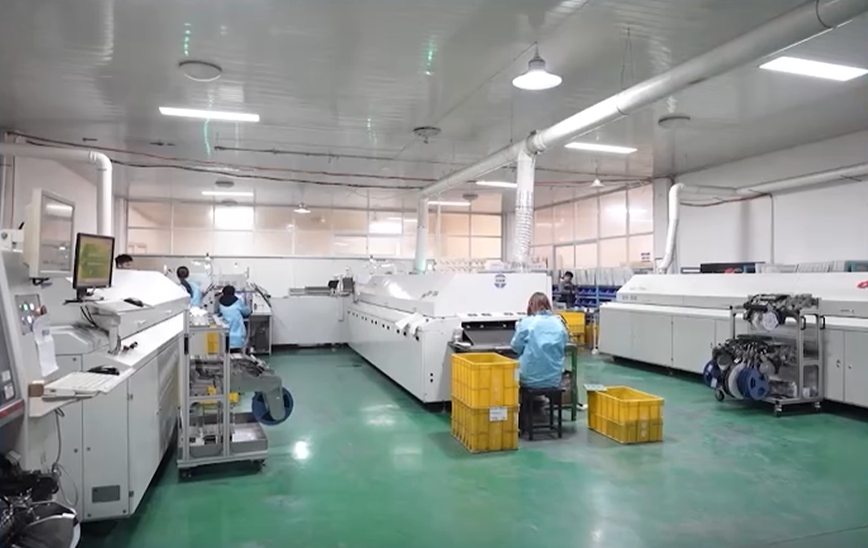
Compact home fitness equipment such as swing massagers and vibration platforms is assembled and tested on the same production lines as treadmills and walking pads, which is why specification discipline matters more than category labels at the sourcing stage.
Why “Compact Electric Device” Is Not a Category
Buyers routinely place a 50W swing massager next to a 200W vibration platform and read the difference as a quality score. It is not. Wattage describes the electrical load a motor has to carry, not the training load delivered to the user. A mechanism that only has to sustain a slow oscillation against the user's own body weight draws far less power than a platform that must generate and control vertical oscillation across 99 selectable levels. The numbers are accurate and the comparison is meaningless.
The second common error is comparing control granularity. The HSM-08VS lists 99 speed levels; the published HSM-08YB specification set does not list speed levels at all. That is a difference in control philosophy, not evidence that one product is more advanced. One device asks the buyer to choose an intensity step; the other asks the buyer to choose a posture, a session length, and a comfortable body position.
The opportunity for buyers is straightforward. In a market where households increasingly build a small footprint stack of two or three devices instead of one large machine, the second and third purchase decisions are about recovery, mobility and short sessions — and those decisions are made badly when the only comparison tool is a watt figure.
The Two Motions, Described by Their Published Specifications
Swing massager: body-driven oscillation
The Home Use Swing Massage Machine, also listed as a Swing Vibration Massager for Home, model HSM-08YB, is described as a Body Swing Relaxation Machine for the Personal Wellness Industry and the Home Health Care Industry. Its published specification set is short and consequential:
- Rated power: 50W
- Maximum user weight: 80KGS
- Gross weight: 11.8KGS
- Product size: 37×35×22CM
- Carton size: 520×430×410mm
- Material: ABS
Mechanically, the device produces a swing oscillation while the user's own body mass supplies the load. Resistance is therefore minimal and posture-driven rather than selectable, and the 80KGS maximum user weight is a hard eligibility filter that should be checked before any other comparison. Because motor demand is low, the unit is compact and light: at 37×35×22CM it fits beside seating rather than demanding floor space in front of a screen or mirror.
Compliance scope for this model in the published set is electrical and material rather than structural: a CE-EMC Certificate of Conformity (certificate HA0122NB072618EM, issued by HATEK on 2022-07-21, referencing EN IEC 55014-1/-2, EN IEC 61000-3-2 and EN 61000-3-3) and a CE-ROHS Certificate of Conformity (certificate HA0122NB072619CH, issued by HATEK on 2022-07-22, referencing 2011/65/EU and (EU) 2015/863).
Vibration platform: platform-driven oscillation
The Whole Body Vibration Machine for Home Use, model HSM-08VS, is listed as a Compact Vibration Plate Machine and Slim Vibration Fitness Machine for the At-Home Workout Industry and the Indoor Fitness Equipment Industry. Its published specification set reads differently in almost every dimension:
- Power: 200W
- Speed: 99 levels
- Timing: 1–10 minutes
- Screen: Speed / Dist. / Time / Mode / PRO.
- Gross weight: 9.8KGS
- Product size: 530×320×145mm; carton size 635×390×160mm
- Material: ABS, set up with magnetic stone
Here the platform generates and controls the movement, and the user holds a standing or semi-standing posture against it. Resistance comes from postural control and gravity, and intensity is selected in steps up to 99 levels. The 1–10 minute timer frames the format as short, repeatable blocks rather than long sessions — a design assumption buyers should either accept or challenge during evaluation, because it defines what the product is built to do.
Compliance coverage for this model is broader in the published set and spans UK, EU electrical and material requirements: a UKCA Certification of Conformity (certificate MTZS24064178, issued by Shenzhen Most Technology Service Co., Ltd. on 2024-06-21, referencing BS EN 60335-1, BS EN IEC 60335-2-32:2021 and BS EN 62233:2008); a CE-LVD Certificate of Conformity (certificate MTZS24064177, issued by the same authority on 2024-06-21); a CE-EMC Certificate of Conformity (certificate MTZS23074017, issued 2023-07-18, referencing EN IEC 55014-1:2021, EN IEC 61000-3-2, EN 61000-3-3 and EN IEC 55014-2); and an ROHS Certificate of Conformity (certificate HA21NB051501CHEM, issued by HATEK on 2021-07-17, referencing 2011/65/EU and (EU) 2015/863).
The Decision Matrix: Kinetics, Resistance, Goals
The framework below is deliberately mechanical. It does not rank the two formats; it separates them by what a buyer is actually purchasing.
| Decision dimension | HSM-08YB swing massager | HSM-08VS vibration platform |
|---|---|---|
| Motion source | Device-generated swing oscillation; body position drives the movement pattern | Platform-generated vertical oscillation; user holds posture against it |
| Rated power | 50W | 200W |
| Intensity control | Not stated in the published specification set | 99 speed levels |
| Session framing | Not stated in the published specification set | Timer 1–10 minutes |
| User weight limit | Maximum 80KGS | Not stated in the published specification set |
| Unit gross weight | 11.8KGS | 9.8KGS |
| Product footprint (L×W×H) | 37×35×22CM | 530×320×145mm |
| Stated application industries | Personal Wellness; Home Health Care | At-Home Workout; Indoor Fitness Equipment |
| Compliance evidence in the published set | CE-EMC, CE-ROHS | UKCA, CE-LVD, CE-EMC, ROHS |
Table 1. Side-by-side specification comparison from published product data. Where a value is absent, the published data set does not state it — that absence is itself a procurement question for the supplier.
From the matrix, three decision rules follow naturally:
- Rule 1 — Eligibility before preference. If any intended user exceeds 80KGS, the HSM-08YB as specified is not an eligible option, regardless of how well its size or price fits. Weight capacity is a filter, not a tiebreaker.
- Rule 2 — Match the motion to the mobility profile. Users who need seated, low-demand, easily entered sessions map to a swing massager. Users who can hold a standing position and want to progress through intensity steps map to a vibration platform.
- Rule 3 — Match the control model to the goal. Where the objective is relaxation and circulation-oriented light activity, unsegmented control is acceptable. Where the objective is a measurable, level-controlled session with visible speed, distance, time and programme feedback, a 99-level platform with an on-screen mode display is the closer match.
Application Mapping: Which User, Which Format
Supplier project data from a portfolio that includes both formats reports the following applications across household fitness equipment: family daily cardio workout, indoor weight loss training, elder daily rehabilitation exercise, office standing walking, small apartment daily light exercise, post-meal fat burning, low-impact leg cardio training, home daily light fitness, and rehabilitation exercise for joint mild discomfort. The same data set reports product-side highlights of foldable compact structure, multi-level shock absorption, a simple operation panel, multiple vibration modes, an anti-slip foot mat, and lightweight portability.
Mapped against the decision matrix, the applications divide along the kinetics line:
| Stated application | Closer format fit | Reason from the specification set |
|---|---|---|
| Elder daily rehabilitation exercise | Swing massager | Seated use pattern; no standing balance required; low 50W motor demand |
| Home daily light fitness | Swing massager | Short, low-intensity sessions; compact 37×35×22CM footprint |
| Rehabilitation exercise for joint mild discomfort | Swing massager | User-supplied load; no platform impact transferred through the feet |
| Post-meal fat burning | Vibration platform | Standing pattern with selectable 1–99 intensity levels and a 1–10 minute timer |
| Low-impact leg cardio training | Vibration platform | 200W platform drive; posture-based resistance; session timer controls exposure |
| Indoor weight loss training | Vibration platform | Progressive speed levels plus on-screen speed, distance, time and mode feedback |
| Small apartment daily light exercise | Either | 9.8KGS and 11.8KGS gross weights are both single-person movable |
| Office standing walking | Neither (portfolio adjacency) | Standing walking is served by the walking pad family, not by these two formats |
Table 2. Application-to-format mapping derived from published specification values and reported household applications. Office standing walking is included to show where the framework stops and another product family begins.
Market Signals Behind Compact Home Equipment
The category context supports specialised buying rather than one-size selection. Fortune Business Insights reports that the global home fitness equipment market was valued at USD 12.88 billion in 2025 and is projected to reach USD 22.99 billion by 2034, at a CAGR of 6.81%; the same publisher projects the market at USD 13.76 billion in 2026. Mordor Intelligence reports a different trajectory for the same category — from USD 11.84 billion in 2026 to USD 17.06 billion by 2031, at a CAGR of 7.59%.
Those two figures should not be averaged. They use different base years, forecast periods and estimation methods, so they are directionally consistent rather than numerically reconcilable. What they agree on is the direction: sustained demand for home-use equipment through the early 2030s.
A second signal is about mechanism preference rather than volume. Fortune Business Insights data indicates that magnetic resistance held 62.4% of the indoor cycling bike market in 2025. Read cautiously, that points to household demand concentrating around contact-free, low-noise resistance systems — a preference that also favours electrically simple, low-noise devices in adjacent categories such as vibration plates and swing massagers, where noise and floor disturbance matter in apartments.
Limits and Boundaries: Where Each Format Stops Working
A decision framework is only useful if it states what a product cannot do.
- Neither format replaces a cardio machine. A 50W swing massager and a 200W vibration platform do not deliver the sustained aerobic load of a motorised treadmill. Where the requirement is cardiovascular volume, the relevant comparison is inside the treadmill and walking pad range — for example HSM-MT19 at 2.5HP with a 1–20km/h range, HSM-MT296 at 2.0HP, HSM-T20 at 1.5HP, or a walking pad such as HSM-W04L2B at 0.75HP with a 1–6km/h range. Using a vibration platform as a treadmill substitute misreads the mechanics.
- The 80KGS user limit is absolute on the HSM-08YB. Buyers serving mixed-demographic markets need a second option for users above that threshold, and should confirm the vibration platform's own user capacity rather than assuming it.
- Power differs inside the vibration family itself. At 200W, the HSM-08VS is the entry point of this product line, not its ceiling: HSM-08VF is listed at 500W and HSM-08VQ at 500W+300W. A buyer who assumes “vibration platform” means a single power class will mis-specify. The 200W figure is best read as a trade for a 9.8KGS unit and a 530×320×145mm footprint.
- Published data has gaps. The HSM-08YB specification set does not state speed levels or a session timer, and the HSM-08VS specification set does not state a maximum user weight. These are verification items for the supplier, not assumptions for the buyer.
Set against conventional low-cost alternatives — unpowered relaxation accessories or manually driven devices — the powered formats trade higher unit cost and an electrical compliance burden for controlled, repeatable movement. That trade only pays off when the compliance documentation actually covers the model being purchased.
Compliance Scope Must Match the Model, Not the Category
Compliance review is where category-level assumptions fail most often. Certificates are issued for a defined scope, and a vibration platform certificate does not cover a swing massager, or the reverse. In the published documentation set used here, the swing massager HSM-08YB is covered by CE-EMC and CE-ROHS conformity certificates, while the vibration platform HSM-08VS is covered by UKCA, CE-LVD, CE-EMC and ROHS certificates. In addition, ASTM F2276 is the core safety standard for home fitness equipment, covering stability and moving parts protection — a useful checklist reference when evaluating any powered home machine.
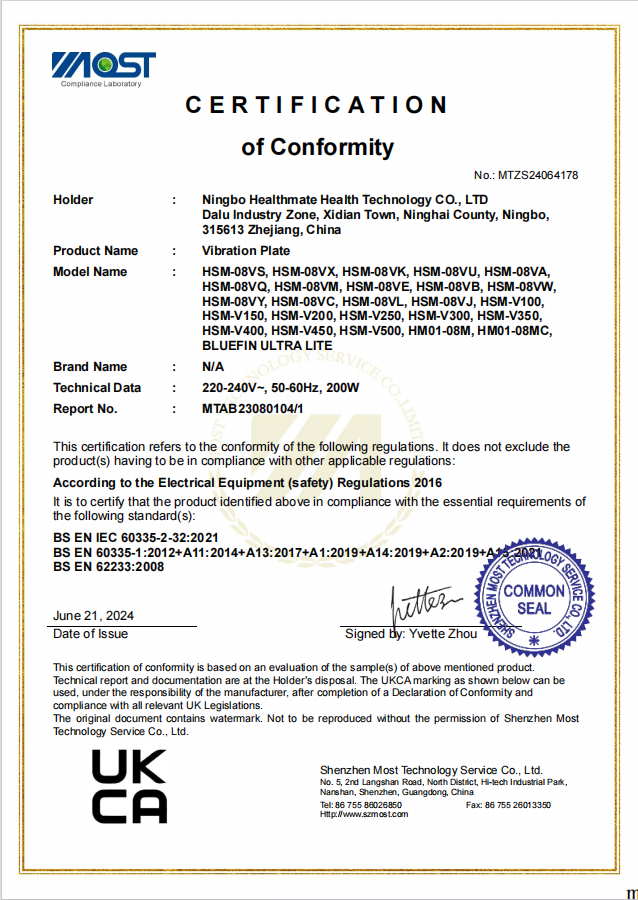
UKCA conformity documentation for the vibration platform scope. Buyers should confirm that each certificate's declared scope names the exact model being ordered.
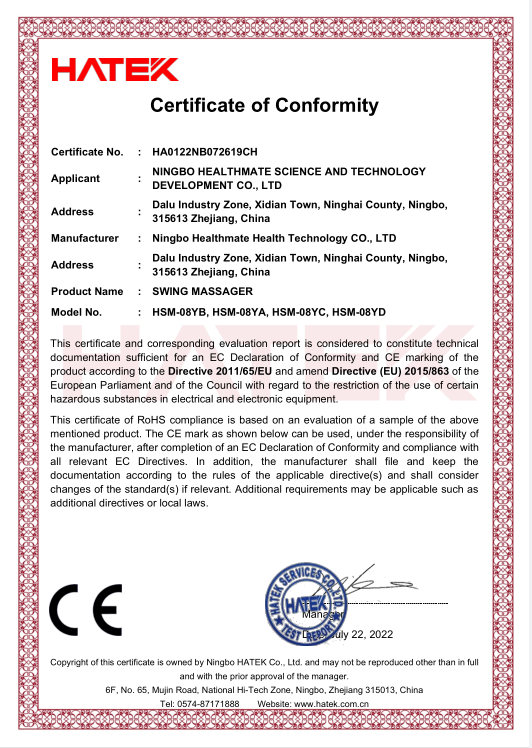
Material compliance documentation for the swing massager scope. A platform certificate and a massager certificate are not interchangeable evidence.
Sourcing Reality: MOQ, Lead Time, and Pilot Orders
For distributors, importers and brand owners, a two-format decision usually becomes a two-SKU order. Ningbo Healthmate operates in OEM/ODM mode with customization across colour, logo, voltage and plug type; monthly capacity is listed at 8,000pcs; lead time is 35–40 days; the minimum order quantity is 100pcs; quality control combines 100% testing with third-party inspection; warranty is 1 year for every damaged part; and products are exported to Europe, the US, Japan, Korea, India, the Middle East and South America.
Those figures change the framework in a practical way. A 100pcs MOQ makes it feasible to order both a swing massager and a vibration platform in a single production cycle and let real sell-through data decide which format deserves the larger allocation, rather than committing to one format from a specification sheet. The 35–40 day lead time applies to both, so a mixed pilot does not extend the calendar beyond a single-format order.
Field Evidence From a 100,000-Unit Program
Programme data reported by the supplier for household fitness equipment shipped globally gives the framework a reality check. The project scale involved shipping 100,000 pieces globally, and the reported outcome was stable running performance with an after-sales failure rate below 2%, a high customer repeat order rate, and positive market feedback regarding household space demand. Client types served in this portfolio span foreign trade wholesalers, Amazon platform sellers, local fitness retail shops, wholesale trading companies and fitness equipment wholesalers, with cooperation durations of 3–5 years.
The operative insight for buyers is the last item: household space demand. It confirms that compactness and floor footprint are commercial variables, not cosmetic ones — which is consistent with both formats here shipping at under 12KGS gross and occupying less than a square metre of floor area.
Future Outlook
Three shifts are likely to shape how this decision is made over the next few buying cycles. First, compliance-led differentiation: with UKCA, CE-LVD, CE-EMC and ROHS documentation already distinguishing the vibration platform scope in this data set, markets in the UK, EU and North America will increasingly reward suppliers whose evidence names the exact model rather than the category. Second, multi-format households: as home fitness equipment demand grows through the early 2030s, the typical purchase is becoming a stack of two or three compact devices rather than one large machine, which raises the value of a decision framework over a single-product comparison. Third, mechanism simplification: the 62.4% magnetic resistance share in indoor cycling in 2025 suggests that low-noise, contact-free mechanisms are where household tolerance is highest — a preference that extends naturally to compact wellness devices used close to living space.
For buyers, the practical consequence is to standardise the evaluation template now — kinetics, resistance, goal, then compliance and commercial terms — so that swing massagers, vibration platforms and any adjacent category are assessed on the same dimensions instead of on a watt figure.
FAQ
1. What is the practical difference between a swing massager and a whole body vibration platform?
A swing massager, such as the HSM-08YB, produces a swing oscillation while the user's own body weight supplies the load, and it is listed with a 50W rated power and a maximum user weight of 80KGS. A whole body vibration platform, such as the HSM-08VS, generates vertical oscillation from the platform itself, is listed at 200W with 99 speed levels and a 1–10 minute timer, and requires the user to hold a standing or semi-standing posture. The difference is which element supplies the movement.
2. Which users should choose the swing massager format?
The swing massager format fits users who prefer a seated, low-demand session and who weigh no more than the stated 80KGS maximum. Its published application industries are Personal Wellness and Home Health Care, and the reported household applications most closely aligned with it are elder daily rehabilitation exercise, home daily light fitness, and rehabilitation exercise for joint mild discomfort.
3. Which users should choose the 200W vibration platform format?
The HSM-08VS fits users who can stand safely on a moving platform and want selectable intensity. Its published application industries are At-Home Workout and Indoor Fitness Equipment, and the reported applications most closely aligned with it are post-meal fat burning, low-impact leg cardio training and indoor weight loss training. It provides 99 speed levels and on-screen speed, distance, time, mode and programme feedback.
4. Does a 50W rating mean the swing massager is weaker than a 200W platform?
No. The two figures describe different mechanical jobs. The swing massager motor sustains a swing oscillation against the user's own body weight, while the vibration platform motor generates and controls vertical oscillation across 99 selectable levels. Lower wattage here reflects a lower motor workload, not a lower-intensity product. Buyers should treat wattage as an engineering input, not as a performance ranking.
5. What weight limits and specification gaps should buyers verify before ordering?
The published specification set for the HSM-08YB states a maximum user weight of 80KGS, which is a hard eligibility limit. The published specification set for the HSM-08VS does not state a maximum user weight, and the HSM-08YB set does not state speed levels or a session timer. Those gaps are verification items to be confirmed in writing with the supplier before purchase orders are placed.
6. Which certificates apply to each format?
For the swing massager HSM-08YB, the published documentation includes CE-EMC (certificate HA0122NB072618EM, HATEK, 2022-07-21) and CE-ROHS (certificate HA0122NB072619CH, HATEK, 2022-07-22). For the vibration platform HSM-08VS, the published documentation includes UKCA (certificate MTZS24064178, 2024-06-21), CE-LVD (certificate MTZS24064177, 2024-06-21), CE-EMC (certificate MTZS23074017, 2023-07-18) and ROHS (certificate HA21NB051501CHEM, 2021-07-17). Certificates are issued per scope, so the declared scope should name the specific model being purchased.
7. How do order terms affect a mixed-format purchase?
Ningbo Healthmate lists OEM/ODM cooperation with customization across colour, logo, voltage and plug type, a monthly capacity of 8,000pcs, a lead time of 35–40 days, a minimum order quantity of 100pcs, 100% testing with third-party inspection, and a 1-year warranty for every damaged part. Because the MOQ and lead time are common to both formats, a buyer can evaluate a swing massager and a vibration platform within one production cycle rather than committing to a single format in advance.
Reference material: the full specification set, including model-level parameters and certificate numbers discussed in this framework, is published in the Ningbo Healthmate product catalogue: HSM New E-Catalog. Product information can also be reviewed at healthma.com.
Have Questions or Need More Details?
Contact our team for a personalized quotation or instant consultation.
Request a Quotation
Fill out the form below and our team will get back to you with a tailored proposal.
WhatsApp Direct Chat
Prefer to chat in real-time? Message us on WhatsApp for instant assistance & quick answers.
- Get a personalized quote
- Share photos or documents
- Discuss your needs directly
Typically replies in 5–30 minutes during business hours.