
T001 vs T002 vs T003: Modular Medical Cart Selection
T001 vs T002 vs T003: Modular Medical Cart Selection
A modular medical storage system only delivers its value at the bedside when the cart that carries the supplies belongs to the same architecture as the shelving that stores them. For hospitals evaluating the Tongde Medical Technology (Ganzhou) Co., Ltd. modular range, sold under the Topmodul brand, that architecture converges on three cart models: the T001 anesthesia cart, the T002 emergency crash cart and the T003 nursing cart. All three sit inside one certified platform, and the purchase decision turns less on certification and more on which department workflow each cart is expected to serve.
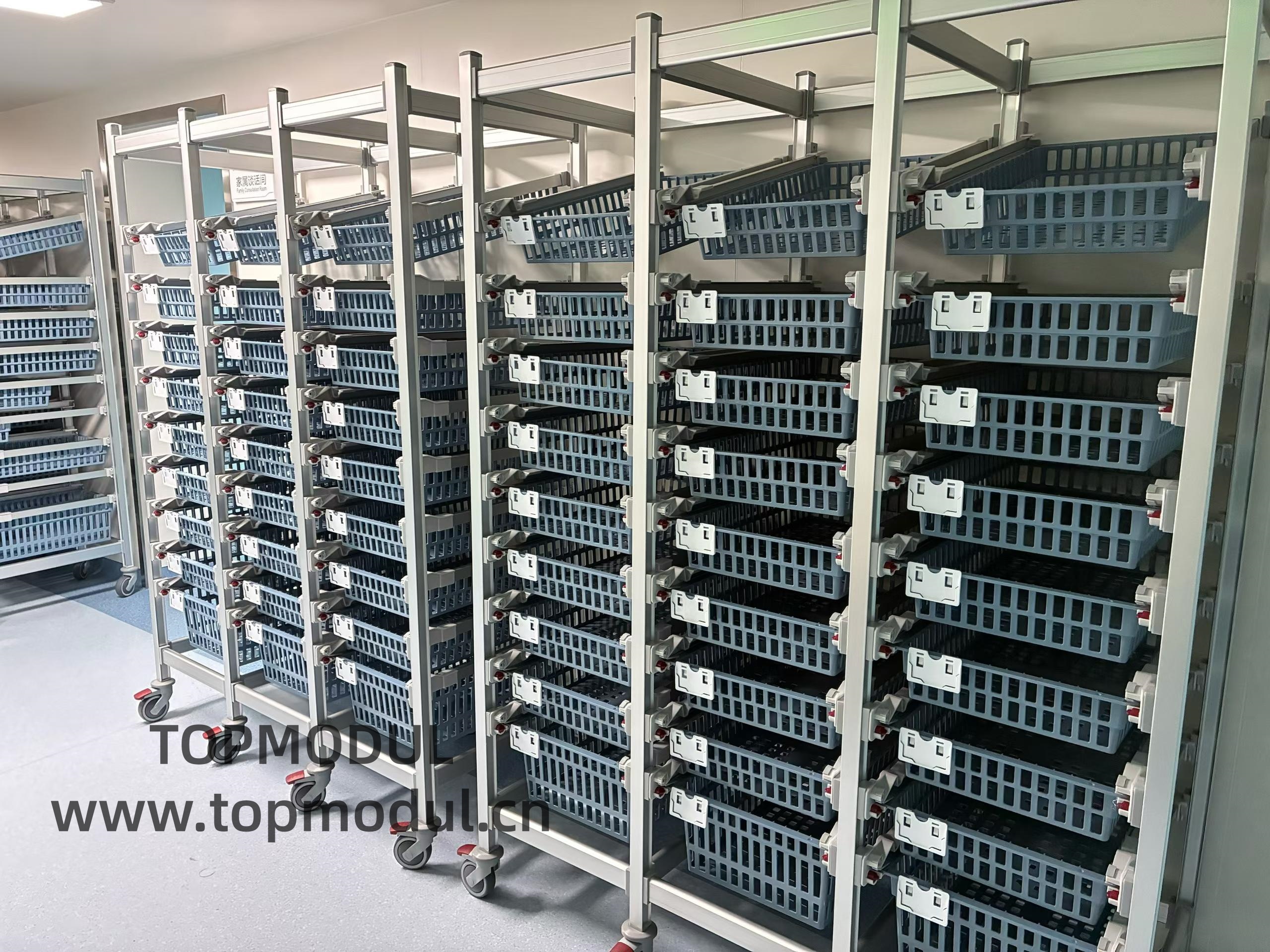
A modular medical cart is the mobile interface between central storage and the department that consumes the supplies.
Why cart selection became a storage-system decision
Hospitals rarely buy carts in isolation anymore. A department that standardises on a tray format expects the same tray to move from a high-density shelving bay into a cart drawer without repacking, and expects the cart to return empty trays to the same indexed location. When those two layers come from different vendors, the storage gains are partly spent on handling workarounds.
The commercial signal behind that operational logic is visible in market estimates. Research published by Grand View Research under its Horizon outlook places the global medical carts market at an estimated US$4.83 billion in 2026, and the same source projects the European medical carts market growing at a CAGR of 15.8% between 2025 and 2030. Separately, ISO 60-40 modular system specifications published via MedicalExpo describe storage capacity increases of up to 50% compared with traditional shelving. Those two data points are frequently read together: capital is moving toward carts, but the capacity argument that justifies the spend is a system-level argument, not a single-unit argument.
That is the context in which a three-model comparison becomes useful. T001, T002 and T003 are not competing products. They are three configurations of one modular platform, and the buyer's job is to allocate them across departments rather than to pick a winner.
Three carts, one platform: what T001, T002 and T003 share
The strongest evidence that these models belong together is documentary rather than descriptive. The EU Declaration of Conformity REP-MDR-20241108M1, issued on 8 November 2024 through the European Authorized Representative REP Europe GmbH, covers medical cart models T001 through T011 as MDR Class I devices. The listed harmonised standards include EN ISO 20417:2021, EN ISO 10993-1:2020, EN 62366-1:2015+A1:2020, EN ISO 13485:2018+A11:2021 and EN ISO 14971:2020/A11:2021. A separate EU Medical Device Notification Certificate, DE/CA20/00205020, issued on 26 November 2024, explicitly names the anesthesia cart, emergency crash cart and nursing cart within its scope.
On the manufacturing side, the ISO 9001:2015 certificate 276Q240086 issued by Huaxinchuang (Beijing) Certification Center Co., Ltd. is valid from 8 April 2024 to 7 April 2027 and covers the production of medical shelves (cabinets) and medical carts. The practical consequence for a procurement team is that the three models can be qualified in a single supplier file instead of three separate technical dossiers.
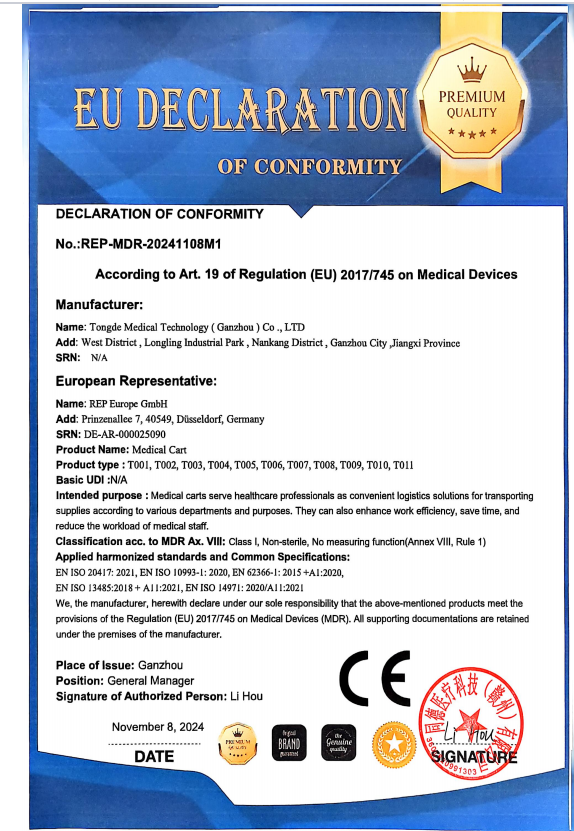
One declaration of conformity covers medical cart models T001 through T011, which is why the three carts can be evaluated under one compliance file.
| Shared attribute | What the record shows |
|---|---|
| Regulatory classification | MDR Class I medical cart, models T001 to T011 under one declaration |
| Named certificate scope | Anesthesia cart, emergency crash cart and nursing cart are all listed on DE/CA20/00205020 |
| Quality management | ISO 9001:2015, certificate 276Q240086, valid 2024-04-08 to 2027-04-07 |
| Storage architecture | Same ISO 6040 modular storage system and modular hospital storage system portfolio |
| Sourcing model | Same OEM production and ODM design and production services, same project-based solution support |
Where the three models actually diverge
The divergence is departmental, not technical in the compliance sense. Model naming and certificate scope indicate the intended clinical setting, and each setting applies a different operating rhythm to the same platform.
The T001 anesthesia cart is positioned for anesthesia-related storage and transport within surgical and procedural areas. In that environment the cart functions as a mobile, self-contained supply position that stays close to where the procedure happens, which places a premium on organised compartmentalisation rather than on rapid response across long distances.
The T002 emergency crash cart is positioned for emergency response use. The defining requirement in that setting is that the cart is complete and immediately movable when called for, so configuration discipline matters more than storage volume. A crash cart that has been reorganised by a department to suit daily convenience stops functioning as a crash cart.
The T003 nursing cart is positioned for ward-level nursing and medication rounds. It faces the highest cycle count of the three, moving repeatedly between storage rooms and patient areas during a shift, which makes cleanability, rolling behaviour and tray stability the practical selection criteria.
| Model | Series role | Primary department setting | Configuration focus at order stage |
|---|---|---|---|
| T001 | Anesthesia cart | Anesthesia and procedural areas | Drawer and tray layout matched to procedure sequences |
| T002 | Emergency crash cart | Emergency and resuscitation response | Fixed, documented arrangement that resists reorganisation |
| T003 | Nursing cart | Ward nursing and medication rounds | High-cycle access, cleaning method, rolling stability |
The table reflects model naming and certificate scope. Absolute dimensions, rated load and specific drawer counts for each model are confirmed at drawing approval, not from public naming alone.
A buyer checklist for evaluating modular medical carts
Published procurement guidance from the manufacturer sets out the parameters that should be locked before an order is placed, and the list is worth treating as an evaluation instrument rather than a brochure point. It divides into product attributes and supplier attributes.
On the product side, the buyer should verify the certification documents, the material, the antibacterial property of the cart, compatibility with the hospital's own cleaning and disinfection liquids, support for high-temperature disinfection, safety features, rated load capacity, overall dimensions, surface treatment and after-sales service. On the supplier side, the buyer should verify factory scale, the ISO 9001 and CE certificates, the production cycle and the quality control system.
A second layer of confirmation is specific to the modular approach. The intended use of the department determines the tray format, drawer or shelf configuration, load requirement, cleaning and disinfection method, and accessory combination. Because those variables are department-defined rather than catalogue-defined, they belong in the technical agreement rather than in the purchase order line description.
- Compliance gate: confirm the declaration of conformity covers the exact model number ordered, not only the product family.
- Cleaning gate: confirm the cart tolerates the disinfectants the hospital actually uses, including any high-temperature disinfection step.
- Load gate: confirm rated load against the heaviest realistic drawer load, not the average load.
- Interface gate: confirm the cart accepts the same ISO 6040 tray format used in the storage room.
- Lifecycle gate: confirm caster and fastener inspection routines and the availability of replacement parts.
Modular versus conventional procurement: where the limits are
A comparison that only lists advantages is not a comparison. Three constraints deserve mention before a hospital commits.
First, the capacity claim is a system-level claim. The up-to-50% storage capacity increase associated with the ISO 60-40 modular system is measured against traditional shelving as a storage configuration. A hospital that buys modular carts but leaves its storage rooms on legacy shelving should not expect the full figure, because the gain depends on the tray standard being adopted on both sides of the transfer.
Second, the commercial terms suit project-scale buying rather than pilot buying. The manufacturer's stated minimum order quantity is 100 units, with a lead time of 30 to 45 days. A single ward wanting to trial two carts is not the target profile of that structure, and buyers planning a staged rollout should sequence departments so that each order clears the threshold.
Third, modularity shifts work to the specification stage. Because tray configuration, drawer layout, load rating and disinfection method are confirmed per department, the buyer carries more definition work up front than with a fixed catalogue cart. That work is the source of the later efficiency, but it is real effort and it needs a named owner on the hospital side.
There is also an operational risk profile that does not disappear with better specification. Documented failure modes for medical storage carts include overloading and deformation, caster faults, surface corrosion and loose structural connections, typically triggered by overload, frequent heavy use or poor maintenance. The stated mitigations are straightforward: observe the rated load limit, wipe off disinfectant residue after cleaning, and inspect casters and fasteners regularly. Components found deformed or loose should be taken out of use and replaced rather than retightened indefinitely.
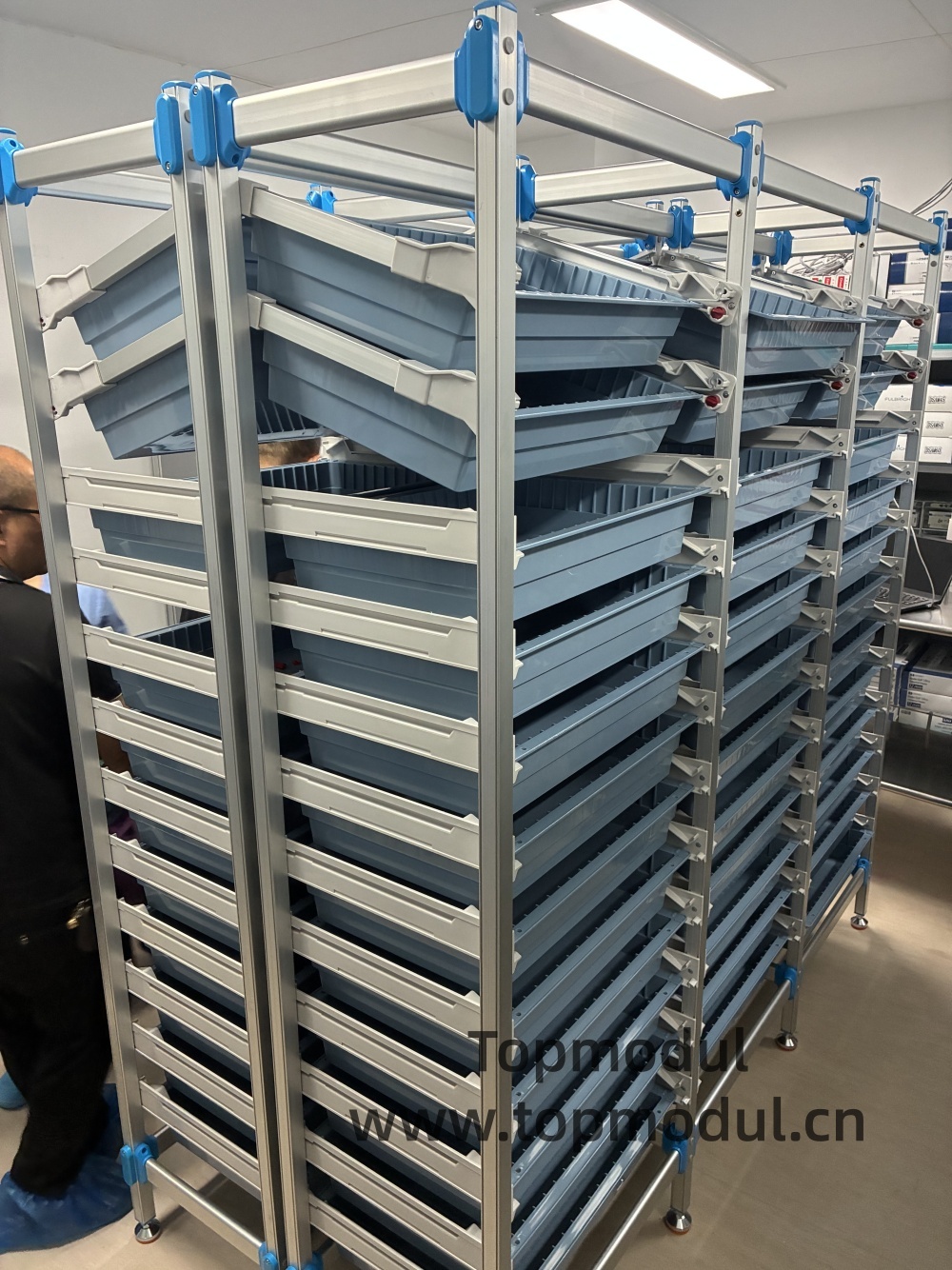
The modular argument is completed only when the shelving layer and the cart layer use the same tray standard.
How the carts are built, configured and delivered
Tongde Medical Technology (Ganzhou) Co., Ltd. is a manufacturer founded in 2003, operating a 30,000 square metre factory with more than 100 employees, including a research and development team of more than 10 people, and exporting around 90% of its output, with Western and Eastern Europe among its main markets. Its production range covers modular medical carts, medical storage carts, medical transport carts, hospital storage carts, medical supply carts, medical nursing carts, anesthesia carts, emergency crash carts, trauma carts, pediatric crash carts, medical storage shelving, hospital medical shelving, sterile storage shelving, medical storage cabinets, smart medical storage cabinets and ISO 6040 medical storage systems.
Manufacturing is supported by injection moulding equipment, a granulator and a raw material warehouse on site, and the manufacturer states a monthly capacity of 20,000 units with 100% testing. Quality control follows a full-process model: incoming quality control, in-process quality control, final quality control and outgoing quality control, carried out by a five-member quality team at each production stage and on every product before packing and shipment.
For buyers customising rather than buying standard configurations, the stated OEM workflow runs in eight documented steps: familiarisation with all customer requirements, whether standard or customised; a detailed quotation that defines requirements; discussion of further needs or concerns; double confirmation of the model number followed by material and size selection; joint approval of materials, colours and sizes; production start after payment and drawing confirmation; regular production progress updates; and photographic verification before delivery.
The service layer that surrounds the hardware includes free maintenance service, installation, debugging and usage training, consultation, and ongoing product feature updates with upgrade services. For a hospital standardising carts across departments, the training and upgrade elements matter as much as the cart itself, because a modular system degrades quickly if staff are not trained on tray discipline.
Application scenarios: matching cart type to department
Project records in the manufacturer's case material show how the cart-and-shelving combination is deployed in practice. A hospital in Malaysia took 100 units for the storage and transportation of medical supplies, with the stated result that bringing supplies to the point of care reduced the time staff spend walking between departments and central supply rooms. A hospital in Taiwan took 100 units for hospital medical product storage and transportation with a similar rationale.
Storage-side projects follow the same logic from the other direction. A hospital in Saudi Arabia took 50 units of high-density shelving to hold large volumes of medical materials and documents in limited space, reporting improved space utilisation and faster retrieval. A healthcare centre in Israel took 10 units of high-density mobile shelving to manage medical files and materials more systematically. A hospital in the United Kingdom took 100 units of medicine storage shelving, reporting improved storage order, faster medicine retrieval, better inventory control and reduced medication errors over a five-year period.
Read together, these records describe an allocation pattern rather than a single product recommendation: high-density shelving for the storage layer, and department-specific carts for the transfer layer, with the tray standard as the connection between them.
The market signal behind modular storage investment
The demand context supports the direction without explaining the choice between T001, T002 and T003. The estimated US$4.83 billion global medical carts market in 2026 and the projected 15.8% CAGR for the European medical carts market from 2025 to 2030 indicate a market expanding in value, and expansion at that rate is typically accompanied by more specification scrutiny rather than less.
The connection between the capacity evidence and the market evidence is worth stating plainly: the up-to-50% capacity gain attributed to ISO 60-40 modular systems is what allows a hospital to justify modular carts as a space and workflow investment rather than as furniture replacement. Where that justification is weak, carts get bought on unit price; where it is strong, they get bought on system fit.
What buyers should watch next
Two developments are likely to shape the next procurement cycle. The first is the extension of modular storage from physical trays into managed storage, which the manufacturer's portfolio already reflects through the smart medical storage cabinet line. The second is the tightening of documentation expectations in European tenders, where a declaration of conformity that names the specific model numbers purchased is increasingly treated as a baseline rather than a differentiator.
For hospitals currently planning a rollout, the practical sequence remains: define the tray standard first, qualify the supplier's certification file second, and allocate cart models to departments third. Reversing that order tends to produce a fleet of carts that cannot be replenished from the storage room they were meant to serve.
FAQ
What do the T001, T002 and T003 carts have in common?
All three are medical carts within the same declared model range. The EU Declaration of Conformity REP-MDR-20241108M1 covers medical cart models T001 through T011 as MDR Class I devices, and the EU Medical Device Notification Certificate DE/CA20/00205020 names the anesthesia cart, emergency crash cart and nursing cart within its scope. Production of medical carts and medical shelves is covered by ISO 9001:2015 certificate 276Q240086.
How should a hospital choose between the anesthesia cart, the emergency crash cart and the nursing cart?
The decision follows the department's operating rhythm. The T001 anesthesia cart is positioned for anesthesia and procedural areas, the T002 emergency crash cart for emergency response, and the T003 nursing cart for ward-level nursing and medication rounds. Because tray configuration, drawer or shelf layout, load requirement, cleaning and disinfection method and accessories are confirmed against actual department use, the selection should be documented per department rather than set once for the whole hospital.
Which parameters should be confirmed before ordering medical storage carts?
Product-side parameters include the certification certificate, material, antibacterial property, compatibility with hospital cleaning liquids, support for high-temperature disinfection, safety, load capacity, dimensions, surface treatment and after-sales service. Supplier-side parameters include factory scale, ISO 9001 and CE certification, production cycle and quality control system.
Can the carts be configured for a specific department layout?
Yes. The manufacturer provides OEM production services and ODM design and production services for medical carts and medical storage systems, together with modular configuration and project-based solution support for hospital storage and cart projects. The configuration is agreed during the quotation and drawing approval stages, before production begins.
What are the minimum order quantity and lead time?
The stated minimum order quantity is 100 units and the stated lead time is 30 to 45 days. Monthly capacity is stated at 20,000 units, with 100% testing and full-process inspection at incoming, in-process, final and outgoing stages.
What operational risks should buyers plan for after delivery?
Documented risks for medical storage carts include overloading and deformation, caster damage, surface corrosion and loose structural connections, typically arising under overload, frequent heavy use or poor maintenance. Mitigations are to observe the rated load limit, wipe off disinfectant residue after cleaning, and check casters and fasteners regularly. Parts found deformed or loose should be taken out of service and replaced.
For buyers who need the full storage-layer specification before finalising cart quantities, the manufacturer's shelving catalogue is available for download: 2026 TM Shelving Catalogue (PDF).
Have Questions or Need More Details?
Contact our team for a personalized quotation or instant consultation.
Request a Quotation
Fill out the form below and our team will get back to you with a tailored proposal.
WhatsApp Direct Chat
Prefer to chat in real-time? Message us on WhatsApp for instant assistance & quick answers.
- Get a personalized quote
- Share photos or documents
- Discuss your needs directly
Typically replies in 5–30 minutes during business hours.