
TC-100 vs TC-300 Tissue Cartoning Machines: Matching Speed to Carton Size
Boxed facial tissue is the largest single application segment in tissue packaging machinery. Facial tissue packaging accounted for 42.1% of global market share in 2025, inside a market valued at approximately USD 3.9 billion and projected to reach USD 4.2 billion in 2026 (Precedence Research / Business Research Insights). For a producer specifying a tissue cartoning machine, that demand reduces to a narrow, practical decision: how much rated speed the line genuinely needs, and at what carton size that speed can be sustained.
This framework compares two WIMACH cartoning models on the four criteria that decide whether a quoted output survives contact with production: packing capacity, carton dimension envelope, carton board grammage, and utility demand. The two models are the TC-100 Tissue Cartoning Machine, rated at 30–100 boxes per minute, and the TC-300Automatic High-Speed Tissue Box Packing Machine, rated at up to 180 boxes per minute.
Why a Rated Speed Figure Is Not a Buying Decision
A cartoning speed rating is a conditional number. It assumes a qualified carton format, a specific board grade, a defined tissue fold and a matched supply of blanks and product at the infeed. Change any one of those inputs and the figure in a quotation sheet stops describing the line.
The practical consequence for buyers is that 100 boxes per minute and 180 boxes per minute are not interchangeable headline numbers. They describe two machines with different mechanical ceilings, different format windows and different demands on the surrounding line. A buyer who purchases on the higher number without checking the conditions behind it can end up with a machine that buffers product rather than flowing it, or with a carton size that falls outside the rated window.
The Two Models and the Entity Behind Them
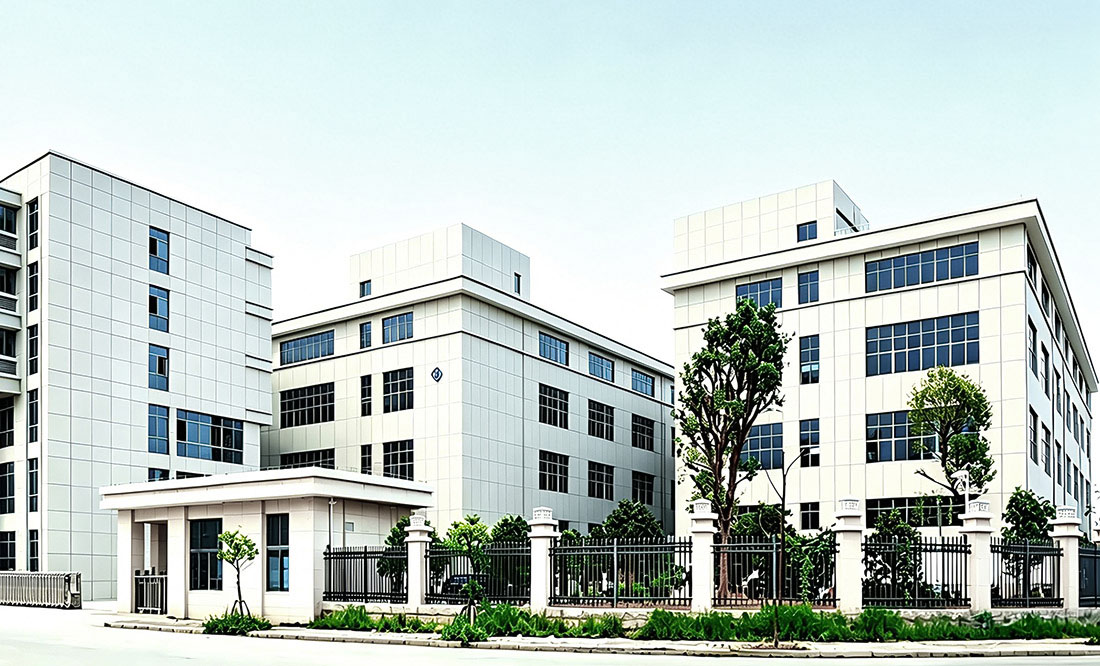
WIMACH is the brand of Wenzhou Wimach Machinery Co., Ltd., a packaging machinery manufacturer based in Ruian, Wenzhou, Zhejiang, China, specialising in tissue packing machines and integrated packaging lines. The company was founded in 2021, operates a 3,000 m² facility with 37 employees, reports an annual output of 160 sets, a five-engineer R&D team, and a 60% export share concentrated in the EU, North America and South America. WIMACH describes more than 12 years of industry experience behind its product range.
Both models in this comparison belong to the same functional family — folded facial tissue packed into paperboard boxes — but they sit at different points on the speed curve:
- TC-100 (Tissue Cartoning Machine): rated 30–100 boxes per minute. WIMACH's published technical data cites a stable packaging speed of 100 boxes per minute for this model.
- TC-300 (Automatic High-Speed Tissue Box Packing Machine): rated at up to 180 boxes per minute.
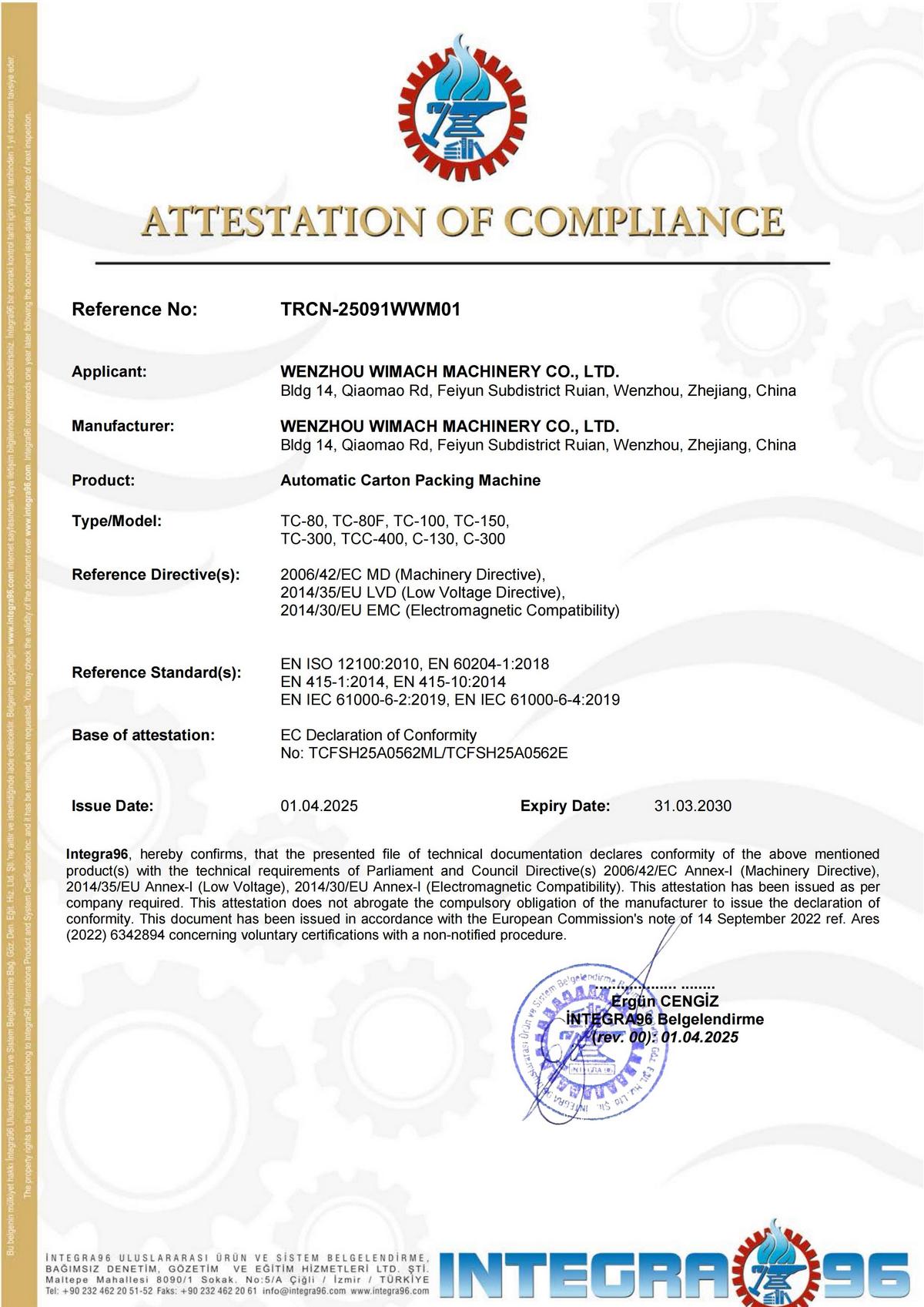
Compliance is shared rather than model-specific. Both the TC-100 and the TC-300 fall under CE attestation TRCN-25091WWM01, issued 1 April 2025 by iNTEGRA96 Belgelendirme and valid to 31 March 2030, covering the Automatic Carton Packing Machine scope against EN ISO 12100:2010, EN 60204-1:2018, EN 415-1:2014, EN 415-10:2014, EN IEC 61000-6-2:2019 and EN IEC 61000-6-4:2019. The same family is also linked to Chinese utility model patent ZL 2022 2 1202677.7, granted 25 April 2023 and recorded against carton-packaging mechanisms including box forming and automatic feeding, and to invention patent ZL 2022 1 1099886.8, granted 6 September 2022, covering a carton packing machine and carton packaging process.
Criterion 1 — Packing Capacity: 30–100 vs Up to 180 Boxes per Minute
Capacity is the first filter, but it should be read as a band rather than a point. The TC-100 spans 30 to 100 boxes per minute, which means the same machine covers a pilot line and a mid-volume commercial line. The lower bound matters more than buyers expect: a machine that runs comfortably at 30 boxes per minute can be started before retail listings are secured and then scaled in the same footprint.
The TC-300's rating of up to 180 boxes per minute roughly doubles the ceiling. For a buyer, the relevant question is not whether 180 is better than 100, but whether the upstream tissue folding and the downstream case packing can absorb 180 boxes per minute. Where either side of the cartoner runs at 100 boxes per minute, the additional capacity on the cartoner converts into buffer stock, larger accumulation conveyors and more frequent stop-start cycles — cost without throughput.
Criterion 2 — Carton Size Envelope
Carton geometry is where most cartoning projects lose time. The format envelope referenced in this comparison is 100–240 mm in length, 100–120 mm in width and 20–90 mm in height. That range covers standard rectangular facial tissue boxes; it does not cover cube formats, canisters or soft-pack bags, which belong to different machine families in the same WIMACH range (the TC-80F cube box cartoner and the TC-80Y canister packing machine respectively).
Two practical points follow. First, a format inside the envelope is not automatically a format at rated speed: cartons at the extreme ends of the length or height range typically require the speed to be confirmed against the specific blank. Second, the 20 mm lower height bound is the constraint most often missed by buyers adding a compact 100-sheet box to a line originally specified for 200-sheet boxes.
Criterion 3 — Carton Board Grammage
The board range in this comparison is 300–400 gsm. Grammage affects creasing quality and box forming stability, and it interacts directly with speed: a heavier board needs more controlled forming force, and a lighter board is more sensitive to feed timing at high cycle rates. Buyers running multiple board grades across a product range should treat grammage as a changeover variable rather than a fixed specification, and should request a forming trial at the lightest and heaviest grade in the portfolio.
Criterion 4 — Power and Air Consumption
Utilities are usually the last item reviewed and the first to delay commissioning. For the TC-100, the documented demand is 6.2 kW of connected power and 120–160 L/min of air consumption. The air figure is a range, not a single value, because pneumatic demand rises with cycle rate and with the number of actuations per cycle.
In practice this means the compressed air supply must be sized to the upper end of the range — 160 L/min — with stable pressure, otherwise the cartoner will run below its rated speed while appearing mechanically sound. Buyers comparing the two models should request the equivalent utility schedule for the TC-300 before finalising factory infrastructure, since the higher-speed model's consumption figures are not interchangeable with the TC-100's.
Side-by-Side Comparison
| Decision criterion | TC-100 Tissue Cartoning Machine | TC-300 Automatic High-Speed Tissue Box Packing Machine |
|---|---|---|
| Rated packing capacity | 30–100 boxes/min (100 boxes/min cited as stable speed in WIMACH technical data) | Up to 180 boxes/min |
| Carton format envelope | 100–240 mm L × 100–120 mm W × 20–90 mm H (envelope covered in this comparison) | Confirm the model-specific format window in the datasheet during technical review |
| Carton board | 300–400 gsm | 300–400 gsm range; trial at target grade recommended |
| Power / air | 6.2 kW; 120–160 L/min air | Request model utility schedule before line design |
| CE attestation | TRCN-25091WWM01 (valid to 31 March 2030) | TRCN-25091WWM01 (valid to 31 March 2030) |
| Best-fit production profile | Mixed-format lines, mid-volume output, staged ramp-up | Single-format, high-volume output with matched upstream and downstream stations |
Where Each Machine Fits: Documented Installations
Installation evidence is more useful than a specification sheet when judging fit, because it shows which model was actually paired with which production profile.
Facial tissue box line, United States
A US tissue paper manufacturer deployed two cartoning machines for fully automatic continuous box packing of facial tissues. The stated problems were irregular filling and product extrusion damage during packing; the reported outcome was higher production efficiency, reduced labour cost and unified packing standards, with CE compliance and fully automated operation listed among the highlights. This is the profile the TC-100 is built for — a box line where format consistency and packing quality, not raw ceiling, drive the purchase.
Integrated facial and cream tissue line, Poland
A Polish project comprising 12 sets of equipment and completed within two years integrates conveying, automatic cartoning, case packing, pallet feeding, robotic palletizing, strapping and stretch wrapping. The cartoning stations in that build are associated with both the TC-100 and the TC-300, alongside TP-280 wrapping and CP-S50 case packing. The takeaway for buyers is structural: a single line can legitimately run a high-speed cartoner on the main SKU and a standard cartoner on secondary or short-run formats, rather than forcing every format through one machine.
Output stability at the finished-goods end is also a useful reference point. In an adjacent canister format, WIMACH's TC-80Y installation in the United Arab Emirates has run for four years at a stable 60 canisters per minute, which illustrates how the company positions output claims as sustained rates rather than peak demonstrations.
What the Market Data Suggests About Format Mix
Two published figures frame the capacity decision. Asia Pacific held a 39.8% share of the tissue packaging machinery market in 2025, and facial tissue packaging accounted for 42.1% of application share in the same year (Precedence Research / Business Research Insights). A region-weighted, facial-tissue-weighted market is one where boxed formats dominate installed capacity — and where the competitive pressure runs through packaging cost per box rather than through machine novelty.
That reading supports a specific purchasing pattern: buyers increasingly specify a cartoner for the dominant SKU and hold secondary formats on a format-flexible machine, instead of seeking one machine that does everything. It also explains why the 30–100 boxes per minute band remains commercially relevant next to 180 boxes per minute machines — most lines are constrained elsewhere before they are constrained at the cartoner.
Automated Cartoning vs Manual and Semi-Automatic Packing
Compared with manual boxing, automated cartoning changes three things simultaneously: output consistency, labour dependency and the number of format variables that must be controlled. The US installation cited above is instructive because the reported problems were not speed-related — they were irregular filling and product damage, both of which scale with labour turnover rather than with machine design.
The trade-off is that automation moves complexity upstream. A cartoner requires a stable tissue fold, consistent blank quality within the 300–400 gsm range, and a compressed air supply that holds pressure at the upper end of the 120–160 L/min band on the TC-100. Manual packing tolerates variation that a cartoner will reject as a jam. Buyers should budget for infeed conditioning and air infrastructure, not only for the machine.
Limits of This Comparison
Three boundaries should be stated plainly.
First, the carton envelope is a comparison input, not a universal guarantee. The 100–240 mm × 100–120 mm × 20–90 mm range describes the format window covered here; the TC-300's specific rated window at 180 boxes per minute must be confirmed in its datasheet, because high-speed cartoning typically operates on a narrower qualified format set than a standard machine.
Second, published speeds are format-conditional. Neither rating should be treated as a contractual acceptance value until it has been demonstrated on the buyer's own carton, board grade and tissue fold. WIMACH's stated quality control sequence for these machines includes no-load and load running tests, dimensional tolerance inspection, mechanical assembly checks, pneumatic leakage testing, electrical safety testing, PLC control logic testing, safety interlock and E-stop testing, long-time aging and surface inspection — the load running test on the buyer's format is the relevant acceptance event.
Third, the utility comparison is asymmetric in the available data. The TC-100 figures of 6.2 kW and 120–160 L/min are documented; the TC-300 equivalent should be obtained directly rather than extrapolated from the smaller model.
Future Outlook
Two pressures are likely to shape cartoning specifications over the next buying cycle. The first is format proliferation: as retailers push smaller pack counts and regional box standards diverge, the value of a machine's qualified format window rises relative to its peak speed. The second is infrastructure cost: power and compressed air are increasingly priced into total operating cost, which favours specifying a cartoner whose utility demand matches the actual throughput requirement rather than the theoretical maximum.
For WIMACH, the commercially relevant trajectory is breadth rather than a single flagship model. With a 160-set annual output, a 60% export share across the EU, North America and South America, and customization of packaging dimensions, machine configuration, voltage and logo supported at a one-set minimum order, the company is positioned to supply either model as a configured unit — with lead times of 30–60 days for a complete packaging line and 30–45 days for customized machinery.
FAQ
What is the throughput difference between the TC-100 and the TC-300?
The TC-100 Tissue Cartoning Machine is rated at 30–100 boxes per minute, and WIMACH's technical data cites 100 boxes per minute as its stable packaging speed. The TC-300 Automatic High-Speed Tissue Box Packing Machine is rated at up to 180 boxes per minute. The difference is a ceiling difference, not a guaranteed production difference, because both figures depend on carton format, board grade and the capacity of the surrounding line.
Which carton sizes do these tissue cartoning machines cover?
The carton format envelope covered in this comparison is 100–240 mm in length, 100–120 mm in width and 20–90 mm in height, with carton board in the 300–400 gsm range. Formats outside that envelope — cube boxes, canisters and soft packs — require different machine families such as the TC-80F cube box cartoner or the TC-80Y canister packing machine.
What power and air supply does the TC-100 require?
The TC-100 requires 6.2 kW of connected power and 120–160 L/min of air consumption. Because the air figure is a range that rises with cycle rate, the compressed air supply should be sized to the upper value of 120–160 L/min with stable pressure, otherwise the machine can run below its rated speed while appearing mechanically sound.
Is the TC-300 justified for a line running below 100 boxes per minute?
Generally no. If the upstream tissue folding or the downstream case packing runs at or below 100 boxes per minute, the TC-300's additional capacity converts into buffer stock, larger accumulation and more frequent stop-start cycles rather than additional output. The TC-300 is better matched to single-format, high-volume production where both sides of the cartoner are specified to the same throughput.
How can a buyer verify rated speed before shipment?
By requiring a load running test on the buyer's own carton, board grade and tissue fold as part of factory acceptance. WIMACH's stated quality control sequence for these machines includes no-load and load running tests, dimensional tolerance inspection, mechanical assembly checks, pneumatic leakage testing, electrical safety testing, PLC control logic testing, safety interlock and E-stop testing, long-time aging and surface inspection. The load running test on the actual format is the event that converts a published rating into an acceptance value.
Which certification covers the TC-100 and the TC-300?
Both models are covered by CE attestation TRCN-25091WWM01, issued on 1 April 2025 by iNTEGRA96 Belgelendirme and valid until 31 March 2030, for the Automatic Carton Packing Machine scope. The listed standards are EN ISO 12100:2010, EN 60204-1:2018, EN 415-1:2014, EN 415-10:2014, EN IEC 61000-6-2:2019 and EN IEC 61000-6-4:2019.
What are the ordering terms for these cartoning machines?
WIMACH quotes a minimum order quantity of one set for these machines. Lead time is 30–60 days for a complete packaging line and 30–45 days for customized machinery, with packaging dimensions, machine configuration, voltage and logo all open to customization. Reported monthly capacity is 13 sets for customized machinery and one set for a complete packaging line.
For full model specifications across the cartoning, wrapping and case packing range, the WIMACH catalogue is available here: WIMACH product catalogue (PDF).
Have Questions or Need More Details?
Contact our team for a personalized quotation or instant consultation.
Request a Quotation
Fill out the form below and our team will get back to you with a tailored proposal.
WhatsApp Direct Chat
Prefer to chat in real-time? Message us on WhatsApp for instant assistance & quick answers.
- Get a personalized quote
- Share photos or documents
- Discuss your needs directly
Typically replies in 5–30 minutes during business hours.