
TC-100 vs. TC-300 Tissue Cartoning Machines: Speed and Carton Size Compared
Two automatic cartoning machines from the same builder rarely compete for the same production plan. The WIMACH TC-100 Tissue Cartoning Machine is rated at 30–100 boxes per minute. The TC-300 Automatic High-Speed Tissue Box Packing Machine is rated at up to 180 boxes per minute. Both are produced by Wenzhou Wimach Machinery Co., Ltd., trading as WIMACH, a tissue packing machine manufacturer based in Ruian, Wenzhou, Zhejiang, China.
For a buyer in the evaluation stage, the useful question is not which model is better in absolute terms. It is which model matches a defined box format, a defined shift pattern, and a defined supply of folded facial tissue from upstream. This comparison sets out the criteria that actually separate the two machines — packing capacity, carton dimensions, carton board grammage, compressed air and power demand, and compliance evidence — and identifies the points where each specification becomes a constraint rather than a selling point.
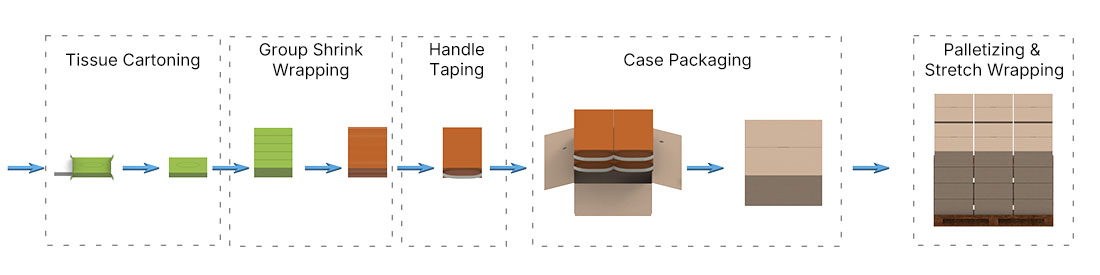
Why the box cartoner carries the capacity decision
Facial tissue packaging is the single largest application segment in this equipment category, accounting for 42.1% of the market share in 2025, according to Precedence Research. The same source puts the global tissue paper packaging machine market at approximately USD 3.9 billion in 2025, with a projected USD 4.2 billion in 2026. Those figures matter to a buyer for one practical reason: box-format lines are where most capital is committed, and where speed mismatches are most expensive to correct after installation.
A tissue boxing machine sits at the end of a chain — folding, counting, stacking, then cartoning, then case packing. Its rated speed is therefore a ceiling, not an average. If the cartoner is rated above what the folding and stacking equipment can deliver, the line runs at the slower upstream rate and the extra capacity is paid for but never used. If the cartoner is rated below the upstream rate, tissue accumulates at the infeed and the whole line throttles to the cartoner. Getting the ratio right is the core of this decision.
The two models at a glance
The table below isolates the specifications most often compared during evaluation. Figures marked as documented come from the manufacturer's published model data; buyers should still confirm them against a quotation for the exact configuration being purchased.
| Criterion | TC-100 Tissue Cartoning Machine | TC-300 Automatic High-Speed Tissue Box Packing Machine |
|---|---|---|
| Rated packing capacity | 30–100 boxes/min (100 boxes/min quoted as stable speed) | Up to 180 boxes/min |
| Carton format window (documented series data) | 100–240 mm L × 100–120 mm W × 20–90 mm H | 100–240 mm L × 100–120 mm W × 20–90 mm H |
| Carton board grammage | 300–400 gsm | 300–400 gsm |
| Power consumption | 6.2 kW | Request per configuration |
| Compressed air consumption | 120–160 L/min | Request per configuration |
| CE attestation scope | Covered under certificate TRCN-25091WWM01 (Automatic Carton Packing Machine) | Covered under certificate TRCN-25091WWM01 (Automatic Carton Packing Machine) |
| Natural fit | Single-format or moderate-volume facial tissue box output | High-volume standard box output, long runs, multi-shift operation |
Speed: what 100 versus 180 boxes per minute actually changes
Converted to nominal hourly figures, 100 boxes per minute equals 6,000 boxes per hour and 180 boxes per minute equals 10,800 boxes per hour. Those are gross figures before efficiency losses, but they are the right starting point for capacity planning because they establish the theoretical maximum that any realistic operating rate will be a fraction of.
The decision rule that follows is straightforward. Estimate peak demand in boxes per shift, add a margin for seasonal peaks and product launches, then divide by the hours the line will realistically run. A producer supplying a regional market on a single day shift is usually buying a TC-100 class facial tissue cartoner. A producer running three shifts against national retail contracts, or supplying private-label programmes with fixed delivery windows, is usually buying TC-300 class capacity — and needs the upstream folding and stacking capacity to feed it.
The line-balance check most buyers skip
Before comparing cartoner speeds, map the actual output of the equipment feeding it. Then map the equipment receiving from it. A high-speed cartoner paired with an undersized case packer simply moves the bottleneck downstream, and a high-speed cartoner paired with a slow wrapper produces the same result upstream. WIMACH's own line references show how this is resolved in practice: the 12-set facial tissue and cream tissue line delivered in Poland integrates conveying, automatic cartoning, case packing, pallet feeding, robotic palletizing, strapping and stretch wrapping, and includes both TC-300 and TC-100 units in the same project — a configuration in which two different cartoning speeds serve two different format streams rather than one competing for the same boxes.
Carton size and board: reading the format window correctly
Supported carton dimensions of 100–240 mm length, 100–120 mm width and 20–90 mm height, with carton board in the 300–400 gsm range, define the physical scope of the cartoning platform. For orientation, the commonly cited standard rectangular tissue box in the United States measures 9.25" × 4.375" × 2.25" — approximately 235 mm × 111 mm × 57 mm. That sits inside the documented window on all three axes, close to the upper limit on length and comfortably inside on width and height.
Three practical consequences follow. First, a producer running standard US-style facial tissue boxes is operating near the long end of the envelope, which leaves limited headroom if a longer box format is introduced later. Second, the width band of 100–120 mm is narrow, so any flat or wide-format pack falls outside the standard configuration and should be raised at quotation stage rather than assumed. Third, board grammage of 300–400 gsm is a real constraint, not a formality: lightweight board behaves differently in creasing and gluing, and board outside the stated range affects both carton formation and the achievable speed within the rated band.
Format flexibility is worth testing explicitly. WIMACH lists quick size changeover among the characteristics of its packaging machinery, and changeover time matters more than rated speed for producers running several SKUs on one line — a machine that reaches 180 boxes per minute but takes a long time to convert between formats may deliver less usable output per week than a slower machine that converts quickly. Ask for changeover time as a measured figure for your own SKU set.
Utilities, compressed air and floor space: the specifications that delay installation
Power and air demand are frequently treated as afterthoughts until the machine arrives. For the TC-100, the published figures are 6.2 kW of power consumption and 120–160 L/min of compressed air consumption. The air figure deserves attention: it is a consumption rate at the machine, and the compressor and receiver must be sized for that draw while also supplying the rest of the plant. A line installed without adequate air capacity shows up as unstable carton formation and intermittent faults, which are then misdiagnosed as machine defects.
For the TC-300, utility specifications should be requested for the exact configuration quoted, since power and air demand scale with speed and with the feeding and forming mechanisms fitted. Add these to the pre-installation checklist alongside floor space for the cartoner itself, clearance for maintenance access, and the pneumatic routing between the compressor and the machine.
Compliance evidence: what the documents cover and what they do not
Both the TC-100 and the TC-300 are covered by CE attestation of compliance TRCN-25091WWM01, issued by iNTEGRA96 Belgelendirme on 1 April 2025 and valid to 31 March 2030, for the scope "Automatic Carton Packing Machine." The harmonised standards cited are EN ISO 12100:2010, EN 60204-1:2018, EN 415-1:2014, EN 415-10:2014, EN IEC 61000-6-2:2019 and EN IEC 61000-6-4:2019 — the packaging-machinery safety and electromagnetic compatibility set. The same certificate also covers the TC-80F Cube Box Tissue Cartoning Machine.
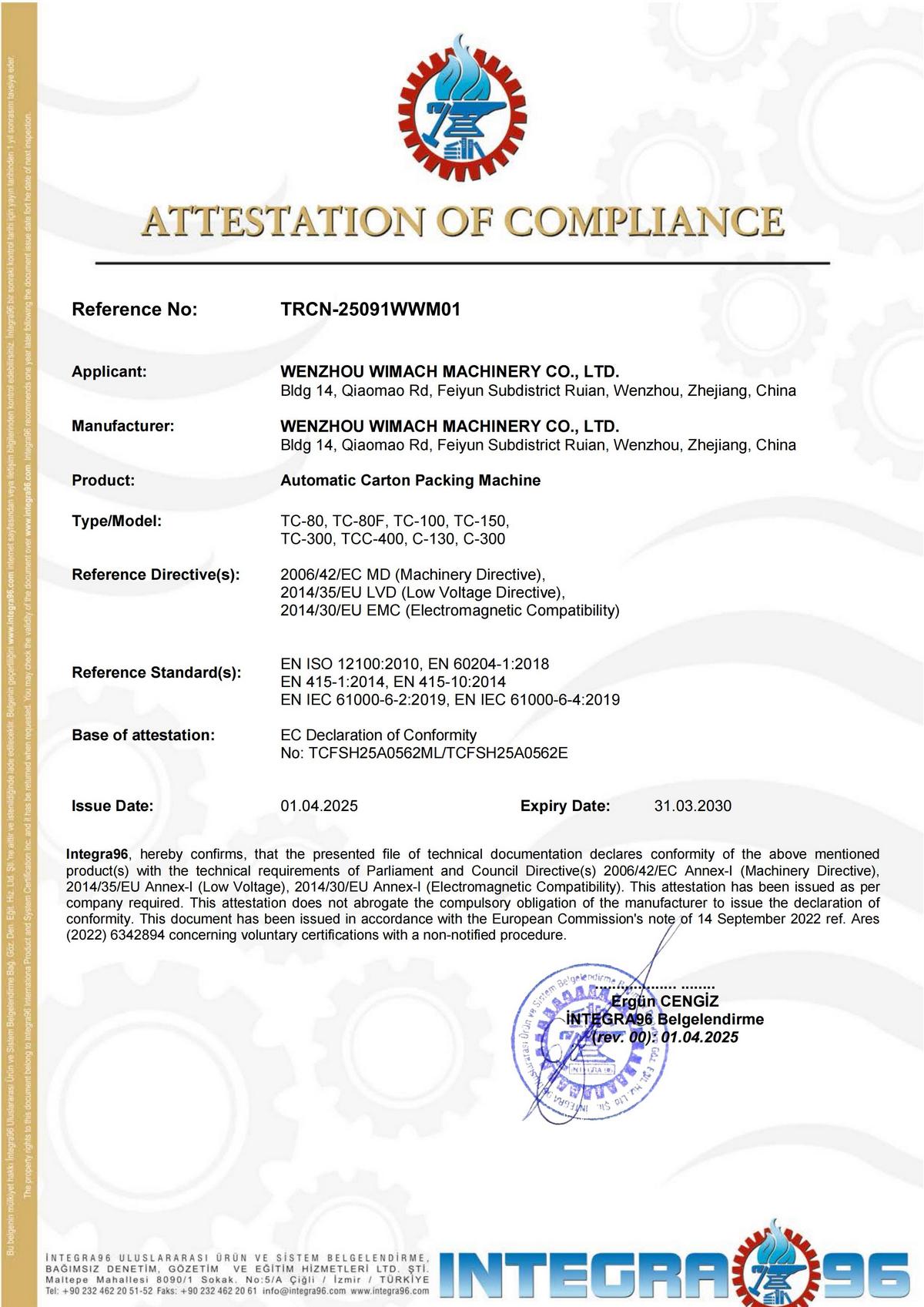
Design documentation adds a second layer of evidence. The carton packing machine and carton packaging process are covered by invention patent ZL 2022 1 1099886.8, issued 6 September 2022 and valid to 17 September 2042, while an automatic feeding mechanism for carton packaging machines and a box forming mechanism are covered by utility model ZL 2022 2 1202677.7, issued 25 April 2023 and valid to 11 September 2033. For a buyer, patents indicate that the feeding and box forming functions are documented designs rather than assembled sub-systems — useful when assessing spare-part continuity, but not a substitute for performance testing.
Application fit: three configurations worth comparing
Single-format facial tissue box production at moderate volume. This is the TC-100's natural territory. A US tissue paper manufacturer installed two tissue cartoning machines for fully automatic continuous box packing of facial tissues, addressing irregular filling and product extrusion damage while cutting labour and unifying packing standards. The reported outcome was higher production efficiency and consistent finished-product quality — the profile of a producer whose constraint was labour and consistency rather than raw line speed.
High-volume, multi-stage box production. This is where TC-300 capacity earns its place. The Polish project referenced above runs 12 sets of equipment across a complete facial tissue and cream tissue line, delivering palletised, strapped and stretch-wrapped finished goods within a two-year project window. In a configuration of that size, the cartoner is one station in a sequence and its speed must be specified against palletizing throughput, not in isolation.
Mixed-format portfolios. Where the box range extends to cube boxes, the TC-80F Cube Box Tissue Cartoning Machine covers the format rather than forcing a compromise on the standard cartoner. Where a project spans both box and roll formats, the line typically pairs a cartoner with a toilet roll wrapping machine — WIMACH's TW-160, for example, is rated at 60–120 rolls per minute and was installed as two sets in the United States for paper-based roll wrapping, in operation for five years. Canister formats follow the same logic through the TC-80Y automatic tissue canister packing machine, which has run two sets for four years in the United Arab Emirates at a stable 60 canisters per minute. A turnkey packing solution for tissue is therefore usually a configuration decision across several format streams, not a single-machine purchase.
A comparison framework buyers can apply
The framework below converts the specifications into weighted decision criteria. It is deliberately model-neutral: the same structure works if a buyer later adds a third supplier to the comparison.
| Criterion | What to ask | Why it decides the choice |
|---|---|---|
| Peak demand fit | Peak boxes per shift, plus growth margin, against 6,000 or 10,800 nominal boxes per hour | Overcapacity is paid for permanently; undercapacity is paid for in overtime |
| Carton envelope headroom | Your box drawing on all three axes against 100–240 × 100–120 × 20–90 mm | Determines whether future format extensions are feasible without a new machine |
| Board specification | Actual board grammage and supplier, against the 300–400 gsm range | Board outside range affects forming, gluing and achievable speed |
| Changeover time | Measured changeover for your SKU set, not a general claim | Multi-SKU producers lose more to changeover than to rated speed |
| Utilities and site | 6.2 kW and 120–160 L/min for TC-100; equivalent figures for TC-300; compressor sizing | Inadequate air supply produces instability misread as machine faults |
| Evidence and after-sales | FAT protocol, CE scope, spare-parts list, installation and training scope | Converts supplier claims into acceptance criteria |
Two supplier-side facts belong in the timeline. WIMACH quotes a monthly capacity of 13 sets for customized machinery, with a lead time of 30–45 days for customized units, 15–45 days for OEM/ODM builds, and 30–60 days for a complete packaging line, at a minimum order quantity of one set. The company operates a 3,000 m² facility with 37 employees and a stated annual output of 160 sets, and exports approximately 60% of output to the EU, North America and South America. After-sales scope covers installation and commissioning, training, warranty, remote technical support, lifetime after-warranty support, and upgrade and retrofit service.
Where this comparison stops
Several boundaries should be stated plainly. First, this is a two-model comparison from a single manufacturer; it does not establish how either machine performs against equipment from other builders, and no verified third-party benchmark data for comparable cartoners was available for this analysis. Second, rated speeds are manufacturer-stated figures under defined product and board conditions. The 100 boxes per minute figure for the TC-100 and the up-to-180 figure for the TC-300 should be validated at factory acceptance on your own carton and board, and throughput should be planned on an OEE-adjusted basis rather than on the nameplate number. Third, no verified public data on machine price, energy cost per thousand boxes, or total cost of ownership for these specific models was available, so cost comparisons would be speculative. Fourth, the carton envelope applies to the cartoning platform — unusual formats, very flat packs or board outside the stated grammage require confirmation rather than assumption.
Market signals worth building into the model
Two structural signals support the investment case. Asia Pacific held 39.8% of the tissue paper packaging machine market in 2025, which concentrates manufacturing and spares supply in that region and makes lead-time and service-distance planning part of the evaluation for buyers in Europe and the Americas. Facial tissue packaging's 42.1% application share confirms that box-format capacity is where the majority of cartoner demand sits. For customs and project planning, tissue packaging machinery is classified under HS code 8422.40, which is worth confirming against the specific machine configuration with a customs broker before shipment.
Outlook
On current evidence, the competitive pressure in this equipment category is shifting from rated speed toward format flexibility, changeover time and documented compliance. That favours buyers who specify measurable acceptance criteria rather than comparing nameplate numbers, and it favours suppliers whose certificates, patents and testing protocols can be examined before purchase. For the TC-100 and TC-300 specifically, the practical outcome is that the two models are likely to remain complementary rather than substitutable: one for producers whose constraint is labour and packing consistency, one for producers whose constraint is volume. Whether that holds depends less on the machines than on how honestly each buyer measures their own upstream and downstream capacity.
FAQ
What is the main difference between the TC-100 and the TC-300?
Packing capacity. The TC-100 tissue cartoning machine is rated at 30–100 boxes per minute, with 100 boxes per minute quoted as its stable speed. The TC-300 automatic high-speed tissue box packing machine is rated at up to 180 boxes per minute. Both handle the same documented carton format window and board range, and both fall under the same CE attestation scope, so the differentiation is throughput rather than format or compliance.
What carton sizes and board weights do these tissue cartoning machines support?
The documented format window is 100–240 mm in length, 100–120 mm in width and 20–90 mm in height, with carton board in the 300–400 gsm range. For reference, the commonly cited standard US rectangular tissue box measures 9.25" × 4.375" × 2.25", approximately 235 mm × 111 mm × 57 mm, which sits within that window. Formats outside the envelope should be confirmed against a specific quotation.
What utilities does the TC-100 require?
The TC-100 is documented at 6.2 kW power consumption and 120–160 L/min compressed air consumption. The air figure is a machine-level consumption rate that must be supplied alongside the plant's other air users, so compressor and receiver capacity should be sized with that draw included. Utility figures for the TC-300 should be requested for the specific configuration being quoted.
Are the TC-100 and TC-300 CE certified, and what does the certificate cover?
Both models are covered by CE attestation of compliance TRCN-25091WWM01, issued by iNTEGRA96 Belgelendirme on 1 April 2025 and valid until 31 March 2030, for the scope "Automatic Carton Packing Machine." The cited standards are EN ISO 12100:2010, EN 60204-1:2018, EN 415-1:2014, EN 415-10:2014, EN IEC 61000-6-2:2019 and EN IEC 61000-6-4:2019. The certificate covers machines, not installed lines; site-level risk assessment remains with the operator and integrator.
How should a buyer validate a claimed packing speed before purchase?
Run a factory acceptance test using your own carton and carton board at the grammage you will actually buy, and record output over a sustained period rather than a short burst. Ask for the test conditions to be documented: board specification, carton dimensions, tissue fold and stack count, and the definition of a packed box. Then plan capacity on that measured rate adjusted for realistic downtime, not on the nameplate figure.
When should a buyer consider the TC-80F or TC-80Y instead?
The TC-80F Cube Box Tissue Cartoning Machine is the appropriate choice when the product portfolio includes cube-format boxes that fall outside the standard cartoner's format window. The TC-80Y automatic tissue canister packing machine covers canister formats, filling facial tissues and paper napkins into paper canisters; a reference installation in the United Arab Emirates has run two sets for four years at a stable output of 60 canisters per minute. Format, not speed, is the deciding criterion in both cases.
Reference document: the WIMACH product catalogue covering cartoning, wrapping, case packing and turnkey line configurations is available for download: Wimach Catalog.
Wenzhou Wimach Machinery Co., Ltd. (WIMACH) — Bldg 14 Qiaomao Rd, Ruian, Wenzhou, Zhejiang, China. Machines described in this article are CE certified under certificate TRCN-25091WWM01.
Have Questions or Need More Details?
Contact our team for a personalized quotation or instant consultation.
Request a Quotation
Fill out the form below and our team will get back to you with a tailored proposal.
WhatsApp Direct Chat
Prefer to chat in real-time? Message us on WhatsApp for instant assistance & quick answers.
- Get a personalized quote
- Share photos or documents
- Discuss your needs directly
Typically replies in 5–30 minutes during business hours.