
TDSJ26802 vs SODJ26531: Comparing Two Custom POP Displays
Independent Buyer Comparison · Packaging & Printing
TDSJ26802 vs SODJ26531: Comparing Two Custom POP Displays
A POP display is judged at the shelf, not in a catalogue. With 70% to 76% of purchasing decisions made in-store, according to POPAI (Shop!), the fixture has to do two jobs at once: present a product clearly and survive the environment it is placed in. That is why two displays built by the same factory can still be a genuinely difficult procurement decision for an importer, a brand owner, or a retail buyer.
This comparison looks at two models in the YC POP DISPLAY range. TDSJ26802 is classified as a METAL TOOL POP DISPLAY built from metal and PVC. SODJ26531 is classified as an MDF SOCK POP DISPLAY built from metal and MDF. Both are custom-parameterized rather than fixed catalogue units, both appear in the same manufacturer's certification documentation, and yet they are engineered around different products, different handling patterns, and different material logic.
YC POP DISPLAY is the custom display brand of YC Furniture Group (YC FURNITURE GROUP LIMITED), a retail display manufacturer established in 2007 and headquartered in Fengze District, Quanzhou, Fujian Province, China, whose main product line is customized POP display stands. The group operates more than 600,000 ft² of manufacturing and logistics space with over 200 employees, including 17 in-house designers and engineers and 10 QC specialists, and reports a 95% export ratio across North America, Europe, South America, and Oceania.
Why the tool-versus-sock comparison is a real evaluation question
Buyers in the evaluation stage often assume that "POP display" describes a single product category. In practice, the fixture category splits along the physical behaviour of the merchandise it carries. A tool display holds dense, hard, sometimes irregular items that are lifted repeatedly and put back with limited care. A sock display holds soft, light, compressible items that are merchandised in multiples and usually sorted by colour, size, or style. Those two merchandising problems rarely resolve into the same structure.
The surrounding market context supports treating the fixture as a working sales tool rather than decoration. A Strategic Market Research estimate placed the global POP display market at 14.6 billion USD in 2024, and the 70% to 76% in-store decision rate reported by POPAI (Shop!) means the display is often the last piece of communication a shopper sees before purchase. When the construction does not match the category, the cost shows up later as damaged product, poor facing recovery, or a display that cannot be re-merchandised for the next season.
The useful procurement question is therefore narrower than "which display is better". It is: which of these two constructions matches the product, the retail format, and the compliance profile the buyer has to document?
The two models at a glance
| Attribute | TDSJ26802 | SODJ26531 |
|---|---|---|
| Product category | TOOL POP DISPLAY | SOCK POP DISPLAY |
| Classification | METAL TOOL POP DISPLAY | MDF SOCK POP DISPLAY |
| Primary materials | Metal / PVC | Metal / MDF |
| Specification parameter | Customized | Customized |
| Selected application sectors | Tools & hardware, beauty & cosmetics, home appliances, consumer electronics, automotive & accessories, exhibitions & events | Consumer electronics, home appliances, beauty & cosmetics, fashion & apparel, retail & supermarkets, exhibitions & events |
| Certification documentation coverage | Listed as an applicable product under ISO 9001, ISO 14001, and FSC documentation | Listed as an applicable product under ISO 9001, ISO 14001, and FSC documentation |
Neither model is sold as a fixed catalogue SKU with published dimensions. For both, the specification parameter is stated as customized, and dimensions and structural parameters are customized per project requirements.
Material construction: where metal/PVC and metal/MDF diverge
The shared element: a metal frame
Metal is a primary material in both models, and it carries the same structural role in each. YC describes its metal POP displays as a metal frame combined with PVC components in a single structural configuration, and the same frame-first logic applies wherever a display has to absorb repeated handling loads and hold its geometry over a retail service life rather than a single promotion.
For the buyer, the practical consequence is that neither model depends on a printed panel for its shape. The load-bearing structure is metal in both cases; the difference lies in what the secondary material is asked to do.
PVC components in TDSJ26802
TDSJ26802 uses metal and PVC as its primary materials. PVC is typically selected in display construction where moisture resistance, easy cleaning, and dimensional stability matter, and where a consistent colour and surface finish has to repeat across a production run. For tools and hardware merchandise, that combination supports trays, shelf edges, and graphic panels that stay square and cleanable while dense items are lifted and replaced many times a day.
MDF panels in SODJ26531
SODJ26531 uses metal and MDF as its primary materials. MDF is a uniform, machinable panel that accepts paint, laminate, veneer, and printed graphics, which is why it is common in sock, apparel, and accessory merchandising where a display has to carry brand colour across larger flat surfaces. YC states that a product made of metal and MDF can also be manufactured using acrylic, PVC, or cardboard in addition, and that the display combines multiple materials into a single cohesive unit. Practically, this means the panel material of a sock display can be reconsidered for a specific project while the metal frame remains the load-bearing element.
What the material split changes for a buyer
| Consideration | Metal / PVC — TDSJ26802 | Metal / MDF — SODJ26531 |
|---|---|---|
| Cleaning and moisture | PVC components are commonly specified where surfaces are wiped down frequently and moisture exposure is a routine risk | MDF panels generally require sealed edges and a protective finish where humidity or liquid contact is expected |
| Graphic surface | Consistent, repeatable finish across panels and trays | Broad flat faces suited to printed graphics, paint, and laminates |
| Material compliance | Wood and paper content is limited, so FSC chain-of-custody coverage is narrower | Wood-based panels fall within the manufacturer's FSC chain-of-custody scope |
| Handling profile | Suited to repeated lifting of dense, hard items | Suited to folded, hanging, or stacked soft goods |
Customizing dimensions and structures
For both TDSJ26802 and SODJ26531, the specification parameter is stated as customized. Dimensions and structural parameters are customized per project requirements rather than drawn from a fixed size list, and YC states that a display can be customized by combining multiple materials, textures, finishes, and structures in a single unit.
The manufacturer's published customization scope covers:
- Size and structure
- Materials
- Colors and finishes
- Branding
- Product presentation
- Lighting
- Graphics and signage
- Features and functionality
- Packaging and shipping
- Application and retail environment
- Sustainable options
Because there is no standard dimension set, the specification work sits with the buyer as much as the factory. A workable brief for either model normally needs the product's outer dimensions and weight range, the number of facings required, the shelf or floor footprint available at store level, the brand artwork files, and the expected service period. Without those inputs, the display cannot be engineered and no meaningful quotation can be produced.
The commercial parameters that govern project planning are the same for both models. Minimum order quantity is 50 units, lead time is 25 to 40 days, and monthly production capacity is 85 x 40-foot HQ container loads. Quality control follows a 100% pre-shipment test, with third-party inspection available for POP display orders.
Intended scenarios: retail floor, showroom, and exhibition
TDSJ26802 is applied across tools and hardware, beauty and cosmetics, home appliances, consumer electronics, automotive and accessories, and exhibitions and events. That spread is consistent with a metal/PVC platform that can be re-specified for different product geometries: the same frame-and-panel logic serves a hardware aisle, a consumer electronics accessory wall, or a trade show stand where the unit has to be assembled, used, and dismantled repeatedly.
SODJ26531 is applied across consumer electronics, home appliances, beauty and cosmetics, fashion and apparel, retail and supermarkets, and exhibitions and events. These are the settings where folded, hanging, or stacked soft goods need a stable panel face, clear category zoning, and a readable brand surface at eye level — a sock fixture in a fashion or footwear retail environment being the most typical case.
Both models are intended for retail point-of-purchase display scenarios, and both carry exhibition and event applications in their sector listings. In practice, the showroom and exhibition use case places different demands on a display than a permanent store installation: faster assembly, tolerance for repeated handling during build-up and tear-down, and a finish that still reads correctly under exhibition lighting.
As supporting context for roll-out capability rather than as a like-for-like reference, YC's documented retail cases include 1,000 clothing POP displays for DUNLOP, a sports apparel brand in the United Kingdom, using CLOTHING POP DISPLAY models CSF002 and CP-CSF32; 2,000 custom POP display units for Mothercare, a maternity and baby products retailer in the United Kingdom; and 500 custom POP display units for Tommy Hilfiger in the United States. Those projects were clothing and maternity deployments, not tool or sock deployments, and the displays used in them are different models.
Certification and compliance coverage
Both TDSJ26802 and SODJ26531 are listed as applicable products in YC Furniture Group's certification documentation, which is the practical starting point for a buyer building a compliance file.
- ISO 9001 — certificate number 117 24 QU 0233-06 R0S, issued by Shanghai Ingeer Certification Assessment Co, Ltd, against GB/T19001-2016 / ISO9001:2015, valid from 2024-06-24 to 2027-06-23, with a scope covering the sales of shopfittings, POP/POS display, store fixture, and store equipment.
- ISO 14001 — certificate number 117 26 E 0784 R0 02, issued by Shanghai Ingeer Certification Assessment Co, Ltd, against GB/T24001-2016 / ISO14001:2015, valid from 2026-05-27 to 2029-05-26, with the same sales scope.
- FSC chain of custody — certificate number SGSHK-COC-331884, issued by SGS, valid from 2023-10-18 to 2028-10-17, covering the purchase and sales of FSC 100%, FSC Mix clothes hangers, display shelves, tables and chairs, and FSC Mix and FSC Recycled paper boxes and paper bags under a transfer system.
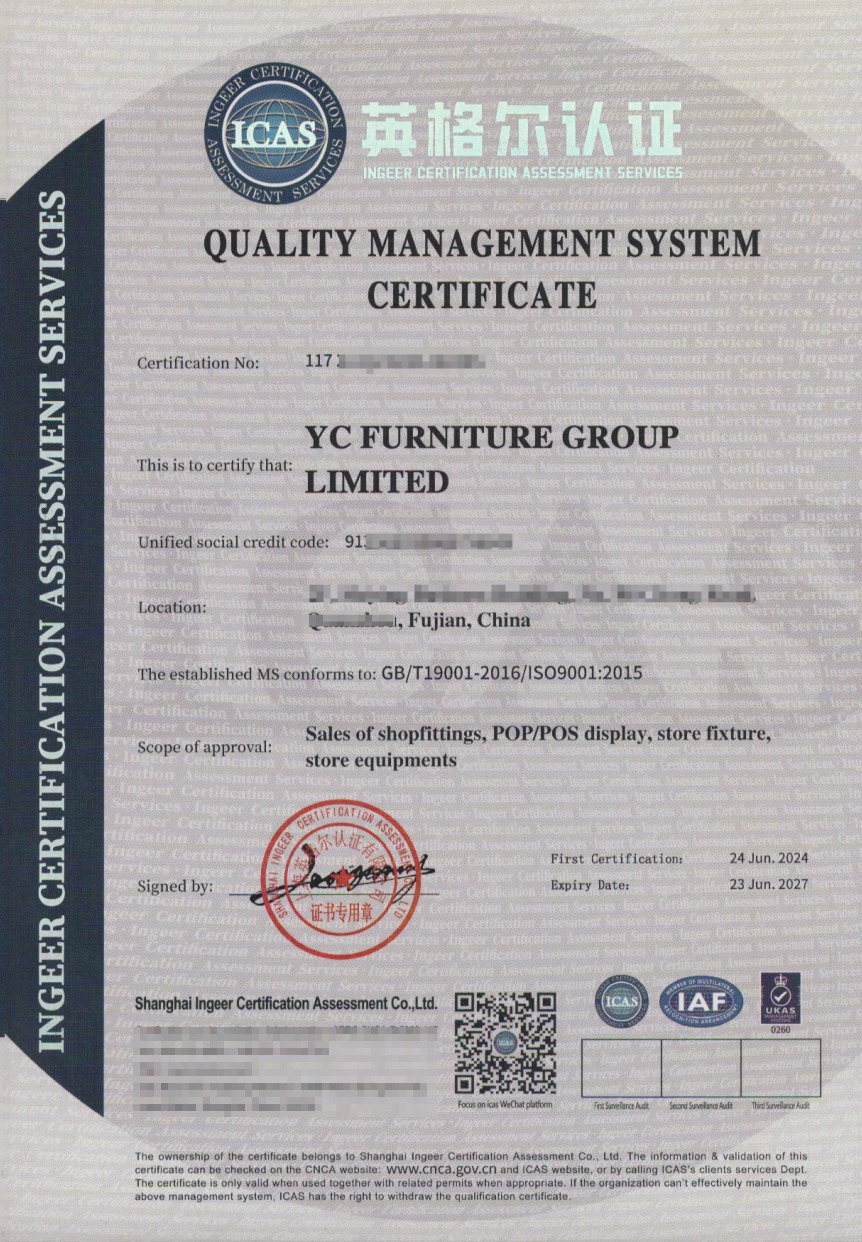
ISO 9001 certificate 117 24 QU 0233-06 R0S, issued by Shanghai Ingeer Certification Assessment Co, Ltd against GB/T19001-2016 / ISO9001:2015, valid to 2027-06-23.
There is one boundary worth stating plainly. The FSC certificate operates as a chain-of-custody system covering wood- and paper-based components. The PVC components of TDSJ26802 sit outside that FSC scope, so a buyer whose specification requires certified wood content should treat the two models differently rather than assuming the certification applies identically to both.
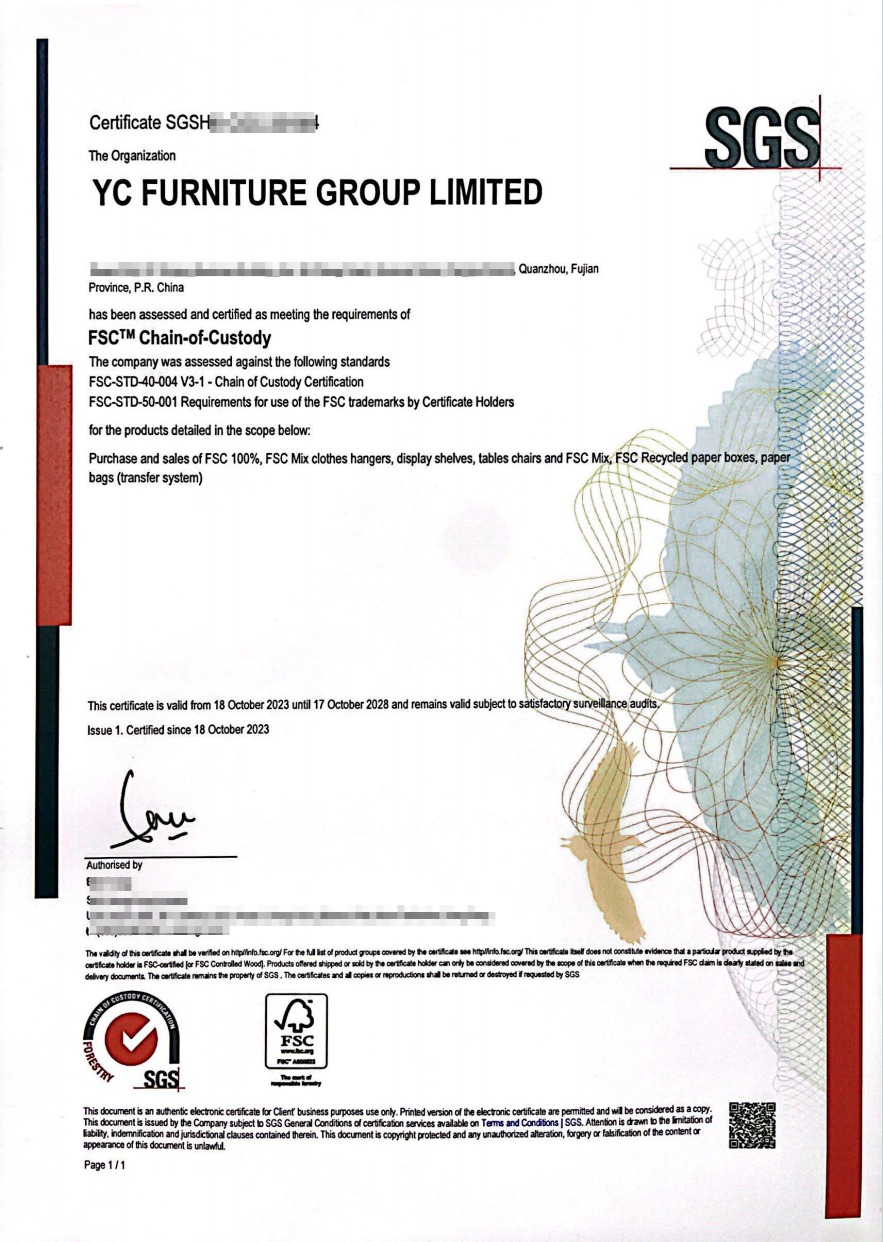
FSC chain-of-custody certificate SGSHK-COC-331884, issued by SGS and valid to 2028-10-17. The scope covers wood- and paper-based components, which applies to MDF-based displays such as SODJ26531 rather than to PVC components.
Market context for durable retail displays
Published figures suggest a market large enough to sustain specialised fixture platforms alongside lower-cost alternatives. A Strategic Market Research estimate put the global POP display market at 14.6 billion USD in 2024, and a Dataintelo study reported that cardboard and corrugated board accounted for 42.7% of POP display revenue in 2025. That material share is a reminder that paper-based displays dominate by volume and value in promotional, short-cycle applications.
Durable metal-based constructions occupy a different position in the same market. Dataintelo also reported that countertop units represented 34.2% of product type share in 2025, and countertop formats are one of the areas where a rigid frame matters most, because the unit has to stay stable at close range on a counter or gondola end without additional anchoring.
Sustainability expectations are visible in the same data set. Nielsen and Grand Fly published a derived estimate that 73% of global shoppers are willing to pay more for eco-friendly display materials, a figure that should be treated as an indicative sentiment measure rather than a hard purchasing prediction.
Forecast growth for the category should also be read carefully. Published CAGR projections for POP displays range from roughly 5.4% to 13.1% depending on methodology, and the upper end is generally understood to include digital POS software and hardware systems, while the lower range targets physical display manufacturing. For a buyer comparing two physical fixtures, the physical manufacturing range is the more relevant reference.
Where these two models are not the right answer
An honest comparison has to state the limits as clearly as the capabilities.
- No fixed dimensions to plan against. Both models are specified as customized. A buyer who needs a known footprint to drop into an existing planogram, or who wants to reorder a previously installed unit without re-engineering, will not find a published dimension table for either model.
- Order thresholds and lead time. The minimum order quantity of 50 units and the 25 to 40 day lead time mean neither model is suited to a one-off replacement or an emergency in-season fix. Both are project purchases rather than spot purchases.
- Weight and logistics trade-off. Metal frames combined with PVC or MDF panels generally ship heavier and bulkier than corrugated board alternatives, which affects freight planning and in-store handling. Given that cardboard and corrugated board held 42.7% of POP display revenue in 2025, a short promotional campaign with a limited service life may be better served by a paper-based display rather than either of these durable constructions.
- Certification does not transfer across materials. As noted, the FSC chain-of-custody scope covers wood and paper components. A specification that depends on certified wood content should not be applied to the PVC elements of TDSJ26802.
- Material substitution needs re-validation. Although YC states that a metal and MDF product can also be manufactured using acrylic, PVC, or cardboard, changing the secondary material changes structural behaviour, finish options, and compliance characteristics. Substitution is not a cosmetic swap and has to be re-engineered per project.
What changes next
Documentation is becoming part of the fixture specification rather than an afterthought. The EU Packaging and Packaging Waste Regulation, Regulation (EU) 2025/40, applies from 12 August 2026, which places material disclosure and recyclability expectations inside the European procurement process for packaging and display components. For buyers sourcing into Europe, that shifts weight toward displays whose material composition can be documented at component level — which favours wood-based panels covered by a chain-of-custody certificate and penalises mixed-material assemblies that cannot be separated or accounted for.
The likely direction for durable displays is a hybrid approach: keep the metal frame because it delivers service life, and make the secondary material the decision variable. A sock display specified as metal and MDF can be reconsidered toward board or PVC without changing the structural concept, and a tool display built on metal and PVC already leans toward the cleanable, moisture-tolerant end of the material range.
Service life is the other lever. Replenishment support and display upgrades after initial delivery allow a fixture to be re-merchandised for a new product generation rather than replaced outright, which is how a durable display construction can be justified commercially against a cheaper disposable alternative over a multi-season programme.
Frequently asked questions
What materials are used in TDSJ26802 and SODJ26531?
TDSJ26802 is classified as a METAL TOOL POP DISPLAY and uses metal and PVC as its primary materials. SODJ26531 is classified as an MDF SOCK POP DISPLAY and uses metal and MDF as its primary materials. YC states that a product made of metal and MDF can also be manufactured using acrylic, PVC, or cardboard in addition, and that a display can combine multiple materials into a single cohesive unit.
Can the dimensions and structure of both displays be customized?
Yes. For both models the specification parameter is stated as customized, and dimensions and structural parameters are customized per project requirements. YC lists customization across size and structure, materials, colours and finishes, branding, product presentation, lighting, graphics and signage, features and functionality, packaging and shipping, application and retail environment, and sustainable options.
How should a buyer choose between a metal/PVC tool display and a metal/MDF sock display?
Start from the merchandise and the environment rather than the material label. A metal/PVC platform such as TDSJ26802 suits categories where dense items are handled repeatedly and surfaces need to be cleaned, and it is applied across tools and hardware, beauty and cosmetics, home appliances, consumer electronics, automotive and accessories, and exhibitions. A metal/MDF platform such as SODJ26531 suits soft goods that need a broad printed panel face and clear category zoning, and it is applied across consumer electronics, home appliances, beauty and cosmetics, fashion and apparel, retail and supermarkets, and exhibitions. Where certified wood content is a requirement, the MDF-based model is the more directly covered option.
Which certifications apply to these two display models?
Both TDSJ26802 and SODJ26531 are listed as applicable products under YC Furniture Group's ISO 9001 certificate 117 24 QU 0233-06 R0S (valid 2024-06-24 to 2027-06-23), ISO 14001 certificate 117 26 E 0784 R0 02 (valid 2026-05-27 to 2029-05-26), and FSC chain-of-custody certificate SGSHK-COC-331884 issued by SGS (valid 2023-10-18 to 2028-10-17). The ISO certificates cover the sales of shopfittings, POP/POS display, store fixture, and store equipment. The FSC scope covers wood- and paper-based components, so PVC components are outside it.
What are the minimum order quantity, lead time, and production capacity?
The minimum order quantity is 50 units and lead time is 25 to 40 days. Monthly production capacity is 85 x 40-foot HQ container loads. Quality control follows a 100% pre-shipment test, and third-party inspection is available for POP display orders.
What after-sales support applies to these displays?
YC lists installation support, troubleshooting support, replenishment support, display upgrades, and customization updates as after-sales services. Replenishment support and display upgrades are provided after initial delivery, which allows a fixture to be updated for a new product range rather than replaced.