
TGIC-Free, HAA & REACH: Decoding Powder Coating Claims
TGIC-Free, HAA & REACH: Decoding Powder Coating Claims
A compliance line is a scoped statement, not a verdict
A powder coating datasheet is rarely one claim. It is a stack of separately scoped claims, each attached to a different test method, a different certificate number, a different sample and, in most catalogues, a different product grade. For a construction buyer assembling a submittal, the useful question is not whether a supplier says “TGIC-free” or “REACH”, but which document covers the finish actually being ordered.
Four terms cause most of the confusion because they sit next to each other in catalogue text: TGIC-free, HAA, VOC-free and REACH. They answer four different questions. TGIC-free describes a formulation choice. HAA names the curing agent that replaces TGIC in that formulation. VOC-free describes what the coating does not release during application and cure. REACH is a regulatory framework, and a REACH test report is a scoped statement about substances in one tested material. None of the four substitutes for another, and none of them independently establishes weather resistance.
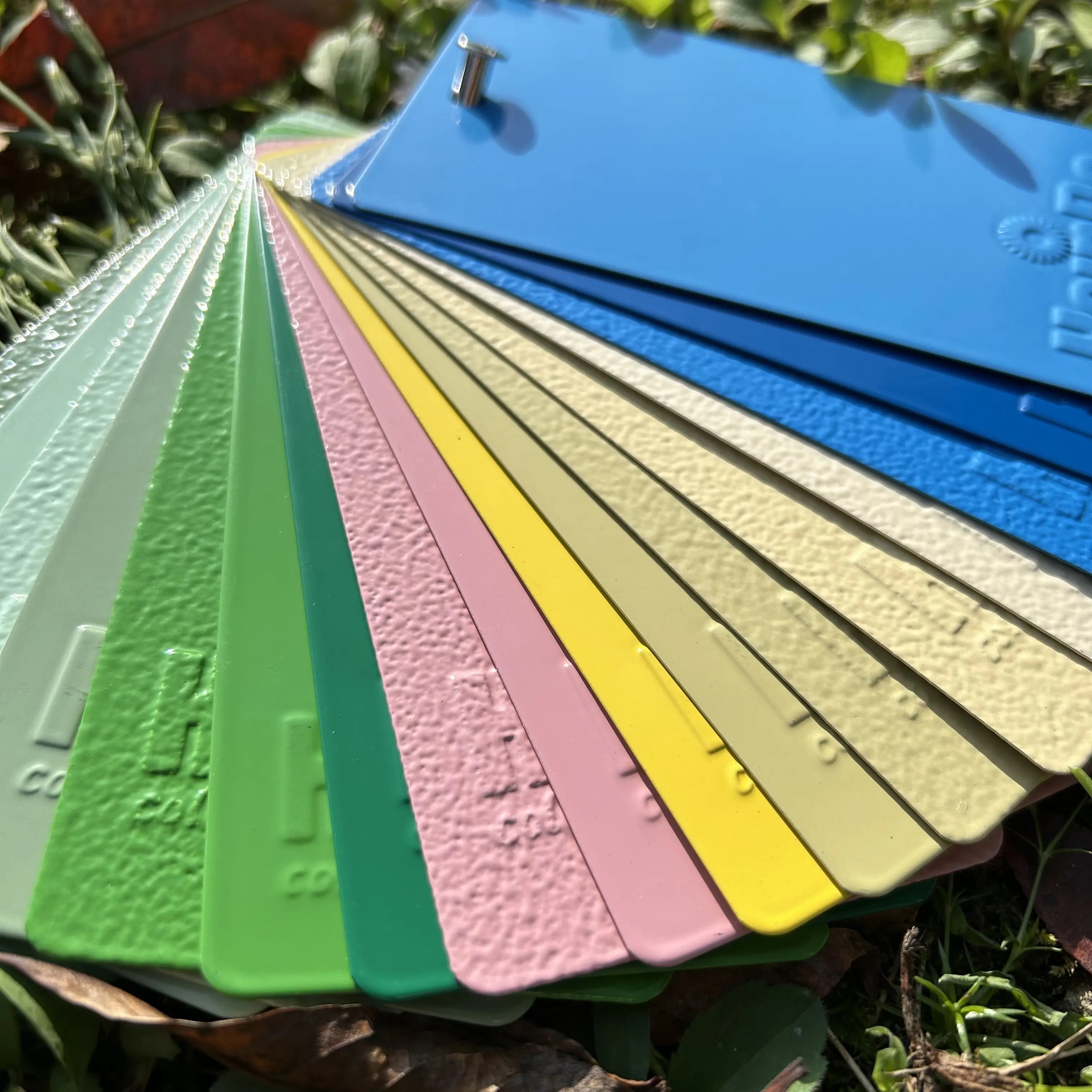
This article is a reading guide for that distinction. It uses the published product and certification records of Chengdu Hsinda Polymer Materials Co., Ltd — a Chengdu-based powder coating manufacturer established in 2015 that exports to more than 70 countries — as a working example, because the same supplier catalogue contains a TGIC-cured aluminum profile grade and a TGIC-free HAA grade with visibly different documentation. That contrast is the lesson.
Why the words get compressed at specification stage
Compliance language is compressed because specifications are written by committees and read by procurement teams under time pressure. A substitution clause that began as “finishes must be free of TGIC-based curing agents and supported by REACH documentation” arrives on site as a single line on a finish schedule. Suppliers respond in kind, quoting one sentence that blends chemistry, emissions and regulation into a reassurance.
The compression is understandable, but it shifts risk downstream. A certificate that satisfies a clause on paper can still fail at inspection if its stated scope names a different product, a different sample or a different legal entity than the one shipping. Reading the scope before accepting the sentence is the whole discipline.
TGIC-cured and TGIC-free HAA: same binder family, different curing agent
TGIC (triglycidyl isocyanurate) and HAA (hydroxyalkyl amide) are both curing agents used in thermosetting polyester powder coatings. In a TGIC-cured system the polyester resin is crosslinked by TGIC; in a TGIC-free HAA system the crosslinker is the amide. That difference is a formulation fact, and it is documented at formulation level, not at brand level.
Hsinda’s published material lists make the distinction explicit. The TGIC-free grade specifies polyester resin, HAA curing agent, pigment and additives. The aluminum profile grade specifies super weather-resistance polyester resin, TGIC curing agent, pigment and additives. Both are polyester powder coatings; only one carries a TGIC-free formulation claim.
| Documented item | TGIC-free HAA polyester grade | Aluminum profile polyester grade |
|---|---|---|
| Formulation | Polyester resin, HAA curing agent, pigment, additives | Super weather-resistance polyester resin, TGIC curing agent, pigment, additives |
| Catalogue classification | Indoor, VOC-free, HAA curing, REACH-certificated powder coating | Aluminum profile, Qualicoat and AAMA powder coating |
| Curing schedule | 180–200 °C, 10–15 min | 180–200 °C, 10–15 min |
| Film thickness / gloss (ISO 2813:2014) | 70 μm / 5%–95% | 70 μm / 5%–95% |
| Adhesion (ISO 2409:2020) / hardness (ISO 15184:2020) | 0 grade / ≥H | 0 grade / ≥H |
| Salt spray (ISO 7253:1996) | 500 h, film unchanged, cross-section corrosion ≤2 mm | 1,000 h, film unchanged, cross-section corrosion ≤2 mm |
| Humidity and heat (GB/T 1740-2007) | 1,000 h, slight gloss loss, ≤ level 1 | 1,000 h, slight gloss loss, ≤ level 1 |
| Weather resistance (ISO 11341:2004) | Not listed on the supplied datasheet | 340 lamp tube, 1,000 h, no powdering, light retention >50% |
| Impact / bending / cupping | 50 kg/cm / ≤2 mm / ≥6 mm | 2.5 Nm / ≤5 mm / ≥5 mm |
Two cautions belong beside that table. First, the mechanical rows are reported in different units on the two documents — 50 kg/cm against 2.5 Nm for impact — so they should not be read as a like-for-like ranking of toughness without a common test configuration. Second, a blank cell means not listed on the supplied datasheet for that grade; it does not establish that the capability is absent.
What a TGIC-free grade’s datasheet does and does not carry
The TGIC-free HAA grade documents salt-spray performance of 500 hours with the film unchanged and cross-section corrosion of 2 mm or less under ISO 7253:1996, and humidity and heat resistance of 1,000 hours with slight gloss loss at level 1 or better under GB/T 1740-2007. Its catalogue classification places it among indoor powder coatings, and its stated applications run to appliance housings, office and residential furniture, interior automotive components, and instrument and electronic equipment enclosures.
That profile is coherent: an indoor, VOC-free, HAA-cured finish with documented corrosion and humidity resistance, mechanical properties of 0-grade adhesion and ≥H hardness, and a 5%–95% gloss range on a 70 μm film. What the supplied datasheet does not list is a UV or natural-exposure weathering result. A buyer who writes “TGIC-free” into an external facade specification and treats it as a weather-resistance substitution is therefore extending a claim beyond the document it came from.
Where the weather-resistance classification actually sits
Weather resistance is carried by a different grade and a different document set. Hsinda classifies its aluminum profile powder coating as an aluminum profile, Qualicoat and AAMA powder coating, and the company states that its powder coatings have passed RoHS, REACH, SGS and AAMA testing. The aluminum grade’s datasheet adds two distinct weathering data points: an ISO 11341:2004 result of 1,000 hours with no powdering and light retention above 50%, and a one-year natural aging exposure in Florida with gloss retention above 50%. The same grade lists 1,000-hour salt spray performance.
Three things are being described here, and buyers should keep them apart. A scheme classification (Qualicoat, AAMA) is a qualification status attached to a product and process. A test row (ISO 11341, natural Florida exposure, ISO 7253) is a measured result under stated conditions. A datasheet statement that a grade “is classified as” such a product is a catalogue positioning. All three are useful, and none of them converts into the others. When a specification demands a classification, the submittal should contain the classification document naming the grade and finish, plus the supporting test rows with their standards and durations — not a marketing sentence that mentions the scheme.
This is also where the practical boundary sits for a project team choosing between the two formulations. Architectural work with an exterior exposure requirement points toward the aluminum profile grade and its weathering evidence. Interior components, furniture, enclosures and equipment where a TGIC-free and VOC-free formulation is the driver point toward the HAA grade and its corrosion and humidity evidence. A project that needs both attributes should be written as two finish lines, not one blended clause.
VOC-free and REACH answer different questions
VOC-free is a statement about emissions during application and cure. Powder coating is applied as a dry powder and forms a film by heat curing rather than solvent evaporation, and the claim appears in Hsinda’s catalogue as a product-type attribute of the TGIC-free and hybrid grades. A supplier description of a Colombian industrial shelving project — 100 tons supplied over a ten-year relationship — likewise characterises the epoxy-polyester electrostatic process as generating zero VOC emissions. That is an environmental and workplace-safety point relevant to a project’s finishes schedule and site conditions.
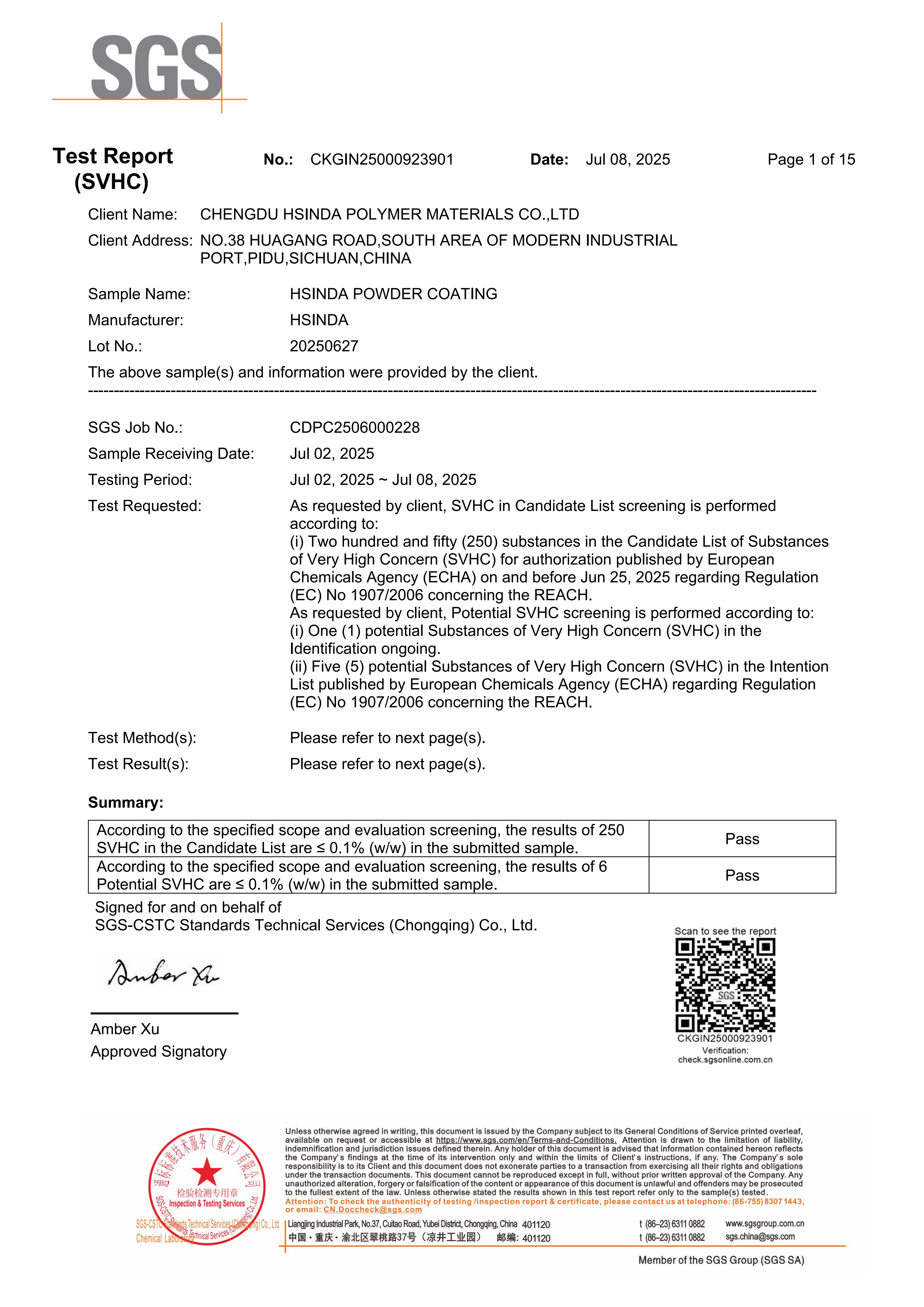
REACH is a substance question, not an emissions question. The relevant document in Hsinda’s register is an SGS REACH SVHC substance hazard test report, number CKGIN25000923901, issued on 18 July 2025 and assessed against EU REACH Regulation (EC) No 1907/2006. Its stated scope is HAA type powder coating. Three readings follow directly from that sentence. The report is a substance-level test, not a product approval for an entire catalogue. Its scope names the HAA grade specifically, so it does not silently cover a TGIC-cured aluminum grade. And because it addresses substances rather than volatile content, it cannot be offered as evidence of VOC-free status — that claim comes from the formulation and process description instead.
A careful buyer will also notice how differently other documents in the same register are scoped. The ISCC PLUS certificate ISCC-PLUS-Cert-CN198-41261025, issued by CTI Certification against EN 15343, names polyester powder coating and carries a validity window from 26 June 2026 to 25 June 2027. The carbon footprint certificate TZJ136660053R0S, issued by Huaqixin Certification Service (Chengdu) Co., Ltd. against ISO 14067:2018 and PAS 2050:2011, is scoped to the R&D and production of thermosetting powder coatings for grade AG82290, valid from 18 July 2025 to 17 July 2028. Neither is a performance claim; both are useful precisely because their limits are written down.
Six fields to read on any certificate
Most certificate disputes are resolved by reading the header rather than the conclusion. Six fields carry almost all of the decision value: the holder, the product or grade scope, the standard and version, the sample or test reference, the issuing body and certificate number, and the validity window. The table below reads five documents in Hsinda’s register through those fields, as an illustration of the method rather than a recommendation of any single certificate.
| Document, issuer and number | Stated scope | What it establishes |
|---|---|---|
| REACH SVHC test, SGS, CKGIN25000923901, issued 18 Jul 2025 | HAA type powder coating; EU REACH (EC) No 1907/2006 | Substance-hazard status of the tested HAA material |
| RoHS test, SGS, CKGEC25000071901, issued 22 Jan 2025 | Black powder, sample no. CKGEC25000071901; IEC 62321 series | Restricted-substance results for one submitted sample |
| ISO 9001, 2052025Q00440R0S, valid to 23 Nov 2028 | Production and sale of thermosetting powder coating | Quality management system coverage of the site |
| ISO 14001, 2052025E00271R3S, valid to 23 Nov 2028 | Thermosetting powder coating, powder coating | Environmental management system coverage |
| ISCC PLUS, CTI Certification, ISCC-PLUS-Cert-CN198-41261025 | Polyester powder coating; EN 15343; 26 Jun 2026 – 25 Jun 2027 | Sustainability certification within a dated window |
The RoHS entry is the clearest teaching case in the register. Its scope names black powder and a specific sample number. That is a legitimate and normal way to test, but it means the report answers a narrow question: this sample, this submission date, this substance list. A buyer ordering a different colour or finish is entitled to ask how that report relates to the material being supplied — and a well-organised supplier will have an answer, often a family-level test rationale or a fresh sample report.
When a certificate is cited but not supplied: six questions
Quotations frequently reference compliance without attaching the document. That is not automatically a warning sign, but it should trigger a specific request rather than a general one. These six questions close most of the gap:
- Which product and grade does the certificate name — the HAA TGIC-free grade, the aluminum profile grade, or a different finish entirely?
- Which legal entity holds it, and is that the entity that will invoice and ship?
- Which standard and version is cited, and is the test row you are relying on actually inside that scope?
- Which sample was tested, and how does that sample relate to the colour, gloss and texture you are ordering?
- What is the validity window, and has the certificate been superseded or withdrawn since issue?
- Which clause in your own specification does the document satisfy, and is that clause about substances, emissions, weathering or the management system?
Question six is the one that prevents most rework. A clause asking for environmental management evidence is answered by an ISO 14001 certificate scoped to thermosetting powder coating. A clause asking for substance compliance is answered by a REACH test report scoped to the relevant formulation. A clause asking for facade durability is answered by a weathering test row or a scheme classification. Presenting one in place of another is where submittals fail.
Reading the pair together on a construction submittal
For architectural aluminum work — profiles, doors and windows, glass curtain walls, sunrooms and partitions — the submittal package should link the finish schedule line to two document sets: the weather-resistance evidence for the aluminum profile grade, and the substance and emissions evidence for whichever formulation the specification names. Where a project requires a TGIC-free formulation for interior components, the HAA grade’s corrosion, humidity and mechanical rows are the relevant technical file, and the REACH report scoped to HAA type powder coating is the relevant substance file.
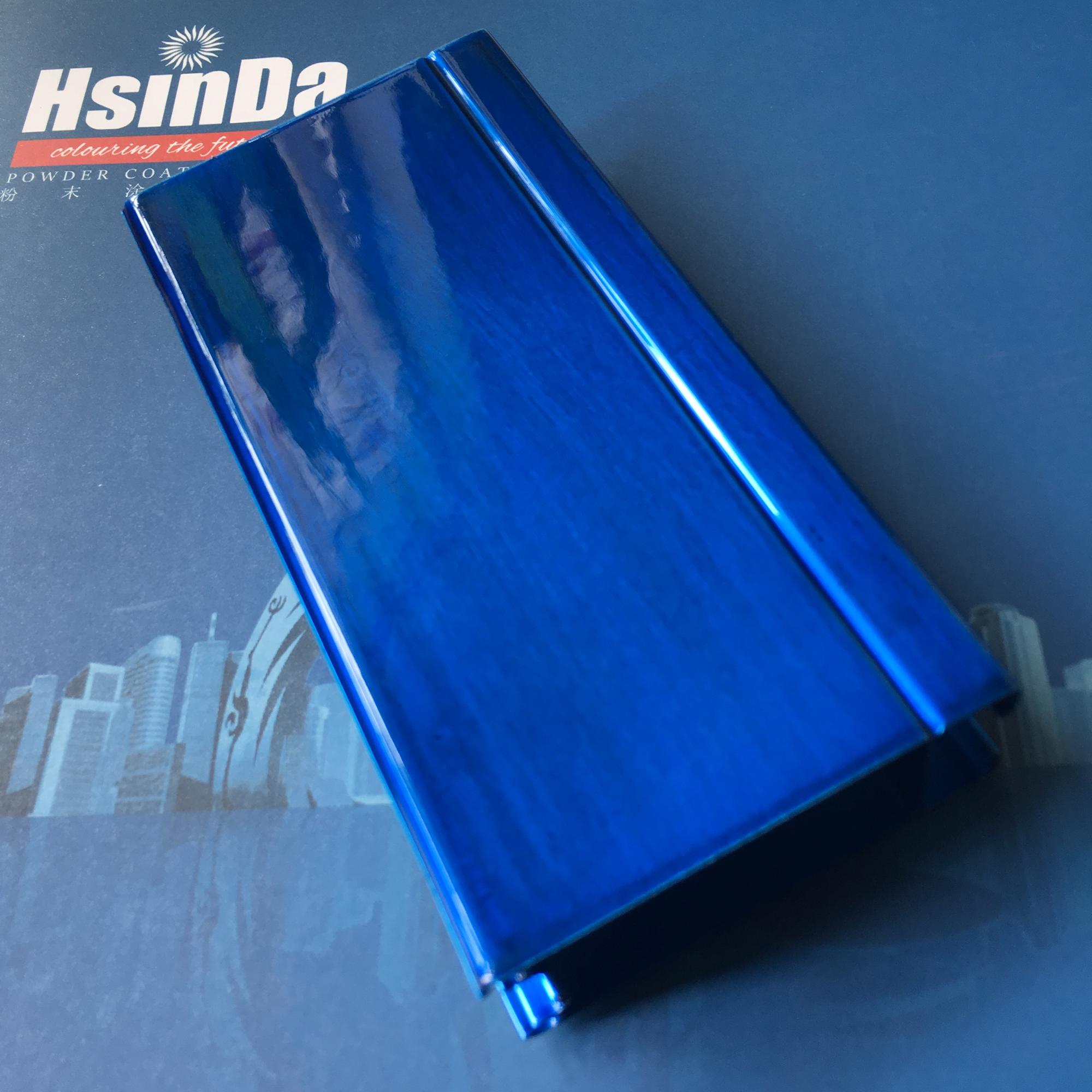
Commercial parameters belong in the same conversation, because a compliance file that cannot be matched to a deliverable order is of limited use. Hsinda publishes a monthly capacity of 400 tons, a minimum order of 300 kg for customised colour work in its ODM mode, and a lead time of 15–20 days, with 100% testing stated as the quality-control position. For a specification-stage buyer, the practical sequence is to confirm the documentation scope first, then confirm that the finish can be sampled and repeated within those parameters. The company’s factory footprint — 10,000 ㎡, 45 employees, an 11-person R&D team and annual output above 5,000 tons across eight production lines and three sample lines — is context for that capability discussion, not a substitute for it.
Outlook: from “do you have REACH?” to “show the scope column”
The direction of travel is toward narrower, better-documented claims rather than louder ones. Where specifications begin to name curing chemistry and regulatory frameworks in the same clause, the supplier response that holds up is a per-grade document set with visible scopes, standards and validity dates. That shift favours buyers who ask a structured question and suppliers who maintain their certificates as records rather than as badges.
The practical conclusion for a construction buyer is modest but useful. Read TGIC-free as a formulation claim attached to a specific grade. Read HAA as the curing chemistry that makes that formulation possible. Read VOC-free as an application and emissions statement. Read REACH as a substance framework evidenced by a scoped test report. Read Qualicoat and AAMA as weather-resistance classifications that travel with their own documentation. Treat any one of these as proof of another, and the specification has quietly become broader than the evidence behind it.
Frequently asked questions
What does TGIC-free actually certify on a powder coating datasheet?
It certifies that the formulation’s curing agent is not TGIC. In the case of an HAA polyester grade, the material list names polyester resin, HAA curing agent, pigment and additives, with no TGIC curing agent. The claim is a formulation statement attached to that grade. It is not a certification of weather resistance, of volatile content, or of compliance with any regulatory framework, and it does not transfer automatically to other grades from the same manufacturer.
Is a REACH certificate the same as VOC-free?
No. A REACH test report addresses substances: Hsinda’s report CKGIN25000923901, issued by SGS on 18 July 2025, is an SVHC substance hazard test against EU REACH Regulation (EC) No 1907/2006, scoped to HAA type powder coating. VOC-free is a statement about volatile emissions during application and cure, and appears as a product-type attribute. A substance report cannot evidence an emissions claim, and an emissions statement cannot evidence substance compliance.
Does a Qualicoat or AAMA classification also cover chemical compliance?
No. Qualicoat and AAMA classifications concern coating performance and process qualification for architectural applications. In Hsinda’s catalogue they attach to the aluminum profile grade, alongside ISO 11341:2004 weathering results and a one-year Florida natural aging result with gloss retention above 50%. Substance and environmental documentation — the REACH report, RoHS report, ISO 9001 and ISO 14001 certificates — sits in a separate document set with its own scopes.
Does TGIC-free mean the coating is weather resistant?
Not on its own. The TGIC-free HAA grade’s supplied datasheet lists salt-spray performance of 500 hours under ISO 7253:1996 and humidity and heat resistance of 1,000 hours under GB/T 1740-2007, and classifies the product among indoor powder coatings. A UV and natural-exposure row is not listed for that grade. Where exterior exposure is specified, the relevant evidence sits with the aluminum profile grade and its weathering data and scheme classification.
What should a buyer do when a certificate is referenced but not supplied?
Request the document itself and read six fields: holder, product or grade scope, standard and version, sample reference, issuing body and certificate number, and validity window. Then map it to the specific clause in the specification. A report scoped to “black powder, sample no. CKGEC25000071901”, for example, answers a restricted-substance question about one submitted sample, and the buyer is entitled to ask how that sample relates to the colour and finish being ordered.
Where can the underlying product and certification details be checked?
Product parameters, certification records and factory information are published by Chengdu Hsinda Polymer Materials Co., Ltd through its website and its downloadable company brochure, which sets out the powder coating range, capacity and certification register. Buyers evaluating a submittal should compare those published records against the specification clauses for the specific project, finish and grade involved.
A PDF copy of the company brochure is available for download: Hsinda powder coating brochure.
Have Questions or Need More Details?
Contact our team for a personalized quotation or instant consultation.
Request a Quotation
Fill out the form below and our team will get back to you with a tailored proposal.
WhatsApp Direct Chat
Prefer to chat in real-time? Message us on WhatsApp for instant assistance & quick answers.
- Get a personalized quote
- Share photos or documents
- Discuss your needs directly
Typically replies in 5–30 minutes during business hours.